Home Blog Page 2450

LKY estate, Govt to bear own costs in suit over transcripts

0

The High Court has ruled that the executors of the estate of Mr Lee Kuan Yew and the Government bear their own costs in the legal suit over an interview agreement Mr Lee had made with the Government.

Dr Lee Wei Ling and Mr Lee Hsien Yang, as executors of their father’s estate, had applied to the High Court to clarify his agreement in relation to interviews he had given in the 1980s for a government oral history project.

They had sought to have the High Court declare that all rights to the interview transcripts belong to the estate following Mr Lee’s death on March 23 last year.

The Government, defended by the Attorney-General, had contested their claims, arguing that Mr Lee’s right to grant permission for use of the transcripts, access to them, or copies to be made, was personal to him, and he did not intend for this right to be transferred to his estate after his death.

In September, Judge of Appeal (JA) Tay Yong Kwang ruled that while the estate does hold the copyright to the transcripts, it was only for the purpose of ensuring the Government’s compliance with the terms of the agreement.

Based on the agreement between the late Mr Lee and the Government, the transcripts were to have been kept by the Cabinet Secretary.

Last month, Dr Lee and Mr Lee had also applied to court to appeal against a particular decision JA Tay had made in the course of the hearing:

They wanted to submit to court a detailed account of how their father’s interview transcripts had ended up with the Government after his death.

But JA Tay did not allow it, saying that “the details were unnecessary and quite irrelevant” to the case. They later withdrew their appeal.

At issue was who should pay costs for both the High Court suit as well as the court application to submit the detailed account, both of which were dismissed by JA Tay.

Rajah & Tann’s Senior Counsel Lee Eng Beng and lawyer Chew Xiang argued for the estate executors that each party should bear its own costs.

The Government, represented by Second Solicitor-General Kwek Mean Luck, Koo Zhi Xuan and Germaine Boey from the Attorney- General’s Chambers, maintained that “while it is entitled to costs since costs generally follow the event, it is not pressing for costs and would leave the issue to the court”.

JA Tay, in judgment grounds released yesterday, stressed that both the plaintiffs and the Government had pursued their positions in the case “honourably and honestly”. He noted that both parties held “genuine views as to how the interview agreement ought to be interpreted” and, ordinarily, the Government is entitled to costs as the court ruled in its favour in both matters.

“However, as the Government is not pressing for costs and in view of what I have said, I agree that each party should bear its own costs for these two matters,” he ruled.

The estate executors are appealing against the court’s dismissal of their suit.


This article was first published on Nov 02, 2016.
Get a copy of The Straits Times or go to straitstimes.com for more stories.
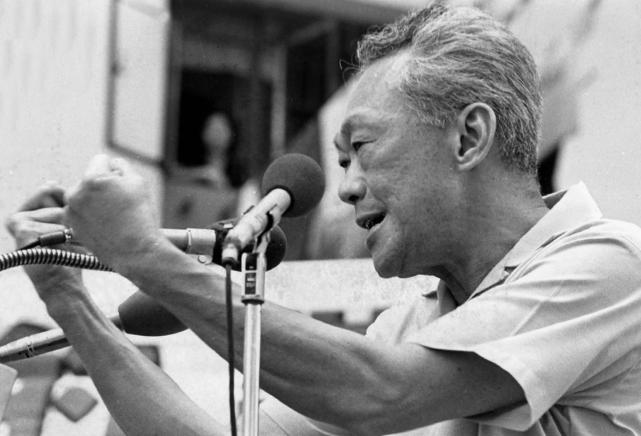
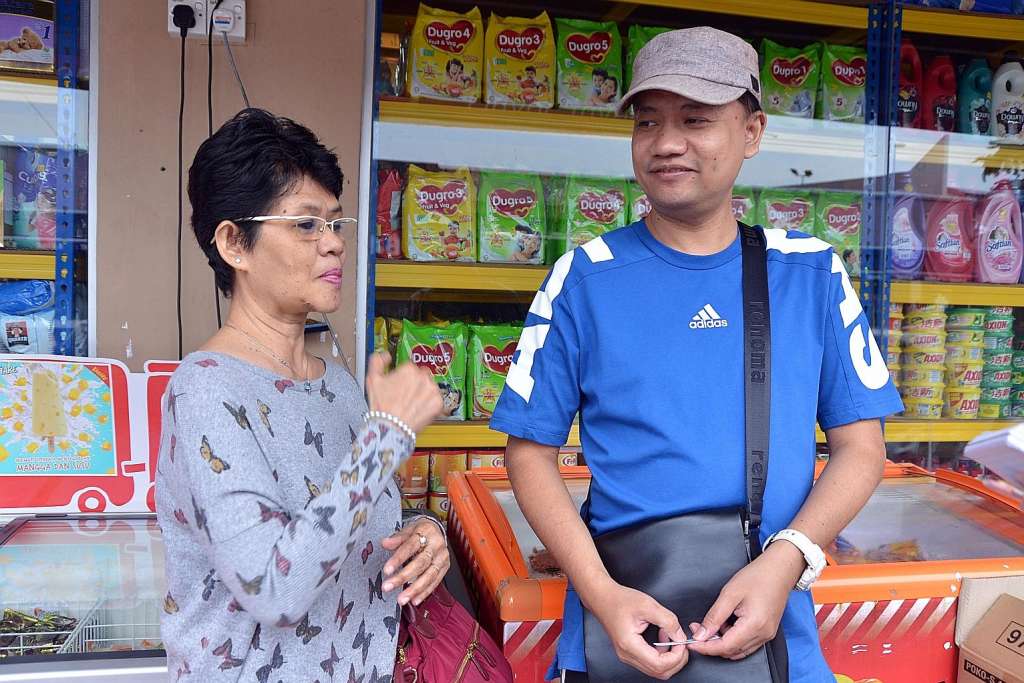
Image: 
Category: 
Publication Date: 
Wednesday, November 2, 2016 – 16:00
Keywords: 
Send to mobile app: 
Source: 


Story Type: 
Others

Source link

Some take new Malaysia road fee in stride

0

Until recently, Mr Johnson Tan would drive his Grab car across the Causeway to refuel, up to four times a week.

Doing that saved him up to $80 for a full tank.

Now the 27-year-old, who has been with Grab for about a year, is having second thoughts. It follows the change in road charge imposed by Malaysia.

From yesterday, Singapore-registered cars entering Malaysia will be charged an extra RM20 (S$6.65).

“I will save less now, so unless I happen to be near the checkpoints, I wouldn’t intentionally drive in,” said Mr Tan, who lives in Sengkang.

The road charge came into effect at the two land checkpoints from 12.01am yesterday.

This followed an announcement by Malaysian Transport Minister Liow Tiong Lai on Facebook last Friday.

FEWER TRIPS TO JB

I will save less now, so unless I happen to be near the checkpoints, I wouldn’t intentionally drive in.

MR JOHNSON TAN, who used to drive his Grab car across the Causeway to refuel up to four times a week.

The extra charge was targeted to be rolled out as early as October last year but was repeatedly delayed. From yesterday, a round trip for a Singapore car going into Johor will cost about $19 and this includes existing checkpoint tolls levied by both countries.

Read also: Singaporeans find ways to make trip across to Malaysia worthwhile

The Straits Times spoke to 12 Singaporean drivers in Johor Baru yesterday.

Unlike Mr Tan, 10 of the drivers said they were unfazed about paying more, saying the road charge still falls within their means.

The drivers were also prepared with sufficient value in their Touch ‘n Go cards, which they now have to tap twice after getting their passports stamped – once for the road charge and again for the checkpoint toll.

They previously tapped once at the Malaysian checkpoint.

“RM20 is still a comfortable rate for me,” said Mr Iskandar Samat, who is self-employed and visits Malaysia at least once a month with his family.

STILL INEXPENSIVE

The roads are a bit quieter as those who are not in a hurry to go to Malaysia may want to monitor how the charge affects us first. But soon, it will be business as usual. It is still not too expensive for us to travel here.

CRANE OPERATOR ISMAIL ATAN

The 42-year-old was in JB with his mother, Madam Sabariah Tik, 64, yesterday for some shopping.

“With the year-end holidays coming up, I think I will be back a few more times this year with my wife and two children (aged 13 and 15 years old),” he said.

Agreeing, Mr Kumar Kaman, 52, who works in the oil and gas industry and owns a house in JB, said: “The charge is fair, so I don’t feel the pinch yet.

“But if it goes up in the future, I may be discouraged from driving.”

Operations manager Desmond Chin, 33, who travels to JB several times a week for work, said: “I don’t have a choice since I have to attend meetings and visit the company’s factory in JB.

“But if I were to come here for leisure, I might think twice.”

However, technician Jani Jamari, 57, said making the trip to visit his favourite eateries has now become “not worth it”.

Further hikes ‘may discourage S’poreans from driving’ to JB

“I go to JB about once a month on my day off to eat because the halal food is cheap and good.

“But now, I may take a ferry to Batam instead,” said Mr Jani, who was busy working out the total cost of a round trip to JB on a piece of paper.

Traffic was smooth entering Malaysia yesterday morning, with some motorists saying they noticed fewer cars on the road.

But several of them said the weekend crowd will return and traffic jams are unlikely to ease in the months ahead.

Crane operator Ismail Atan, 60, said: “The roads are a bit quieter as those who are not in a hurry to go to Malaysia may want to monitor how the charge affects us first.

“But soon, it will be business as usual. It is still not too expensive for us to travel here.”


This article was first published on Nov 02, 2016.
Get a copy of The Straits Times or go to straitstimes.com for more stories.

Image: 
Category: 
Blurb: 
<p>Until recently, Mr Johnson Tan would drive his Grab car across the Causeway to refuel, up to four times a week.</p>
Publication Date: 
Wednesday, November 2, 2016 – 13:00
Send to mobile app: 
Source: 


Story Type: 
Others

Source link

Ex-BSI banker trial: Yeo Jiawei worked closely with Jho Low, a central figure in 1MDB, says witness

0

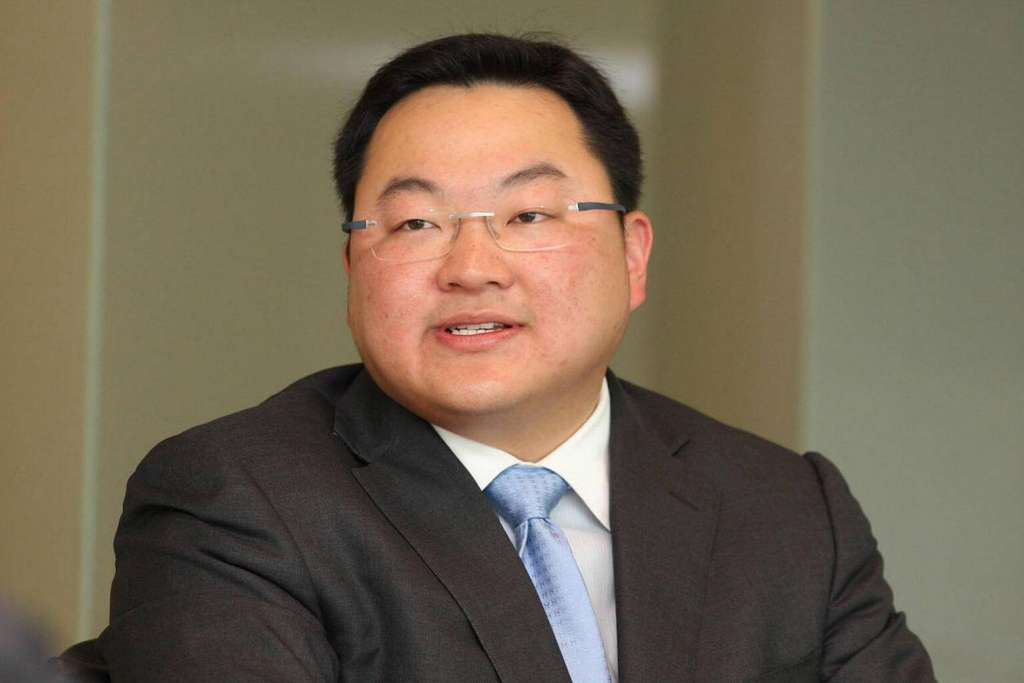
Former BSI banker Yeo Jiawei had a close working relationship with controversial Malaysian tycoon Low Taek Jho, a central figure in the scandal-hit 1Malaysia Development Berhad (1MDB) fund, a court heard yesterday.

Yeo, 33, left BSI Bank here in 2014 after Mr Low expressed “interest in taking him on in some kind of capacity”, said Malaysian national Kevin Swampillai, Yeo’s former supervisor at BSI, yesterday.

Their working relationship was so close that Yeo accompanied Mr Low, better known as Jho Low, on his private jet for work trips, including to Las Vegas last year to catch a boxing match. Yeo had a selfie taken with boxer Mike Tyson, said Mr Swampillai, testifying on the second day of the 1MDB-related trial.

He said working with Mr Low may have seemed a better opportunity for the Singaporean as Mr Low was “constantly in the news, had quasi-celebrity status… and big investment deals around the world”.

The prosecution cited this close relationship with Mr Low as one of the reasons why Yeo attempted to pervert the course of justice in the four charges he is now facing. Seven other counts concerning cheating, money laundering and forgery are set for trial next year.

Read also: Trial of ex-BSI banker linked to 1MDB: Yeo Jiawei made $26m by age 32

Yeo, who was a BSI wealth planner between December 2009 and July 2014, is accused of facilitating illicit transactions involving 1MDB that led to BSI’s closure here.

Mr Swampillai, who was formerly BSI’s head of wealth management services but is now unemployed, revealed the lengths taken to hide US$5 million (S$6.9 million) in referral fees he received from “implementing various structures” and “undertaking financial arrangements” for BSI clients.

Yeo amassed a $26 million fortune from various sources, including alleged illicit schemes to defraud BSI while he was an employee.

The idea of earning such commissions began during a trip they took to Labuan, Malaysia, in 2012, Mr Swampillai told the court. “We decided we would find an intermediary who would be used to identify certain funds, and have conversations with the funds about the nature of underlying transactions that would take place, and the kind of fees that the fund would earn.

“We were trying to find a margin between what the bank earned, what the fund managers earned, and create a margin that would be paid to Yeo and myself.”

The pair received commissions from a number of entities, including Bridge Partners International Management, and a fund called Devonshire, Mr Swampillai said.

But they hid these payments as BSI “clearly would not condone such a practice”, he added.

After Yeo left BSI, both men communicated fairly openly but “as the Commercial Affairs Department (CAD) investigations began, communications were almost exclusively through Telegram and use of secondary phone”, he said. They used a secret feature on Telegram that allows chats to be deleted from each other’s phone records.

They even devised a missed call system to let each other know they had not been picked up by the CAD, said Mr Swampillai. After Yeo left BSI, he became known by his code name “James” to individuals in circles he was involved with, including Mr Low, Mr Swampillai said.

His testimony also revealed the role of Yeo’s associate, Mr Samuel Goh Sze-Wei. Yeo is alleged to have told the two men at a meeting at the Swiss Club in March to lie to the police about some fund transfers.

“Yeo kicked off the meeting saying, ‘The time has come for us to hold hands together’, and that we should align our stories. Given the fact that all three of us had been questioned by CAD, the threat of exposure was very real,” he said.

But Mr Swampillai said he abandoned the plan when taken in for questioning as it was “a cover story that had too many holes, and wouldn’t stand up to any scrutiny”.


This article was first published on Nov 02, 2016.
Get a copy of The Straits Times or go to straitstimes.com for more stories.
Image: 
Blurb: 
<p>Former BSI banker Yeo Jiawei had a close working relationship with controversial Malaysian tycoon Low Taek Jho, a central figure in the scandal-hit 1Malaysia Development Berhad (1MDB) fund, a court heard yesterday.</p>
Publication Date: 
Wednesday, November 2, 2016 – 14:01
Send to mobile app: 
Source: 


Story Type: 
Others

Source link

Private banks lacking scale exit Singapore

0

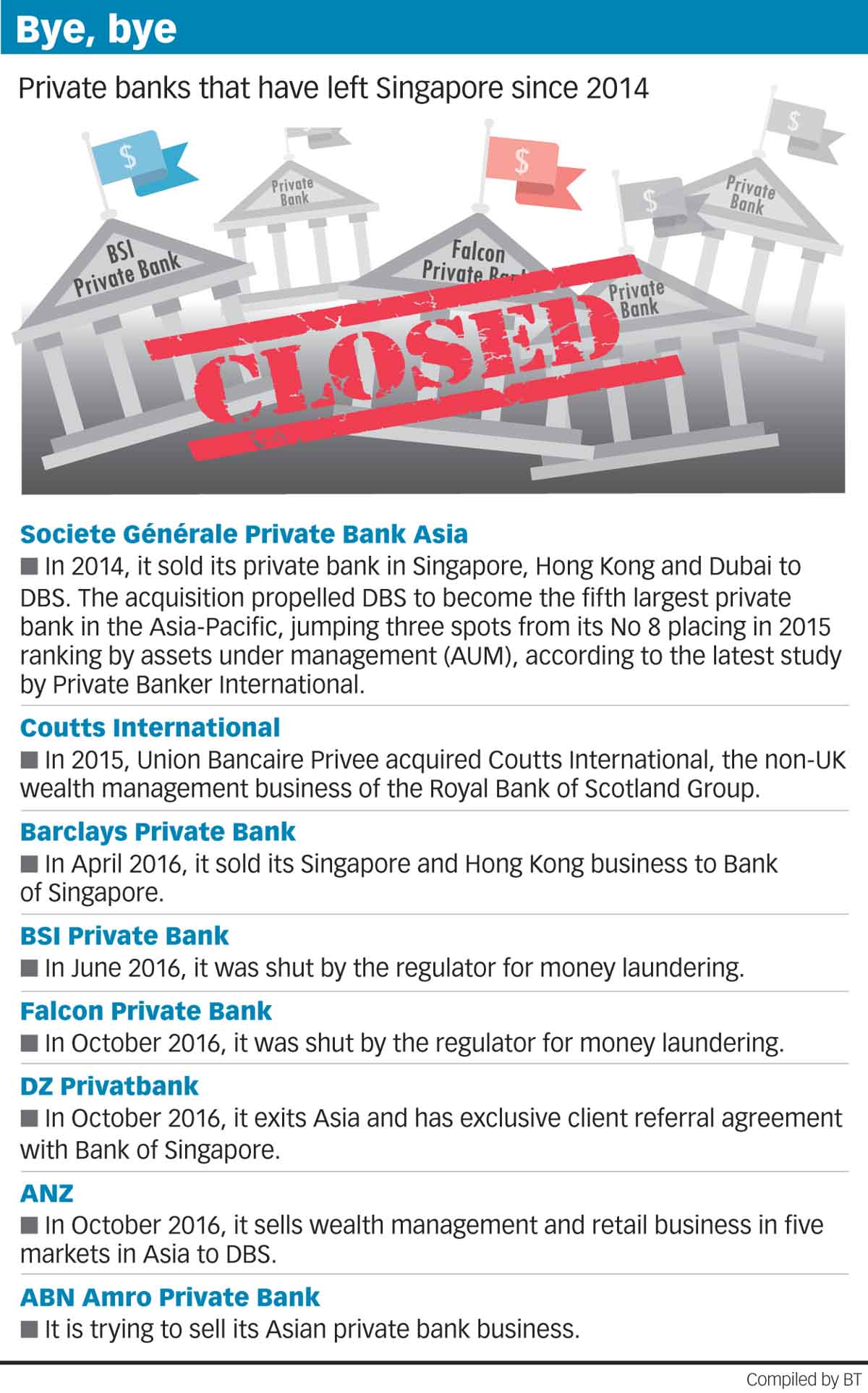
Just like real estate is about location, location and location, private banking is about scale, scale and scale – it is what’s needed to cope with the high cost of the business, say industry players.

Monday’s surprise move by DBS Bank to snap up most of ANZ’s wealth and retail business in Asia for a bargain-basement price of S$110 million, or 0.5 per cent of the S$23 billion of assets under management, once again hammered home the point that scale is needed to run a private bank.

Over the past two years, eight foreign private banks (ANZ included) have exited or will soon exit Singapore. Of the eight, two were closed by the Monetary Authority of Singapore for anti-money laundering violations. ABN Amro is reportedly the eighth departure, with the Dutch lender soon to sell its Asian private bank.

Both DBS and ANZ, Australia’s fourth largest bank, mentioned scale as the reason for the sale. It wasn’t that the business didn’t turn a profit. It did; for FY16, it turned in a cash profit of A$50 million.

ANZ is not a small player in Asia, and this sale does not signal its retreat from the region, it said. In fact, ANZ regards Asia as core to its strategy of banking large corporate and institutional clients, driven by trade and capital flows, particularly with Australia and New Zealand.

ANZ Institutional Asia employs 1,490 people across 15 markets in the region.

But, as ANZ chief executive Shayne Elliott said of the sale to DBS: “In retail and wealth, although we have grown a profitable business in Asia, without greater scale, ANZ’s competitive position is not as compelling.”

Tan Su Shan, DBS’s group head of consumer banking and wealth management, said Asia continues to clock decent growth rates, so the organic growth outlook for the wealth-management business remains intrinsically intact, despite cyclical volatility.

She said: “For banks looking to create a sustainable wealth-management business here, there are a few things to consider. Firstly, it is the bank’s ability to build scale, be sustainable and invest for the future.

“Secondly, banks must be able to serve the local and global needs of Asian clients.”

DBS has been aggressively building up its private bank business, timing it nicely with Asia’s explosive wealth growth. A joint survey by PwC and UBS last month said that, in Asia last year, a new billionaire was minted every three days.

DBS chief executive Piyush Gupta said that, with Asia growing at 6 per cent, Europe at 1 and the US, 2, “you’d all give a left arm to be in Asia under the current economic conditions”.

As Asia is tipped to be the richest region in the near future, private banks in the region need to adapt their business models to meet the growing demand.

Bahren Shaari, Bank of Singapore’s chief executive, said: “For instance, with the rising cost of doing business, banks need to achieve scale, so further consolidation is inevitable. In the case of Bank of Singapore, we have enough scale to aspire to be among the top three private banks in our core markets.”

Graphic: The Business Times

But while Asia has the right conditions to attract private banks, it has to be borne in mind that the bulk of the rich are self-made or entrepreneurial; the joint PwC-UBS survey said about 85 per cent of Asian billionaires are first-generation.

This means banks need to offer investment-banking services and access to debt and equity markets for clients looking to expand their businesses. They should not just sell wealth-management products or throw rare-whisky parties, which have become fashionable in some quarters.

A private banker who turned down an offer from a major distiller to host a rare-whisky party said: “My clients are too busy making money to come for the whisky.”

Credit Suisse, the third-largest private bank in Asia, decided in a strategic review last year to combine investment banking with private banking.

Francesco de Ferrari, the bank’s head of private banking for the Asia-Pacific, said earlier this year: “The business model that is best suited to Asian clients’ needs is the integrated bank with private banking as a core business and its DNA, but also strong investment banking and asset-management capabilities.”

So if some foreign banks have decided to exit Singapore, it doesn’t point to foreign banks beating a retreat from Asia.

DBS’ Ms Tan noted that the largest private banks in Asia are, in fact, Swiss or American: “While some foreign players have left the scene, there are several who are still fairly dominant here.

“These are primarily the large Swiss and US and banks who have managed to build scale in their private-banking businesses, either through long-term organic growth or through combining their wealth management business with a retail, corporate/investment banking or asset management business.”

UBS, Citi, Credit Suisse, HSBC and DBS are Asia’s top five private banks. Julius Baer, Morgan Stanley, JP Morgan, BNP Paribas and Deutsche Bank round up the top 10.

Ms Tan said: “That said, there remains more scope and opportunities for dominant local or regional players like DBS to gain market share as clients here look for customised solutions with a safe and steady name who remains committed to the region and the business.”


This article was first published on Nov 2, 2016.
Get The Business Times for more stories.

Image: 
Publication Date: 
Wednesday, November 2, 2016 – 13:33
Keywords: 
Send to mobile app: 
Source: 


Rotator Headline: 
8 foreign private banks exiting Singapore over past 2 years
Story Type: 
Others

Source link

Why scams succeed: Human behaviour experts explain

0

Despite unconvincing storylines and widespread media coverage, people are still falling for scams. Human behaviour experts explain the psychological techniques used to cheat people.

Source link

Fire engulfs Sungei Kadut warehouse, 7 rescued

0

Seven people were rescued after they were trapped in an office building adjoining a warehouse at 65 Sungei Kadut Loop, which caught fire early Wednesday morning, the Singapore Civil Defence Force says.

Source link

More SMRT staff deployed, mobile signals may be cut to probe Circle Line disruption: LTA

0

SINGAPORE – Additional staff will be deployed to Circle Line (CCL) trains and stations, and temporary telecommunication signal suspensions could kick in as the Land Transport Authority (LTA) and SMRT grapple with the return of a signal interference that…

Source link

StanChart says faces probe over work on Hong Kong IPO

0

Hong Kong – Standard Chartered could face “financial consequences” after an investigation in Hong Kong over its role in an initial public offering, the firm said as it reported another round of disappointing earnings results, sending its share price tumbling.

The London-based, Asia-focused lender said authorities were looking into its conduct while co-sponsoring the listing in the city in 2009, dealing another legal blow to the firm, which is already facing a US probe.

“The Group has been informed by the Hong Kong Securities and Futures Commission that it intends to take action against Standard Chartered Securities (Hong Kong) … in relation to its role as a joint sponsor of an initial public offering listed on the Hong Kong Stock Exchange in 2009,” it said in its interim earnings report.

“If it does take action there may be financial consequences” for the bank, it said in the report Tuesday.

The announcement came as it said pre-tax profit improved in the third quarter to September but was still well short of expectations, while revenue was also below forecast.

Shares in the firm plunged 6.52 per cent by the break in Hong Kong Wednesday. Its London-listed shares ended down 5.42 per cent.

Last week Swiss giant UBS said it could faced a fine and suspension from sponsoring IPOs in Hong Kong over a listing in the city.

Neither bank said which IPO the actions referred to, but the Financial Times cited an unnamed source as saying the investigations centred on the listing of China Forestry Holdings.

Standard Chartered is still being probed by US authorities over claims of bribery by an Indonesian power company, MAXpower Group, which is controlled by the bank.

The probe is the latest in a string of legal problems for the bank, which paid $667 million (S$927 million) in 2012 to settle charges it violated US sanctions by handling thousands of money transactions involving Iran, Myanmar, Libya and Sudan.

In August 2014, the bank was hit by US regulators with a $300 million fine and restrictions on its dollar-clearing business for failing to detect possible money-laundering.

Image: 
Category: 
Publication Date: 
Wednesday, November 2, 2016 – 13:25
Keywords: 
Send to mobile app: 
Source: 


Story Type: 
Others

Source link

Egypt’s Mona Samir is Unfazed by Her Opponent’s BJJ Pedigree

0

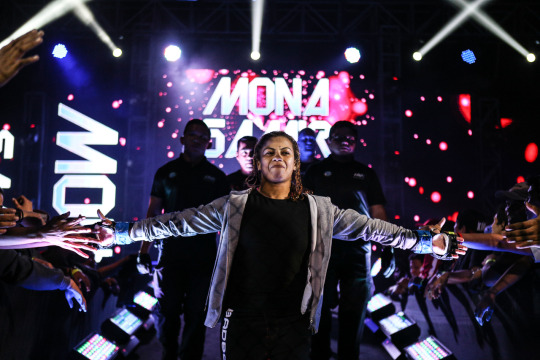
Egyptian strawweight Mona Samir will look to secure her first win under the ONE Championship banner on Friday Night, 11 November, when she meets Michelle Nicolini at ONE: DEFENDING HONOR, which broadcasts live from the Singapore Indoor Stadium.

Samir comes from a strong wrestling background, as she is a four-time African Wrestling Championship silver medalist in freestyle wrestling, and the top-ranked female wrestler in Egypt. As for Nicolini, she is an eight-time Brazilian jiu-jitsu world champion and quite arguably the discipline’s best female practitioner.

With both fighters’ strengths being in the grappling arts, fans should expect the fight to play out on the mat. Samir is very confident in her training, strategy and abilities, but once the cage door shuts, she is looking beyond the immense ground skills, as she feels the fight will take shape elsewhere.

“We have a game plan for this fight, and BJJ and wrestling are not the only measure for any MMA fight,” the 27-year-old explains. “This fight is dependent on how you take your chances in the cage.”

Nicolini comes into the fight highly-touted for her long and outstanding BJJ career. The Brazilian, who trains out of the Singapore-based Evolve MMA camp, is an ADCC submission wrestling world champion and eight-time Brazilian jiu-jitsu world champion who holds a third stripe on her black belt. Armed with a 2-1 record, she makes her ONE debut against Samir.

The Egyptian believes the key point of the bout will be that it falls under the rules of MMA, claiming: “I think I have the advantage in this fight. She is good in BJJ, but not in the cage.”

Samir trains with many of her fellow countrymen and women at Egyptian Top Team. The sport is still in its infancy in Egypt, and the team is filled with up-and-coming fighters looking to make a name for themselves on MMA’s biggest stage. It is a tight-knit group of hungry mixed martial artist, all of whom are on the verge of breaking out.

“My team is one of the best teams in the Middle East,” she declares. “They have a number of good warriors and fighters. I am really happy when I come to training with my team, especially my coach Mohamed Abdel Hamid. He always trains with us and gives his best to us. I fight for my team and my coach. I want to make them happy always.

“We have a number of great fighters at our gym. My coach Mohamed Abdel Hamid is a world champion in kickboxing, K1, and also a BJJ brown belt. I am training with Aya Saied, Walaa Abbas, Mahmoud Salama, and Amira Badr.”

Thanks in large part to ETT and the great stable of Egyptian fighters competing in ONE, MMA is becoming more well-received in Egypt on a daily basis, and the potential for growth is through the roof.

“Six years ago, MMA in Egypt was nothing,” Samir admits. “I think it was only kickboxing that was known in Egypt. The Evolution Championship came to improve it from zero to a very good level now. I think they are improving themselves and also, all the fighters are more focused in the sport.”

Samir’s professional record stands at 1-2, and she lost her only fight in the promotion — also her official MMA debut — to current ONE Women’s Atomweight World Champion Angela Lee at ONE: ODYSSEY OF CHAMPIONS in September 2015, where she was tapped out in the first round via rear-naked choke.

The Egyptian wrestler feels the pressure, and the realization that this fight is a “must win” for both the short term, and long term, success of her career.

“I know this fight is going to be very hard, but I must win because I want to be the first Egyptian female fighter to get a victory in ONE Championship,” Samir states. “I have a big war in this event, so I don’t just want to take part for myself. I want to make history for my team and for my family.”

Image: 
Egypt’s Mona Samir is Unfazed by Her Opponent’s BJJ Pedigree
Category: 
Publication Date: 
Wednesday, November 2, 2016 – 13:21
Send to mobile app: 
Source: 


Story Type: 
Others

Source link

ESM Goh to be Governing Board chairman of LKY School from April next year

0

LKY School says ESM Goh will succeed Professor Wang Gungwu, who is stepping down on Mar 31, 2017. 

Source link