Home Blog Page 2395

Working his way back to fitness after 'horrendous' period

0

Living with cancer: An ST series

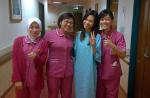
Mr Arun Rosiah is not just a physical exercise specialist by profession. He also walks the talk, taking part in marathons, and is able to do hundreds of push-ups a day.

So it came as a rude shock when he discovered he had third-stage colorectal cancer at the age of 51.

He first noticed something was wrong in March last year. He needed to go to the toilet more frequently and there was blood in his stools, which were pencil thin.

But he felt no pain so he did not go to a doctor till the end of October.

In fact, if not for his vertigo spells, he probably would have put it off even longer. The primary school teacher waited for a school break before going to the Woodlands Polyclinic, where the doctor referred him to specialists at National University Hospital.

The vertigo turned out to be minor – but not his other problem. The specialist said it looked “nasty” and that Mr Arun needed a colonoscopy as soon as possible.

“I immediately thought I had cancer and that I was going to be dead soon,” he recalled.

But he kept the ominous possibility from his wife, also a teacher, even while she went with him to the hospital. She said: “He looked calm when he came out, so I didn’t think it was anything serious.”

They had lunch, and were going for “retail therapy” when she asked him: “So, what did the doctor say?”

That was when she found out. She broke down completely and was furious that he had kept his problem a secret from her till then. That night, they told their children, now aged 14, 18 and 20.

But he did not start his treatment immediately, against his doctor’s advice. His older children were still studying at the polytechnic, but it was the year-end holidays for his youngest son.

He and his wife decided to take him for a short holiday in Penang.

Mr Arun recalled: “I was afraid this might be the last time we could go on holiday together.”

The price for the hotel room was high, since it was a last-minute booking. While they were checking in, the staff at G Hotel Kelawai asked why they had not booked earlier for a cheaper rate. They upgraded the family to a suite when they found out.

It was the best holiday they had ever had, said his wife, whose name is also Rosiah. He began treatment this January.

His doctors decided to try to shrink the tumour, which was in the rectum, with chemotherapy and radiation, before they removed it through surgery.

The first few sessions were fine, but then the radiation took its toll. Moving his bowels felt like “there were more than 1,000 needles poking me. On a pain scale of 1-10, this was a 12”, said Mr Arun.

His doctor gave him painkillers, which worked but made him constipated. That then caused bloatedness and pain. That period was “horrendous”, he said.

But there was good news to come. Following surgery to remove the tumour and 20cm of his large intestine and rectum, doctors found he was clear of cancer.

By October, he was back at work.

He still has a stoma bag to collect his faeces while his body recovers but this is temporary. It will be removed next month and he will be “normal” again.

But life is anything but normal now. After his close brush with death, he is closer to his family, his faith and to the friends who stuck by him. What has not changed is that he is training for next year’s StanChart marathon.


This article was first published on November 9, 2016.
Get a copy of The Straits Times or go to straitstimes.com for more stories.

Image: 
Publication Date: 
Wednesday, November 9, 2016 – 12:23
Send to mobile app: 
Source: 


Story Type: 
Others

Source link

Long John Silver’s: 21 New Discount Coupon Deals valid from 14 Oct – 20 Nov 2016

0

Long John Silver’s discount e-coupons – just flash on your mobile device to redeem. Valid till 20 Nov

Long John Silver’s: 21 New Discount Coupon Deals valid from 14 Oct – 20 Nov 2016

More reasons to dine at Long John Silver’s. Flash any of the coupon images below at any Long John Silver’s outlet and save up to $3.60, valid from 14 Oct to 20 Nov 2016

Source

Colorectal cancer numbers far too high, say experts

0

Living with cancer: An ST series

Every day, five people here are diagnosed with colorectal cancer and two die of it. These numbers are far too high, say experts, since this is one of the most preventable cancers.

But not enough people here are using the available screening tools to detect the cancer in the early stages, or better yet, catch the problem before it becomes cancer.

Generally, colorectal cancer develops from polyps that grow on the inside walls of the large intestines and the rectum. If the polyps are discovered early and removed, they are not allowed to become cancerous.

It usually takes more than a decade for a polyp to become a tumour, so there is a large window of time for it to be dealt with.

In the US, where 60 per cent of people aged 50 and older have colonoscopy screening, the incidence of this cancer has fallen by 30 per cent over the past decade. It is now the fourth most common cancer there.

In Singapore, it remains the top cancer, although the rise in cases appears to have plateaued since 2000.

Singapore is ranked 16th by the World Cancer Research Fund in terms of the incidence of this cancer. It is higher in countries like South Korea and Australia, but lower in Japan and the United States.

Doctors advise a test every year to detect any blood in stools that could signal the cancer and a colonoscopy every decade from the age of 50, when the incidence of this cancer starts to climb.

The procedure, in which a tiny camera is inserted through the anus into the intestines to check for polyps and cancerous cells, costs about $1,200 to $2,000. Subsidised patients pay about $300 to $500. Depending on the complexity, between $1,250 and $1,850 for this test can be paid for with Medisave.

Overall, however, the rates of surviving colorectal cancer have improved vastly over the years.

The prognosis is especially good for those whose tumours are discovered in the early stages, before they have broken through the walls of the intestines.

Dr Ho Kok Sun, a colorectal surgeon at Mount Elizabeth Medical Centre, said the standard treatment is surgery if the cancer is still within the colon.

This is classified as stages one and two. Patients at this stage have a very high chance of surviving beyond five years, the holy grail for cancer survival.

But once it has spread through the four layers of the colon wall, the odds of survival plummet. Said Dr Ho: “Once it’s spread through the wall, as the intestines move, the cancer cells are like rice grains dropping off the surface. That’s one of the worst types of spread.”

When that happens, the loosened cancer cells can attach themselves to a host of organs and tissues nearby.

The cancer can also spread from the lymph nodes into the blood stream and the rest of the body, with the liver typically being the first target.

Dr Chee Cheng Ean, a consultant in haematology-oncology at the National University Hospital, said the actual stage of the cancer sometimes cannot be determined until after surgery, when the nearby lymph nodes are removed and checked. At least 12 nearby nodes need to be removed to check if they have the cancer.

At stages three to four, the cancer has spread to the lymph nodes or broken through the intestinal wall. Patients in those stages would need chemotherapy to reduce the risk of recurrence – 50 per cent in stage three without chemotherapy – to 40 per cent.

“The actual benefit is 10 percentage points, which is enough to justify chemotherapy,” she said, since it means that out of 10 patients doing chemotherapy, the cancer would not recur in one additional patient.

Doctors are divided on the benefits of chemotherapy for stage two cancer, where the cancer has breached the colon wall but has not affected the lymph nodes. As the risk of recurrence is lower, so too are the benefits of chemotherapy.

Both Dr Ho and Dr Chee say Singapore offers “state-of-the-art” treatment for colorectal cancer, including targeted therapy that works best with certain types of colorectal cancer.

As a result, deaths have fallen, even though more people are getting the cancer. Between the five-year periods of 2005-2009 and 2010-2014, the five-year survival rate went up from 46 per cent to 51 per cent for men, and from 51 per cent to 53 per cent for women.

Even patients with stage four cancer, in which it has spread to other parts of the body, are living longer than they did before.

Said Dr Ho: “For stage four cancer 20 years ago, when people asked how long they had, the answer would be six weeks to six months. “Now, we have patients on long-term chemotherapy. We can control, but not cure, it.”

The effect of this treatment varies, he said. For some, quality of life is “lousy” for a few days after treatment, then fine for the next few weeks, and the whole cycle then repeats with the next treatment. This can go on for years. Others say it is so bad, they would rather die.

salma@sph.com.sg

facebook.com/ST.Salma


This article was first published on November 9, 2016.
Get a copy of The Straits Times or go to straitstimes.com for more stories.

Image: 
Publication Date: 
Wednesday, November 9, 2016 – 12:15
Send to mobile app: 
Source: 


Story Type: 
Others

Source link

Christy Chung marries younger fiance in marine-themed wedding

0

Wedding bells sounded for Canadian actress Christy Chung a third time on Tuesday (Nov 8) as she exchanged her vows with fiance Golden Zhang Lunshuo.

The couple shared photos of their big day on China’s social media site Sina Weibo, revealing a matching set of traditional Chinese wedding gowns.

Also known as the kua, Chung’s elaborate wedding dress took 2,200 hours of sewing. As per Chinese custom, she also donned dragon and phoenix bangles, necklaces and rings to usher in a harmonious and prosperous marriage.

Although Chung has been married twice, this is the first time she has performed the traditional Chinese wedding rites. The 46-year-old told the media that she never thought she would have the opportunity to marry again, and did not expect the third one to be the most fulfilling.

The couple changed into a more modern piece for the evening banquet, which was based on a marine theme, bringing back memories of Chung’s role as a mermaid in 1994 film Mermaid Got Married. Earlier, the couple had sent out wedding invites which showed a photo of them dressed as a mermaid and a merman.

Chung walked in with a dazzling mermaid gown with an impressive train cascading off her waist. Her 34-year-old groom complemented her in a simple white pressed suit adorned with similar shimmering embellishments.

Guests were treated to a generous door gift pack, which included lipstick and skin care products. Each blue box had a pair of kissing fishes carved into it, representing eternal bliss.

Chung has three daughters from her previous marriages. Her eldest, 18-year-old Yasmine Ross, put her studies on hold and travelled back to Beijing to witness her mother’s union. Ross, along with her younger sisters, attended the wedding as flower girls.

To celebrate their union, Zhang had partnered with the three girls to produce a new song, “Honey Honey” for Chung. The music video was aired just before the wedding.

Despite their 12-years age difference, the couple, who met on a dating show, battled heavy criticism and announced their plans to get hitched on the same programme.

Chung had also told the media that she wants to have a child with Zhang, allaying whatever fears her in-laws may have on continuing the family line.

Chung’s daughters have also reportedly accepted Zhang as their new father, as the actor assured his parents, saying: “Blood relationships are not as important as having sincerity and trust. We have become closer than ever and we will be happy living together.”

debwong@sph.com.sg

Image: 
Publication Date: 
Wednesday, November 9, 2016 – 12:19
Send to mobile app: 
Source: 


Rotator Image: 
Story Type: 
Rewritten Story

Source link

Upgrade more ageing flats? Govt must do sums carefully

0

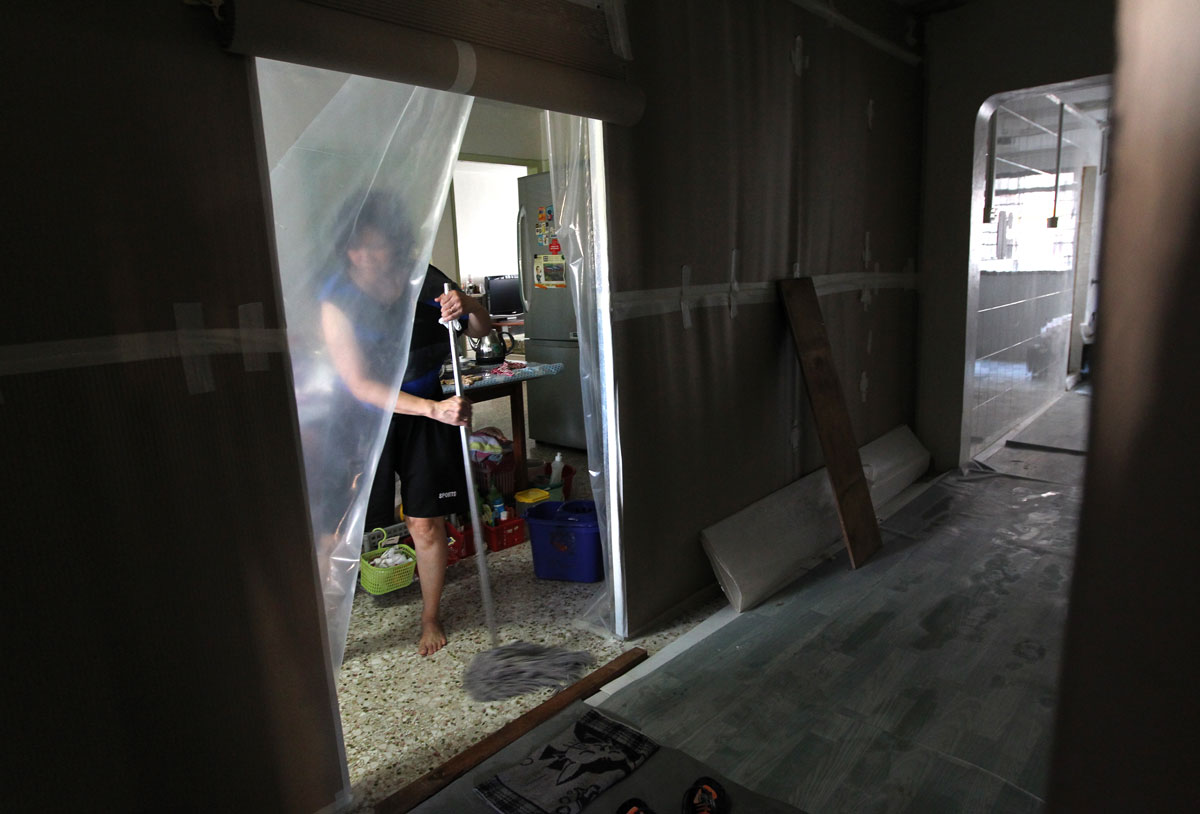
The Government’s fiscal position and budget have to be carefully considered when deciding whether to expand the Home Improvement Programme (HIP), National Development Minister Lawrence Wong said in Parliament yesterday.

He was responding to Ms Lee Bee Wah (Nee Soon GRC) who had asked whether the scheme, which upgrades ageing flats, can be extended to units built after 1986 when they become 30 years old.

The scheme, introduced in 2007, applies only to flats built up to 1986 and which have not undergone the Main Upgrading Programme.

Ms Lee pointed out that some blocks in Nee Soon South were built just after the cut-off date, in 1987 and 1988.

This has led to residents comparing flats that have been upgraded with those that have not.

Mr Wong noted that the HIP is not a one-time expenditure, but a multi-year expense that has cost “billions of dollars”.

Of the 300,000 eligible flats, more than 200,000 have been selected to undergo the programme. The remaining eligible units will be selected by the 2018 financial year.

“So when we want to think about another round of upgrading, I think it’s fair and prudent for the Government to think about sustainability, to consider whether or not we are able to afford such a major programme that will run through many years, potentially even past this term and future terms of government,” said Mr Wong, who is also Second Finance Minister.

“Certainly from an MND (Ministry of National Development) point of view, I will be very happy to support this and I will want all our older towns to be upgraded as soon as possible. From an MOF (Ministry of Finance) perspective… I have to say we will have to consider this very carefully and study and make sure that budget availability is sustainable,” he added.

Both Ms Lee and Ms Jessica Tan (East Coast GRC) raised the issue of clothes drying racks, which are sometimes challenging for residents, especially the elderly, to use. Many old flats come with pipe sockets for laundry poles to be slotted in, but these can be difficult to manoeuvre with heavy loads of laundry.

Ms Tan asked if the design could be modified even if the HIP could not be extended in totality.

Mr Wong gave the assurance that feedback from residents will be factored into future upgrading projects, even in the form of smaller refinements.

“We will always take into consideration feedback like the ones that have been expressed about hanging of clothes, and we will see what we can do in future rounds of upgrading,” he said.

yeosamjo@sph.com.sg


This article was first published on November 9, 2016.
Get a copy of The Straits Times or go to straitstimes.com for more stories.
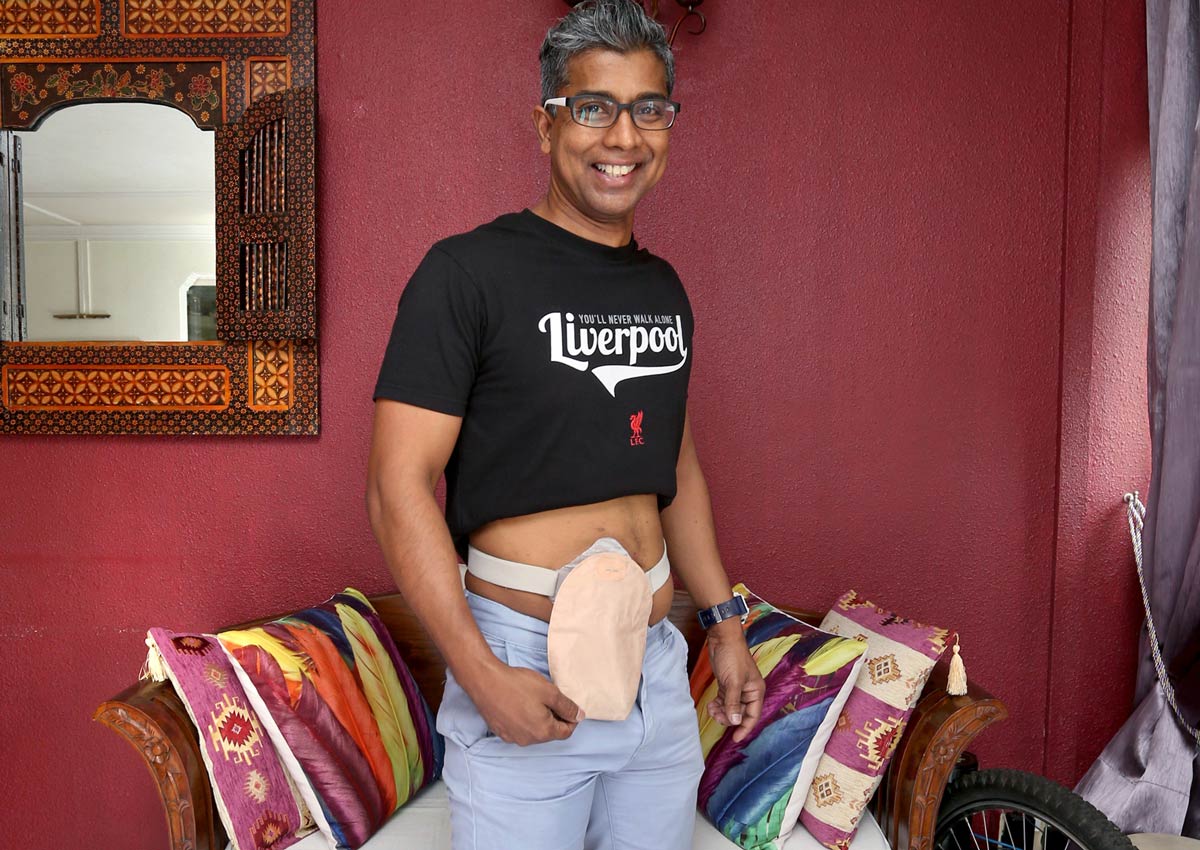

Image: 
Category: 
Publication Date: 
Wednesday, November 9, 2016 – 17:00
Keywords: 
Send to mobile app: 
Source: 


Story Type: 
Others

Source link

Mix of cheer and concern in Malay community

0

Some applaud move to set aside next presidential election for community but others fear it may be seen as tokenism.

Members of the Malay community reacted to news that Singapore’s next president could come from among their ranks with a mix of cheer and concern.

While some yesterday applauded the move to set aside the 2017 presidential election for the Malay community, others still wrestled with worries that this special arrangement would fly in the face of meritocracy and be seen as tokenism.

Association of Muslim Professionals vice-chairman Zhulkarnain Abdul Rahim, 35, pointed out that young Malays like him have yet to see a member of their community take up the mantle of president.

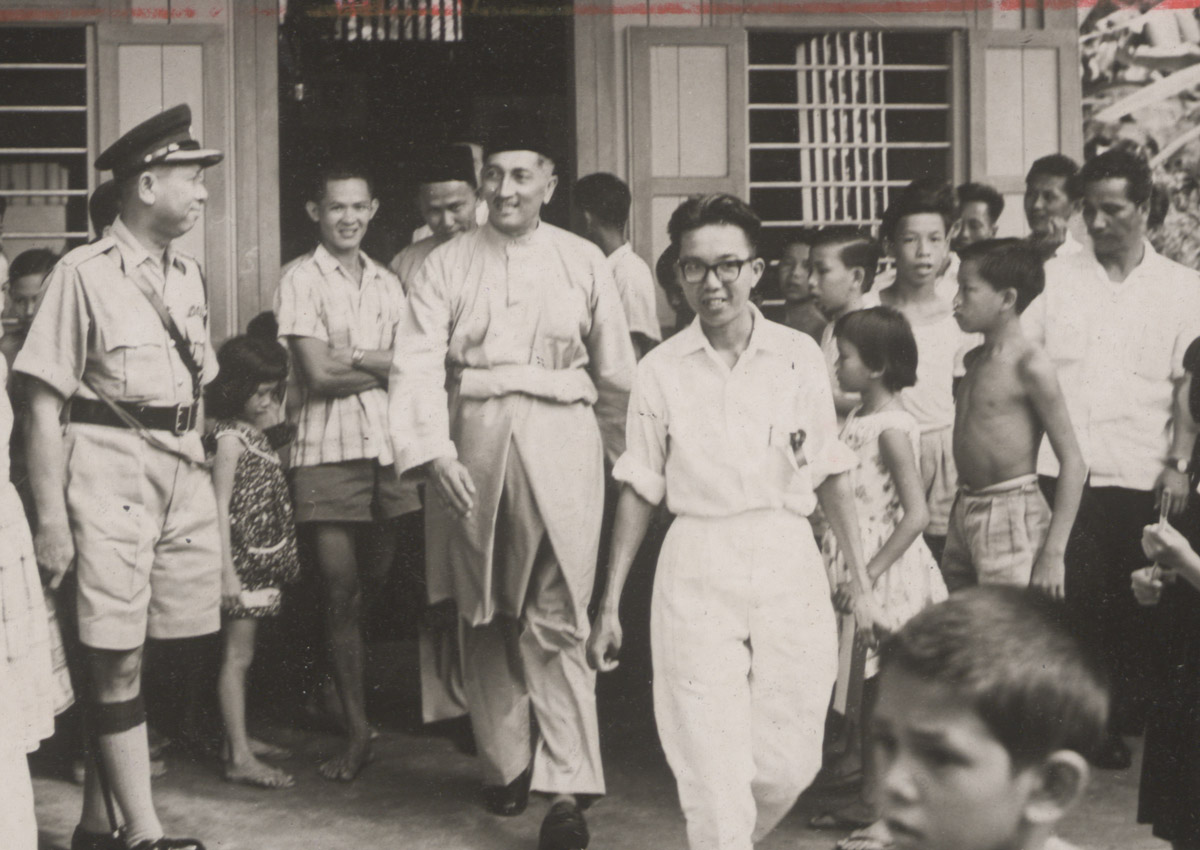
Mr Yusof Ishak, who died in office close to five decades ago, was Singapore’s first and only Malay president so far. Community leaders and observers say possible candidates for the post next year include Speaker Halimah Yacob and former minister Abdullah Tarmugi.

Said Mr Zhulkarnain, a law firm partner: “To me, having a varied representation across all races and possibly gender, in the highest office in the land, is important to all Singaporeans, in particular the young. This new system… guarantees that a Singaporean child growing – going to school, national service, and then on to working life – would probably see presidents from different races.

“That is a strong visual for racial diversity in his formative years.”

And, Iseas – Yusof Ishak Institute fellow Norshahril Saat, 33, said it would be worrying if a president does not emerge from a particular community for longer periods of time. “It will further entrench certain stereotypes about the community’s capability,” he said.

But concerns about a reserved election undermining meritocracy or being seen as tokenism remain.

On Monday, Minister-in-charge of Muslim Affairs Yaacob Ibrahim reiterated that Malay candidates must meet the same standards demanded of those from other communities, insisting: “We do not want, and we cannot accept, tokenism.”

Still, some like analyst Liyana Mohamad, 26, said the very concept of an election set aside for Malay candidates gives the community an unfair shot at the office of president.

“No matter how much it is stressed that what is important is quality, you are still clearing the field of other qualified candidates for the benefit of one community. I cannot bring myself to accept that,” she said.

“If the president is to be a unifying symbol, it is going to be hard when there are people across all communities – Malay and non-Malay – divided over the move.”

Former Nominated MP Zulkifli Baharudin, 57, wished Malay candidates can contest openly, alongside those from other communities, even as he acknowledged accommodations may have to be made.

He said: “Ideally, voters would be colour-blind, and race would not matter, but we are not at that stage yet. But, I don’t think this system should be entrenched forever. As society grows and changes, we should be able to think about doing away with the reserved election. I am certain I will see that day happening.

“And until the Malays can stand on their own two feet, without any assistance, without any special arrangements, we have not arrived.”

asyiqins@sph.com.sg


This article was first published on November 9, 2016.
Get a copy of The Straits Times or go to straitstimes.com for more stories.

Image: 
Category: 
Publication Date: 
Wednesday, November 9, 2016 – 12:05
Send to mobile app: 
Source: 


Story Type: 
Others

Source link

Help on hand for workers: Swee Say

0

Worries about jobs in a tepid economy were uppermost in the minds of five MPs as they shot a series of questions at Manpower Minister Lim Swee Say yesterday, with a sharp focus on help for retrenched professionals, managers, executives and technicians (PMETs) and job -matching.

Mr Gan Thiam Poh (Ang Mo Kio GRC) asked for the success rates of job-matching and training programmes in helping PMETs, while Nominated MP Randolph Tan wondered whether the Ministry of Manpower (MOM) monitored if participants of the programmes stayed on at the jobs they were placed in.

Responding, Mr Lim said 6,400 PMETs found jobs through statutory board Workforce Singapore and the Employment and Employability Institute in the first nine months of this year.

Also, the number of schemes to help PMETs switch careers will expand from 22 to 50 by year’s end.

His ministry also tracks participants of training and job placement programmes by age and sectors.

But the key indicator of the programmes’ success is whether people stay employed, said Mr Lim. “Even if they leave the company but continue to be in employment, the outcome is still positive.”

Latest figures show 11,890 workers were retrenched in the first nine months of this year. But figures on how many of them were PMETs are not available.

Last year, of the 13,450 workers retrenched, more than 9,000 were residents, of whom about seven in 10 were PMETs.

Labour MP Patrick Tay (West Coast GRC) suggested MOM work closely with unions and bosses to reduce the number of job mismatches. Mr Lim agreed, saying: “There’s a lot more we need to do and can do.”

Mr Murali Pillai (Bukit Batok) asked if MOM would encourage companies to give a forecast of their hiring plans before allowing them to hire foreigners.

Mr Lim said that while employment forecasts can be made for industries, “not many companies are prepared to make that kind of commitment upfront”.

Labour MP Desmond Choo (Tampines GRC) asked MOM to consider linking job training and placement programmes with the new jobs that investments bring.

The minister said that was already being done, with training and job placement programmes arming workers with new skills in demand. Portable medical benefits for workers was another issue raised.

Will the Government promote or even make it compulsory for companies to give medical benefits tied to the individual worker rather than to his employment with the company?

Mr Lim, in his reply to Mr Ong Teng Koon (Marsiling-Yew Tee GRC) and Nominated MP and union leader K Thanaletchimi, said portable medical benefits are not popular because companies find their premiums costlier.

“The take-up rate has not been high,” he said. Only 4 per cent of companies surveyed by MOM in 2013 gave that benefit.

He added that the Government sees MediShield Life, introduced last year, as a portable medical insurance scheme that companies can be encouraged to tap on.

MOM will work with unions and employers to promote the scheme, Mr Lim said.

tohyc@sph.com.sg


This article was first published on November 9, 2016.
Get a copy of The Straits Times or go to straitstimes.com for more stories.

Image: 
Publication Date: 
Wednesday, November 9, 2016 – 17:00
Keywords: 
Send to mobile app: 
Source: 


Story Type: 
Others

Source link

Alternative models of elected presidency not workable: PM

0

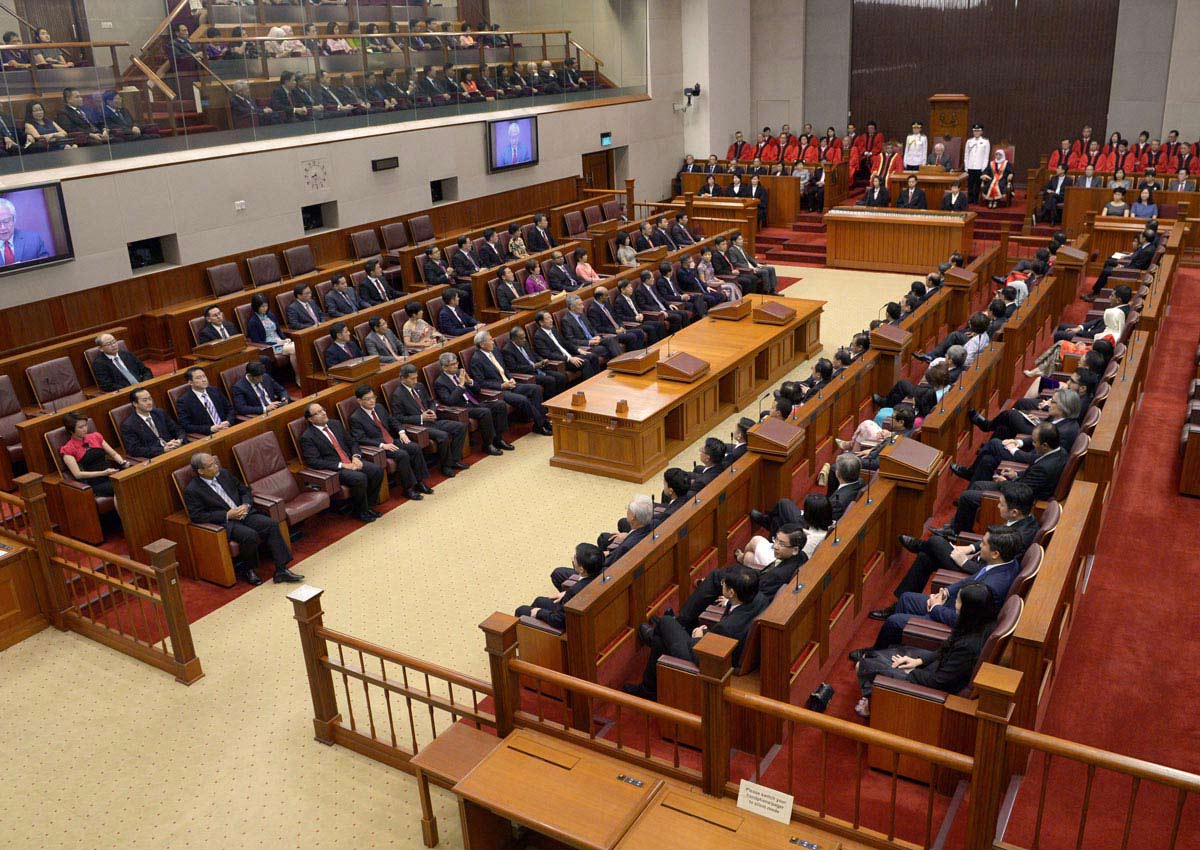
It may not be easy to improve the elected presidency system to get it right, but the task has to be done as the alternatives will likely create worse difficulties down the road, Prime Minister Lee Hsien Loong said in Parliament yesterday.

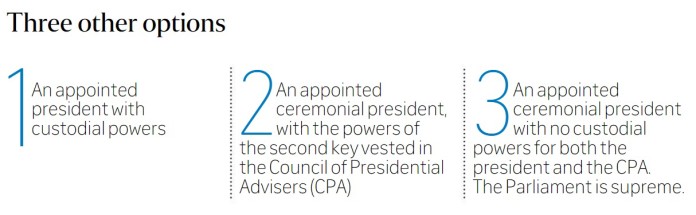
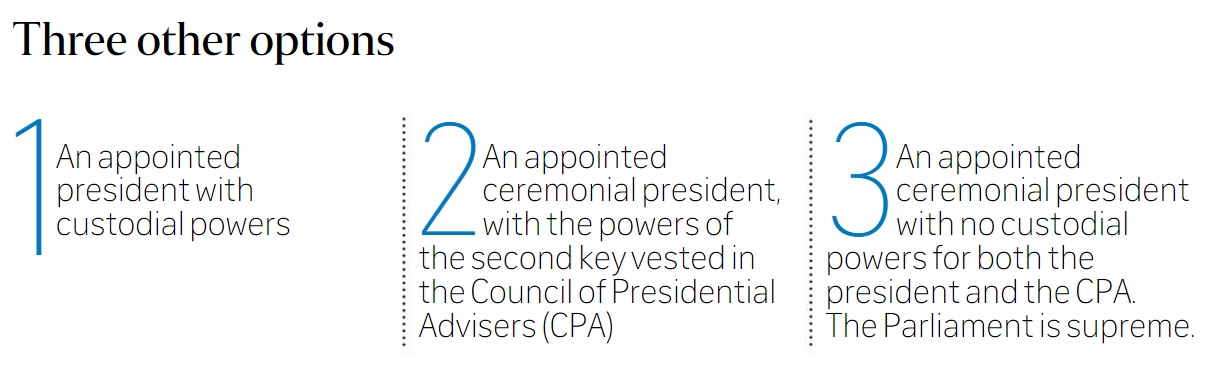
He presented three alternatives and went through why they were not ideal, on the second day of the debate on proposed changes to the elected presidency.

Non-elected president with custodial powers

An appointed president who is given the same custodial powers as an elected president may find it difficult to go against the government’s decisions, Mr Lee said.

“To veto the government is a major decision. You must have a democratic mandate to make that call.”

All may be fine when an unelected president approves proposals by the elected government, Mr Lee said, but he may find it tough to stand his ground when he disagrees.

The government can rightly argue that it is elected and represents the people’s will, and the president, who is appointed and does not have the people’s mandate, has no right to disagree, he said.

He added: “The president’s ‘no’ will not stick.”

Non-elected president, custodial powers vested in CPA

There have been calls to revert to a system with an appointed president playing a ceremonial role, and to have the president’s custodial powers vested in the Council of Presidential Advisers (CPA) instead.

Mr Lee said the CPA – a council of unelected non-political wise men – works well as an advisory panel to the president when he is elected by the people, and has the mandate to make the final decision.

But if the unelected council becomes the decision-maker, it will have problems saying no to the government just as an unelected president would, he added.

If the council members were to be elected, “the CPA becomes an Upper House”, and elections would be needed “for six, eight, or 10 presidential advisers”, Mr Lee said.

“Instead of having one presidential race risking being politicised, we would have six, eight, or 10 CPA races at a similar risk.” This magnifies, instead of reduces, the problems the elected president faces, he added.

Non-elected president, no second key

The third alternative, said Mr Lee, is to appoint a president with a purely ceremonial role, do away with the president’s custodial powers, dismantle the CPA, and let Parliament be supreme.

But that would be “very unwise” as this leaves Parliament with unrestricted power to do as it pleases, with no safeguard in place. Citing what Deputy Prime Minister Teo Chee Hean said in Parliament on Monday, Mr Lee said the pressure “is to do more rather than to spend less”.

He added: “I cannot recall the last occasion in this House when any political party or MP has pressed the Government to spend less or to raise more taxes.”

If Parliament is made supreme, he said, it creates a single point of failure. “Everything hinges on the outcome of a single general election, on the government elected into Parliament in that one vote every five years,” he added.

leepearl@sph.com.sg


This article was first published on November 9, 2016.
Get a copy of The Straits Times or go to straitstimes.com for more stories.
Category: 
Publication Date: 
Wednesday, November 9, 2016 – 11:59
Send to mobile app: 
Source: 


Story Type: 
Others

Source link

Man helps put out fire, then disappears

0

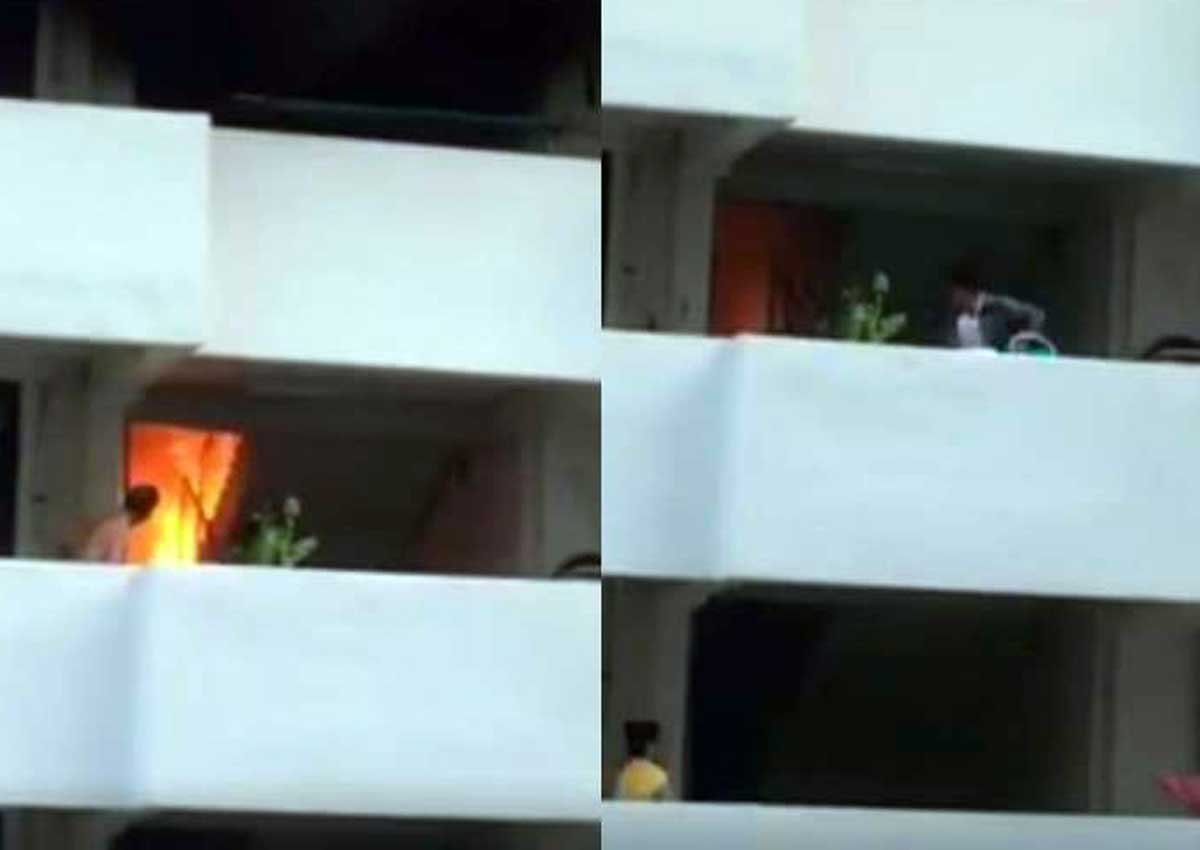
Mr Peter Lim, 66, was going to work when he noticed a fire at the lift landing between the third and fourth storeys of Block 59, Lengkok Bahru, off Jalan Bukit Merah.

He rushed to the third storey to alert residents. But a man in a blue shirt was already banging on the door of the unit closest to the fire.

The mystery man then helped to put out the blaze before vanishing.

A video of the fire was posted yesterday on Facebook by Madam Suhaini Ali, who saw the incident as she was sending her child to school.

Mr Lim, who lives in Block 52, said he saw the man in blue run out of a coffee shop at Block 58.

ALERTED

He told The New Paper: “He alerted the residents. Then we and three residents put out the fire.”

Sales exhibitor Teng Hau Hin, 46, who lives on the third storey next to the lift landing, was awoken by his wife at about 7.30am after the man in blue alerted her to the fire.

The couple and their 14-year-old daughter joined Mr Lim and the man in blue to fight the fire.

Mr Teng said in Mandarin: “We formed a human chain and passed 20 to 30 pails of water to put out the fire. It was big and there were three explosions. The floor shook. We were scared.”

He said they put out the fire in 15 minutes.

The Singapore Civil Defence Force (SCDF) said it was alerted at about 7.40am and sent a fire engine, a Red Rhino and an ambulance.

No one was hurt in the fire, which involved discarded items.

Residents told TNP that there were piles of discarded items at the lift landing in the past few days.

Mr Teng said he had called the Tanjong Pagar Town Council about this.

But a town council spokesman told TNP it had not received any such feedback in the past three months.

She added: “However, this is no excuse for our workers to not remove discarded items in a timely manner.

“Our workers sometimes have problems identifying whether the items placed at the common area are to be discarded as some residents also place their personal items along the common area.

“We would like to seek our residents’ assistance not to leave discarded items at the lift landing or common area as these can be potential fire hazards.”

The police have classified the case as mischief by fire. Investigations are ongoing.

bxliew@sph.com.sg


This article was first published on Nov 9, 2016.
Get The New Paper for more stories.

Image: 
Category: 
Publication Date: 
Wednesday, November 9, 2016 – 14:00
Send to mobile app: 
Source: 


Rotator Headline: 
Mystery man helps put out fire in Bukit Merah, then disappears
Rotator Image: 
Story Type: 
Others

Source link

Elected presidency has influenced Singapore politics for the better: PM

0

Prospect of a veto alone has lessened the temptation for political parties to promise the world during elections.

The elected president’s custodial powers over the national reserves have influenced Singapore politics for the better, even if the veto over the Government’s spending proposals has never been exercised, Prime Minister Lee Hsien Loong said.

“The prospect of a veto alone has lessened the temptation for political parties to promise the world to voters in general elections,” he said, adding that he believed it was an important reason why the opposition parties have been cautious with their spending proposals.

“Without the second key, I am sure some opposition parties would have gone to town many elections ago. The People’s Action Party Government would have come under pressure to match their generosity, and might well have found it difficult to hold the line,” he said.

Mr Lee was speaking on the importance of the elected presidency as a safeguard in the political system, during the second day of debate in Parliament on proposed constitutional changes to the highest office of the land.

He reiterated the lessons from Australia that Deputy Prime Minister Teo Chee Hean had raised on Monday. During the boom years of its commodities, the Australian government spent A$18 out of every A$19 it received in extra revenue.

When the boom ended, it went into deficit and had to make painful spending cuts.

“Singapore is not in such a position and for that, some credit must go to the system of the elected president with veto powers over reserves,” Mr Lee said.

Ultimately, the goal is to design a system with the right balance between a decisive government and adequate stabilisers, he added.
Without stabilisers, there will be serious consequences if anything goes wrong.

But should the stabilisers become too strong, gridlock would set in.

Singapore started very close to the first extreme, with “a unicameral, single Parliament, untrammelled”, Mr Lee said. So, the elected presidency was introduced to protect the reserves and key public service appointments.

“This is not a fundamental shift from our system of parliamentary democracy, but it is an important one, because every system needs political stabilisers,” he said.

Addressing arguments that the power to safeguard the reserves should be vested in Parliament, Mr Lee said it would create “a single point of failure” as everything would hinge on a single general election.

In countries with an Upper and a Lower House, polls are often held separately in different constituencies and the timing staggered so that “you are never risking everything on one throw of the electoral dice”.

But the elected presidency is not all smooth sailing either. A unique system, it is “very difficult to get right because the balance is delicate”, said Mr Lee.

As the president is elected by the people, he has a mandate. But the mandate is not to govern but to be used only to veto specific government actions.

Also, the 2011 presidential polls showed that issues outside the president’s constitutional role can be touted in a fierce contest.For instance, one candidate championed a $60 billion economic plan which he claimed would create jobs, while another pushed for greater recognition of national servicemen.

Still, Singapore should persevere with the elected presidency, Mr Lee said. “But for all these difficulties, I am convinced the elected president has been a plus for our system.”

Turning to overseas examples of political systems, he cited two countries on extreme ends in terms of checks and balances.

Britain has no written Constitution and comes closest to a Parliament with no constraints as it can theoretically make decisions as major as abolishing the monarchy through a simple majority, he said.

Even so, British courts have become a check on the government by making judgments that are, in effect, executive decisions.

This can be seen in the judicial response to government measures against terrorism.When it tried to deport convicted foreign terrorists, “the cases are endlessly litigated and the government finds itself impotent to act,” he said.

On the other hand, “the United States has elevated the separation of powers into a sacred doctrine” with three centres of power – Congress, the presidency, and the Supreme Court – constantly balancing one another.

“The tension is always there, and often results in gridlock. But the US accepts that, because their overriding priority and philosophy is to prevent an overbearing government.”

Mr Lee also noted that James Madison, one of the US founding fathers, wrote that: “If men were angels, no government would be necessary. If angels were to govern men, neither external nor internal controls on government would be necessary.

A dependence on the people is no doubt the primary control on the government; but experience has taught mankind the necessity of auxiliary precautions.”

Mr Lee said such a system would not work in Singapore.

“But we, too, need some ‘auxiliary precautions’, some stabiliser, besides the ‘primary control’, which is the fact that Parliament is elected by the people. And for us, that stabiliser is the elected president.”

ziliang@sph.com.sg 


This article was first published on November 09, 2016.
Get a copy of The Straits Times or go to straitstimes.com for more stories.

Image: 
Category: 
Publication Date: 
Wednesday, November 9, 2016 – 11:36
Send to mobile app: 
Source: 


Story Type: 
Others

Source link