Home Blog Page 2376

China's Communist pilgrims pay homage in Xi Jinping village

0

LIANGJIAHE, China – Three caves in a remote Chinese village where Xi Jinping was sent during the Cultural Revolution receive a constant stream of Communist pilgrims, come to pay homage four years after he came to power.

Xi, then 15, was ordered to Liangjiahe in 1969 as part of Mao Zedong’s “Up to the Mountain and Down to the Countryside Movement”, which saw educated city youth deployed to rural areas.

The urbane son of a Communist Party grandee, Xi spent seven years hauling grain and sleeping in cave homes on fleabitten brick beds.

But he has said he “left his heart” in Liangjiahe, and credits the experience with his political formation long before he became the most powerful man in the world’s second-largest economy.

Now the dusty village in Shaanxi province, 1,000 kilometres from Beijing, has been transformed into a living shrine to Xi’s years of toil, with vintage Mao posters, thermoses, and kerosene lamps giving the cave homes he occupied an authentic feel.

Between 1,000 and 7,000 tourists visit every day, state media reported, riding in on a highway opened this year, and Xi himself blessed the location with a return journey last year.

In the newly paved main street, Guo Moxi, who worked the fields with Xi, said that since he was appointed as general secretary of the ruling party four years ago on Tuesday, everyone’s lives in Liangjiahe had seen “a big change”.

Four years Xi’s junior, Guo recalls a gentle person of “broad understanding” who was “very compassionate” towards ordinary people.

“He was prepared to spend his life in Liangjiahe. He suffered a lot of hardship and wanted to change the face of this place.” In a sleek museum affiliated with an elite Communist party college in nearby Yan’an, young guides in elegant jackets narrated to elderly visitors the “Four Hardships” Xi suffered – flea bites, bad food, hard labour and assimilating into the peasantry.

Yang Xianglin, a former teacher whose cave home is decked floor to ceiling with enlarged photos of Xi and his wife, painted a picture of the politician as an almost legendary figure, reading books between breaks in hard labour, with a fierce spirit “so one could see he was no common man”.

Last month Xi, already widely seen as China’s most powerful leader for decades, was named the “core” of the Communist Party leadership, giving him a personal authority his immediate predecessors never achieved.

[EMBED]https://studio.brightcove.com/products/videocloud/media/videos/5112661309001[/embed]

His descent from privileged childhood to the countryside, and later return to triumph after trials and suffering, contains “fairy tale elements” akin to the Prince and the Pauper, deepening his common appeal, said Warren Sun of Australia’s Monash University.

“The current promotion of Liangjiahe as a new ‘sacred site’ is apparently part of an effort to bolster Xi’s image as a prince of the people,” he told AFP.

Such myth-making marks a striking difference between Xi and his predecessor Hu Jintao, said Victor Shih of the University of California San Diego.

“Hu tried to downplay his personal history to avoid any appearance of a personality cult,” he told AFP. “We have not seen such effort in the Xi administration.” .

Fields of cabbage still line the road through Liangjiahe, but most residents now spend their days catering to tourists. Some rent out caves or courtyard homes, others drive shuttle buses or have opened shops selling Liangjiahe-branded red-date wine and hot sauce.

Average yearly incomes have nearly doubled from 7,900 yuan (now $1,200) in 2012 to more than 15,000 yuan last year, according to the town’s museum.

A county development plan calls for new restaurants and cave inns to give up to 300 overnight guests a taste of Xi’s life, with hard brick beds and earth stoves to “strictly protect the Liangjiahe brand image”.

Previously free, the village now charges 20 yuan per ticket to enter.

“When he was young, he was incredible,” said a retired teacher named Wang, describing his visit to Liangjiahe as “a form of spiritual self-education”.

The explosive growth of Communist-related tourism in China over recent years has been fuelled in part by Xi’s charisma, and by lingering nostalgia for the simpler era of Mao Zedong.

“Red Tourism has a kind of need for leader worship, for hero worship, for worshipping miracles,” said He Jianmin, head of tourism management at Shanghai University of Finance and Economics.

“If we went to France maybe we would want to see Napoleon. Napoleon was an ordinary Frenchman, but he was a leader. People have this kind of fondness for the past, a leader-worship complex.” But a middle-aged tourist in Liangjiahe surnamed Li sounded a note of dissent, saying it was “wrong” to build the village into a place of adulation for Xi.

“It’s a bad Chinese habit,” he said. “Because a leader lived here, they turn it into an education base, they twist the experience and turn it into a kind of worship.” Whether Xi was a good leader, he said, “time will have to judge”.
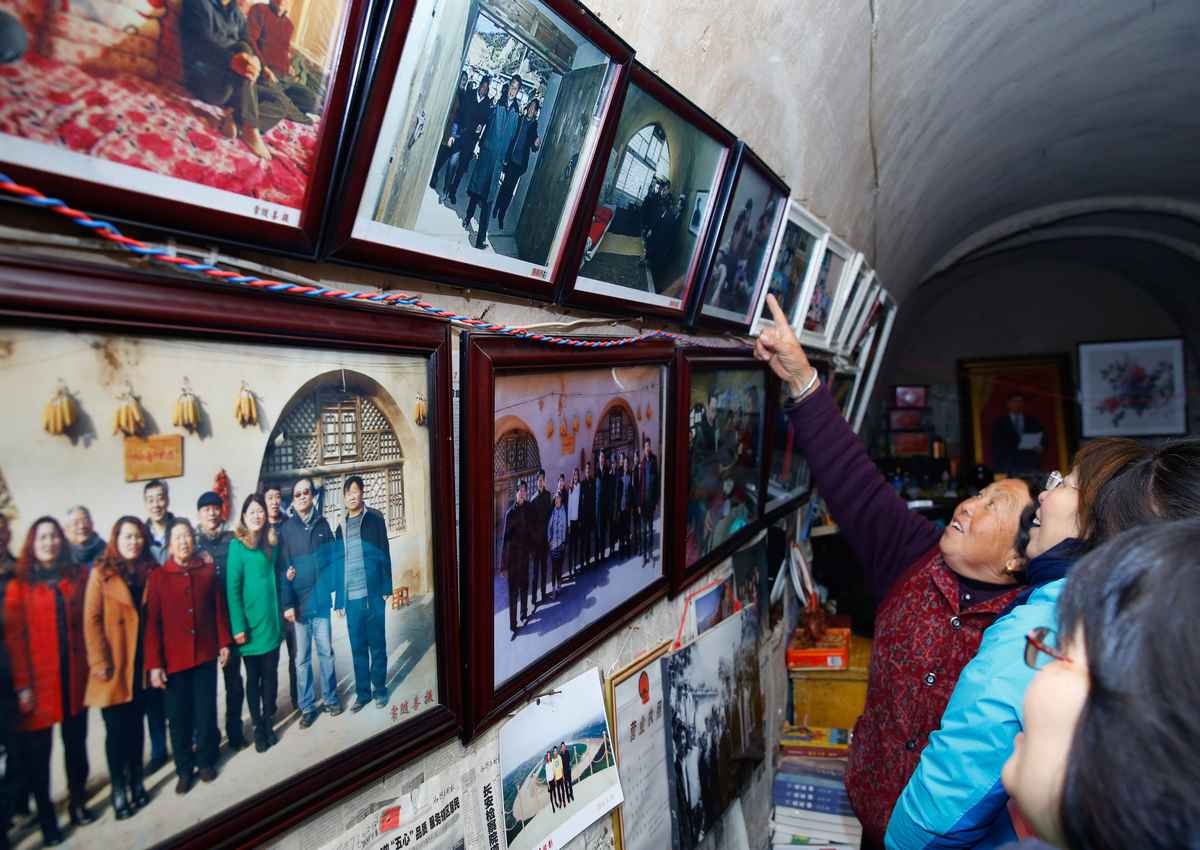

Image: 
Category: 
Publication Date: 
Sunday, November 13, 2016 – 13:10
Keywords: 
Send to mobile app: 
Source: 


Story Type: 
Others

Source link

Advice columnist apologises for reply to alleged rape victim

0

The author of an advice column in Teenage magazine has apologised for her widely panned response to an alleged rape victim.

In an open letter, Ms Kelly Chopard, who has penned the Dear Kelly column since 1996, said: “I sincerely apologise if my response to Raped After Lying To Mum came across as harsh and ‘blaming the victim’.”

Ms Chopard, who counsels primary and secondary school students, argued that she had never blamed the victim, but instead adopted “a particular tone so as to make sure the writer does not engage in such risky behaviour again”.

She also insisted that she “wanted everyone to know the danger of sending the wrong signals”.

Her letter came in response to outrage online, including from gender equality advocacy group Association of Women for Action and Research (Aware).

Read also: Aware responds to Teenage Magazine’s victim blaming advice column 

In a letter published in the magazine’s latest issue, the alleged victim related her experience of going to her boyfriend’s home for dinner and a movie, drinking, and waking up the next morning naked in bed with him, without any memory of what had happened.

Ms Chopard responded by telling the writer she had misled her boyfriend into thinking she wanted to have sex by acting “like a girl who has been around” and that she should be “grateful that he wore a condom”.

It is not known if the letter is a genuine one, or if the writer had made a police report.

The Sunday Times contacted Teenage magazine for comment via e-mail but did not receive a response.

In an e-mail to the magazine’s editor-in-chief, Aware accused the columnist of implying that it is acceptable to sexually assault someone who has had sex before.

It added: “Consent needs to be acquired at every stage of physical intimacy. If a person is too drunk or intoxicated to give fully voluntary agreement, they are not legally able to give consent.”


This article was first published on Nov 13, 2016.
Get a copy of The Straits Times or go to straitstimes.com for more stories.

Image: 
Category: 
Blurb: 
<p>The author of an advice column in Teenage magazine has apologised for her widely panned response to an alleged rape victim.</p>
Publication Date: 
Sunday, November 13, 2016 – 14:00
Keywords: 
Send to mobile app: 
Source: 


Story Type: 
Others

Source link

Infant dies after plunging three storeys from escalator in China

0

An infant in China has died after plunging three storeys from an escalator in Shanghai Qingpu Wyatt Plaza.

The accident happened when the grandmother of four-month-old baby boy lost her balance as she stepped on the escalator, reported Chinese news website xinmin.cn.

Footage from microblogging site Sina Weibo showed the elderly woman losing her grip on her grandchild as she tilted over the escalator’s handrails, struggling to regain her balance.

Gif: Sina Weibo

The baby, who was in his grandmother’s left arms, was thrown off the escalator in the ensuing chaos.

The toddler’s mother was walking behind with another child when she witnessed the incident. She immediately rushed down the escalator, but it was too late.​

According to Taiwan news portal EBC, emergency responders pronounced the baby dead at the scene.

Before this latest accident, no safety breaches were reported on the escalator, the same report added.

Reactions online mostly empathised with the family, especially the grandmother. Some netizens also noted that the elderly tend to be weak, making it tricky when leaving infants in their care.

grongloh@sph.com.sg

Image: 
Category: 
Publication Date: 
Sunday, November 13, 2016 – 11:29
Send to mobile app: 
Source: 


Story Type: 
Others

Source link

Korean shamans enraged by 'female Rasputin' scandal

0

SEOUL – As if South Korea’s scandal-hit president Park Geun-Hye didn’t have enough to worry about with single-digit approval ratings and massive protests, she now has thousands of very disgruntled shamans on her case.

Practitioners of the centuries-old spiritual tradition are furious that their reputation has been tainted by association with the corruption scandal involving a close friend of the president, Choi Soon-Sil.

The daughter of a shadowy religious figure, Choi has been dubbed “Korea’s Rasputin” and the president’s “shaman adviser,” because of the influence she allegedly wielded over Park and reports linking her to shamanist rituals.

“We are so angry. She made all of us look like corrupt charlatans,” said Lee Won-Bok, head of the national association, Shaman Korea.

“Whether Choi Soon-Sil is really a shaman or not, she soiled the reputation of genuine, hard-working shamans in this country. We are not like her,” Lee told AFP.

Choi is currently under arrest for fraud and abuse of power, having allegedly used her long-time friendship with Park to force donations out of major companies to foundations she set up and used for her personal gain.

She is also accused of meddling in affairs of state, despite holding no official position.

Shamanism is deeply ingrained in Korean culture, and despite living in one of the world’s most technologically advanced countries, many Koreans still consult shamans – as intercessors with the spirit world – for medical reasons, divination, or just personal advice.

The rituals can be grisly affairs for the uninitiated, with the shaman plunging a pointed trident into the head of a dead pig, or biting the heads of live chickens while dancing in a trance-like state.

But the actual purpose of such ceremonies is benign and often very intimate – wishing peace to the soul of a dead relative, or just courting good luck for an upcoming project.

According to Lee, South Korea has around 300,000 registered shamans, or one for every 165 people in the country.

Joining their number requires a rigorous initiation process overseen by an experienced shaman and Lee said his members were adamant about defending the integrity of their profession.

Hundreds have signed a petition urging the media to cease describing Choi as a shaman, and some plan to join mass street protests calling for Choi to be jailed and Park to resign.

Choi has never publicly described herself as a shaman, and the media speculation seems largely founded on the idea that she inherited the mantle from her late father.

Choi Tae-Min was a charismatic pastor who had reportedly worked as a shaman before setting up his own cult-like group in the 1970s, combining tenets of Buddhism, Christianity and shamanism.

He became a mentor to Park after the assassination of her mother in 1974, and a US diplomatic cable published by Wikileaks noted widespread rumours that he had “complete control over Park’s body and soul.” After her father’s death in 1994, Choi Soon-Sil remained close to Park and there were reports – firmly denied by the president – of shamanist rituals being performed in the presidential Blue House.

The mocking tone of much of the media coverage – with Park being described as a puppet of a “shaman-ruled kingdom” – has bothered people like Yang Jong-Sung, head of the Seoul-based Museum of Shamanism.

Yang said he was reminded of the language used during Japan’s 1910-45 colonial rule over the Korean peninsula, when shamans had been dismissed as frauds and swindlers.

“Shamanism had played an important role in our communities for centuries and then they were labelled as mere superstition to be eradicated,” he told AFP.

The practise survived the Japanese, the devastation of the Korean War and has thrived in the modern, high-tech, prosperous nation South Korea has become.

“One of the biggest times for us is election season,” Lee said. “Many candidates want to know if they have a chance to become a city council, governor, or a parliamentary member.

“But our role ends there … we don’t meddle with state affairs or extort money from companies,” he said.

In recent years, there has been government support, with some well-known shamans and regional shamanistic rituals officially designated “intangible cultural assets.” Min Hye-Gyeong, a prominent shaman, describes herself as a “grass-roots servant” for ordinary South Koreans seeking blessings for their harvests or better health for their communities.

“A big part of our job is soothing the pain and sorrow of ordinary people at times of trouble, and helping them find emotional comfort,” said Min, 50.

“It’s infuriating that the political scandal overshadowed all the positive aspects of our role and made us targets of mockery,” she said, while preparing to perform a ceremony for a 70-year-old widow in memory of her late husband.

Clad in layers of colourful traditional cloth and waving large swords and a bundle of bells, she danced, spun and leaped around to a high-volume, trance-like accompaniment of flute, drums and gong.

Her client wept, rubbed her hands together in prayer and bowed deeply as Min sang songs and recited verses to soothe the husband’s soul and ensure the health of his living relatives.

“I wanted to send this message to my late husband that I miss him so much and he does not need to worry about me as my children are taking good care of me,” the widow, Kang Tae-Suk, told AFP.

“I feel so much comfort now … my heart feels lighter, my mind calmer.”

Image: 
Category: 
Publication Date: 
Sunday, November 13, 2016 – 11:11
Keywords: 
Send to mobile app: 
Source: 


Story Type: 
Others

Source link

Football: Spain, Italy cruise as Wales held again

0

PARIS – Wales conceded an agonising late equaliser as Serbia battled to a 1-1 draw in a World Cup qualifier on Saturday as former champions Italy and Spain both won 4-0.

Earlier Saturday, the Republic of Ireland has stunned Austria 1-0 in Vienna and are top of Group D on 10 points, with Serbia second on eight and Wales third on six.

Gareth Bale rocketed Wales into a 30th-minute lead in Cardiff after Hal Robson-Kanu dispossessed Matija Nastasic and fed the ball to the Real Madrid forward, who cracked home a powerful snap shot to make it 1-0.

But Aleksander Mitrovic was fastest to react with four red shirts around him when Antonio Rukavina whipped in an inviting cross to level for the visitors late in the game.

“It was a disappointing result, we feel like we threw away two points. We’re at home, 1-0 up after 85 minutes, it’s two points lost,” Bale admitted after the game.

Just moments before Serbia had levelled, Bale had seen a snapshot come agonisingly back off the post.

Wales coach Chris Coleman was less disappointed and was looking down the road.

“We are four points behind Ireland but we play them twice,” he said. “We have a massive chance. Tonight the boys deserved all three points.” It was the third game in a row the Welsh have gone ahead only to draw.

“We can be proud of ourselves. We are on the right track. Today we can be happy with one point,” said Serbia captain Branislav Ivanovic.

The Irish top Group D thanks to a James McClean strike three minutes after half-time in Vienna.

“This is going to be a very tight finish. But this has been a splendid start for us and we are delighted with the 10 points,” said Ireland boss Martin O’Neill.

Spain and Italy continue to set the pace at the helm in Group G and both have 10 points.

Spain played at Granada where Macedonia’s Darko Velkovski scored a 34th minute own goal before Votolo on 63 minutes, Nacho Monreal (83) and veteran striker Aritz Aduriz (85) gave them a comfortable win.

Taking on minnows Liechtenstein, Italy’s Anfrea Belotti scored either side of strikes from Ciro Imobile and Antonio Candreva.

Eran Zahavi converted an 18th-minute penalty to set Israel on their way with Dan Einbinder and Eliran Atar making sure they beat Albania 3-0 in Tirana.

Iceland failed to replicate their Euro 2016 heroics in a 2-0 defeat in Croatia in Group I.

Croatia grabbed the lead after 15 minutes through Inter Milan midfielder Marcelo Brozovic, but it was Iceland who took control after that in Zagreb, where the game was played out in front of empty stands after a FIFA stadium ban.

Despite having plenty of the ball in both halves, Iceland failed to make the crucial breakthrough.

And the home side punished them in injury time, Brozovic again doing the damage against the run of play.

Croatia, now top of the group with 10 points from four games, finished the match with 10 men after Ivan Perisic was sent off at the death.

Also in Group I, Turkey revived their slim hopes of making it to Russia in 2018 with a 2-0 home victory over Kosovo in Antalya.

Burak Yilmaz and Volkan Sen scored within four minutes of one another in the second half to leave Kosovo bottom on just a solitary point.

Georgia and Moldova played out a 1-1 draw in Tbilisi to remain rooted in the bottom two spots in Group D.

Image: 
Category: 
Publication Date: 
Sunday, November 13, 2016 – 09:12
Keywords: 
Send to mobile app: 
Source: 


Hermes ID: 
2 738 900
Hermes ID String: 
VLWCQ13
Hermes Author: 
GRONGLOH
Story Type: 
Others

Source link

Trumpocalypse now? Not for everyone

0

S M ONG SMONG@SPH.COM.SG Why would anyone vote for a former reality TV star to be president of the United States? I found out…

Hello? Halloooo!

Are you there? Anyone still alive?

Has the world ended yet?

For supporters of US president wannabe Hillary Clinton, it might as well have.

We survived exploding Samsung phones and washing machines for this?

As US talk show host Stephen Colbert said on Tuesday night when America elected its first commander-in-chief to have ever sold steak: “It feels like we’re trying to avoid the apocalypse, and half of the country is voting for the asteroid.”

That asteroid is of course Mr Donald J Trump, the next president of the not very United States.

PHOTO: AFP

Where was Bruce Willis to blow up the crotch-grabbing space rock threatening to destroy the Earth when you needed him?

Instead of Armageddon hero Willis, which celebrities did Mrs Clinton get to endorse her? Beyonce? Katy Perry? Lady Gaga? All of them were no match for Scott Baio.

But didn’t the polls say the former First Lady would win the election?

As it turned out, it was a perfect illusion.

Thanks, Gaga.

I, too, was stunned by the outcome like I was groped by a 70-year-old real estate tycoon.

Former Nominated Member of Parliament Janice Koh pretty much described how I felt as the election results came in when she tweeted: “It’s like watching a train wreck about to happen in slow motion, and you can’t do nothin’ about it.”

Maybe we can blame the train wreck on a “rogue train”, like the one blamed last week for the disruptions plaguing the MRT Circle Line.

Hey, that could be the next Star Wars sequel – Rogue Train One: An SMRT Story.

I’m so traumatised by a Trump presidency being forced onto the world that I feel like writing to Teenage magazine’s Dear Kelly for advice on how to cope.

Yes, maybe I’m naive, but I didn’t ask for it – even though I sort of predicted the Republican’s victory six months ago.

In May, I wrote in this column about Mr Trump: “The former star of The Apprentice TV show is about as likely to beat Mrs Hillary Clinton as a football team that barely escaped relegation last season is to win the English Premier League.”

Thanks, Leicester City.

I ASKED A FRIEND

To try and make sense of it all, I reached out to an American friend who I suspected is a Trump supporter, judging by a Facebook post or two.

She lives in a rural part of Wisconsin, a state which has consistently voted for the Democratic presidential candidate since 1984 – until now.

She’s Caucasian, 41, and is studying to be a nurse while working part-time.

Married with three grown children including a daughter with Down Syndrome, she also volunteers with the Special Olympics.

On Thursday, I messaged her on Facebook: “Did you vote for Trump?”

She confirmed my suspicion with a quick “Yup”.

I asked: “What do you like about him?”

She replied: “I like the fact that he’s not a career politician and I think that we need someone in who is going to work for the country.

“I like the fact that he wants to repeal Obamacare because the American people who are forced to have it can’t afford the premium much less the deductible.”

I then tried to ask as diplomatically as possible: “So all the negative character stuff wasn’t a factor?”

She replied: “Was I happy about that? No. But everyone at some point has said stuff that he did, women included.

“Is everyone perfect? Hell no!

“I like the fact that he wants to go in and try to get rid of ISIS. Our military is in places that we should never have been in the first place.”

Answering a question I didn’t ask, she added: “You sure as heck know I’m far from racist, a bigot, uneducated, etc.”

Rather undiplomatically, I countered: “Well, yeah, but Trump is.”

She replied: “That’s what the media portrays. He’s done a lot of good things that people don’t look at.”

She went on to criticise president Barack Obama and Mrs Clinton, but claimed she is neither a Republican nor a Democrat: “I think too many people have blinders on because they are only Democratic or Republican and don’t look at the broad picture of it all.”

But she acknowledged: “Trump is by no means someone who has the best character.

“But if he can implement changes and make things better, then great.”

So for my friend and the 60 million Americans who voted for the man behind Trump University, it certainly wasn’t the end of the world even as Lady Gaga and anti-Trump demonstrators protested around the country after the election.

I, for one, am glad that the world didn’t literally end because then I would have missed out on all the great Singles Day sales on Friday.

I read that ex-California governor Arnold Schwarzenegger is replacing the Donald on Celebrity Apprentice. Could The Terminator star one day become the leader of the free world too?

I have seen T2: Judgment Day.

Never mind Trumpocalypse.

Will you be ready for Arniegeddon?

Source link

Hed Chef: Tom yum-inspired spice paste

0

Store-bought paste offers convenience but I get a kick out of making my own concoctions.

In return for the time and effort, you can avoid the use of artificial flavouring and preservatives. You also get to control the amount of salt or sugar.

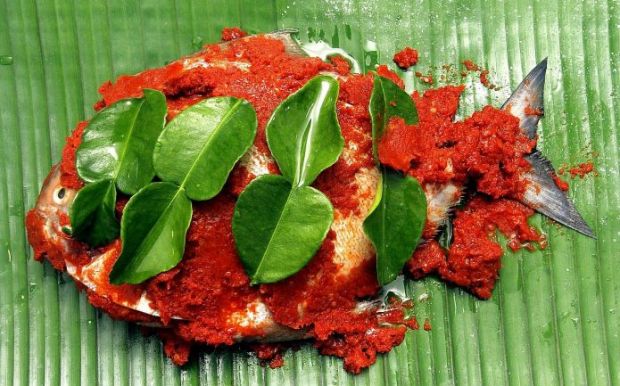
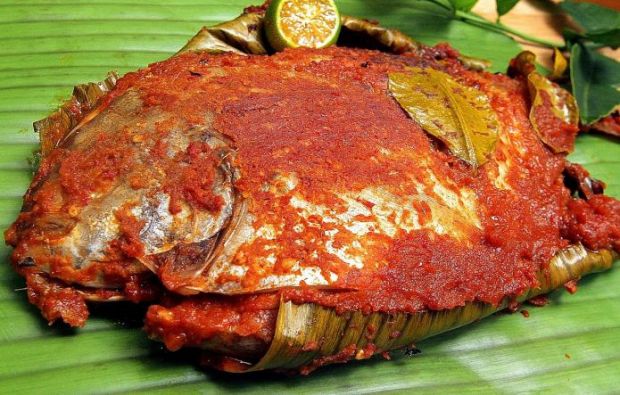
This week, I am sharing a recipe for a tom yum-inspired spice paste which I use to stuff a black pomfret for grilling.


TNP PHOTOS: HEDY KHOO

If you like a sharper tang, increase the quantity of tamarind juice.

Drizzle coconut oil on the fish for extra flavour.

Store the excess paste in a glass jar in the fridge. If kept properly, it should easily keep for up to two weeks.


INGREDIENTS

  • 1 black pomfret
  • 2 tbsp of coconut oil
  • 2 pieces of banana leaves
  • 4 toothpicks, soaked in water
  • 1 level tsp salt

Spice paste

  • 80g dried chillies
  • 60g dried prawn, soaked
  • 6 kaffir lime leaves, de-stemmed
  • 250g shallots
  • 50g garlic cloves
  • 50g galangal, chopped
  • 50g ginger, chopped
  • 4 lemongrass stalks
  • 1 tbsp coriander powder
  • 1 tsp belacan powder
  • 3 tbsp tamarind pulp (assam jawa)
  • 250ml water
  • 2 tbsp palm sugar
  • 1 tsp salt
  • 4 tbsp cooking oil

METHOD

1. Remove the stems of the dried chillies. Boil until softened. Discard water and rinse the chillies.

2. Peel and discard the outer two layers of the lemongrass stalks. Use only 5cm of the white root part and slice it.

3. Soak the tamarind pulp in 250ml of water. Strain, reserving the liquid (tamarind juice).

4. Grind the galangal, ginger, lemongrass stalks, dried prawn, chillies, kaffir lime leaves, shallots, garlic, coriander powder, belacan powder, tamarind juice, palm sugar and salt.

5. Heat the four tablespoons of cooking oil. Add the spice paste and reduce the heat to medium-low. Fry over medium-low to low heat until the spice paste thickens and the oil rises to the surface. (A)

6. Remove from pan and let it cool.

7. Blanch the banana leaves to soften them. After blanching, leave them to cool and wipe dry.

8. Rinse and pat dry the black pomfret.

9. Make two curved incisions on each side of the fish. (B)

10. Rub salt on the fish, including in the stomach cavity.

11. Place in a bowl four tablespoons of the fried spice paste, to be used to stuff the fish.

12. Trim the edges of the banana leaves. Layer the leaves on a clean flat surface.

13. Place the fish on the banana leaves. Stuff the fish with the fried spice paste. Drizzle the coconut oil over both sides of the fish. (C)

14. Wrap the fish by folding over the top and bottom edges of the banana leaves. Secure the sides with toothpicks.

15. Heat a flat-bottomed pan and place the wrapped fish in it. Fry over medium-low heat for 35min to 40min, or until the fish is cooked.

Source link

Old but still gold

0

BATTLE OF EUROPE

ENGLAND MASTERS 4
(Darren Anderton 2, Teddy Sheringham 28, 54, Emile Heskey 56)

GERMANY MASTERS 2
(Fredi Bobic 31, 42)

It was a different era, with different players and in a different setting.

But the England Masters’ 4-2 win over the Germany Masters at last night’s Battle of Europe at the National Stadium evoked some comparisons, albeit light-hearted ones, of England’s 1966 World Cup Final victory over West Germany by the same score.

With a chuckle, former Tottenham Hotspur winger Darren Anderton said after the match: “The boys are pretty pleased and are having a laugh about the score being 4-2 again. It was perfect.”

But, in a separate post-match press conference, former Bolton Wanderers striker Fredi Bobic was in a jovial mood for some banter.

The 45-year-old said: “I wasn’t born in 1966, sometimes Germans are laughing about it because it’s 50 years ago, and now we know (Geoff Hurst’s controversial 1966 World Cup Final goal) wasn’t a goal after all… But after that, Germany have had a better record.”

Given that most of the players were on the wrong side of 40, the pace of the 80-minute match was never going to be faster than a Sunday league match, even though it looked like one from the sidelines, with the substitutes and team officials sitting on ice boxes and, later, white plastic chairs.

Former Spurs winger Anderton put the English ahead within 90 seconds, with the 44-year-old connecting with a cross from Sheringham at the byeline with a header and deflected past German goalkeeper Perry Brautigam.

The English were in control for much of the first period, although the Germans made some headway with their attempted lobs over the English backline to find Alexander Zickler.

The former Bayern Munich midfielder, 42, even attempted a diving header from an acute angle in the 27th minute, which was saved by former Liverpool goalkeeper David James, and almost injured his shoulder in the process.

German legend Lothar Matthaeus joked: “He could have been the top scorer, and even better than (Cristiano) Ronaldo and (Lionel) Messi; (scoring) was always his problem.”

It was arguably Germany Masters’ best chance before Manchester United cult hero Sheringham doubled the England Masters’ lead in the 28th minute.

ASSIST

Receiving the ball in the middle of the opponents’ half, Anderton relayed it to Heskey at the edge of the box.

With his back to goal, the former Leicester and Liverpool striker produced a neat back-flip to find Sheringham, England’s captain of the night, alone in the box.

Sheringham made no mistake from 10 metres out, leaving Brautigam with no chance with a powerful shot into the roof the net.

Anderton said: “That’s what Teddy is all about, isn’t it?

“He is still fit as a fiddle, and he’s got so much quality.”

Bobic reduced the deficit nine minutes before half-time and levelled terms for Germany Masters two minutes after the restart, slotting home from close range after Michael Thomas lost possession in his own box.

But any chance of a German revival was snuffed out in the 54th minute, when Sheringham bagged his second of the night by finishing off an unselfish lay-off by McManaman in the six-yard box.

Heskey then secured victory for the English side in the 56th minute, tapping home from point-blank range off Lee Hendrie’s cross, although Jens Nowotny got the last touch.

Darius Vassell had the ball in the back of the net in added time, but was adjudged to be in an offside position.

Both sets of players said they enjoyed themselves and lauded the fans and the atmosphere last night.

Bobic said: “I was surprised by the speed (of tonight’s game). I’ve played so many legends games and some were really boring. Everyone wanted to win.”

Matthaeus added: “The game was wonderful, I hope we can play next year again. We are ready for a rematch, and I hope we will change the result.”

GOING STRONG: Emile Heskey (in red) delights England fans with a goal. TNP PHOTO: ARIFFIN JAMAR

STARTING LINE-UP

ENGLAND MASTERS: David James, Michael Gray, Steve Howey, Des Walker, Luke Young, Carlton Palmer, Steve McManaman, Darren Anderton, Teddy Sheringham, Darius Vassell, Emile Heskey.

GERMANY MASTERS: Perry Brautigam, Marko Rehmer, Jens Nowotny, Guido Buchwald, Jorg Albertz, Mario Basler, Lothar Matthaeus, Oliver Neuville, Alexander Zickler, Dietmar Hamman, Carsten Ramelow.


WHAT THE 
FANS SAY

“I am here to watch the likes of Lothar Matthaeus, Mario Basler and Karl-Heinz Riedle, and I was quite impressed with what I saw. They may be old, but they still played really well.”

– Germany fan Jan Dalheiuer, 44, charity executive

“As a Liverpool fan, I wanted to catch the likes of Steve McManaman and David James tonight and I must say that they are still quite good for their age. But I was most impressed with the German goalkeeper (Perry Brautigam). He pulled off quite a number of great saves.”

– England fan Adil Kamis, 42, engineering executive

“I was hoping to catch Paul Scholes (withdrew due to illness) here today, but it was good to see the likes of Danny Murphy, Teddy Sheringham and Darren Anderton. The game was more competitive than I had imagined, and I was quite entertained.”

– Richard Adam, 35, managing director of a software company

Source link

Disco was a way of life

0

Most people know disco for its flashy costumes and packed nightclubs.

But for event planner Derek Joseph, 55, disco was a way of life.

He would know. Back in 1979, Mr Joseph was Singapore’s first representative to the EMI World Disco Dancing Championship, where he finished sixth.

Mr Joseph tells The New Paper on Sunday: “It was something we all enjoyed together at each other’s house parties.

“It was all we had back then – you must remember this was a time before the Internet or even CD players.”

WINNER: He wore a kurta – a traditional Indian outfit – while representing Singapore in the international competition. PHOTO: YOUTUBE

Mr Joseph says many of the nights in his early teenage years were filled with these house parties. Disco music had debuted in the early 1970s, and it was all people danced to.

Mr Joseph, who is married with two teenage boys, became fascinated with the music and would even mimic the performances he saw.

His biggest inspiration? Michael Jackson.

“Every weekend without fail, I would press my face against the television, watch him on The Jackson 5 and copy their performances,” says Mr Joseph.

All that practising showed in his dancing, and Mr Joseph says his friends would always single him out for his moves.

At their insistence, Mr Joseph signed up for the first Singapore Disco Dancing Competition, which he describes as a “nerve-racking experience”.

He says: “I had only danced for fun, but this was a whole other thing altogether.”

In order to set himself apart from the other competitors, he decided to incorporate Indian dance influences into his performance.

“I needed a winning card, something to set me apart from the rest. Luckily, my friend’s sister could teach me the traditional dance steps,” he says.

KURTA

But the dance steps were not enough. A few days before the competition, he went to Serangoon to buy a kurta – a traditional Indian outfit – to perform in.

His efforts paid off. Mr Joseph placed first and flew to London to represent Singapore – all at the age of 17.

It was his first time overseas, and Mr Joseph says the level of competition at the international championship was unprecedented.

He says: “I remember walking up to the dance floor – it was the biggest I had ever seen in my life.

“There were hundreds of mirror balls and people were flying around and somersaulting.”

Sticking to what he knew best, Mr Joseph put on the kurta – only this time it was made by a professional and adorned with sequins. He continued adding an Indian dance twist to his moves too.

“It was important to be different, especially at the international stage,” he says.

Although he did not place in the top five, Mr Joseph counts himself lucky that he managed to even make it to the finals, a feat he says he had never dreamt of achieving.

A video of the 1979 disco championships has been spreading online recently. Mr Joseph says watching it brought back plenty of good memories.

“I was surprised, because it’s still there after so many years. At first, I watched it and kept quiet, because I’m easily embarrassed,” he says.

He adds with a laugh: “Somehow my brother saw it. Next thing you know, everyone, even my boys, were watching. If I were 22, it would be cool. But at this age, I was a bit shy.”

Despite the embarrassment, Mr Joseph says he is proud as it was rare for Singapore to be represented on the international stage.

He says: “Finally Singapore appeared somewhere at the time. It was a good feeling.”

As he excitedly flips through his collection of photographs from the time, Mr Joseph says: “I’m so fortunate to have been able to represent Singapore.”

Source link

Disco fever ended as quickly as it started

0

Most people know disco for its flashy costumes and packed nightclubs.

But for event planner Derek Joseph, 55, disco was a way of life.

He would know. Back in 1979, Mr Joseph was Singapore’s first representative to the EMI World Disco Dancing Championship, where he finished sixth.

Mr Joseph tells The New Paper on Sunday: “It was something we all enjoyed together at each other’s house parties.

“It was all we had back then – you must remember this was a time before the Internet or even CD players.”

WINNER: He wore a kurta – a traditional Indian outfit – while representing Singapore in the international competition. PHOTO: YOUTUBE

Mr Joseph says many of the nights in his early teenage years were filled with these house parties. Disco music had debuted in the early 1970s, and it was all people danced to.

Mr Joseph, who is married with two teenage boys, became fascinated with the music and would even mimic the performances he saw.

His biggest inspiration? Michael Jackson.

“Every weekend without fail, I would press my face against the television, watch him on The Jackson 5 and copy their performances,” says Mr Joseph.

All that practising showed in his dancing, and Mr Joseph says his friends would always single him out for his moves.

At their insistence, Mr Joseph signed up for the first Singapore Disco Dancing Competition, which he describes as a “nerve-racking experience”.

He says: “I had only danced for fun, but this was a whole other thing altogether.”

In order to set himself apart from the other competitors, he decided to incorporate Indian dance influences into his performance.

“I needed a winning card, something to set me apart from the rest. Luckily, my friend’s sister could teach me the traditional dance steps,” he says.

KURTA

But the dance steps were not enough. A few days before the competition, he went to Serangoon to buy a kurta – a traditional Indian outfit – to perform in.

His efforts paid off. Mr Joseph placed first and flew to London to represent Singapore – all at the age of 17.

It was his first time overseas, and Mr Joseph says the level of competition at the international championship was unprecedented.

He says: “I remember walking up to the dance floor – it was the biggest I had ever seen in my life.

“There were hundreds of mirror balls and people were flying around and somersaulting.”

Sticking to what he knew best, Mr Joseph put on the kurta – only this time it was made by a professional and adorned with sequins. He continued adding an Indian dance twist to his moves too.

“It was important to be different, especially at the international stage,” he says.

Although he did not place in the top five, Mr Joseph counts himself lucky that he managed to even make it to the finals, a feat he says he had never dreamt of achieving.

A video of the 1979 disco championships has been spreading online recently. Mr Joseph says watching it brought back plenty of good memories.

“I was surprised, because it’s still there after so many years. At first, I watched it and kept quiet, because I’m easily embarrassed,” he says.

He adds with a laugh: “Somehow my brother saw it. Next thing you know, everyone, even my boys, were watching. If I were 22, it would be cool. But at this age, I was a bit shy.”

Despite the embarrassment, Mr Joseph says he is proud as it was rare for Singapore to be represented on the international stage.

He says: “Finally Singapore appeared somewhere at the time. It was a good feeling.”

As he excitedly flips through his collection of photographs from the time, Mr Joseph says: “I’m so fortunate to have been able to represent Singapore.”

Source link