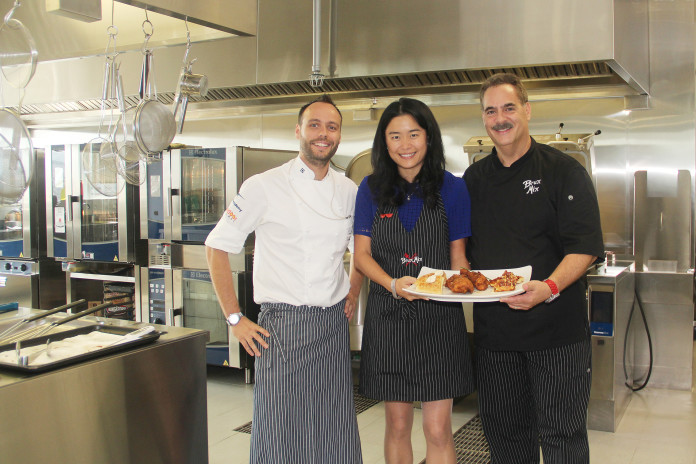
SINGAPORE: Small- and medium-size enterprises (SMEs) in Singapore are “truly blessed” with the support they receive from the Government, according to Helene Raudaschl, managing director of gourmet food supplier Indoguna Singapore.
“(If) you are in Hong Kong or Dubai and you want to go overseas, it’s not so easy. You’re all on your own. You’ve got to do all your research. You’ve got to do everything yourself because there is no such governmental assistance that you can tap on.”
Born and raised in Hong Kong, Raudaschl was exposed to the ins and outs of running a small company from a young age with her grandfather and mother running a food business. In the late 1990s, she moved to Singapore and joined Indoguna, which was set up in 1993 as an importer of premium chilled meat from all over the world.
The company has since expanded into product ranges such as sustainable seafood, fine food, boutique wines and cheeses, and its customers include top hotels and restaurants, gourmet shops, supermarkets and airline caterers. Under her leadership, Indoguna recently ventured into Qatar.
Indoguna was also the first company in Singapore to bring in live mussels and clams from Australia and the first to set up a fermentation room in Singapore to produce salami and air-dried meat.
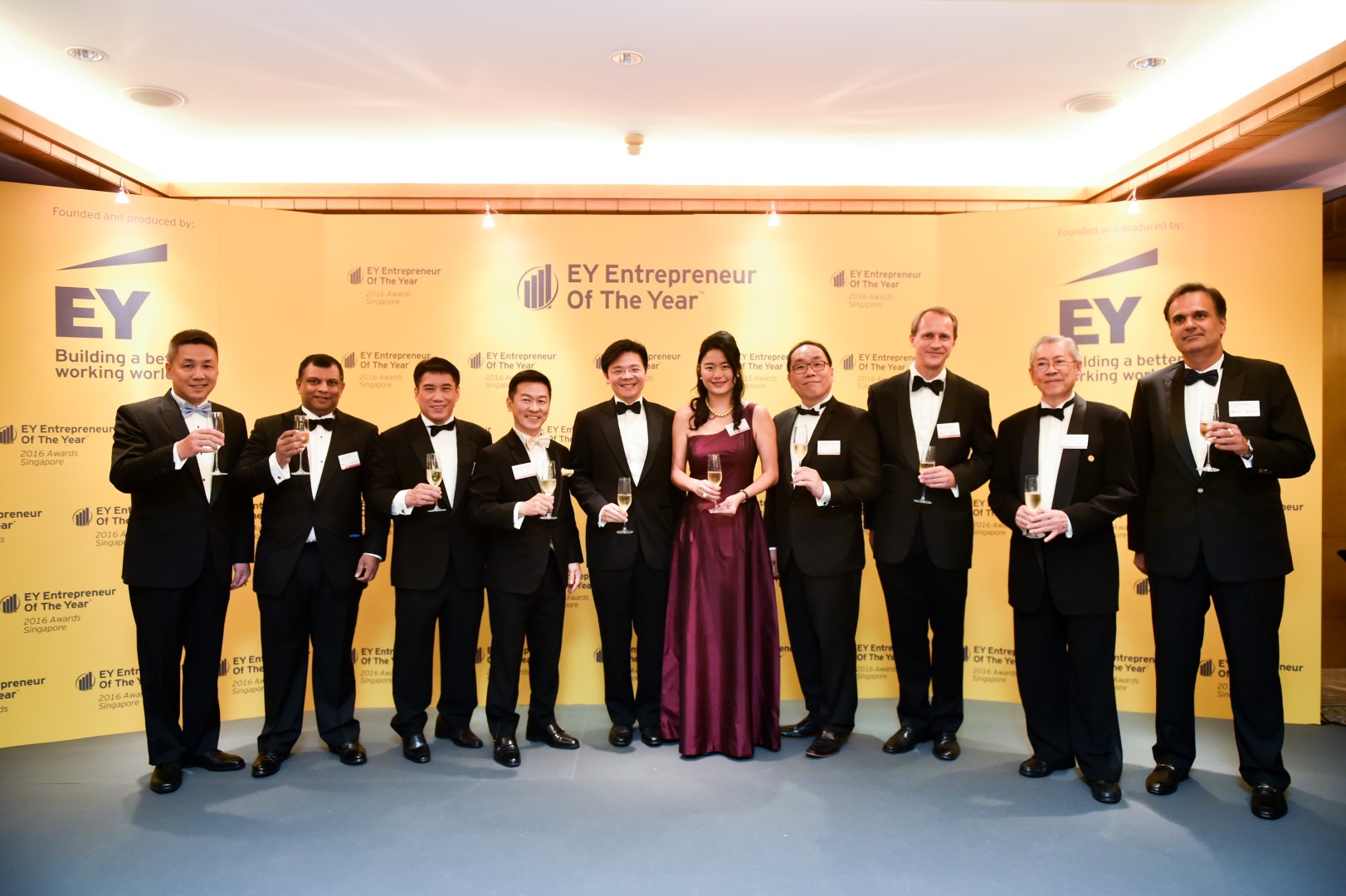
This year, Raudaschl was named EY (formerly Ernst & Young) Entrepreneur of the Year in the F&B distribution category. She goes On the Record with Bharati Jagdish about how she and her team achieved this and how her family shaped her love for food and business.
Helene Raudaschl: My grandfather – my mother’s father – was also in the food business in the 50s and 60s, and I guess the family tradition carried on. Food has been a very important part of the family and from young, my mum took my sister and me from the time we were five years old out to see customers, to see products. On the weekends, she would bring products from the office to show us lobsters, caviar, truffles. I think at that time, everything was very new even in Hong Kong.
It intrigued us because every weekend there was something new. I remember we had artichokes for the weekend and nobody in my friends’ circle knew what artichokes were then. Smoked salmon was an ultimate luxury a few decades ago and she always taught us to try new things and not be scared about the things you don’t know, to try them at least once. It was very interesting because we liked the flavours and we liked the excitement. Even today, when you open a bottle of wine that you don’t know, even if it’s the same label, a different year gives you a very, very different taste and that’s what interests me.
Bharati: What about the way your mother ran her business influences the way you run your business today?
Raudaschl: I remember she would never take “no” for an answer. She went through a lot to build what she built. In the 80s in Hong Kong, it was a very Chinese culture and it was very difficult for a woman to start a business on her own, let alone with two kids. I really admired her determination and perseverance to continue the journey even though it was extremely tough for her.
I have it easy compared to what my mom went through, not just from the business perspective, but the peer pressure, the culture, the family. She did it in spite of the Chinese culture then, which said a woman should stay at home. I don’t face that at all, but she really inspired me with her determination in spite of the challenges she faced. It really drives me to be the best in everything I do.
Bharati: Why did she do what she did in spite of the obstacles?
Raudaschl: Well, it’s something that she grew up with. When she was a teenager, she was already working in a food-related company. I understand it was an airline catering business providing food products with a mentor at that time. In fact, he was almost like my godfather and he’s Australian-Jewish. He was living in Hong Kong and started that business to cater food to the Vietnamese airlines until the war broke out and that operation stopped.
Subsequently, my mother joined this gentleman when he continued his business by setting up one of the first few food importing companies in Hong Kong. This was about 40 years ago. At that time, even raspberries were considered exotic. And at that time, smoked salmon was a luxury. You had to go to the best fine-dining restaurant to have a thin slice of smoked salmon. He passed away probably 12 or 15 years after they started the business together and she wanted to carry on his legacy. He had an extremely good reputation in the marketplace and I remember we would go to all the best hotels, best restaurants and they would be really welcomed by the chefs and general managers of the hotels. They were very important to the restaurants’ success because of the ingredients they were able to import into Hong Kong.
My mother really enjoyed the business and she already had a lot of relationships with customers and suppliers and the bottom line is, why put that to waste if you can continue that legacy. That’s why when he passed away, she actually went on to start her own business and take on all the suppliers and customers.
GLOBAL VISION
Bharati: Let’s talk about the strategies you employ today. Indoguna is a global SME. What exactly did it take to make it globally?
Raudaschl: For me, it’s really about having a vision and having that passion to do what I think the business could do and follow through with that direction, that mission, that vision, that goal. In our company we work more like a family business. We don’t focus overly on corporate structures and forecasts. We do have those things but at the core it’s really based on gut feelings and vision and say: “Look, I can see for myself that Indoguna can go to the Middle East. We can go to Hong Kong.” That’s the vision that I really see and we work towards getting to that ultimate goal based on that big vision.
We work towards having that dream realised by employing certain strategies. When we talk about strategies, if I open Indoguna in Singapore or I open Indoguna in Dubai or Abu Dhabi, actually the process doesn’t really change. All that changes is the government regulations, government requirements on how you run a business. But in terms of business strategy, and how we do our business, there’s no difference in how I run my business in Singapore or I run my business in the Middle East, it doesn’t change.
The business philosophy we have had since day one is about quality. We want to have the best quality product possible. By quality, I don’t mean luxurious things. I mean the best quality in whichever category or class, so even within the level of economy class, I want to provide the best quality in terms of value for money. That has always been number one. We stand by our products. It’s first about quality. And price always has to be relevant. We give our customers the best in what we can provide.
On the manufacturing side, we are applying more and more automation in terms of equipment. Definitely finding out about technology and equipment that can replace certain tasks and speed up the process of production is our continual effort. We are open to ideas especially in the digital age. We are thinking about how to process customer requests, orders, because our clients are multi-national. If you look at the cuisines in Singapore – that is the amount of nationalities we are dealing with all the time. Everybody’s orders, languages and so on are very different. So we’re thinking how we can do everything via smartphone, but because a lot of traditional chefs still don’t use computers, we still have to think about what is the easiest way that they can use the phone to check out a product or find out information or place an order.
Today, to accommodate this group, we still have fax machines in spite of technological advancements. Every morning, we still receive faxes through our fax machine from restaurants. In our environment, we have to accommodate. We’re not a business that stands there and says: “Look, this is what we do and you’ve got to follow us.” We go out and ask customers: “What do you need? We will accommodate your needs.” We recognise that everybody is different.
Bharati: Businesses in Singapore are going through a challenging period. What are the things you live by during times like these?
Raudaschl: I really believe in innovation and looking at different channels that you’ve never looked at before. Today, if you look at our business, we’ve changed so much in terms of channels of doing business. Even today, I believe that there are segments of our businesses that we have not even explored. I think in this day and age, your business has to be flexible, to be agile. That’s really the survival skill people need.
For example, in our business, we decided to create several brands so that we can be agile and flexible to accommodate market needs. Take a branded bag. In a not-so-great economy, I may not buy the bag. I’ll buy a Tier-2 brand. Some companies are not able to do that because they are only focused on premium branding. In our kind of business though, we need to continue monitoring the production numbers. So three years ago, I was only producing the premium brand. Today, I have to do second-, third- or fourth-tier branding in order to see healthy production numbers. So we have to be adaptable.
Bharati: This ability to be adaptable – how much more adaptable have you had to be in the last few years as compared to before?
Raudaschl: As a small company, we rely on our own funds and our own resources. Profits get re-invested. We make, invest, and the added challenge is that when we started in the 90s, things didn’t move that fast. At that time, when there was a new trend, it would last two to three years.
Today, product trends change super fast because of the speed of social media and the challenge of a small business is funding. In order for us to grow fast, we need a lot of funds. Cash flow is really a strong point. We can’t grow at the speed that MNCs and much larger companies can afford to grow, because we just don’t have the resources to double up, triple up every year. But if you see it as a marketplace, the F&B, tourism and the lifestyle scenes are doubling up, tripling up at speeds that you cannot imagine. If I look at our customers and partners for example, whether in Hong Kong, Singapore or Dubai, when they talk about expansion plans, they talk about opening 10 outlets in a year, another 20 outlets somewhere else in another two years. It’s so fast. For us, as an SME, that’s a challenge. Not just in terms of cash flow but building equipment so that you can be more productive to deliver to more markets. We have to be willing to invest to build. You don’t want to miss opportunities. So we look for new marketplaces.
In terms of going global, I think the biggest problem for us is really understanding culture. This takes time and always say that how much time you spend on something is how much reward or information you reap. I still have so much to understand about Qatar. All of our businesses are geared towards tourism in various markets, but we still have to understand the local culture – how they think, how they react. When I first went to the Middle East, people were questioning how a lady like myself could go to Middle East to do business. I have to say that so far I don’t feel anything as a woman businessperson compared to the men who are doing business in the Middle East. I always feel very welcomed. People are generally friendly, wanting to assist.
Bharati: And they respect businesswomen.
Raudaschl: They do. They are very respectful. But still, understanding the culture is the biggest thing. It’s not just about opening a business and making profits, or making the business grow. You need to understand the culture in order to get customers to want to work with you. For example, you need to understand the difference in pace. You go there and the pace is probably minus 20 times. And you just have to have the patience. You can get angry and frustrated and make all the complaints, but things will not change and in fact, you might damage your relationships with customers if you do that or pressure people. You just have to go at their pace.
I still remember the first time I applied for my work permit in Dubai. It took me four days. They don’t have what we have in Singapore where they give you a straight answer when you want to apply for an employment pass. In Singapore, they give you a whole list of things you need and then you submit them and wait. Over there, they’ll tell you one thing, then after submission, they’ll ask you for something else and you might say, “But it’s not on the list.” But you still have to get it. So it could go back and forth four days in a row.
In business, it’s the same. The banks and the importation rules. It has improved a lot I must say, but in the beginning, you will end up spending a lot of extra money because you will never know, for example, when your goods might get stuck in the seaport for an extra number of days because the rules have been changed suddenly. The rules change constantly and they don’t tell you straight away. Yes, it costs us a lot of extra in dealing with these things but the country is very new as well in terms of these things. In Dubai, in the early 2000s, it was all so new to them – the importation of the international products that we were bringing in. They had no idea what we’re bringing in. So it was the learning stage for them as well.
So these are the things that we have to bear with in an emerging market compared with us going into a very sophisticated market because those markets are very much matured in our kind of business. But they are saturated and that doesn’t allow me to shine as much as I can in emerging markets and that’s why in spite of the challenges, I like to go to markets that are very behind but have potential to grow. That’s why I went to Dubai in the early 2000s and Qatar which has the potential for us to grow in the next 10 years. But of course there are the sacrifices that I mentioned. There are all these downsides but these are the balances that we have to accept.
SINGAPORE FIRMS ARE “TRULY BLESSED”
Bharati: A lot of companies, SMEs in particular, feel a sense of apprehension when it comes to going overseas. What would you say to them?
Raudaschl: Well, I think we are in a very fortunate country. One of the things that Singapore gave me that no other country has, from my experience, is that the Government gives a lot of support to SMEs to go global. They give a lot of seminars, a lot of guidance and advice. The SMEs in Singapore are really truly blessed because let’s say, you are in Hong Kong or Dubai and you want to go overseas, it’s not so easy. You’re all on your own. You’ve got to do all your research. You’ve got to do everything yourself because there is no such governmental assistance that you can tap on, whereas in Singapore, you have IE Singapore, the Government is behind it, there’s lots of IT support which actually can give the SMEs a lot more confidence.
Of course, you’re still going to have to make it on your own. But at least there is some guidance. Somebody is watching over you. If you want to ask any questions, there will be someone you are familiar with, a Singapore association for example, to actually assist you and I think that’s really key. In terms of finding your path, of course, you’ve got to do your market research and be very agile. As an entrepreneur, you need to see opportunities yourself and take them. But the added good thing is that here, you’ve got the Singapore Government’s support.
Bharati: You’ve said that SMEs in Singapore are very blessed. However, considering the public discourse we are seeing, a lot of them don’t feel blessed enough. For example, many SMEs are grappling with manpower issues and the Government curbs on foreign manpower are making it all the more challenging. Do you think there are good reasons for SMEs to not feel all that blessed?
Raudaschl: I think that no country is perfect. I speak from my own experience. I really see that in my own experience – how blessed we are as an SME in Singapore. Some people might not agree and they might not be happy and they feel that it is not enough. The only thing I can say is that that’s based on their experience. In my experience, having worked in different countries in the world, I really feel, comparison to comparison, that Singapore has given its people and businesses a lot of support which you would never find anywhere else.
Remember the SARS crisis, the economic crisis? In our Hong Kong business, we had to drastically retrench because we couldn’t afford the expenses. In Singapore, we retrenched zero. Because the Government said, “I’m going to help you with your payroll.” We were able to go through those bad times and look forward to the good ones. The Government’s message was don’t retrench people because if you retrench people, these people will have nothing for the next whatever number of months or however long the crisis lasts. If people don’t have a job, they don’t spend money, they don’t take the bus, they don’t have lunch and the economy stops.
There’s no country in the world that would do that for their people and companies. The Europeans, Americans, Australians and even fellow Asians, my company in Hong Kong, my family – they were all so envious. If you look at other international companies, they probably have the same view as me because we have experienced it. We have experienced what it is like to do business in Hong Kong. We’ve experienced what it’s like in Dubai. When the crisis came in 2008, ’09, ’10, do you know what we got in those countries? Nothing from the government. We were on our own. We had to pump our own cash into the business to keep it from closing. If you look at Hong Kong, there was no government support.
Bharati: But then you end up stronger, more resilient.
Raudaschl: It depends on how you look at it. I believe it is the person him or herself who makes or breaks a business. There shouldn’t be an over-reliance on government anyway. The person is the leader and he or she changes the destiny and the future of any company. If he doesn’t have what it takes, even government support won’t help in the long run.
Bharati: Because government support can only go so far.
Raudaschl: Exactly, it’s not going help you come out of troubles altogether, but at least it’s going to assist you in uncertain times. If you look at government support, they also don’t support every company there is. You have to have a good track record, you have to have good company governance, you have to qualify for support. So you can’t just do nothing and get support. I’m sure there is complacency in Singapore just like everywhere else. But there are also hungry and ambitious people who look for opportunities themselves and succeed.
Bharati: Since you speak so fondly of Singapore, I wonder why you haven’t taken up citizenship yet. You are still a PR, but a few years ago, in a media interview, you did mention considering taking up citizenship. What’s holding that up?
Raudaschl: There are a few things to consider. My son is studying in the US and he wants to be a professional basketballer. So I don’t really know his direction. I’m just waiting to see what he wants to do before committing to big changes.
Bharati: Anything over the years that you would classify as a failure?
Raudaschl: There’s definitely quite a number. I wouldn’t say they were major failures. My character is: Make a mistake, rectify it and move on. If you ask me today to give you an example of a mistake I’ve made, I won’t be able to because I always move on quickly to look at the positive side of things.
Bharati: Many businesses say that the cost of doing business in Singapore can be rather high and with the other issues that we’re seeing now, manpower shortages etc., Singapore may not be such a good place to do business right now. Indeed this is partly why Singapore businesses are going overseas too. What do you think?
Raudaschl: I understand all that but Singapore is still stable, the currency is very stable, the Government is stable and it has got very good infrastructure and organisational capabilities. No country is 100 per cent perfect. Every place has challenges. It’s just different challenges. You can choose not to do business in Singapore if you’re not a Singaporean, if you’re not living here or if you don’t have family here. Fair enough. But I think that as a Singaporean, or a Singaporean PR where you have family, you have roots here, we should make the best out of this platform. It is a great base to have all your standards apply, your SOPs and your governance established and use this as a base to go overseas.
RESPECTING THE AUTHENCITY OF FOOD
Bharati: Over the years, you’ve also done quite a bit in terms of ethical consumption, sustainable seafood and so on. What are your plans in this arena?
Raudaschl: A lot of aspects of the food business are still very governed by certain countries. For example, we buy things from certain countries that have very strong sustainable organic and natural attributes like Australia and America. A lot of these countries are themselves governing those kinds of products so that there is a longevity to the product mix in terms of sustainability. Of course, in our marketplace, exotic products are very welcomed because of the level of restaurants and the chefs we have in Singapore. In Hong Kong and Dubai as well, the expectations are very high.
But we must find a balance too. We will not buy something that is going extinct. We also respect the seasons. For example, lot of people are now trying to recreate white truffles. White truffles are a seasonal thing. The season starts in the middle of October towards December. People try to replicate it to make truffles available all year round. But we will not do it because I want to respect the seasons. It’s the same with oysters. There are different seasons for different countries. We need to respect that. But now people create different breeding methods so that the oysters can be available all year round. It doesn’t make sense. Let’s not push nature.
Bharati: Since you’re in the business of food, what are your views on the emotive issue of Singapore heritage and hawker food – making it worthwhile for younger people to join the profession, ensuring that hawkers make profits cooking and selling quality hawker food while keeping it affordable to the masses.
Raudaschl: I think it’s very important to continue the tradition of Singapore, what people eat and what they enjoy. But the reality is that the hawker environment may not be really something that will last for a long time. It’s understandable because the younger generation are very well-educated and working in a hawker centre where it’s maybe a 4×4 and very hot may not be the way in the future. But if we could recreate business spaces based on the hawker store concept, it can be very successful as well. We’ve seen some examples. It could even be a chain of stalls. Can you imagine if you have a good laksa chain? It can also go overseas and this will inspire younger people to say, “Yeah, I can grow an empire out of this.”
Bharati: But even if the food is cooked in a central kitchen, it needs to be done well, authentically.
Raudaschl: Yes. Quality. Don’t cut corners. I know somebody who makes ramen and has a big chain. They still boil the soup stock for 20 hours. You can buy instant stocks now, but no, they boil their own from scratch. These are the things you need to adhere to. I believe that it is quite like our salami. We still use the traditional air-drying time method which can take up to 12 weeks. I hang one sausage for up to 12 weeks before I sell it. Imagine the amount of time and money I spend. I can cut it down by half by adding some things to the sausage, but I just don’t want to. It has to be original, follow the old timers’ methods to preserve the meat naturally.
But when it comes to local hawker food I also think that if you can have a corporate idea to make it healthier by using better oils, it would help as well. Even in the international space, people will love it.
Bharati: People need to be willing to pay for it though.
Raudaschl: I always say that eating is a big part of our lives. What’s the problem of spending a little bit more so that you ensure that what you’re putting in your body is beneficial? And while affordability is important, we also have to understand that quality food takes money. There should be a range of choices though so that there is something for everyone.
GIVING PEOPLE CHANCES
Bharati: What keeps you interested in what you do?
Raudaschl: Until today, I’m really driven by the fact that we can achieve something. Everyone has an aspiration of doing better and better in my team and I’m driven by that. I’m driven to see our people being successful, driven by the fact that customers are very satisfied with our product range, driven by the fact that I can open new markets where I never was able to before. Today, by adopting new platforms and new possibilities with our product mix, I can open up new markets like Qatar. We just started and it looks like a promising new market for us. These kinds of things really drive me.
Bharati: How do you keep the people you work with within your company interested as well?
Raudaschl: Innovation, developments, new projects – always have new things for them to aspire to. If you don’t have new things, everybody becomes stagnant. There are people who are happy to be stagnant, but there are a lot of people who still want more. If you look at our company, every year, we win some kind of important business award. This keeps everybody going. We’ve talked about a Dubai factory since 15 months ago. Everybody is excited about the product mix. We’re going to Qatar. We have new plans for 2017 and I think that the younger bunch, they already have some experience in our business and they aspire to look at where they will be in 10 years. They can see their career paths.
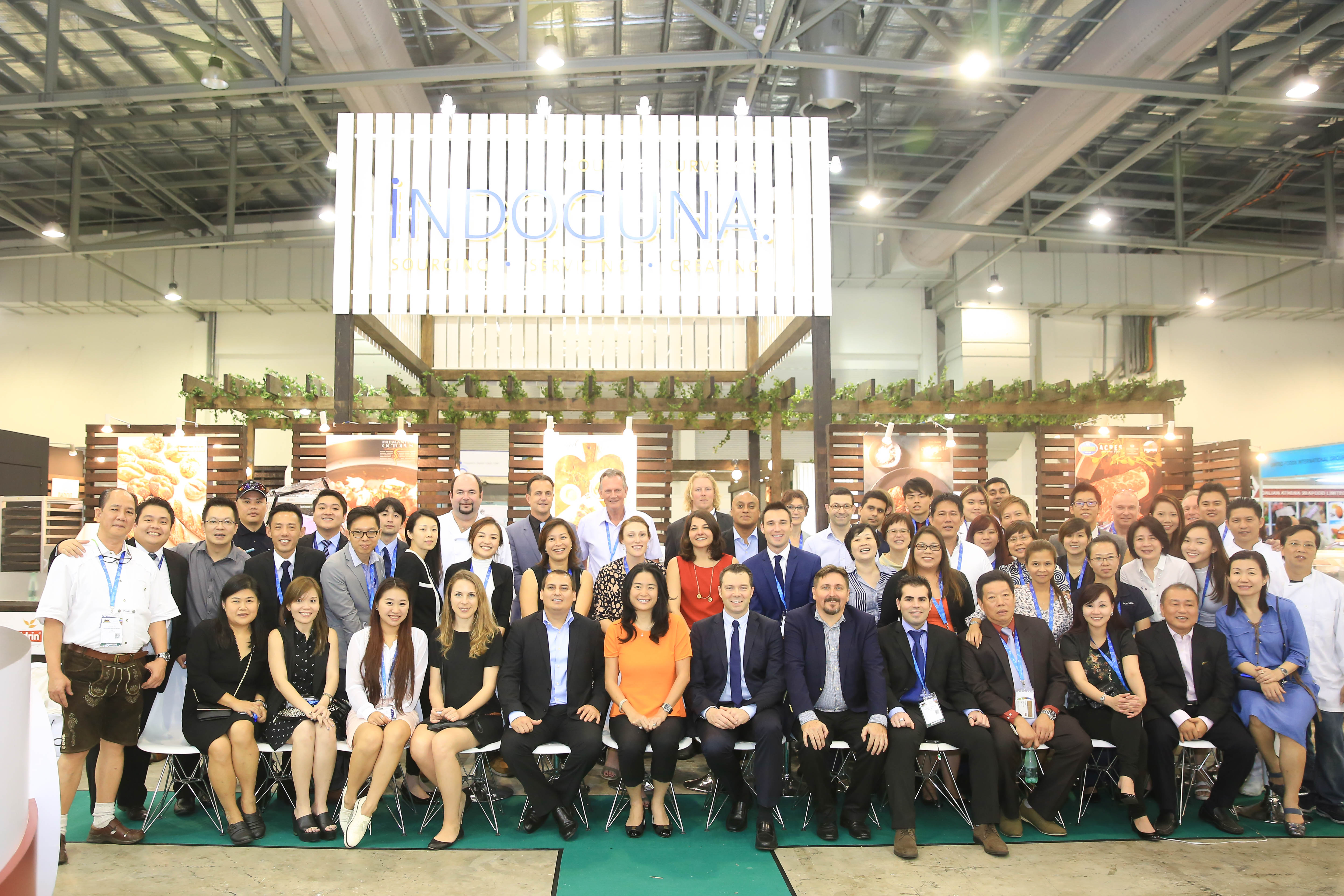
Helene Raudaschl with Indoguna employees.
I work closely with my team. I’m not the kind of leader who sits behind a desk and instructs. I’m really on the ground. I’m in the marketplace. I’m on the production floor. I’m very hands on. We share a lot of ideas and we encourage our people to give us new ideas. We have success in retaining talent because of this. We continuously provide training.
In fact, if you look at our business today, I can say that a number of employees have gone through many departments because that’s their path of career growth. They don’t get stuck somewhere for 10 to 20 years. They always have that growth opportunity if they want to learn different things, to grow in different areas. There are also employees in our business who have been working in the same department for 15 to 16 years and they grow within the department. They’re happy with that and they’re good at it, the point is if they want the opportunity to move, they can too. Always give them the chance to learn and do better for themselves.