Home Blog Page 2287

Singapore students top global benchmarking survey for maths, science again

0

SINGAPORE — Singapore students have once again proven their prowess in science and maths by topping the charts in one international benchmarking study released on Tuesday (Nov 29). 

Not only are they scoring well in these subjects, but compared to their global peers, Singapore pupils also have more positive attitudes towards learning these subjects and say they enjoy them, putting paid to the Education Ministry’s (MOE) efforts to reduce content and allow students to learn in a more active way.

In the latest Trends in International Mathematics and Science Study (TIMSS), Primary Four and Secondary Two students in Singapore outperformed their peers from 63 other countries in both maths and science. The Republic’s students have consistently done well in the study conducted every four years here since 1995, although the last time Singapore topped all four charts was in 2003.

MOE said the latest results also affirmed a trend that students today are better able to apply knowledge and skills, and solve non-routine math and science problems. 

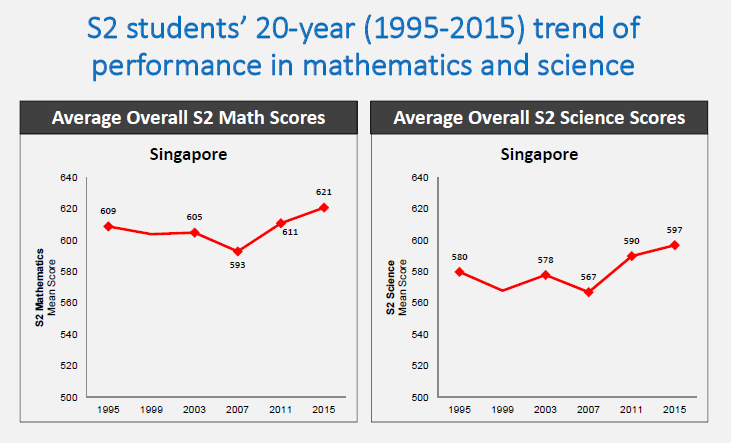
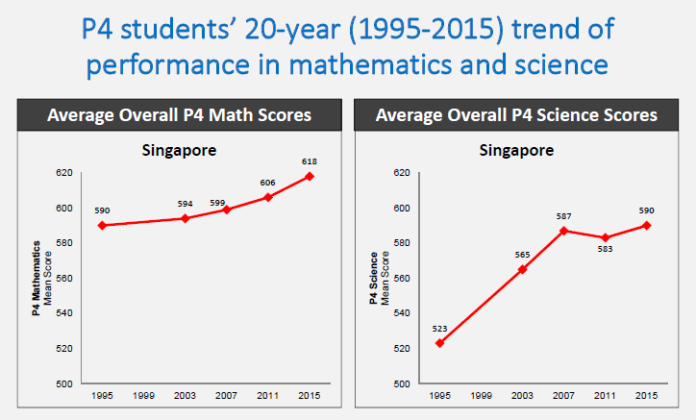
Comparing 2015’s results with 1995’s, the Primary Four pupils’ average score of their ability to understand, apply and reason went up from 590 to 618 in math, and from 523 to 590 in science, while Secondary Two students’ score rose from 609 to 621 in math, and from 580 to 597 in science. 
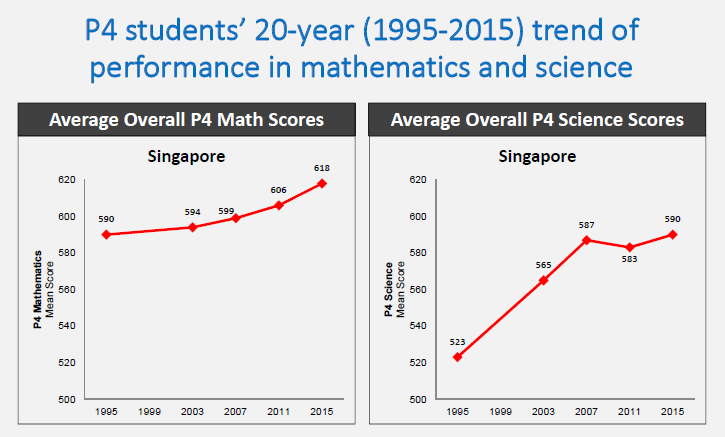
Coming in second and third for the Primary Four level are Hong Kong and South Korea in math, with their students scoring an average of 615 and 608 respectively, and South Korea and Japan in science, with 589 and 569 respectively. All scores are adjusted to a 500 scale average.

At the Secondary Two level, in math, South Korea and Chinese Taipei trail behind Singapore with average scores of 606 and 599. In science, Japan and Chinese Taipei take second and third place, with scores of 571 and 569.

The latest study involved about 6,500 randomly-selected Primary Four students and about 6,100 randomly-selected Secondary Two students across all Singapore schools. Altogether, more than 582,000 students, 250,000 parents and 51,000 teachers were roped in for the study internationally.

Syllabus changes, which saw two “massive rounds” of content reduction in 1998 and 2003, could have played a part in the improvements, said Ms Low Khah Gek, deputy director-general of education (schools). 

“The reason for content reduction is really to free up time, so that our teachers can teach differently, our students… can learn in a more active way, and be given more space to actually investigate, explore, as well as talk in class,” she said. 

While the study found very small proportions of students who are “low performers” in maths or science, Ms Low said that number is  “consistently tracked” to “see how we can enhance our learning support in order to make sure that our students really meet the baseline competencies needed for math and science”.

The study also revealed that students here have positive attitudes towards learning the two subjects, with 85 per cent and 88 per cent of Primary Four students said they enjoy learning math and science respectively – both are 1 percentage point higher than the international average.

On the other hand, 92 per cent and 91 per cent of Secondary Two students say they value the learning of math and science respectively, compared with the international average of 87 per cent and 81 per cent.


Source link

RSAF tests balloon system to enhance aerial and maritime security

0

SINGAPORE: The Republic of Singapore Air Force (RSAF) is testing a new system to enhance aerial and maritime security, announced the Ministry of Defence on Tuesday (Nov 29). 

The Aerostat is a tethered helium-filled balloon that’s attached with a 360-degree censor to monitor threats over Singapore’s air and sea space. 

It will complement the Singapore Airmed Forces’ (SAF) suite of sensors, to allow for “timely and decisive response to safeguard Singapore’s peace and security,” said MINDEF.

This is crucial as the island has many built-up areas which make it difficult for censors to monitor low-flying threats, said Defence Minister Ng Eng Hen who observed a testing of the aerostat system at Choa Chu Kang Camp on Tuesday.

“For small city states like Singapore, the need to put up defences must depend on layers of defence … we’ve procured this aerostat, and it adds another layer of defence and confidence in terms of what we are able to detect,” added Dr Ng.

The aerostat will have a clear line of sight over Singapore’s air and sea space. (Graphics: MINDEF)

Aerostat can fly as high as 600m – about three times the height of Swissotel The Stamford hotel – and can monitor threats as far as 200km beyond Singapore shores.

When fully operational, the 55m-long balloon will be able to provide round-the-clock monitoring. The data is processed at a ground station where the balloon is tied to.

MINDEF added that radiation emissions from the radar equipment on the aerostat will be as safe as that of mobile phones.

The aerostat has completed initial tests at the manufacturer’s facility in the United States and the tests at Choa Chu Kang Camp will go on for one year before it will be rolled out for use. 

Source link

PPAP shows ‘world peace and love’

0


Piko-Taro, who sang the viral hit, says songs do not need great meaning as long as they make people laugh and dance

The first thing you notice about Japanese singer Piko-Taro may not be the animal-print pyjamas he likes to wear or his drawn-on pencil moustache.

It may well be his height.

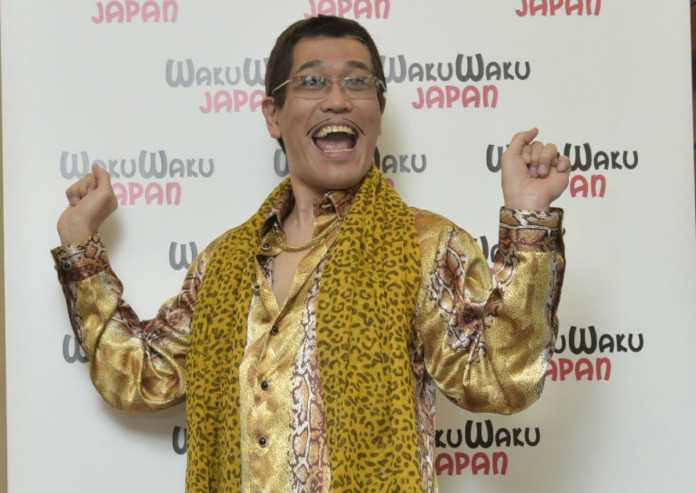
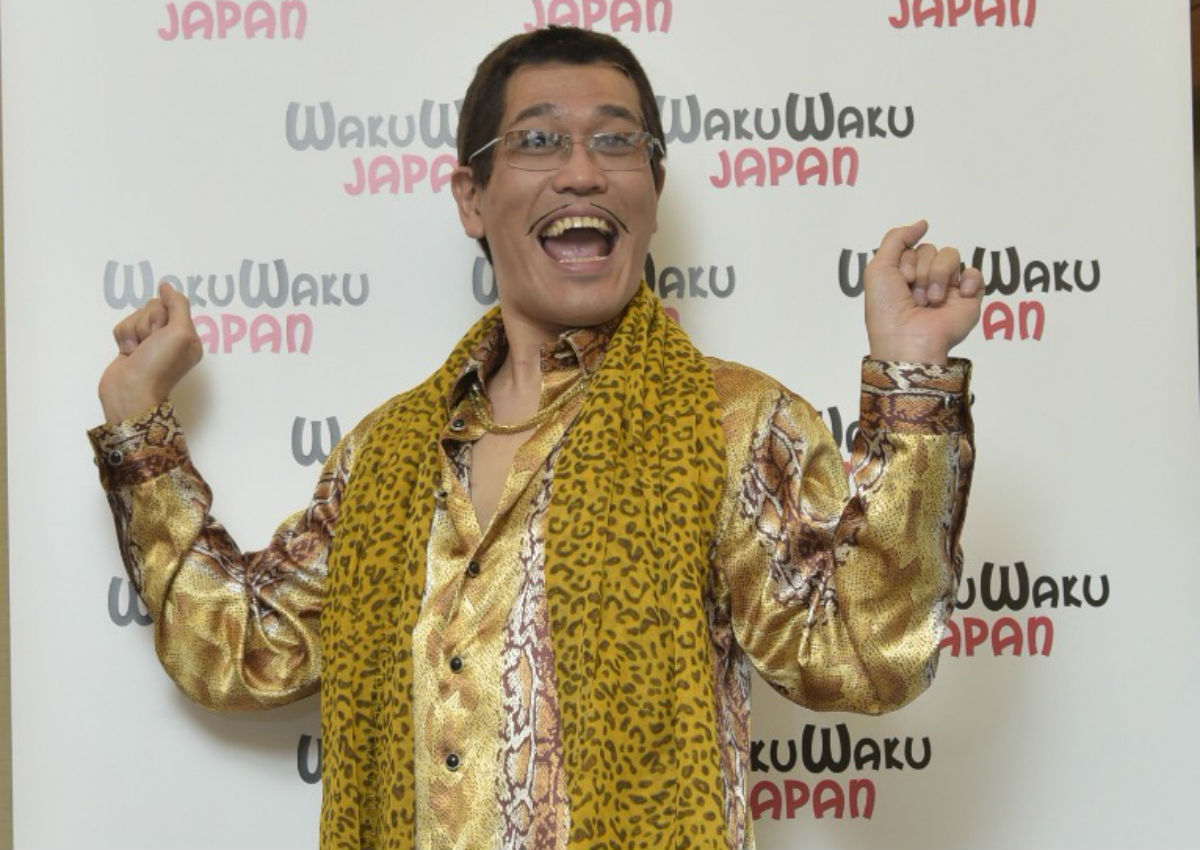
The 1.86m-tall funnyman behind viral hit PPAP (Pen-PineappleApple-Pen) swooped into Singapore on Sunday for a 20-minute appearance at the end of Anime Festival Asia Singapore.

Most people do not realise how tall he is, he says. “Usually you see me on a small screen, on YouTube,” he adds at a pre-performance media conference.

His height matches his towering success in the world of viral videos – since PPAP was uploaded in August, the 45-second song has racked up 92 million views on YouTube, been namechecked by Canadian pop star Justin Bieber and even scored a Guinness World Record for being the shortest song to chart on the US Billboard Hot 100 charts.

There are plans for him to release an album. One possible track on the album is his most recent song, the 56-second Neo Sunglasses, which bears his usual offbeat dance moves and lyrics, which are mostly the Japanese words for “dazzling” and “dark”.

A pop-up PPAP cafe opened in Tokyo earlier this month, serving food comprising apples, pineapples and even chocolate sticks or “pens”.

While some might dismiss his song and antics as silly (PPAP has 32 words and most of them are “apple”, “pen” and “pineapple”), Piko-Taro says his music carries big themes of world peace and love.

“A song is something that can make people smile. The lyrics don’t have to have great meaning. If it can make people laugh and dance, that gives it meaning,” he says, speaking through an interpreter.

Referring to the many people across the world who have made their own versions of PPAP – from Bollywood-style to beatboxing and ballads – he says: “I think why it went viral is because so many people have covered the song. It has become everyone’s song.”

Japanese TV channel Wakuwaku Japan brought him here to appear at the festival. He will also be featured in a music programme on the channel that will air on Dec 30.

Piko-Taro, the alter-ego of 53-year-old Japanese comedian Kazuhiko Kosaka, is charming and his energy infectious.

When he notices this reporter’s carefully chosen leopard-print dress, he says with wide eyes and in limited English: “Oh nice, like Piko-Taro!”

Asked to reveal something people might not know about him, he raises his right pant leg: “It’s the biggest secret I’ve never told any media – my shoe size is 29cm (US men’s 13).”

And touching his right forearm, he adds: “And another secret, I have very nice skin. Baby skin.”

He performed PPAP three times at Anime Festival Asia on Sunday.

If anyone was sick of the crazily catchy earworm, it did not show – the 2,500-strong crowd at Suntec Singapore Convention & Exhibition Centre sang, danced and laughed with Piko-Taro as he performed his hit song.

Besides the original version, he also performed the longer PPAP – a 2min 40s version with more lyrics and an R&B-style music segment designed to showcase his quirky dancing.

He declares tongue-in-cheek at the end: “The song is so short because I get tired. I’m still catching my breath.”


This article was first published on November 29, 2016.
Get a copy of The Straits Times or go to straitstimes.com for more stories.

Image:
Category:
Publication Date:
Tuesday, November 29, 2016 – 16:00
Keywords:
Send to mobile app:
Source:

Story Type:
Others

Source link

Asian flair in festive fare: Mulan the Musical

0

End the year with The Nutcracker set in Shanghai, Journey To The West retold in a Singapore setting and Mulan The Musical with familiar faces

The last weeks of the arts calendar are usually awash in festive cheer.

But it is not all Christmas jingles and portly men in red suits. Arts lovers can end their year with a rich spread of shows that run the gamut from East to West.

While Christmas favourites such as the Singapore Symphony Orchestra’s annual Christmas Concert remain an anticipated staple, there is a strong Asian flavour thrumming through the final weeks of 2016 too.

The Singapore Dance Theatre’s take on The Nutcracker, for one, comes with an Asian twist – it is set in pre-World War I Shanghai.

And Asian cultures collide in Ding Yi Music Company’s Of Music And Art: The Legend Retold. In it, the folktale of Singapore’s southern Sisters’ Islands is resurrected through a dazzling mix of Chinese chamber music, sand art and Javanese dance.

Iconic characters such as the legendary woman warrior Hua Mulan and the mischievous Monkey King will stalk the stage too.

For its traditional Christmas pantomime, theatre troupe Wild Rice whisks the 16th-century Chinese classic Journey To The West to Singapore, as a runaway orphan tries to find his way home to Jurong West from Haw Par Villa.

First staged in 2014, Monkey Goes West features wushu moves and a motley crew of recognisable characters, including the Monkey King and the ever-hungry Pigsy.

Meanwhile, another familiar classic springs to life at Resorts World Sentosa.

In Mulan The Musical – a Singapore adaptation of the sold-out Taiwanese production – the tale of a woman who disguises herself as a man to enlist in the army in place of her ailing father gets a comic and colourful reimagining.

This is the first year Resorts World Sentosa has picked an Asian tale for its year-end blockbuster. Last year, it took on Cinderella. Before that, it was Peter Pan.

Mr Khoo Shao Tze, vice-president of resort sales and entertainment, says: “The legendary tale of Mulan is familiar to audiences of all ages”.

Mandarin theatrical productions have traditionally been well-received by the local market, but we find that there is a dearth of them and hope to fill this void.

“In line with the year-end festive atmosphere, we also wanted to present something entertaining and light-hearted. So the staging of Mulan The Musical, a rambunctious new comedy, is a natural choice for us.”

Mulan The Musical

Caption: Television actress Ann Kok (above) plays Mulan’s pregnant elder sister.Photo Credits: Mulan The Musical Limited Liability Company

With Mulan The Musical, Ann Kok, a television veteran of more than 20 years, is relearning the ropes of being an actor.

It is, after all, relatively unfamiliar ground for the actress, whose first and last brush with theatre was in the 2009 musical, The Peranakan Ball.

But next month, she returns to the stage for a musical comedy based on the story of Hua Mulan, a woman who disguises herself as a man and enlists in the army to take her frail father’s place.

Kok, 43, who will play Mulan’s pregnant elder sister, says: “I’m hoping the audience will see me on another level, other than just a television actor. In the past, there was no television and people had to go to the theatre.

“Now, I’m going through the process of becoming a stage actor, to start from the basics again and fine-tune my performing skills.”

Besides learning to cope with the pressures of live theatre – there are, she points out, no second takes – she is also polishing up on fundamentals for her return to the stage, from her body language to her awareness of where she has to stand.

She is finding a renewed awe for blocking – or the positioning and movement of characters.

“It’s important because audiences don’t just see my face like they do on television,” she says. “They’ll be seeing me from head to toe throughout those two hours of performance.”

Another well-known face from Singapore television will also be making the leap from screen to stage for the musical, which runs at Resorts World Sentosa from Dec 16 to Feb 5.

Pierre Png, who plays the army’s company sergeant major, is taking a step outside his comfort zone – something he sees echoes of in Mulan’s story.

“It’s not only about her being filial or brave. But it’s also about her daring to dream and to dream big. Like a kite soaring up into the sky, we cannot be lazy and be afraid of changes,” says the 43-year-old, whose last foray into theatre was the whimsical Phua Chu Kang The Musical more than a decade ago.

“We need to get out of our comfort zone, be tough and be brave enough to go against the wind… Taking on this project has been my’going against the wind.'”

Resorts World Sentosa collaborated with Taiwan’s Tainaner Ensemble and Studio M to take Mulan The Musical outside Taiwan – where it had two sold-out runs in 2009 and 2011.

Audiences in Singapore can expect a fresh adaptation with dialogue infused with local humour and colloquialisms, as well as new scenes and songs.

The show – which will be performed in Mandarin with English surtitles – features more than 100 cast, creative and crew members; more than 85 sets of elaborate costumes; and almost 3,500kg of custom-made props and sets.

Taiwanese vocalists Li Chien-na and Lai Ying-ying will take turns performing as Mulan during the show’s run, while Chou Ting-wei, a finalist on Taiwanese singing competition One Million Star, plays Mulan’s love interest, the General.

For 31-year-old Li, Mulan’s male alter-ego Munan is a role she readily admits to identifying with.

“I’m quite tomboyish and that allows me to get into character easily,” she says.

Meanwhile Png, in describing his role of the army’s intimidating company sergeant major, pays cheeky homage to his own days in green.

“I immediately saw some similarities between this character and the warrant officers I encountered during my national service days,” he quips. “I truly love all of them, strict as they were. Their training made me tougher. This will be sort of a tribute to them.”

BOOK IT / MULAN THE MUSICAL

WHERE: Resorts World Theatre, Resorts World Sentosa, 8 Sentosa Gateway

WHEN: Dec 16 to Feb 5, 8pm

ADMISSION: $38 to $128 from Sistic (go to www.sistic.com.sg or call 6348-5555)

INFO: The show is rated Advisory 16 for mature content and coarse language.


This article was first published on November 29, 2016.
Get a copy of The Straits Times or go to straitstimes.com for more stories.

Image: 
Publication Date: 
Tuesday, November 29, 2016 – 16:00
Keywords: 
Send to mobile app: 
Source: 


Story Type: 
Others

Source link

Japan’s anime power

0


The country hopes to use the global attraction to its manga and anime to help draw tourists, whose numbers the Abe administration ambitiously hopes will swell to 40 million by 2020.

As the curtains fell on the Rio Olympic Games, one man stood out as the biggest star of the moment: Super Mario. Or rather, his alter ego, Japan’s Prime Minister Shinzo Abe.

The second Mr Abe appeared on stage with the video game character’s trademark red cap and red ball, the audience inside Rio’s Maracana Stadium – and the Internet – went wild.

Within minutes, Mr Abe’s impersonation of the popular Nintendo game character reached all corners of the world via social media. So did the hashtag #tokyo2020.

The adulation underscores the global appeal of Japan’s soft power, much of it projected through manga and anime.

“Japanese anime has now become a global phenomenon and seemed a natural thread for the presentation show,” Ms Hikariko Ono, spokesman of the Tokyo 2020 organising committee, told The Straits Times.

Japanese authorities now want to tap this soft power for tourism, amid an ambitious drive by the Abe administration to double burgeoning foreign tourist arrivals to 40 million by 2020.

Tourist spending is expected to increase from 3.4 trillion yen (S$45 billion) last year, when the country drew nearly 20 million visitors, to eight trillion yen in 2020.

In September, leading manga and video game and publishing company Kadokawa, Japan Airlines and JTB, Japan’s largest travel agency, launched the Japan Anime Tourism Association (Jata).

It marks the first concerted effort by industry players to attract more foreign visitors to Japan through anime tourism.

The outfit’s very first initiative is to create the country’s first anime/manga “pilgrimage” route featuring sites across Japan used in the most popular tales.

Anime and manga fans around the world can recommend their favourite spots online at: animetourism88.com/en.

Jata will draw up the final 88-destination route based on fans’ input and in consultation with local governments, anime and manga creators, and tourism industry players, Mr Fumiyuki Kakizawa, Jata’s deputy secretary-general, told The Straits Times.

A preliminary pilgrimage route is expected to be up and running early next year, he said.

“I think it’s important for us to create such a route for non-Japanese visitors to visit sacred sites of anime,” he said through an interpreter.

The association, working with industry members and local governments, wants to create a whole suite of services and products, from shuttle buses to merchandising, to boost the experience for visitors – and bring in the yen.

“Just taking photos is not so interesting,” said Mr Kakizawa.

“If visitors can put on the characters’ costumes, eat the candies eaten by the main characters, they will have done something interesting and exciting in Japan and hopefully come back.”

Anime tourism, to be sure, has been popular for years, part of the domestic anime industry which in 2014 was worth 1.63 trillion yen, according to the latest data provided by the Japan External Trade Organisation (Jetro).

Yet the anime tourism market is relatively untapped and has much growth potential, he added.

Anime – short for animation in Japanese – accounts for only 1.4 per cent of the estimated US$17 billion (S$24 billion) global market.

Manga, or comics, has a 24.1 per cent share of the US$6 billion global pie, according to Jetro.

Currently, only 9 per cent of inbound visitors say they visit Japan for its pop culture, including anime and manga.

Jata’s surveys in Akihabara, Tokyo’s haven for anime/manga lovers, show that most foreign tourists do not know how to get to most anime sites, said Mr Kakizawa.

Currently, tourists travel to Saitama prefecture, just next to Tokyo, to see the birthplace of the much-loved Crayon Shin-chan.

Further south, Tottori prefecture touts a “Conan Town” filled with billboards, statues and a train dedicated to the popular Detective Conan.

In Tokyo, Ghibli Museum and Gundam Front are must-see destinations for anime and manga fans.

But these fans are, by and large, Japanese, said Mr Kakizawa.

“Anime and manga have fans all over the world – Singapore, for example, has hosted the Anime Festival Asia every year since 2008. It is these fans that we want to attract,” he said.

Singaporean anime fan Tan Mei Lin says she can’t wait for the anime “pilgrimage” route to be ready.

The 26-year-old teacher grew up watching Doraemon and Dragon Ball.

Her current favourites are One Punch Man, a superhero satire, and Assassination Classroom, a science fiction anime featuring a monster-turned-teacher.

“If there is a chance to visit the sites then (I) definitely must go,” she told The Straits Times.

The Japanese government also hopes more inbound tourists can help revitalise ageing local prefectures.

“Up to a third of Japan’s regions are seeing their population shrink as young people leave for the big cities, said Mr Mamoru Kobori, executive vice-president of the Japan National Tourism Organisation.

“As domestic tourism is expected to slow down, we have shifted focus to inbound tourism.”

That plan is likely to gain traction, going by the success of hit movie Kimi No Na Wa (Your Name).

Since its release in late August, the feature-length animated movie about two body-swapping teenagers has earned more than 18 billion yen in Japan as at Nov 7.

It is currently showing in Singapore and dozens more countries.

The backdrop of a scene in the film, a train station in the town of Hida – some 300km west of Tokyo – has been drawing up to 40 fans a day since August, Japanese media reported.

Other sites, including a shrine in Shinjuku, Tokyo, have also become popular.

Ms Tan, the Singaporean anime fan, says she would love to visit Lake Suwa in Nagano, another stage for Your Name.

Officials, however, concede that much remains to be done to make Japan more foreigner-friendly.

A lack of English-speaking staff and signage as well as insufficient hotels and inns are the two most pressing issues.

“We need local governments, restaurants and hotels to be proactive (in welcoming foreign visitors),” said Mr Kakizawa.

But for all the effort to promote the new, many foreign tourists like the country just the way it is.

Mr Geoffray Fortin, a 30-year-old French tourist, says he likes Japan for its “very interesting culture”.

“It can be very futuristic in one place, then in the next district it’s all temples and other traditional stuff,” he told this reporter as he looked at the robots displayed at Gundam Front in Tokyo.


This article was first published on November 29, 2016.
Get a copy of The Straits Times or go to straitstimes.com for more stories.

Image:
Category:
Publication Date:
Tuesday, November 29, 2016 – 15:19
Keywords:
Send to mobile app:
Source:

Story Type:
Others

Source link

Japan’s anime power

0


The country hopes to use the global attraction to its manga and anime to help draw tourists, whose numbers the Abe administration ambitiously hopes will swell to 40 million by 2020.

As the curtains fell on the Rio Olympic Games, one man stood out as the biggest star of the moment: Super Mario. Or rather, his alter ego, Japan’s Prime Minister Shinzo Abe.

The second Mr Abe appeared on stage with the video game character’s trademark red cap and red ball, the audience inside Rio’s Maracana Stadium – and the Internet – went wild.

Within minutes, Mr Abe’s impersonation of the popular Nintendo game character reached all corners of the world via social media. So did the hashtag #tokyo2020.

The adulation underscores the global appeal of Japan’s soft power, much of it projected through manga and anime.

“Japanese anime has now become a global phenomenon and seemed a natural thread for the presentation show,” Ms Hikariko Ono, spokesman of the Tokyo 2020 organising committee, told The Straits Times.

Japanese authorities now want to tap this soft power for tourism, amid an ambitious drive by the Abe administration to double burgeoning foreign tourist arrivals to 40 million by 2020.

Tourist spending is expected to increase from 3.4 trillion yen (S$45 billion) last year, when the country drew nearly 20 million visitors, to eight trillion yen in 2020.

In September, leading manga and video game and publishing company Kadokawa, Japan Airlines and JTB, Japan’s largest travel agency, launched the Japan Anime Tourism Association (Jata).

It marks the first concerted effort by industry players to attract more foreign visitors to Japan through anime tourism.

The outfit’s very first initiative is to create the country’s first anime/manga “pilgrimage” route featuring sites across Japan used in the most popular tales.

Anime and manga fans around the world can recommend their favourite spots online at: animetourism88.com/en.

Jata will draw up the final 88-destination route based on fans’ input and in consultation with local governments, anime and manga creators, and tourism industry players, Mr Fumiyuki Kakizawa, Jata’s deputy secretary-general, told The Straits Times.

A preliminary pilgrimage route is expected to be up and running early next year, he said.

“I think it’s important for us to create such a route for non-Japanese visitors to visit sacred sites of anime,” he said through an interpreter.

The association, working with industry members and local governments, wants to create a whole suite of services and products, from shuttle buses to merchandising, to boost the experience for visitors – and bring in the yen.

“Just taking photos is not so interesting,” said Mr Kakizawa.

“If visitors can put on the characters’ costumes, eat the candies eaten by the main characters, they will have done something interesting and exciting in Japan and hopefully come back.”

Anime tourism, to be sure, has been popular for years, part of the domestic anime industry which in 2014 was worth 1.63 trillion yen, according to the latest data provided by the Japan External Trade Organisation (Jetro).

Yet the anime tourism market is relatively untapped and has much growth potential, he added.

Anime – short for animation in Japanese – accounts for only 1.4 per cent of the estimated US$17 billion (S$24 billion) global market.

Manga, or comics, has a 24.1 per cent share of the US$6 billion global pie, according to Jetro.

Currently, only 9 per cent of inbound visitors say they visit Japan for its pop culture, including anime and manga.

Jata’s surveys in Akihabara, Tokyo’s haven for anime/manga lovers, show that most foreign tourists do not know how to get to most anime sites, said Mr Kakizawa.

Currently, tourists travel to Saitama prefecture, just next to Tokyo, to see the birthplace of the much-loved Crayon Shin-chan.

Further south, Tottori prefecture touts a “Conan Town” filled with billboards, statues and a train dedicated to the popular Detective Conan.

In Tokyo, Ghibli Museum and Gundam Front are must-see destinations for anime and manga fans.

But these fans are, by and large, Japanese, said Mr Kakizawa.

“Anime and manga have fans all over the world – Singapore, for example, has hosted the Anime Festival Asia every year since 2008. It is these fans that we want to attract,” he said.

Singaporean anime fan Tan Mei Lin says she can’t wait for the anime “pilgrimage” route to be ready.

The 26-year-old teacher grew up watching Doraemon and Dragon Ball.

Her current favourites are One Punch Man, a superhero satire, and Assassination Classroom, a science fiction anime featuring a monster-turned-teacher.

“If there is a chance to visit the sites then (I) definitely must go,” she told The Straits Times.

The Japanese government also hopes more inbound tourists can help revitalise ageing local prefectures.

“Up to a third of Japan’s regions are seeing their population shrink as young people leave for the big cities, said Mr Mamoru Kobori, executive vice-president of the Japan National Tourism Organisation.

“As domestic tourism is expected to slow down, we have shifted focus to inbound tourism.”

That plan is likely to gain traction, going by the success of hit movie Kimi No Na Wa (Your Name).

Since its release in late August, the feature-length animated movie about two body-swapping teenagers has earned more than 18 billion yen in Japan as at Nov 7.

It is currently showing in Singapore and dozens more countries.

The backdrop of a scene in the film, a train station in the town of Hida – some 300km west of Tokyo – has been drawing up to 40 fans a day since August, Japanese media reported.

Other sites, including a shrine in Shinjuku, Tokyo, have also become popular.

Ms Tan, the Singaporean anime fan, says she would love to visit Lake Suwa in Nagano, another stage for Your Name.

Officials, however, concede that much remains to be done to make Japan more foreigner-friendly.

A lack of English-speaking staff and signage as well as insufficient hotels and inns are the two most pressing issues.

“We need local governments, restaurants and hotels to be proactive (in welcoming foreign visitors),” said Mr Kakizawa.

But for all the effort to promote the new, many foreign tourists like the country just the way it is.

Mr Geoffray Fortin, a 30-year-old French tourist, says he likes Japan for its “very interesting culture”.

“It can be very futuristic in one place, then in the next district it’s all temples and other traditional stuff,” he told this reporter as he looked at the robots displayed at Gundam Front in Tokyo.Anime Festival Asia 2016

Category:
Publication Date:
Tuesday, November 29, 2016 – 15:19
Keywords:
Send to mobile app:
Source:

Story Type:
Others

Source link

Japan singer calls police to report spying, is arrested

0

TOKYO – Fallen Japanese pop star Aska has been arrested on drugs charges after calling police to tell them he was being spied on at home by a hidden camera, police and reports said Tuesday.

The singer – one half of folk rockers Chage and Aska – was slurring on the call when he insisted he was being watched, Jiji Press and other media said.

Police who visited his Tokyo home on Monday arrested the 58-year-old on suspicion of using stimulants and MDMA, a force spokesman told AFP.

Aska was given a three-year prison term, suspended for four years, in December 2014 for possession and use of the same drugs.

Narcotics are heavily regulated in Japan and the police make much of high-profile arrests.

Writing on his blog, Aska denied reports that a police urine test had come up positive for drug use, saying the result was “not positive. It’s 100 per cent impossible.” Chage and Aska made their musical debut in 1979 and remain hugely popular in Japan and other parts of Asia including Singapore, Hong Kong and Taiwan.

Read also: Japan singer Aska guilty of drug use

Japan singer Aska guilty of drug use

Image: 
Category: 
Publication Date: 
Tuesday, November 29, 2016 – 15:07
Keywords: 
Send to mobile app: 
Source: 


Story Type: 
Others

Source link

South Korea Park to address nation over scandal

0


SEOUL – South Korean President Park Geun-Hye will address the nation over a snowballing influence-peddling scandal on Wednesday, her spokesman said, as Seoul lawmakers stepped up efforts to impeach her.

The televised address – Park’s third over the scandal that has engulfed her presidency – will be made at 0530 GMT Wednesday, her spokesman said without elaborating further.

Meanwhile, a sufficient number of ruling party lawmakers joined the three opposition parties in endorsing a motion to remove the president from office, lawmakers said.

“We plan to have the impeachment passed (by parliament) this week”, floor leader Woo Sang-Ho of the main opposition Democratic Party was quoted as saying by Yonhap news agency.

Woo’s counterpart in the second largest opposition People’s Party, Park Jie-Won also said the impeachment motion would be passed on Friday.

Massive weekly protests have been intensifying over the past month, with up to 1.5 million people braving freezing temperatures in Seoul Saturday to demand Park’s resignation, according to organisers.

Park’s justice minister and a senior advisor have both stepped down, while even staunch supporters from within the president’s ruling Saenuri Party have joined calls for her departure.

Park has issued public apologies over the scandal involving her long-time confidante Choi Soon-Sil, who has been arrested for fraud and abuse of power, but has defied repeated calls to resign.

Choi is also accused of interfering in government affairs, despite holding no official position.

The 60-year-old allegedly leveraged her relationship with Park to coerce donations from conglomerates, including SK, Lotte and Samsung, to non-profit foundations which she set up and used for personal gain.

Park had promised to submit herself to a judicial probe, as well as a separate investigation by an independent special prosecutor to be appointed by parliament.

But she backtracked, with her lawyer rejecting a series of requests by prosecutors to make herself available for questioning.

Her approval ratings have plunged to a record low for a sitting president as top advisers and some of South Korea’s most powerful companies are caught up in the ever-widening scandal.

The headquarters of SK, Lotte and Samsung were raided by state prosecutors last week along with the offices of the finance ministry and state pension fund.

If parliament passes the impeachment motion, Park would immediately be suspended from official duties and her prime minister would take over as an interim head of government.

The Constitutional Court could take as long as six months to decide whether to approve the impeachment.

Read Also:
“My heart is breaking”, says South Korean President Park Geun-hye in tearful apology
What to know about South Korean President Park Geun Hye’s influence-peddling scandal

Image:
Category:
Publication Date:
Tuesday, November 29, 2016 – 15:03
Send to mobile app:
Source:

Story Type:
Others

Source link

POSB offers 1.38% p.a. for 4 months when you deposit fresh funds with no minimum required from 28 Nov – 15 Dec 2016

0

POSB’s fresh funds deposit promo is back! Get 1.38% p.a. bonus interest with a 4-mth deposit – no minimum deposit required

POSB offers 1.38% p.a. for 4 months when you deposit fresh funds with no minimum required from 28 Nov – 15 Dec 2016

Get 1.38% p.a. interest for 4 months! Earn higher interest with the new POSB Fresh Funds Account promotion valid from 28 November 2016 to 15 December 2016, Capped at S$50,000, with no minimum amount required.

Source

Singapore tops Asia in per capita returns from infrastructure

0

Singapore generates the highest built-asset income per person in Asia, at US$35,900(S$51,185.62), according to the Global Built Asset Performance Index by design and consulting firm Arcadis.

The index is designed to understand how built assets can power more growth to economies by examining the income generated by buildings and infrastructure (for example, roads, airports, power plants, malls, railways, ports) across 36 countries and comparing it to the size of the economy measured by gross domestic product (GDP) as well as per-capita incomes.

In Singapore’s case, the study found that historically, the Republic has enjoyed a steady increase in returns on built assets per capita, although this growth has plateaued.

It said: “High savings rates were ploughed into productive investments that created a strong manufacturing hub, which resulted in Singapore steadily moving up the value chain. Now competing in some of the most high-value knowledge industries, reliance on built assets is slightly reduced, though it retains some of its high-tech manufacturing.”

It added that Singapore’s economic growth, which includes investment in both built and intangible assets, is certainly slowing.

“It may be difficult for the country to keep up its current rates in a world of lower trade growth and where the regional engine, China, has moved into a lower gear. However, the resilience of Singapore’s economic growth over decades has been remarkable and so only a slight reduction is expected.”

Last week, the Singapore government said it sees 2017’s growth at a modest pace of 1-3 per cent, mirroring its earliest forecast for 2016, amid a backlash against globalisation.

The Arcadis report noted: “This optimism in the strength of the economy is shown through new smart infrastructure and urban development projects such as the new Central Business District in Jurong, into which the country is investing heavily”.

Integral to the new Central Business District will be the Singapore terminus for the High Speed Rail to Kuala Lumpur in neighbouring Malaysia.

“There continues to be significant investment in Singapore’s Changi Airport, with the new Terminal 4 under construction, and plans for both the new Terminal 5 and a third runway, which will double passenger capacity from the current 66 million to 135 million by 2025.”

Girish Ramachandran, head of business advisory, South-east Asia at Arcadis, said: “It is evident that Singapore is keen to continue building new, smart and value-worth assets, and paying greater attention to maximising the productivity and performance of existing assets for the long term.”

Governments around the world develop infrastructure not just to improve the quality of life for their citizens, but also to generate better returns for the economy.

Across the world, a total of US$36 trillion of GDP was generated from the built environment in 2016, an increase of US$3 trillion from 2014.

Singapore’s total built asset returns is US$204 billion in 2016, up 3 per cent from US$198 billion in 2014.

Its built assets makes up about 45 per cent of GDP. Globally, it has the third highest built asset returns per capita, after Qatar and the United Arab Emirates.

Qatar has overtaken Singapore as the leading country in built asset returns per capita with an average of US$66,300, showing the former’s success in economic diversification away from hydrocarbons.

After Singapore, the economies with the highest built-asset income per person in Asia are Hong Kong, Japan, Malaysia, South Korea, Thailand, China, Indonesia, the Philippines and India – in this order


This article was first published on November 29, 2016.
Get The Business Times for more stories.

Publication Date: 
Tuesday, November 29, 2016 – 16:00
Send to mobile app: 
Source: 


Story Type: 
Others

Source link