Home Blog Page 2261

Homeland tales win big at Silver Screen Awards

0


Stories of uneasy relationships with one’s homeland won major prizes at last night’s Silver Screen Awards organised by the Singapore International Film Festival.

Clinching two awards was Bangladeshi film Live From Dhaka, which won for Best Performance and Best Director in the Asian Feature Film Competition.

It is director Abdullah Mohammad Saad’s debut feature film, about a partially handicapped man who lives his life in anguish while plotting ways to leave Dhaka, the capital of Bangladesh.

Also in the Asian Feature Film Competition, White Sun by Nepali director Deepak Rauniyar won Best Film. The 87-minute film tells the story of a Maoist guerilla who returns home to bury his father, and his struggle to reconcile with his wife.Actor Simon Yam, X Factor Australia’s Natalie Ong among stars at Silver Screen Awards

Held at Marina Bay Sands, the Silver Screen Awards honours excellence in film-making in Singapore and the region.

Singaporean filmmaker Liao Jiekai, 32, won Best Director in the South-east Asian Short Film Competition. Cinemovement, a group of dance and film artists, approached him to collaborate on the evocative dance-inspired 12-minute film The Mist. The work features two women who recollect sounds and images from places in their shared memories.

Another winner in the same competition category was Singaporean filmmaker Chiang Wei Liang, 29, who received the Best Singapore Short Film award for Anchorage Prohibited, which features two migrant workers in Taiwan with a child and no money, and their quest to get employed.

The Best South-east Asian Short Film award went to Indonesian film In The Year Of Monkey by Wregas Bhanuteja. In the 16-minute film, protagonist Diah is desperate for money and seeks help from her friend Jarwo by selling a matchstick for 10,000 rupiah.

Two veterans in Asian cinema were also lauded at the ceremony.

Hong Kong film director Fruit Chan, 57, received the Honorary Award, which recognises individuals who have made exceptional and enduring contributions to Asian cinema.

Hong Kong actor Simon Yam, 61, got the Cinema Legend Award, for Asian actors and their outstanding achievements in bringing Asia’s story to life on screen.

He said in a mix of English and Mandarin: “With this legend award I cannot retire, and I won’t. I will continue making movies for my daughter who is almost 12 years old. I’ve done many movies with police, and gangsters, which are not very suitable for her. I want to do more light-hearted comedies for her.”


This article was first published on Dec 04, 2016.
Get a copy of The Straits Times or go to straitstimes.com for more stories.

Image:
Category:
Blurb:
<p>Stories of uneasy relationships with one’s homeland won major prizes at last night’s Silver Screen Awards organised by the Singapore International Film Festival.</p>
Publication Date:
Sunday, December 4, 2016 – 14:33
Keywords:
Send to mobile app:
Source:

Rotator Headline:
Actor Simon Yam and X Factor Australia’s Natalie Ong among stars at S’pore’s Silver Screen Awards
Rotator Image:
Story Type:
Others

Source link

Sunshade which dislodged in Tampines had no reinforcement bars on one side: BCA report

0

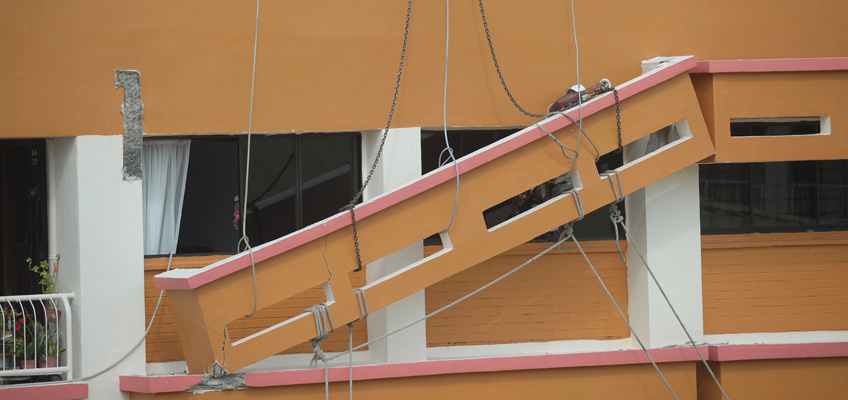
SINGAPORE – Two months after a concrete sunshade on the fourth floor of a Tampines block fell onto the sunshade on the third storey, the Building and Construction Authority (BCA) has found that other existing sunshades at Block 201E Tampines Street 23 and its surrounding blocks are safe.

For the affected sunshade at the incident block, the engineers’ investigations confirmed that the side that had dislodged had no reinforcement bars (rebars).

In a statement on Dec 4, BCA said it had earlier directed Tampines Town Council to engage a professional engineer to carry out a detailed investigation, following the incident on 25 September 2016.

The conclusion was that the sunshade dislodged because of the way it was constructed and not due to structural design.

Additional checks on similar sunshades in the precinct were also conducted.

These include ultrasound scanning checks, conducted by an independent accredited testing laboratory. The ultrasound checks showed that reinforcement bars were detected in all existing sunshades at Block 201E and surrounding blocks.

To further verify the findings from the ultrasound checks, the professional engineer, in the presence of BCA engineers, carried out sampling checks by removing a strip of concrete cover to expose the rebars to establish the number and size of rebars.

“These checks confirmed that the existing sunshades are adequately supported on the columns and are safe,” said the BCA.

BCA said it also conducted an independent assessment of the findings and concurs with the PE’s conclusions.

candicec@sph.com.sg

Image: 
Category: 
Publication Date: 
Sunday, December 4, 2016 – 14:32
Keywords: 
Send to mobile app: 
Source: 


Story Type: 
Others

Source link

Help from a stranger turns her life around

0

Things were looking bleak but a chance meeting with a stranger helped Ms Jaycie Tay, who was twice incarcerated and dropped out of school, defy the odds to achieve a diploma. And the 32- year-old twice-divorced mother of four is now gunning for a degree, as well as a brighter future.

It was late 2013 and Ms Tay had attended a course funded by the Government and a halfway house earlier in the day. She was training to be a florist.

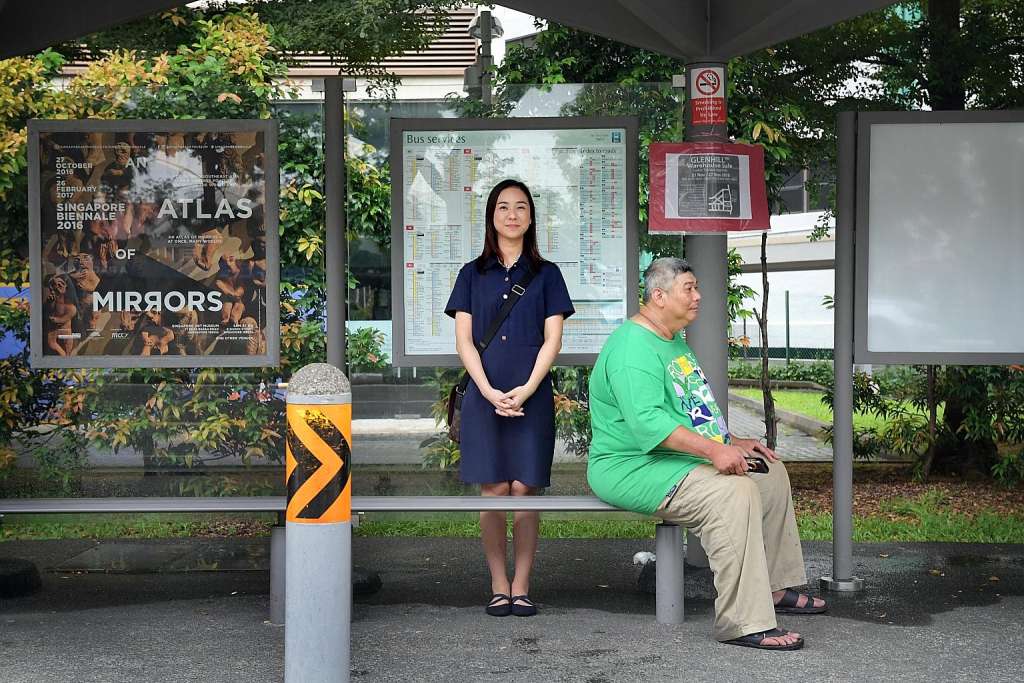
Ms Tay, who was on the last leg of her 18-month sentence for drug offences, was waiting for a bus in Yishun to return to halfway house The Turning Point when she met Mr John Shu, a now 50-year-old mechanic. He had to take a bus that day as his motorcycle was in the workshop. The pair started talking and soon struck up a friendship.

She began to confide in Mr Shu, who is married with a 22-year-old daughter in polytechnic and a 19-year-old son working as a chef.

She shared her life story and her desire to pursue a diploma to give her children a better future. She had worked as a waitress and a retail assistant, among other jobs, but they paid less than $2,000 a month.

  • Skills-training bursary for ex-offenders

  • The Yellow Ribbon Fund Star (Skills Training Assistance to Re-start) Bursary was launched in 2010 to assist financially needy former offenders in vocational and skills training, to help them find jobs.

    The bursary covers up to 100 per cent of the course fees for diploma and degree programmes.

    Since it was launched, 128 students have been on the bursary scheme and 52 have graduated.

    The graduates include one who earned a diploma in banking and finance services from Nanyang Polytechnic and another who attained a diploma in culinary skills from Shatec.

    The bursary is open to all former offenders who have been accepted by any educational institution in Singapore. It is disbursed by the Yellow Ribbon Fund, a charitable fund that helps offenders and their families.

    Theresa Tan

She said her parents, who are divorced, were not supportive of her plans to upgrade herself. And she did not have the $5,000 needed for the course fees.

Besides, she was getting treatment for depression then and the people around her felt she could not cope with handling a messy divorce, caring for her children and going back to school all at once.

Mr Shu said: “Her wish to get an education is a good thing. And since her family is not supporting her and no one supports her, I thought I would support her and give her a way out.”

Mr Shu, who earns just over $2,000 a month, gave her about $6,000 to pay for her diploma and other expenses. This was a few months into their friendship. He said he and his wife, who works as a hawker, can get by on their income.

Ms Tay began her studies shortly after her release in 2014 and graduated with a diploma in marketing management from Kaplan Higher Education Institute eight months later.

Hitting the books was a huge change for a girl who was introduced to drugs by her friends as a teenager. She was only 18 when she was jailed for one year for drug offences. When she became a mother at the age of 20, she quit drugs.

But she returned to drugs to escape from her woes when her first marriage broke down. She has two children from that union, a 12-year-old daughter and a 10-year-old son. Her first husband has custody of them.

Her second husband was also a drug abuser and they were arrested at the same time for drug offences.

About four years ago, the couple was jailed and their daughter, only a baby at the time, was left in the care of her in-laws. The girl is now five.

Ms Tay’s second sentence, served at the Drug Rehabilitation Centre at Changi Women’s Prison, “shook” her up. “I saw how the other drug addicts ended up with nothing. Their children did not want them; they had no house and no money. I did not want to be like them.”

Behind bars, an inmate encouraged her to further her studies. And with Mr Shu’s help, she became a diploma holder.

His help did not end there. While studying for her diploma, she found herself unexpectedly pregnant with her fourth child – with her second husband. Their marriage was on the rocks. She wanted a divorce and was worried about her finances.

Mr Shu said: “I encouraged her not to abort as the baby is innocent. I told her that if she can’t afford to raise the child, I will help her. I will help her all the way.”

Ms Tay said Mr Shu paid for her visits to the gynaecologist and even cooked for her when she was recuperating from the childbirth during her confinement month.

“He never asked for his money back or for anything in return,” she said. “Others have made unpleasant remarks (implying we are having an affair) but we are clean.”

Ms Tay, who is working as an administrative assistant, said she has offered to repay part of the sums that he gave her, but he has declined. She declined to reveal her pay.

“He has helped many people, not only me… Some (of his friends) have taken advantage of him.”

Mr Shu, a primary school graduate, said in a mix of Mandarin and Hokkien: “Why should I calculate so much about helping others? I already have one foot in the grave and if I need help in the future, others would help me.”

He said he is just glad that she managed to get her life back on track, adding: “I see Jaycie as a family member, like my younger sister.”

Last month, Ms Tay started a part- time course – Bachelor of Business Studies in Management – at Kaplan. The degree is awarded by University College Dublin. She won a bursary from the Yellow Ribbon Fund Star Bursary to pursue the degree. She said the fees cost over $20,000.

“I never thought a stranger (who became a friend) would help me so much. I hope that by sharing my story, other former offenders can also feel there is hope in life,” she said.


This article was first published on Dec 04, 2016.
Get a copy of The Straits Times or go to straitstimes.com for more stories.

Image: 
Category: 
Blurb: 
<p>Things were looking bleak but a chance meeting with a stranger helped Ms Jaycie Tay, who was twice incarcerated and dropped out of school, defy the odds to achieve a diploma. And the 32- year-old twice-divorced mother of four is now gunning for a degree, as well as a brighter future.</p>
Publication Date: 
Sunday, December 4, 2016 – 14:13
Send to mobile app: 
Source: 


Story Type: 
Others

Source link

Shoppers, be alert to terror threats, Josephine Teo urges

0

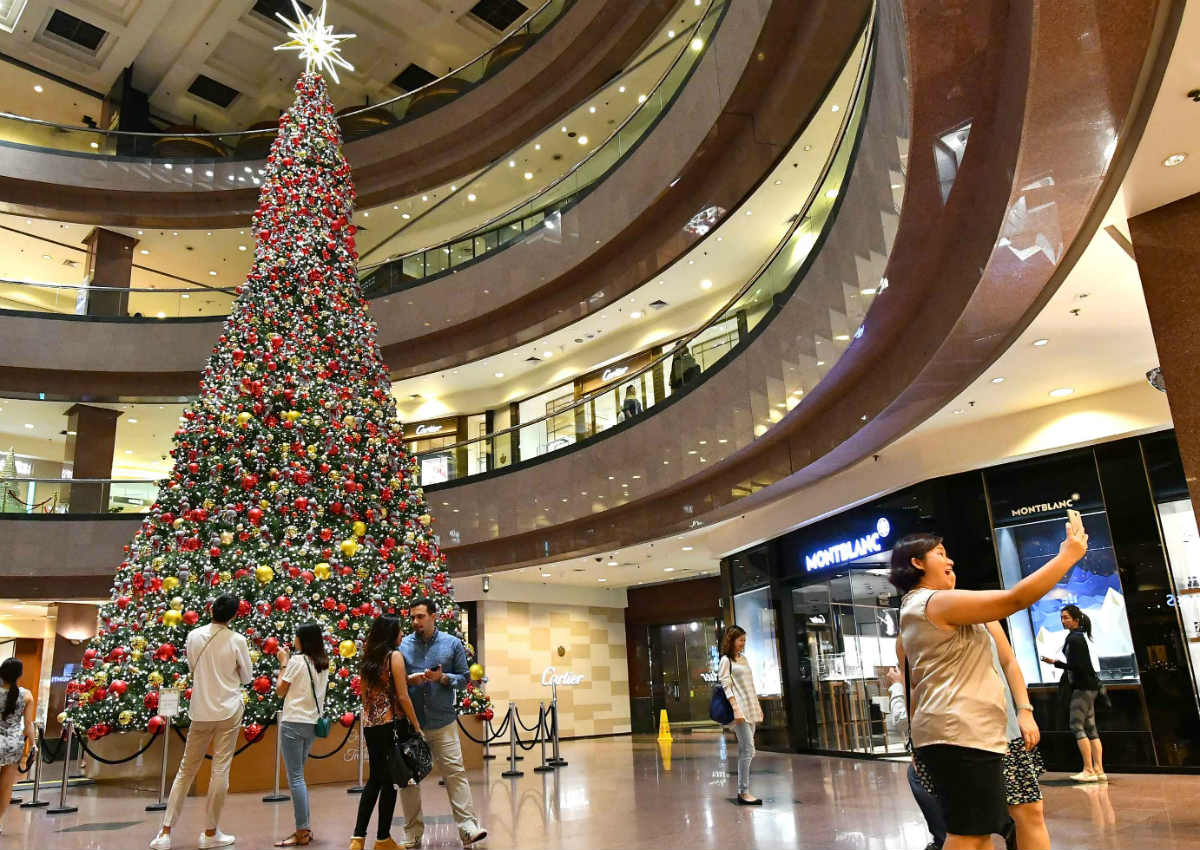
In the midst of the usual year-end sales, shoppers can also do their part to stay alert to terror threats, said Senior Minister of State (Prime Minister’s Office, Foreign Affairs and Transport) Josephine Teo yesterday.

She was speaking at the opening of the third police community roadshow, held at the HDB Hub in Toa Payoh.

The roadshow marked the expansion of the Shoppers-On-Watch programme to the heartland.

The programme, first introduced in May as part of a safe shopping campaign in Orchard Road, aims to educate shoppers on how they can prevent crime by looking out for suspicious behaviour.

Mrs Teo said the programme complemented the SGSecure movement introduced in September as part of efforts to increase levels of preparedness for crises such as terror attacks.

“By calling upon members of the public to look out for suspicious characters and behaviour, Shoppers-On-Watch reinforces the need to stay alert to any tell-tale indicators of terrorist activities,” said Mrs Teo, who is also a Member of Parliament for Bishan-Toa Payoh GRC.

The Singapore Police Force encouraged shoppers to stay alert and report any suspicious activities or items to retailers or the police to “prevent, deter or detect” crime and terror-related activities.

Some retailers have been trained on how to respond when shoppers provide information about suspicious activity in their premises.

On Friday, Home Affairs and Law Minister K Shanmugam said there was a greater terror threat now compared with last year. He noted an uptick in terrorism-related arrests in Indonesia, and said extremism propagated by terror group Islamic State in Iraq and Syria had taken root in the region.

Transport workers, too, have been identified as first responders in crisis situations, during the public transport sector’s first counter- terrorism seminar, also on Friday.

Mr Desmond Choo, a member of the Government Parliamentary Committee for Home Affairs and Law, said people must “stay vigilant” during this period, especially in crowded areas such as year-end countdown parties.

“Terrorists have neither downtime nor vacation,” he said.


This article was first published on Dec 04, 2016.
Get a copy of The Straits Times or go to straitstimes.com for more stories.

Image: 
Category: 
Blurb: 
<p>In the midst of the usual year-end sales, shoppers can also do their part to stay alert to terror threats, said Senior Minister of State (Prime Minister's Office, Foreign Affairs and Transport) Josephine Teo yesterday.</p>
Publication Date: 
Sunday, December 4, 2016 – 14:01
Send to mobile app: 
Source: 


Story Type: 
Others

Source link

Slogans, placards and food – South Korean protests a boon for restaurants

0


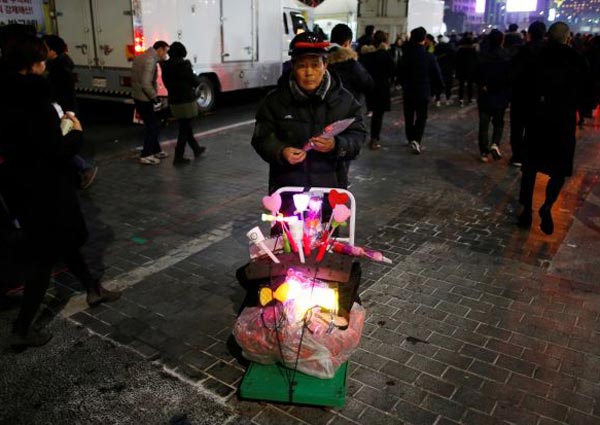
SEOUL – As protesters march through Gwanghwamun Square in downtown Seoul, the centre stage of huge weekly demonstrations calling for South Korean President Park Geun-hye to step down, nearby restaurants hustle to prepare for a busy night.

Many bars and restaurants in the area, home to government offices and near the presidential Blue House, have been doing roaring business well into the night when the protests are held every Saturday. The boom is a relief for neighbourhood restaurants after a new anti-graft law in September limited the value of meals that could be accepted by civil servants.

Saturday’s protest calling for Park to resign over an influence-peddling scandal was the largest yet, with organisers putting the total number of participants at 1.7 million, while police say the crowd at its peak totalled 320,000.

The demonstrations taking place for six straight weekends have been festive and peaceful, with parents bringing children and protesters putting flower stickers on police-bus barricades. It’s a contrast to violent anti-government protests South Korea has seen in the past, when activists hurled rocks at police lines and were sprayed with pepper gas.

“We’ve prepared three to four times more than usual and set up seven more tables outside,” said Cho Joung-suk, owner of Gwanghwamun Yeontanjib, a restaurant specialising in grilled eel. Nearby, protesters chanted “Park Geun-hye step down now!” and “We are the owners of the country!”

Activists marched to within 100 metres (yards) of the Blue House, one holding up a red sign reading “Arrest Park Geun-hye”.

Cho, who usually shuts the restaurant on weekends and closes by midnight on weekdays, said that last week she had customers until around 4 a.m. on Sunday morning.

Kim Min-sung, a student who sat for South Korea’s high-stakes university entrance test two weeks ago, was at his third protest.

“I had been studying for the past couple of months but I felt that I had to come out and protest after the exam as the situation had become serious,” he said, taking a break at a restaurant specialising in South Korea’s famous chicken and beer, or “chimaek”, combination.

LED CANDLES, SELFIE STICKS

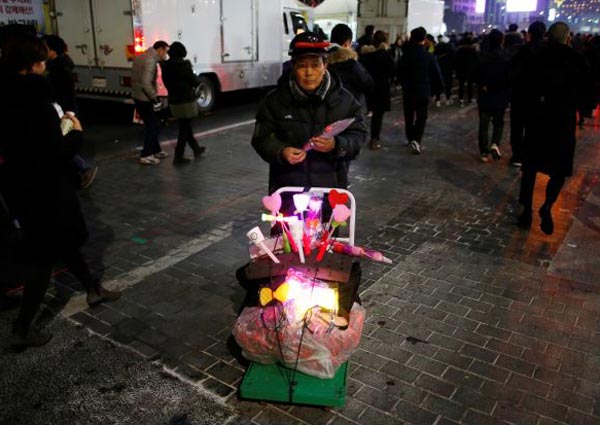
The anti-Park demonstrations have featured rappers and musical actors taking the stage in Gwanghwamun Square, while protesters carrying LED candles cheer with synchronised waves. In small alleyways, vendors were selling street food, selfie-sticks and the candles.

While many business owners are profiting from the protests, the political crisis helped push consumer sentiment to a nearly 7-1/2 year-low in November. Some merchants say the demonstrations have been disruptive to their business.

Park, whose approval rating stands at just 4 per cent, according to a poll released on Friday, has refused calls to step down immediately. Last week, she asked parliament to find a way and a timeline for her to leave office, but the opposition plans to bring an impeachment motion to a vote on Dec. 9.

Park is accused of colluding with her long-time friend Choi Soon-sil to enable her to meddle in government affairs.

Seo Young-pyo, a resident of Jeju Island, 450 km (280 miles) south of Seoul, came to Saturday’s protest with his 18-year-old daughter.

“It’s not that there is less passion outside of Seoul or on Jeju Island. But Gwanghwamun Square in Seoul is the centre of Korean society and there is a lot to see and learn,” he said.

As Saturday night wore on, protesters took breaks for hearty meals and talked politics over drinks. Many joined long queues to use public toilets.

Kim Song-ryul, owner of Geosung Hof, a chimaek restaurant, said the carnival-like mood was a key driver of stepped-up business.

“There are families with young children in strollers who come to the protests and drop by our restaurant. The festive atmosphere really is a change from the past where there was violence,” he said.

The recent rise in weekend sales has been a boost for many business owners in Gwanghwamun whose core trade of serving office workers was squeezed by the anti-graft law that limits the value of a meal that can be accepted by a civil servant to 30,000 won ($25.72).

Still, Kim, owner of the chicken and beer restaurant, has mixed feelings about the unexpected bonanza.

“If our sales rose due to good business every day, I would feel better. But to be honest, I don’t feel that great about the entire situation,” he said.

Image:
Category:
Publication Date:
Sunday, December 4, 2016 – 13:23
Send to mobile app:
Source:

Story Type:
Others

Source link

Crowds throng Zouk’s final party in Jiak Kim St

0


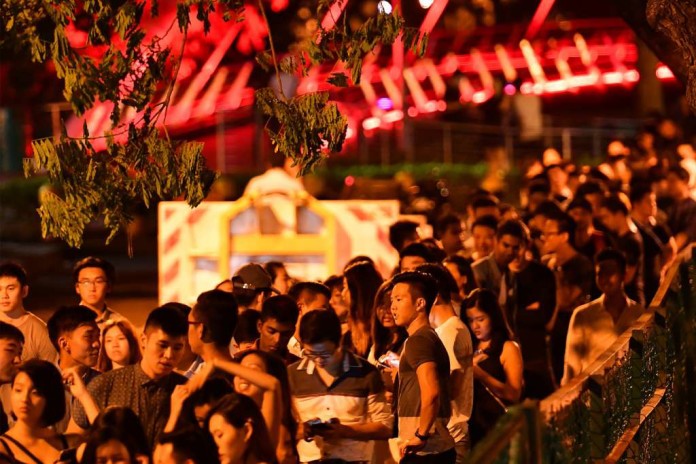
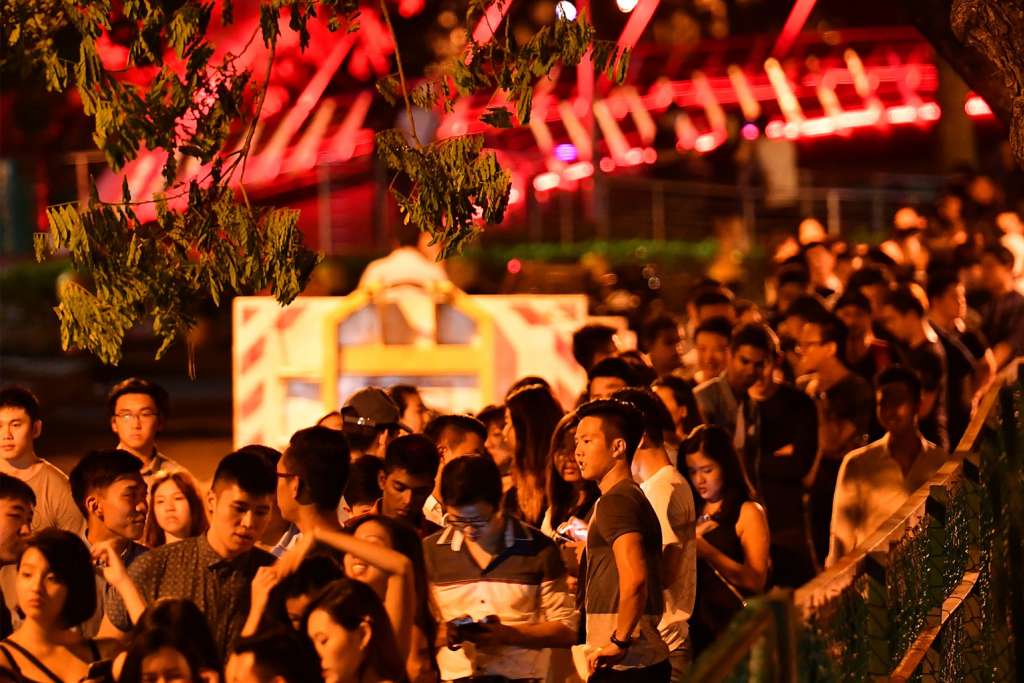
After 25 years at its iconic Jiak Kim Street location by the Singapore River, Singapore nightlife institution Zouk opened its doors there for the last time last night.

The crowds gathered for the historic occasion from as early as 7pm, four hours before the doors opened at 11pm. Mr Ko Chong Tat, 29, who works in the banking industry, joined the queue to enter the club at around 9pm, even though he is not a regular clubgoer.

“It was important to be here because it’s the last night. I won’t be able to do this again,” he said.

Zouk will have its soft opening at its new Clarke Quay location on Dec 17. Ms Vickie Lee, Zouk’s security supervisor, will be moving over to the nightspot’s new Clarke Quay premises with her security team.

The 51-year-old, who has been with Zouk for 12 years, said she was not sad about leaving Jiak Kim Street, but said she would “miss the place”.

“I’ve seen so many funny things happen here – we work from 6pm to closing every day, but I think, today, we will remain open till 7am.”


This article was first published on Dec 04, 2016.
Get a copy of The Straits Times or go to straitstimes.com for more stories.

Image:
Category:
Blurb:
<p>After 25 years at its iconic Jiak Kim Street location by the Singapore River, Singapore nightlife institution Zouk opened its doors there for the last time last night.</p>
Publication Date:
Sunday, December 4, 2016 – 14:00
Keywords:
Send to mobile app:
Source:

Story Type:
Others

Source link

What's behind Singapore's latest run-ins with Beijing

0

Singapore-China relations appear to have taken a turn for the worse.

The recent seizure of nine Singapore Armed Forces armoured vehicles in Hong Kong is the latest in a series of incidents that have made many wonder what is happening between the two countries.

Why is it that what appeared to have been acceptable in the past is now viewed by one party in a different light?

In the case of the SAF carriers, they were in transit in Hong Kong en route to Singapore after their deployment in Taiwan where SAF troops hold regular exercises.

Read also: Singapore will not allow any single issue to hijack ties with China, says Vivian Balakrishnan

Singapore’s military arrange- ment with Taiwan has been a longstanding practice, started in 1975 when it was building its armed forces from scratch and needed space not available in its own country for training purposes.

Chinese leaders might not have liked the arrangement but they did not make a public issue of it.

Indeed, it did not stop the two countries from establishing diplomatic relations in 1990.

Suddenly, Beijing now says it has a serious problem with it, going by what its spokesman was quoted as saying: “The Chinese government has always firmly opposed countries that have diplomatic ties with China to have any form of official exchanges with Taiwan, including military exchanges and cooperation.”

When relations between two countries turn sour, the past can be recast and reinterpreted.

Read also: Singapore envoy refutes China report on South China Sea

The same could be said about China’s displeasure over Singapore’s position on the South China Sea (SCS) issue.

Singapore has said that, as it is not a claimant country, it will not take sides in the dispute which involves several South-east Asian nations and China.

But it hopes the disagreements will be settled peacefully according to established principles: Adherence to international laws and the protection of freedom of navigation in the affected waters.

Singapore has stuck closely and consistently to these principles which China did not take issue with in the past.

In recent years, though, China has become more assertive, constructing various facilities on some of the disputed islands and refusing to take part or accept the verdict of an international tribunal which had ruled in favour of the Philippines’ case.

It has also taken issue with Singapore, accusing it, through reports in the Chinese media, of instigating other Asean countries to take an unfriendly position regarding the SCS issue, a charge Singapore has vigorously denied.

Why is Singapore’s consistent position on the SCS now viewed so antagonistically and provoking such a strong reaction from Beijing? The short answer: China has changed.

As Professor Wang Gungwu, a noted historian, observed last week at a forum, China today isn’t the same country as the one which needed help from many countries, including Singapore, in the 1980s and 1990s to develop its economy.

“The China that needed our external help is no longer that way at all. China now is actually in the position of being looked to for help… and Singapore has to reassess its position not because of anything specific that Singapore has done or what the Chinese have done.”

The change has been most pronounced in the economic sphere. China is now the largest trading partner of almost all the countries in the region, including Singapore, and is the largest source of tourism and investments.

This economic impact has been mainly positive, boosting growth and opportunities for many countries which have benefited from the vast and growing Chinese market.

But along with its economic strength has come political and military clout.

As its influence and ability to project its power increases, China is changing the geopolitical landscape.

The most significant impact of this will be in the shifting balance of power between China and the United States, but this re-balancing will take some time because America is a superpower and will not cede ground easily.

But smaller countries do not enjoy this advantage and will feel China’s growing weight more dramatically, like small buoys in the sea buffeted by a supertanker passing by.

Because of its proximity, South-east Asia will be one of those most affected.

China’s growing assertiveness in the South China Sea dispute is but one manifestation of this, and there will no doubt be many others.

In such a scenario, it would be unrealistic to expect a trouble-free time as countries in the region adjust to the new reality.

In fact, many South-east Asian states have already shifted their positions, the most dramatic being the Philippines led by newly elected President Rodrigo Duterte, who declared recently that his country had realigned with China and was moving away from the US.

There is bound to be friction and tension in the coming years as governments make adjustments to accommodate the new growing power.

Singapore’s recent problems with China should be seen in this light – an inevitable clashing of gears as the many moving parts change direction and, sometimes, collide.

It would be highly unusual if there were no ups and downs as the balance of power shifts.

It is important, therefore, to take a longer-term view of the changing ties and chart a course that ensures Singapore’s interests are protected in the foreseeable future.

This is especially pertinent as Singapore has many other interests and linkages with the rest of the world which it assiduously developed over the years.

These overlapping relationships have made the country what it is today – globally connected and relevant – and have been a large part of what made it successful.

It cannot suddenly change course without serious damage to its international standing.

But it also makes for a more challenging foreign policy because some of these countries have different and competing interests with China.

As the balance of power shifts, Singapore will have to make new calculations and adjustments.

It will require nimble and adroit leadership able to navigate the changing landscape.

But the people, too, need to understand the new realities and not become unduly flustered or, worse, panicked into submission at the slightest pressure.

They should know that how Singapore responds to Chinese action can have far-reaching consequences for itself and the region, and that it isn’t just a simple matter of not displeasing China for the moment, whatever the costs.

Foreign Minister Vivian Balakrishnan was right to point out that the relationship isn’t defined by one single issue but is multifaceted .

Singaporeans need to have a deeper understanding of how the world is changing, how the changes affect the country, where their interests lie, and what it takes to do well in the new environment.

These are testing times; they are a foretaste of more to come.

  • The writer is also a senior fellow at the S. Rajaratnam School of International Studies.


This article was first published on Dec 04, 2016.
Get a copy of The Straits Times or go to straitstimes.com for more stories.
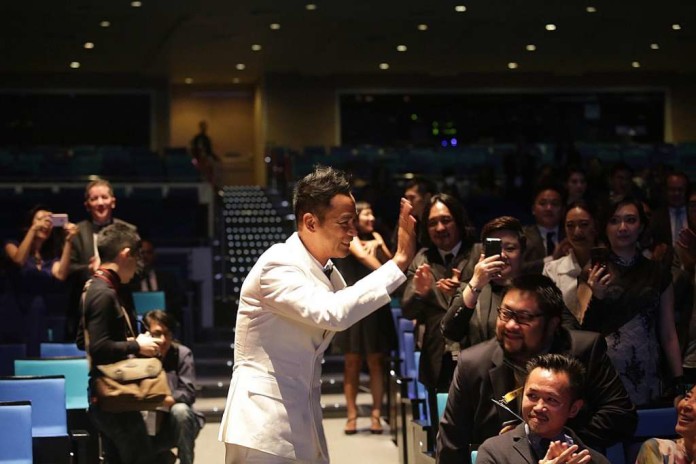
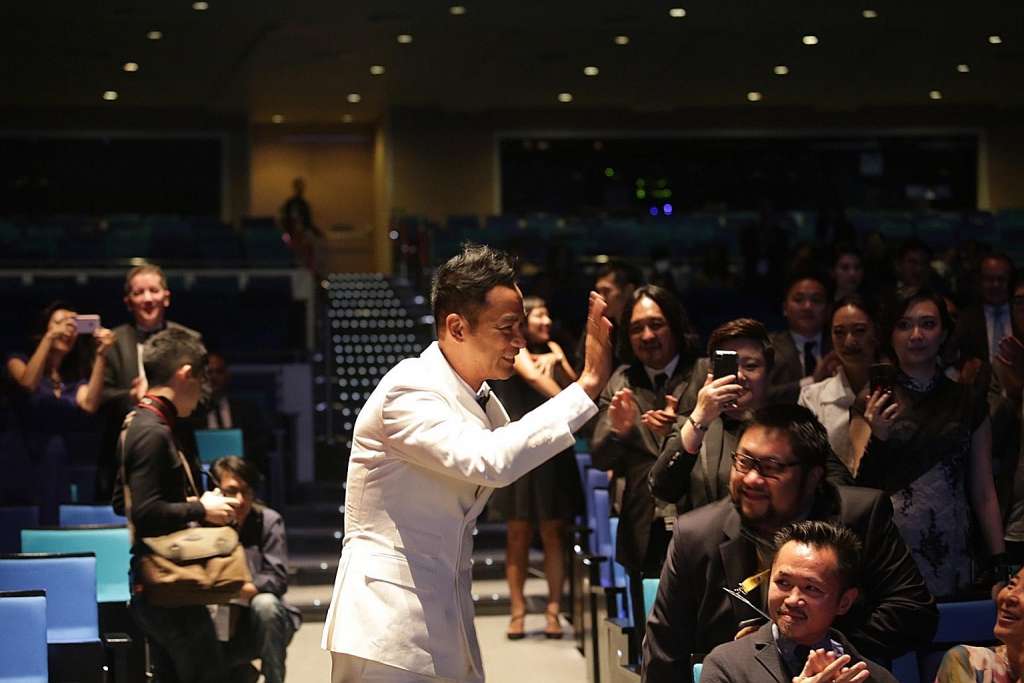
Image: 
Blurb: 
<p>Singapore-China relations appear to have taken a turn for the worse.</p>
Publication Date: 
Sunday, December 4, 2016 – 14:00
Send to mobile app: 
Source: 


Story Type: 
Others

Source link

Scoot’s 72hr sale offers fares fr $45 all-in to over 15 destinations from 4 – 6 Dec 2016

0

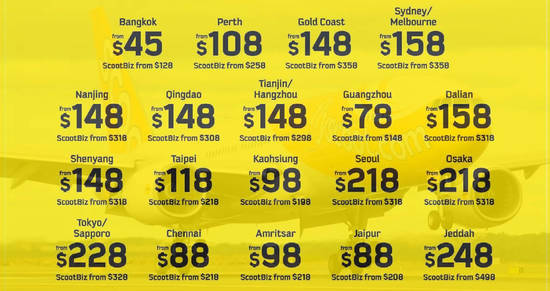
SCOOT new 72hr promo fares from $45 all-in till 6 Dec! Travel from 13 Dec 2016 – 9 Jun 2017

Scoot’s 72hr sale offers fares fr $45 all-in to over 15 destinations from 4 – 6 Dec 2016

SCOOT to 22 destinations on Scoot’s full fleet of Boeing 787 Dreamliner! For 72 hours only till 6 Dec, enjoy fares starting from $45 all-in to destinations such as Bangkok, Perth, Gold Coast, Sydney, Melbourne and more

Source

K-pop groups BTS, EXO and TWICE win big at MAMA 2016

0


South Korean idol groups Bangtan Boys (BTS), EXO and TWICE won big at the 2016 Mnet Asian Music Awards (MAMA) at AsiaWorld-Expo Arena in Hong Kong.

Held on Friday night, BTS won Artist of the Year, and snatched the best dance performance award for male group artists, Yonhap reported.

K-pop boy band EXO won the Album of the Year award for the fourth consecutive year.

It also snagged three more awards, including best male group artist.

Song of the Year and the best female group artist awardwent to girl group, TWICE.

The group’s mega-hit “Cheer Up” hit 100 million views on YouTube in 207 days after its release on April 25.

Yonhap reported that it set the record as the fastest K-pop music video to reach the milestone.

Other Asian and international artistes were also recognised for their contributions.

The award for best international producer went to US rapper-producer Timbaland, while Quincy Jones won for best contributor.

Thai artist J. Da was awarded best choreographer, and Japanese Hironobu Tanaka and Hidaka Masahiro received the awards for best engineer and best performance organiser.

Fashion-wise, the women stole the show on the red carpet, with Ha Ji-won turning heads in a glittery gown with a plunging neckline.

While male artistes and celebrities suited up in various shades of black, Taiwanese actor stood out in a multicoloured long coat. South Korean actor Lee Byung-hun similarly bucked the trend in a white tux with black bowtie.

South Korean K-pop band I.O.I also perked up the otherwise sombre red carpet, with all 11 members appearing in frilly white dresses.

candicec@sph.com.sg

Image:
Publication Date:
Sunday, December 4, 2016 – 12:08
Send to mobile app:
Source:

Rotator Headline:
Female celebs steal the show at Mnet Asian Music Awards red carpet
Rotator Image:
Story Type:
Rewritten Story

Source link

S Korea crisis proves perils of cheating at school

0


SEOUL – When South Korea’s Park Geun-Hye looks back on the scandal-fuelled implosion of her presidency, she may reflect ruefully on what lit the first fuse – a parent pulling strings over a child’s education.

Park’s downfall was the result of her friendship with Choi Soon-Sil – a secretive, long-time confidante who stands accused of meddling in state affairs, squeezing tens of millions of dollars from local companies and amassing a fortune by leveraging her ties to the president.

It’s a damning list of charges, but one that may never have come to light but for a fatal misstep by Choi two years ago in using her influence to secure her daughter’s admission to an elite university.

This was the first loose thread pulled at by investigators probing Choi, and one that swiftly unravelled the entire scandal that now looks set to cost Park her presidency.

According to a formal audit, Choi’s daughter, Chung Yoo-Ra, was given preferential treatment when applying to Ewha Womans’ University in 2014 and was admitted at the expense of other candidates with better qualifications.

As a student, she was given a perfect attendance record despite cutting some classes, and her high grades did not reflect her actual academic performance.

In the light of the far more dramatic revelations that followed, Choi’s string-pulling on her daughter’s behalf might seem like a relatively minor infraction.

But while South Koreans have become resigned to a certain degree of corruption and influence-peddling, there are a few sacred cows that even the most powerful mess with at their peril – and education tops the list.

A rigorously meritocratic education system lies at the heart of South Korea’s stellar rise from the ashes of the 1950-53 Korean War to Asia’s fourth-largest economy.

The system is highly competitive and can take a distressing toll on young students who devote their teenage years to studying for the national college entrance exam.

Admission to one of a handful of elite universities – such as Ewha – is seen as vital to a student’s future prosperity, social standing and even marriage prospects.

But however cut-throat it might be, there is steadfast public faith and trust in the exam’s fairness, with every applicant sitting the same paper on the same day, and a formalised marking system.

That faith is summed up in a term popular for decades, “a dragon from a ditch” – a person of modest means who rose to success through education and hard work.

Model “dragons” include former president Lee Myung-Bak, who worked as a garbageman to earn college tuition, and his predecessor Roh Moo-Hyun – a poor farmer’s son who self-studied to pass a bar exam.

“The long-held belief that even those who are poor and from a humble background can rise up the social ladder through education has been a major strength of our society,” the daily Dong-A Ilbo said in a recent editorial.

“But Chung and Choi shattered this faith and hope spectacularly,” it said.

Park’s presidency has coincided with growing disquiet over a widening disparity in incomes and opportunities – an inequality now embodied in the public mind by Choi and her daughter.

In a now-infamous Facebook posting in 2014, Chung flaunted her privilege, saying: “Money is part of your talent. If you don’t have talent, blame your parents.” The depth of anger over Chung’s admission to Ewha has been illustrated by the large number of high-school students who have taken part in weekly mass demonstrations that have seen millions march through the streets of Seoul and other cities.

“I was so angry about Chung and couldn’t even sleep when I first heard about her scandal,” said Jenny Park, a 16-year-old high school student.

“What’s the point of studying night and day when the rich and powerful can rig the whole system so easily?” she said, waving a banner reading “We didn’t study hard for this.” Prosecutors have accused Park Geun-Hye of colluding with Choi, and the president’s approval rating among students – and pretty much the entire under-40 demographic – is currently close to zero.

In many ways, young South Koreans face bigger challenges than their parents’ generation who enjoyed ample and relatively equal opportunities during the rapid growth that peaked in the 1970s and 80s.

As the economy slowed and firms hit by a global downturn stopped hiring, the jobless rate has increased, reaching a record high in February of 12.5 per cent for those under 30.

The top 10 per cent of earners account for nearly a half of overall income – the highest ratio in Asia – according to a study by the International Monetary Fund published this year.

Instead of “dragons from a ditch” people now talk of “dirt spoons” for those stuck in low-paid jobs with bleak prospects and “gold spoons” for those born to rich and well-connected families.

“Given how this scandal unfolded, how can I can tell my 15-year-old daughter: ‘study hard, then you can be successful?'” office worker Kim Hwa-Young, 45, said at a recent anti-Park rally.

“I can’t let my daughter live in a country like this… and tens of thousands of parents gathered here must feel the same,” Kim said.

Image:
Category:
Publication Date:
Sunday, December 4, 2016 – 10:45
Send to mobile app:
Source:

Story Type:
Others

Source link