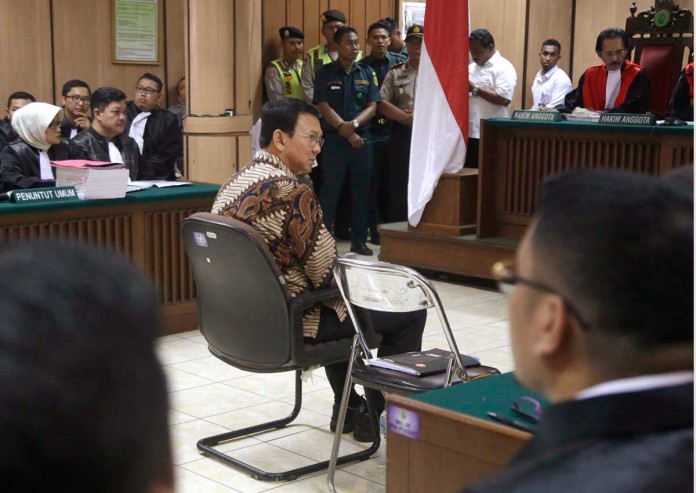
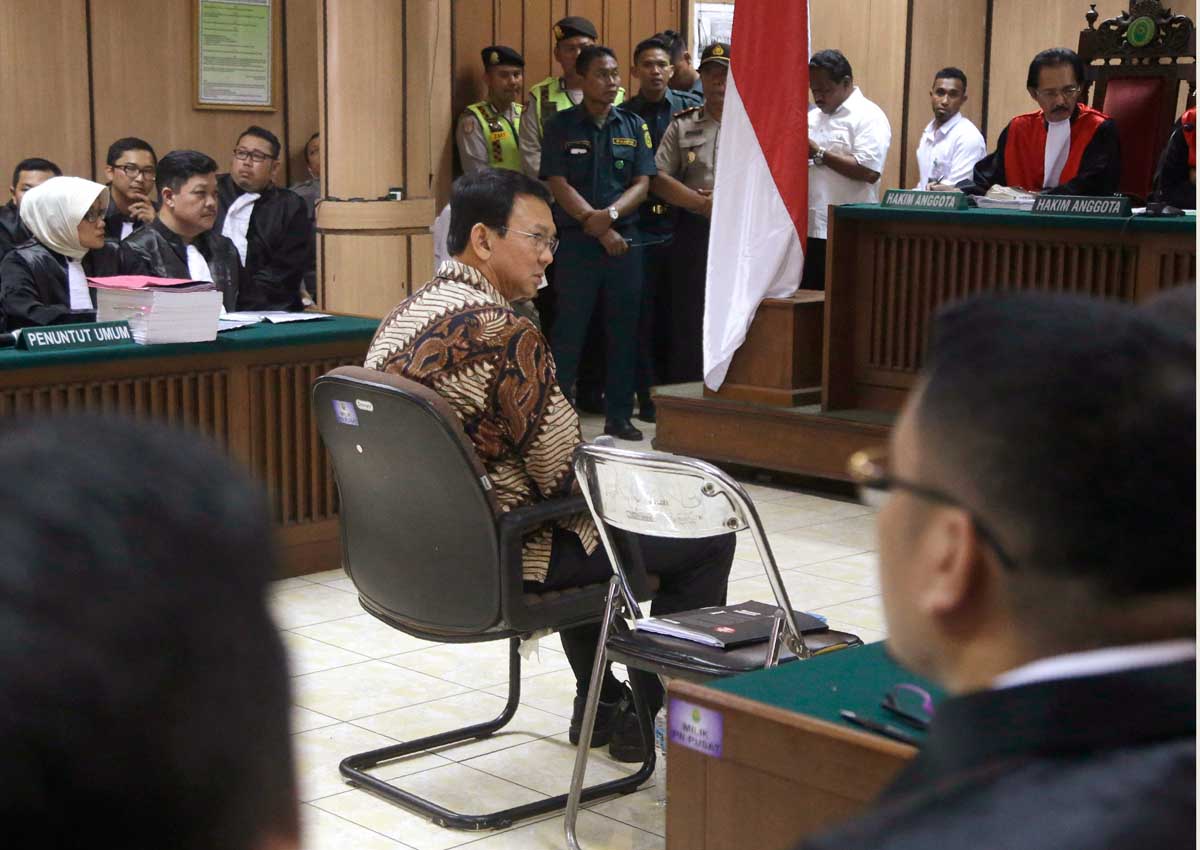
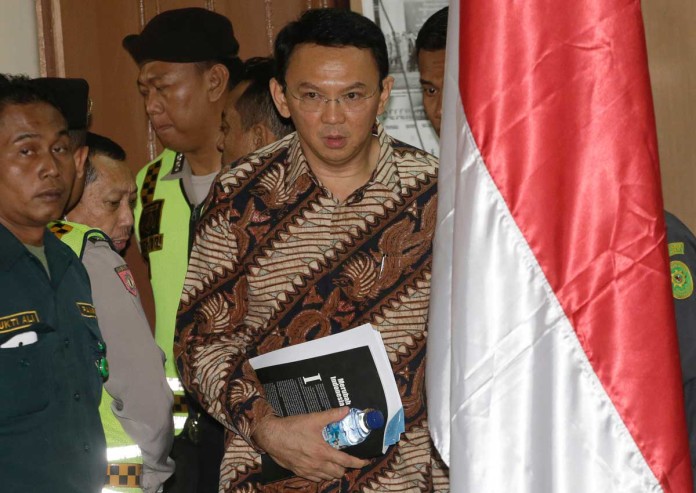
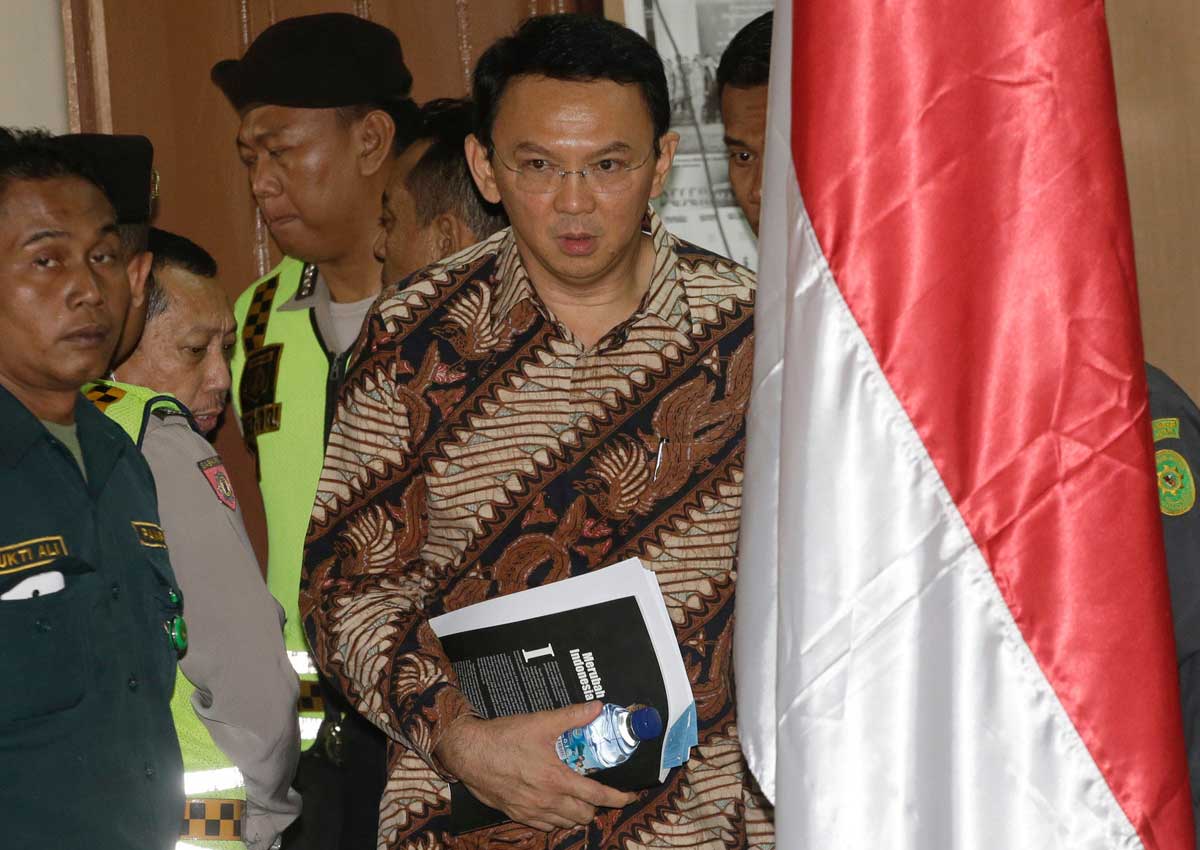
Jakarta Governor Basuki Tjahaja Purnama, better known by his nickname Ahok, sits in the defendant's chair during his trial at the North Jakarta District Court in Jakarta on December 13, 2016.
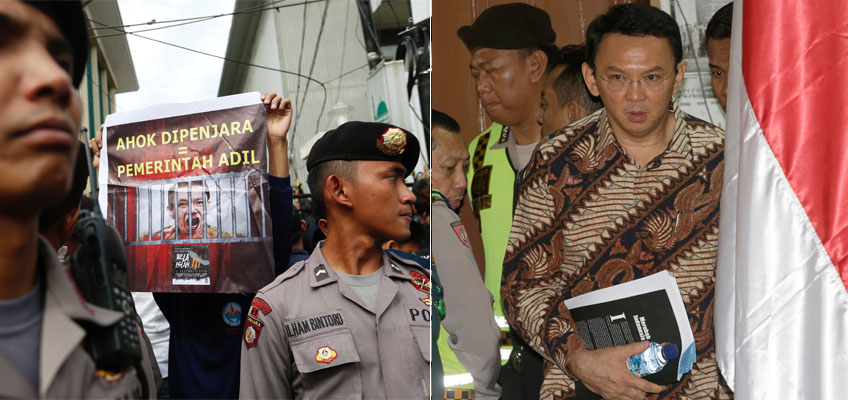
Hardline Muslims rallied on December 13 under heavy police guard outside an Indonesian courthouse where Jakarta's Christian governor Purnama is standing trial in a high-profile blasphemy case that has gripped national attention. / AFP PHOTO / POOL / Tatan SYUFLANA
JAKARTA – A tearful governor of Jakarta denied on Tuesday he had intended to insult the Quran at the start of his blasphemy trial in the Indonesian capital, which is seen as a test of religious freedom in the world largest Muslim-majority nation.
Around 100 Muslim protesters calling for the jailing of Governor Basuki Tjahaja Purnama, an ethnic Chinese Christian, chanted “God is great” outside the court.
Authorities have pledged tight security for the trial after tens of thousands of Muslims, led by hardliners, took to the streets in December and November, to call for Purnama’s arrest and to urge voters not to re-elect him in February.
The rallies, with over 150,000 participants each, were the biggest Jakarta has seen in nearly two decades.
Purnama told the court that he had not intended any insult when he made comments about his opponents’ use of the Quran in political campaigning. He denies wrongdoing but has apologised for the remarks.
“It is clear what I said in the Thousand Islands was not intended to interpret the (Quran), moreover to insult Islam or the ulema,” said the governor, who was dressed in a batik shirt.
Purnama said that his comments were targeted at rival politicians trying to get an unfair advantage in the election by saying that voters should not support a non-Muslim.
Purnama is running for re-election against two Muslim candidates.
Tens of thousands of Muslim hardliners in protest march against Jakarta governor for alleged blasphemy
The trial was aired live on television and there were also supporters of the governor, whose nickname is Ahok, outside the court.
“He is absolutely suited to be governor. The city has come a long way in terms of development…,” said Charles Simanjuntak, 46, a supporter of the governor who does not believe he committed blasphemy.
Among the protesters opposed to the governor, one group held a placard reading “Jailing Ahok = fair government” President Joko Widodo, seen as an ally to Purnama, has blamed “political actors” for fuelling the protests, but declined to elaborate. Widodo has faced widespread criticism for not doing enough to protect the country’s religious minorities.
Indonesia has the world’s largest Muslim population, but the country of 250 million also has sizeable Christian, Hindu and Buddhist communities and dozens of groups that adhere to traditional beliefs.
Purnama, if found guilty, faces up to five years in prison. Almost all blasphemy cases in recent years have ended in conviction.
As Jakarta’s first ethnic Chinese governor, Purnama won kudos for shaking up the city’s sleepy bureaucracy and for taking steps to ease the city’s notorious traffic. But his abrasive language and insistence on clearing the city’s slums has alienated many voters.
Recent opinion polls showed Purnama, once the frontrunner in the race to lead Jakarta, has now slipped to second place, behind Agus Yudhoyono, the son of former president Susilo Bambang Yudhoyono.
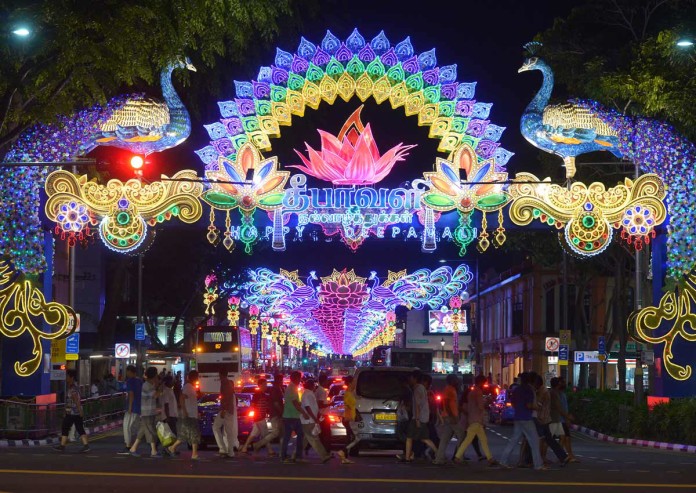
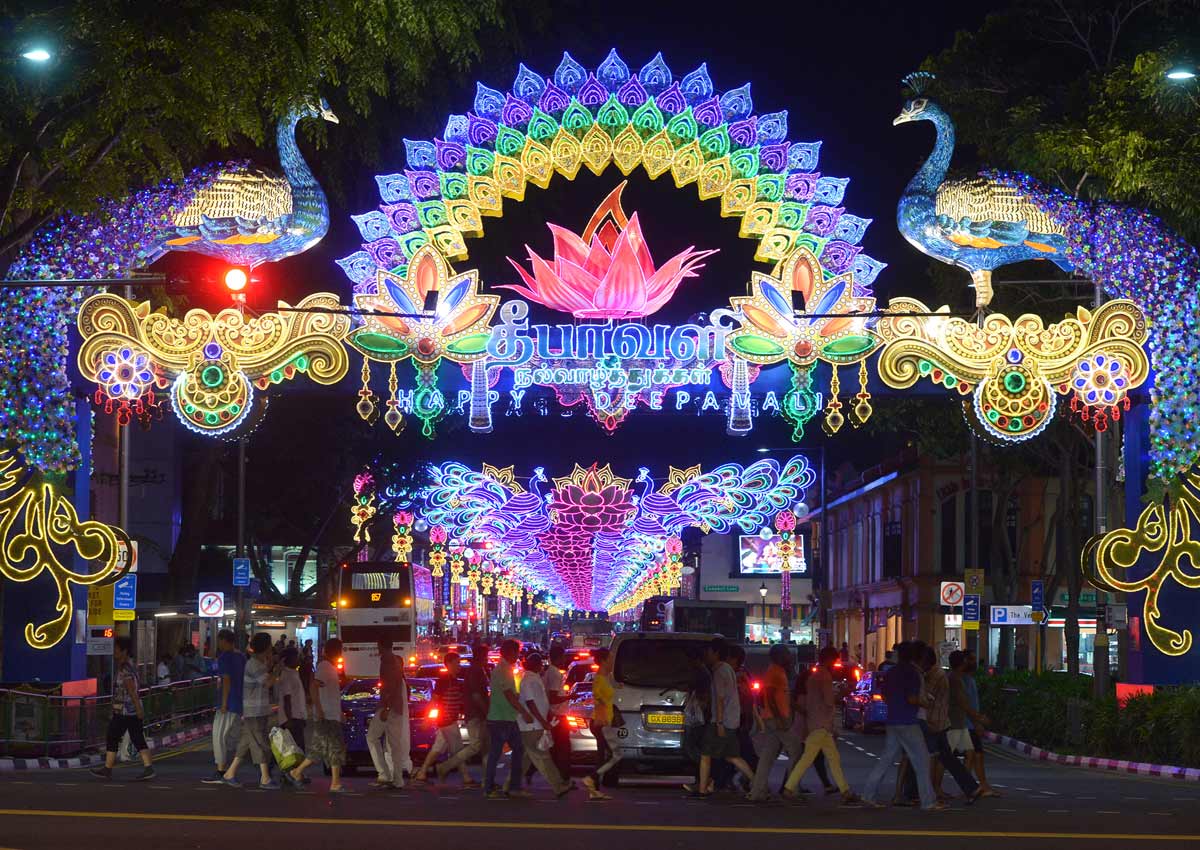
Contrary to his observations, Little India is firmly on the tourist map, and is prominently listed in travel guides such as Lonely Planet and Fodor’s Travel.
One will find many backpacker hostels teeming with tourists in the area.
My friends and I have also taken countless overseas guests to have delicious meals in restaurants there, without mishap.
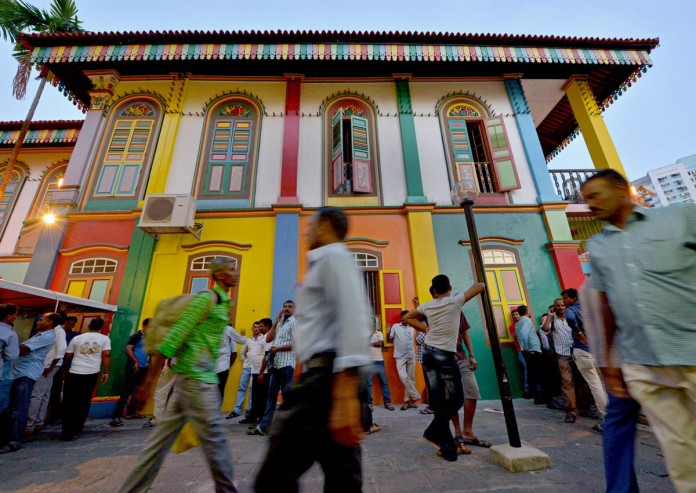
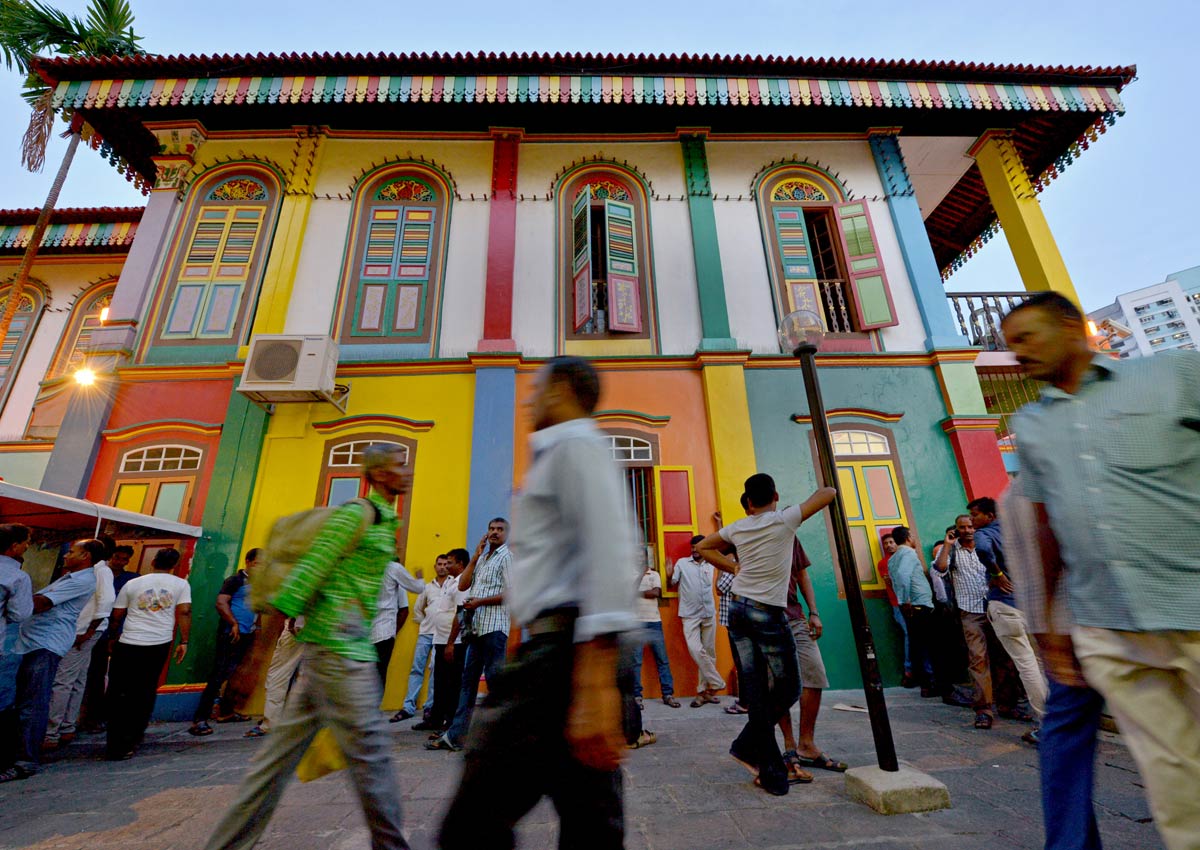
The presence of all sorts of businesses in Little India, and the ordinary people who patronise them, offer a glimpse of everyday life that more-developed districts do not.
The authorities should be commended for keeping its unique atmosphere, even with the lack of spacious pedestrianised streets.
Little India does not need to be like Chinatown.
In an era when travellers are becoming increasingly savvy, discerning and intrepid, more gentrification is the last thing our tourism sector needs.
Organising and sanitising every part of the country is the usual thought in Singapore, but we must keep in mind that if we continue doing this, we would lose the flavour and culture of Singapore (“Little India needs sprucing up” by Mr Roy Goh Hin Soon; Dec 10).
Little India, Chinatown and Geylang Serai should be different from one another.
Sometimes, being not so organised is attractive.
Little India’s “disorganised state”can be a draw.
Tourists would remember this and share it when they return home.
This can only be a good thing.
While safety must always be a concern, let us not sanitise and organise Little India and other such places, and turn them into any other tourist location.
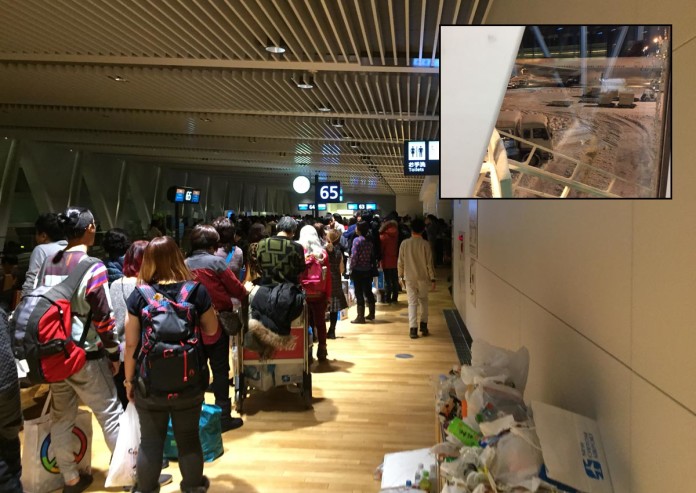
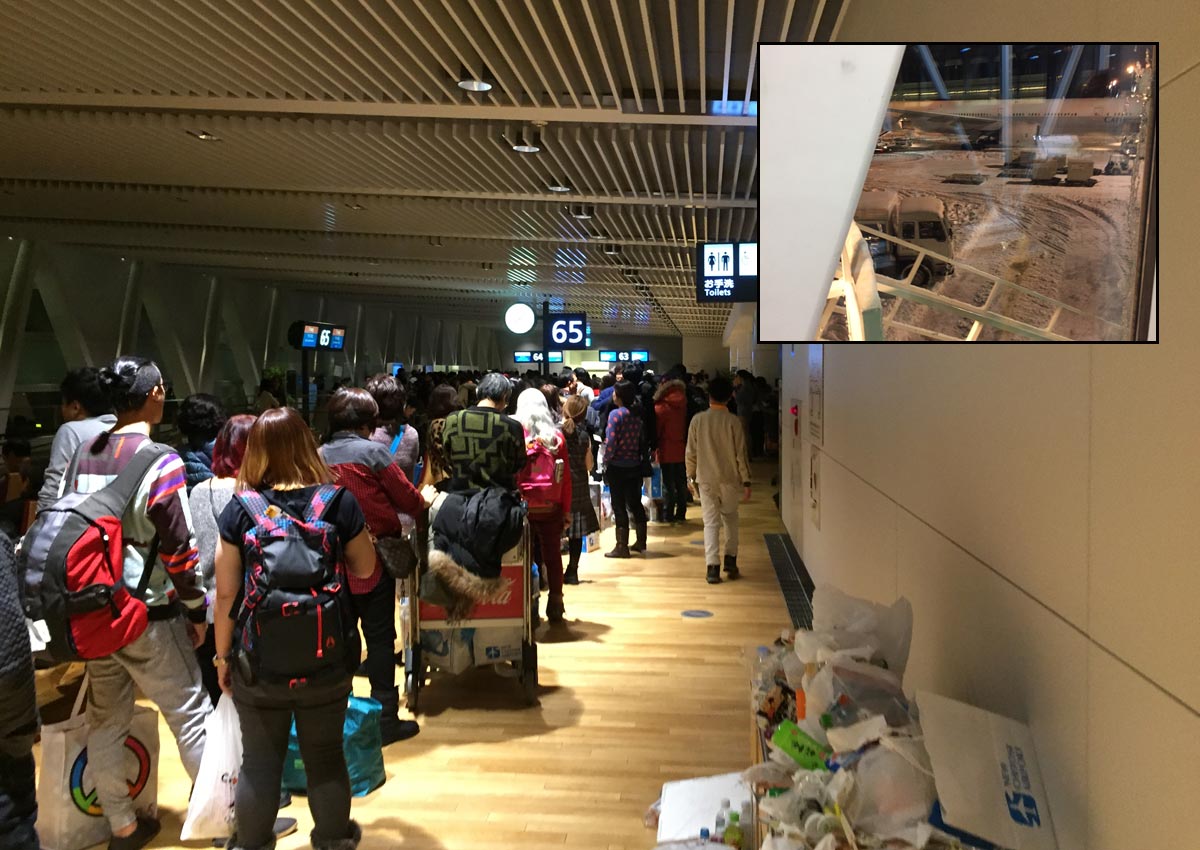
Nearly 200 Singapore Airlines passengers were stuck in northern Japan over the weekend for about 57 hours after heavy snow closed airport runways and caused hundreds of flight cancellations.
Most of them finally made it back to Singapore from Hokkaido early yesterday morning, with some having spent Saturday night sleeping on the airport floor as surrounding hotels were fully booked.
While prospective travellers are continuing with their Hokkaido plans and the weather has improved, tour agencies are monitoring the situation.
One passenger, Mr Jason Goh, 45, who returned to Singapore with his wife and 13-year-old daughter, said there was “a lot of confusion” at New Chitose Airport in Hokkaido’s capital Sapporo, a tourist hot spot.
He was supposed to take an eight-hour flight on SQ661 on Friday at 7.55am Singapore time (8.55am Sapporo time).
Heavy snow in Japan causes train closures, flight delays
An SIA spokesman said there were 192 passengers on board, but as the runways were closed, the flight was rescheduled to depart the next morning.
The flight was renumbered to SQ9661.
But Mr Goh boarded the same plane twice on Saturday, only to have the flights cancelled each time.
The second time, the plane had started moving and he thought he could finally return home.
“But then the crew suddenly told us it was cancelled. They said no other airports could take us and the pilot had exceeded his duty hours,” said Mr Goh, a senior human resource executive who was on a tour by travel agency SA Tours.
“Then why did they ask us to board the plane again?”
By then, hot meals at the airport’s foodcourt were also sold out and his family had to make do with snacks to ease their hunger.
The floor which he slept on was cold and hard, he said.
When SQ9661 finally took off on Sunday evening, many passengers clapped, relieved that they did not have to spend another night in the airport, Mr Goh recalled.
“I just wanted to get out of the country,” he said.
Upon arrival, affected passengers were given in-flight gift vouchers for buying duty-free items on SIA flights or through mail order, as well as notices of the delay to help them make travel insurance claims.
SIA said Flight SQ9661 was further delayed on Saturday as the airport runways remained closed.
On why passengers were again asked to board that day only for the flight to be cancelled, the airline said it was aware that the crew would not be able to operate on a direct flight to Singapore as they would have exceeded their duty hours.
So, the airline wanted to divert them to Hong Kong or Taipei and arrange for a change of crew before proceeding to Singapore.
“However, other factors such as the need for further de-icing as well as obtaining air traffic control clearance created a further delay which resulted in our crew not being able to operate to Hong Kong or Taipei. It was then that we decided that the aircraft could not take off,” said SIA’s spokesman.
Due to a shortage of available hotel rooms, some passengers slept in the airport.
SIA issued them blankets, meal boxes and breakfast vouchers.
SQ9661 finally left Sapporo with 132 passengers on Sunday evening and arrived in Singapore at 1.02am yesterday.
The remaining passengers were rebooked on alternative flights, said the SIA spokesman.
SA Tours managing director Kay Swee Pin said its group of 34 passengers have since returned safely.
Travel agency Chan Brothers Travel, which has several tour groups of between 20 and 35 people each departing daily to Hokkaido until the end of the month, said their itineraries have not been affected by the weather conditions.
“However, we are closely monitoring the situation and changes will be made if necessary as customer safety is our utmost priority,” said a spokesman.
This comes even as the the Japan Meteorological Agency said the worst of the bad weather that had grounded hundreds of flights and train services in Hokkaido last weekend is over.
Tokyo experienced their first November snowfall in 54 years
According to its seven-day forecast, snowfall is still expected on Japan’s northern island, though not to the extent of the heavy snowfall that had pummelled Sapporo.
As of yesterday, domestic and international flights, as well as local train and tram services, had resumed operations.
Sapporo had been blanketed by 65cm of snow by 3pm on Saturday – the heaviest snowfall recorded in early December in nearly 30 years.
On Sunday, the snow cover at 7pm was 58cm, the Sapporo District Meteorological Observatory said.
At New Chitose Airport, a total of 252 flights were cancelled on Saturday and another 162 on Sunday, Japanese daily Yomiuri Shimbun said.
Meanwhile, JR Hokkaido railway company said a total of 192 train runs had to be suspended on Saturday, and another 56 on Sunday.
mellinjm@sph.com.sg
This article was first published on December 13, 2016. Get a copy of The Straits Times or go to straitstimes.com for more stories.
Walk through a lush, virtual rainforest from the past and learn stories behind Singapore’s old trees at the new National Museum rotunda
For the revamp of its glass rotunda, the National Museum of Singapore looks to the natural world.
The rotunda, which reopened last Saturday after a two-year hiatus, now houses two new permanent works.
Digital art installation Story Of The Forest, by renowned Japanese digital art collective teamLab, creates a virtual rainforest thick with animals and flowers – based on paintings from the museum’s William Farquhar Collection – for visitors to walk through.
At the base of the rotunda is Singapore, Very Old Tree by home-grown photographer and artist Robert Zhao, an exhibition of 17 photos that juxtaposes old trees around Singapore with the people who know their stories.
The rotunda closed two years ago for its first revamp since its launch in 2006. Previously, a video of life in a day in Singapore was projected 360 degrees in the space.
The two new works are part of the museum’s $11-million revamp of its permanent galleries.
Museum director Angelita Teo, 44, says the new installations are both a nod to the region’s ecological heritage and a call for visitors to engage more with the natural world.
“We hope it inspires those who see it to contribute more to documenting their environment,” she adds.
Digital marketing executive Josephine Tan, who visited the rotunda when it reopened last Saturday, finds the new additions “mesmerising”.
“It was surprising to find out that Story Of The Forest featured flora and fauna from the past,” says the 25-year-old, adding that the effect was hypnotic.
BRINGING 19TH-CENTURY DRAWINGS TO LIFE
A tapir and a deer are among the inhabitants in interactive installation Story Of The Forest (above), which brings to life works from the National Museum’s William Farquhar Collection of Natural History Drawings. The Straits Times
A slow loris peers curiously through a fringe of leaves. A tapir lumbers heavily past. A deer emerges from the undergrowth, is startled and gallops off into a burst of petals.
These are among the inhabitants of the digital rainforest through which visitors to the glass rotunda of the National Museum of Singapore can now wander.
Story Of The Forest, an interactive installation inside the revamped rotunda, opened to the public last Saturday.
Japanese digital art collective teamLab was commissioned to create the work, which brings to life 69 illustrations from the museum’s William Farquhar Collection of Natural History Drawings.
The collection comprises 477 watercolour drawings of regional flora and fauna in the 19th century commissioned by Farquhar, Singapore’s first British Resident.
The museum’s director, Ms Angelita Teo, hopes the installation will help more visitors, especially younger ones, connect with the Farquhar collection.
“To young people, these are just drawings. Using technology to bring them to life could excite them to look at them more closely.”
On entering the rotunda from the second floor, visitors cross a bridge under a dark dome, from which constellations of digital flowers constantly tumble.
Visitors then walk down a spiral slope around the rotunda’s cylindrical drum and pass through a virtual forest projected onto the walls, through which animals move.
A mobile app offers visitors the chance to “capture” the animals they spot, somewhat like in the smartphone game Pokemon Go, and find out facts about them.
At the bottom of the rotunda, luminous trees spring up as flowers cascade onto them. As more people move around the space, more trees and animals will emerge.
It took 30 artists from teamLab 21/2 years to complete the work, which is projected onto screens about 170m long.
When asked to rate how difficult it was on a scale of one to 10, the collective’s founder Toshiyuki Inoko gives it a solid 10.
The greatest difficulty, the 39year-old says in Japanese through a translator, was to create a seamless illusion on the rotunda’s curved interior, using close to 60 painstakingly positioned projectors.
TeamLab is known for cuttingedge installations that meld art and technology, such as Crystal Universe at ArtScience Museum, where 178,000 LED lights react to visitors’ movement, giving the illusion of stars moving in space.
The National Museum project was, however, the first time teamLab had worked with so much curved surface.
It had to build a life-size replica of the dome in a warehouse in Tokyo, where it is based.
This was to make sure it got everything right for its set-up in Singapore, which took two months.
The heat created by the projections was another problem.
A second, smaller fireproof dome had to be built inside the 15m-high rotunda to house the installation, to mitigate fire risk and block out light and heat.
Ms Teo recalls the challenges of construction within the tight, round confines. “The scaffolding itself was a work of art,” she quips.
She praises the dedication of the Japanese team towards perfecting the most minute details. “They would spend hours programming the fall of a single leaf.”
Rather than a video that plays on a loop, the animation is a computer programme that reacts in real time to visitors. This means no scene will be repeated.
“We want to break boundaries between the artwork and the viewer,” says Mr Inoko.
His favourite way to enjoy the installation is to lie on the floor at the bottom of the rotunda.
Whenever somebody crosses the bridge above, a tree will shoot up next to him.
He says dreamily: “All the flowers are falling and it’s like I am floating, suspended, navigating the universe.”
CAPTURING OLD TREES AND THEIR STORIES
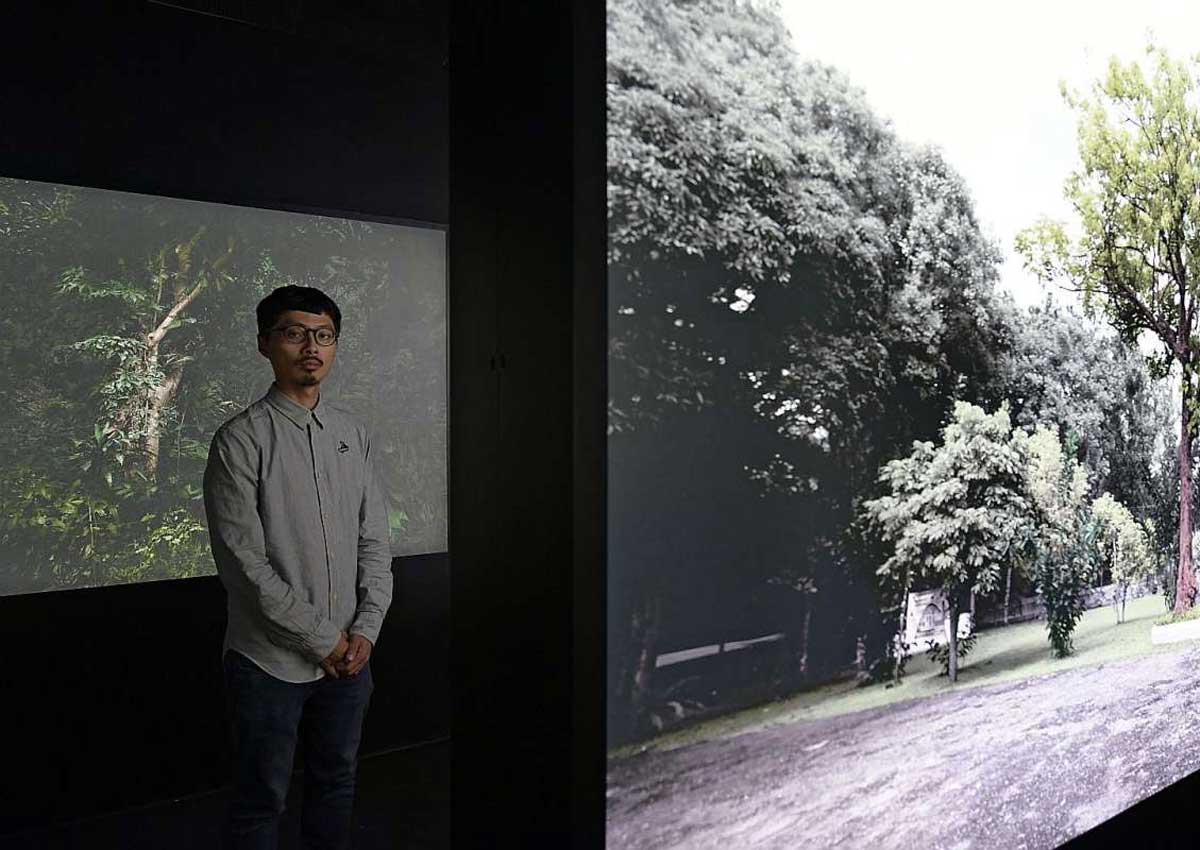
Singapore, Very Old Tree showcases 17 photos by local artist Robert Zhao (above) of old trees around Singapore and the people whose lives they have taken root in.The Straits Times
Twenty years ago, odd-job labourer Ramanathan, who goes by one name, saved a mangosteen sapling from bulldozers near Old Kallang Airport.
Mr Ramanathan, now 70, replanted it in the same area and has been spending time with it every day, sometimes sleeping in its shade overnight.
His story is one of those told in the project, Singapore, Very Old Tree, by local artist and photographer Robert Zhao.
The collection of 30 photographs features old trees around Singapore, as well as the people whose lives they have taken root in.
Seventeen of the photos appear as lightboxes in an exhibition at the foot of the National Museum of Singapore’s glass rotunda. The other 13 photos are not displayed.
Zhao, 33, had not worked with trees before this, but was inspired to branch out into this area by a 1904 postcard from the National Archive of a huge tree with a person, tiny in comparison, standing in its shade.
“It occurred to me that if that tree is still around today, it could be 100 or even 200 years old,” he says.
“Our landscape changes so fast, but these trees remain. They are silent witnesses to the history of Singapore.”
For about a year, he trekked all over Singapore with his wife, arts journalist Adeline Chia, also 33, looking not just for old trees, but also people who were able to tell their stories.
This was no easy task. They would sometimes have to stake out a tree of interest for two to three weeks before they could find somebody with knowledge of its history.
More often than not, they hit dead ends.
“I would see trees so old, so big and magnificent, that I knew they had some wonderful story to tell,” he says.
But he would be unable to find any human connection.
Despite this, he persevered in gathering the stories of trees. Some notable trees he photographed include the “Seletar Wedding Tree”, a casuarina in Seletar Reservoir.
Couples would queue on weekends to take bridal shots with it.
Another is the Monkey God Tree in Jurong West, an African mahogany that had part of its bark scraped off in a car accident, revealing what looks like the outlines of two monkeys on its trunk.
People would come from all over Singapore to pray at the tree for good luck and lottery wins.
Zhao himself was caught up in the story of one of these trees, when he watched the massive banyan tree behind The Substation get uprooted in 2014 to make way for the construction of a new Singapore Management University building.
“They thought it would take them one day, but it took them four,” he recalls. “Bats were flying out of it when they were trimming it down.”
When parts of the banyan had to be cut away, old bricks from the former National Library were found among its roots.
Zhao photographed the tree later in transition, as it sat in a nursery waiting to be transplanted to a location not yet known.
Were he a tree himself, he would be a banyan, he says.
“It is wild and uncontrollable, yet it has learnt to thrive well in the city.”
Through his work, he hopes to explore the ways in which urban planting impacts individuals.
“How does being a green city really affect Singaporeans?
“We grow and we cut, we grow and we cut – it’s part of the way our landscape is.
I want to find the trees – and the stories – that remain.”
354908
2016-12-07 09:36:51
Photo Gallery
National Museum adds stunning forest-themed installations
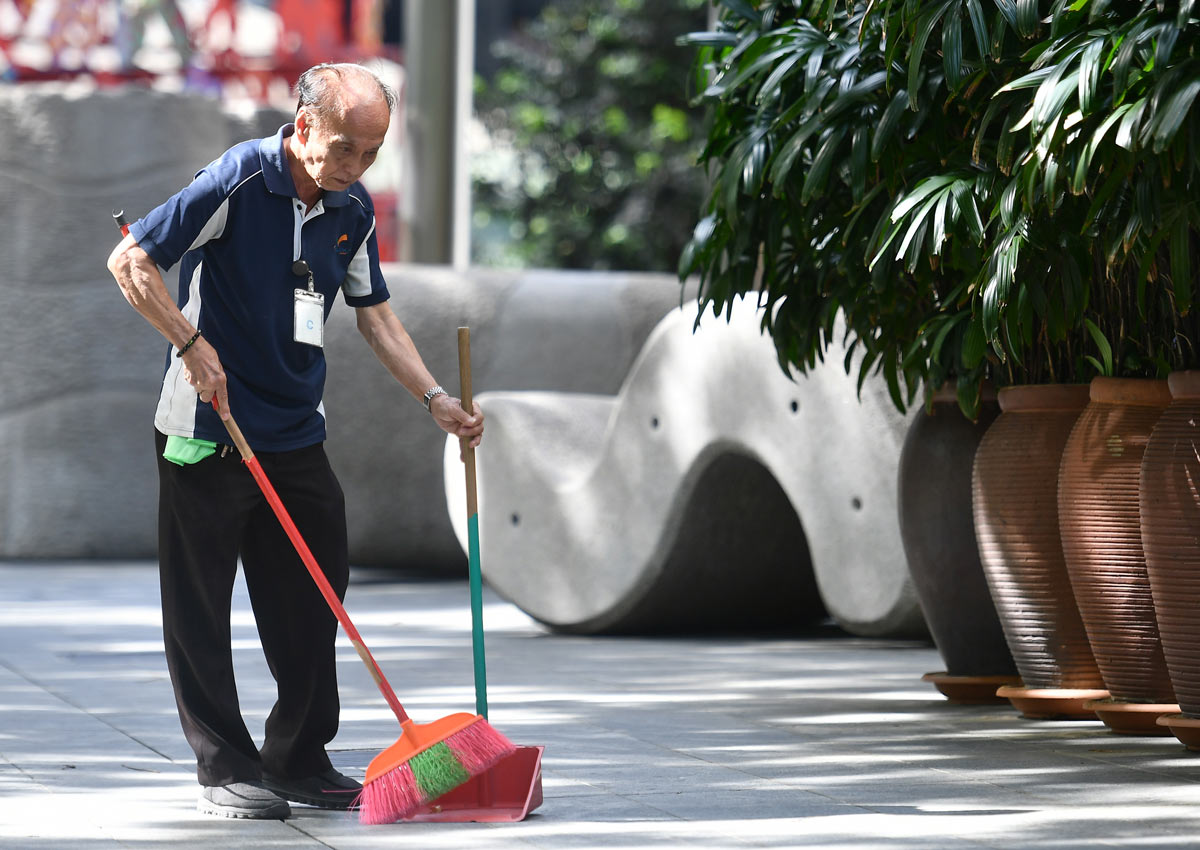
Cleaners’ basic pay will go up by $200 in the next three years, starting from next July. It will then rise yearly by 3 per cent for three years.
Those employed by the same business for at least 12 months will get a yearly bonus, starting from 2020, of two weeks of basic monthly pay.
The recommendations, unveiled by the Tripartite Cluster for Cleaners (TCC) yesterday, further boost the wages of some of Singapore’s lowest-paid workers.
Said National Trades Union Congress assistant secretary-general Zainal Sapari, who chairs TCC: “The (change) may be seen as a half-step, but (it) is a big half-step. This is the first time we are forcing an industry’s annual increments, as well as some form of bonus.”
The Government has accepted the recommendations, which will benefit about 40,000 Singaporeans and permanent residents employed by more than 1,200 cleaning firms.
Companies with service contracts that start before next Julyhave until July 1, 2018 to comply with the recommended wages.
The TCC suggestions follow its review of the progressive wage model in the cleaning industry.
The modelaims to raise the pay of low-wage workers through skills upgrading and improvements in productivity.
It applies to the cleaning, security and landscape sectors, and became compulsory for the cleaning industry in September last year.
The model specifies a starting pay of at least $1,000 a month for cleaners, with wages rising to $1,400 and more for higher-skilled cleaners, and from $1,600 for supervisors.
The median basic wage of full-time cleaners grew by 9 per cent from 2012 to last year. It was $1,100 in June last year.
Said Mr Zainal: “We need to make employment terms and conditions better. Otherwise, the type of workers attracted to the cleaning industry will be the vulnerable ones.”
Jakarta Governor Basuki “Ahok” Tjahaja Purnama will receive legal assistance from 80 lawyers for his blasphemy trial, which will start on Tuesday at the North Jakarta District Court – now temporarily located at the former Central Jakarta District Court building on Jl. Gajah Mada No.17, Central Jakarta.
Led by lawyer Sirra Prayuna, the legal team will assist Ahok to ensure the court’s judge panel that Ahok never had any intention to commit blasphemy against Islam and Muslim people in Indonesia.
One of Ahok’s lawyers, Ronny Talapessy, said they were ready to face Tuesday’s trial, which was scheduled to be the reading of indictments.
“Today, we will convey our exception against the indictments,” Ronny told The Jakarta Post. He refused to reveal further details of the exception.
A panel comprised of five appointed judges from the North Jakarta District Court is scheduled to start the trial at 9 a.m. They are H. Dwirso Budi Santiarto, Jupriyadi, Abdul Rosyad, Joseph V Rahantokman and I Wayan Wirjana.
Tens of thousands of Muslim hardliners in protest march against Jakarta governor for alleged blasphemy
The Attorney General’s Office’s (AGO) prosecutor team led by Ali Mukartono has charged Ahok of violating Articles 156 and 156 (a) of the Criminal Code (KUHP) concerning blasphemy, which carries a maximum sentence of five years in prison. This led to criticism because it took only less than a week for the prosecuting team to examine Ahok’s 826-page case dossier.
Ahok was accused of blasphemy after he cited Surah Al Maidah 51 during his conversation with people in Thousand Islands during a visit on Sept.27.
Get $5 off your taxi fare when you book via ComfortDelGro Taxi Booking App from the 13th of December to 14th December and use the promo code “INSTA5”. Valid for the first 4000 redemptions
Hong Kong: The city’s pro-democracy camp has secured more than a quarter of the seats – its most ever – on an election committee that will pick Hong Kong’s next leader.
In the election on Sunday, the pan-democrats, the main opposition to the pro-establishment bloc deemed to be supportive of China, won 325 seats in the 1,194-member panel which will choose the city’s next chief executive on March 26 next year.
A record 107,000 voters, or 46 per cent of 230,000 eligible voters, turned up to vote to fill 733 seats on the committee.
The remaining 461 seats were returned uncontested or held by the likes of lawmakers.
The turnout was nearly 20 percentage points higher than that for the previous committee election in 2011, when the overall turnout rate was 27.6 per cent.
Analysts say this reflected professionals’ discontent with the city’s government.
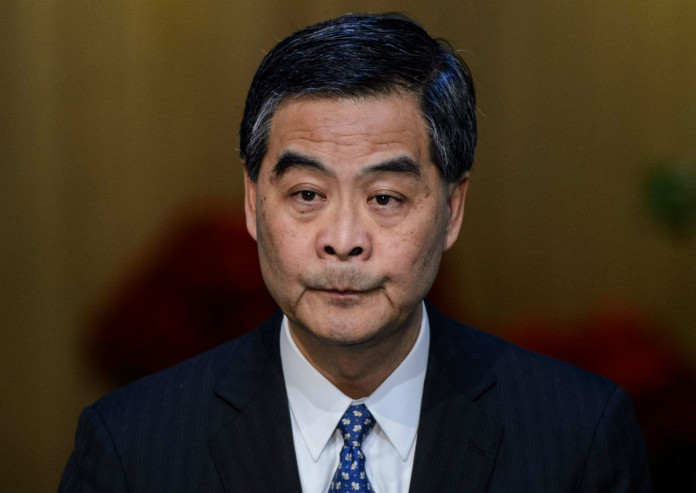
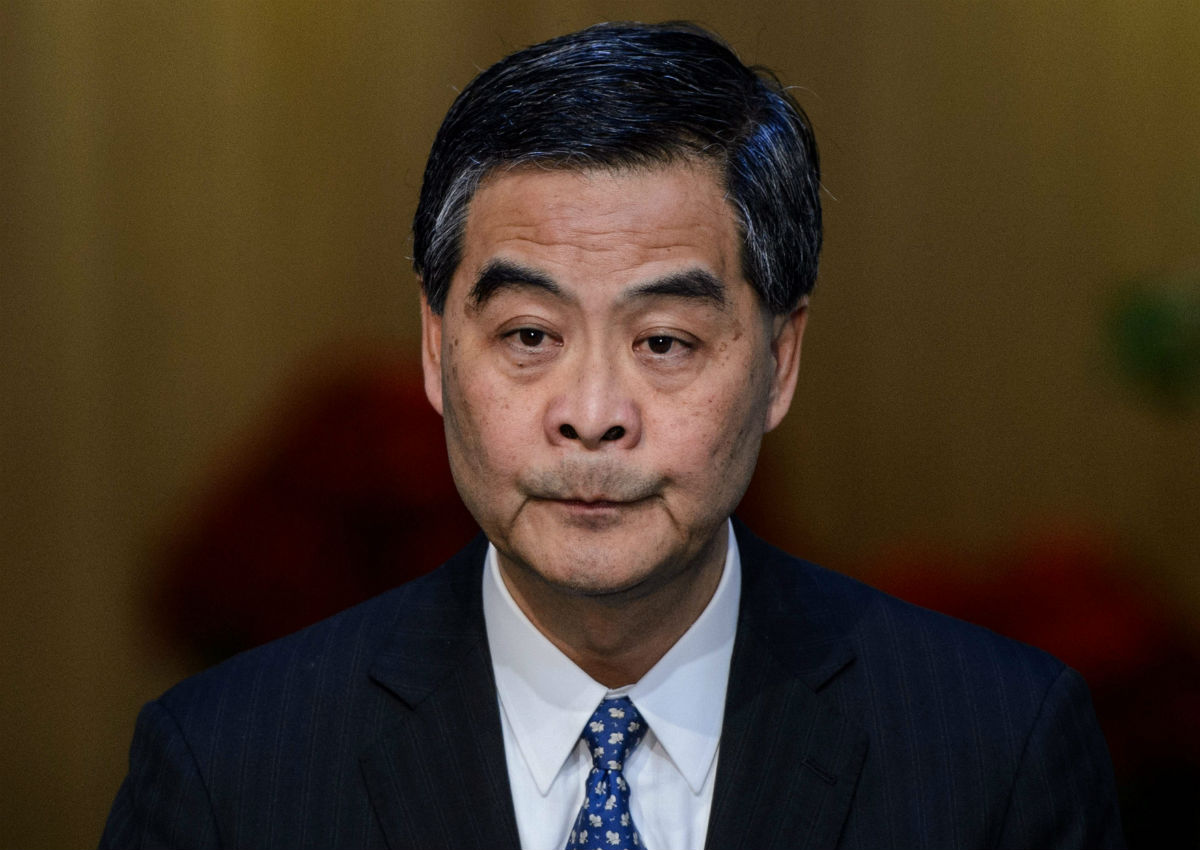
Political analyst Willy Lam believed Hong Kong Chief Executive Leung Chun Ying’s announcement last Friday that he would not seek re-election spurred more pro-democracy supporters to vote.
“Pan-democrats want to prove to Beijing that they have the ability and they are a force to be reckoned with,” said Dr Lam, who noted how the ballots were previously dominated by pro-Beijing voters.
The election committee is made up of four major sectors – economic, professional, social and political – each having 300 seats.
These are subdivided into 38 sub-sectors. The pan-democrats, who won 205 seats in the 2011 election committee polls, had targeted at least 300 seats in their bid to stop Mr Leung from winning a second term.
At least 601 votes are needed for a contender to become the next chief executive.
Occupy Central co-founders, who had failed in their push for a “one man, one vote” system in choosing the chief executive four years ago, managed a clean sweep of 30 seats in the higher education sub-sector.
The pro-democracy camp saw landslide victories in five other professional sectors – legal, education, social welfare, IT and health services.
The camp also gained almost all seats in the accountancy sector and the architectural sectors.
Veteran politician Alan Leong of the Civic Party, who was elected under the legal sub-sector, said that by acting together, the pan-democrats could prevent another candidate who showed similar traits and ideologies as Mr Leung from being elected as the next chief executive.
UNITY
“Our unity means we are not a negligible force. But as to exactly how important we shall be depends on the final mix of candidates.”
Only retired judge Woo Kwok Hing has so far announced he is running for the top post.
A pro-establishment figure, lawmaker and former Security Secretary Regina Ip, is expected to announce her candidacy on Thursday.
Two other potential pro-establishment candidates are Chief Secretary Carrie Lam and Financial Secretary John Tsang, who has quit his post and is expected to declare his candidacy.
If all three potential pro-establishment contenders enter the race, this could lead to votes being split, giving the pan democrats a bigger say in the outcome, said analysts.
“We could see CY Leung’s supporters turning to Carrie Lam and there is a possibility that John Tsang might win some votes from the pan-democrats,” said Dr Lam.
How the chief executive is elected
Hong Kong’s next leader will be elected by an Election Committee made up of 1,194 members.
The committee represents four sectors – economic, professional, social and political.
Under these, there are 38 sub-sectors representing various trades, professions, social services groups and district organisations.
The committee comprises business elites, professionals and lawmakers.
Some of the sub-sectors elected their members by drawing lots, while others were voted in during a polling exercise on Sunday.
About 230,000 people under the various sub-sectors were eligible to cast their ballots to fill 733 seats on the 1,194-member Election Committee on Sunday.
And a record number of 107,000 registered voters cast their votes.
This term, 461 seats are returned as they were uncontested or held by ex officio members, or those given a seat by virtue of their posts, such as lawmakers in the Legislative Council.
Six sub-sectors – legal, education, higher education, social welfare, IT and health services – saw clean sweeps by the pan-democratic camp, while business sectors such as hotels, tourism and commerce continued to be dominated by pro-establishment forces and tycoons.
The hotels sub-sector, dominated by property developers, saw Mr Gary Harilela, director of Harilela Hotels, Mr Lui Che Woo, founder of K. Wah Group, and second-generation tycoons including Sino Land’s Mr Daryl Ng Win Kong, Hopewell Holdings’ Mr Thomas Wu and Henderson Land Development’s Mr Martin Lee Ka Shing, elected, reported South China Morning Post.
In the financial services sub-sector, 33 candidates fought for 18 seats, and eight who supported Mr Leung Chun Ying in his bid to become chief executive in 2012 were re-elected.
To become a chief executive candidate, one must secure nominations from at least 150 committee members.
The next chief executive needs to secure more than 600 votes to win.
This article was first published on December 13, 2016. Get The New Paper for more stories.
She was crossing the road at a pedestrian crossing on Jalan Sultan when a car shot past her.
Shocked by the narrow miss, Madam Ang Chai Lian, 72, fell and hit her head.
With her head bandaged, Madam Ang told Chinese language newspaper Lianhe Wanbao at Tan Tock Seng Hospital (TTSH) that she was fortunate to be alive.
“Had I been one step quicker, I would have been dead,” she said.
The cleaner was among the eight people injured when a grey sedan crashed into a black MPV at the junction of Jalan Sultan and Victoria Street just before 8.15am on Sunday.
The sedan also crashed into a traffic light as the MPV skidded out of control before ending up on the second lane of Victoria Street, in front of Hotel Boss, reported The Straits Times.
Madam Ang, who lives alone, was on her way home from the market.
She told Wanbao that she had barely taken two steps onto the traffic light crossing when the car zoomed past, narrowly missing her.
“I was so shocked that I fell backwards and hit my head, which developed a bump. I was in so much pain that it took me five minutes to get up,” she said.