28.7 C
Singapore, SG
Thursday, September 24, 2026
Home Blog Page 2211

India's stellar economic performance set to slow this year: ADB report

0

For several years, India has been a star performer among Asian economies, with annual output rising continually above the 7 per cent level while China’s growth has eased and other economies slowed.

But India’s short-term prospects have dimmed, according to the Asian Development Bank (ADB).

In a supplement to its Asian Development Outlook 2016 Update report that was published in September, the ADB said on Wednesday that it was cutting its earlier projection that Indian gross domestic product (GDP) would grow by 7.4 per cent this year to just 7 per cent.

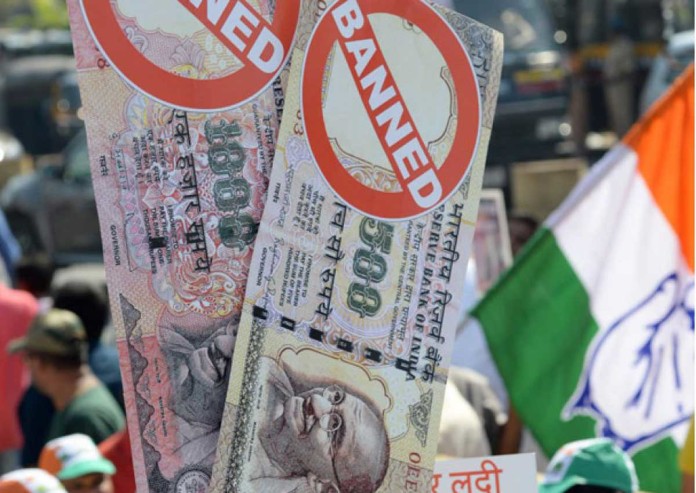
This is due, the ADB said, “to weak investments, a slowdown in the country’s agriculture sector, and the lack of available cash due to the government’s decision to ban high-denomination banknotes”.

The decision affecting banknotes, the ADB said, “will likely affect largely cash-based sectors in the country including small- and medium-scale businesses”.

It added, however, that “the effects of the transition are expected to be short-lived and the Indian economy is expected to grow at 7.8 per cent in 2017”.

The impact of the Indian downgrade on South Asia as a whole will be to slow growth in the sub-region to 6.6 per cent in 2016 compared to an earlier forecast of 6.9 per cent, although growth is forecast to bounce back to 7.3 per cent next year.

The impact on “developing Asia” as a whole will be to slow growth in 2016 from the 5.7 per cent growth forecast in September to 5.6 per cent, the ADB noted.

Meanwhile, “economic growth in developing Asia remains broadly stable”, the Manila-based development institution suggested.

“Asian economies continue their robust expansion in the face of global economic uncertainties,” said ADB deputy chief economist Juzhong Zhuang upon the launch of the latest report.

“Structural reforms to boost productivity, improve investment climate, and support domestic demand can help maintain growth momentum into the future.”

Combined growth in the advanced industrial economies has, meanwhile, “exceeded expectations, ticking up 0.1 percentage point to 1.5 per cent in 2016”, said the ADB report.

“Growth in 2017 (for advanced economies) is maintained at 1.8 per cent.

Robust consumer spending supported the US’ supportive monetary policy and improved labour markets fuelling growth in the euro area.”

Growth forecasts by the ADB for East Asia as a whole are maintained at previous levels for 2016 and 2017.

Growth this year will reach 5.8 per cent, with a slight moderation to 5.6 per cent in 2017, the ADB suggested.

Growth in China, the world’s second-largest economy, “is expected to hit 6.6 per cent this year, driven by strong domestic consumption, solid wage growth, urban job creation, and public infrastructure investment”, said the ADB.

The forecast for China in 2017 is maintained at 6.4 per cent.

“In South-east Asia, growth forecasts remain unchanged at 4.5 per cent in 2016 and 4.6 per cent in 2017, with Malaysia and the Philippines expecting stronger growth due to a surge in domestic consumption and public and private investment, compared to lower growth forecasts in Brunei, Myanmar, and Singapore.”

The outlook in central Asia is, meanwhile, maintained at 1.5 per cent in 2016 and 2.6 per cent in 2017, as the ongoing recession in the Russian Federation and low global commodity prices for oil and natural gas continue to dampen growth in the sub-region


This article was first published on December 14, 2016.
Get The Business Times for more stories.
Image: 
Category: 
Publication Date: 
Wednesday, December 14, 2016 – 16:05
Send to mobile app: 
Source: 


Story Type: 
Others

Source link

Singapore will also prosper if Iskandar Malaysia region succeeds: PM Lee

0

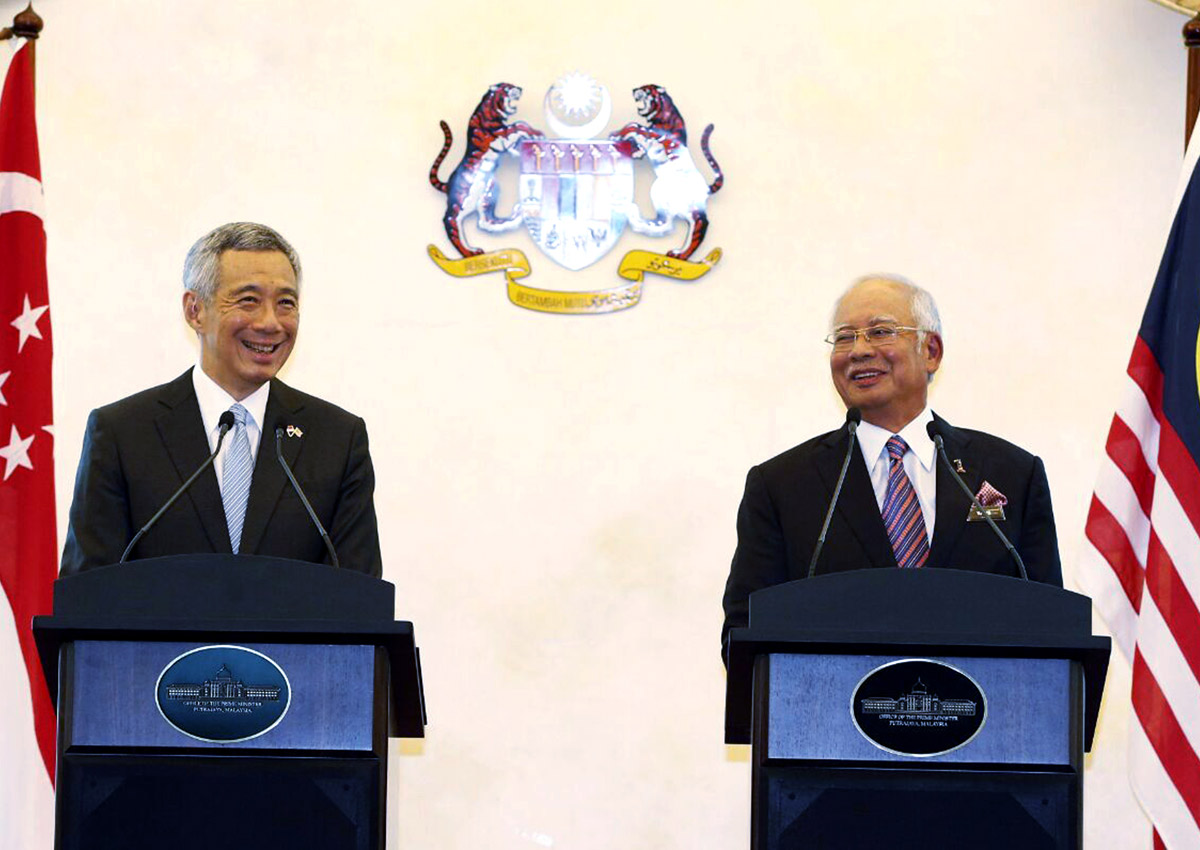
Singapore will prosper if the neighbouring Iskandar Malaysia region in the state of Johor does well, said Prime Minister Lee Hsien Loong on Tuesday.

Mr Lee, who was in Putrajaya to attend the annual leaders’ retreat with Malaysian Prime Minister Najib Razak, said he congratulated Mr Najib on the tenth anniversary of Iskandar Malaysia this year.

Since its launch, Iskandar Malaysia has attracted more than RM200 billion (S$64.3 billion) in cumulative committed investments, with a sizeable amount coming from Singapore companies.

Singapore is currently the second-largest foreign investor in both Iskandar Malaysia and Johor.

Mr Lee added that both governments continue to work closely together via a joint ministerial committee for Iskandar Malaysia.

This high-level committee has met a dozen times since it was formed in 2007. The last meeting was held in Singapore in March this year.

Mr Lee also noted that the various joint-venture projects between Singapore’s Temasek Holdings and Malaysia’s Khazanah Nasional are making good progress.

The two investment companies have a couple of joint projects in Iskandar Malaysia, namely Afiniti Medini and Avira Medini.

These have a strong focus on wellness and have a combined gross development value of some RM3 billion.

Temasek and Khazanah also have a joint-venture company in Singapore called M+S Pte Ltd, which operates two major mixed-use developments – Marina One in Marina South and Duo in the Ophir-Rochor area.

“(The joint projects) show visibly that this is a win-win partnership that is progressing well,” said Mr Lee at a press conference alongside Mr Najib at the Malaysian Prime Minister’s Office.

The subject of water also came up during the leaders’ retreat. Mr Najib said the two countries have agreed to work closely together to ensure that Singapore gets its share of water from Malaysia under the current agreement.

“There are some challenges, not least some of the effects of climate change that has affected the supply of water,” said Mr Najib.

Mr Lee said that when it comes to water, both Singapore and Malaysia are clear on where they stand on this important issue.

“We are happy that we’ve agreed on the importance of ensuring reliable and adequate water supplies from the Johor river as provided for in the 1962 water agreement, and to take the necessary measures in order to make this happen,” said the Singapore leader.

The Johor River Barrage is in the final stages of completion and will be fully operational by March 2017.

Mr Lee said this barrage has already made a difference to help increase the yield of the river.

Among the other topics that the two leaders discussed during their retreat were regional and international developments such as the impending change of government in the United States and Brexit in the UK.

They also talked about the importance of ASEAN integration and cohesion in a highly uncertain global environment.

Mr Najib said that both countries are “very pleased” with the overall state of bilateral relations between Malaysia and Singapore.

“There will always be challenges, but given the commitment at the highest levels that this should be an important relationship, one that is predicated on finding solutions, resolving problems and moving forward in a positive way,” he said.

“That’s the spirit that reflects the relationship that we’ve enjoyed between (PM Lee and I) and the two governments.”

leeuwen@sph.com.sg


This article was first published on December 14, 2016.
Get The Business Times for more stories.
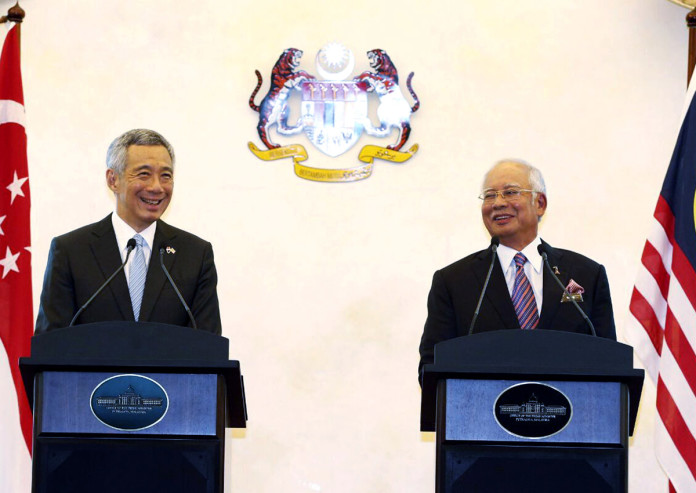
Image: 
Publication Date: 
Wednesday, December 14, 2016 – 14:09
Send to mobile app: 
Source: 


Story Type: 
Others

Source link

Singapore is no tax haven: Govt, experts here

0

A recent report has revived claims Singapore is a tax haven but the Singapore Government and experts here reject the label emphatically.

They say the report contains inaccurate assertions and fails to recognise recent steps here to crack down on tax evasion.

The Republic ranked fifth on a list of the “world’s worst tax havens” in the report compiled by British charity Oxfam, with the “worst” being countries which “employ the most damaging tax policies”.

Switzerland, long known for its banking secrecy, came in fourth and Bermuda placed first.

A Singapore Ministry of Finance (MOF) spokesman said: “Singapore’s tax policies are designed to support substantive economic activities in order to create skilled jobs and build new and enduring capabilities in Singapore.

“We do not condone any tax evasion activities or actions aimed at base erosion and profit shifting (Beps). Singapore is able to keep the headline corporate tax rate competitive at 17 per cent because we are fiscally prudent and have a diversified tax base.”

Beps includes booking profits in a nation with low corporate tax to avoid higher taxes where the business mainly operates.

Singapore’s corporate tax rate of 17 per cent is among the lowest in the world.

If United States President-elect Donald Trump has his way, the US corporate tax rate will be slashed from 35 per cent to 15 per cent.

As tax havens generally have low taxes, Singapore is often viewed as a tax haven.

Mr Chris Woo, tax leader at PwC Singapore, is adamant the Republic is not a tax haven.

“Singapore has always had clear law and regulations on taxation. Our incentive regimes are substance-based and require substantial economic commitment. For example, types of business activity undertaken, level of headcount and commitment to spending in Singapore as well as projected growth in Singapore,” he said.

Mr Chester Wee, partner of international tax services at Ernst & Young Solutions, noted that Singapore adopts tax policies that enhance economic competitiveness and attract foreign direct investments.

He added: “Singapore’s tax incentive programmes come with strict substance-based conditions such as headcount requirements, local business spending and value-added activities.”

The MOF also said Singapore has been working with the global community to combat tax evasion.

In recent years, the Organisation for Economic Cooperation and Development and G-20 have started a project encouraging tax authorities to set standards to help clamp down on Beps, and Singapore has provided input since 2013.

The MOF added that since June, Singapore has joined another plan to “work with other participating jurisdictions to ensure the consistent implementation of measures under the BEPS Project, and a level playing field across jurisdictions”.

An earlier international review this year also rated Singapore and Switzerland as “largely compliant” in tax matters.

The MOF noted that Oxfam cited a “lack of withholding taxes as one of the characteristics of our regime”.

“This is inaccurate. Withholding tax (for example, interest, royalty, services and so forth) is applicable for payments made to non-resident persons,” the MOF spokesman said.

The MOF added that Singapore does not impose withholding tax on dividends owing to its one-tier corporate tax system.

Profits are taxed at the corporate level – as a final tax.

Mr Wee said: “In terms of several other criteria that Oxfam has listed in order to qualify as a tax haven, Singapore is in a better position than many other jurisdictions. The perception of Singapore as a tax haven stands to be corrected.”

rachaelb@sph.com.sg


This article was first published on December 14, 2016.
Get a copy of The Straits Times or go to straitstimes.com for more stories.
Image: 
Category: 
Publication Date: 
Wednesday, December 14, 2016 – 14:00
Keywords: 
Send to mobile app: 
Source: 


Story Type: 
Others

Source link

Abe wants to cut Japan's long work hours so women can return to workforce – but will it work?

0

TOKYO – Japan is notorious for its long working hours. A typical worker pulls an average of 60 hours per week, compared to workers in the United States, who work an average of 34.4 hours each week.

But this may soon be a thing of the past if Prime Minister Shinzo Abe manages to reform the workforce driving the Japanese economy.

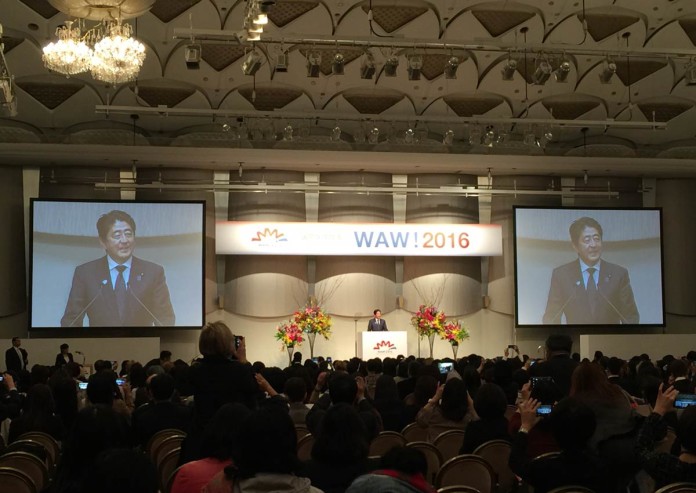
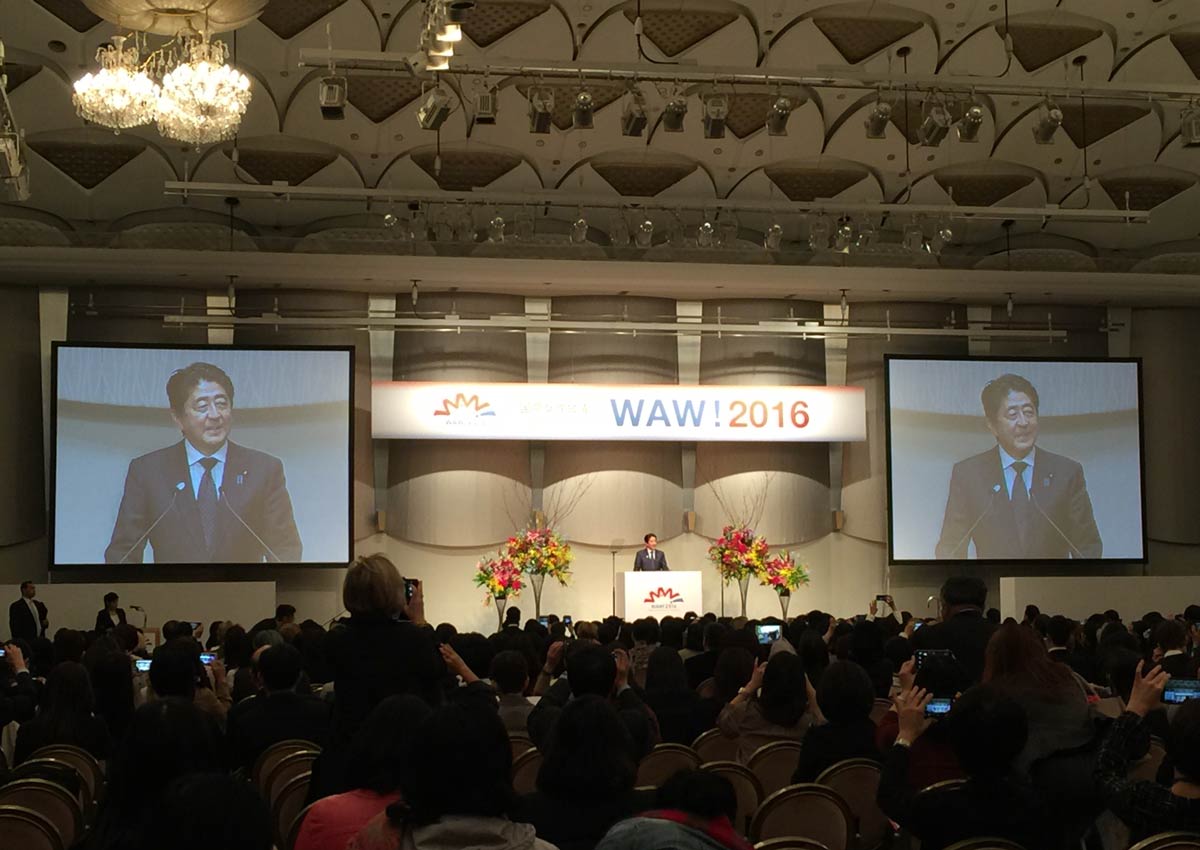
At the third World Assembly for Women 2016 (WAW! 2016) held in Tokyo on Tuesday (Dec 13), Abe addressed the practice of working long hours, a problem he said is “rooted in our corporate culture and our lifestyle here in Japan”.

To counter this, he plans to reform the way Japanese work by introducing measures such as ceilings on allowable overtime work, closing wage gaps between men and women, and providing more incentives for companies. 

Japan’s ageing workforce has been challenged with the absence of working women, where 3 million women between 25 and 40 years old who have left their jobs to look after their children, find it difficult to return to work.

This gap is costing the economy.

According to data released by Goldman Sachs in 2014, closing the gap between working men and women will boost Japanese GDP by as much as 13 per cent, so it is no wonder that getting women back at work – and in leadership positions – tops Japan’s priority list, so much so that the prime minister in 2015 labelled the dynamic engagement of women as “womenomics”.

While Japan has introduced a policy in April, whereby companies are required to incorporate numerical targets in hiring women and promoting them to key executive positions, the goal of getting women to occupy 30 per cent of management positions by 2020 is proving to be challenging.

Although employment rate of mothers have increased by 71.6 per cent from 2012 to 2015, lack of childcare facilities and help at home from spouses are the main reasons that are preventing women from working again.

“Reforms to our ways of working will not succeed without changes to men’s ways of thinking. Couples should share the responsibility for household chores and for child-raising.

“Japanese men are notorious – but I am not the case – for not doing housework,” said Abe at the opening address of the two-day conference, attended by delegates from the United Nations as well as international participants from various sectors.

Abe also recommended the civil service lead by example and that men should take paternity leave right after their wives give birth.

While there are concerted efforts by the government to push for men to share household chores with their wives – even getting elementary school boys to take up compulsory home economics classes and male politicians to don pregnancy suits – women are still doing five times more chores than their husbands.

Childcare facilities in the neighbourhoods are few and far between, not to mention the long wait lists. Teleworking as an option is only just being explored.

“We will revise the the guidelines for teleworking, which until now have been limited to cases of telecommuting from home, to match the current situation in which mobile devices permeate society.

“We will also compile means of controlling working hours in order to avoid giving rise to long working hours,” said Abe.

Will “womenomics” work?

Getting women to revitalise the economy is far more complex than having more childcare leave or dishing out guidelines to the private sector. Changing men’s mindsets on what a woman’s “real job” will be a long and arduous task, but what needs to be fixed urgently is Japan’s day care centre system.

An article published by The Japan Times in April described the “vicious cycle” of day care centres here.

While the shortage in day care centres stem from the 1990s, the issue of low wages for nursery teachers has prevented more day care centres from being built. On top of that, a point system that prioritises parents by their career, marital status, health and income are hindering the chances of registering their children.

Although the Japanese government has adopted multiple measures to improve the childcare facilities, the root problem lies where the money is.

According to The Japan Times, nursery teachers earn an average of 219,000 yen (S$2,707) per annum, compared to the national average of 333,000 yen. The taxing nature of the job has also led to high turnover rates among nursery teachers.

While the government injected 17.7 billion yen this year to bring about just a 1.9 per cent increase in salary, it has yet helped to make significant improvements to the nursery sector.

Increasing nursery teachers’ wages and improving their jobs will directly help other women in Japan return to the workforce.

If that cannot be realised, Japan’s ageing workforce may see fewer and fewer women in the coming years.

klim@sph.com.sg

AsiaOne editor Karen Lim is attending the WAW! 2016 conference held on Dec 13 and 14 in Tokyo as the Singapore representative under invitation by Japan’s Ministry of Foreign Affairs.

Image: 
Publication Date: 
Wednesday, December 14, 2016 – 13:25
Send to mobile app: 
Source: 


Story Type: 
Original Story

Source link

PM shows his senior credentials

0

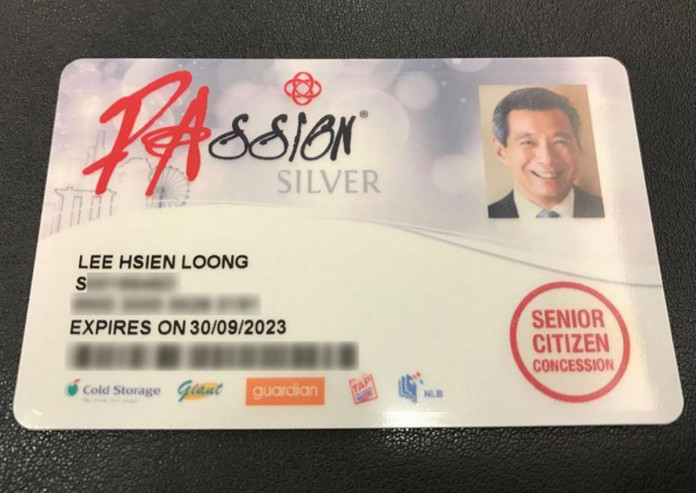
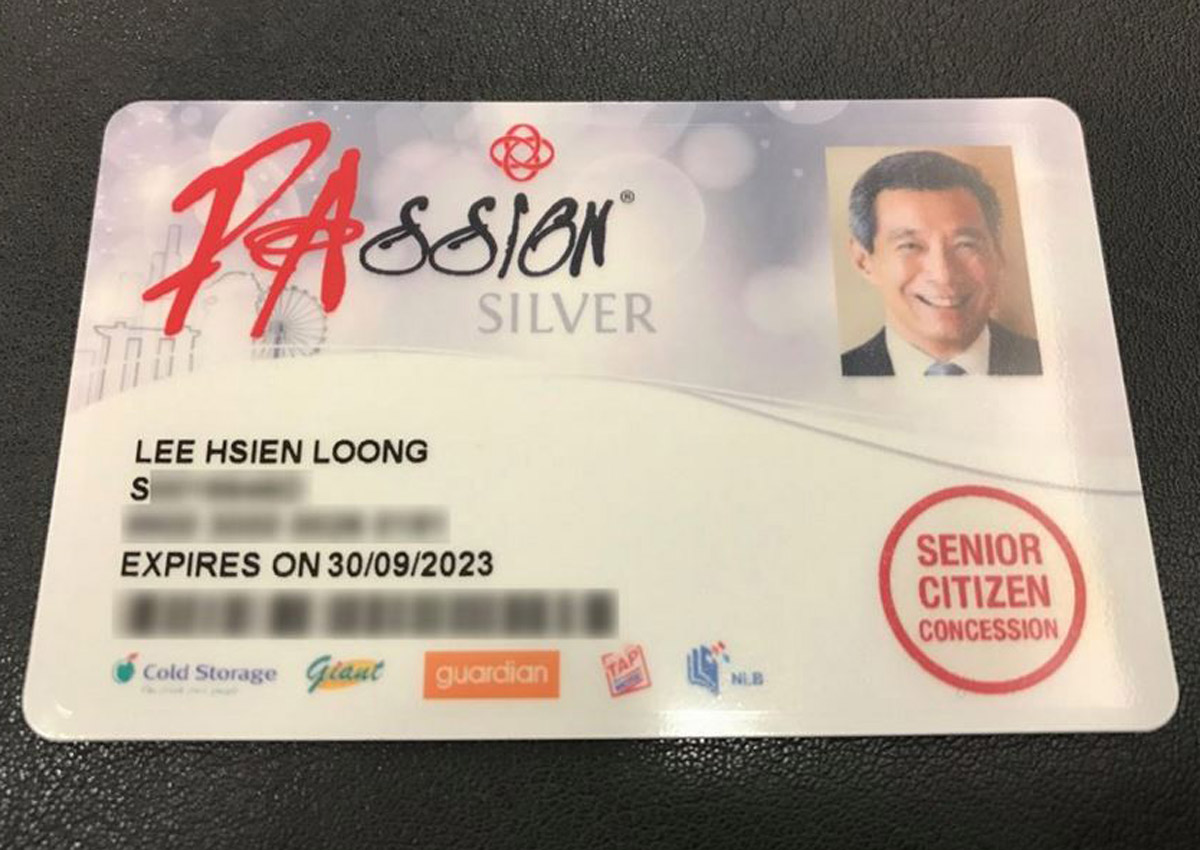
Prime Minister Lee Hsien Loong posted a photo of his new PAssion Silver Concession Card on Facebook and Twitter yesterday, joking that he is “now a certified senior citizen”.

PM Lee, who turned 64 in February, added that he is “looking forward” to using his card.

Netizens responded with jokes of their own, along with good wishes.

Facebook user Elaine Chan said: “Dear PM, you may possibly be one of the very few to wear (a) suit and tie for (a) picture on such a card.”

The new PAssion Silver Concession Card, which was launched on Dec 4 this year, merges the existing Senior Citizen Concession Card with the PAssion card.

It is a joint initiative by the Ministry of Health, Ministry of Transport and People’s Association (PA), and is supported by the Land Transport Authority and Singapore Business Federation.

on Facebook

Received my new PAssion Silver Concession Card yesterday. I am now a certified senior citizen! 🙂

This new card was…

Posted by Lee Hsien Loong on Monday, 12 December 2016

The card is given free to all Singaporeans who are 60 and older, and provides concessionary fares on public transport as well as discounted rates for PA community clubs’ courses, activities and facilities.

Other benefits include 3 per cent discounts at Giant supermarket outlets on Tuesdays and at Cold Storage stores on Wednesdays.

From Dec 5 this year, the card is automatically mailed to the home addresses of those who are currently 60 and older, and who are existing Senior Citizen Concession Card holders.

Those who do not have Senior Citizen Concession Cards will receive a letter by Jan 31, 2017, requesting a photograph submission before they can receive their PAssion Silver Concession Cards.

Seniors who turn 60 next year will receive invitation letters after they become eligible.

lydialam@sph.com.sg


This article was first published on December 14, 2016.
Get a copy of The Straits Times or go to straitstimes.com for more stories.
Image: 
Category: 
Publication Date: 
Wednesday, December 14, 2016 – 14:00
Send to mobile app: 
Source: 


Story Type: 
Others

Source link

Jun Ji-hyun the only woman on 10 best actors list

0


Jun Ji-hyun of “The Legend of the Blue Sea” was the only woman who made it on the list of the 10 best actors of 2016, compiled by Gallup Korea.

The research firm, between Nov. 4 and 25, had run a survey targeting 1,700 Korean men and women above the age of 13 to freely answer their pick of this year’s best two movie stars.

Actor Hwang Jung-min of “The Violent Prosecutor (2015),” “The Wailing (2016)” and “Asura: The City of Madness (2016)” topped the results.

Following in order were Song Gang-ho of “The Age of Shadows (2016),” Gong Yoo of “Train to Busan,” Ha Jung-woo of “The Handmaiden” and Yoo Hae-jin of “LUCK-KEY.”

Lee Byung-hun of “Magnificent 7,” Lee Jung-jae of “Operation Chromite,” Jung Woo-sung of “Asura: The City of Madness, Jun Ji-hyun of “The Age of Shadows” and Ma Dong-suk of “Train to Busan” rounded up the top ten.

Jun, who came in ninth, was the only female in the list.

A local media outlet commented, “Jun is the pride of the Korean actresses in the largely male-dominant field.”

Image:
Category:
Publication Date:
Wednesday, December 14, 2016 – 12:30
Send to mobile app:
Source:

Story Type:
Others

Source link

Analysts slash Singapore growth forecast in 2016 to 1.4%: MAS survey

0

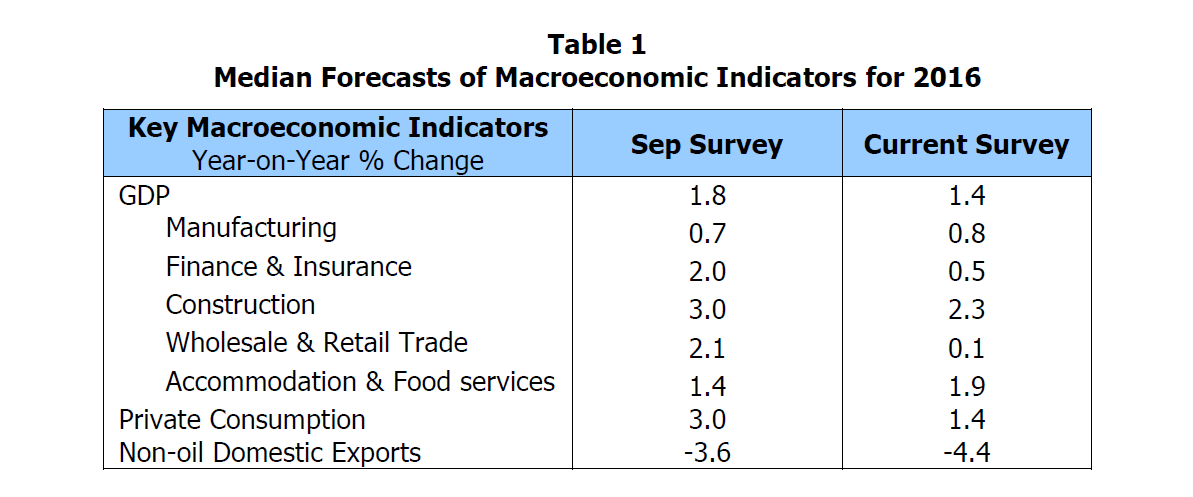
SINGAPORE: Analysts are less optimistic about Singapore’s economy, cutting their growth forecast for 2016 for the third time this year, according to a quarterly survey released by the Monetary Authority of Singapore (MAS) on Wednesday (Dec 14).

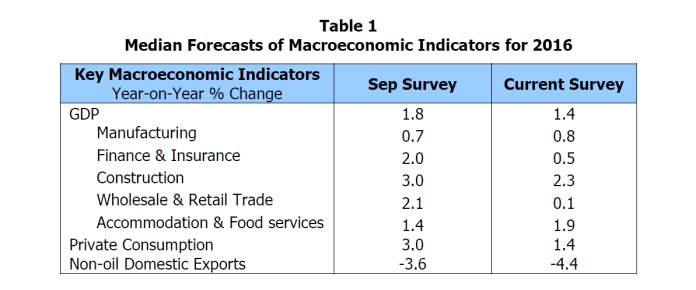
Growth is now expected to come in at 1.4 per cent this year, down from earlier forecasts of 1.8 per cent in the June survey and 1.9 per cent in the March survey.

While in line with the Government’s forecast of 1 per cent to 1.5 per cent growth, it would be Singapore’s weakest annual growth since 2009.

The Singapore economy expanded by 1.1 per cent in the third quarter, lower than the median forecast of 1.7 per cent by analysts in the September survey. For the fourth quarter of 2016, the economists said they expect the economy to expand by 0.8 per cent.

The analysts also cut their growth forecast for 2017, lowering it to 1.5 per cent from an earlier prediction of 1.8 per cent. 

The manufacturing sector is now expected to expand by 0.8 per cent this year, up slightly from 0.7 per cent in the previous survey. The accommodation and food services industry is expected to grow 1.9 per cent, up from 1.4 per cent.

Analysts were less upbeat about other major sectors. The wholesale and retail trade industry is now expected to expand 0.1 per cent this year, down from 2.1 per cent. The growth forecast for the finance and insurance industry was also cut to 0.5 per cent from 2 per cent, while the forecast

INFLATION FORECAST UNCHANGED

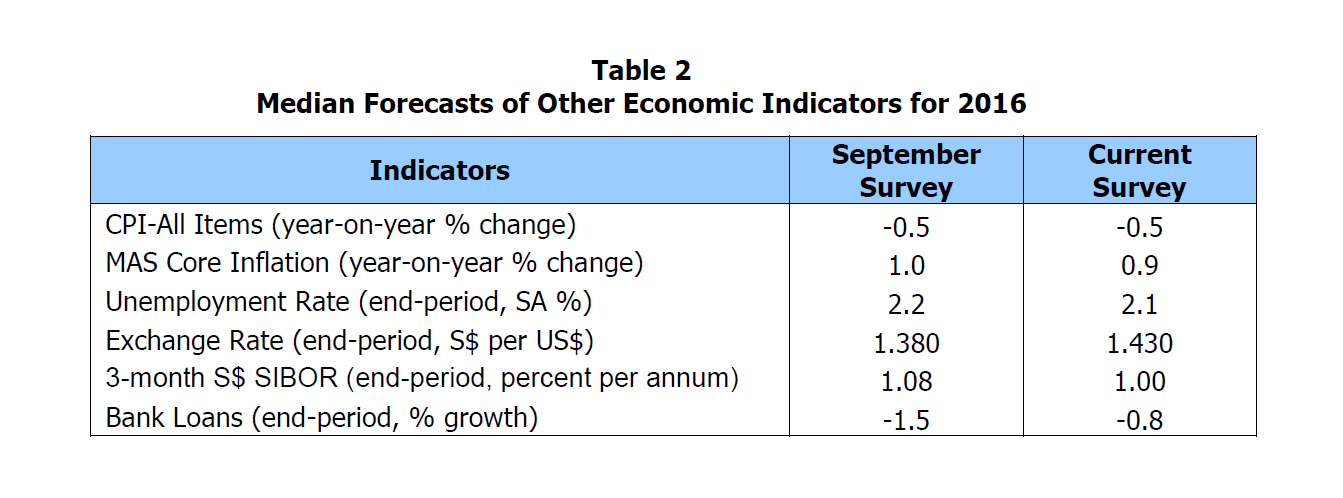
Inflation for the year is expected to come in at -0.5 per cent, unchanged from the analysts’ forecast in the previous survey. For the fourth quarter of 2016, inflation is expected to be zero per cent.

Core inflation – which excludes accommodation and car prices – is expected to 0.9 per cent, slightly down from 1 per cent predicted in the previous survey.

Headline inflation for next year is likely to be 1 per cent, unchanged from the previous survey, while MAS core inflation is expected to be 1.3 per cent, down slightly from the earlier forecast of 1.4 per cent.

Looking ahead, economists said they expect the unemployment rate to be 2.1 per cent at year-end, down from the 2.2 per cent in September’s prediction.

The MAS Survey of Professional Forecasters is conducted every quarter after the release of detailed economic data for the preceding three months. The median forecasts in the latest report were based on the estimates of 22 economists and analysts, MAS said. 

Source link

DBS/POSB cardmembers enjoy exclusive fares on Qatar Airways till 31 Dec 2016

0

DBS/POSB cardmembers enjoy exclusive fares on Qatar Airways to more than 45 cities in Europe, Americas & more till 31 Dec

Travel period: 22nd November 2016 – 30th September 2017

DBS/POSB cardmembers enjoy exclusive fares on Qatar Airways till 31 Dec 2016

Exclusively for DBS/POSB Credit and Debit Cardmembers, Qatar Airways is offering additional discounts off current promotional fares to more than 45 cities in Europe, the Americas, Africa and the Middle East!

Source

Illegal dog slaughter to be banned in Moran Market

0

The slaughter of dogs will be abolished and butchery facilities removed from South Korea’s largest dog meat market, in a move which officials described as a step toward ending the animal welfare controversy over the industry.

The decision was announced Tuesday by Seongnam City Government and the vendors’ association of Moran Market, which, among others, represents its 22 dog meat dealers.

According to their agreement, the dog meat vendors will start removing slaughter facilities and dog cages from next week and will completely move them out by early May.

The city will provide financial support for them to refurbish their shops for new businesses.

The agreement came as part of the city’s project to remodel the traditional, open-air market.

“Starting off with the removal of slaughtering facilities and cages in the market, we will ultimately stop the dog meat trade in Moran Market,” Seongnam city official Kang Won-gu told The Korea Herald.

Moran Market, which opened in the 1960s and sells almost everything from live animals to antiques, has seen at least 80,000 dogs sold either dead or alive each year.

It supplies one third of all dog meat consumed in the country.

Live dogs are kept in cages for customers to choose.

They are then slaughtered at the market in plain sight.

“This may be the beginning of (a long path toward) solving issues surrounding dog meat consumption. (The agreement) will hopefully eradicate the negative image of Moran Market,” Seongnam Mayor Lee Jae-myung told a press conference, announcing the deal with vendors.

Quoting Mahatma Gandhi, Lee also said, “Seongnam City will take the initiative to transform South Korea’s image since ‘the greatness of a nation can be judged by the way its animals are treated.'”

The Korean Animal Welfare Association welcomed the move.

“Seongnam city took a big step toward changing the dog meat industry here,” Jang In-young, an official at the association said over the phone.

“But we will have to constantly monitor dog meat shops in the market (to see) if they really stop slaughtering dogs and change their business (after the agreement). The city government will also need to keep pushing the idea to ultimately ban the sales of dog meat here.”

With no laws having been passed to completely illegalize the sales of dog meat so far, butchery, farming and the consumption of dog meat have continued to thrive in a legal gray area.

The Livestock Product Sanitary Control Act, which governs the slaughter and disposal of livestock and the processing, distribution and inspection of livestock products, does not categorize dogs as livestock that can be processed as food.

Moran Market’s dog meat vendors have been under attack from animal rights groups around the world for their use of brutal methods to slaughter dogs such as through electrocution, hanging, or beating.

Noise and the odour caused by the slaughtering as well as animal carcasses have been a main source of complaints in adjacent residential areas.

Residents often complained that the dog meat market tainted the town’s image.

Seongnam City said its task force would assist vendors in looking for new businesses.

It also plans to solicit opinions from residents, animal right groups, dog meat vendors and others through debate sessions.

Image: 
Category: 
Publication Date: 
Wednesday, December 14, 2016 – 12:11
Send to mobile app: 
Source: 


Story Type: 
Others

Source link

Economists cut Singapore's GDP growth forecasts to 1.4% for 2016, 1.5% for 2017: MAS

0

The outlook for Singapore’s economic growth was trimmed yet again, according to an official survey of forecasters released Wednesday.

The December survey of professional forecasters, sent out in late November, by the city-state’s central bank, the Monetary Authority of Singapore (MAS), found economists turned more bearish since the previous survey.

They expected Singapore’s economy would grow just 1.5 per cent in 2017 on average, down from the September survey’s forecast for 1.8 per cent and the June survey’s projection of 2.1 per cent.

The latest forecasts for 2017 growth ranged from 0.7 per cent to 2.3 per cent.

The December survey, which had 22 respondents, doesn’t reflect the MAS’ own forecasts.

Read also: Over 13,000 laid off in first 9 months of 2016, highest since 2009: MOM

In a statement released December 2, the MAS said it expected Singapore’s gross domestic product (GDP) would rise by 1-3 per cent in 2017 after rising an estimated 1.0-1.5 per cent in 2016.

Singapore’s small, open economy has been buffeted by declines in global trade as well as its exposure to sharp drops in commodity prices.

Redundancies in the first nine months of the year hit their highest since the first nine months of 2009, during the global financial crisis, government data earlier this week showed.

The forecasters expected the headline consumer price index (CPI) would rise 1.0 per cent next year.

The survey found the Singapore dollar was expected to weaken further against the greenback, with the average forecast expecting the US dollar to be fetching around 1.465 Singapore dollars at the end of 2017. The forecasts ranged from 1.37 to 1.55 Singapore dollars. At 12:06 p.m. HK/SIN, the greenback was fetching S$1.4255.

Read also: ‘Technical recession’ looms for Singapore

In the survey, the forecasters also cut their outlook for this year’s growth to 1.4 per cent from 1.8 per cent in the September survey. That followed third-quarter growth coming in weaker than expected at 1.1 per cent on-year, below the September survey’s forecast of 1.7 per cent.

The forecasts for 2016 growth ranged from 1.1 per cent to 1.6 per cent.

The economists now expected the finance and insurance sector would grow just 0.5 per cent in 2016, down from 2.0 per cent in the previous survey. They also cut the wholesale and retail trade growth forecast to 0.1 per cent for 2016, down from the September survey’s 2.1 per cent growth forecast.

The private consumption growth forecast was cut to 1.4 per cent for this year, down from 3.0 per cent in the September survey.

The headline consumer price index was expected to fall 0.5 per cent for the full year, with the forecast unchanged from September.

For the fourth quarter of 2016, economists expected just 0.6 per cent on-year growth on average, with a median forecast of 0.8 per cent. The forecasts ranged from a 0.6 per cent contraction to 1.4 per cent growth.

Read also: Singapore malls are dead as retail occupancy reaches lowest levels in 10 years

Image: 
Publication Date: 
Wednesday, December 14, 2016 – 12:05
Send to mobile app: 
Source: 


Rotator Image: 
Story Type: 
Others

Source link