28.7 C
Singapore, SG
Thursday, September 24, 2026
Home Blog Page 2210

Fight Card Announced for ONE: QUEST FOR POWER in Jakarta on 14 January

0

ONE Championship looks to kick off the new year with a bang when the promotion returns to Jakarta, Indonesia, for their first event of 2017.

Indonesia’s bustling capital city will once again play host to an exciting evening of mixed martial arts dubbed ONE: QUEST FOR POWER, which promises to showcase top international MMA talent alongside the best Indonesia’s top combat sports talents.

The show is scheduled for Saturday, 14 January 2017, at the Jakarta Convention Center.

In the main event, undefeated ONE Middleweight World Champion Vitaly Bigdash (8-0) is set to make his highly-anticipated return to the ONE Championship cage against Polish powerhouse Marcin Prachnio (12-2).

Bigdash, as fans may recall, turned in an absolutely epic performance in his last bout, defeating former champion Igor Svirid to win the title more than a year ago. The Russian middleweight sensation came back from multiple knockdowns to forge his own technical knockout victory.

It was considered one of the best fights in 2015 and arguably the most memorable battle inside the ONE Championship cage.

image

On the other hand, the 28-year-old Prachnio is riding a seven-fight win streak, including two since joining the promotion, defeating both Leandro Ataides and the highly-regarded Jake Butler of Evolve MMA.

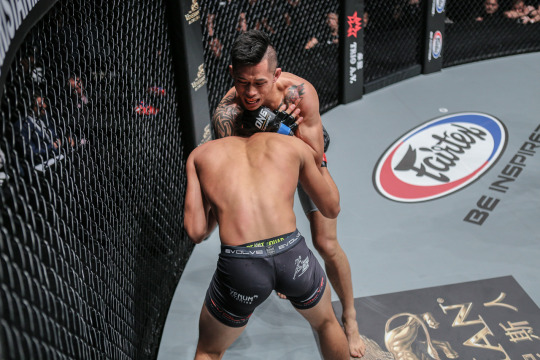
Also to see action at ONE: QUEST FOR POWER is Australian featherweight and former title challenger Martin “The Situ-Asian” Nguyen (7-1). He’ll take on Japanese MMA veteran Kazunori Yokota (25-6-3).

Both Nguyen and Yokota have a common opponent in the form of ONE Featherweight World Champion Marat “Cobra” Gafurov. Gafurov finished both men via rear-naked choke in title bouts.
image

Nguyen is coming off three impressive victories, all thrilling finishes inside the ONE Championship cage. In his most recent outing, Nguyen scored one of the best submissions of the year, putting well-touted featherweight talent Christian Lee to sleep with a guillotine choke.

Yokota, on the other hand, lost to Gafurov in his last contest. However, the Japanese fighter does own the edge over Nguyen in experience, with over 30 professional mixed martial arts bouts under his belt. Prior to his bout against Gafurov, Yokota was riding a 13-fight win streak.

It is an interesting matchup to say the least. You have the raw potential and youthful power of Nguyen, who has improved greatly since he challenged for the belt in 2015, and you have Yokota, who has seen it all inside the cage during a career spanning more than a decade.

Aside from these two compelling bouts, Dutch-Indonesian fighters Vincent Latoel and Anthony Engelen are set to see action inside the ONE Championship cage.

image

Latoel will be taking on Filipino lightweight Vaughn “The Spawn” Donayre, who gave a great account of himself in a tough loss to Singapore’s Amir Khan this past November, while Engelen goes up against Malaysian MMA pioneer AJ “Pyro” Lias Mansor.

Other bouts include Stefer Rahardian versus Jerome S. Paye, Adrian Matheis against the Philippines’ wushu gold medalist Rene Catalan, as well as a battle between “The Terminator” Sunoto and Cambodian Khun Khmer practitioner Chan Heng.

Additional bouts will be announced at a later time.

Confirmed bouts so far for ONE: QUEST FOR POWER are as follows:

Main Event:ONE Middleweight World ChampionshipVitaly Bigdash vs Marcin Prachnio

Main Card:Kazunori Yokota vs Martin NguyenAnthony Engelen vs AJ PyroVincent Latoel vs Vaughn Donayre

Preliminary Bouts:Stefer Rahardian vs Jerome PayeAdrian Matheis vs Rene CatalanSunoto vs Chan Heng

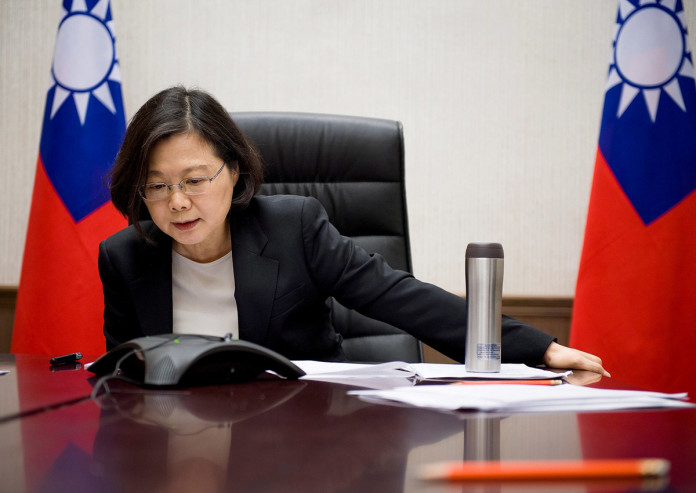
Image: 
Fight Card Announced for ONE: QUEST FOR POWER in Jakarta on 14 January
Category: 
Publication Date: 
Wednesday, December 14, 2016 – 17:36
Send to mobile app: 
Source: 


Story Type: 
Others

Source link

China warns Taiwan over independence after Trump call

0


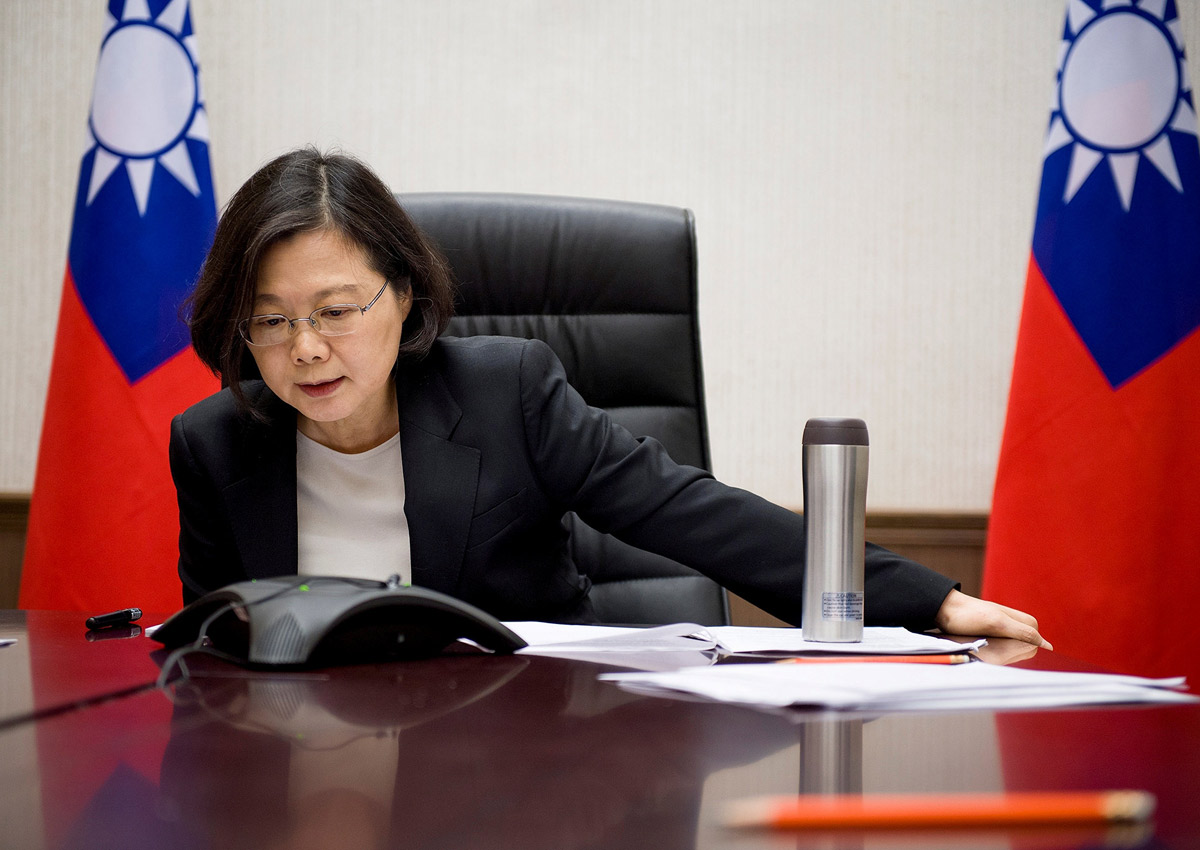
BEIJING – China warned Taiwan that declaring independence would be a “dead end”, state media said Wednesday, after the island’s democratically elected president phoned Donald Trump in a precedent-breaking move.

Beijing’s stance of opposing and blocking “Taiwan independence splittism” is “firm and unmovable”, Taiwan Affairs Office spokesman An Fengshan said at a briefing Wednesday, according to state-owned China News.

Read Also: Trump’s tough talk on Taiwan threatens China more deeply than you think

“We have unshakable willpower, ample confidence, and sufficient capability,” he said. “Facts will show those people that ‘Taiwan independence’ is a dead end.”

The comments came after Trump, the US president-elect, shocked the diplomatic establishment and angered Beijing by speaking directly with Taiwanese leader Tsai Ing-wen after his election victory.

After fierce criticism of the move, he upped the ante, taking to Twitter to ask why he should not be allowed to speak to Tsai, then attacking Chinese foreign and economic policy.

On Sunday, the billionaire businessman went a step further and suggested he could jettison Washington’s decades-old “One China policy” – a compromise allowing the US to do business with both China and Taiwan while only recognising Beijing diplomatically.

Read Also: Taiwan urges calm from China after Trump call

The remarks were a step too far for Beijing, which had initially seemed resigned to taking a wait-and-see approach to the president-elect.

On Monday, Chinese foreign minister Wang Yi warned Trump that anyone who challenges Beijing’s interests on the island will “lift a rock only to crush his own toes”.

China sees Taiwan, which has not been ruled by Beijing for more than 60 years, as a rogue province awaiting reunification, by force if necessary.

Cross-strait relations have deteriorated since Tsai, the island’s first female president, took office in May after her China-sceptic Democratic Progressive Party won a landslide victory.

Image:
Category:
Publication Date:
Wednesday, December 14, 2016 – 16:51
Send to mobile app:
Source:

Story Type:
Others

Source link

NTU testing new driverless mini bus

0

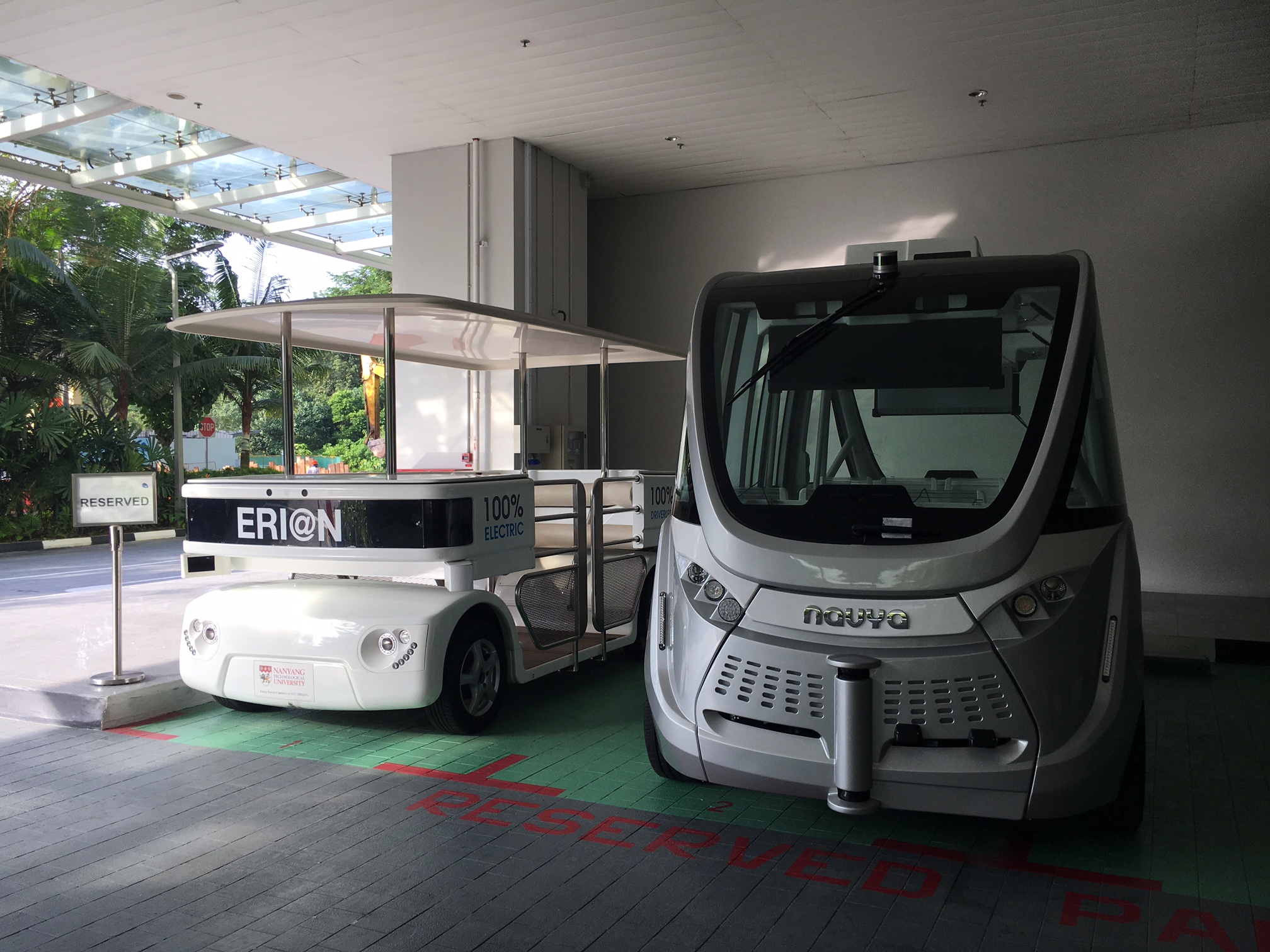
SINGAPORE: A new driverless mini bus is the latest autonomous vehicle that’s being put to the test by the Nanyang Technological University (NTU). It is bigger and more sophisticated than the self-driving golf cart and shuttle that NTU has put on trial since 2013.

One key improvement in testing the mini bus is having more sensors on board for navigation, said the university. There are four cameras and eight light radars, two of which are three-dimensional and provide 360-degree detection. It is also equipped with a GPS system and 3G communication.

At a preview on Wednesday (Dec 14), NTU said the mini bus, which is fully enclosed and air-conditioned, can take up to 15 people, with 11 seated and four standing. By comparison, the older shuttle that NTU has been testing since 2013 only has standing room for eight passengers.

The new vehicle can move at speeds of up to 45kmh, although this will be capped at the campus limit of 40kmh for the trial – still double the speed cap of the shuttle.

On a full charge, the vehicle can run a distance of 130km before running out of power. The NTU team added that it is looking to shorten the charging time of about six to eight hours by developing wireless fast charging technology.

The open-air driverless shuttle (left) beside the autonomous mini bus, both being tested by NTU. (Photo: Olivia Siong)

JOURNEY TO BIGGER PROJECTS

Developed by French firm Navya, the mini bus will be tested on the roads between CleanTech Park and the NTU campus within the next three months.

This project is also part of NTU’s road map to eventually trial a 45-seater autonomous bus in its campus in 2018. It was announced in October that the Land Transport Authority (LTA) and NTU’s Energy Research Institute will test two single-deck driverless buses – each with a capacity of 80 passengers – between NTU and CleanTech.

Such technology, however, is expensive, acknowledged Professor Subodh Mhaisalkar, executive director of NTU’s Energy Research Institute. The mini bus, for example, comes with a price tag of between S$150,000 and S$300,000. Professor Subodh said user acceptance and finding the right business model will be crucial to the success of these driverless vehicles.

“The challenges are can you choose sensors which are lower cost? Can you bring the cost of converting a vehicle to an autonomous vehicle down?” he said. “Then, we are working on different apps where you can use them for mobility on demand. Really the vehicle should be seen as a ‘horizontal elevator’. You should call it when you need it.”

Researchers say the mini bus could eventually be deployed on a larger scale to tourist destinations and industrial parks. “Of course a big potential is also the Jurong Innovation District, both the sea port as well as the airport – indoor operations,” said Professor Subodh.  “These vehicles are fully electric, so there’s no emissions. There’s no problem operating them in a fully enclosed, air-conditioned environment.”

Source link

Mothers are the reason why women are not pursuing careers in science

0

GENDER DISPARITY IN FIGURES:

– Only 6% of top 100 tech companies have women CEOs
– Only 9% of apps are developed by women
– Almost 90% of electronic goods in the world are created by men
– 10-15% high level managers are women
– Women hold only 20% of positions in energy sectors, and are non-tech related

TOKYO – What would you tell your daughter if she told you she wanted to become an engineer, or a scientist, or even a physicist?

If you’re a father, you are more likely to believe that your girl has the right to do anything she chooses.

But if you’re a mother, you’ll probably want your daughter to be happy, and being in a field that is dominated by men seems to be the last thing you want her to do.

According to Professor Averil Macdonald from the University of Reading, mothers tend to have stereotypical views of what the science world is and are cautious about their daughters entering a world where she may not be happy.

On top of that, girls are often faced with different expectations from parents and teachers. This in turn has a major influence on their confidence level and what they are capable of doing.

This mindset needs changing if the world is to see more women being involved in the science, technology, engineering and mathematics (STEM) fields.

Women have historically been underrepresented in the STEM fields and the United Nations has been looking at this gap as an opportunity.

Besides gender imbalance, the earnings of a female graduate is significantly lesser than men.

In Singapore, only 29 per cent of women are researchers, according to a 2015 UNESCO report on Women in Science. Malaysia had the highest proportion of female researchers (49 per cent) in Asia, while Japan ranked the lowest at 14 per cent.

Seeing an urgent need to address the gender disparity in the science field, the Japanese government launched a Women’s Initiative in Developing STEM Career (WINDS) at the G7 Ise-Shima Summit in May. 

At a panel discussion on the second day of World Assembly for Women 2016 (WAW! 2016) held in Tokyo this week, the main challenge identified was the need to address stereotypical views of career choices.

And it all begins at the family level.

“Teachers are the greatest influence of the subject choice of girls, while families are creating influence on career choice,” said Prof Macdonald on Wednesday.

She added that the UK had failed at getting girls interested in science and discovered that they had made no improvement over the years.

Another reason she identified was that teachers in the UK tend to be biased and will recommend choices for girls which are “stereotypically ‘girl’ choices”. 

The influence of a family on a girl’s career choice mirrors that of data gathered from the recent Programme for International Student Assessment, or Pisa survey, conducted by the Organisation for Economic Co-operation and Development (OECD).

Girls are less confident when it has to do with science and this has to do with the expectations that parents and teachers have on them.

“Parents feel boys should go for engineering, science, maths and ICT (information and communication technology), and girls should go for healthcare related careers within STEM,” said Ms Montserrat Gomendio, deputy director for the directorate for education and skills at OECD.

Ms Gomendio added that the Pisa survey also showed a higher proportion of women graduates than men in most countries, but this does not translate into career choices.

Businesses need to take responsibility too

There is also a need for businesses to look at communicating what it means to fit in an industry or organisation that is predominantly male.

Prof Macdonald said: “For any woman applying for a job, she will often ask ‘can I fit in?’. This is specific for females. If we know we cannot fit in, we go somewhere else.

“Businesses need to look at this and make it clear on how she will fit into the STEM world, otherwise she will take her talent somewhere else.”

“This is pivotal and we need to be clear in articulating the business case in diversity. It is a pragmatic business case,” he added.

The onus is on companies to address this at the human resource level.

Principal consultant at Environmental Resources Management in Japan, Ms Rebecca Green, said: “We struggle with the lack (of women), they’re (women) just not there.

“We don’t take responsibility that’s necessary for communicating and working with education and government sectors, to translate what it means for women to be in an engineering and science role, and show girls what it means. If you ask an 8-year-old girl to ask their parents what a chemical engineer does, their parents may not know.

“But what the businesses can do is to come in and tell them that,” said Ms Green.

klim@sph.com.sg

AsiaOne editor Karen Lim is attending the WAW! 2016 conference held on Dec 13 and 14 in Tokyo as the Singapore representative under invitation by Japan’s Ministry of Foreign Affairs.

Image: 
Publication Date: 
Thursday, December 15, 2016 – 08:00
Send to mobile app: 
Source: 


Story Type: 
Others
W.T.M. (Why This Matters): 
Women have historically been underrepresented in the science, technology, engineering and mathematics (STEM) fields. More often than not, the main reason why girls do not pursue a career in STEM is due to their parents – most specifically, their mothers. This gender imbalance was addressed at day 2 of World Assembly for Women 2016 in Tokyo.

Source link

Pixar's first original story under Trump a 'love letter to Mexico'

0

SAN FRANCISCO – It is known for movies about monsters, insects and children’s toys but Pixar’s latest, very human story is “a love letter to Mexico” at a time of simmering racial tension.

Taking the country’s Day of the Dead festival as its theme, “Coco” will hit US theatres some 12 months after Donald Trump’s November 8 election victory on an anti-immigration ticket that enflamed Hispanic communities across America.

It has been hailed as a welcome corrective to a divisive presidential campaign in which Trump called many Mexican immigrants rapists and vowed to build a wall between the United States and its southern neighbour.

“We’re creating it for the world and it’s going to hopefully have a great positive influence around the world,” said “Coco” director Lee Unkrich, who has been at Pixar since 1995’s “Toy Story,” directing its two sequels.

“But for Mexico particularly, we’re trying to create on some level a love letter to Mexico and I hope people embrace it that way.”

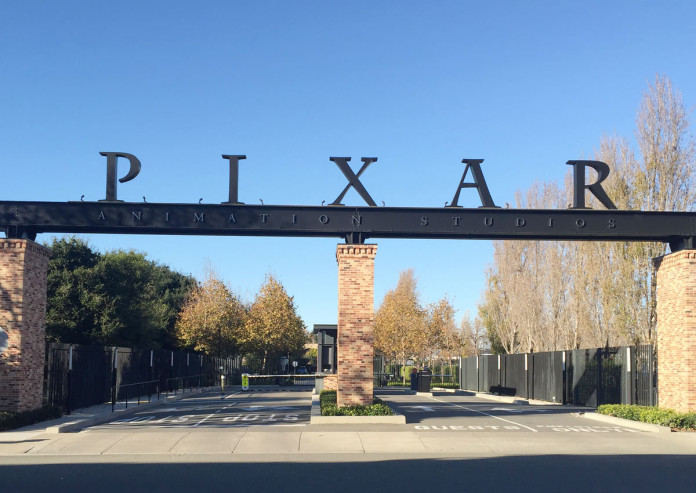
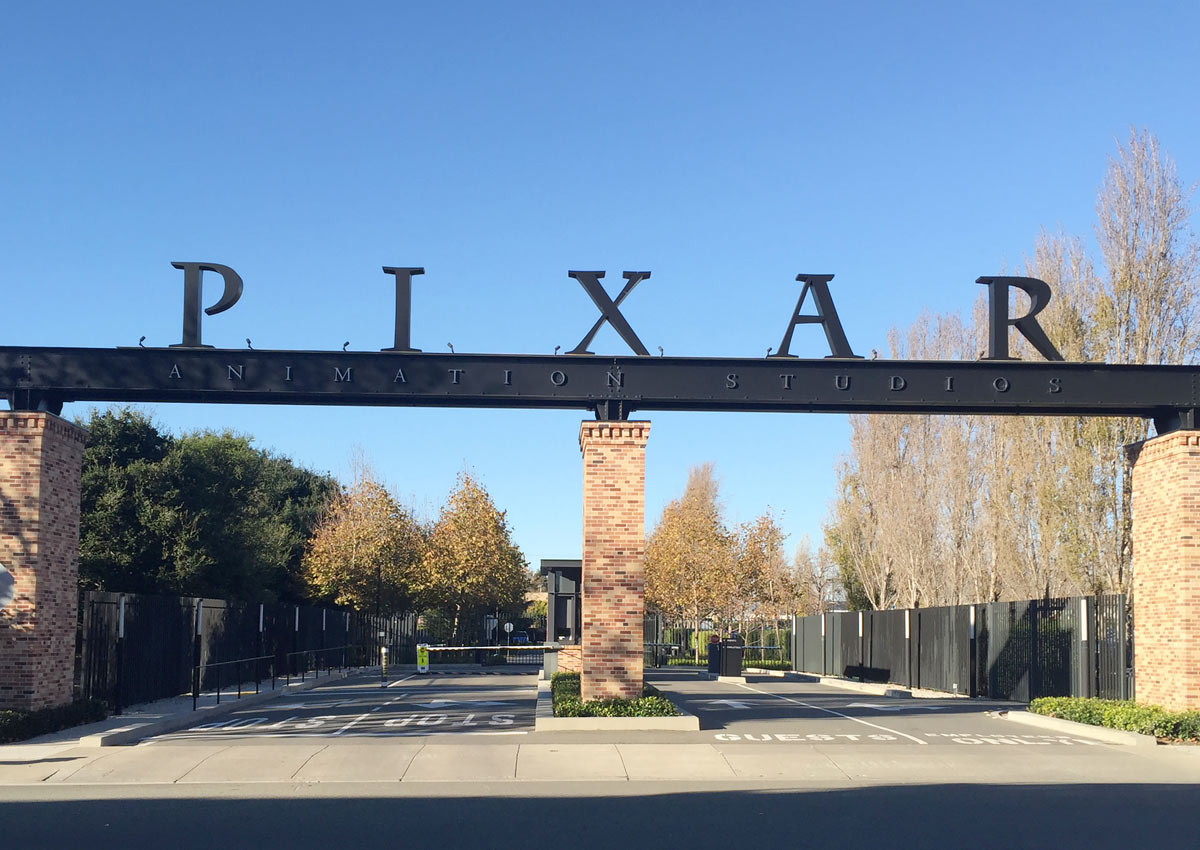
Pixar showcased early artwork for the movie as it opened the doors to its secluded headquarters in the Bay Area of San Francisco to the news media, with its 21st year as a feature film studio drawing to a close.

Starring newcomer Anthony Gonzalez, Gael Garcia Bernal (Amazon’s “Mozart in the Jungle”) and Benjamin Bratt (“Doctor Strange”), “Coco” tells the story of a 12-year-old Mexican musician who journeys to the Land of the Dead in search of his ancestors.

Pixar’s 19th feature-length movie follows 21 years of unparalleled success marked by $11 billion (S$15.7 billion) in box office receipts and 13 Oscars since “Toy Story” blazed a trail as the world’s first computer-generated feature film.

The company began life in 1979 as the Graphics Group, the computer division for Lucasfilm, charged by George Lucas with developing a digital film and sound editing system and advancing computer graphics.

John Lasseter, the legendary founding director of the division’s feature output, came on board in 1983, and three years later it was bought by Apple guru Steve Jobs and given its now-famous name.

After winning plaudits for a series of pioneering shorts, the studio turned its attention to full-length movies, joining with Disney to produce “Toy Story,” which went on to become the highest-grossing film of 1995, making $374 million worldwide.

“Of course we were completely buoyed by how well it did, critically and commercially, I knew at that point I wanted to continue to be a part of what we were doing at Pixar and luckily they wanted me to continue helping them,” Unkrich told AFP.

Jobs relocated the company in 2000 to a 22-acre campus in Emeryville, near San Francisco, where every detail was carefully designed to encourage creativity among its 600-strong workforce, which has since doubled.

Employees can swim in an outdoor heated salt water pool, play football or beach volleyball, enjoy picnics in an amphitheater or gather in the main building, designed with the same modernist architectural vision as the Apple Store.

Pixar had already won best animated picture Oscars for “Finding Nemo” and “The Incredibles” by the time Disney bought the company for $7.4 billion in 2006, making Jobs its largest single shareholder.

A hatful of further statuettes followed as “Ratatouille,” “WALL-E” and “Up” saw Pixar’s reputation transformed from new kid on the block to animation’s king of the castle.

It has not all been plain sailing – “Cars 2” was seen as a creative misstep and panned by critics while the domestic box office receipts for “The Good Dinosaur” came in below its production budget.

Unkrich recalls “Toy Story 2” being plunged into crisis when the production team realised with the deadline looming that the story was not working.

The crew got back on course after Jobs – who died in 2011 – took Unkrich aside and advised him that the achievements he was most proud of were always when “there wasn’t enough time and there weren’t enough resources but somehow people came together and got the work done.”

“Coco” is leading a new wave of original Pixar films under development following the studio’s recent announcement that it was putting sequels on the back burner after 2019’s “Toy Story 4.”

“With each new one we make, there’s never any guarantee that they’re going to work or be accepted,” says Unkrich.

“We try our best every time to make engaging films that we’re interested in and we just hope the rest of the world likes them.”

Image: 
Category: 
Publication Date: 
Wednesday, December 14, 2016 – 16:11
Keywords: 
Send to mobile app: 
Source: 


Story Type: 
Others

Source link

Leases for Mt Vernon halls extended

0

Parlours to remain for at least another year till demolition of complex: NEA

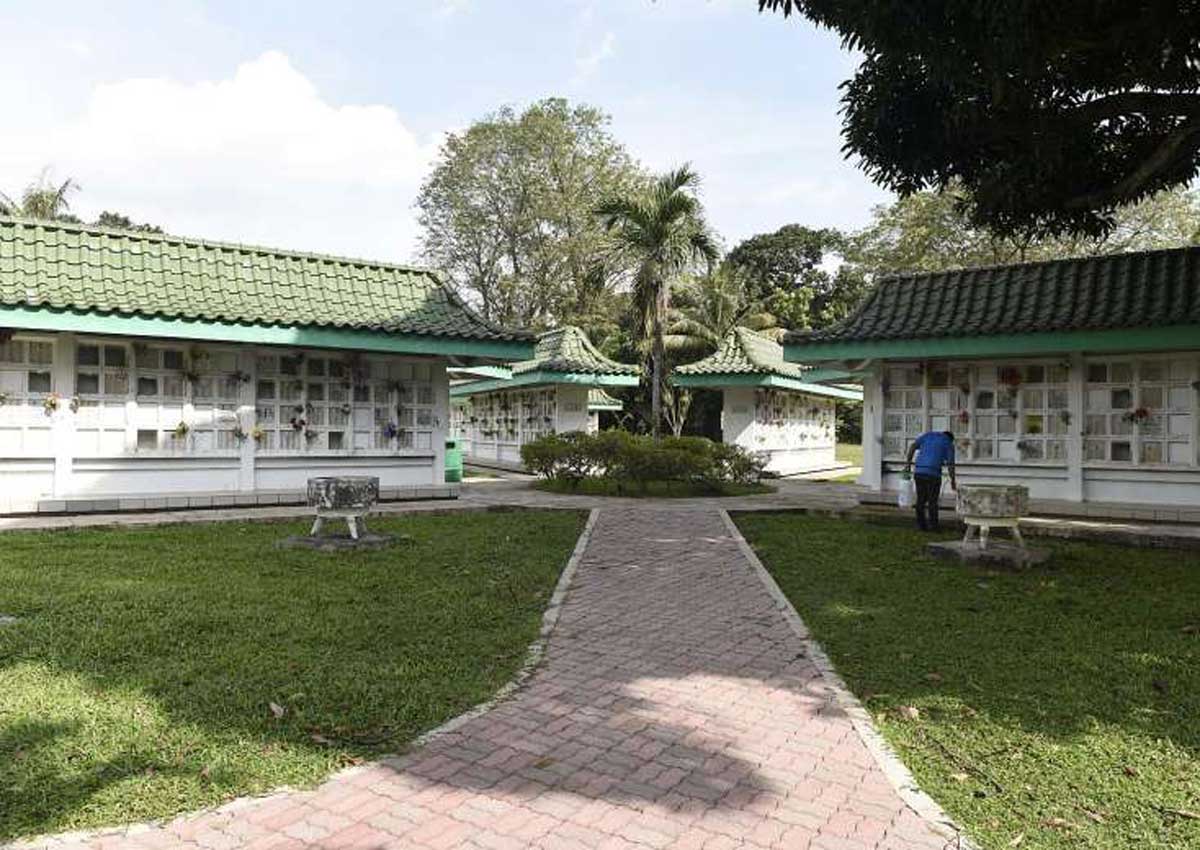
The funeral parlours at Mount Vernon Columbarium will remain for at least another year, before they are demolished to make way for a new housing estate.

The authorities have extended the leases for the parlours at the complex in Upper Aljunied Road for a second time, Today newspaper reported yesterday.

The leases for Mount Vernon Parlours 1 and 2, which are run by Singapore Casket, were supposed to expire this month, but have been extended to next December.

Mount Vernon Sanctuary has six halls, whose leases, due to end next March, have been extended to March 2018.

The National Environment Agency (NEA) told The Straits Times that it plans to continue the leases for the funeral parlours until they are required to be cleared together with the columbarium blocks. It did not say when this might happen.

There have been concerns that the demolition of the complex would result in a serious shortage of facilities where wakes can be held.

Mount Vernon Sanctuary is among the largest operators here, as its six halls can accommodate up to 600 people.

Singapore Casket also has 10 halls in its Lavender Street building, besides its two parlours at Mount Vernon.

Both private operators have seen an increase in demand for their halls.

In 2013, the authorities announced that the complex would be cleared to make way for the Bidadari housing estate.

The leases of the parlours had been extended once before, in 2014. It appears unlikely that the leases will be extended a third time.

Since November last year, there have been three batches of Bidadari flats launched for sale.

The Housing Board said earlier that the flats will be progressively completed from the third quarter of 2019.

Part of the site has been set aside for a “new and modern” Mount Vernon Funeral Parlour, the authorities said.

They added that this new complex will be well integrated into the surroundings to “minimise the visual impact on nearby residential buildings” and will also “serve as an extension of the park greenery”.

Next-of-kin have to claim existing niches at Mount Vernon by June 30 next year.

These niches will be relocated to the Mandai Columbarium.

More than 12,000 of the 20,000 niches have been claimed as at the end of last month, said NEA.

Mount Vernon Sanctuary’s chief executive Deborah Andres said that the firm was “pleased to be able to continue serving the community”, but added that its long-term future was uncertain.

She hopes to operate in the new funeral parlour at Bidadari, but has yet to finalise any plans.

“We’d love it if the Government could give us an opportunity to rebuild on a plot of land,” said Ms Andres.

She added that the firm has been in discussion with the authorities about possible locations.

“But the only locations we were told about were in Choa Chu Kang or Mandai, which are not as conveniently located (as the current one),” she said.

mellinjm@sph.com.sg


This article was first published on December 14, 2016.
Get a copy of The Straits Times or go to straitstimes.com for more stories.

Image: 
Category: 
Publication Date: 
Wednesday, December 14, 2016 – 17:05
Keywords: 
Send to mobile app: 
Source: 


Story Type: 
Others

Source link

Competitive bids expected for high-speed rail project: PM

0

Competitive bids are expected when tenders are called for the high-speed rail systems between Singapore and Malaysia, and the best one will be chosen, Prime Minister Lee Hsien Loong said yesterday.

Speaking at a press conference after the annual Leaders’ Retreat, Mr Lee said the future high-speed rail line between Singapore and Kuala Lumpur has attracted plenty of interest from industry players.

In an interview with Bernama last month, Mr Lee said the Japanese, Koreans and Chinese – who have high-speed rail systems – have been lobbying hard for the contract, and deciding which one is best would be a very difficult decision.

Asked yesterday if the contract could be awarded to a consortium, he said it was “premature to speculate on the permutations”.

He added: “If they get together, I think that is for the good, but I have not seen it happen very frequently – the Chinese, Koreans and Japanese getting together.”

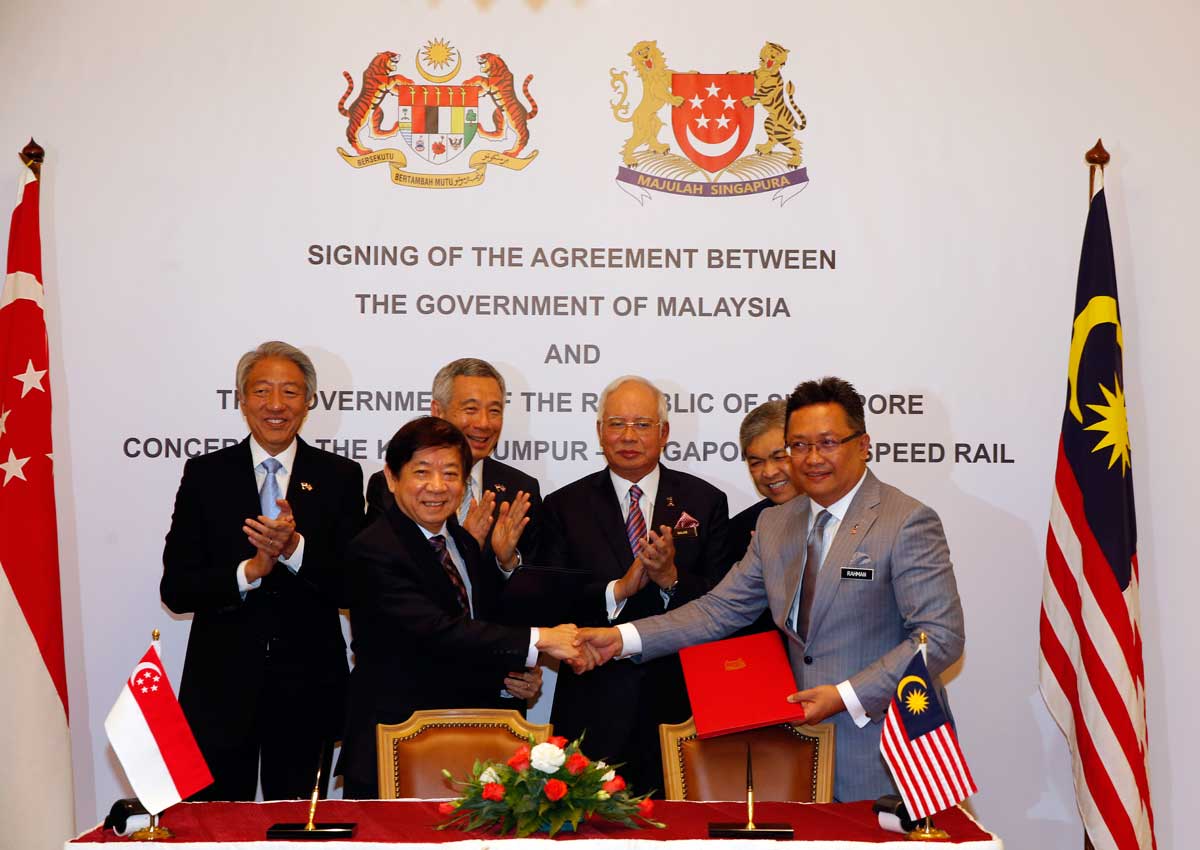
Singapore and Malaysia signed a legally binding pact for a 350km high-speed rail line yesterday.

It formalises, among other things, financing, commercial and procurement frameworks for the project.

In response to queries on how much the line is expected to cost, a Singapore Transport Ministry spokesman said it is “not appropriate” to announce cost estimates now as they are subject to further engineering studies, and could influence the bids submitted for tenders.

A target date has been set for the non-stop service between Singapore and Kuala Lumpur: Dec 31, 2026.

Asked how the two governments would ensure that the project remains on track in the current global economic slowdown, Malaysian Prime Minister Najib Razak said it is largely viable.

Also, the governments would be able to get long-term financing for it.

On whether the line would be extended farther north beyond Kuala Lumpur, Datuk Seri Najib said doing so would add to its complexity and magnitude. It should be confined to between Kuala Lumpur and Singapore, he added.

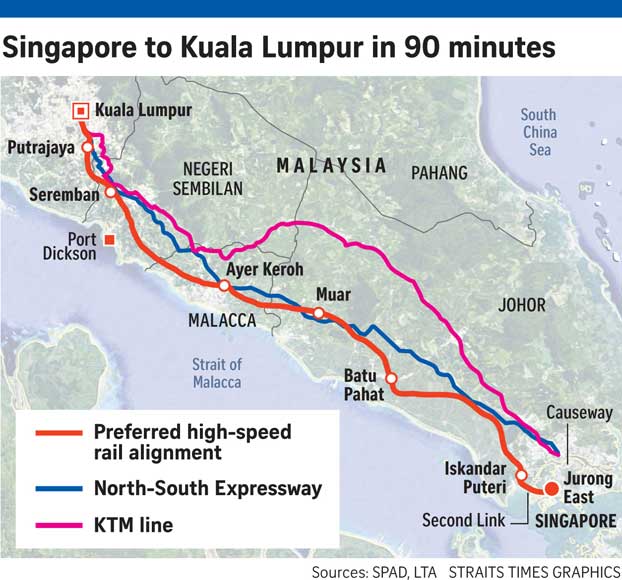
Most of the line – 335km of it – will be in Malaysia, with the remaining 15km in Singapore.

Three services will ply along the dual-track line, which will be designed for a top speed of 350kmh.

There will be an express service between the two terminal stations – Jurong East in Singapore and the upcoming Bandar Malaysia development in Kuala Lumpur; a shorter shuttle service will also connect Singapore and Iskandar Puteri in Johor.

Both countries will call a joint tender for an international operator to run the non-stop and shuttle services.

Malaysia will also call a tender for an operator to run a separate domestic service from Kuala Lumpur to Iskandar Puteri that will make stops at five other stations along the way: Putrajaya, Seremban, Ayer Keroh, Muar and Batu Pahat.

In scheduling the train services, the international operator will have priority over the domestic operator.

Mr Lee said Singapore will continue to work closely with Malaysia in a joint ministerial committee for the Iskandar region.

He noted that joint venture projects between Temasek Holdings and Malaysian sovereign wealth fund Khazanah Nasional in Iskandar Malaysia are progressing well, citing the Afiniti Medini and Avira Medini developments.

The projects by Khazanah-Temasek joint venture M+S in Singapore are also progressing well, he added.

Iskandar Puteri is one of three locations where Customs, immigration and quarantine facilities of both countries will be located.

Singapore and Kuala Lumpur are the other two.

This means international-bound travellers will need to clear Customs and immigration only once, when departing the respective countries.

With many more people expected to commute between the two sides when the line is completed, security has been raised as a concern.

Asked about it, Mr Lee said security was a major issue discussed and resolved in planning for the line.

There has to be a balance between ensuring secure borders and making it convenient for passengers to clear immigration, he said.

“There must be trust and understanding, and mutual agreement as to what the powers are, what the arrangements are, what you can do, what the fail-safe responsibilities are in case somebody tries to break through,” he added.

“We have thought long and hard about this, we need this both for the HSR (high-speed rail) as well as for the RTS (Rapid Transit System link), and we will make it work.”

roysim@sph.com.sg


This article was first published on December 14, 2016.
Get a copy of The Straits Times or go to straitstimes.com for more stories.

Image: 
Publication Date: 
Wednesday, December 14, 2016 – 17:05
Send to mobile app: 
Source: 


Video Media: 
Other Video Media
Story Type: 
Others

Source link

Doctors barred from paying agents percentage of fees

0

Doctors who pay a third-party agent (TPA) a percentage of the fee they get from patients will be infringing the new medical code of ethics which goes into force next month, the Singapore Medical Council (SMC) said yesterday.

The new Ethical Code and Ethical Guidelines released in September had been ambivalent on this, which was a matter of concern to doctors party to such arrangements.

The SMC had said that fees should not be “primarily” based on the work done by doctors, or be “so high” as to constitute fee splitting.

TPAs are a diverse group that generally charge for their services by claiming 10 per cent to 25 per cent of the doctors’ fees.

Some represent companies that provide their staff with medical benefits and can also help to keep costs down. Others help insurers manage healthcare claims.

However some, often referred to as a medical concierge, simply collect payment for introducing a patient to a doctor.

The SMC is concerned that such fees could push up costs for patients.

To a query from The Straits Times last month on whether doctors can continue paying TPAs a percentage of their bill under the new ethics code, the SMC had said it was “deliberating” on the matter and would provide clarification.

This came in the advisory sent by SMC president Tan Ser Kiat to all doctors yesterday, which spelt out clearly that “fees that are based on a percentage of what doctors charge patients may be construed as a form of fee splitting”.

Elaborating, Professor Tan said the work done by a TPA in handling and processing patients “does not vary depending on the fees doctors charge patients”.

So, paying them a percentage of the bill to the patient would reflect the work done by the doctor and not the TPA. This is prohibited.

He added that it would be considered a breach of professional ethics “regardless of when the doctor entered into such an arrangement with the third party”.

But to give these doctors time to negotiate a new agreement and in order not to leave patients in the lurch, that particular guideline will be delayed for six months, going into force only on July 1.

He reminded doctors that their duty is to always place patients’ best interests above business or financial considerations. They should consider if such agreements “will result in profiteering”.

He said: “The fees must reflect the fair work done by third parties in handling and processing the patients. The fees must also be transparent to the patient.”

Dr Desmond Wai, a gastroenterologist in private practice who has agreements with three TPAs, applauded the ruling, which he sees as the SMC’s “efforts to clamp down on unethical practices” by some medical concierges who merely introduce patients for a fee.

He is fine with telling patients the amount that goes to the third party, which he says comes from his fee, and is not from a mark-up.

When asked about the penalty that doctors face for breaching the code, the SMC said: “The penalty depends on the extent of the misconduct, for example, it may vary from a letter of advice or warning to a formal disciplinary inquiry, depending on the circumstances.”

salma@sph.com.sg


This article was first published on December 14, 2016.
Get a copy of The Straits Times or go to straitstimes.com for more stories.

Image: 
Category: 
Publication Date: 
Wednesday, December 14, 2016 – 15:20
Keywords: 
Send to mobile app: 
Source: 


Story Type: 
Others

Source link

Ikkousha offers 50% off Tonkotsu Ramen for one-day only at two outlets on 15 Dec 2016

0

Ikkousha 50% off Tonkotsu Ramen at Tanjong Pagar Plaza & Chijmes on 15 Dec

Ikkousha offers 50% off Tonkotsu Ramen for one-day only at two outlets on 15 Dec 2016

Ikkousha celebrates Tanjong Pagar’s 3rd anniversary on 15th December with 50% off classic Tonkotsu Ramen at their two outlets exclusively via J Passport coupon

Source

S'pore up 2 places to rank 16th most expensive location in the world for expats

0

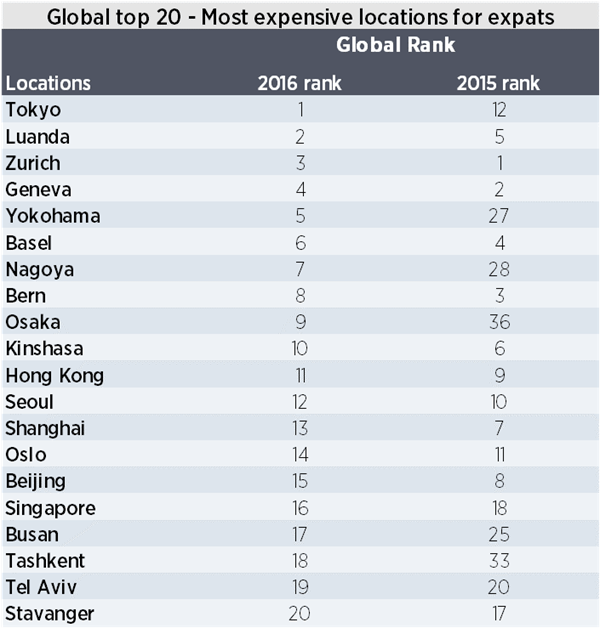
SINGAPORE — The Republic is now the 16th most expensive location globally for expatriates, up two places from 18th last year, according to ECA International’s latest Cost of Living survey released on Wednesday (Dec 14).

Singapore has risen from 33rd to 16th over the past five years.

“The Singapore dollar has appreciated against most major currencies in the months leading up to our survey. Despite low price rises, the impact of the stronger currency means that where companies provide cost of living allowances to their international executives assigned to Singapore, these will likely need to be raised to ensure that employee purchasing power is maintained,” said Mr Lee Quane, ECA’s regional director of Asia.

Tokyo overtook Zurich to take the global top spot this year for the first time since 2012. Four other Japanese cities were also featured in the top 20 global ranking, They are Yokohama (5th), Nagoya (7th) and Osaka (9th).

Hong Kong, on the other hand, saw its ranking slip from 9th place last year to 11th place this year.

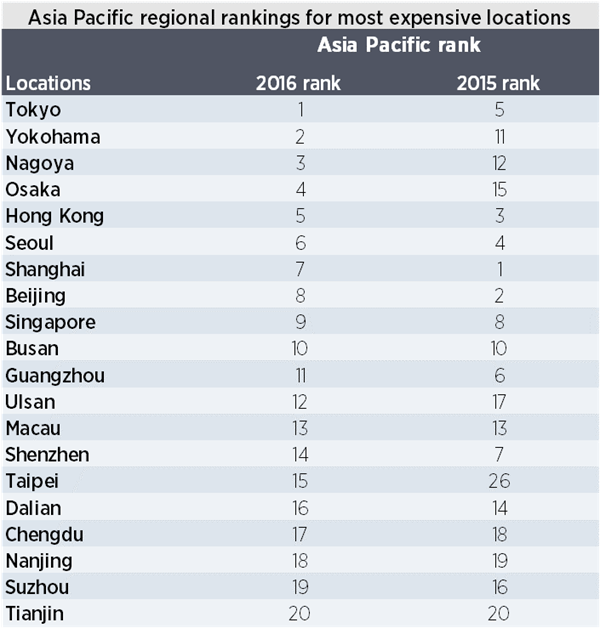
Other Asia Pacific cities that made it into the top 20 include: Seoul (12th), Shanghai (13th), Beijing (15th) and Busan (17th).

The relative strength of the Japanese yen in the survey period was the reason Japan overtook Hong Kong this year, said ECA International. At the same time, the slight depreciation of the renminbi against the yen and HK dollar over the past year led to Shanghai and Beijing falling below Tokyo and Hong Kong in the rankings.

But Mr Quane said: “This does not truly follow the general trend seen in China over the past five years, during which locations in Mainland China have averaged an 88 place increase in the global rankings. It is likely that major Chinese cities will remain expensive destinations for mobile employees for the foreseeable future.”

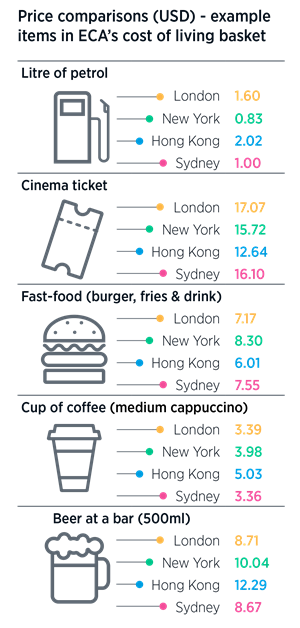
ECA International’s main cost of living surveys are carried out in March and September using day-to-day goods and services commonly purchased by assignees such as food and motoring.


(Infographic: ECA International)

Living costs such as accommodation rental, utilities charges and school fees are not included in the survey.


(Graph: ECA International)


(Graph: ECA International)

Source link