Home Blog Page 2136

2016 is hottest year on record for Singapore and the world

0

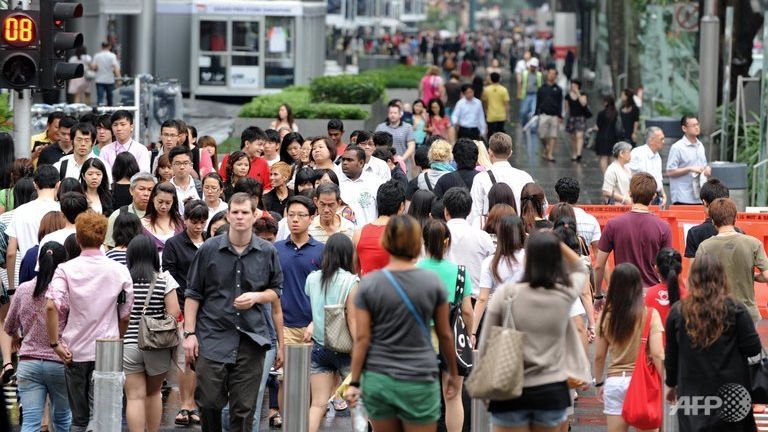
SINGAPORE – The year 2016 has been the hottest year on record globally – and for Singapore too, reveals an update from the Meteorological Service Singapore (MSS).

The mean annual temperature recorded at the Changi climate station – which is used as a reference station – is 28. 4 deg C as of Dec 29.

This exceeds the current record of 28.3 deg C set in 1997, 1998 and 2015.

“Temperatures soared in the first half of 2016 due to the effects of a very strong El Nino,” said an MSS spokesman, referring to the weather phenomenon associated with prolonged warmer weather in this part of the world.

“The temperatures remained well above the long-term average for the rest of the year. New monthly records for the hottest January, April and August were set in 2016.”

The El Nino phenomenon had also caused widespread coral bleaching, more severe in duration compared to two other major bleaching events in 1998 and 2010.

The weatherman also said that rain is also expected for the first two weeks of 2017, although it is likely to be less wet compared to the rainy weather experienced in the past two weeks.

Thundery showers are still expected mostly in the afternoon on five to seven days over the next fortnight, and could extend into the evening on a few days.

However, the rainfall for the first half of January is expected to be slightly below normal, said the MSS.


This article was first published on Dec 30, 2016.
Get a copy of The Straits Times or go to straitstimes.com for more stories.

Image: 
Category: 
Publication Date: 
Saturday, December 31, 2016 – 09:00
Keywords: 
Send to mobile app: 
Source: 


Story Type: 
Others

Source link

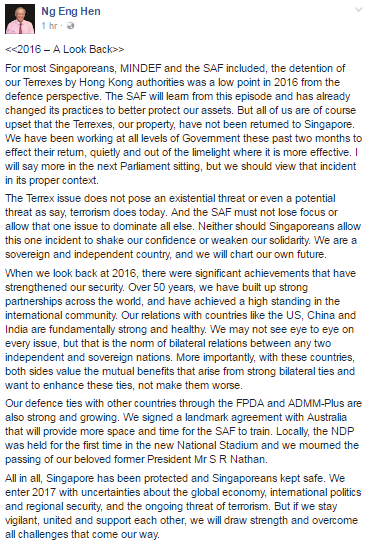
Govt working at all levels to get Terrexes back; SAF will learn from this: Ng Eng Hen

0

SINGAPORE — The Republic has been working at all levels of government “quietly and out of the limelight” to get the Terrexes back from Hong Kong, Defence Minister Ng Eng Hen revealed in a Facebook post on Friday (Dec 30).

Describing the seizure of the Terrexes on Nov 23 as a “low point in 2016 from the defence perspective”, Dr Ng added that “the SAF will learn from this episode and has already changed its practices to better protect our assets”.

Dr Ng, who shared a video on the highlights of the year for the Singapore Armed Forces (SAF), said that the Terrex issue “does not pose an existential threat or even a potential threat as say, terrorism does today”.

He noted that the SAF must not lose focus or allow one issue to dominate all else. Similarly, he added, Singaporeans should not allow the seized Terrexes incident to “shake our confidence or weaken our solidarity” as a nation.

“We are a sovereign and independent country, and we will chart our own future.”

In his Facebook post, Dr Ng said he would be elaborating more on the issue when Parliament sits next on Jan 9.

Nine of the SAF’s Terrex Infantry Carrier Vehicles, were seized by Hong Kong customs on Nov 23, while enroute back to Singapore from Taiwan.

One month later, on Dec 23, the Singapore Government had conveyed its “formal position” to its Hong Kong Special Administrative Region (SAR) counterpart on the detention of the vehicles and have been awaiting “a full resolution of this matter” and the return of “our property”.

Looking back on the year past, Dr Ng noted that there were significant achievements that have strengthened our security.

“All in all, Singapore has been protected and Singaporeans kept safe. We enter 2017 with uncertainties about the global economy, international politics and regional security, and the ongoing threat of terrorism. But if we stay vigilant, united and support each other, we will draw strength and overcome all challenges that come our way,” he wrote.

Source link

A year in which Singapore embraced a broader meaning of success?

0

SINGAPORE: With homegrown talent taking top honours at the Olympics and Paralympics, in the arts and the culinary world, did 2016 signal a shift towards a Singapore that’s ready to celebrate more idealistic pursuits and a broader definition of success?

Yes, said Professor David Chan, who described the statistically “amazing” accomplishments by such a small population as not just about talent and practice, but “also parental influence, passion and peer influence”.

When parents want “the best” for their child today, it means: “Will the child be happy, will the child grow up to not only accomplish, but inspire people and have a very meaningful life?” said the director of the Behavioural Sciences Institute at Singapore Management University.

“And if that is what parents want … it is about time to realise that is not about academics alone.”

The question about redefining success was put by moderator Gaurav Keerthi to the panel for Singapore Review 2016, in a discussion that airs on Channel NewsAsia on Friday (Dec 30) at 8pm.

Joseph Schooling with his parents, Colin and May, at Parliament House. (Photo: Justin Ong)

But Mr Chee Hong Tat, Minister of State for Health and for Communications and Information, took the argument even further.

“Just as we do not want to focus only on academic results, I think we should also move away from defining success as winning medals on the international stage,” he said.

Rather, “the definition of success to me would have to come down to what we do as individuals… having the resilience and the courage to face challenges, and overcoming the odds, emerging stronger.

“We see that in our Olympians and Paralympians, we see that in our students, people who go through adversity, we see that in our filmmakers and in our entrepreneurs,” said Mr Chee.  “That, to me, will allow us to have many, many more successes beyond that small number of medal winners.”

Mr Leon Perera, a Non-Constituency Member of Parliament from the Workers’ Party, said however that hurdles to nurturing talent should be removed.

“Financial obstacles should never stand in the way of people who have talent to fully develop. There should not be obstacles for people with disabilities, special needs, ex-offenders and so on. We need to harness all the available talent,” said Mr Perera.

A NEED TO REINVENT ONESELF

“Reinvention” was a common theme running throughout the issues tackled in the discussion, which ranged from the economy and jobs to race.

For instance, speaking up as special guests in the audience, chefs Anderson Ho and Randy Chow – who coached Team Singapore to a culinary World Cup gold – talked about more Singaporeans looking to alternative careers in the kitchen.

Mr Chow said: “Back in our time, 30 years ago, the ‘cannot-make-it’ group in school, we would end up in the kitchen. But in today’s world, we have a lot of professionals, graduates, lawyers, engineers coming into our profession.”

Watch: How homegrown pastry chef Daniel Tay wants  to take on the world

And amid the harsh reality of slower economic growth, redundancy among PMETs and structural changes to jobs, personal reinvention is more imperative than ever, said the panellists.

Plan to cycle through “two, or maybe three or even more careers” in one’s lifetime, said Ms Wong Su-Yen, CEO of Human Capital Leadership Institute. “Instead of thinking about it as sequential – learn, work and then retire – we have to be much better at learning and working at the same time,” she added.

Indeed Mr Shamir Rahim, CEO and founder of Sypher Labs, said he has observed how job seekers are already learning to redefine themselves differently.

“For the first time in the four years we have been around, we actually saw many applicants from varied walks of life, from banking and architecture. In the interviews, what they will emphasise is not so much their credentials or degrees (but) their skills and side projects that they’ve worked on,” he said, noting that future-economy employers are hunting precisely for these “diamonds in the rough”.

To help tide retrenched individuals over as they focus on retraining and reskilling for new careers, Mr Perera reiterated his party’s idea of a “redundancy insurance scheme”.

While Prof Chan noted the merits of such a scheme, he emphasised the need to ensure a match between skills and jobs out there. “The question, then, from the government perspective is to increase your skills – but you had better increase the right skills so that they can match the jobs.”

 He added: “If everybody thinks that academics is the only way to go, you will never get the skills, and then you actually will not be able to do the job.

“So we do not have to wait for the Government to redefine academic success – the economy has already redefined it.”

The Channel NewsAsia special, Singapore Review 2016, airs Dec 30, 8pm (SG/HK), with an encore telecast Dec 31, 6pm.

Source link

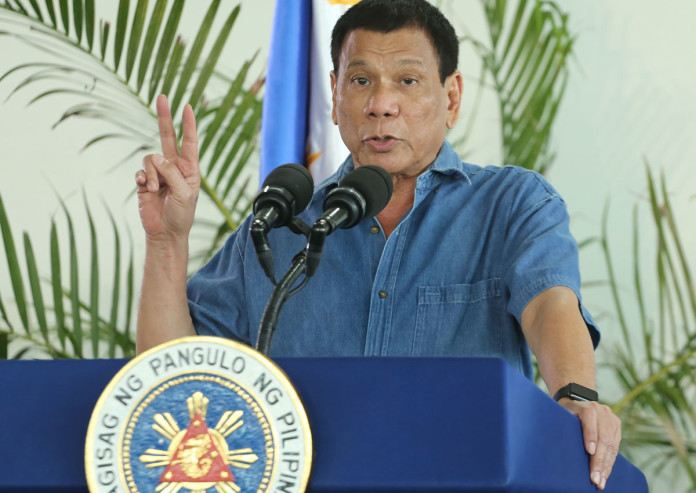
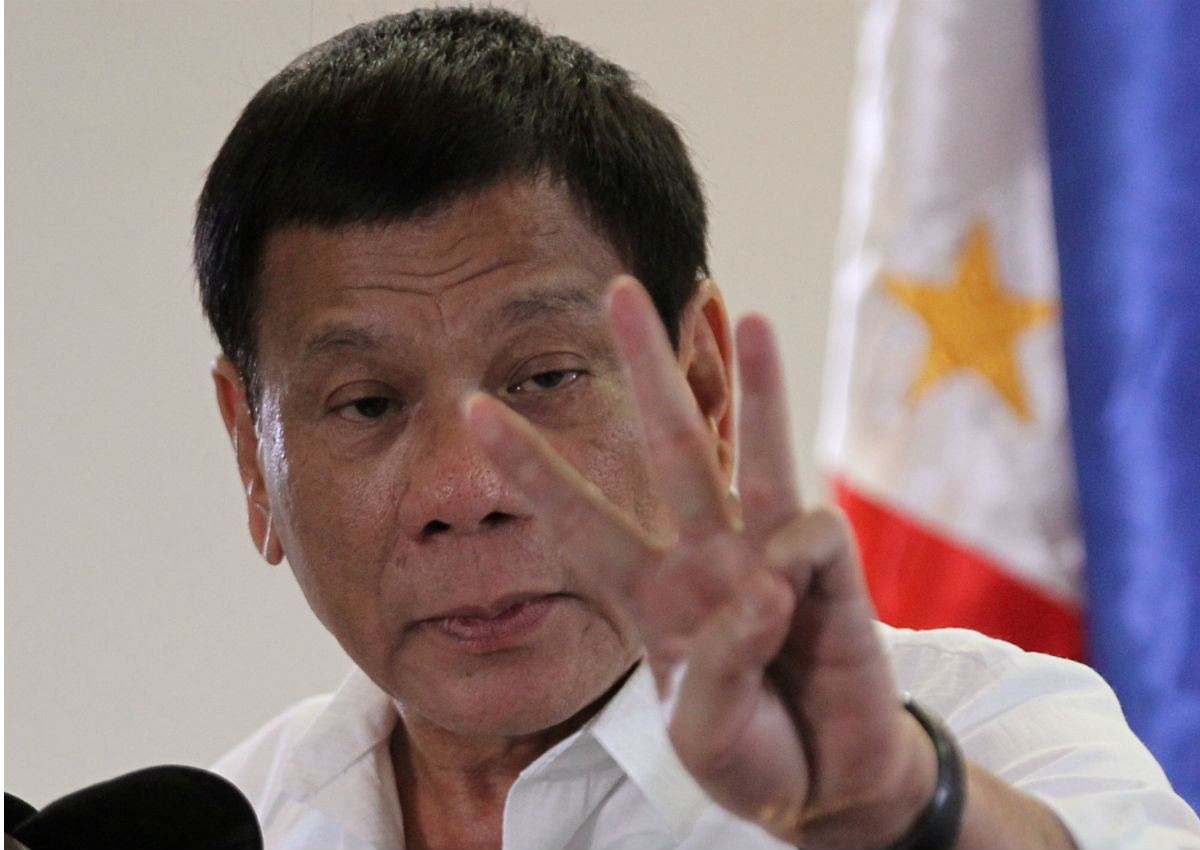
I don’t have time to be nice, says Philippine President Rodrigo Duterte

0


MANILA –

He wants him to be “more cordial” to the Filipinos, but stubbornly speaking President Rodrigo Duttett says he must do his job, even if that means his life or the president’s dangers.

“I can not run any more, I do not want to be a very popular president,” Duterte said in an interview with the state-run PTV 4 on Thursday night (Dec. 29).

“My job, my commitment to you (is to eradicate) corruption, illegal drugs … I would do it,” he said.

“I do not care, I’m done, I do not have time to pretend to be good,” he added.

The Chairman asked what he considered the majority of the people to support his Government in the drug war.

Mr. Duttle noted that during the campaign he had made a “solemn” promise to eradicate corruption, crime and illicit drugs.

He also said part of his commitment was to allow former President Ferdinand Marcos to bury in Libyan Ghana Bayani.

The president said before concluding, “I hope I can be better with your companion, but there is a task to do that I would do, even if I had to put my life and the president itself in jeopardy. The network that day he recently in his TV interview series.

Mr. Duterte reiterated that he was willing to step down if people thought he could not solve the country’s problems.

Image:
Category:
Publication Date:
Friday, December 30, 2016 – 18:30
Send to mobile app:
Source:

Story Type:
Others

Source link

Free Gardenia cream roll with any purchase of Gardenia wholemeal loaves at Fairprice till 12 Jan

0

Free Gardenia cream roll with any purchase of Gardenia wholemeal loaves at Fairprice till 12 Jan, while stocks last

Free Gardenia cream roll with any purchase of Gardenia wholemeal loaves at Fairprice till 12 Jan

Get a FREE pack of GARDENIA Cream Roll 65g (Assorted) with any purchase of GARDENIA Wholemeal Loaves at Fairprice.
Source

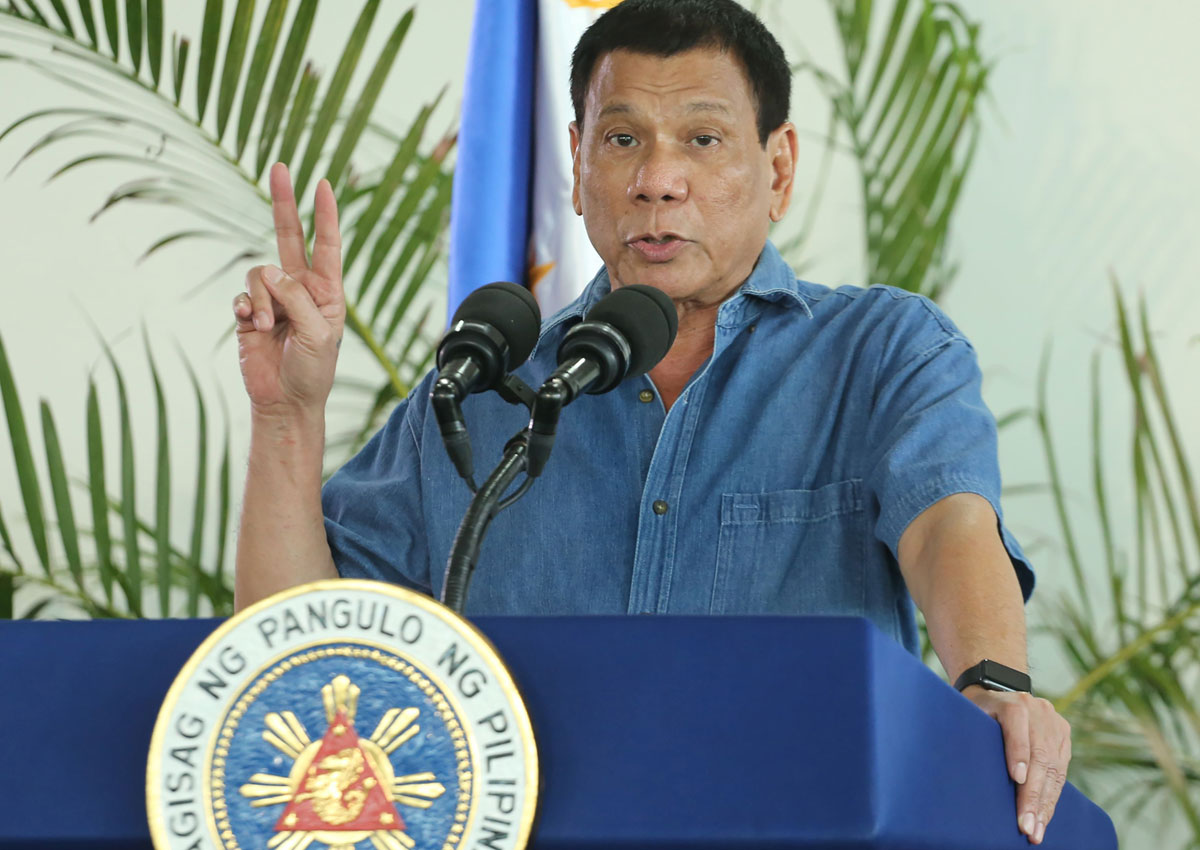
Duterte delegates Philippines into economic sweet spot but misgivings rising

0


After six months at the helm in the Philippines, Rodrigo Duterte has been touting just two achievements of his presidency – a vicious war on drugs and a surprise alliance with his country’s bitter rival, China.

Yet behind the curse-laden bluster and populist demagoguery that has defined Duterte’s rule, he presides over one of the world’s fastest growing economies, and has put cabinet colleagues to work on drafting reforms and legislation to tackle the economy’s most stubborn structural problems.

Advisers say Duterte’s economic successes come from using a strategy he honed as the long-time mayor of Davao City at a national level.

He concentrates on busting crime and deliberately delegates the handling of the economy to others.

By his own admission, Duterte says he is no expert on the economy and leaves it to”the bright guys” in his cabinet.

Economic Planning Secretary Ernesto Pernia sees the president only twice monthly and rarely hears feedback.

He said Duterte was focused almost entirely on crime and drugs.

“That has been his obsession,” he told Reuters.

“He essentially leaves other issues and concerns to the cabinet.”

The strategy seems to have worked so far although economists are beginning to question how long it can last.

“That’s what we’re hoping for, that his core economic team can prevail,” said Bank of the Philippine Islands (BPI) economist Emilio S. Neri.

“The fundamentals are there but we are leaning towards deficit spending and stimulus-driven growth and some unsustainable populist policies are worrisome.”

At the national level, Duterte’s signature campaigns have included his tilt toward China while turning his back on long-term ally the United States in addition to the war on drugs.

He rarely mentions it, but the economy has boomed under his watch, although some of the gains have been ascribed to the previous administration’s policies and Duterte’s decision to retain them.

Growth reached an annual 7.1 per cent in the third quarter of the year, Asia’s second highest and the country’s strongest quarter in three years.

The government expects full-year growth around 7 per cent.

The economy is expected to grow 6.5-7.5 per cent in 2017, but there are worries that Duterte’s erratic behaviour could impact policy, with political risk over his drugs crackdown and foul-mouthed outbursts at some big donors and investors.

Markets have signalled their concern.

In the six months since Duterte took over, the main stock index has lost nearly 20 per cent in dollar terms and is among the worst performers in Asia.

Over the same period, the peso currency is down around 5 per cent to the dollar, but other currencies in the region are also depressed.

DECISIVE LEADERSHIP

But Duterte has plenty of supporters, who say his decisive leadership and intolerance of bad governance will be a long-term boon for the economy.

In Davao City, he helped lure investors, dramatically cut red tape and fired inept officials. In 2014, Davao saw growth of a 9.3 per cent, compared to 6.1 per cent nationwide.

Analaysts at Nomura have said his populist, development-centred approach suggests he is “strongly motivated”to address the Philippines’ biggest weakness – infrastructure.

Expenditure on infrastructure, including on flood management schemes, ports, a rapid-transit bus system and a rail line, makes up a quarter of next year’s record $67 billion budget.

Consumer spending is strong, helped by $22 billion of remittances in the first 10 months from Filipinos overseas, a 4 per cent rise.

Unemployment was a record low 4.7 per cent in the third quarter, from 5.7 per cent a year earlier.

“He should deserve credit,” Finance Secretary Carlos Dominguez told Reuters.

“Unfortunately, people are always looking at the controversial statements. But if you judge it, he has done an excellent job …the important thing is the trust and confidence of businesses in him is very high.”

JITTERS

Duterte’s volatility and seemingly unilateral foreign policy has caused jitters and confusion, especially when he turned hostile towards the United States and then started cosying up to China, with which the Philippines has a history of mistrust over the South China Sea.

Duterte announced his “separation” from the United States in Beijing in October, shocking even his own ministers, who scrambled to assure investors – without his consent – that his policy was to diversify, not sever ties.

It’s a gambit that could pay off, with an intractable dispute with Beijing now on the back burner and China pledging to provide the Philippines with billions of dollars in infrastructure loans and ramp up farm and fisheries imports.

Nevertheless, economists warn that hot-headedness and willingness to take big risks could be a problem if it spills into policymaking, especially if it impacts US firms, which account for three-quarters of the country’s $23 billion business-processing outsourcing (BPO) sector.

Some big US firms have delayed BPO investments to undergo more due diligence.

Capital Economics notes a “growing risk that Duterte makes it harder” to attract big investment.

Moody’s has a stable outlook, expecting “continued economic outperformance relative to peers”, assuming Duterte’s drugs war doesn’t distract him from his economic reforms.

“There’s lots of focus going into the anti-drugs programme,”said BPI’s Neri. “In six months, economic policy reforms seem to have taken a back seat.”

Image:
Category:
Publication Date:
Friday, December 30, 2016 – 17:27
Send to mobile app:
Source:

Story Type:
Others

Source link

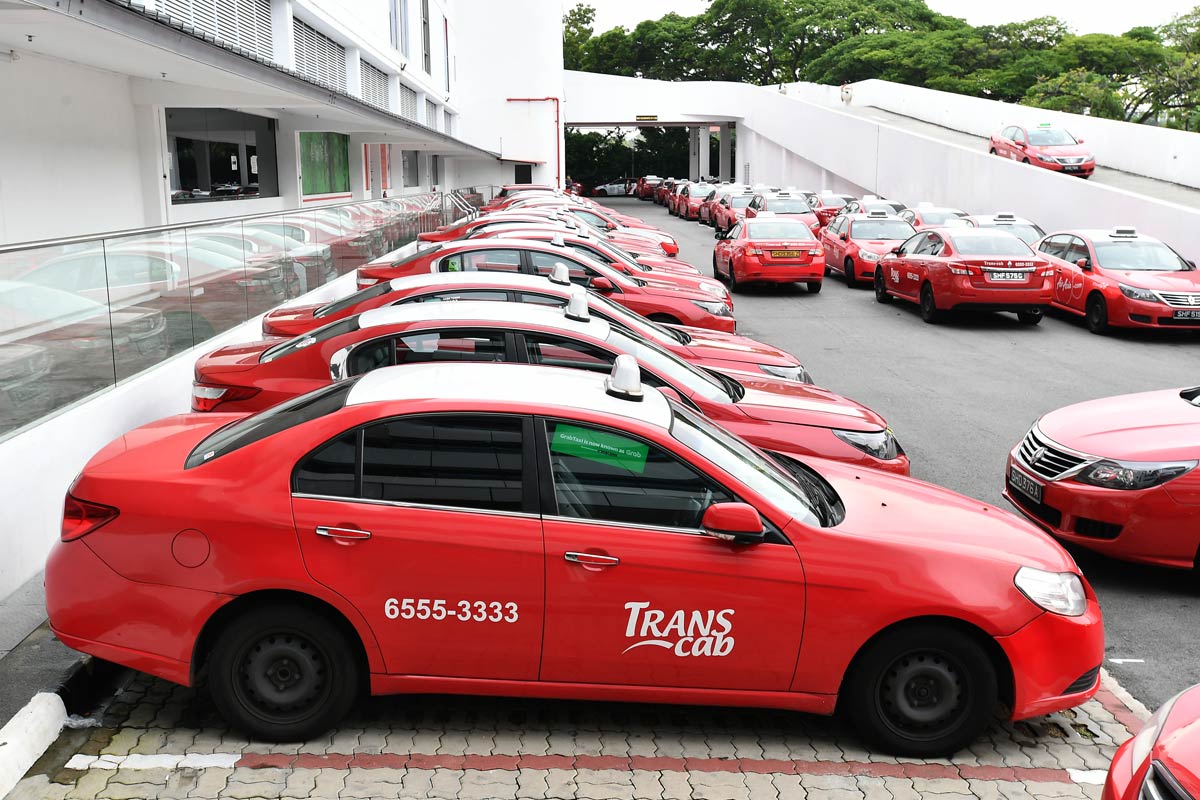
Rows of idle Trans-Cab taxis caught on dashcam video reveals possible fate of taxis in Singapore

0


[UPDATE] Trans-Cab has just announced a cut in rental rates of their taxis, in a bid to help lighten the burden of drivers, who have “told the company that third-party apps like Uber and Grab have taken a toll on [their] earnings”.

Even if you’re not a frequent user of taxis or private-hires, the reality that taxi drivers are facing a harder time due to the competition that came with the emergence of Uber and Grab is one that doesn’t need much introduction or background.

While as consumers, we win with a larger variety of services, and promo codes being dished out like it’s Christmas every single day, taxi drivers are feeling the heat when it comes to securing their livelihood.

However, recently, Second Minister for Transport Ng Chee Meng announced that changes to the Land Transport Authority’s (LTA) Taxi Availability (TA) framework will take place from January 2017, in a bid to level the playing field between private-hires and taxis. The changes will entail that taxis will no longer be required to clock a minimum daily mileage of 250km, and operators will “no longer have to meet availability requirements between 6am to 7am and 11pm to 12am, otherwise known as “shoulder peak periods””.

But of course, the newcomers aren’t completely at loggerheads with the taxi companies, as their GrabTaxi and UberTAXI services allow consumers to make taxi booking via their apps.

In fact, Grab announced at the start of September this year that they will be bringing all 7,000 or so Trans-cab drivers onto their platform.

It was Grab’s first collaboration with a taxi operator, and Teo Kiang Ang, Trans-cab’s Managing Director, explains that they decided on collaborating with Grab as they believe that their technology will be able to bring in more ride bookings for Trans-cab drivers.

Whether or not the playing field will eventually be levelled out with the measures remains to be seen, but a recent dashcam video seems to have revealed that taxi company Trans-cab isn’t doing very well currently.

Just an hour or so ago, Facebook page Thelocalsociety uploaded a video of a car cruising in between what seems to be never-ending lines of idle Trans-cab taxis., along with caption “What happen (sic) to Transcab? Lots of cars not taken up for rental. Probably Uber & Grab is hitting hard.”.

The time stamp on the video suggests that it was recorded yesterday.

What was even more revealing was the background commentary (of sorts) that came with it, by,we’re guessing, a Trans-cab driver going back to the taxi depot to return the car.

Speaking entirely in Hokkien, the owner of the gruff voice didn’t say much, but here’s a rough translation of the main gist of what he said:

“So many cars ah, siao* liao, siao liao. Trans-cab finished liao.” (Siao means crazy in Hokkien)

While we can’t be entirely sure if the idle cabs captured on the video truly reflects the reality of Trans-cab and taxi companies in Singapore, it won’t be a surprise if it was true, either.

Image:
Category:
Publication Date:
Friday, December 30, 2016 – 17:18
Send to mobile app:
Source:

Video Media:
Other Video Media
Story Type:
Others

Source link

Impeached S Korea president spared court appearance

0


Seoul –

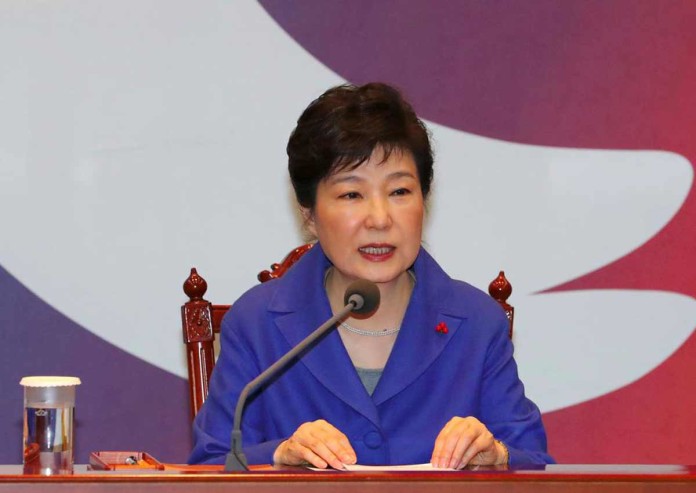
The court is responsible for verifying the bombing of South Korean President Park, said Friday that she would not be asked to appear in court.

But the Constitutional Court said Park’s close friend Choi Soon-Sil, the center of the corruption scandal known as “Rasputin”, triggered the fall of the president and had to file an interrogation on January 10.

The National Assembly earlier this month passed a motion asking the court to call the park and ask her directly.

“The request was refused,” the court said.

The court has 180 days to consider the parliamentary initiative, and in a letter to New Year’s letter, President Park Han-hee says it will “make a decision as soon as possible”.

If the bomb is confirmed, the presidential election must be held within 60 days.

Park is accused of collusion with Choi, the powerful company to tens of millions of dollars to the Choi control suspicious foundation.

Choi has been officially accused of abuse of power and extortion.

Image:
Category:
Publication Date:
Friday, December 30, 2016 – 17:30
Send to mobile app:
Source:

Hermes ID:
2 841 998
Hermes ID String:
AS1230-PGH
Hermes Author:
SSANDREA
Story Type:
Others

Source link

China's yuan set to have biggest annual loss since 1994

0

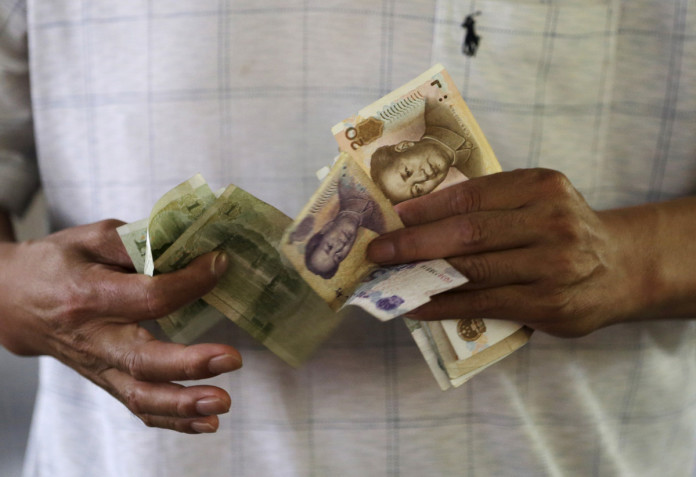
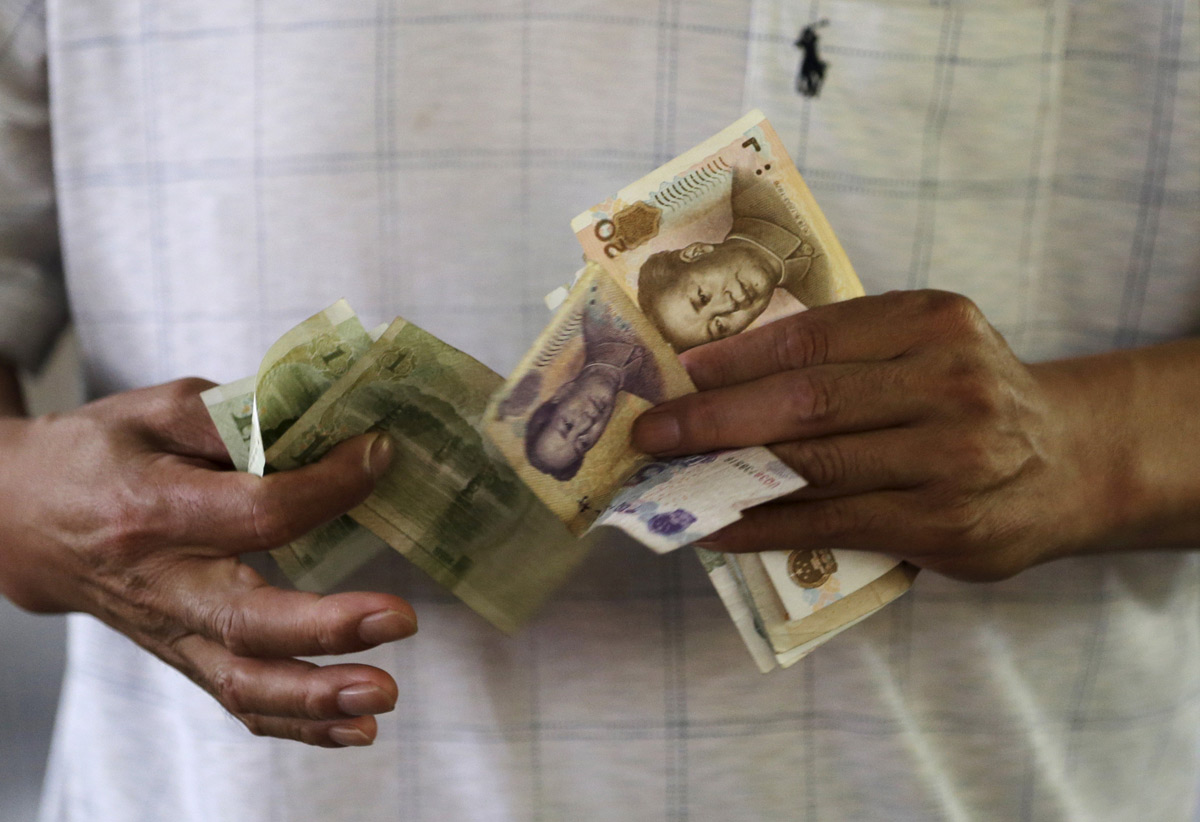
SHANGHAI – China’s yuan firmed against the dollar on Friday after the central bank fixed a much stronger midpoint, but the currency is on course to be the worst performing major Asian currency this year and have its biggest annual loss since 1994.

The yuan, which has reached an 8-1/2 year low, was on track to lose nearly 7 per cent against the dollar in 2016.

The People’s Bank of China set Friday’s midpoint rate at 6.9370 per dollar prior to the market opening, much firmer than the previous fix of 6.9497.

The stronger guidance rate came after a fall in the dollar on global markets as traders used the quiet holiday period to profit from the greenback’s recent gains, while a drop in US Treasury yields on waning risk appetites reduced its appeal.

A gauge of dollar strength against six other currencies fell to its weakest level in more than two weeks. The figure stood at 102.4 after touching a low of 101.99. The previous close was 102.68.

A trader at a Chinese bank in Shanghai said that in the wake of Britain’s vote to leave the European Union and Donald Trump’s US presidential election victory, the yuan “is likely to weaken further next year”.

On Friday, the spot yuan market opened at 6.9310 per dollar and was changing hands at 6.9495 at midday, 57 pips firmer than the previous late session close and 0.18 per cent softer than the midpoint.

Another trader at a foreign bank in Shanghai said trade was calm on the last business day of the year, but he saw more uncertainty ahead.

“The yuan may be more volatile next year after changes to the CFETS index basket,” he said.

While moves would still mostly depend on changes in the US dollar, “newly-added currencies like the South Korean won will create some noise,” the trader predicted.

Late on Thursday, China announced a change in the way in how a key yuan index will be calculated in the new year, nearly doubling the number of foreign currencies in the basket that’s used to set the yuan’s value.

The US dollar’s weight will be reduced to 22.4 per cent from 26.4 per cent and the euro’s to 16.34 per cent from 21.39 per cent, the China Foreign Exchange Trade System (CFETS) said.

Traders noted that authorities adopted a different approach towards the yuan at the end of this year.

“The central bank was more inclined to release depreciation pressure on the yuan this time last year, when they loosened their grip on the spot rate and let the currency weaken to elevate the dollar purchase cost for those who want to swap yuan for dollars at the beginning of the next year,” said one trader at a Chinese bank.

“But this time, authorities want to stabilise the currency as they are afraid of triggering stronger expectations of depreciation,” he said.

China’s authorities have rolled out policies over the past two months to tighten its grip on capital outflows after a slide in the yuan, which was down to hit 8-1/2 year lows.

The offshore yuan was trading 0.28 per cent weaker than the onshore spot at 6.9691 per dollar.

Offshore one-year non-deliverable forwards contracts (NDFs), considered the best available proxy for forward-looking market expectations of the yuan’s value, traded at 7.302, 5.00 per cent weaker than the midpoint.

One-year NDFs are settled against the midpoint, not the spot rate.

Image: 
Category: 
Publication Date: 
Friday, December 30, 2016 – 16:02
Send to mobile app: 
Source: 


Story Type: 
Others

Source link

'Kimi no Na wa' director worries about movie's popularity

0

Since its release in June, Japanese animation movie Kimi no Na wa (Your Name) has been stealing the world’s attention.

The movie has been an enormous success, even surpassing renowned animation studio Studio Ghibli’s Princess Mononoke’s earnings, according to Inquirer.net.

Although director Makoto Shinkai described the movie as “incomplete”, the teenage body-swapping romance movie has not only raked in huge earnings, but also managed to take home awards from United States and Europe.

The movie has even been nominated for Oscars, Antara news agency reports.

However, despite being called the “next Ghibli” or “new Hayao Miyazaki”, Shinkai has recently stated that the popularity of the animation has begun to worry him. He even called it “unhealthy”.

“Of course I am happy when people mention Miyazaki’s and my name in the same breath. It feels like a dream. But I know that they are praising ‘Your Name’ too much because of course, I am not on a par with Miyazaki,” Shinkai commented.

The 43-years old director also said that he did not want Miyazaki, the man behind classical hits, such as Spirited Away, Howl’s Moving Castle and My Neighbor Totoro to see his movie, “Because he will see all its flaws”.

Shinkai explained that Your Name, the animation team of which was led by Miyazaki’s disciple Masahi Ando was created in two years and not without obstacles.

Aside from feeling that the time was not enough, the budget for the movie was also running out and had to be stopped.

However, he also said that he knew the movie was going to be a hit when he saw the audience’s reaction at a Los Angeles premiere.

He stated that the emotional flow, from laughing to sobbing matched his expectations.

With regard to the movie’s success, Shinkai stated that he was “obviously happy that it worked”, but at the same time “afraid that it worked too well”.

Your Name was released in Indonesia on December.

Image: 
Category: 
Publication Date: 
Friday, December 30, 2016 – 15:49
Send to mobile app: 
Source: 


Story Type: 
Others

Source link