Home Blog Page 1212

Elderly couple trapped in lift for more than 2 hours in Yishun

0

SINGAPORE: An elderly couple was trapped for more than two hours in a lift at an HDB block in Yishun on New Years’ Day and had to be pulled out through a small gap.

Mrs Amy Yong, 79, and her husband Mr Mike Yong, 81, were making their way home from church at about 10am when the lift malfunctioned.

The couple live on the second floor of Blk 637A Yishun Street 61. There is only one lift servicing the four-storey block.

“They had stopped by the market just after church,” the couple’s son, Mr Stephen Yong, 58, told Channel NewsAsia. “They came back, hit the (button for the) second floor, the doors shut and jammed.

“The lift moved for a second then it stopped,” he said, adding that the lift was stuck between the first and second floors.

The couple’s son said that responders from Nee Soon Town Council arrived within 12 minutes after his parents rang the emergency button.

Mr and Mrs Yong, who did not have their mobile phones on them, had used the responders’ phone to call their son.

SCDF officers attempting to rescue the elderly couple trapped in the lift at an HDB block in Yishun. (Photo: Veronica Yong)

The town council responders managed to open the doors of the lift, but could not get it to work and so contacted Sigma, the lift maintenance company, the son said. But when Sigma arrived, they too could not get the lift to restart “because of a problem with spare parts”, he added.

By this time, his parents – who have high blood pressure – had been trapped for more than one hour and were beginning to get giddy. Mr Yong too was “already panicking and very pale”, said his son.

The elderly couple, who have high blood pressure, is seen waiting to be rescued after being trapped for more than two hours. (Photo: Veronica Yong)

“They (Sigma) wanted to go to another building to get the spare parts. I stopped them because we didn’t know how long it would take. It could take another hour or so,” the couple’s son said.

At this point, Mr and Mrs Yong’s daughter, Ms Veronica Yong, 55, who had also arrived at the scene, decided to call the Singapore Civil Defence Force (SCDF), who arrived within 10 minutes.

SCDF said it was alerted to the incident at about 11.50am.

“Upon arrival, there were chairs already placed inside the lift. SCDF officers then entered the lift through a gap from the second floor and hoisted the couple out while they were sitting on the chairs,” SCDF said.

Mrs Yong was pulled out of the lift at about 12.40pm, her son said. Mr Yong was pulled out shortly after.

The elderly woman was who trapped in the lift being helped by a resident and SCDF officers. (Photo: Veronica Yong)

Mr and Mrs Yong’s son said that paramedics assessed his parents at the scene and found that they had elevated blood pressure. His parents declined to be taken to the hospital for further checks, he added.

“I want to raise the issue of poor lift conditions and the good work of the SCDF,” Mr and Mrs Yong’s daughter said. “I heard my neighbour saying recently that it (the lift) had malfunctioned.”

Her brother added: “There are a lot of elderly staying here. If the maintenance of the elevator is not working, it’s very bad for them.”


Source link

Man, 29, charged after stabbing wife in Geylang

0

Singapore

Monday, January 1, 2018 – 15:39

The Straits Times

Others

Source link

Shuttle buses to support shorter EWL operational hours for January weekends: SMRT

0

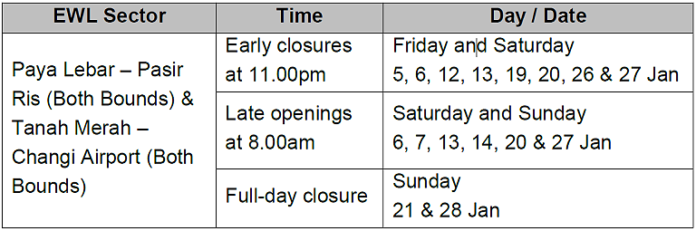
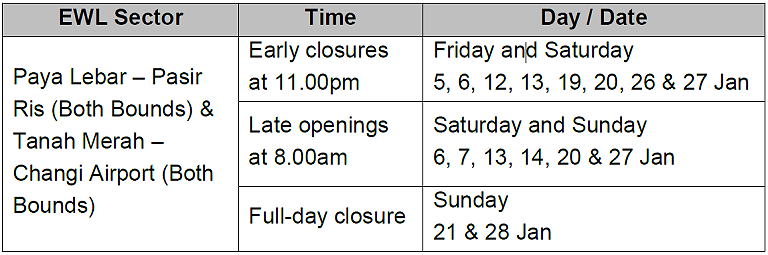
SINGAPORE: Ten MRT stations along the East-West Line (EWL) will have shorter operational hours on weekends in January, SMRT said in a news release on Monday (Jan 1).

SMRT said the measures from Jan 5 will “facilitate more rail maintenance and renewal works on the eastern stretch of the East-West Line”.

The stations include those from Paya Lebar to Pasir Ris, and from Tanah Merah to Changi Airport, the release said.

(Source: SMRT)

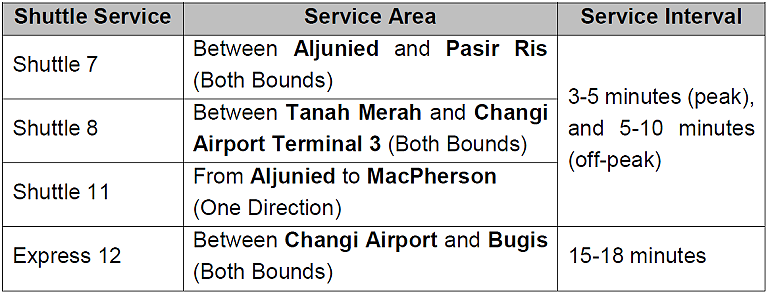
Two shuttle bus services will be made available for commuters during these weekends, it added.

“During the early closure, late opening and full-day closure of these stations, two shuttle bus services, Shuttle 7 and Shuttle 81, will be available for commuters travelling between Aljunied and Pasir Ris MRT stations, and between Tanah Merah and Changi Airport MRT stations respectively. These shuttle bus services will stop at pick-up and drop-off points near the affected MRT stations.”

Two additional shuttle bus services, Shuttle 11 and Express 12, will also be introduced.

“Shuttle 11 will provide commuters with a connection between Aljunied MRT station and the Circle Line and Downtown Line at MacPherson MRT station, while Express 12 will provide commuters with a connection between Changi Airport and the city area,” SMRT added.

(Source: SMRT)

LONGER TRAIN SERVICE INTERVALS ON NSL

Train services on the North-South Line (NSL) between Orchard and Marina South Pier MRT stations will operate at longer intervals of 10 to 15 minutes after 11.00pm on Friday and Saturday nights, and before 7.00am on Saturday and Sunday mornings, in January, SMRT said.

“During this period, there will also be no service between City Hall and Raffles Place MRT stations on the NSL. However, the route is still served by the EWL,” it added in the release.

Night bus services and some regular bus services along the affected stretch will be enhanced with additional buses during this period.

Last month, 17 EWL MRT stations and two NSL MRT stations were fully closed on Dec 10 and Dec 17 to allow for extended engineering hours. In addition, between Dec 8 and Dec 31, 17 EWL stations from Tiong Bahru to Tuas Link as well as Bukit Batok and Bukit Gombak stations on the NSL closed earlier on Fridays and Saturdays (at 11pm) and opened later on Saturdays and Sundays.

SMRT said commuters may get the latest updates on affected train services and alternative transport arrangements on SMRT’s website, as well as through SMRT’s Facebook, Twitter feed, and the SMRT Connect app.

Source link

A Bitcoin New Year for this Singapore bar

0

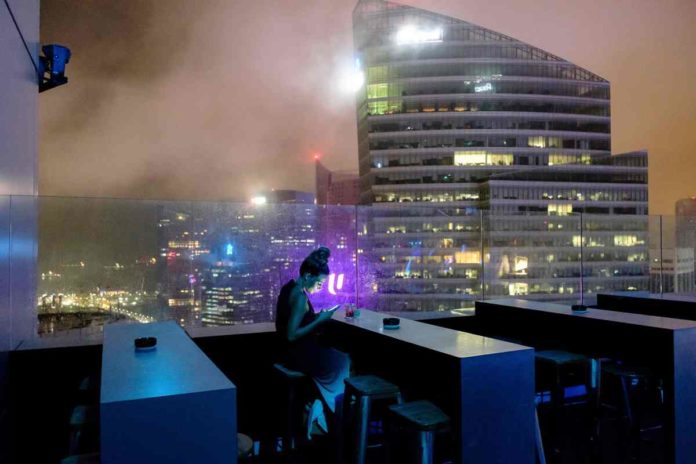
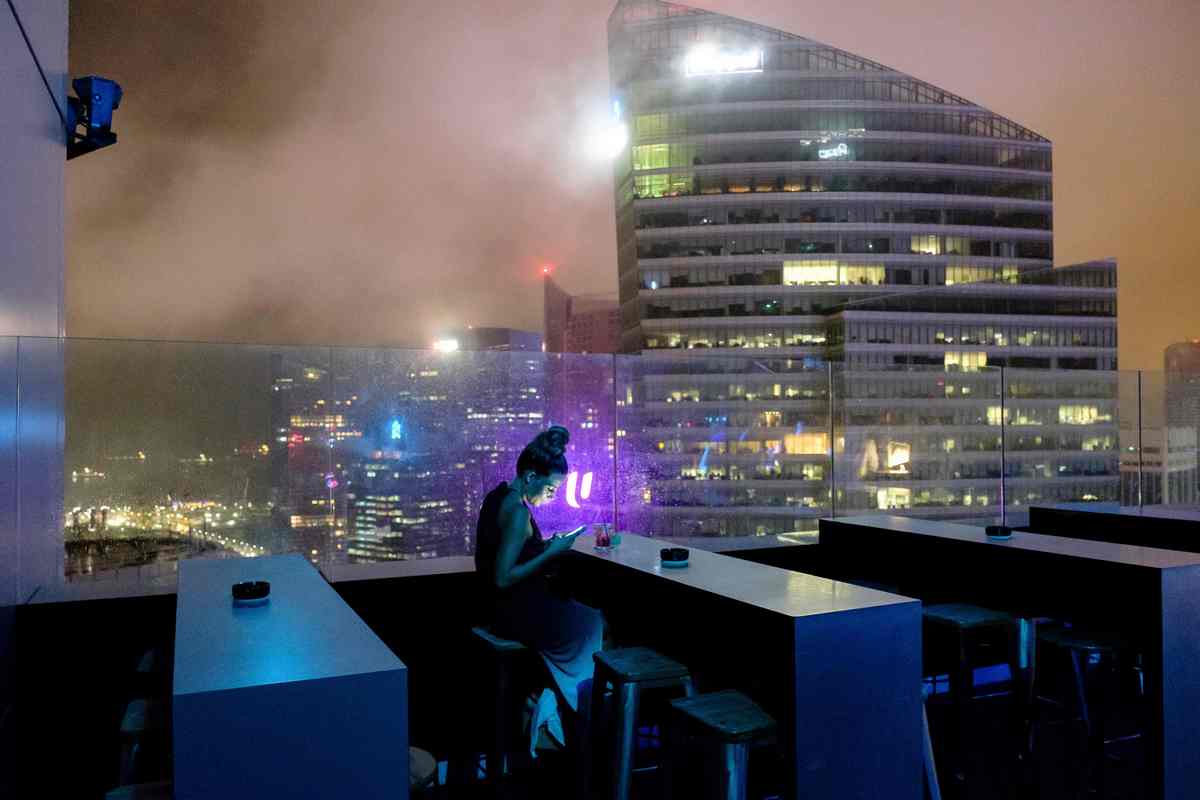
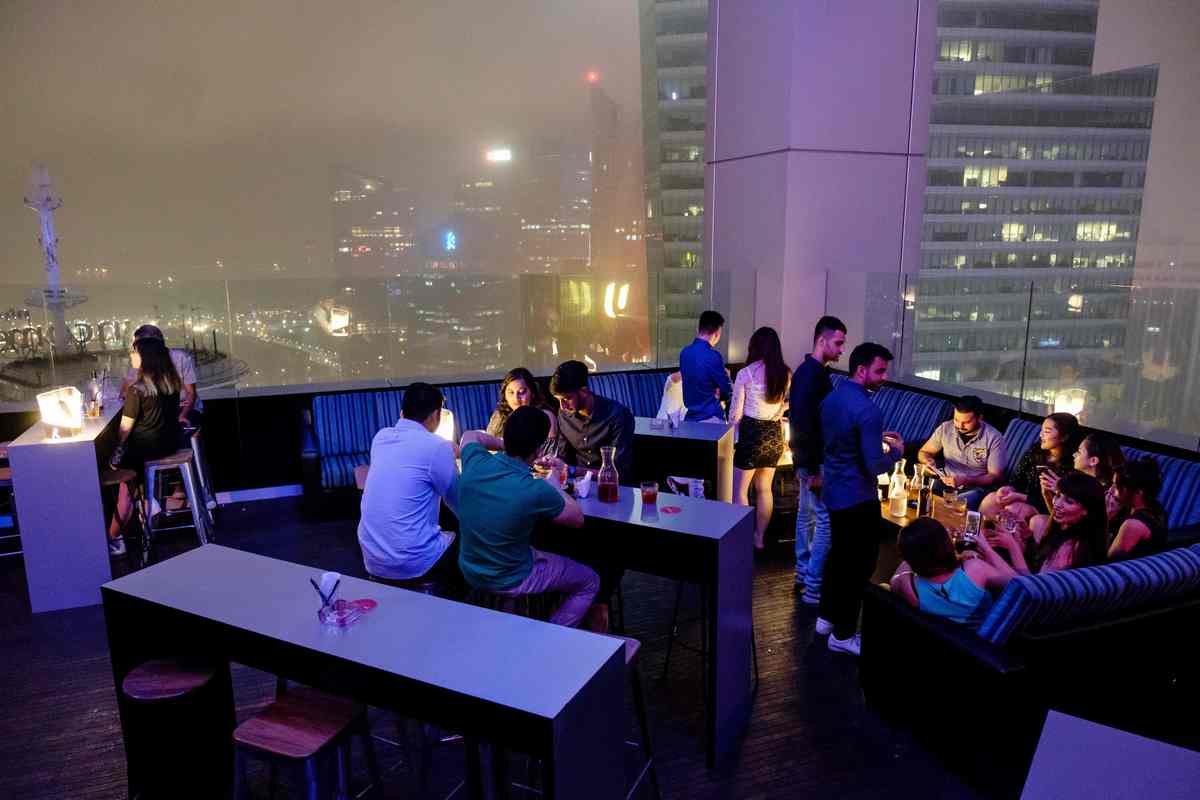
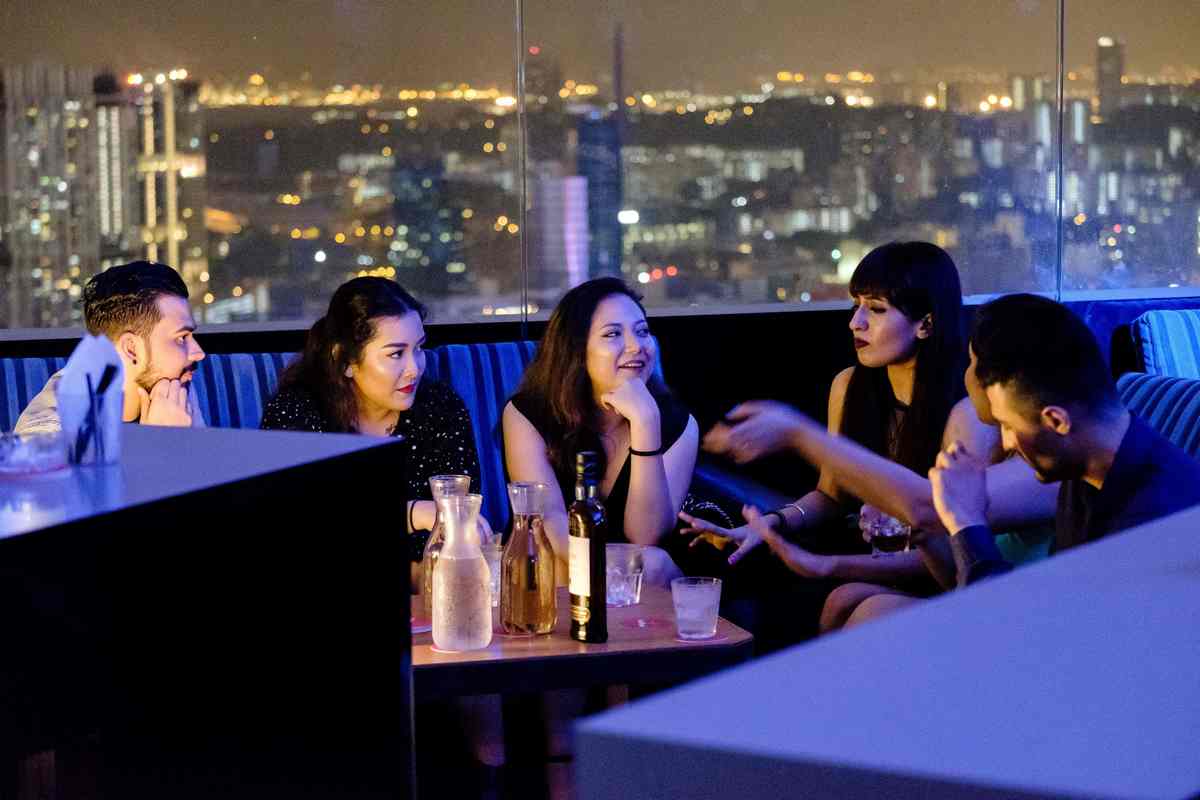
A Singapore bar that bills itself as the world’s highest cryptocurrency club is offering a New Year’s Eve package that includes a limousine pick-up and butler service – but it’ll cost you a whole bitcoin.

Skyline, on the 45th floor of a skyscraper overlooking the city-state’s glittering waterfront, is promising party-goers a luxury-filled night out, with champagne and oysters and caviar.

But it won’t come cheap, with the price of bitcoin – which has surged dramatically in recent months –hovering around US$13,000 yesterday.

The party at Skyline is called “Bianco”, with revellers dressed in white enjoying a night of drinking and dancing before watching the New Year’s fireworks display over the waterfront.

Photo: AFP

While the club has run the night before, it is the first time they are offering a bitcoin deal, and customers can also pay in regular cash.

Manager Subaish Rajamanickam said they received a lot of inquiries about the package – but no one had yet signed up for it.

The New Year idea came after the bar ran other successful virtual currency-themed nights for people in the financial technology sector, which is booming in the city-state.

Read also


Singapore cryptocurrency cafe launches as regulators sound warnings
Singapore cryptocurrency cafe launches as regulators sound warnings<!–

Singapore cryptocurrency cafe launches as regulators sound warnings

//afarkas.github.io/lazysizes/lazysizes.min.js

Skyline was the first club in Singapore to accept cryptocurrencies when it started taking payments in Ethereum, a bitcoin rival.

“We had a couple of cryptocurrency after-parties here, and we have also themed a night … called Crypto Thursdays,” Rajamanickam said.

“So that basically got the ball rolling for cryptocurrency acceptance here at Skyline,” he added.

But most transactions are still in regular cash and there was scepticism among some customers about using bitcoin, due to its surging price and recent volatility.

“It’s too expensive to buy alcohol or (conduct) any transaction using cryptocurrency in today’s environment,” said Spencer Campbell, a 47-year-old financial consultant.

Photo: AFP

Created in 2009 as a piece of encrypted software, bitcoin has been used to buy everything from pizza to cars, and is increasingly accepted by major companies such as online travel giant Expedia.

It has surged more than 25-fold this year and hit a record of around US$19,500 earlier in December.

Analysts have put the recent increases down to a decision by US regulators to allow bitcoin futures to trade on major exchanges.

But bitcoin has slipped back after a series of warnings from governments – including Singapore – and analysts about the risk and volatility associated with cryptocurrencies.

It fell more than 11 per cent after South Korea – a hotbed for cryptocurrency trading – announced curbs on anonymous trading of virtual currencies on Thursday.

Singapore

Monday, January 1, 2018 – 10:21

More about

bitcoins Food and Drinks Cryptocurrency

AFP

Others

Source link

Singaporean man killed in motorcycle accident in Thailand, Singaporean woman injured

0

Singapore

Monday, January 1, 2018 – 08:44

The Straits Times

Others

Source link

Partygoers brave the rain to usher in 2018 at Marina Bay

0

SINGAPORE: Revellers were out in force to usher in the New Year at the Marina Bay countdown event, undeterred by the wet weather on Sunday (Dec 31).

Those who braved the rain were rewarded with the first fireworks display of the night at 8pm. This year’s event featured minute-long fireworks on the hour, which culminated in a six-minute extravaganza at midnight.

Several countdown events took place across the island but the one at Marina Bay was the largest, with more than 350,000 people expected to turn up, organisers said.

Organisers said they expect more than 350,000 people to turn up for Singapore’s largest New Year countdown. (Photo: Elizabeth Neo)

This year, there are also light projection shows. Armed with ponchos and umbrellas, revellers watched as The Fullerton Hotel, Merlion and ArtScience Musuem were transformed by projections every hour from 8pm.

Amid the festivities, heightened security measures were put in place. These included bag checks and announcements asking the public to be on alert for anything suspicious.

The Fullerton Hotel will light up every hour from 8pm until close to midnight. (Photo: Elizabeth Neo)

Out at sea, safety boats conducted patrols to ensure that other vessels kept a safe distance from where the fireworks will take place. Meanwhile, security boats from the Police Coast Guard were also on the alert for any security situations. 

The Marina Bay countdown, which is in its 13th year, is organised by the Urban Redevelopment Authority.

Source link

Partygoers brave the rain to usher in 2018 at the Marina Bay

0

SINGAPORE: Revellers were out in force to usher in the New Year at the Marina Bay countdown event, undeterred by the wet weather on Sunday (Dec 31).

Those who braved the rain were rewarded with the first fireworks display of the night at 8pm. This year’s event features minute-long fireworks on the hour, which will culminate in a six-minute extravaganza at midnight.

Several countdown events are taking place across the island but the one at Marina Bay is the largest, with more than 350,000 people expected to turn up, organisers said.

Organisers said they expect more than 350,000 people to turn up for Singapore’s largest New Year countdown. (Photo: Elizabeth Neo)

This year, there are also light projection shows. Armed with ponchos and umbrellas, revellers watched as The Fullerton Hotel, Merlion and ArtScience Musuem were transformed by projections every hour from 8pm.

Amidst the festivities, heightened security measures have been put in place. These include bag checks and announcements asking the public to be on alert for anything suspicious.

The Fullerton Hotel will light up every hour from 8pm until close to midnight. (Photo: Elizabeth Neo)

Out at sea, safety boats conducted patrols to ensure that other vessels kept a safe distance from where the fireworks will take place. Meanwhile, security boats from the Police Coast Guard were also on the alert for any security situations. 

The Marina Bay countdown, which is in its 13th year, is organised by the Urban Redevelopment Authority (URA).

Source link

New drones, command vehicles to help police fight crime better

0

SINGAPORE: Police forces in other countries sometimes use helicopters to tail suspects with bright searchlights and loudhailers.

The Singapore Police Force (SPF) might not have a chopper, but its newest asset can do a similar job: An unmanned aerial vehicle (UAV) prototype equipped with new features like red-and-blue blinkers, searchlight and audio warning system.

The UAV was unveiled on Thursday (Dec 28) at the Tanglin Police Division, as part of a showcase highlighting the hardware deployed during the New Year’s Eve celebrations.

Since 2016 the police have been testing UAVs for traffic management and crowd monitoring, but it deployed its latest drone for the first time on Sunday during the countdown event at Marina Bay.

The drone can be used in hostage situations and search and rescue operations. (Photo: Jeremy Long)

“This prototype is the result of close collaborations between the police and relevant industry partners to build our UAV assets that can be used for different police operations,” a spokesperson said.

The drone, which took a few months to develop, can be used during search and rescue operations, hostage situations and public order incidents.

And its features are tailored for such missions.

The 16,000 lumens searchlight – an average car headlight is about 1,500 lumens – is bright enough for operations in forested areas.

Officers can also “communicate” with the public via the audio warning system, which can emit a loud siren and play pre-recorded messages. Audio messages can be heard from as far as 100m away.

When it comes to visuals, the drone’s full high-definition camera can make things appear five times closer, meaning it can spot a car licence plate clearly from the sky. It can also take photos and video and operate both day and night.

The 12kg drone can stay in the air for about 20 minutes before its batteries need replacing. To that end, the police also tested on Sunday a separate UAV connected to a power cable. This allows the drone to stay airborne longer.

The drone is operated using a console and tablet. (Photo: Jeremy Long)

On the ground, the drones are operated by a two-man team, comprising a pilot and safety officer, using a console fitted with a tablet. The police declined to reveal how many pilots it has.

Pilots must go through several months of training and pass a Civil Aviation Authority of Singapore (CAAS) certification test before flying the UAVs. In line with CAAS regulations, the drones can only fly up to a maximum height of 60m.

The UAV starred in a police showcase of assets deployed during the New Year’s Eve celebrations. (Photo: Jeremy Long)

“The UAVs will provide a useful aerial situational picture to the command post, complementing the deployment of other surveillance systems such as closed-circuit television (CCTV) cameras,” the spokesperson added.

The police hopes to operationalise the drones by the fourth quarter of this year, after improving and finalising their design.

DIVISION COMMAND VEHICLE

At the showcase, the police also revealed its new division command vehicle (DCV), which was deployed for the first time ever during the festivities at Clarke Quay.

The DCV is used in potentially lengthy operations that demand a higher level of coordination with other agencies. Some examples include hostage or suicide situations.

The new division command vehicle is suitable for operations that require more coordination. (Photo: Jeremy Long)

To handle such missions, the vehicle comes in-built with the latest police systems that allow officers to manage resources and communicate with various units and headquarters.

It is also equipped with a pan-tilt-zoom camera that can be raised almost 6m above the ground, allowing the police to conduct 360-degree surveillance and see incidents up to 150m away. 

The DCV’s camera gives officers and all-round view. (Photo: Jeremy Long)

In addition, the DCV takes up less space than its predecessor, the bus-sized forward command vehicle. When fully deployed, the latter takes up the size of three buses, which is not practical in cramped areas like Housing Development Board car parks.

The DCV, which holds up to six officers and supports an outdoor briefing post, can be deployed in a matter of minutes, much faster than its older counterpart.

The DCV’s external briefing area. (Photo: Jeremy Long)

“During major incidents, SPF will quickly deploy the DCV to command and coordinate operations,” the spokesperson said. “The DCV can be set up expeditiously and is also a more nimble vehicle capable of manoeuvring through congested terrain.”

The police currently has two DCVs in its fleet and will continue to trial them before additional vehicles are rolled out to the six police land divisions.

POLICE CAMERA WITH SPEAKER AND LIGHT

The police also tested on Sunday four CCTV cameras with speaker and light capabilities. This camera is designed to get the public’s attention by stating that the police are on their way. This, for example, can be used to break up fights.

To achieve this, the light – which comes in standard or blinking mode – can be used to illuminate the location, while the speaker can play a pre-recorded message indicating that the police have eyes on the situation.

The new police camera with speaker and light. (Photo: Jeremy Long)

Currently, only one of the cameras – situated along River Valley Road because of the number of public entertainment outlets there – is permanent. The other three, located at Marina Bay, Bayfront MRT Station and near the Esplanade, were removed after the countdown event.

However, the police are conducting further trials on the camera in the hope of installing more islandwide.

The police camera along River Valley Road. (Photo: Jeremy Long)

“With the additional capabilities, the cameras serve not just as tools to prevent and deter crime, but can also allow police to respond to crimes or incidents in progress,” the spokesperson said.

“Potential perpetrators will be aware that police are monitoring their actions and this may help to prevent the situation from escalating further before police’s arrival.”

Source link

Snipers, Gurkhas deployed to keep Singapore safe during New Year’s Eve celebrations

0

SINGAPORE: The Singapore Police Force (SPF) is going all out to beef up security measures for New Year’s Eve celebrations. More than 2,450 officers will be deployed at the Marina Bay Singapore Countdown and at 25 other countdown events across the island on Sunday (Dec 31). 

At the Marina Bay party alone, where about 350,000 people are expected to turn up, more than 700 officers will be deployed, clocking 7,000 man hours.

Among those on duty are two of the SPF’s elite forces – snipers from the Special Tactics And Rescue (STAR) unit and members of the Gurkha Contingent. 

Hidden from plain sight as they carry out their duties, the STAR sharp shooters are equipped with long-range and sniping capabilities. They are prepared for counter-terrorism operations and play a critical role in detecting and taking out well-hidden enemy snipers

The snipers are deployed during high-profile events such as the National Day Parade and New Year’s Eve countdown, and their eagle eyes are well trained to spot targets in the most complex of urban settings.

The STAR snipers are armed with two weapons – the 7.62mm caliber Arctic Warfare Sniper Rifle, and the 5.56mm caliber Special Operations Forces Combat Assault Rifle.

STAR snipers are armed with the 7.62mm caliber Arctic Warfare Sniper Rifle and the 5.56mm caliber Special Operations Forces Combat Assault Rifle. (Photo: Hani Amin)

Those who are chosen to be part of this elite force must first pass the selection stage where officers go through a basic sniping module to assess their competency. Officers who show good potential will then be earmarked for an advance course, which they must pass in order to take on the role of a sniper.

Another unit being deployed to keep the nation safe while it celebrates is the Gurkha Contingent. Formed in April 1949, the contingent has historically provided a “strong-arm” within the SPF, and are capable of quelling civil disturbance and carrying out specialist security tasks.

Members of the Singapore Police Force’s Gurkha Contingent. (Photo: Hani Amin)

“They have been an impartial strategic force in Singapore, which usually responds to public order incidents. Of course with the evolving threat posed by terrorism, officers have also been trained to deal with public security incidents such as gunman attacks in Singapore,” says DSP Arun Guruswamy, an officer with the Gurkha Contingent.

He added: “They go through very rigorous training, and they have always been known for their physical and mental resilience and their high level of fitness, so their uncompromising approach will definitely act as a deterrent to anyone who even minutely thinks about disrupting the safety of our country.”

Armoured vehicles used by the Gurkha Contingent. (Photo: Hani Amin)

On New Year’s Eve, the Gurkha Contingent will carry out high visibility vehicle patrols in armoured vehicles, which measure 6m in length, 2.9m wide and 2.6m high. SPF said the presence of the vehicle alone is enough to serve as a deterrent to possible security incidents.

Source link

Singapore’s bicentennial commemoration in 2019: A time to reflect on its rich history

0

SINGAPORE: About four months ago, former parliamentary secretary Yatiman Yusof wrote to the Government. His request – to name a street in what will be the Bidadari housing estate after a school that had recently been demolished. 

That school was Sang Nila Utama Secondary School at Upper Aljunied Road. According to the Malay Annals, Sang Nila Utama is a Palembang prince who gave Singapore its name in the year 1299. When the school opened in 1961, it was the first Malay-medium secondary school set up by the Government.

“In came a reply from a very senior officer from the Housing Development Board to say that ‘Ok, we will have a small plaque to say that this is the site of the former Sang Nila Utama Secondary School’,” Mr Yatiman shared. 

He said the school reflected a big milestone in Singapore’s education system, as prior to its opening, many Malay girls did not go to school because most then were run by Christian missionaries.

“But when the Government introduced multi-lingual education for secondary schools, thousands of Malay girls went to secondary schools and now their numbers overwhelms the males in the universities.

“The school captured the changing policy and it was a big milestone in our education system. Would a small plaque be sufficient?”

Mr Yatiman said he hopes this lack of depth in understanding Singapore’s history will be addressed through the Singapore Bicentennial, a series of events and projects in 2019 that will commemorate 200 years since the arrival of Sir Stamford Raffles onto Singapore shores. 

The commemoration was announced by Prime Minister Lee Hsien Loong on Sunday (Dec 31) in his New Year Message.

Sharing more details with the media, executive director of the Singapore Bicentennial Office, Gene Tan, said that rather than a celebration, the Bicentennial is a time to reflect on the nation’s journey. 

“It’s a prequel to SG50 (Singapore’s 50th year of independence),” Mr Tan said, adding that projects being planned will also explore the 500 years before 1819, widely accepted as the year modern Singapore was founded by Raffles.

The office will be supported by an advisory panel consisting of members from the public and private sector. They include Mr Yatiman and historian, Prof Tan Tai Yong.

Gene Tan (left) with advisory panel members including Professor Tan Tai Yong (second from right) and Yatiman Yusof (right). (Photo: Monica Kotwani)

“SINGAPORE’S HISTORICAL EVOLUTION DID NOT JUST SPRING OUT OF 1819”

Prof Tan, who is the President of Yale-NUS College, said the commemoration will allow people to understand how Singapore came to be as a nation in 1965, including what shaped it and what challenges earlier generations had to overcome.

And that is why, he said, it is important to go beyond 1819, to get the “full complexities of history”. That’s because new research is “pushing the boundaries of knowledge further backwards”.

“(Going by) popular belief and what we learn in school is that 1819 marker is the start of history in Singapore,” he said.

“To some extent it is true because 1819 was the beginning of the making of modern Singapore … but to say that everything that happened before 1819 is irrelevant is wrong historically.”

“Singapore’s historical evolution did not just spring out of 1819 but was kind of a continuation of something that had happened, as far as evidence can tell, all the way back from the 14th century onwards. We can trace it back to Sang Nila Utama.”

For example, Prof Tan said research shows that as early as the 14th century, Singapore was part of regional dynamics, functioning as an emporium, a trading port and had been a part of a political tussle involving the various empires such as Sri Wijaya, Majapahit, the Cholas, Ayutthaya and even the Chinese, presumably because they realised the strategic significance of the island.

WORKING WITH THE COMMUNITIES TO ENSURE THEIR STORIES ARE TOLD

At the same time, those on the panel acknowledged that the commemoration should not be a reflection of just one story nor a “rose-tinted” account of the last 200 years.

For example, Mr Tan said digging deep into Singapore’s history during the commemoration should also reflect the squalor, infighting and segregation that surfaced during some darker periods.

Dr Tan added glossing out such parts of the nation’s history would be a missed opportunity in understanding the “complexities and richness” of our past.

Mr Tan said the idea that Singapore flourished under British rule is just one part of a story.

“If it was just the colonial administration, without the traders, without the intermediaries from the Chinese communities, without the Chettiars handling the money-lending, without all these elements, the system could not have worked, the ecology could not have worked,” he said.

Organisers will work with the various communities to piece together these stories. They include religious organisations such as mosques, schools, cultural associations and government bodies. More than 60 partners have already been engaged. 

MAKING USE OF MULTIMEDIA, IMMERSIVE EXPERIENCES TO TELL STORIES

Organisers said the scale of the Singapore Bicentennial will not be as large as the SG50 celebrations were.

Instead, come 2019, the commemoration will ride on existing events organised by its partners.

For example, Mr Tan said museums and other institutions, which normally organise exhibitions each year have been asked to use the bicentennial commemoration as a theme.

He said the National Day Parade in 2019 could also reflect this theme during celebrations.

There are also plans to organise a “centerpiece” event where Singaporeans can gain a better understanding of the nation’s rich history in an accessible manner.

More details on projects will be released in the middle of next year. 

Source link