Pop superstar Lady Gaga and the psychedelic rapper Childish Gambino will perform at the Grammy Awards on January 28, organizers of the music industry’s biggest night announced Thursday.
Unveiling the first acts for the televised gala, the Recording Academy announced the return of Gaga, who at the 2016 Grammys put on a hi-tech medley of David Bowie songs in tribute to the late rock legend.
Gaga was shut out of the four main categories at the Grammys but Childish Gambino took surprise nominations for Album of the Year and Record of the Year, which recognises best song.
Childish Gambino, the stage-name of the actor and comedian Donald Glover, won acclaim and viral internet attention for his funk-infused album “‘Awaken, My Love!'” and its key single “Redbone,” a sultry song touching on race and infidelity.
Pop singer P!NK and country quartet Little Big Town will also perform at the Grammys, which are returning to New York from Los Angeles for the first time since 2003 to mark the 60th edition of the awards.
To showcase New York, the Grammys will honour Broadway with a tribute to the music of Andrew Lloyd Webber and Leonard Bernstein led by “Dear Evan Hansen” star Ben Platt, the Recording Academy said.
Broadway mainstay Patti LuPone, who appeared in the original Broadway cast of Lloyd Webber’s “Evita” in 1979, will return to the Grammys to sing the musical biopic’s signature song, “Don’t Cry For Me, Argentina.”
SINGAPORE: Securing Singapore against terror threats will require more than Singaporeans being vigilant or knowing when to run and hide when a crisis hits home.
An obsession with terror attacks can blindside us to the more serious and long-term risks of radicalising influences that seek to create schisms and divide society, weakening our social fabric.
The difficult challenge remains how to inoculate ourselves from these influences and be more discerning about potentially polarising developments, especially if complacency about racial and religious harmony sets in.
While Singapore continues to be spared from terrorist attacks, thwarting plots targeting places at home, developments over the past year suggest the fight is far from over.
Even with the defeat of the Islamic State in Mosul last year, our view is countering radicalisation remains a never-ending uphill battle given persistent, ground-up efforts by extremist groups.
Radicalisation can spread and take root rapidly as extremist groups harness the power of the Internet to preach their brand of exclusivism, distort events and create misinformation.
THE PERPETUAL THREAT
The threat of returning fighters from Islamic State’s theatre of operations in Iraq and Syria is one many Southeast Asian countries are keenly aware of, especially Malaysia, Indonesia and the Philippines who have struggled with domestic sources of extremism and terrorism for many years.
In 2017, the battle for Marawi was a game changer that challenged the way Singaporeans thought about the threats of radicalisation.
No longer did radicalisation confine itself to actions that terrorise urban centres in countries far away, it now had the potential to convince radicalised elements to take up arms and lay siege to a major Southeast Asia city, reminiscent of the Islamic State’s occupation of Raqqa and Mosul.
The Philippines says its aid priority is rebuilding war-battered Marawi AFP/TED ALJIBE
But the trouble is developments in Marawi may have reinforced perceptions that such threats remain foreign, whereas there should be an underlying worry that a more sophisticated and charismatic exclusivist ideology may find traction here.
18 Singaporeans have arrested in the past two years including youths, women and auxiliary police officers.
The reappearance of Singaporean militant Megat Shahdan Abdul Samad in a propaganda video a week ago serves as a powerful reminder of the Islamic State’s intent to target Asia, possibly even Singapore and embolden more radicalised individuals to carry out attacks.
But Shahdan is far away from Singapore, leading many to think the threat is just as distant.
The reality is Singapore needs to watch out for greater interplay of radicalisation and regional developments that can seed ill will and communal conflict by proliferating feelings of victimhood, injustice and disenfranchisement.
Regional issues, if not actively and openly discussed, can lead to polarisation among segments of society and the creation of enclaves.
Calls for jihad against Myanmar by the group Front Pembela Islam in Indonesia rallied a few foreign militants to fight against injustice experienced by the Rohingya in Rakhine.
Startling images of the Rohingya’s plight may be fodder for extremist groups.
Global jihadist groups, even when weakened, can exploit underlying tensions to sustain their extremist ideology in Southeast Asia, and garner support from individuals convinced they can be liberators of disenfranchised Muslims everywhere.
Islamic State-inspired attacks have risen all across Europe last year, including the Manchester Arena bombing and the London attacks. US President Donald Trump’s announcement on Jerusalem and a more assertive Saudi Arabia risk more tensions building up globally including in Singapore.
US President Donald Trump’s decision on December 6 to recognise Jerusalem as Israel’s capital sparked deadly protests in the Palestinian territories AFP/THOMAS COEX
COUNTERING EXTREMISM AND EXCLUSIVISM
Blunt enforcement efforts by the Singapore Police Force such as actions to ban foreign preachers and the employment of detentions under the Internal Security Act can mitigate the spread of exclusivist teachings.
Regional cooperation through joint military training between the Singapore and Philippine armies may help countries build deterrence against the ambitions of regional jihadist groups to establish a caliphate.
But efforts to counter exclusivist ideology are arguably more important. The key challenge in these efforts is keeping pace with myriad contemporary issues that may feed an extremist ideology.
Initiatives such as the future Singapore Islamic College and newly-established network of religious teachers (asatizahs) and youth groups by the Islamic Religious Council of Singapore (MUIS) are crucial in strengthening the Muslim community’s position to counter extremist ideology.
These efforts must continue to be carefully calibrated and communicated in order to avoid creating a perception that the Muslim community is being targeted. Jihadist groups and radical ideologues can capitalise on this perception to challenge counter-terrorism efforts.
Like what Home Affairs Minister K Shanmugam said a week ago: “Islamophobia … increases the risk of violence both from terrorists who kill in the name of Islam, and from those who want to attack Muslims.”
The key to avoiding this perception is to encourage engagements within the Muslim community in understanding Islam especially as young Muslims deal with issues of purpose and identity in navigating the events of today.
The wider public must see these engagements as efforts to leverage our Muslim community as a source of strength and inoculation against radicalisation, rather than as a community at risk.
Given the changing global terrorism landscape, Singapore has to double down on its counter-radicalisation efforts. We must also anticipate how extremist groups may seek new opportunities in uncertainties born by these developments to perpetuate their ideology and justify acts of terror.
Remy Mahzam is an associate research fellow at the International Centre for Political Violence and Terrorism Research. Faizal A Rahman is a research fellow at the Centre of Excellence for National Security at the S Rajaratnam School of International Studies at Nanyang Technological University, Singapore.
SINGAPORE: At around 11.10pm on Friday (Jan 5), it all began with the familiar announcement chime.
Then, a message: “Attention please. There is no more train service. We are closing the station. Good night.”
With that, the second round of MRT closures – this time on the eastern sector of the East-West Line – kicked off.
Commuters strolling towards the station stopped and looked around. But there were no loud groans, only quick sighs. Nobody seemed irritated that the trains were shutting shop earlier than usual.
The scene moments before it was announced the last train had left. (Photo: Aqil Haziq Mahmud)
Their composure mirrored that of the 10 or so SMRT staff deployed at the Terminal 3 entrance to the station. These men and women, some donning luminous lime green vests, seemed prepared for a thousand queries.
After all, about an hour earlier, dozens of them were briefed about their duties by a man who spoke in a booming voice. He had made clear the timings and pick-up location of the supporting shuttle services.
SMRT staff being briefed before the closure. (Photo: Aqil Haziq Mahmud)
Commuters caught up by the closure started murmuring at large signs, placed smack in the middle of the space, directing them up an escalator to the departure hall for the shuttles.
The large sign near the Terminal 3 entrance to the station. (Photo: Aqil Haziq Mahmud)
But the first signs of uncertainty soon appeared.
A man strode confidently to the platform, only to be stopped in his tracks. No more trains, he was told. Startled, he made a U-turn back up the escalator. I hopped on behind him.
The man, who said he works at the airport, told me he had no idea the trains were closing early. He was heading to Toa Payoh, so he’d take one of the shuttles out first. Nevertheless, he said he expected it to be a smooth journey.
I caught up with another woman who was also going up the escalator. She, too, said she works at the airport. The difference is she knew of the early closure.
“So far, the guiding and signs have been quite okay,” said the woman, who was making her way to the shuttles from Terminal 2.
TV signs inside the Terminal 2 baggage claim area. (Photo: Aqil Haziq Mahmud)
Putting myself in the shoes of a tourist arriving at Terminal 2, I made my way to the arrival hall there. Inside the baggage claim area, a TV sign clearly stated: “Last train to city has departed.”
Outside the baggage claim area, however, there were no signs for the shuttles. Assuming I wanted to take the train to the city, I would have followed permanent signs to the station anyway.
At the Terminal 2 entrance to the station, I was greeted by more shuttle signs and staff in vests. I didn’t see many tourists going to take the shuttles, though.
MINOR BLIPS, BUT ALL GOOD
Back at Terminal 3, I reached Gate 8 of the departure hall, where staff had formed two neat, snaking queues with red tape and black poles. One line was for Shuttle 8, the other was for Express 12.
Both lines were never fully utilised as take-up was slow. Still, marshals were diligent in ushering commuters to either queue. Shuttle 8 passengers waited outside under a shelter.
Outside, auxiliary officers used traffic cones to demarcate a roughly 50m stretch for shuttles to pick and drop commuters. One officer used a light stick and whistle to attract the buses and ward off other vehicles.
Cones to mark off where the buses stopped. (Photo: Aqil Haziq Mahmud)
The shuttles arrived on time, as there seemed to be at least one bus at any one moment. Shuttle 8 came in off-peak intervals quicker than the advertised five minutes, while the lower frequency Express 12 was punctual too.
An auxiliary officer guides a bus to its drop-off point. (Photo: Aqil Haziq Mahmud)
However, there were some hiccups.
First, a couple of buses seemed to go beyond the drop-off point, alighting commuters beside the blocked-off boarding area. This meant they had to walk along the side of the road before entering the terminal through a small door beside Gate 8.
“Why you never stop the bus here?” one official asked another. “I thought you said push in front?” was the reply.
A few minutes later, three bunched up Shuttle 8 buses seemed to stop too early, missing the drop-off point by a good 100m or so. The lone auxiliary officer whistled and waved frantically, finally attracting the attention of the drivers who duly pushed forward.
The boarding area outside Gate 8. (Photo: Aqil Haziq Mahmud)
Still, these incidents were the exception rather than the norm, as commuters boarded and alighted at the correct points for the most part.
One of them, undergraduate Zhang Pin Zheng, looked pleased as he alighted from a Shuttle 8 bus.
“It’s quite fast,” said the 23-year-old, who was going to pick up his girlfriend who had just returned from a holiday. “I stay in Choa Chu Kang and took two hours to travel (here) – which is about the same as if I took the train.”
Mr Zhang, who took the Downtown Line to Expo station before continuing to the airport on Shuttle 8, said the directions at Expo were clear. “There was signage that tells you to go to the shuttle and staff marshalling you all the way,” he added. “It was quite smooth.”
THE SHUTTLE EXPERIENCE
Past midnight, the already short queues wound down. The staff in vests stood idle; one started looking at her phone. It was time for me to take Shuttle 8 to Tanah Merah station.
Queues were minimal. (Photo: Aqil Haziq Mahmud)
At 12.16am sharp I jogged past marshals waving me on. This is the last bus, they chirped. I nodded – everything was on schedule. Men holding clipboards pencilled in the data.
Shuttle 8 was a standard single-decker bus. Mine was empty save for a couple who sat near the back. They had just sent off a friend and were heading back to Serangoon.
Inside Shuttle 8. (Photo: Aqil Haziq Mahmud)
One of them, who only wanted to be known as Mr Tan, said he knew about the shuttles but not where they were leaving from, until he saw the signs.
“We were about to go down (the escalator) when we saw a lot of people,” the 23-year-old undergraduate said. “I think there should be more signs because people can easily miss them.”
I walked to the front and spoke to the driver, who told me that he was on his second Airport to Tanah Merah trip. He’ll be doing the morning rounds later too, when the trains start later. But before that, he has to pick up the bus from a depot in Jurong at 4am.
Won’t you be tired? I ask. He shrugged it off and laughed.
The driver spoke to me in a mixture of English and Malay. (Photo: Aqil Haziq Mahmud)
The bus stopped at Expo, but nobody boarded. Instead, a few SMRT staff poked their heads in. Mr Tan and his companion asked if they had reached Tanah Merah. “Where are we ah?” one of them quipped.
We did arrive at Tanah Merah after a perfectly comfortable ride. Shuttle 8 dropped commuters off at the same stop where Shuttle 7 would take them onwards to Aljunied. More SMRT staff were on hand for guidance.
Despite that, it was a slightly different scene at Tanah Merah.
SMRT maintenance workers. (Photo: Aqil Haziq Mahmud)
There was also a different breed of SMRT workers there – those dressed in crumpled T-shirts and baggy work pants. They rolled heavy equipment towards the station, ready to toil through the night to renew and maintain our rail lines.
Then, the purpose of these closures could not have been any clearer to me.
Shuttle 7 stopping at Tanah Merah. (Photo: Aqil Haziq Mahmud)
At 12.54am, the last westbound Shuttle 7 service pulled away from Tanah Merah, later than scheduled. The SMRT staff packed up and said their goodbyes.
With shuttle services to support the late opening set to begin just a few hours later, they’ll have an early start.
SINGAPORE: On paper, it would seem Singapore has made great strides towards becoming a sporting nation.
Sports funding has increased over the years. Today, we have a Sports School and a Sports Hub. There’s even a road map for “using sport as a strategy for Singaporeans to have a healthier and better life through the impactful experience of Sport” in the form of Vision 2030.
In the last few years, the Physical Education syllabus in schools has also been boosted.
Swimmer, Joseph Schooling’s gold medal win at the 2016 Olympics rallied the nation and is much lauded even today.
In last year’s SEA Games in Kuala Lumpur, we saw Singapore athletes deliver a record-breaking overseas performance with 57 gold, 58 silver and 73 bronze medals.
IS SPORTS FUNDING HALF-HEARTED?
However, amid these achievements, there lie several ‘buts’.
While a focus on mass participation is positive in order to encourage healthier lifestyles and perhaps even to catalyse participation in competitive sports, focus seems to be lacking at the high-performance level.
Sports funding may have increased over the years, but local athletes often say it’s insufficient.
Just this year, the Government announced enhancements in the form of an injection of S$50 million over five years into the High Performance Sports system and a new One Team Singapore matching grant.
Singapore’s 4x100m medley relay champions at the 2017 SEA Games. (Photo: Justin Ong)
But still, some athletes have taken to crowdfunding to support their needs, giving rise to questions from members of the public about the sufficiency of Government funding.
In a recent edition of “On the Record”, CEO of Sport Singapore, Lim Teck Yin, sought to allay these concerns.
He, in fact, said that athletes are getting much more than they let on.
“A vocal few fail to acknowledge what is already being given. Very often, I wonder if I should come out on social media and declare the amount of money they are actually getting from Government.”
When I asked why he doesn’t for the sake of transparency, he said, “I’d rather not because I think we position these athletes as role models and they are. I do understand what they perceive their struggles to be. I understand they perceive that a lot more can be done and to their credit, they are standing up to take action.”
Lim pointed out that beyond funding in the form of cash, there are many other ways in which Singapore athletes are supported.
“There’s medical support and support in terms of sports science. Sports science has physiology, nutrition, psychology, strengthening and conditioning and even facility support. And all this is free for the athletes.”
In spite of this, many promising athletes have told me that if they didn’t hold down full-time jobs, it would be impossible to pursue their sporting dreams.
Joseph Schooling had the financial support of his parents who made numerous sacrifices.
Not many families would have the means in spite of personal sacrifices.
Lim assured me that the system for spotting athletes at a younger age and investing in them has improved.
But even the current system has its limitations.
“At what stage should we intervene with more money? How much flexibility would we have to make bets and how much latitude do we want to give ourselves for failed bets as opposed to having much stronger success rates? This is a continuing conversation to have.”
As an affluent nation that claims to be serious about being a sporting nation too, surely more latitude can be exercised even if it means intervening later with more money. More transparency on funding would also help citizens develop more informed views on such issues.
Lim, however, firmly believes that the Government should not be solely responsible for funding.
“The meaningfulness of the achievement of our national athletes will be enhanced only when the village gets behind them in substantive ways. When there’s an over-reliance on one party to do everything, the value of bringing people together is lost. We need to build something great together.
He is not wrong. Corporates need to get behind this effort too.
SPORTS – A VIABLE CAREER?
How far does the current state of affairs go towards inspiring confidence in potential athletes and their parents that a sporting career need not be a tremendous struggle and that it can be viable?
As an example, the sorry state of Singapore football exacerbates the situation.
As the new Football Association of Singapore Council takes steps to heal local football, many Singaporeans express scepticism, with some saying the sport is a lost cause here and no more time or money should be invested in it.
Fazrul Nawaz in action during Singapore’s AFC Asian Cup 2019 Qualifiers fixture against Turkmenistan. (Photo: AFP)
The public has witnessed years of poor performance so those who make these remarks can’t be blamed for feeling some measure of disillusionment.
A Channel NewsAsia report last year found that average squad members in the S.League earn less than S$3,000 a month, while players who regularly feature in the national team can pull in S$5,000 to S$8,000.
Many feel this is discouraging considering the high cost of living in Singapore.
Whether more public funding can be given is a discussion we all have to contribute to. Most would agree that serious and committed athletes deserve funding.
Others say if athletes have to struggle with money, wouldn’t it discourage them from being committed?
ARE WE TOO PRAGMATIC?
We also need to consider what sporting excellence means to us.
Are many of us unwilling to take risks or apathetic because for many years of our country’s growth, we were conditioned to focus on academics?
The dictum for many years was and in some quarters continues to be: Study hard, get into a good school, get a stable job or make lots of money as an entrepreneur. Sports is leisure, nothing more.
In 2015, President of the Singapore Sailing Federation and then Nominated Member of Parliament, Dr Benedict Tan said: “We are goal oriented and we monitor closely our key performance indicators (KPIs). We pay close attention to what is tangible and measureable, i.e. medals and grades.”
Are we being too pragmatic? If our children don’t show prodigious talent, shouldn’t we encourage them to at least explore it, instead of pouring water on their ambitions.
TAKING ACTION
Even while we feel this way, we clearly recognise the value of sports.
The jubilation surrounding Schooling’s Olympic gold was evidence of this.
We were inspired. We waxed lyrical about the value of sports in instilling discipline, determination and in bringing a nation together and making us proud.
Joseph Schooling stands with his family as he receives a standing ovation in Parliament.
Lim said: “Everything we do must have meaning to Singaporeans. If an Olympic gold medal does not make sense to the majority of Singaporeans, we will not pursue it.”
Many of us agree that it’s meaningful, but agreement is not enough.
Some experts have suggested it’s not at all about money or the viability of a sporting career. Rather it is the issue of facilities.
In some countries kids play football and other games on the streets. It is ingrained in them from a young age. In Singapore, you often have to make prior arrangements to use facilities.
Countries such as Iceland also have more facilities for sports like football than we do on a per capita basis. We have space constraints to consider.
FAS’ Deputy President, Bernard Tan has suggested having more artificial pitches, and more floodlit and covered facilities to encourage kids to play more organically.
Some experts feel if all this were in place, more people would participate in community and competitive sports and the money will come.
OUR ATTITUDES TOWARDS SPORTS
In 2016, a hue and cry by residents living near the Home United Youth Football Academy in Mattar Road also led to a debate about our attitudes towards sports.
The residents had complained about the noise generated by youth training activities at the academy.
Some had said this was reflective of a culture that discourages sporting activities.
But when we almost missed the chance to watch Joseph Schooling win his gold medal “live” during the Rio Olympics because of broadcast rights issues, the public was livid.
Another contentious issue that gets the public talking is the Foreign Sports Talent Scheme even though foreign talent make up a very small percentage of sportspeople here.
To date, we have five Olympic medals – three of which were won by foreign-born athletes.
The fact that such debates are generated shows that sports still means something to many of us.
WHOLE-HEARTED FOCUS AND VISION
Structures like the Sports Hub may attract international sports events and enable Singaporeans to be inspired by world-class athletes on our shores, but clearly much more is needed to help us prioritise sports.
We see initiatives to boost community sports, outdoor education, competitive sports, but all this needs to be woven into a tapestry that makes us a truly sporting nation that must also make sense to citizens.
Singapore’s Yu Shuran won a gold medal for ice skating at the 2017 SEA Games on Sunday (Aug 27). (Photo: Justin Ong)
Athletes’ funding concerns must be addressed more transparently.
More corporates need to have faith in our sportspeople. Don’t just wait for an athlete to win a medal before putting money into his or her development.
Poor leadership in sports associations needs to be addressed more quickly and decisively.
Citizens must demand more from the country’s investment in sports and exact public pressure on sports associations and organisations to ensure every dollar is used effectively.
We can also do our part in terms of exposing, encouraging and supporting our athletes and our own children who have the desire and the potential to succeed.
This requires whole-hearted effort. Let’s either go full-steam ahead or not at all.
SINGAPORE: “Are you scared of cockroaches?” Thomas Fernandez asked over the phone, when I asked to join his staff for a couple of days.
“Terrified,” I told the CEO of local pest control company, PestBusters.
Yet, here I was a month later, lugging canisters of chemicals to my first job as a pest controller.
Ivan, an experienced pest management specialist and my mentor for the day, made sure my personal protective equipment (PPE) was worn correctly.
“Are there always cockroaches when we open up the manholes?” It felt like a stupid question, but I wanted to prepare myself mentally.
This was the first order of business: “Dusting” the manholes as part of the monthly maintenance of sewers to ensure they are free of pests like cockroaches. This involves spraying a powder-like chemical inside sewers and manholes.
Cockroaches in direct contact with the powder would die immediately, as I would find out later. But its residual effect is also powerful, killing cockroaches that pick up the powder on their legs and ingest it while grooming themselves.
Ivan handed me two long metal hooks with which to lift the cover. I secured them to two holes, and pulled. Nothing.
After two more tries, I gave up, and Ivan took over, lifting the manhole lid up and out with some effort.
The manhole lid must have weighed more than 30 kg, and after attempting three times, I gave up and handed the hooks to Ivan. (Photo: Gaya Chandramohan)
Even in the dark, I could see the cockroaches scurrying about. I stood a metre away from the hole, very aware that the cockroaches could fly out at any moment.
“Today you won’t be handling the chemical,” Ivan said, adding I needed to be licenced to handle the powder.
“But the second canister has water, so you can try it out and pretend it’s the real thing,” he said.
While Ivan shone a bright torch into the manhole, I grabbed the canister in one hand and the spray nozzle in another, and slowly sprayed the water. By then, there were about 10 cockroaches running into and past the different sewer holes.
The manhole was also pretty deep, and to reach the cockroaches, I cringed and put my arm in further for the water to reach the bottom.
After what felt like an eternity, Ivan told me to stop, passed me his torch, and dusted the real chemical inside the manhole. The cockroaches immediately reacted to the white powder, and started flying madly. One flew inches from my face.
I screamed, caught by surprise.
The manhole was deep and I had to put my arm in up to my elbow for the spray to reach these pesky critters. (Photo: Gaya Chandramohan)
Ivan was more thorough, pointing the nozzle in all directions, including in crevices and on top of the sewer to ensure the powder would be dusted on all surface areas.
Once he was done, he lifted the manhole cover and closed the sewer. He handed me some masking tape, and told me to ensure all four sides of the gaps surrounding the manhole cover were sealed.
“The cockroaches will try to escape, so we need to make sure all points are sealed,” he said. I bent down, by this time perspiring profusely, and taped the manhole.
“Okay, now we have to do all the others,” Ivan said. I looked up, unhappy to see five more manholes, and five more potentially terrifying encounters.
Ivan explained that we needed to be thorough. That’s how one can ensure maximum exposure of the cockroaches to the residual chemicals.
“SO DIRTY, WHY DON’T YOU SWITCH JOBS?”
On the way to our next location, Ivan told me he’s been in the industry for about 12 years. Previously, he worked in the banking industry. Surprised, I asked what made him make such a drastic switch to this industry.
“That’s what many people ask,” he said.
“I wanted a challenge. People are surprised when they find out I have a diploma. And when I tell them I work in pest management, they tell me to switch jobs.
“They still think it’s a dirty job dealing with pests and insects.”
Ivan’s decision to switch to the pest management industry 12 years ago was a result of wanting to be challenged, but he still gets people questioning his choice of profession, and advising him to switch to another job. (Photo: Gaya Chandramohan)
Such perceptions are in stark contrast to the leaps the industry has made in professionalising its staff, improving safety and focusing on research.
When he joined the industry after completing his national service, Mr Fernandez said there were no safety guidelines for handling chemicals.
“I wasn’t using gloves or masks,” he recalled.
“In those days, we had knapsacks and your chemicals would leak onto your back. You’d be spraying, go back and shower and you think it’s okay but over time, the chemicals would build up in your blood stream.
“In fact there was such a high dosage of chemicals in my body that the doctor said I just had to stay away from using them for a while.”
President of the Singapore Pest Management Association, Andrew Chan, who has been in the industry for some 35 years, recalled workers keeping arsenic trioxide, a potent chemical used to kill termites, at home.
All this changed in 1998, when authorities enacted the Control of Vectors and Pesticides Act. This meant needing a licence to operate, and ensuring that staff attended basic training courses before handling chemicals.
Mr Chan, who is also General Manager of Anticimex Southeast Asia’s Merger and Acquisitions department, said the industry is also professionalising through a focus on education and higher skills.
True enough, I found out that there is more to the job than just spraying pesticide indiscriminately. During training, which is compulsory for new staff, the first thing I was told was that treating with pesticides is just one component of managing pests.
“More importantly, we need to know what is supporting the survival of these pests,” said Eugene Surendra, Pestbusters’ director of technical and client services.
“If you can address that, your application of pesticide will be lessened.”
Indeed, the training session often felt like an entomology 101 class, with Eugene explaining the life cycles of various insects, their protective shells and what application methods would be most effective at eradicating these insects.
I also learnt more about the different species of insects. For instance, I found out that the cockroach I had come to fear and would encounter inside the manhole was an American cockroach. While they can fly and are bigger in size, they also breed slower than their German cousins, which are the smaller cockroaches that are commonly found in food and beverage outlets.
As the industry evolves towards more environmentally-friendly practices, more companies are emphasising on educating their staff on insect biology and behaviour, to ensure minimum use of chemicals with maximum efficiency. (Photo: Hanidah Amin)
Hence, the American cockroach population was easier to control, much to my relief. The lesson on the life stages of pests would also be useful for my next assignment.
HALF THE POPULATION DOES NOT REACT TO BED BUG BITES
“Follow the blood” had been Eugene’s advice for the next assignment. The occupants of this one bedroom rental unit were facing a bed bug infestation, and a voluntary welfare organisation (VWO) had sought help on a pro bono basis.
Uncle Tyeo, one of the occupants, showed me the bites on his back. Both he and his co-tenant had been enduring the bugs for months. As he was putting his shirt back on, I saw a massive bed bug crawl across his blue shirt. After killing it, Ivan and I moved in.
I remembered my training with Eugene, when he said bed bugs lose about half of their blood meal within five hours of feeding.
And because at least half the population is thought to be unreactive to bed bug bites, identifying blood spots was the best way of identifying an infestation.
Walking in barefoot, I had barely taken two steps when I spotted dried blood spots on the white floor tiles.
Ivan led me to the bedroom area, where a spring mattress lay, black stains visible throughout. Across it was a shower curtain that was haphazardly drawn, hiding another soft mattress, a metal bedframe and items such as clothing and bags.
“The black stains are the bed bugs’ fecal matter,” Ivan pointed out. They were on the mattress and on the wall.
As Ivan inspected each part of the bedroom area, I thought of how a big part of the job was like investigative work. One needed both theoretical knowledge to understand the most efficient treatment methods, but experience allowed experts like Ivan to suss out these pesky creatures.
I remembered Eugene saying bed bugs could not fly or jump, so they needed to be close to ‘the host’. That’s why inspections almost always start where people sleep.
One of the many bed bugs Uncle Tyeo had to endure for months in his rented home in Clementi. (Photo: Gaya Chandramohan)
BED BUGS: A GLOBAL RESURGENCE
With more people travelling than ever before, pest control experts say bed bugs have become a big challenge.
Experts like Mr Chan and Mr Fernandez said people still associate bed bugs with having a dirty home. In fact, they said many of their clients are five-star hotels.
“In some hotels, the first guest might bring bed bugs into the room on his luggage, but the next two or three guests might not react to the bed bug bites,” Mr Chan said.
“By the time the sixth or seventh guest complains, the infestation has grown tremendously.”
“It’s not just in hotels, people travel to Batam to play golf – I’ve seen bed bugs on the ferries that take us to and fro,” Mr Chan said.
While chemicals are efficient in eradicating an infestation, Mr Chan technological advances in the industry are also proving to be effective.
Back in Clementi, I was about to use a relatively new method to treat the infestation. Behind the shower curtain, Ivan had pulled open a piece of rubber-like material attached to the wall. Out came adults and nymph bed bugs amids hundreds of small transparent bed bug eggs. It was a fascinating and creepy sight.
It did not take Ivan long to find the bed bugs’ nesting spot, filled with possibly hundreds of eggs and nymphs. (Photo: Gaya Chandramohan)
Ivan assembled the white contraption we had brought from headquarters, and turned it on. Instead of chemical spray, we were going to use a steaming machine to kill the bed bugs.
“Typically, we’d have to come back a week later when the eggs hatch, to do another round of spraying. But with this steamer, we can kill the live bed bugs and the eggs at the same time.”
The steaming machine could reach a temperature of 180 degrees Celsius, more than the 60 degrees Celsius temperature needed to kill bed bugs.
Under Ivan’s watchful gaze, I pointed the nozzle towards the mattress and carefully moved it along the length of the mattress. Every so often, a bed bug would fall off lifelessly, having been hit by the blast of hot steam.
It was tedious and laborious having to cover the entire surface area of the mattress with the steam. This meant slowly moving the nozzle lengthwise, down, across, up and then starting the process on a different section of the exposed material.
In just 15 minutes, my face was drenched in sweat, as was my T-shirt. My arms were trembling and my back hurt.
I also felt badly for Ivan, knowing I was slowing him down.
After treating the mattress and the wall above, I moved to the furniture behind the shower curtains. Every single item – from the rubbery material that hid the nest of eggs, to the bed frame and a disposed piece of tissue under the bed frame, had to be treated before being thrown away.
Almost two hours later, we were just about done. Ivan had determined that the infestation was limited to the bedroom area. He wrote a report on the infestation, while I advised Uncle Tyeo, under Ivan’s guidance, to wash his clothes in hot water as a precaution.
Showing Uncle Tyeo a dead bed bug on his bedsheet and explaining to him how to wash his clothes as a precaution. (Photo: Hanidah Amin)
EDUCATING MEMBERS OF THE PUBLIC
This step is necessary and critical to ensure clients and members of the public play their part in keeping their homes pest-free. Mr Fernandez said the first point of defence against pests in hotels is the staff. One of his first major clients, a five-star hotel, faced a major infestation of rats and cockroaches.
Other pest control companies had not been able to get rid of the infestation. Desperate, the hotel offered him the job.
“The general manager was committed to work with me, as were all the heads of department,” Mr Fernandez said.
“Everyone had a role. For example, the security department would go around patrolling the staircase. If they saw food left behind that could attract a pest, they had to report it to housekeeping. Housekeeping became the reporting body which we would monitor. If everybody started to cooperate, I knew I could solve the problem.”
Education and awareness also needs to be extended to members of the public to keep estates clean. While there are reports of rat infestations in public areas, Mr Chan said they tend to be localised to areas where food is readily available such as near bin centres, markets and food centres.
“There are also kind-hearted people who feed stray cats and dogs, and the food is left there, which attracts rats,” he said.
MORE WORK BY INDUSTRY MEMBERS NEEDED
But with more than 300 players in the industry, they agreed that part of the problem could also be service quality. Both Mr Chan and Mr Fernandez noted that price-cutting is common within the industry to win Government tenders.
“Even with pest control engaged in town councils, we have so many cockroaches and rats, why? Because of price cutting,” Mr Fernandez said.
“But are they qualified to do the job? Are they doing it well? Do you grade them? Are you still giving the contract to the cheapest?”
More and more companies like Mr Chan’s and Mr Fernandez’ are investing in technology and research to offer a more efficient service to clients. Mr Chan gave the example of the steamer machine to kill bed bugs, which is more effective but also three times more expensive than a typical chemical treatment.
The steamer is more effective than chemicals, killing both the adult bed bugs and eggs, but it also costs up to three times more due to its laborious nature of treatment. (Photo: Gaya Chandramohan)
In treating termites, it is no longer the traditional use of a “sprayer and screwdriver” to check for infestations. Now they use carbon dioxide detectors and thermal imaging cameras to spot termites.
Mr Chan said this typically means they are also more expensive than those still using traditional methods. But he acknowledged that authorities are increasingly aware of these shortcomings.
“They are taking steps to evaluate the tenders in a more professional manner and not totally depending on pricing but also service quality,” Mr Chan said.
Done for the day, Ivan and I headed back to PestBusters’ headquarters in the East. I was exhausted, both physically and mentally. I asked Ivan how I stacked up against other newcomers.
“Not bad lah, it was tough today,” he replied.
“Hey Ivan, do cockroaches have a smell?” I suddenly asked. It was something of a strange super power I had prided myself in having, to the amusement of friends.
Ivan laughed, saying they indeed had a smell, as did other pests like bed bugs.
“You see, you are a natural for this industry.”
I sat back, feeling vindicated after all these years. Maybe I was.
SINGAPORE: Even as the monsoon season brings minimum temperatures of 23°C to 24°C during this first fortnight of January, it will also produce a weather condition that is five times hotter than the sun: Lightning.
In a year, Singapore can be struck about up to 11,500 times. That is because, on average, the country experiences 168 thunderstorm days per year. And with every thunderstorm, there is a chance of lightning.
In November, a bolt almost hit a MRT train, causing it to stall after striking trackside. Last month, Changi Airport warned passengers to be prepared for baggage delays as its ground handlers exercised caution when there were lightning risks.
With so much lightning activity here, here are five things people may have always wanted to understand better about lightning and what it can, or cannot, do.
1. WHICH IS EARTH’S LIGHTNING CAPITAL?
Contrary to some headlines online, Singapore is not the lightning capital of the world. According to a 2016 study supported by America’s National Aeronautics and Space Administration, the top hotspot is not even a city, towering with skyscrapers.
It is Lake Maracaibo, Venezuela, which receives about 233 lightning flashes per square kilometre a year. Singapore, on the other hand, sees 17 flashes per sq km yearly.
And a flash counts as a strike only if it hits an object, on the ground or in the air.
2. HOW LIKELY AM I TO BE STRUCK BY LIGHTNING?
Statistician Adrian Roellin from the National University of Singapore told the Channel NewsAsia programme Why It Matters that the odds of getting hit here is one in 286,000 in a year.
Based on his calculation, lightning would hit approximately 20 people here each year.
The National Environment Agency has an app that sends alerts when lightning occurs. But it is not possible to predict where lightning will discharge and hit, said its principal meteorologist (Meteorological Systems Department) Mah King Kheong.
“You’d have to know … the entire atmospheric condition right under the thunderstorm clouds,” he said. “We’d have to know … the ground itself – typically it’s where the charge is accumulating.”
While it is not possible to predict lightning direction, this much is known: Based on the data compiled, the northern and western parts of Singapore have more lightning activity.
3. WHAT ARE THE ODDS OF SURVIVING A STRIKE?
A bolt can contain up to one billion volts, enough to power a 60-watt light bulb for six months – and enough to kill. In India, lightning kills at least 2,000 people a year.
But most people who are struck do survive, said Singapore General Hospital’s Jeremy Wee, who has more than 10 years of experience in emergency medicine and has treated lightning victims.
Of those who survive, however, 75 per cent may get a permanent disability, he added. A lightning strike could leave a person with deep wounds and burns and may lead to kidney failure, brain damage, hearing loss, paralysis and coma.
That is because lightning will disrupt the heart’s rhythm, which may cause it to stop beating.
Dr Wee advised: “There’s a myth that if someone is struck by lightning, it’s not safe to touch the patient. That’s not true because after the lightning has struck a patient, usually there’s no more electrical energy.”
4. HOW ARE BUILDINGS, AND THOSE INSIDE, PROTECTED?
Lightning tends to strike the tallest object, and Singapore has about 200 skyscrapers as well as close to 4,700 high-rise buildings. The law mandates that all buildings must have a lightning protection system.
“It wouldn’t be uncommon for a building to be struck once (or) twice … but (it doesn’t matter) because the lightning protection system is doing its job,” said Unitech director Thomas Yeo, who has spent a career in lightning safety.
The job of what is called a building’s “down conductor” is to intercept and discharge lightning energy safely to the ground. And Mr Yeo advises people against touching the conductor “or even going anywhere near it”.
He explained: “There’s a risk of side flashing when the lightning energy can’t fully discharge through the earthing system … because it seeks an alternative path. So if you’re in the way, you’re in harm’s way.”
But that is likely only if the protection system is not working well – in which case lightning could get into a building’s other metallic structures and even electrical appliances in homes. That is why there are national safety standards.
5. WHAT ABOUT PLANES AND TRAINS?
A commercial aeroplane gets struck by lightning once a year on average. But generally, “nothing will happen”, said Singapore Polytechnic’s aeronautical engineering course chair Liew Hui Sing, who has studied planes for over 15 years.
When a plane is hit, the lightning will get discharged back to the ground, with nary a blip or flicker on the instruments. In fact, it is safer up in the air than down on the ground when lightning strikes.
“Aircraft manufacturers have done many years of research and development, and they’ve also (done) rigorous testing to ensure that the avionics systems and electrical systems can withstand these kind of conditions,” said Mr Liew.
Aircrafts are built on the Faraday Cage principle, referring to structures enclosed by conductive material that create an exterior path for electric currents, in order to protect what is in inside. Singapore’s MRT trains are designed in a similar way.
The last reported case of a train hit by lightning was in May 2016 on the North-South Line. It disrupted southbound services from Yishun to Yio Chu Kang stations, but the passengers were safe.
In contrast, being out in the open during a thunderstorm is more dangerous. Hiding under a tree would not help, especially if it is the tallest object in the area.
It is best to look for shelter as soon as possible, especially as lightning, in fact, can strike twice in the same place.
Watch this episode of Why It Matters on Jan 8, Monday, at 8pm (SG/HK).
SINGAPORE: After no jackpot winner emerged in the S$9.7 million Toto New Year Draw on Friday (Jan 5), punters held out hope for a bigger prize in the next draw as Singapore Pools had said on its website that the jackpot would be “snowballed to the next draw”.
“Group 1 has no winner, and the prize amount of S$12,279,983 will be snowballed to the next draw,” Singapore Pools initially wrote on its website.
But this turned out to be an error that was corrected about 15 minutes later.
It later updated the sentence to: “Group 1 has no winner, and the prize amount of S$12,279,983 has been cascaded to Group 2.”
In response to queries from Channel NewsAsia, a Singapore Pools spokesperson said: “There was a brief technical glitch which was rectified quickly.”
Several local media outlets and netizens, who were reporting off Singapore Pools’ website, had repeated the error, causing some confusion over the prize money for the next draw.
“Group 1 has no winner, and the prize amount of S$12,279,983 will be snowballed to the next draw,” Singapore Pools initially wrote on its website. (Image: Singapore Pools website)
It quickly corrected its mistake to: “Group 1 has no winner, and the prize amount of S$12,279,983 has been cascaded to Group 2.” (Image: Singapore Pools website)
GROUP 2 WINNERS SHARE GRAND PRIZE
According to Singapore Pools’ prize structure, the Group 1 prize money does not snowball beyond a fourth consecutive draw.
If there is no jackpot winner at the end of four consecutive draws, the spoils will be shared equally among the next prize group that has winners.
Jan 5’s S$9.7 million jackpot had already been rolled over from three prior draws on Dec 25, Dec 28, and Jan 1, where there were no Group 1 prize winners. This meant that the jackpot should not be rolled over into the next draw, but cascaded down instead.
Singapore Pools clarified that each Group 2 winner shares the Group 1 prize in addition to the Group 2 prize. This works out to be S$13.86 million in total.
As a result, 19 winners in the Group 2 category walk away with a prize of S$729,761 each.
Interest was keen for Jan 5’s New Year draw, with long queues forming outside Singapore Pools outlets islandwide early on Friday morning.
The bets, opened since Tuesday, closed on Friday at 9pm with the draw taking place at 9.30pm.
The winning numbers are: 03, 04, 13, 19, 23, 47, with 05 as the additional number.
The jackpot prize for the next draw on Jan 8 will be S$1 million.
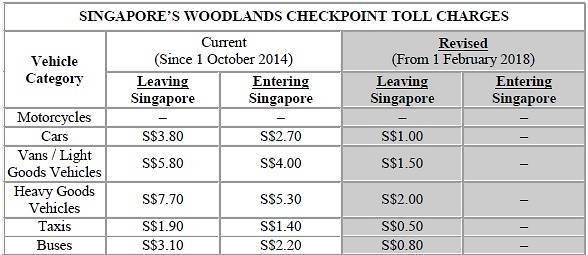
SINGAPORE: The toll charges for vehicles leaving and entering Singapore will be revised from February, the Land Transport Authority (LTA) announced on Friday (Jan 5).
This is to “match Malaysia’s recent removal of toll charges at the Eastern Dispersal Link”, and is in line with Singapore’s long-standing policy of matching Malaysia’s toll rates, the LTA said in its press release.
Currently, vehicles leaving Singapore via the Woodlands Checkpoint have to pay between S$1.90 to S$7.70. This will be decreased to between S$0.50 and S$2.00.
For cars leaving Singapore, the charges will be reduced from S$3.80 to just S$1.00.
Toll charges for all vehicles entering Singapore via Woodlands Checkpoint will be removed.
The LTA also reminded motorist to ensure there is sufficient value in their Autopass cards before driving through the checkpoints so to minimise inconvenience.
It is the responsibility of motorists to pay all required tolls, fees and charges using the payment machines located at the immigration booths, LTA said.
Those who evade payment of the tolls, fees and charges are liable to a pay a composition sum of S$50, or S$100 for repeat offenders.
Should they refuse to pay the composition sum, they may be charged in court and face a fine of not more than S$1,000, or three months’ jail.