Singapore
Sunday, January 7, 2018 – 12:25
Residents of Toa Payoh block jittery over neighbour's antics
The Straits Times
Others
SINGAPORE: Five existing playgrounds in four towns, namely Toa Payoh, Pasir Ris, Woodlands and Choa Chu Kang will be rejuvenated with the help of residents and their community, announced the Housing and Development Board (HDB) on Sunday (Jan 7).
Following the successful pilot of HDB’s Build-A-Playground (BAP) initiative at Canberra estate in Sembawang, which saw residents coming together to co-create a playground for their estate, the BAP will be extended to four other HDB towns under estate renewal plans.
The existing playgrounds, located at Woodlands Admiral Garden, Seashell Park, Tembusu Park and the neighbourhood parks at Lorong 8 Toa Payoh and Lorong 1 Toa Payoh, will be rejuvenated under estate renewal plans such as HDB’s Remaking Our Heartland (ROH) programme and the Town Councils’ Neighbourhood Renewal Programme (NRP).
Engagement activities with residents for the planning of the new playground at Tembusu Park will begin this year.
CANBERRA OPENS FIRST COMMUNITY-BUILT PLAYGROUND
The announcement comes after the Adventure Playground @ Canberra, a pilot project under the BAP initiative, was declared open by Minister for National Development & Second Minister for Finance Lawrence Wong on Sunday.

File photo of Adventure Playground @ Canberra. (Photo: Vanessa Lim)
Located at the Canberra estate in Sembawang, the 185 sqm treehouse-and-kelong inspired playground was co-created by some 1,800 people, including residents and students from nearby schools.
It was conceptualised after gathering feedback from the community through various engagement activities. Residents had suggested the kelong (fishing jetties) theme as they wanted it to reflect the heritage of Sembawang, which used to be dotted with fishing villages and kelongs.
Speaking at the event, Mr Wong said opportunities to further expand the BAP initiative to more HDB estates across Singapore will continue to be explored.
“(While) the playground design evolves, one thing we’ve learnt is that the most important aspect of a playground is not just the design but the process. How residents come together to design it and to take ownership of it. When you take ownership of it, you take pride in it,” said Mr Wong.
SINGAPORE: As a sociologist and a gerontologist, the retirement phase is of great importance and interest to me.
From the life-course perspective, retirement is the cessation of gainful activity or full-time work. It is a phase in one’s life which has accrued much attention due to the growing longevity of human beings and demographic ageing of most societies around the globe.
In Singapore, the retirement age has been increased from 60 to 62 years, and re-employment is possible until 67 years and beyond.
Today, more seniors aged 55 to 64 are working than ever before.
One reason why people are retiring later may be that attitudes about retirement are shifting as people live longer lives.
In 1996, I conducted 13 focus groups with people in their 50s in Singapore to gain insights into the complex perceptions and processes involved in the preparation for retirement.
In Asia, many are self-employed, they do part-time work in a family business or they are housewives. In the strict sense of the word retirement, many may feel that this group would never retire.
Yet, some housewives in my focus group research mentioned they looked forward to retiring.
When asked to clarify, one lady said she would like to hand over the role of running the household to her daughter-in-law so that she would not have to worry about cooking meals and keeping the home clean.
More Singaporeans aged 55 to 64 are working today. (Photo: Pixabay/gracic)
It seems that retirement can have a different meaning for people in various cultures and contexts.
Perhaps people retire late because they haven’t thought about what to do with themselves when they retire and the idea may be frightening.
The reality of impending retirement only starts to dawn when people enter their 50s.
Even though we all know preparation for retirement should start from the time we start working, the many responsibilities of providing for your family, personal needs and paying off debts prevent us from fully considering what we’d like to do when we retire.
Those who look forward to retirement as a time to achieve their dreams, to immerse themselves in a start-up or social enterprise, or take up hobbies and adventures that they could not indulge in earlier, would probably have a positive outlook.
For some others, it may be a time of uncertainty and soul-searching.
Thoughts on whether one should transit into part-time work after 62 or continue to work at the same pace even though one feels fatigued are commonplace.
THE ANSWER TO ONE’S LIFE STAGE
Another reason why people put off retirement is that their work keeps them going.
In a small study that involved interviews with older workers who had opted to continue working after 62, we found that their choice was driven by the desire to contribute to society, keep healthy, be socially connected and mentally active. Hence, retirement was not the answer to their life stage yet.
Some may wonder why someone would want to continue working when he or she could easily lead a more relaxing life.
Sociologists have explained that sometimes there is an intrinsic fear of letting go of one’s work identity. Many individuals have identities largely made up of their work role, particularly men.
Customers were more satisfied with mobile and broadband services from their telcos in the first quarter of this year, compared to the same period last year. (File photo)
Could it be that more people are putting off retirement, not because they enjoy the work but because retirement creates a vacuum in their lives?
In a recent news report on the loneliness epidemic, former US surgeon-general Dr Vivek Murthy said:
We live in the most technologically connected age in the history of civilisation, yet rates of loneliness have doubled since the 1980s.
Many are afraid of loneliness – for instance, singles who live independently – and may hence delay retirement.
In 2016, 47,400 seniors in Singapore lived alone, about double the number in 2006. The figure is projected to swell to 61,000 in 2020 and 83,000 in 2030, according to news reports. While some seniors living by themselves may have family, others may not.
This trend of seniors living alone may outstrip the projection if we consider the trend of more adults choosing to remain unmarried in Singapore.
While not all people who live alone are lonely and isolated, I think it’s safe to surmise that in the retirement phase, retirees are likely to have unmet psychosocial needs if they do not have family members.
In some cases, they may have family members but do not share cordial relations.
An old man walks by himself. (File photo: Francine Lim)
A TRANSITION NOT A STAGE
In my view, retirement is not a stage but a transition, and the choices people make about how much to work bear this out.
Seniors who are healthy may enjoy their work and have a passion for it, including doctors and counsellors, and they feel that work gives their lives meaning and purpose.
Having a purpose gets more important as we grow older – it gives one the push to wake up and get going. It provides nourishment to the mind, body and soul.
In Singapore, most financially secure people who reach 65 years exit from the workforce – they’re the most unencumbered group who can make decisions about when to retire. After a few years of “honeymooning”, they may return to contribute as consultants or part-time employees.
Those whose health is deteriorating may have to leave their jobs, even if they are not financially secure.
The last category consists of those who have financial liabilities but good health – they may continue working for as long as possible until they bid farewell.
Voluntary retirement with sufficient financial means is obviously the ideal situation.
But as much as work is important to achieving this, active preparation for retirement is vital, for it paves the way for a more satisfying life stage in our golden years.
Professor Kalyani K Mehta is head of the gerontology graduate programme at the Singapore University of Social Sciences.
Read also: A commentary on making the best use of your golden years.
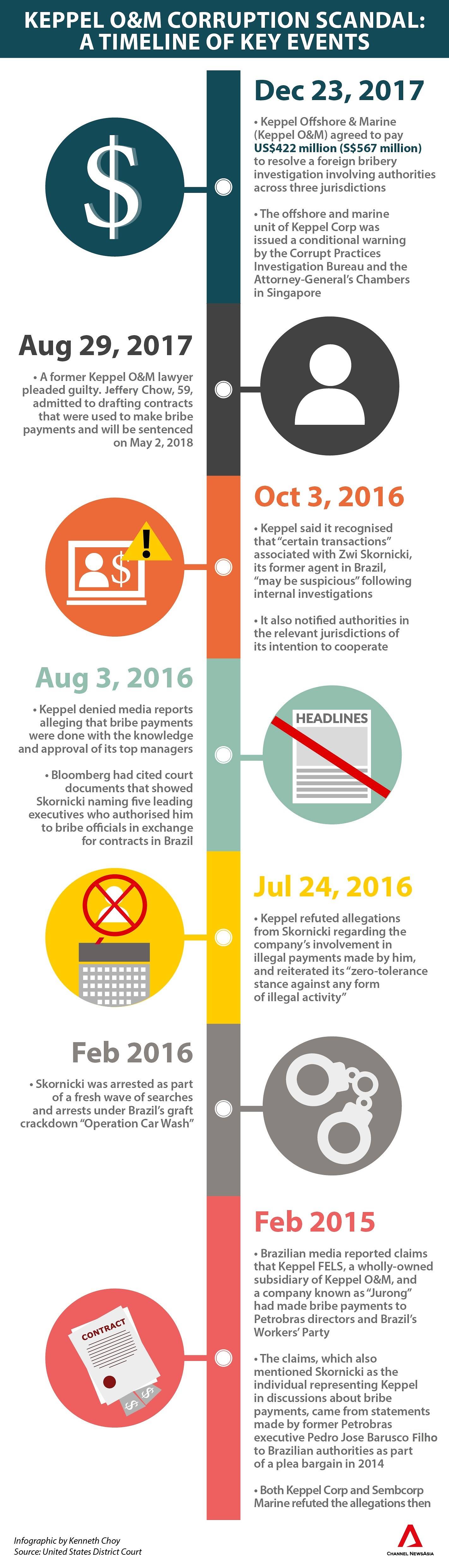
SINGAPORE: Keppel Offshore & Marine’s (Keppel O&M) involvement in an international corruption scandal came to light last month as Singapore’s largest oil rig builder said it would pay a hefty fine as part of a global resolution with authorities in three countries.
The settlement, reached with criminal authorities in the United States, Brazil and Singapore, is unprecedented for a local company. So is the penalty, totalling US$422 million (S$567 million), which is believed to be a record involving a Singapore-listed entity.
The corrupt payments of US$55 million made between 2001 and 2014 also surpassed the bribes unearthed in a corruption bust at shipbuilder Singapore Technologies Marine (ST Marine) in 2014.
Then, at least S$24.9 million in bribes were falsely claimed as entertainment expenses and made to employees of ST Marine’s customers in return for ship repair contracts. Seven former ST Marine executives were convicted last year for their part in the graft scandal.
The latest bribery scandal involving Keppel O&M, a unit of conglomerate Keppel Corporation, has raised questions about its corporate governance and caused turbulence, albeit temporarily, in the shares of mainboard-listed Keppel.
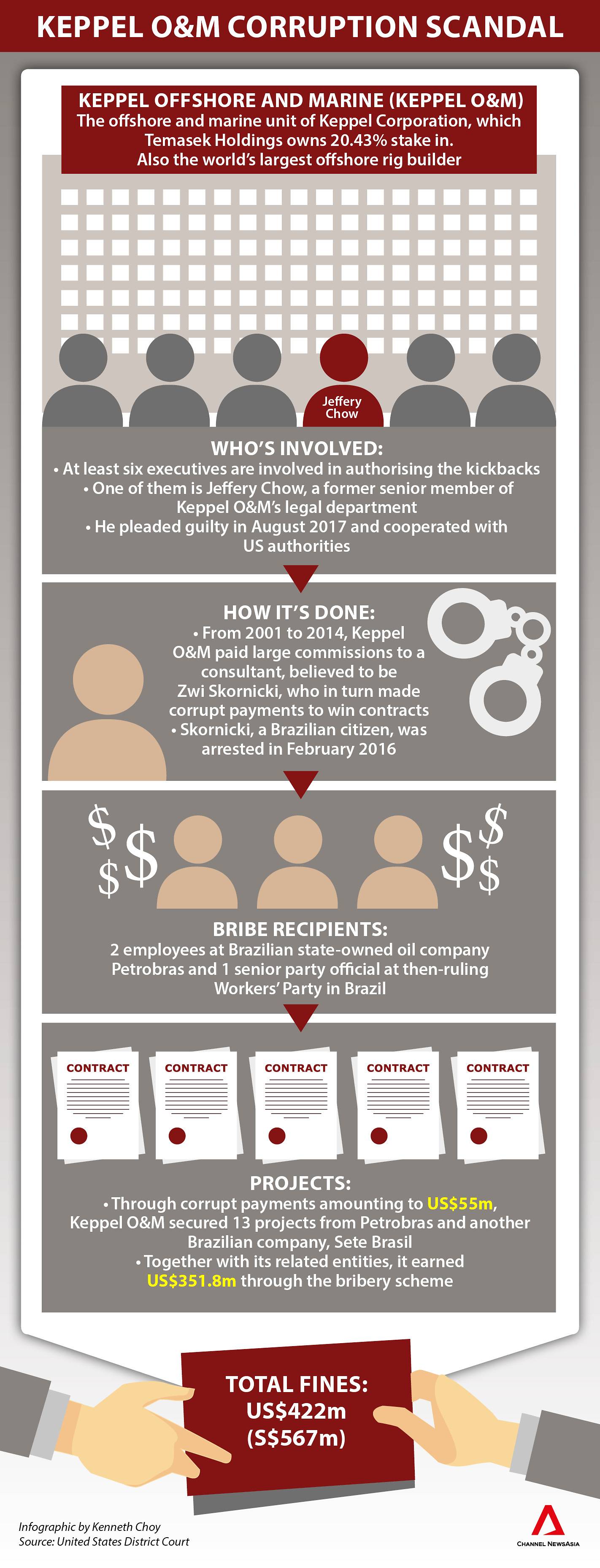
State investment firm Temasek Holdings holds a 20.43 per cent stake in Keppel as of Aug 15, 2017.
WHAT HAPPENED: According to court documents released by the US Justice Department, Keppel O&M “knowingly and willfully conspired” to pay bribes as part of a “decade-long scheme” to win 13 contracts with Petrobas and Sete Brasil.
These two Brazilian oil companies have been embroiled in a sprawling graft probe dubbed “Operation Car Wash” carried out by the country’s federal police since 2014.
From 2001 to around 2014, millions of dollars in bribes were disguised as large commissions to a consultant in Brazil under legitimate consulting agreements.
These illicit payments, made to bank accounts in and out of the US under the names of shell companies controlled by the consultant, were then transferred to bank accounts elsewhere and into the pockets of Petrobras officials and politicians at the then-governing Workers’ Party in Brazil.
From the 13 contracts that it secured through the 13-year-long bribery scheme, Keppel O&M and its related entities earned US$351.8 million.
WHO’S INVOLVED: The consultant, who played the key intermediary role in this bribery scheme, was not named in the US court documents but is believed to be Mr Zwi Skornicki, Keppel’s former agent in Brazil from 2000 to 2016.
Mr Skornicki was arrested in February 2016 as part of a fresh wave of searches and arrests under “Operation Car Wash”. He was nabbed after former Petrobras executive Pedro Jose Barusco Filho made the allegations against him in his testimony to Brazilian police as part of a plea bargain in November 2014.
US court records also pointed out the involvement of six former executives at Keppel O&M, with four of them being Singapore citizens. One of the remaining executives is a legal permanent resident of the US, while the other holds US citizenship.
The executives are unnamed in the US court documents. An August 2016 report by Bloomberg, which referred to Mr Skornicki’s Jul 21 testimony in court, named five top managers at Keppel and its marine and offshore units who allegedly knew about and authorised his bribe-for-contract payments in Brazil.
They include former CEOs of Keppel O&M Chow Yew Yuen and Tong Chong Heong, former CEOs of Keppel FELS Brasil Tay Kim Hock and Kwok Kai Choong, as well as former Keppel CEO Choo Chiau Beng. Mr Choo was also Singapore’s non-resident ambassador to Brazil from 2004 to 2016.
The Keppel executive, who is a US citizen, is believed to be Mr Jeffery Chow – a senior member at Keppel O&M’s legal team from 1990 to 2017.
The 59-year-old admitted to drafting contracts for bribe payments and has pleaded guilty on Aug 29, according to US court documents. He is scheduled to be sentenced on May 2, 2018.
Bribe recipients were two Brazilian officials who worked at Petrobras between 2003 and 2012, and one party official who held a senior position in Brazil’s Workers’ Party.
According to Mr Skornicki’s testimony, the party official is believed to be Mr Joao Vaccari Neto, the former treasurer of Brazil’s Workers’ Party. He has been sentenced to 15 years and four months in jail for corruption and money laundering in September 2015.
THE PROJECTS: The bribery scheme landed Keppel O&M with 13 contracts from Petrobras and Sete Brasil. Here are the details of each:
1. The P-48 Project
Around 2001, Keppel O&M, through a joint venture, won a subcontract to convert a floating platform for Petrobras. From around June 2001 to April 2002, bribe payments of US$300,000 were made to government officials in Brazil with “instructions and authorisation” from Keppel O&M’s executives, according to court documents.
2. The P-51 and P-52 Projects
In 2003, the consultant received authorisation from Keppel O&M executives and the firm’s joint venture partner to pay bribes equal to a percentage of the contracts’ value. That added up to about US$13.3 million.
The consultant made the illicit payments through an intermediary to a Brazilian official at Petrobras, who kept some of the money for himself and shared the rest with another company official and Brazil’s Workers’ Party.
3. The P-56 Project
Around 2007, the consultant learned from a Brazilian official that Keppel O&M and its joint venture partner would need to pay bribes in an amount equal to a percentage of the contract value to obtain the P-56 project which resulted in about US$14.2 million in bribes. The money went to a Brazilian official and the Workers’ party.
In the same year, the consultant received authorisation to pay the bribes, which was approximately US$14.2 million.
4. The P-53 and P-58 Projects
In 2005 and 2009, executives of Keppel O&M and a Keppel O&M subsidiary in Singapore authorised the consultant to pay bribes equal to a percentage of the contract value of both projects to a Brazilian official and the Workers’ Party. The bribes paid to secure portions of two floating platform hull conversion projects from Petrobras, was approximately US$4.4 million.
5. The P-61 Project
Around 2007, Keppel O&M and Keppel O&M USA, as part of a joint venture with an engineering company, began work to obtain a large platform construction contract from Petrobras.
In 2009, the consultant received authorisation from a Keppel O&M executive and an executive at Keppel O&M’s Brazil subsidiary to pay bribes equal to a percentage of the project’s contract value to a Brazilian official and the Workers’ Party. The sum was about US$8.8 million.
6. The Sete Brasil Projects
Between 2011 and 2012, Sete Brasil contracted with five companies to commission the construction of a fleet of ultra-deepwater rigs for which Petrobras would be the end user. The construction contracts were split among the companies, with a Keppel O&M subsidiary successfully bidding for contracts for construction of six semi-submersible units.
Court documents showed that participating companies, including Keppel O&M, negotiated bribes with a Brazilian official equal to 0.9 per cent to one per cent of the value of their respective contracts.
Two-thirds of the payments were designated to the Workers’ Party and one-third was to be divided equally between the relevant Petrobras and Sete Brasil executives.
During the negotiation period, Keppel O&M executives authorised the consultant during several telephone calls to pay one per cent of the contract value as bribes. Accordingly, the consultant received approximately US$14.4 million in bribes to the Brazilian officials and the Workers’ Party.
WHAT KEPPEL DID: Keppel was first cited in the “Operation Car Wash” investigation in February 2015 when Brazilian media reported claims that Keppel FELS, a wholly-owned subsidiary of Keppel O&M, and Sembcorp Marine’s shipyard in Brazil had made bribe payments to Petrobras directors and the Workers’ Party in Brazil.
Both companies refuted the allegations then.
When court testimonies from Mr Skornicki emerged in July 2016 with allegations of Keppel’s involvement in illegal payments made by him, the Singapore conglomerate denied the allegations and reiterated its “zero-tolerance stance against any form of illegal activity” in a filing to the Singapore Exchange on Jul 24.
Later in August 2016, Keppel denied the Bloomberg report that bribe payments were done with the approval and endorsement of its senior management.
It said: “None of the individuals named in the article, including the current CEO of Keppel Offshore and Marine Mr Chow Yew Yuen, have ever authorised Mr Skornicki to make any payments as bribes.”
Only in October 2016 did it announce that it recognise “certain transactions” associated with the company’s former agent in Brazil “may be suspicious” following internal investigations. It also notified authorities in the relevant jurisdictions of its intention to cooperate.
Following the disclosure last month, Keppel Corp chairman Dr Lee Boon Yang said the company was “deeply disappointed” by the incident, adding that “global companies such as Keppel have both a legal and moral duty to operate fully within international laws and regulations”.
“Since the allegations emerged, we have moved quickly and decisively to put in place stricter controls and embedded best practices across the group to ensure that such unacceptable behaviour will not be repeated,” Dr Lee added.
Keppel Corp CEO Loh Chin Hua also said that “effective compliance controls are now thoroughly embedded” across its businesses, “supported by rigorous anti-corruption training and robust compliance and governance regimes”.
US court documents said Keppel O&M has taken on “extensive remedial measures” as part of the deferred prosecution agreement.
Those included disciplinary action against 17 former or current employees which led to seven employees departing the company; demotions and/or written warnings to seven employees; approximately US$8.9 million in financial sanctions on 12 former or current employees; and anti-corruption and compliance training for six employees.
A Keppel spokesperson told Channel NewsAsia that the company has “separated with all the executives defined as ‘relevant individuals’ in the Statements of Facts released by the authorities.”
Disciplinary action has been taken against employees involved in the misconduct, including separation and financial penalties, added the spokesperson. But the company is unable to “comment on any individual employee, or the specific penalties imposed against individuals” for legal reasons.
When asked about the guilty plea by former lawyer Jeffery Chow, Keppel’s spokesperson mentioned deep disappointment in the behaviour uncovered.
“It is not how Keppel conducts business. We have taken robust steps to strengthen controls and compliance to ensure that such unacceptable behaviour is not repeated,” the emailed response added.
Amid questions raised by corporate governance experts about the efficacy of its auditing and internal governance, the spokesperson responded to queries on Jan 5 that the current boards of directors of Keppel Corp and Keppel O&M “were not aware of the illegal payments” made in Brazil.
The illegal payments were “deliberately concealed by those complicit in the bribery and structured as agency fees”.
“The agency fees were not approved by the Boards of Keppel Corporation or KOM as they were built into the contract values of the respective projects and bidding for projects is in the ordinary course of KOM’s business,” the spokesperson added.
Keppel also revealed that it began its internal inquiry led by external counsel when allegations first surfaced in 2015.
The denials by Keppel then, and in July as well as August 2016, were issued after taking into consideration the relevant evidence available at that time.
“As the inquiry continued and suspicious transactions in Brazil were uncovered, Keppel promptly announced in October 2016 that it had notified the authorities in the relevant jurisdictions and offered to cooperate fully and extensively in the investigations. Keppel also encouraged all its employees to cooperate fully with the authorities,” the spokesperson added.
WHAT’S NEXT: In Singapore, Keppel O&M has accepted a conditional warning from the Corrupt Practices Investigation Bureau (CPIB).
This was issued in lieu of prosecution for corruption offences punishable under the Prevention of Corruption Act and part of the global resolution, said the Dec 23 joint statement from the Attorney-General’s Chambers (AGC) and the CPIB.
The local authorities said that in issuing the conditional warning in lieu of prosecution, “due consideration was given to the substantial cooperation” rendered by Keppel O&M to the investigations – which included the unit’s self-reporting to AGC and CPIB of the corrupt payments made by it – and the “extensive remedial measures taken”.
“Investigations in respect of the individuals involved are ongoing,” the statement added.
Meanwhile, Singapore’s Workers’ Party (WP) has filed questions related to the bribery scandal for the Parliament sitting on Jan 8.
Members of Parliament Pritam Singh, Sylvia Lim and Png Eng Huat have collectively tabled four questions to seek details about the global resolution that Keppel O&M reached with authorities, the investigations being carried out by local authorities, as well as answers about the role of the finance ministry and Temasek Holdings in overseeing the conduct of government-linked companies (GLCs) overseas.


Yesterday morning, I noticed that there was a new Facebook friend request in my inbox.
Clicking on the tab to check who it was, I realised that it was sent by my close friend from university.
Finding it a bit odd (though not completely implausible), I wondered why she created a new Facebook profile when she already had another – filled with years of photos and memories.
Giving her the benefit of the doubt, I accepted the friend request without hesitation,
But there was a nagging feeling that the situation wasn’t as simple as it seemed.
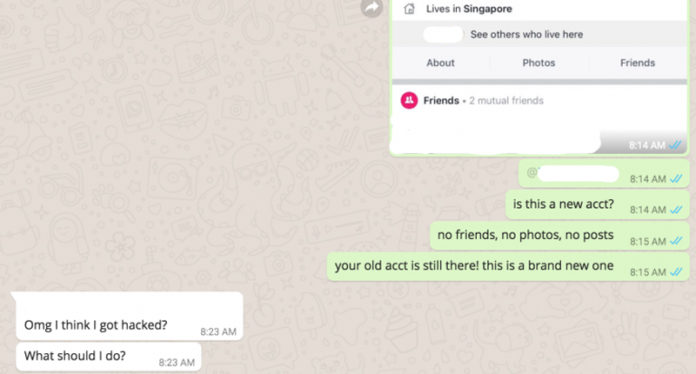
And it was when I checked her new profile that I knew something fishy was up.
Her profile photo was exactly the same as the one she had on her older account. If she was truly creating a new profile, perhaps to separate her work and personal contacts, why would she use the same photo?
There was nothing on the profile, other than her profile photo and friends list.
Her old profile was still running and very active.
I decided to check with the source directly, and Whatsapped her immediately:
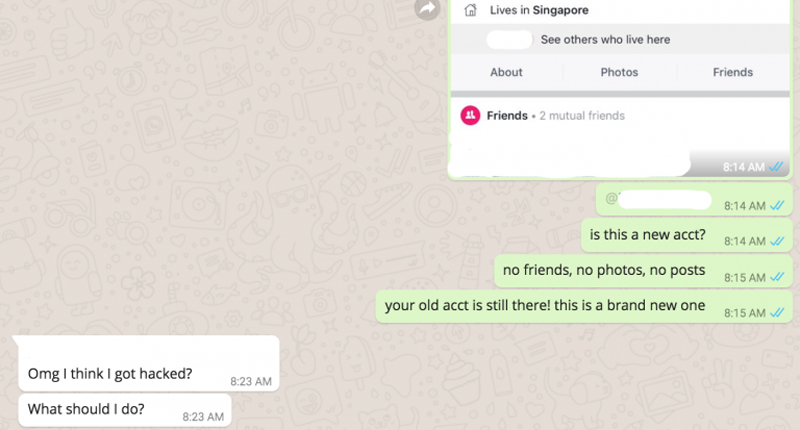
A mutual friend’s boyfriend, who was also added to the new account, had also received Facebook messages from my ‘friend’ asking for his phone number.
We quickly got into action, and reported the account.
My friend also changed her profile photo and posted a warning on her real profile:
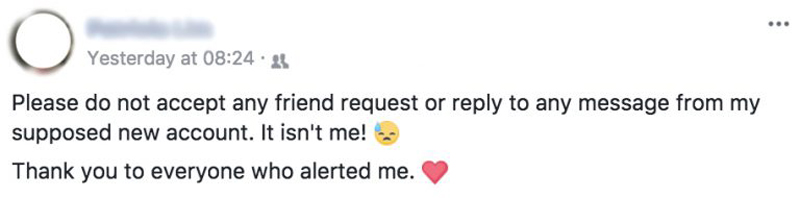
Her post wasn’t the first of its kind that I’ve seen.
Over the past few weeks, different Facebook friends have come out with their experiences on how they, too, were impersonated by scammers that were Facebook messaging their friends, asking for personal details like their phone numbers and OTone-timetime passwords).
In fact, even the Singapore Police Force noticed the rising occurrence of the scam last year:
I DIDN’T FALL FOR THE SCAM, BUT MY MUM DID
Yesterday, my mum was also targeted by the same scam.
Except in her case, the scammer got his/her way.
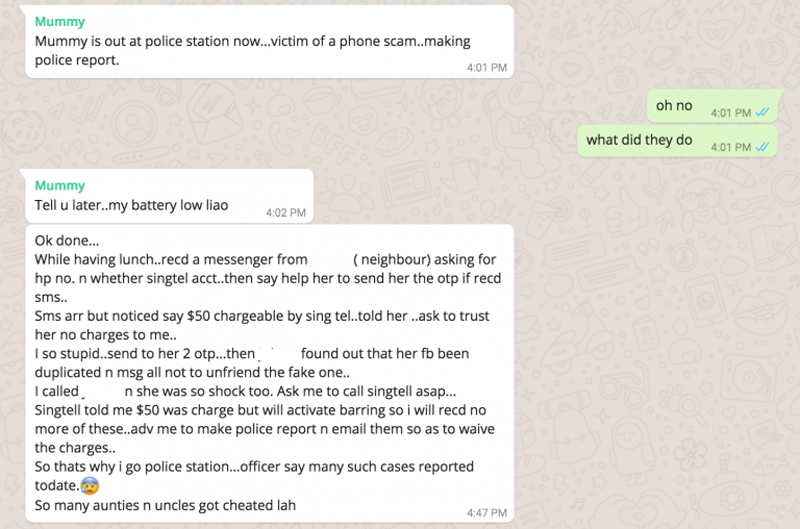
Singtel told me that $50 was charged, but they will activate barring so I will receive no more of these […] So that’s why I went to the police station. The officer said that there are many such cases reported to date.
I immediately asked for the screenshots from the convo, and the modus operandi is exactly like how it is in all the other cases.
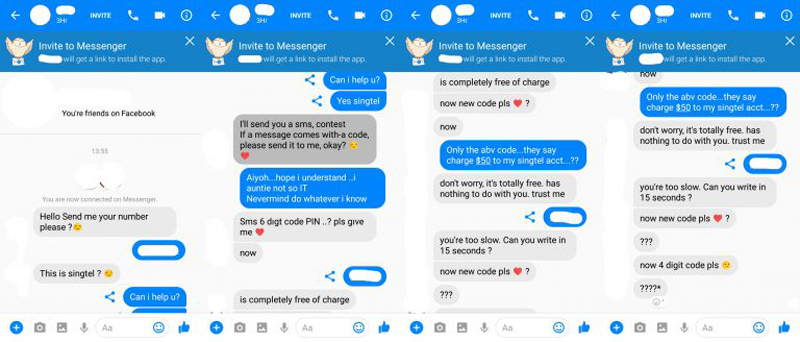
After finding out your phone number, they will then charge various amounts to your account, asking you for the OTP to verify the payments for things like gift cards or gaming credits.
If you’re lucky, you’d realise that something is fishy before the scammer gets away with too much.
Fortunately for my mum, the amount was just $50, and she managed to contact Singtel and the Police in time.
MILLENNIALS MIGHT BE AWARE, ‘AUNTIES’ AND ‘UNCLES’ MIGHT NOT BE
Aiyoh…hope I understand…I auntie not so IT.
The situation is a glaring example of how technology, while easily accessible to all, might leave some pockets of users behind.
For those like my mum, while they’re savvy with using platforms like Facebook to communicate and post photos, they might not be equally savvy about how scammers are operating these days.
Personally, I felt bad about not warning my mum in the first place, but just like every other scam, most people don’t know until they get burnt.
This ‘Facebook friend’ scam will eventually die down when scammers realise that people aren’t falling for their tricks, but more sneaky methods would pop up soon enough.
While adopting a constant state of distrust isn’t the way to go, it might be better to just remind friends and family to always be vigilant and hold their personal information even closer to themselves.
This article was first published on Vulcan Post

Internet crimes and scams Facebook



SINGAPORE: The windscreen of a van was damaged after an e-scooter fell onto the vehicle, according to a video circulating online on Saturday (Jan 6).
In the video, a van is seen driving out of a multi-storey carpark when an e-scooter fell and cracked the vehicle’s windscreen. The driver was not injured.
Driver Jason Yu told Channel NewsAsia that the damage cost S$2,500 to fix.
The e-scooter was also damaged in the incident, with its handlebars and several other components dislodged.
Mr Yu said that no one claimed the e-scooter after the incident and that he had called the police immediately.
According to the police, the incident took place on Dec 30 at about 8am outside Block 165A, Teck Whye Crescent.
The police have classified it as a case of rash act and investigations are ongoing.
The e-scooter involved in the incident was also damaged, with some of its parts dislodged. (Photo: Jason Yu)