SINGAPORE: Just Acia, an eatery selling Asian food at underground mall Dhoby Ghaut Xchange, has been suspended for two weeks for selling “unclean” food.
In a suspension notice on Friday (Jan 12), the National Environment Agency (NEA) said the restaurant had accumulated 12 demerit points over the past year – six points for each offence of selling food that was unclean.
It was fined a total of S$800 for the offences.
Just Acia, a restaurant at Dhoby Ghaut Xchange.
The two-week suspension will begin on Saturday. But Just Acia had been alerting customers of a temporary closure since Jan 6, saying in a Facebook post that it was doing “minor upgrading maintenance works in the kitchen area”.
Another eatery, Mohammadi Restaurant, was also handed a two-week suspension, effective Saturday.
Located at Lembu Road in the Little India area, the restaurant also accumulated 12 demerit points in the last 12 months and fined S$800, for failing to register an assistant and for handling food with bare hands.
NEA said that establishments which accumulate 12 or more demerit points during a 12-month period may, depending on their past record, be suspended for either two or four weeks, or have their licence cancelled.
Food handlers working at the restaurant premises would also be required to attend and pass the basic food hygiene course again.
SINGAPORE: The rainy weather Singapore has been experiencing this month is expected to gradually ease over the weekend, said the National Environment Agency (NEA) on Friday (Jan 12).
However, it is likely to remain chilly, with the lowest temperature forecast to range between 22 and 24 degrees Celsius for the next few days.
NEA has said that the cool and wet weather is due to a monsoon surge that’s affecting the South China Sea and the surrounding region.
As of 4pm on Friday, the lowest temperature was 21.4 degrees Celsius at Jurong West – that broke 2017’s low of 21.7 degrees Celsius recorded on two days in January and August.
The highest temperature on Friday was just 24.7 degrees Celsius at Sentosa, as of 4pm.
In the past five years, temperatures have dipped below 21.4 degrees Celsius in 2016 (21.2 degrees Celsius), 2014 (20.1 degrees Celsius) and 2013 (20 degrees Celsius).
In our regular light-hearted look at an issue making the headlines, Genevieve Loh has braved the chill to come up with ways of keeping warm in the current conditions.
A rainy day in Singapore. (File photo: AFP/Roslan Rahman)
(Updated: )
Bookmark
SINGAPORE: It’s only the first month of the year and Singapore has already hit a new low. In temperature, that is.
According to data from the Meteorological Service Singapore this morning (Jan 12), temperatures in Ang Mo Kio and Pulau Ubin dipped below 22 degrees Celsius, while other parts of Singapore experienced temperatures of below 23 degrees Celsius.
These are not numbers that us tropical islanders living approximately one degree north of the equator are used to. But aren’t we a resilient, air-conditioning loving bunch who have the smarts and skills to take this chilly weather on the chin and brave our way through it?
And even if we can’t or won’t, we all know it’s simply the Singaporean way to complain about how it’s too cold and rainy before we go back to complaining about how it’s too hot and sunny when the weather turns again.
In the meantime, here are five tips on how we can go about coping with the Big Chill. Shiver me timbers, it’s the only way we know how to deal with 21.9 degree Celsius weather.
TIP 1:
According to a 2012 study published in the Journal of Consumer Research, when people feel physically cold, they look for psychological warmth. And what better way to stay both physically and psychologically warm than to cuddle up against a hot body with a romantic movie blasting in the background? Another alternative: go round offering free hugs. To willing recipients of course. It’s a much nicer idea than leaching some body heat in a packed MRT train during rush hour, right?
TIP 2:
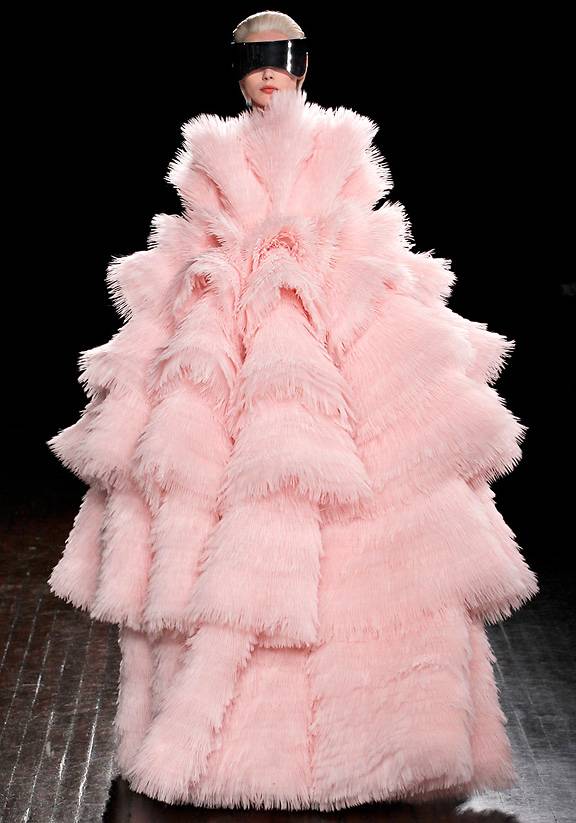
Alexander McQueen Fall/Winter 2012 collection ( Photo: www.Vogue.com)
Take the opportunity to wear your snazziest winter gear without looking like (too much of) an idiot. So break out that leather jacket you usually save for your overseas holidays or that cute lightweight sweater you just purchased. But do rethink that urge to put on your ski suit and hat.
TIP 3:
The chicken here is tender and has the aroma of soy and sesame. (Photo: Xing Yun Hainanese Boneless Chicken Rice facebook)
This might just be your only chance to consume as many calories as you can for the most legitimate reason. According to www.livescience.com, Loren Greenway, CEO of the Wilderness Medical Center in Salt Lake City, Utah says “it always helps to be well-fed…This is all-important, to keep your blood sugar up enough to provide the energy you need to keep warm in a cold situation.” This of course, is not an open invitation to be a total glutton. But as body generates heat as it digests the foods you eat, certain foods will indeed help you keep warmer than others. So hearty stews, foods that are high in energy and other other meals rich in protein and carbohydrates should be on the list.
TIP 4:
Couldn’t afford that winter wonderland vacation to Europe or that ski trip to Whistler? This is the perfect opportunity to recreate that holiday right here in Singapore. Search the longest running youtube video of a fireplace, don your favourite woolly hat, fix yourself a thick, hot cup of Milo and pretend you’re in an alpine ski lodge.
TIP 5:
Go for a drive on any Singapore expressway during rush hour. Or downtown Orchard Road on a weekend night. That’s always a sure-fire way to get the blood boiling!
Chinese superheroes will soon be joining the pantheon of larger-than-life Marvel universe mainstays Spider-Man, Iron Man and the X-Men, a company official said as the comic book giant makes a major thrust into Asia.
As part of a push to grow its Asia fanbase, the Disney-owned franchise has released mobile games in China, opened “Marvel Stores” in South Korea and is searching for artistic talent in the Philippines, Marvel editor-in-chief C.B. Cebulski said.
“We have been making great strides especially in Asia. We try to hire more Asian creators, writers and artists to bring a piece of their culture to Marvel comics,” he said in Manila where he visited a major university for fresh talent.
The comic giant plans to introduce two new Chinese superheroes: “Sword Master” and “Aero” who will be based in China, Cebulski added.
“They are going to be heavily based on Chinese culture and Chinese mythology but set in the modern world and they will interact with the other heroes (in the Marvel universe),” he said.
These new characters will be drawn in the ‘manga’ style of Japanese comics that is more popular in Asia, he added.
Cebulski, who has lived the last two years in Asia, serving as Marvel’s vice president for the region, conceded that Marvel had not given Asian characters prominent positions in the past compared to mainstays like Captain America or the Hulk.
But this is changing, he said. “We want to have stories that are reflective of every culture.”
There is huge fan expectation over Marvel’s latest flagship movie — Black Panther — which will be released worldwide next month.
The film stars Chadwick Boseman playing Marvel’s breakthrough black superhero T’Challa, a king of a fictional African nation who first featured in the company’s comic books in the late 1960s.
Luke Cage, another popular black Marvel superhero, has also had a recent revival through a popular TV series on Netflix.
But Asian superheroes are still comparatively rare in the Marvel universe despite the franchise’s growing popularity there.
In the Philippines, a former US colony, Marvel is already deeply ingrained in the nation’s popular culture, said Cebulski.
Filipino illustrators in turn have also provided art for Marvel comics since the 1970s.
People from the Southeast Asian nation are now the third largest nationality of artists employed by Marvel, just behind Americans and Italians, Cebulski said.
SINGAPORE: When Ms Sharon Toh returned to work after giving birth, she was faced with a dirty reality – if she was going to continue to feed her son breastmilk, she would have to express milk in the toilet.
Ms Toh, 38, who was then working as a frontline officer in a bank, asked to express milk in a hidden area, but she was not given permission to.
“The bank was in a mall, so I just chose a toilet that was most deserted,” Ms Toh said. While there were nursing rooms in the mall, she could not afford to wait in the queue for the two cubicles during her one-hour lunch.
But there were times it got too unbearable.
When people came to do their ‘big business’, the sound and the smell, it’d be too disgusting, so I’d just cut short the session and leave.
That came with its own problems, as the milk that was not expressed resulted in engorgement and infection. It was so stressful that Ms Toh started looking for another job.
Senior Minister of State for Health Amy Khor on Friday (Jan 12) encouraged employers to support mothers like Ms Toh who want to continue breastfeeding after returning to work.
Dr Khor pointed to figures from the 2011 National Breastfeeding Survey which showed that breastfeeding dropped significantly after mothers returned to work. They gave reasons such as lack of facilities and difficulty working flexible hours, Dr Khor said at an event at CapitaLand’s offices where she toured its nursing rooms.
Addressing space or financial constraints that small- and medium-sized enterprises may face in providing lactation facilities, Dr Khor said: “We can encourage building owners and developers to set up common family and nursing rooms that their tenants can access and utilise.”
Another mother, 32-year-old Karine Yong who works as a planning officer, told Channel NewsAsia she also had to use the toilet along with other breastfeeding mums.
“We know how people discriminate against people pumping or feeding in the toilet but we have no choice. We maintain high hygiene on our hands and pumping parts,” she said.
Breastmilk is usually expressed with a device called a pump, then stored, usually in a fridge or a cooler bag, and fed to the child at a later time.
Ms Chen Mei Hui (left) and Ms Celeste Lok at a nursing room in CapitaLand’s offices. (Photo: Jalelah Abu Baker)
Other mothers Channel NewsAsia spoke to said they resorted to pumping in stuffy rooms or meeting rooms, under the constant stress of knowing that others might want to use the room at any time.
BREASTFEEDING ADVOCATES ECHO CALLFOR MORE SUPPORT
President of Breastfeeding Mothers’ Support Group (Singapore) Elaine Chow said that employers need to show more support for breastfeeding mothers.
While she said large companies do “fairly well” in providing support, smaller companies report space constraints in providing a suitable area for employees.
For a mother to continue breastfeeding after she returns to work, she will need a clean, private area for her to express her milk and also needs to schedule times to express breast milk during the work day, said Ms Chow.
“This prevents her from having painful engorgement when her breasts become full from milk, causing pain and possibly even infection – and also provides breastmilk for the baby’s feeds the next day.”
She held up the United States as an example. The country passed a law requiring all employers covered under the Fair Labour Standards Act to provide breastfeeding mothers with the time and space to express breastmilk at work.
Ms Eleanor Foong, a moderator on Singapore-based Facebook group Breastfeeding Mums, which has more than 27,000 members, said that mothers tend to struggle with direct supervisors who are not understanding about the need to express milk, and that some companies may think of expressing milk as a luxury, or an extra break.
She suggested that smaller companies could tap on those that do have dedicated facilities so employees can share them.
In fact, not having the time or the right space to express milk could have negative effects on the mother, said Ms Pamela Lim, a counsellor who is trained to advise on breastfeeding.
“Having to go to the toilet is so unhygienic. If they are uncomfortable and pump less than they need, they would suffer the engorgement, which tells the body to make less milk,” she said.
A nurse holds bottles of collected breast milk. (File photo: AFP/Andrej Isakovic)
Not being able to breastfeed as much may also lead to stress and guilt and affect the milk supply in turn, she added.
GOVERNMENT INITIATIVES TO SUPPORT BREASTFEEDING
Friday’s event was the latest in the Government’s push towards breastfeeding as the healthier meal option for infants, after the high prices of formula milk came into the spotlight last year.
The Health Promotion Board (HPB) has shared information on the benefits of giving birth in hospitals certified under the Baby-Friendly Hospital Initiative (BFHI), and is working with organisations such as the National Trades Union Congress (NTUC) and Singapore National Employers Federation (SNEF) to encourage more employers to create breastfeeding-friendly workplaces for mothers.
BFHI-certified hospitals actively encourage and support breastfeeding, and are barred from sponsorship arrangements with formula milk companies.
HPB, SNEF and NTUC also have an employer’s guide to breastfeeding at the workplace that provides employers with information on what they can do to support employees to continue breastfeeding after returning to work.
Employers and building owners can also tap on the WorkPro Work-Life Grant introduced by the Ministry of Manpower in 2013. Under the grant, co-funding of up to S$20,000 is also available to build lactation rooms.
A Ministry of Manpower (MOM) spokesperson said that fewer than 10 applicants have sought co-funding for lactation rooms, as many are able to provide, or already have access to, lactation rooms.
According to an NTUC survey, the percentage of working mothers with access to private lactation rooms increased from 35 per cent in 2013 to 60 per cent in 2016.
COMPANIES THAT HAVE MADE THE EFFORT
At software firm Greenwave Systems, a meeting room was properly converted into a lactation room in 2016 by tapping on MOM’s grant.
Its director of global human resources Josephine Cheng said that when she joined, there were no proper room for mothers to express milk, so she reached out to the management.
Greenwave Systems tapped on MOM’s grant to convert a room into a lactation facility. (Photo: Greenwave Systems)
“One of the challenges was availability of space, so we converted one of the small meeting room to lactation room with a fridge to store breastmilk,” she said.
Employees also get time off to express milk, and can choose to go home to do so, she said. Managers were also briefed to be flexible if employee exceeded the approved time off as lactation time may differ from individual to individual, she added.
The grant helped defray costs for minor renovation works such as installing a blackout blind to cover the glass door and a fridge to store breastmilk, she said.
Another company, tech firm Unity Technologies, went further and created a purpose-built lactation facility when shifting offices.
“We were fortunate to have been involved in the office layout and planning during its design stage, and we wanted to ensure that there were appropriate facilities for present and future lactating mothers,” said the company’s human resources business partner Jocelyn Cai.
Head of business development Joyce Law, 38, who used to express milk in a meeting room in the previous office said that it is wonderful to have a purpose-built space.
“At the previous office, I’d have to use the meeting room and no one could use it at that time, so it was stressful. Having a room to use privately with a fridge is a huge improvement,” she said, adding that having it in a corner also helps with the privacy.
SINGAPORE: Polytechnic graduates took a longer time to find employment in 2017, but earned more as compared to the students in 2016, according to the results of a Graduate Employment Survey published on Friday (Jan 12).
The survey was jointly conducted by Nanyang Polytechnic, Ngee Ann Polytechnic, Republic Polytechnic, Singapore Polytechnic and Temasek Polytechnic and included feedback from 15,173 fresh graduates from 2017 and post-national service graduates from 2014.
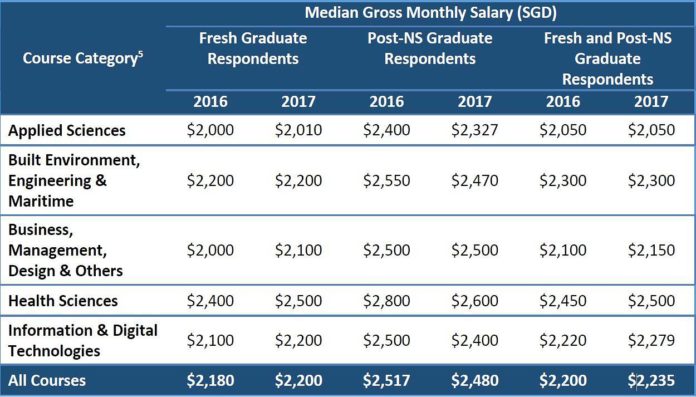
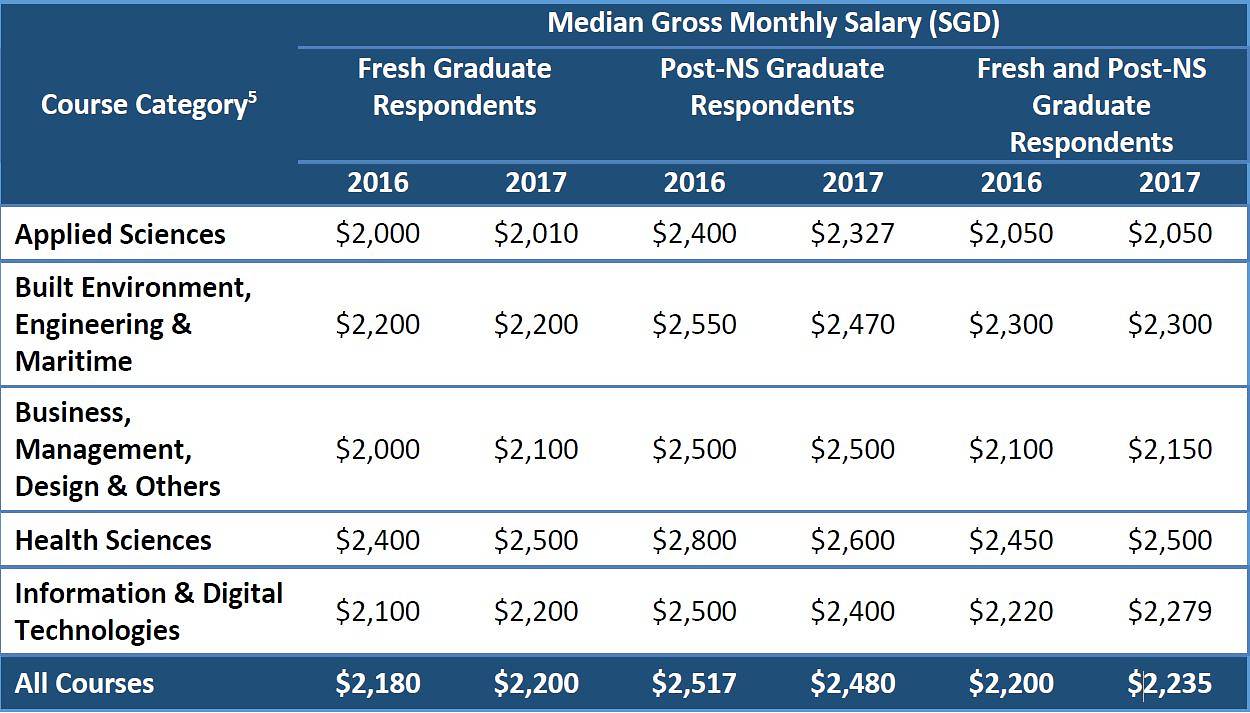
The median gross monthly salary in 2016 for both fresh and post-national service graduates was S$2,200. In 2017, this figure increased to S$2,235.
When analysed by polytechnic courses, the data showed that students who graduated from health sciences earned the most compared to their peers from other courses, at S$2,450 in 2016 and S$2,500 in 2017.
Median gross monthly salaries for polytechnic graduates in 2017. (Table: Graduate Employment Survey)
However despite these higher salary numbers, the data showed that polytechnic students are taking a longer time to find employment.
In 2016, the overall employment rate six months after graduation was 91.9 per cent. This fell to 87.3 per cent in 2017.
The decline was due in part to year-on-year changes in labour and economic conditions and student preferences upon graduation, the polytechnics said in a joint press release.
“We are seeing more polytechnic graduates choosing not to look for a job and instead, pursue further studies,” said the 2017 Graduate Employment Survey Committee.
Actress Apinya “Saipan” Sakuljaroensuk and her actor boyfriend Nuttawuth Boonrapsap on Friday morning went to an interview with police officers regarding her recent Instagram post that allegedly violated the Computer Crime Act.
The 27-year-old Saipan is alleged to have live-streamed a shot of her 24-year-old boyfriend’s penis on her Instagram account earlier this month, the shot of which then went viral, prompting her to delete the Instagram story and issue an apology for the “accident”.
Responding to a summons Saipan and Nuttawuth met with officers at the Technology Crime Suppression Division (TCSD) in Bangkok as part of their investigation into whether the actress had violated the law by uploading pornographic images onto a computer system accessible to the public.
Police have said if the investigation deemed the actress’s action as violating the law, they would file a charge against her. Violating the law carries a punishment of up to three years in jail and/or a Bt60,000 (S$2,491) in fine.
Actor Lee Jung-jin and singer Euaerin are in a romantic relationship.
It was reported Thursday morning that the two stars are dating, along with some photos of them playing golf together. According to the report, despite the 10-year age gap, the two share a love for sports, particularly golf.
An hour after the report surfaced, Lee’s management agency said, “(The actor) confirmed that he has been dating her for the past seven months.”
After debuting as an actor in 1998, Lee starred in drama series and films, such as “The K2” and “Pieta.” He has recently been showcasing his talent as a photographer, releasing a photo book that features celebrities.
Euaerin, whose real name is Lee Hye-min, debuted in 2007 as a fashion model. She switched to singing in 2009 by joining the girl group Nine Muses. She has been pursuing a solo career since leaving the group last June.
iKon on Friday heralded its return, as the boy band confirmed the release date for its second full-length album, “Return,” for Jan. 25
YG Entertainment on Friday released the first official poster for the new album on its blog yg-life.com, with images of the seven members and the release date.
According to the agency, the title symbolizes the group — going on its fourth year since its 2015 debut — reflecting upon how it first started. “(The album) will tell how (iKon) is retaining its passion to achieve their goal through music,” the company said.
The K-pop act last year made its mark on the Japanese market, but its promotional efforts in Korea were virtually nonexistent.
“We understand how Korean fans feel. As iKon will lead off this year for YG, the group will focus on promotions in Korea more than ever before,” a YG official said.