SINGAPORE: Woodlands Checkpoint was extremely busy during evening peak hour on Thursday (Jan 18). Throughout the meandering lines of cars and motorcycles, drivers vented their frustrations with random, pointless honking and flashing lights.
The tension was palpable, with people wanting to navigate their way through as quickly as possible.
The situation was not helped when I told the auxiliary officer checking my car boot that I wanted to pay Goods and Services Tax (GST) on the groceries I bought during my afternoon trip to JB.
Inside the Tesco tote bags were groceries worth S$197.66. (Photo: Amir Yusof)
“Err … can I see your receipts please,” said the young man, after glancing at the three Tesco supermarket tote bags filled with fruit, sporting goods and baby milk powder. I knew that the total value of my shopping spree was RM590 (S$197.66) – more than the S$150 of goods I could bring back after less than 48 hours out of Singapore without paying GST.
I passed him the receipts before taking a cursory glance at the driver of the blue BMW next in line behind me. If looks could kill, I would have been dead instantly.
After about five minutes, the officer at the passport booth directed me to another officer who had magically appeared next to my car, talking into his walkie-talkie.
He motioned me to follow him to a separate area, before instructing me to park. “Don’t forget your wallet,” he said, pointing me to a Singapore Customs booth, where four or five people were already queueing.
A man in line told me he had bought a table from IKEA and “had no choice” but to declare it, while a woman in the queue looked exasperated. Her car boot was filled to the brim with white boxes and an officer told her: “Sorry I’m afraid I have to hand this over to the Immigration and Checkpoints Authority (ICA).”
After another ten minutes of standing in line, I was told that the GST due for my purchases amounted to S$3.20. I paid by nets and was waved off by the officer with a brochure with information on duty-free concessions and GST tax relief.
All in all, it took me 20 minutes to pay for GST, on top of the usual 45-minute evening peak hour jam.
SOME SHOPPERS ADMIT TO EVADING GST
For some Singaporean grocery shoppers I spoke to at Tesco Extra Tebrau City earlier in the day, paying GST at the land checkpoints is too much of a hassle.
They admitted to sneaking in small-sized items such as groceries, handbags and wallets as they thought they would not get caught by officers at both the Woodlands and Tuas checkpoints.
A 49-year-old engineer, who wanted to be known only as Khalid, said that he would travel up to Johor Baru every week just to buy groceries in bulk for his family. He has never paid GST.
Shoppers at Tesco Hypermarket Tebrau City. (Photo: Amir Yusof)
“It can cost up to RM600 (S$199) each time. I buy everything – detergent, fruits, vegetables, milk for the kids,” said Khalid.
“I know I have to pay GST but I have never got stopped before (at the Checkpoint). Maybe it’s because everything is relatively small and in plastic bags,” he said.
According to the Singapore Customs website, all goods brought into Singapore – including new items, souvenirs, gifts or food products – are subject to 7 per cent GST.
However, travellers can enjoy GST relief on goods meant for their personal use depending on the time spent away from Singapore. For travellers who are away for 48 hours or more, the value of goods granted for GST relief is S$600, with those out of the country for less than 48 hours subject to the lower threshold of S$150.
Cashiers at Tesco Extra supermarket in Tebrau City. (Photo: Amir Yusof)
Singaporean shopper Kelvin Cheng, 28, told me he was aware that other shoppers use creative ways to avoid detection when sneaking in luxury items like handbags and wallets at Singapore’s land checkpoints.
“I heard that some would remove the price tags and wear it on themselves to avoid detection,” he said.
“Cases like this are a reminder to declare. It’s just not worth breaking the law,” he added. “Especially if I’m bringing in goods in many bags, I would declare at customs and pay the tax. I am scared to get caught.”
Mr Cheng added that shopping with his wife allows the tax relief limit for them as a couple to be S$300.
“My wife travels with me, so the chances of us exceeding (the combined tax relief limit of) S$300 for our items is low,” he said.
‘IT WILL BE ON MY CONSCIENCE’
Like Mr Cheng, food and beverage business developer Muhammad Syahid Bin Ismail told Channel NewsAsia that he would declare to custom officers, especially when buying large quantities of grocery items, as well as home furniture.
“Sometimes we really had no choice to declare because the car was full of boxes. But we usually do no matter what. It will be on my conscience,” he said.
Last year, Mr Syahid spent about RM2,200 (S$734) in total for lights and fans for his new home in Pasir Ris, which amounted to around S$51 in GST.
“It’s still worth the hassle because we saved at least 50 per cent,” he said.
WANT TO AVOID DELAYS? USE THE APP, CUSTOMS AND ICA SAY
In response to queries from Channel NewsAsia, Singapore Customs and ICA explained in a joint statement that to make the GST payment process “seamless and hassle-free”, travellers may use the Customs @SG mobile app.
(Source: Singapore Customs)
“The mobile app allows travellers to declare and pay duties and GST anywhere and anytime before they arrive at the checkpoints in Singapore,” they said.
“Once tax payment is successful, the app will create an e-receipt in the travellers’ mobile devices and travellers may exit the checkpoints via the Green Channel,” ICA and Singapore Customs added. “If travellers are stopped for checks, they can show the e-receipts stored in their mobile devices as proof of payment to the officers.”
The Singaporean shoppers Channel NewsAsia spoke to on Thursday were not aware that the app existed.
Newlyweds Sharon and Paul Chia, who were doing their Chinese New Year shopping at Tebrau City, told Channel NewsAsia that knowing about the app would have saved them a lot of time.
“We brought back a plasma TV and sound system last month. We had to spend an hour queuing because of the massive jam during the holiday period,” said Mrs Chia.
After learning about the app, Mr Khalid said that he will consider using it.
“I guess this makes (paying for GST) easier. And if they (authorities) step up enforcement checks at the checkpoints, it’s a good tool to have,” he said.
SINGAPORE: “Man in black. He’s been following us.”
We had just walked past the junction of Geylang Lorong 22 and Guillemard Road when Sergeant Kamal Aziz alerted us.
I turned to my right and was just in time to catch a trailing glimpse as the man slipped into a sidewalk.
Dressed in a black T-shirt and grey bermudas, he was the person we did an identity check on just a while ago.
The man had been behaving suspiciously. Earlier on, he turned around the minute he saw us approaching on Geylang Road. Though he managed to blend into the morning crowd and sneaked away, the policemen I was with spotted him at another side street soon after and decided to make a move.
They found nothing on him but a quick check via a handy electronic device that the patrol officers carry with them showed the man’s previous offences in peddling contraband cigarettes.
And now, he was tailing us on a bicycle as we continued our foot patrol.
A GAME OF CAT AND MOUSE
It was my first day with the Ground Response Force (GRF) officers from Geylang Neighbourhood Police Centre (NPC). One of the busiest NPCs in Singapore as I was told, its officers form the backbone of law and order in Geylang, industrial estates in Ubi and nearby residential areas, such as MacPherson.
GRF officers, or more commonly referred to as neighbourhood policemen, perform a wide range of duties from street patrolling, manning police counters and are usually the first responders to 999 calls.
For my two-day attachment, which includes a 12-hour day shift and a night shift, I was assigned to follow Sgt Kamal and Sgt Shaun Goh.
Our key task was to patrol the streets of Geylang.
When we reached at around 8am, the area seemed relatively peaceful. Shophouses along Geylang Road were opening for business while ordinary folk got ready for the day.
Nothing out of the ordinary, I thought.
But according to the police officers, people, working as “lookouts” for criminal activities such as illegal gambling and contraband cigarette peddling, were already out and about.
“It’s their body language and facial expressions. You can always tell if they have something to hide,” Sgt Goh told me, while keeping an eye on the surroundings and paying attention to his walkie-talkie.
Foot patrol at Geylang. (Photo: Hanidah Amin)
Years of on-the-ground patrolling had made both policemen skilled multi-taskers and what my untrained eye failed to pick up, they did.
It also did not take me long to realise that effective patrolling required a thorough understanding of the area. While this could be achieved over time, “there’s no time to learn slowly” when it comes to Geylang, according to Sgt Goh.
“The learning curve is steep,” he said, referring to each Geylang lorong and its associated illegal activity. “You just have to pay attention to what everyone is doing and keep up.”
And that I tried, as slowing the police officers down in times of emergency or critical moments is the last thing I’d want to do.
But there were times when I was left trying to catch up.
Once, when the officers made a dash across Lorong 12 Geylang and into a back alley after spotting a man on an e-bike whom they suspect to be a “lookout”. I had been oblivious to the man who, according to the officers, similarly tried to evade us whenever we were near.
At a back alley in Geylang, police officers screen the identity of a man who was behaving suspiciously. (Photo: Hanidah Amin)
A few hours later, I found myself sprinting across Geylang Road as the officers spotted another man for the same reason.
This time round, the man was less cooperative. When asked for his identity documents, he pretended he did not have them with him and feigned ignorance for other questions. Later, he attempted to snatch his passport, prompting both police officers to grab hold of his arms while issuing him stern warnings.
Standing at just an arm’s length away from the man, my heart was pounding and I contemplated if I should take one step back.
Despite these, Sgt Kamal told me that Geylang is now “less chaotic” compared to when he first started patrolling the area five years ago, with a step-up in enforcement efforts over the years being the key reason.
According to Minister for Home Affairs and Law K. Shanmugam, an inter-agency operations centre (IAOC) that allows operations involving multiple agencies to be planned and executed, has been set up at the Geylang NPC for nearly two years now.
Since April 2016, multi-skilled enforcement teams, comprising of auxiliary police officers (APOs) from various law enforcement agencies, have been performing high-visibility patrols at Geylang, according to Mr Shanmugam’s written reply to a parliamentary question on Jan 9, 2017.
Foot patrolling duties also covered carparks and crime-prone HDB blocks. (Photo: Hanidah Amin)
Technology has also been tapped to enhance enforcement efforts at Geylang.
More than 170 police cameras have been installed in the area since 2015 – a four-fold increase from 2014. Together with the increased street lighting in the Geylang lorongs, these have helped to “enhance the deterrence and detection of illicit activities at back alleys and side lanes”.
Serious crimes reported at Geylang, including robbery and snatch theft, have fallen by more than 42 per cent to 77 in 2016, from 134 in 2013. Public order-related cases, such as affray and serious hurt, have also declined 27 per cent over the same period of time, said Mr Shanmugam who stressed that more can be done to address other offences and social disamenities in Geylang.
One of the most recent police operations in Geylang include the arrest of 19 men last month, which is probably why patrols in the area felt like an endless cat-and-mouse game.
“Lookouts”, with their Bluetooth headsets, mobile phones and sometimes e-bikes, keep watch by taking strategic positions at coffeeshops or entrances to specific side streets like Lorong 16 Geylang, where illegal gaming activities and peddling of contraband cigarettes were concentrated.
Some, like the man in black who was spotted by Sgt Kamal, followed police officers around though they usually stop after their covers were blown.
But one thing was for sure: While we had our eyes on them, they too were watching us.
INJURIES APLENTY
Needless to say, Geylang is an area where people are not exactly the most compliant or respectful of police officers.
As we did our foot patrol, every nook and corner seemed to have an injury-related memory for the officers in blue.
For Sgt Kamal, a flight of staircase facing Geylang Road, and located between Lorong 20 Geylang and Lorong 18 Geylang, was where he and his partner were pushed to the ground after they were splashed with water by an accomplice of a man they found to have a packet of heroin in his shoes.
The man and his accomplice ran away but Sgt Kamal soon caught up with the man and wrestled him to the ground in the middle of Geylang Road before the officers arrested him.
In another lorong, an accused had tried to grab Sgt Kamal’s revolver when they were locked in a scuffle.
Both incidents resulted in bruises and scratches for the 32-year-old.
And when we passed by Lorong 25 Geylang, both Sergeants recalled the high-risk incident of a man splashing kerosene on another team of police officers from Geylang NPC. Desperately resisting arrest, the man had threatened to set the officers on fire by holding up a cigarette.
Foot patrol at Geylang. (Photo: Gaya Chandramohan)
The sense of hostility towards policemen in Geylang also extends to verbal abuse as I found out during my overnight shift on day two.
In one of the back alleys, we met one of the men we had screened on the first day. Riding past me and towards the officers, he muttered “Belah”, which means “Go away” in Malay, before riding off quickly.
The tauntings are common, said Sgt Kamal, who recalled being berated with racial slurs by a drunken man a few years ago.
To be sure, this is not unique to Geylang.
Across Singapore, cases of abuse against police officers have been on the rise, said Mr Shanmugam at a Home Team Academy awards ceremony last September
Noting a 65 per cent increase in physical and verbal attacks against officers to 484 such cases in 2016 from 2014, the Home Affairs Minister noted that authorities have “zero tolerance” for such abuse cases.
As such, MHA has been working with the Attorney-General’s Chambers (AGC) to press for harsher sentences against those who prevent officers from carrying out their duties, Mr Shanmugam added.
However, the harm caused by malignant words does not diminish when they are delivered via the Internet. The rising tide of vitriol online, such as those found in the comments section on websites and social media, can also have demoralising impact.
Said Sgt Goh: “Sometimes I feel especially affected when I go online and see in the (comments section), people bashing the police force for no reason at all.”
“Being human means you’ll have a strong urge to rebut these people but I guess so long as the Internet exists, everyone will have something to say so despite feeling angry, I’ve learnt to just read and move on,” he added.
RESPONDING TO 999 CALLS
Our patrolling duties also extend to crime-prone HDB blocks and carparks. To my surprise, quite a number of drivers left valuables, such as cash cards or GPS devices, in open view when they leave their cars, making them vulnerable targets for theft.
What the police officers would do in such instances is to note down the number plates and submit them to relevant authorities who would notify these drivers.
Officers on patrol can retrieve information about persons or vehicles of interest easily via this electronic device. (Photo: Hanidah Amin)
We were also despatched to respond to 999 calls, which seemed to increase during the night shift. As messages about new cases came through, we found ourselves zipping to and fro Geylang and the other neighbourhoods.
Cases we attended to range from incidents at the HDB estates, which included accidents, complaints of noise pollution and littering, as well as a dispute over a summon issued to a man for littering.
More than dozens of bottles of insect repellent found at a HDB staircase landing. (Photo: Gaya Chandramohan)
During our night shift, we were also activated to serve as reinforcements for the arrest of a drug addict along Haig Road. The man, believed to be a repeated offender, was found with packets of heroin and was nabbed on the spot by plain clothes policemen.
A man arrested for drug possession. (Photo: Gaya Chandramohan)
Later on at around 2am, we were activated to a hotel in Geylang where a Singaporean man was arrested for dealing with contraband cigarettes.
However, these calls could be false alarms sometimes.
While patrolling, we were notified of an urgent call about a suspicious character spotted at Upper Boon Keng. But after rushing back to the police car, we were told that it was a nuisance call.
This, unfortunately, is part and parcel of the police’s day-to-day work, said Sgt Kamal.
According to figures from the Ministry of Home Affairs, the police received an average of about 1.3 million 999 calls annually between 2014 and 2016. This amounts to slightly more than 3,500 calls every day.
In a written reply to a parliamentary question on Aug 1, 2017, Mr Shanmugam noted that only about 40 per cent of these calls required direct police intervention and police resources were dispatched.
The remaining calls were either nuisance calls or misdirected calls that did not require police attention, such as complaints about the cleanliness of common properties.
Still, the officers stressed the need to treat each case, even the seemingly mundane calls, with importance given the unpredictable nature of their work.
“Sometimes, when the case messages come through, you may not expect it to be a serious case but it could suddenly escalate,” said Sgt Goh.
“You have to stay focused because there are certain decisions that you make at crucial moments that if you didn’t, will have greater repercussions.”
We spoke to a resident who called for help after his neighbour fell and lost consciousness at home. (Photo: Hanidah Amin)
LONG HOURS ON THE JOB
While most part of police work is unpredictable, one thing remains constant: the long hours on the job.
A typical shift for an NPC officer is 12 hours long. This excludes team briefings before and after each shift, as well as preparation time for the loading of firearms and other necessary equipment.
Police officers usually get assigned to a day and a night shift before being given two days off.
On my first day, I arrived before dawn and knocked off at about 9pm. Needless to say, hours of foot patrolling and the need to maintain constant vigilance left me physically and mentally drained.
The following day, it was another 14 hours on the job. Staying sharp through the gruelling wee hours of the overnight shift was particularly difficult for me but for the officers in blue, work goes on be it day or night.
“You just learn to deal with it,” said Sgt Goh, recalling his first day at work nearly three years ago.
“It was a day shift but I remember returning back to the station at close to 10pm. I was shocked that I ended work so late and it was only my first day.”
Police officers attend briefings before and after each shift. (Photo: Hanidah Amin)
And due to the long hours, sacrifices, such as quality time with loved ones, were inevitable.
“My father had been sick but one day, he suddenly asked if I wanted to go out with him. I told him I couldn’t because I had to work,” recalled Sgt Kamal. “Three days after, he was admitted into the intensive care unit (ICU) and passed away.”
Since then, being able to return home to his family at the end of each work day has been the biggest source of contentment for Sgt Kamal. Especially since his mother, who initially objected to his career choice, has relented and gave him her blessings.
“My mum wanted me to have an office job but I secretly signed up to be a police… She has accepted my work but I think she still hopes that I can be posted to another neighbourhood or department.”
“I always try to explain to her that if I do my job well, I’ll be safe. Otherwise, I’d just go home in long sleeves,” Sgt Kamal said with a laugh, referring to how he would wear long-sleeved shirts or pants to cover up his bruises.
Patrolling Geylang with Sgt Kamal Aziz and Sgt Shaun Goh. (Photo: Hanidah Amin)
Other sources of job satisfaction can also be a simple “thank you” after an incident is resolved or a friendly “hi” from members of the public.
Given the neighbourhood that they patrol day to day, it’s not difficult to understand why.
While rare, Sgt Goh said he has met people, usually senior citizens, who asked if he’s had time for meals.
“Bits of appreciation like these do make me feel a little better when I’m on duty.”
This reminded me of an encounter on my first day. We were walking by a bus stop along Guillemard Road when a little boy sitting on one of the seats and accompanied by his parents shouted: “Hello police, how are you?”
His voice filled with a tinge of excitement.
Brows furrowed in concentration as he patrolled, Sgt Kamal’s face relaxed upon hearing that.
To the beaming kid, he smiled and waved back: “Hello!”
SINGAPORE: It started with a fever. To fight off the infection, Madam Siti Hajar had to rely on antibiotics, as her immune system was weak owing to her diabetes.
But even when she returned to work, she did not feel any better. In fact, her vision began to be affected. So the next day, she went to Changi General Hospital’s accident and emergency department.
“I only remember going to hospital and then registering and seeing the nurse, and from there, I can’t remember anything else,” she told the Mediacorp programme Talking Point. (Watch the episode here.)
After admission, she was diagnosed with a strain of klebsiella pneumoniae that was resistant to multiple antibiotics. That bacterial infection in 2016 left her blind and in embattled health as it spread to her other organs.
Since their discovery, antibiotics have been wonder drugs for millions of patients in the fight against diseases. But they could not help Mdm Siti, 45, who is now living with the effects of a superbug infection.
WATCH: “It affected my whole life” (2:28)
4 IN 5 WRONGLY THINK THEY CURE COLDS
Like her, one in nine hospital patients here have now been infected by superbugs, bacteria that have become invulnerable to antibiotics over years of exposure.
Worldwide, overuse of antibiotics has led to the rise of antimicrobial resistance. And in Singapore, the problem is compounded by a lack of knowledge of how these drugs work.
Research done by public health experts has found that 78 per cent of Singaporean patients think antibiotics cure infections like common colds and sore throats.
And 66 per cent also believe that antibiotics help these upper respiratory tract infections, which are commonly caused by viruses, to heal faster.
That is why a third of patients expect to be prescribed these drugs – which work only against bacteria, not viruses – when they visit their general practitioners. And if these are not given, some patients would visit another doctor.
Family physician Kelvin Goh from the Northeast Medical Group has faced such pressure from patients, some of whom may insist on antibiotics owing to a “bad experience”.
“They may have seen a doctor for a viral infection. They were told (they) didn’t need antibiotics and subsequently developed a bacterial infection that necessitated either hospital or specialist care,” he explained.
TEST BEFORE PRESCRIBING
The way to distinguish between bacterial and viral infections, he said, is through a good clinical history and good physical examination, supplemented by blood tests and other culture infection tests.
A minority of infections are caused by bacteria, noted Assistant Professor Mark Chen from the National University of Singapore’s Saw Swee Hock School of Public Health, and “some doctors may prescribe antibiotics because they’re worried about missing these respiratory infections”.
But doctors should be more willing to take swabs and do simple tests instead, highlighted Dr Goh.
GP Dr Kelvin Goh.
“We need to educate both the professionals and the public. The doctors must gain the patients’ trust,” he added. “(Only then would) the patient take the advice of the doctor that … no antibiotic is needed.”
If all else has failed, Dr Goh has given these drugs to patients who asked for them, “but we’ll tell them clearly that (they have) a viral infection”.
There are patients, he said, who obtain antibiotics online or from overseas if they cannot get them from any one of the 2,600 GPs here.
While such behaviour is not common, Talking Point did find a number of websites claiming to be online pharmacies – operating outside Singapore – that sold these drugs, allowing patients to get them without prescription.
Though antibiotics cannot be bought over the counter here, patients could still buy them on established platforms like eBay and Carousell, and have them delivered to their home.
WHEN EVEN A CUT BECOMES DEADLY
But the consequences of misusing and developing a resistance to these drugs can be “very worrisome”.
For one thing, the discovery of new antibiotics has slowed in the past few years because the endeavour “is no longer profitable”, said Dr Andrea Kwa, a clinician scientist and specialist pharmacist (infectious diseases) at the Singapore General Hospital.
Resistance to the new drugs occurs within two to three years now, which is “way shorter than their patent period”, she explained.
“Simple procedures like hip replacement, appendectomy (and) emergency caesarean may get more and more difficult to perform, because the infections that could come about as a complication can be more resistant,” she added.
It could get worse if no antibiotic will be effective.
Associate Professor Hsu Li Yang, who leads the Saw Swee Hock School of Public Health’s Antimicrobial Resistance Programme, said:
We’re concerned that … people with the simplest types of infections, like (from) a prick on a rose thorn or cuts, can die.
To prevent the build-up of bacterial resistance, the development of new drugs must be accelerated or the improper use of antibiotics must be reduced, he said, citing the example of patients with viral infections.
“We can also increase vaccination, even (against) conditions like influenza,” he added. “If patients do not present (themselves) at the doctor’s with coughs and colds, then the doctors won’t prescribe antibiotics, so … we also reduce the antibiotic pressure overall.”
To help stop the rise of superbugs in hospital, Dr Kwa has a team monitoring antibiotic use and also developing counter-strategies, such as by designing tests of antibiotic combinations if an individual drug is not useful.
As new cases start to reveal the effects superbugs can have, the war against them is likely to intensify.
Mdm Siti is already one of the casualties. “This bacterium (klebsiella pneumonia) has affected my whole life,” she said. “Now I’m like a child, a toddler learning to how to walk … how to carry on with life.”
Watch this episode of Talking Point here. New episodes air on Mediacorp Channel 5 every Thursday, 9.30pm.
SINGAPORE: Two 11-year-old boys, believed to be classmates, have been found more than 24 hours after they went missing in Sengkang on Thursday afternoon (Jan 18).
Javier Teo Ren Jie and Axel Lim Jun Wei were located in Yishun – more than 10km from Sengkang – at about 9.45pm on Friday.
“Both boys are safe and well, and are not victims of crime,” said the police in a Facebook update, thanking members of the public for coming forward with valuable information.
Earlier on Friday, the police made an appeal for information on the whereabouts of the two boys.
The police said Javier was last seen at Blk 273D Compassvale Link at about 7.10am on Thursday, while Axel was last seen at a shopping mall along Rivervale Drive at about 7.30pm.
Facebook user Leftone Shady – who referred to Javier as “our son” in a post she put up on Thursday afternoon – said that Javier was last seen at Park Green condominium with his classmate, Axel.
She added in an update that both Javier and Axel went to “play Buddy cards at Rivervale Plaza and may have been last seen there”.
It is unclear how she is related to Javier. She referred to Javier as “our son” in the Facebook post, but also stated that she is not his biological mother.
The post, which was shared more than 6,000 times by Friday afternoon, has since been deleted.
Screenshot of the Facebook post by user Leftone Shady.
A video of an Institute of Technical Education (ITE) graduate speaking out against the stigma against ITE students has been circulating online.
In the video posted on YouTube, 21-year-old Choo Hong Xuan recounted how he had come across social media postings after the recent release of the GCE O-Level results, criticising students who did not perform well.
He quoted a post in which the person said that these students ‘deserved no pity’, and should go to ITE because they refused to work hard.
Choo, devastated by the comment, stressed that there is absolutely nothing wrong with enrolling in ITE.
He said:
“I want to firmly tell all the parents and the students who scored badly that there is absolutely nothing wrong with being in (ITE).”
Choo also emphasised the inherent faults with the education system lies with unsupportive parents who are ashamed with their children or afraid of losing face when discussing their children’s academic performances with their relatives.
He reasons that this encourages students to adopt the same mindset as their parents, repeating the vicious cycle.
Choo continued:
“You’re just mentally killing your own children and you don’t even know it yourself.”
Choo drew from his own experience, citing his mother’s shame after he was assigned to the Normal (Academic) stream instead of the Express stream, after doing badly in his Primary School Leaving Examination (PSLE).
He lamented:
“I was disappointed in myself also.
“She had to hide the fact that I was studying in Normal (Academic) stream by telling my relatives that I was studying in the Express stream.”
Choo also revealed that he went through a period of depression when he was in secondary school but hid his condition form his parents.
His mother also wanted him to retake his N-Level examination when he scored 20 points, but Choo just could not see himself repeating Secondary 4 again.
Fortunately, he found hope.
He told his mother firmly that he wanted to enrol in ITE.
After enrolling, he slowly improved on his studies.
Under the guidance of his dedicated teachers, Choo managed to pursue his dreams, even managing to clinch a gold at the acclaimed WorldSkills Singapore competition.
He added:
“It’s okay if you don’t go to a polytechnic or junior college (JC) right now because there will be many opportunities ahead of you. So just relax, and take your time, you know.
“But most importantly is that you really work hard for your dreams and don’t give up. Never, never give up.”
Singapore
Friday, January 19, 2018 – 15:52
More about
Education and Schools ITE (Institute of Technical Education)
Nearly 10 passers-by rushed to the rescue of a nine-year-old boy who was trapped under a car in an accident at Geylang East Avenue 1 yesterday (Jan 18) at around 3.50pm.
The boy was crossing the road at a raised zebra crossing when he was hit by the car, trapping him underneath.
According to eyewitnesses, eight or nine passers-by came to the boy’s aid and attempted to lift the car to free him, reports The Straits Times.
They managed to free the boy within five minutes.
A bystander said that the boy emerged with his legs covered in blood.
The Singapore Civil Defence Force (SCDF) praised the heroic act of the bystanders in a Facebook post: “Real heroes don’t wear capes.”
on Facebook
Real heroes don’t wear capes.
On Wednesday afternoon, a 9-year old boy was crossing the road when he was hit by a car,…
Posted by Singapore Civil Defence Force on Thursday, 18 January 2018
In response to media queries, the police said that they were alerted to the accident at 3.51pm.
The boy was conscious when sent to KK Women’s and Children’s Hospital, a police spokesman said.
The first was a long pink velvet coat paired with pinstripe pants and matching pink socks. The second look was more casual with baseball-inspired snap off pants.
With his boyish good looks and cheeky demeanour, Chun Song Moon was able to garner a lot of attention from the netizens. He even landed himself a contract under My Company, the same company that manages his sister.
Song Ji Hyo is certainly not the only celebrity with a talented younger sibling.
Photo: Weibo
According to reports by the Chinese media, Chinese superstar Fan Bing Bing’s 17-year-old brother, Fan Cheng Cheng, has been undergoing vocal and dance training in Korea for nearly a year.
He is currently signed to Yuehua Entertainment, a Beijing-based company that was responsible for cultivating talents like popular singer Han Geng and boyband Uniq.
Like sister, like brother
Fan Bingbing and her family at her engagement party last yearPhoto: Weibo/Fan Bingbing
Fan Bing Bing’s teenage brother made headlines after the Chinese actress formally introduced him to her 61 million Weibo followers with this post, “This is my brother, Fan Cheng Cheng @Adam0616, please take good care of him!”
It was recently revealed that Fan Cheng Cheng will be a contestant in “Idol Producer”, a Chinese reality boy group survival show produced by online video platform, iQiyi.
Photo: Weibo
The show will bring together 100 trainees from different entertainment agencies who will then undergo a four-month-long training session. Out of the pool of 100 trainees, nine will be chosen to debut as a unit boy group based on popular vote.
Just like Fan Cheng Cheng, the future looks bright for Chun Song Moon.
In Oct 2017, Chun Song Moon made his acting debut in the web drama “29gram” where he starred alongside his sister. In the web drama that centres on the lives and love stories of four social media influencers, Chun Song Moon plays Jo Yi Ahn, a free-spirited and carefree character.
While it’s hard to say whether Fan Cheng Cheng and Chun Song Moon follow in their sisters’ footsteps to stardom, we do know that you will be seeing a lot of them in the future.
British police said Thursday they are investigating a man over a third sexual assault, with the Press Association news agency reporting that US actor Kevin Stacey is the suspected assailant.
The assault allegedly occurred in central London in 2005, during Spacey’s 11-year tenure at The Old Vic theatre in the British capital.
“On 13 December we received an allegation that the man sexually assaulted a man (Victim 3) in 2005 in Westminster,” a Metropolitan Police spokeswoman told AFP on Thursday.
The force does not name people before they are charged with a crime, but the Press Association said the accused was the same man from earlier complaints.
The other two alleged victims said they were assaulted in 2005 and 2008 in the Lambeth area of the city where The Old Vic is located.
They came forward in the wake of the Hollywood scandal which erupted last year after numerous claims of sexual assault and harassment were made against mogul Harvey Weinstein.
Spacey has since faced a series of abuse allegations, prompting The Old Vic to launch an investigation into the actor’s tenure at the theatre between 2004 and 2015.
A total of 20 claims of inappropriate behaviour were received, covering a broader period of 1995 to 2013, and have not been verified.
Maria Ozawa slammed ride-hailing drivers’ unprofessional behaviour after experiencing incidents of stalking and even sharing of her mobile phone number.
In a Facebook post, the former adult-film star shared text messages exchanged with an unknown number.
A man named “Ben” told her he got her number from an Uber driver.
He said, “Sorry. I just want to know your name. And things you like. Hope you won’t get mad.”
Ozawa said that she doesn’t use her real name when using TNV (transport network vehicles), but still experiences her privacy being invaded.
She shared that she hadn’t received assistance from Uber as their hotline went unanswered.
The actress, who is currently a business partner in the Philippines, couldn’t help lamenting, “I LOVE the Philippines but Why can’t I trust this country AT ALL!? Why are the people SO UNPROFESSIONAL!?”
When a netizen suggested she use Grab, she replied, “It happened to me in Grab too. This country is seriously lacking with professionalism.”
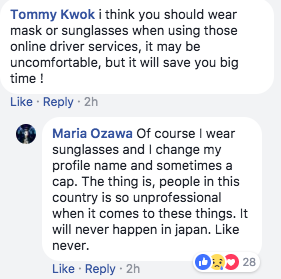
Some comments suggested she change her behaviour to avoid such incidents. One proposed she use sunglasses to mask her identity. She said she already goes through several measures to do so.
“Of course I wear sunglasses and I change my profile name and sometimes a cap. The thing is, people in this country is so unprofessional when it comes to these things. It will never happen in Japan. Like never.”
One stated that she should use her “common sense” and get a different number. The netizen rationalized the drivers’ behaviour as “boys will be boys” and told her to “go back to Japan.”
Other netizens saw past the victim-blaming, explaining that the drivers’ actions were wrong and that public personalities still have the right to privacy.
“It’s like you’re giving boys a license to do bad things because they are boys,” read a comment. “Uber and Grab have [a] privacy policy and if the drivers are following this policy, they won’t give out numbers of their riders, celebrity or not.”
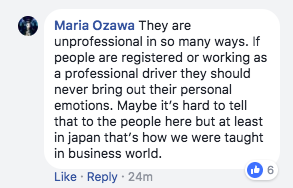
Ozawa replied to the comment, “If people are registered or working as a professional driver they should never bring out their personal emotions. Maybe it’s hard to tell that to the people here but at least in Japan that’s how we were taught in business world.”
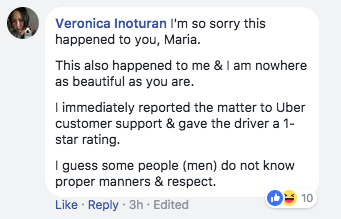
Ozawa also received sympathy: A netizen admitted that she had a similar experience. “I guess some people (men) do not know proper manners and respect.”
Still, Ozawa considered getting a different number.
“What an (sic) hassle to just live in this country… dba (right)?”
Women’s safety and customers’ privacy have been a problem among ride-hailing apps.
In 2016, an Uber driver in Quezon City allegedly forced a woman to perform oral sex. In the same year, a former forensic investigator for the company revealed that Uber employees in the US used customer data to track politicians, celebrities, significant others, or exes.
Uber confirmed last year that over 100,000 Filipinos were affected by a data breach.