Home Blog Page 1168

‘Who wants ugly hands?’: Made-in-Singapore kungfu falls out of local favour, but flourishes in Greece

0

SINGAPORE: A framed, grainy photo of the Singaporean man hangs on the wall. With a black belt wrapped around his waist, he strikes a menacing fighting pose while his stern visage peers over students practising kungfu in the quiet Nikaia suburb of Athens. This is the Singapore Chapkoondo Institute, and it is one of five schools imparting the titular made-in-Singapore martial art to hundreds of followers all over Greece.

Yet in its birthplace of Singapore, there are no schools and only two active practitioners left. Leong Siew Chong – chapkoondo co-founder and the man in the picture – died recently, leaving his younger brother and co-inventor Steven Leong Siew Wah to carry the torch along with a sole disciple.

Half a century ago, the Leong brothers first planted chapkoondo’s roots by contesting a brutal, bare-knuckle “leitai” contest at Southeast Asian level. Forged by the rigorous tutelage of their father Leong You – a native Chinese kungfu master – Siew Chong emerged heavyweight champion while Steven, at just 15, won the lightweight title.

Siew Chong’s photo can be seen in the background at this chapkoondo school in Greece (Photo courtesy of Ioannis Leontaris)

“We both used a signature short, sharp punch – ‘chap’ – to knock out our opponents,” said Steven, now 65. “So we took the name ‘chapkoondo’ and started a dojo after experimenting for a few months.”

The duo mixed and merged techniques from five kungfu systems – Hung Ga, Choy Li Fut, Shaolin, Eagle Claw, Qigong – and later added the shitoryu blend of karate to produce, in 1969, the first martial art originating from Singapore, ahead of Xinjiaquan in 1985.

The latter, also known as Singafist, showcases a sequence of choreographed movements while chapkoondo, Steven said, is about “fighting and not for show only”.

Singaporeans were sold. “We had 200 students enrol in the first three months. Over the next five years, we had a total of six schools – all in the Orchard Road area – and over 1,000 members at one point,” he said.

Steven attributes this to the buzz generated by his and his brother’s leitai achievements, but also acknowledged the ‘60s and ’70s were a golden age for Chinese martial arts.

“Kungfu was very, very popular then. There were competitions being organised every year, and people wanted to join our classes to learn as both exercise and self-defence.”

THE JETSETTING YEARS

Now in his senior years, Steven adheres to a daily discipline of qigong and kungfu practice along with weights training at the gym. 

Steven practising controlled breathing and movement as part of qigong (Photo: Ruyi Wong)

Little wonder he is nimble as ever – capable of casually breaking out a gymnastic split or launching into a whirlwind nunchaku routine – all while cutting a robust and powerfully-built figure.

His left fist, in particular, ripples with thick sinews around the fingers, knuckles and wrist: A product of decades spent putting the “chap” in chapkoondo.

It’s not hard to see a prime, teenage version of himself receiving multiple offers to teach martial arts overseas. As Siew Chong stayed back in Singapore to run the schools, Steven either performed or instructed in many countries, including Canada, US, England, France, Greece, Italy, Australia, Japan, Nepal, Thailand and Malaysia.

He achieved the most success while based in Canada: In 1977 he won the world kungfu championship in the middleweight category, and that same year was appointed martial arts instructor to the Canadian police. Steven later went on to teach at Australian and American police academies.

On the far left, Steven is pictured with his world title in 1977, on the far right he poses with his brother Siew Chong after being crowned Southeast Asian champions in 1968. (Photos courtesy of Steven Leong)

Then came an opportunity to feature in his own kungfu TV show in Quebec. After weeks of demonstrating “kata” patterns and weapon use; breaking bricks and sparring with other martial arts exponents, local media dubbed him the “Canadian Bruce Lee”.

Local newspapers reported on Steven’s overseas exploits, and the Canadian TV show he starred in. 

Television spots in other countries such as Japan followed and Steven, now bitten by the acting bug, decided to take his dreams to the silver screen.

His Mandarin name can be found in the starring credits of 1980 Taiwanese movie Prodigal’s Tears, and more prominently in Hong Kong kungfu flick The Young Hero which was released the next year.

Posters for Hong Kong movie Young Hero (left) and Taiwanese production Prodigal’s Tears.

Online footage of the latter shows Steven playing a Japanese villain, gamely executing his own stunts and putting the protagonist – the character of Chinese hero Huo Yuanjia – in a real spot of trouble early on.

Steven said there were other films, some even produced by Asian cinema icon Golden Harvest, but he has “chucked most of the posters”. “My thinking was just to enjoy the experience, not become a famous star,” he shrugged.

BRUCE LEE “WAS VERY FRIENDLY”

Amongst Steven’s tales and travels, one – if true – stands out most: a brush with the legendary Bruce Lee himself.

According to Steven, this happened in 1970, when he was in the US and a friend took him to Lee’s first school, the Jun Fan Gung Fu Institute in Seattle. At the time, Lee was in between an American TV role as Kato on The Green Hornet and his eventual breakout film The Big Boss.

“He was very friendly and we had a conversation in Cantonese. Then we did some sparring and playing around to learn each other’s style. His legs were very fast. But it wasn’t a real fight, so there was no ‘winner’,” Steven claimed.

A 1986 Singaporean newspaper article comparing Steven to Bruce Lee.

This would make him perhaps the only Singaporean to ever have a pugilistic exchange with Lee – but no photos were taken and the only witnesses were a handful of Lee’s first-generation students.

Channel NewsAsia attempted to contact those still alive and was informed by the Seattle institute that Taky Kimura, one of Lee’s closest friends, now has advanced dementia at the age of 94.

Another disciple, 83-year-old James DeMile, said: “I doubt Bruce would spar with anyone in that period of time. Maybe talk about kungfu and review concepts, but spar, no. Bruce always looked at anyone from any kungfu background as a threat, and was very cautious about showing what he knew.”

Nonetheless, Singaporean newspapers ran with the story back in the 1980s, and Steven’s life and times even attracted the proposal of an autobiography – but halfway through the project the ghostwriter disappeared.

FROM SINGAPOREAN WANE TO GREEK BOOM

With acting offers drying up, Steven returned home at the age of 30, only to find a diminished appetite for kungfu in Singapore, just like the rest of the world.

His brother’s chapkoondo institutes were forced out by landlords several times, with each shift in location bringing about a loss of students. Gradually, they shut down all their schools.

Steven insisted the problem was not financial. “Yes, there was not much money to be made from the schools, with the fees only S$10, but we had a lot of students,” he said. “And we also sold traditional Chinese medicine we made ourselves.”

“We just didn’t know how to organise and manage things properly. I tried to form a school again, but it was hard – people were not interested or not free because of work.”

Steven wound up instructing martial arts to Gurkha soldiers in Singapore, and later followed in his old man’s footsteps to become a Chinese physician.

Steven at his traditional Chinese medicine store in Telok Blangah (Photo: Ruyi Wong)

That was how he met his current and only student Ang Wei Lun, 30. “Thirteen years ago, I was injured in a fight in school and my mum told me to go see Steven. I went to his shop, saw all his trophies and photos and asked him to take me in as a disciple,” said Ang.

“At first he didn’t want to, but I kept dropping by and asking him to teach me, until he did.”

Some 10,000km away in southeastern Europe, there is no such paucity of interest in chapkoondo. It was Steven who started the first school in Greece while on his world tour of the 1970s – and till now this Singaporean martial art continues to make appearances on Greek television shows.

Steven teaching a class at the first chapkoondo school opened in Greece (Photo courtesy of Steven Leong)

“They’re very active – over the years they’ve kept demonstrating and performing for people to see,” said Steven.

The Singapore flag used to hang at the Singapore Chapkoondo Institute, until it ran out of space (Photo courtesy of Ioannis Leontaris)

At present the largest school is the aforementioned Singapore Chapkoondo Institute run by Ioannis Leontaris, 55. He travelled to Singapore in the 1980s to learn from Siew Chong, who died in his sleep last month aged 85.

Leontaris receiving his black belt and endorsement from Siew Chong (Photo courtesy of Ioannis Leontaris)

In 2011, Leontaris was appointed as the only official chapkoondo authority overseas.

“Through hard training, our students have become well-known for their successes,” he told Channel NewsAsia, pointing to his charges medalling at World Wushu Championships of recent years.

“There have been amazing fighters in chapkoondo, and it will be a pity if in Singapore they do not continue this wonderful martial art.”

A RETURN TO GLORY DAYS?

But Steven said he was not giving up – and together with Ang, is thinking of ways to “make chapkoondo big in Singapore again”.

“If there’s a chance to develop it, I want to … though I don’t have much time because of my business and my patients.”

“First, we must have a space, and in Singapore it’s not as easy as 30 years ago when rent was not so expensive,” he mused. “It can’t be taught in an open area where there’s no privacy and everybody can see.”

Said Ang: “Traditional martial arts should evolve with time but not lose its essence. I think chapkoondo has a place in modern society, but it really has to be repackaged – if not it’ll just be a community centre type of exercise.”

Steven agreed, saying he was open to modernising the system – but current priority still goes to recruitment.

“It’s just two of us, so we need more,” said Ang. “I’ve a few friends who are interested and I practice with them, but really, who wants to have ugly hands?”

Steven demonstrates a chapkoondo move on his disciple (Photo: Ruyi Wong)

Both master and disciple also rejected the oft-heard criticism of kungfu being useless in real-world applications.

“At first I didn’t think it would protect me in a fight either. But when I ran into trouble, I wasn’t injured,” said Ang, relating how he once used chapkoondo to take on eight drunk men who had initiated violence first.

Steven, too, has a similar story – one that was reported in local Chinese-language newspapers in 1986 with a headline that read “Robbers dare to attack kungfu star”.

“I was in Penang with a friend when a car tried to run us over, then two big-sized guys came out with parangs,” Steven grinned. “I fought them off with my kicks. No kungfu – die straight away.”

Today, he faces a different sort of battle to rescue a familial creation – and legacy – from extinction. With spirit willing and flesh far from weak, there is hope yet. Plus, just like it was in the beginning, he has a partner-in-crime steadfast and committed to the cause.

“I will do everything I can to make sure this tradition doesn’t disappear,” said Ang. “Chapkoondo is Singaporean, and I don’t wish for it to be lost.”

(Photo: Ruyi Wong)
Source link

Commentary: Singapore Airlines doesn’t deserve our online hating

0

SINGAPORE: Any mention of Singapore Airlines (SIA) in the news is usually greeted with great interest.

In the airline’s early days, as it forged ahead to establish itself as a market leader in air travel, the reaction was undeniably one of beaming pride.

“Look at those planes. So nice, it’s Singapore Airlines. Singapore, you know,” was a typical response.

About 10 years ago, when it first unveiled its new A380s, the mood in Singapore was one of excitement where enthusiastic travellers couldn’t wait to book their next flight.

Yet recently, it seems Singaporeans have taken a more critical view to news about the airline.

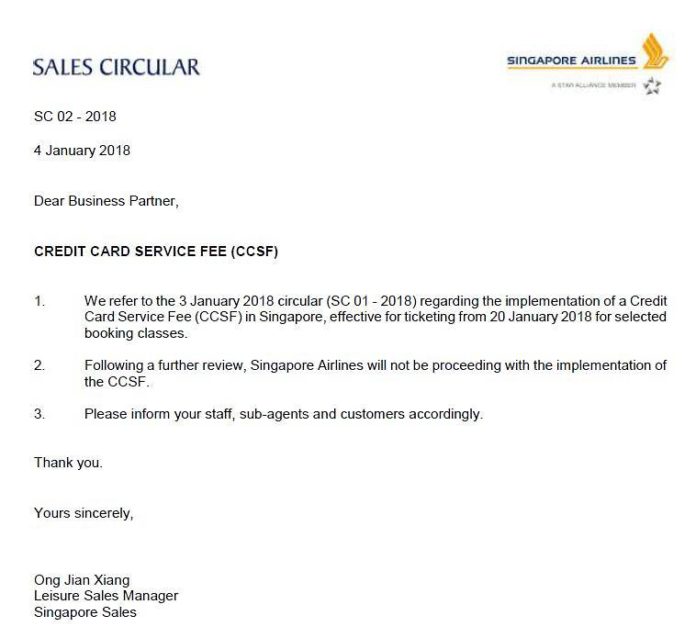
Just look at how netizens responded on the back of SIA’s announcement that a credit card surcharge would be imposed on some passengers – and the subsequent cancellation of these plans.

Raising fees of any kind is a difficult business, so it was no surprise netizens were initially peeved.

What was surprising, however, was the scorn poured on SIA’s response to cancel these plans.

Instead of giving SIA credit for reacting decisively, some observers said its “flip-flopping” was a “bad move” that risked hurting SIA’s premium brand, because it suggested that SIA was not confident it could justify its decision.

The tone was unquestionably one of disappointment – with netizens concerned that this was sullying the image of a national icon. Some remarked it was unusual for a company not known for making impulsive decisions.

The sales circular issued by Singapore Airlines to its business partners on Jan 4, 2017.

SIA’s auto-inclusion of travel insurance also drew the ire of watchful Singaporeans who wondered what the company was up to, even though it clarified this was implemented last year.

Never mind recent news that SIA was ranked one of the safest carriers in the world, and one of the most punctual in this region, or that it has just unveiled new A380 jets.

Many say this was all expected of SIA. In fact, some readers complained SIA’s makeover of its A380 jets was lacklustre.

So it seems SIA can catch no break. Yet was the flak over its credit card charge policy fair? And more broadly, why are we Singaporeans so quick to throw stones at SIA these days?

REALISTIC EXPECTATIONS?

No doubt as travellers, we want low-cost tickets to get the most out of our holiday dollars. We understandably feel annoyed at the prospect of having to pay more for pretty much the same service, and SIA’s U-turn may have vindicated our complaints.

SIA’s employees, shareholders and business partners may also be justifiably anxious about moves that may impact the company’s competitiveness, where its financial future has a tangible impact on their lives.

Indeed, businesses themselves must surely expect some level of industry scrutiny and public interest today, where analyses dished out by experts on annual financial statements typically make news headlines and studies have shown sentiments on social media can influence stock market prices – and SIA is no exception.

In fact, for publicly listed companies like SIA, one might be tempted to argue the criticism they received for extra charges was fair game. Where other full-service airlines including Qantas and Emirates impose similar charges, SIA had levied these only on price-sensitive Economy Lite passengers.

What’s leading us to have such high expectations of SIA? (File photo: REUTERS/Edgar Su)

But it seemed like vast numbers of expressed concerns on social media went beyond keeping prices competitive and meeting basic standards for customer satisfaction. This is where things got a little murky.

One netizen bemoaning the fact that he now had to ask for champagne in the Silver Kris Lounge said the way SIA was saving costs was “becoming an embarrassment”.

Another took the chance to complain about how he never gets any free upgrades to first class anymore.

Where a few others also asked SIA to “spare a thought” for economy class passengers who have to deal with “leg cramping” seats, it was starting to sound like Singaporeans believe that the airline should be providing some sort of public service.  

Where some called SIA’s moves calculative and desperate, it was also starting to sound like netizens were pursuing a personal vendetta against SIA.

A few said they had been prepared to retaliate by paying their credit card fees in coins over the counter (even though this isn’t quite how credit card fees are charged). Many claimed they would switch to Cathay Pacific.

And to add insult to injury, netizens then questioned SIA’s professional instincts, with many asking: “What kind of a business strategy is this?”

On the revamped SIA A380 economy class, the seats doesn’t look as cramped as some netizens have made them out to be. (Photo: Singapore Airlines)

OVERLY INVESTED

Much as many criticise SIA online, no doubt this stems from a deep connection that Singaporeans feel towards it and the high standards that people love.

Overseas work stints, studies abroad or long holiday trips make their planes our first point of contact with anything vaguely Singaporean after a period away from home.

Experts have also highlighted that to many Singaporeans, SIA is the physical manifestation of the Singapore story, and its successes speaks well of Singapore’s ambitions to be connected internationally.

But do our vested interest go beyond the emotional? Do Singaporeans feel a strong sense of ownership because it’s a Temasek-linked company for instance?

Or perhaps Singaporean taxpayers feel they contribute in some way to SIA’s good fortune – in paying the salaries of those at the Ministry of Transport negotiating for the greater liberalisation of air travel and the removal of restrictions on air transport imposed by other countries that benefit SIA?

Whatever the reason, what’s certain is many will continue to follow closely every piece of news of their transformation. News of SIA’s use of local farming produce in inflight meals and the reintegration of SIA Cargo back into SIA Group were widely read last year.

So some say, why not offer our two cents on how it can improve then?

Giving our take on SIA seems to stem from good intentions, when SIA is a company close to the hearts of many readers. 

News of SIA’s plans to impose a credit card surcharge on some passengers drew netizens’ attention. (File photo: AFP/REMY GABALDA)

Yet familiarity seems to be breeding contempt. Might it be that years of treating Singapore Airlines as a national asset of strategic importance is now leading us to expect SIA dispense benefits other ordinary companies wouldn’t?

Have we unwittingly become victims of SIA’s success, where years of it standing out as a hallmark of our nation’s progress have led us to harbour absurdly high and unfair expectations of it?

DON’T GET TOO ATTACHED

It might be worth reminding ourselves when such news of SIA’s plans and performance are reported that SIA is not a public agency but a privately-owned, profit-driven company that answers to shareholders and has to keep its head above water.

We might gripe personally about the changes that impact us as paying passengers. But it’s quite another thing to demand special perks and it definitely seems unfair to pour cold water over SIA’s business strategy, when we pay scant attention to how it has performed.

In fact, where it has made bold moves to transform its business model amid strong headwinds, surely the fact that its stock price has been on an upward trend in the past year is more telling of whether it has succeeded?

It’s also telling that SIA’s passenger traffic and cargo loads are seeing growth, even as intense competition especially from the Gulf airlines are putting pressure on yields, suggesting SIA’s prospects are brighter than we give it credit for.

No doubt netizens will continue to follow news about SIA with interest. The inclusion of local farming produce into SIA’s inflight meals seemed like a crowd pleaser for one. (Photo: Monica Kotwani)

For those of us still clutching to some sentimental affinity to SIA, it’s also worth keeping in mind the goodwill around the world it has built up for Singapore, where SIA has been an aviation industry leader and face of our country for many decades.

At the end of the day, it is interesting that those who badgered SIA online were mostly Singaporeans. And when SIA had moved swiftly in response to the public reaction, it’s also us Singaporeans who then showered it with even more disdain.

To a foreign observer, it must look as if Singaporeans are embarrassing SIA and not the other way around.

Perhaps next time, we should withhold judgment on SIA’s moves until more facts emerge. 

And more importantly, let’s not get our nationalistic attachment to SIA go to our heads.

Source link

Police car mounts divider at Kampong Bahru Road

0

SINGAPORE: A police car was involved in an accident along Kampong Bahru Road on Friday (Jan 26) afternoon. No injuries were reported, and investigations are ongoing, the police said.

Photos circulating online show a police car stuck over a divider in wet road conditions. At least one other police car was on the scene. 

(Photo: Telegram/SGRoad Blocks, Traffic News)

In response to queries from Channel NewsAsia, the police confirmed the accident and said that they were alerted to it at 5.12pm.

Details on how the accident occurred or how many police officers were in the car were not readily available. 

Channel NewsAsia has asked the police for more details.

Source link

Rescued baby hawksbill turtle released back into the wild

0

SINGAPORE: A hawksbill sea turtle that was rescued from a broken, unhatched egg was released back into the waters of Sisters’ Island this week, the National Parks Board (NParks) and Wildlife Reserves Singapore said.

The healthy baby turtle has been also microchipped so that it can be identified if it returns to Singapore’s shores in the future, the agencies said in a media release on Friday (Jan 26).

The broken egg was part of a clutch of eggs found on one of the Southern Islands by NParks employees last September. The premature hatchling inside it was barely alive and severely dehydrated.

The hawksbill turtle egg was found broken with a premature hatchling inside. (Photo: NParks)

NParks handed the hatchling to Wildlife Reserves Singapore (WRS), which started treatment for it immediately, providing it with the necessary fluids. It received critical care overnight, and by morning, the hatchling had completely emerged from its egg. It weighed just 10g when it hatched.

The baby turtle was just 10g when it hatched. (Photo: Wildlife Reserves Singapore)

Raised on a diet of mussels, flower crab, shrimp, squid and fish, the hatchling tipped the scales at 500g four months later. 

It was also provided with “live rocks”, or ocean rock with algae and other micro-organisms, an essential part of a sea turtle’s diet. 

A veterinary check on Jan 3 showed that the turtle was healthy and well, and the decision was made to return it to the wild as soon as possible.

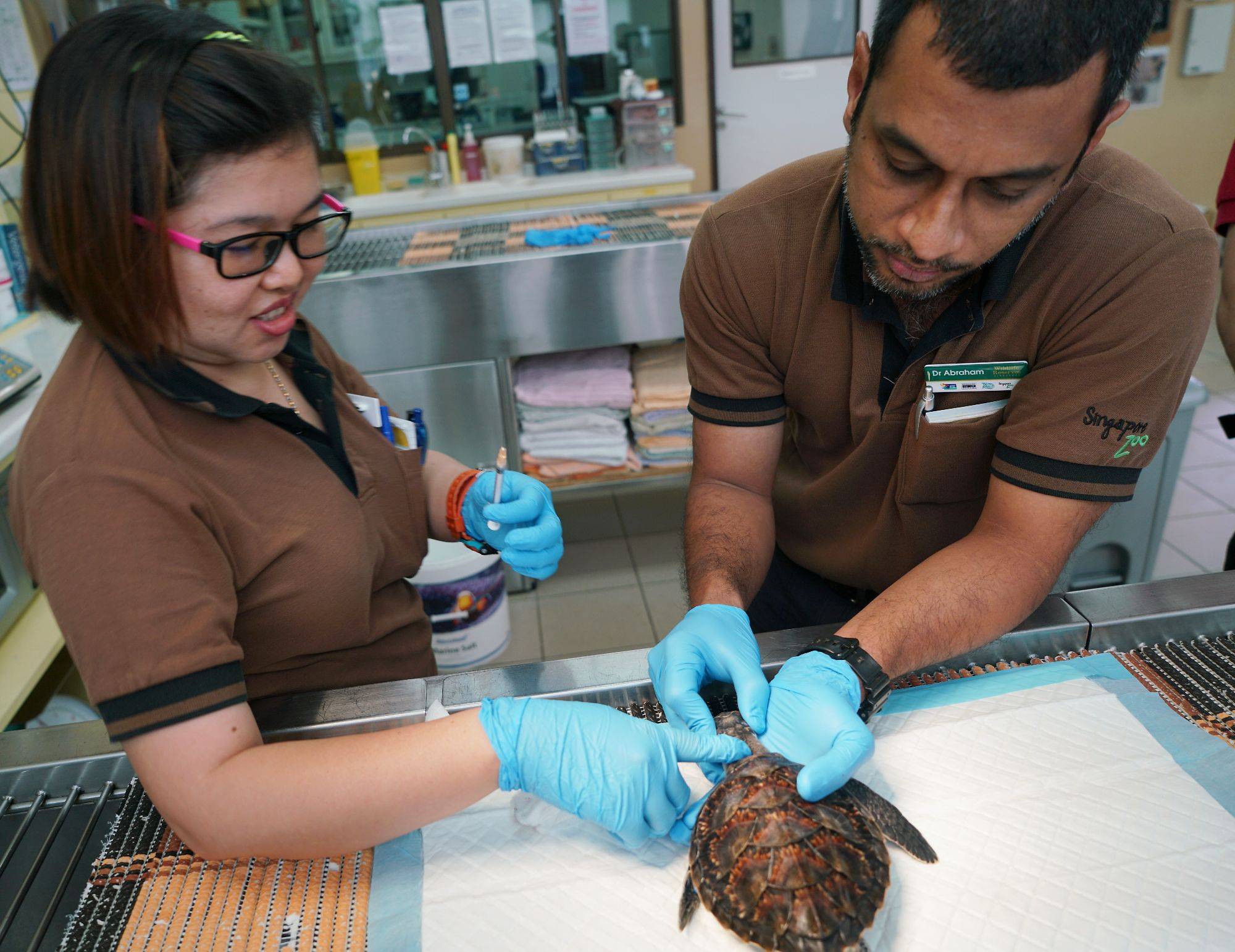
Thorough veterinary check were conducted by WRS veterinarians, Dr Yaoprapa Mathura (left) and Dr Abraham Mathew (right) on the rescued hatchling. (Photo: Wildlife Reserves Singapore)

The turtle was released on the beach at Sisters’ Islands Marine Park, where it scurried into the sea and started swimming immediately.

The baby hawksbill turtle on the beach at Sisters’ Islands Marine Park, just before it went back into the sea. (Photo: NParks)

It paddled around the shallow lagoon waters for a while before making its way slowly towards the mouth of the lagoon, and finally, out to the open sea.

“The knowledge gained from the rescue and rehabilitation of the hatchling will contribute to our understanding of the critically endangered hawksbill sea turtle and help to guide conservation efforts,” NParks and WRS said.

MORE SIGHTINGS OF CRITICALLY ENDANGERED HAWKSBILL TURTLE IN 2017

18 sightings of the hawksbill sea turtle were recorded on Singapore’s shores in 2017. The figure is nearly half the 43 sightings reported between 2011 and 2016.

In 2017 alone, there were more than 500 successful hatchlings from seven separate hawksbill turtle nests, NParks and WRS said. 

The baby turtle back in its natural habitat. (Photo: NParks)

Many sightings were reported by members of the public, NParks and WRS said, noting that the increased number of sightings was not only an encouraging sign for the species, but also reflected heightened public awareness of the turtles. 

The agencies said those who encounter a turtle should speak softly and keep their distance from it. Touching the turtle may scare or provoke it, and one should not handle the eggs as it might damage them.

Source link

Tencent invests in 'Mission: Impossible' studio

0

Beijing – Chinese internet giant Tencent said on Friday it will take a stake in the US production company behind the “Mission: Impossible” and “Terminator” series, marking China’s latest incursion into Hollywood.

The deal will give Tencent the opportunity to co-finance Skydance Media films, which will benefit from the Chinese firm’s distribution and marketing in the world’s second-largest movie market, firms said in a statement.

It did not provide financial details but the Los Angeles Times cited an unidentified source familiar with the deal as saying Tencent had paid more than $100 million for a stake of five to 10 per cent.

Founded in 2010, Skydance has produced 15 films, most in collaboration with Paramount Pictures, including the “Star Trek” franchise.

It is preparing to release sequels to the “Mission: Impossible”, “Terminator”, and “Top Gun” sagas in the next two years.

Tencent has become one of the world’s most valuable companies, raking in profits from its addictive mobile game “Honour of Kings” and WeChat, China’s most popular all-purpose social media app that has nearly a billion users.

Last year it joined the exclusive club of companies with a market capitalisation of more than $500 billion.

It has already made inroads into the movie business, investing in last year’s Hollywood blockbuster “Kong: Skull Island” while it also has control of one of China’s major movie ticketing services.

Its partnership with Skydance “also supports collaboration on other media initiatives, including television, interactive and virtual reality”, the statement said.

The move comes after major conglomerate Dalian Wanda, whose interests range from real estate to entertainment, snatched up Legendary Entertainment – maker of “Jurassic World” and Christopher Nolan’s “Batman” trilogy – for $3.5 billion, as well as US-based cinema chain AMC Theatres.

But it also follows warnings from Beijing against the “irrational investments” overseas by Chinese companies, particularly in the cinema industry.

A financing deal between Huahua Media and Paramount Hollywood studios valued at $1 billion fell through in November as a result of the regulatory tightening.

Friday, January 26, 2018 – 17:39

More about

Hollywood

Others

Source link

AETOS tapping technology to address manpower crunch

0

SINGAPORE: Security firm AETOS has developed a new fire detection system that uses a surveillance camera to spot a fire and raise the alarm before it gets too big.

Called the Intelligent Fire Detection System, it uses advanced video analytics and fire detection algorithms to detect flames as low as 25cm, and has an accuracy rate of more than 95 per cent, said AETOS.

It added that the system can be integrated into any existing security camera infrastructure.

This was among the technologies showcased at the launch of AETOS’ new complex at Corporation Drive in Jurong on Friday (Jan 26), and the security firm is tapping such tools to address the manpower crunch faced in the industry.

“Even with fewer officers, suspicious incidents can be attended to more quickly. AETOS is thus able to help building owners reduce the number of security guards deployed without compromising security,” said Second Minister for Home Affairs Josephine Teo at the official launch. 

AETOS’ new complex at Corporation Drive. (Photo: Ahmad Khan)

The firm’s Cash-in Transit Vehicles, which are used to transport cash and valuables, have more security features to cut down on the number of officials needed when they are out on the job.

Mr Jackson Lim, Chief Operating Officer of AETOS, said: “At this moment, our vehicles require a crew of three armed guards to do it at any one time. With the technology that AETOS has introduced in particular now that we are able to do live streaming of all the images that our vehicles carry. 

“There are nine cameras on-board, we are able to see every single kind of activity this camera gives us, including inside as well exterior of it. Not only do we become more effective, not only do we have much better surveillance, we only need a crew of two instead of three. That’s one-third saving of manpower itself, and that’s significant,” he added. 

AETOS began operations at its new seven-storey building last December. 

The complex includes an indoor rifle range, new equipment like an X-ray machine for training purposes and a Command Centre.

The command post provides enhanced operational capabilities, such as monitoring of field personnel, vehicle fleets and deployment sites to reduce reliance on manpower.

Mrs Teo said: “The appropriate use of technology to carry out routine, labour intensive tasks, allows the security officer to focus on tasks that are more complex or require human judgement, such as incident response. Technology also allows a security officer to secure a larger area with greater effectiveness. All these will make our security officers more productive.”

She added that the Ministry of Home Affairs will be revealing initiatives to support companies to invest in technology during the launch the security industry transformation map next month.

Source link

99 suspected drug offenders arrested in islandwide blitz

0

SINGAPORE: Nearly 100 suspected drug offenders were arrested between Jan 21 (Sunday) and Jan 26 during a five-day islandwide blitz by the Central Narcotics Bureau (CNB). 

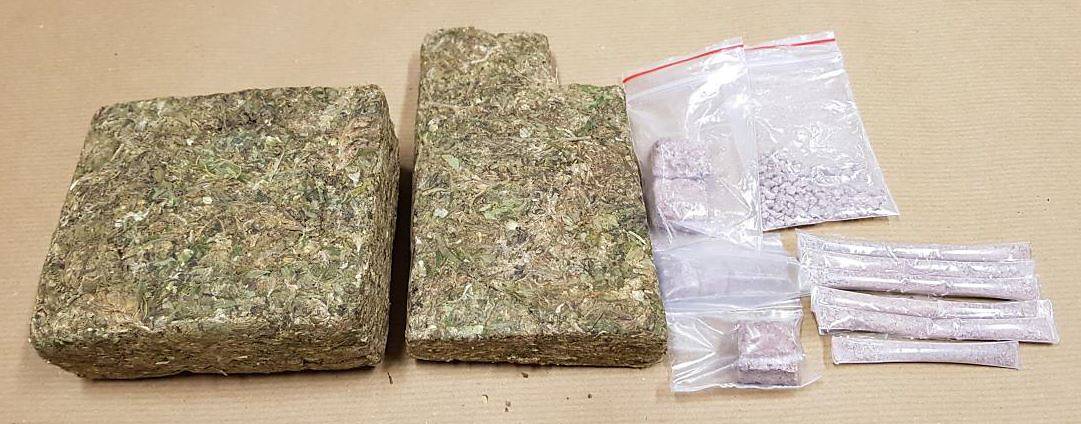
Drugs with a street value of more than S$52,000 were seized during the operation, which covered areas like Ang Mo Kio, Balestier, Clementi, Geylang, Toa Payoh and Woodlands, said CNB in a news release on Friday. 

About 570g of cannabis, 268g of Ice, 46g of heroin, 30g of ketamine, 62 ecstasy tablets, 56 erimin-5 tablets, 12 yaba tablets, some methadone and GHB (gamma-hydroxybutyrate) were found during the raids.

ARRESTS IN RANGOON ROAD AND WOODLANDS RING ROAD

In one case, a 34-year-old suspected drug trafficker was arrested on Monday at Rangoon Road, along with a suspected drug offender. 

Officers recovered 268g of Ice, 89g of cannabis, 10g of ketamine, 62 ecstasy tablets, 50 erimin-5 tablets, 12 yaba tablets and a bottle of liquid suspected to be liquid ecstasy from the suspected drug trafficker’s hideout. The seized drugs have an estimated street value of about S$34,000.

One of the packets of Ice recovered was packed and concealed to look like a chocolate snack. 

Ice packed and concealed to appear as a chocolate snack was recovered from a suspected drug trafficker’s hideout along Rangoon Road. (Photo: CNB)

Drug paraphernalia like three digital weighing scales were also recovered. 

In a separate case on Thursday, large amounts of cannabis were seized and a 56-year-old suspected drug trafficker was arrested at a multi-storey car park in Woodlands Ring Road. 

Cannabis and heroin seized from a 56-year-old suspected drug trafficker arrested near Woodlands Ring Road on Jan 25, 2018. (Photo: CNB)

CNB officers found 28g of cannabis and 13g of heroin on him. They subsequently found 451g of cannabis, 25g of heroin, two bottles of methadone, a digital weighing scale and a bottle containing orange-coloured liquid suspected to contain controlled drugs at his home. 

Investigations against all the suspects are ongoing.

Source link

Woman hits 9-year-old nephew, burns him with lighter and dangles him out of 3rd-floor window

0

Upset that she was spotted by her nephew while using drugs, a woman beat the child and even dangled him from the window of a 3rd-floor unit.

The incident happened on Feb 4, 2017, and the 39-year-old woman was charged in court on Monday (Jan 22), reported Lianhe Wanbao.

She pleaded guilty to one count of child intimidation and abuse and was sentenced to 10 months’ jail.

The court also noted that she had just entered a drug rehabilitation centre, and was scheduled to be released the next month.

Her sentence would start from the day which she was charged, on Sep 22, 2017.

The victim, a primary 4 student was living with his aunt at the time of the incident.

Read also


13-year-old girl sent to work at massage centre ends up being raped, bitten and abused
13-year-old girl sent to work at massage centre ends up being raped, bitten and abused<!–

13-year-old girl sent to work at massage centre ends up being raped, bitten and abused

//afarkas.github.io/lazysizes/lazysizes.min.js

Both his parents are in jail due to drug offences.

On Feb 3, 2017, the boy saw the woman heating up a white powder and inhaling the resulting vapour.

Afraid that he would be beaten, he ran out of the house.

The accused managed to find the boy just after midnight and brought him back to the house.

Enraged, she made him kneeled at the door, while she continued to use the white powdery substance.

After that, she approached the boy and threatened to throw him down from the third-floor unit.

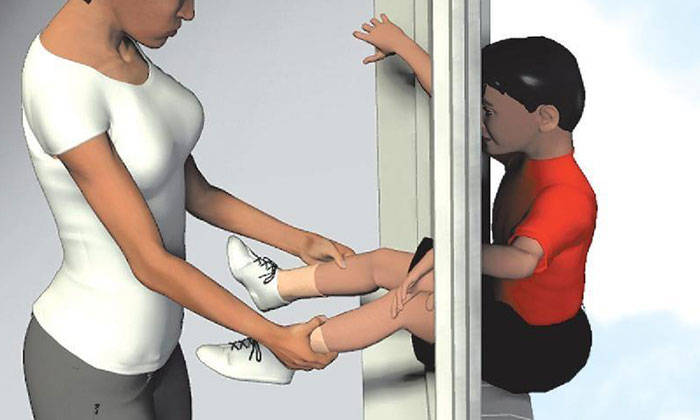
She carried him into the kitchen, grabbed both his legs and dangled the boy outside the window.

At the time, his upper body was completely out of the window.

Afraid that she would let go, the boy held tightly to the laundry rack, and pleaded with the accused not to loosen her grip.

The accused later pulled him in.

However, she then hit the boy on his head with an aluminium laundry pole and a bamboo scratcher.

She also slapped his elbow and left foot, while using a gas lighter to burn him.

After the incident, the boy’s teacher discovered the wounds on the boy and asked him how he had gotten them.

The truth was finally revealed when the boy told her.

According to a medical report, the boy suffered bruises on many parts of his body.

He also bore scars on his head and neck.

During the mitigation plea, the accused’s lawyer said that the accused was deeply remorseful for her actions, and know that she must keep her emotions in check.

The lawyer also said that the boy had been naughty and left the house, only for him to be brought to a police station by a passerby.

The lawyer also added that the accused has seven children and was with three of her children during the time of the incident.

As her husband was working, she had to look after the children and the house on her own.

The lawyer also cited that two months before the incident, the accused had just given birth.

The toil of caring for her children and the boy caused her to experience tremendous stress.

Singapore

Friday, January 26, 2018 – 16:49

Stomp

Others

Source link

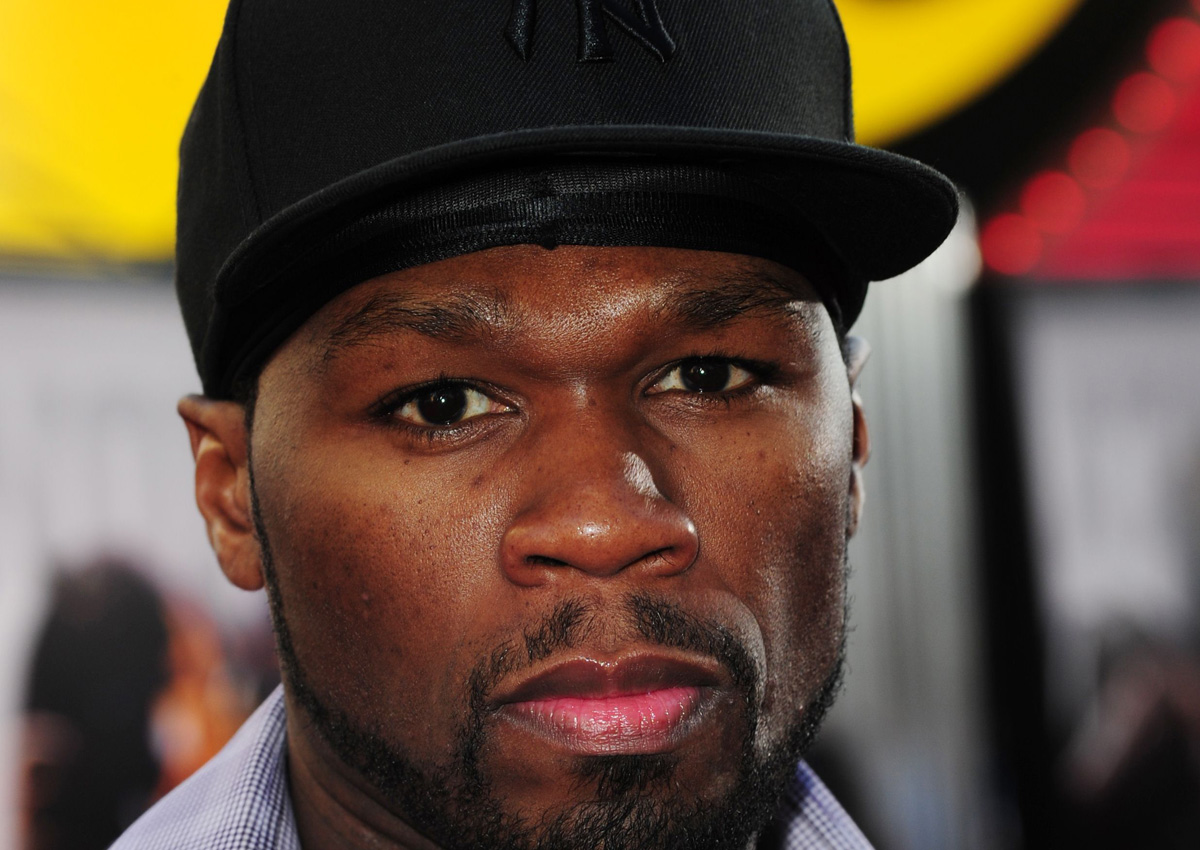
Rapper 50 Cent now millionaire thanks to bitcoin

0

United States rapper 50 Cent has recently found out that he is a millionaire in bitcoins, thanks to sales of a previous album.

In 2014, 50 Cent released his album Animal Ambition and became the first musical artist who accepted bitcoin as payment. According to TMZ, he let his bitcoin account lie untouched, and just recently discovered that he is a bitcoin millionaire.

50 Cent said on his Instagram account that he had forgotten he accepted the cryptocurrency as a form of payment.

By the time the album was released in late 2014, Billboard wrote an article titled “9 albums that flopped in 2014 (or did they?)”, and mentioned Animal Ambition as one of the flops that year. Billboard wrote, “Despite plenty of publicity, 50 sold less than a third of the first-week sales for his previous studio effort.”

Billboard did not mention that 50 earned around 700 bitcoins from the album sales in an account he neglected. Since then, the bitcoins have become worth nearly US$8 million (S$10.4 million).

At the time of the album’s release, a single bitcoin was worth $660. Now, the same amount is worth $11,200 according to Coindesk. At the time, 50 said on Reddit that he would “stay with times” and accept bitcoin as payment, but the hip-hop star apparently forgot about his account and let it rest.

Bitcoin evangelists on Twitter were quick to respond 50’s tweet, and pitched the rapper various crypto platforms and coins that he should check out next.

Friday, January 26, 2018 – 16:13

More about

bitcoins

Others

Source link

Does Reese Witherspoon have 3 legs on the cover of 'Vanity Fair'?

0

We all probably gushed and let out a sigh of appreciation when we saw the latest cover of Vanity Fair featuring Oprah Winfrey, Nicole Kidman, Reese Witherspoon, Tom Hanks, Michael B. Jordan, Zendaya, Claire Foy, Jessica Chastain, Michael Shannon, Harrison Ford, Gal Gadot, Robert De Niro, and Graydon Carter (aka the man who started the Hollywood issue of VF.)

It’s one breathtaking cover photographed by Annie Leibovitz until you see something odd-Reese seems to have three legs. Look closely!

on Twitter

https://platform.twitter.com/widgets.js

on Twitter

https://platform.twitter.com/widgets.js

Reese addressed the issue on her Twitter account with such humour saying, “Well… I guess everybody knows now… I have three legs. I hope you can accept me for who I am.”

on Twitter

https://platform.twitter.com/widgets.js

She even shared how she doesn’t regret snuggling Oprah and recommends that everyone does so when they get the chance.

Other netizens pointed out that Reese wasn’t the only one with an extra limb. Apparently, Oprah had an extra arm based on the behind the scenes photos. Can you see it?

on Twitter

https://platform.twitter.com/widgets.js

Oprah replied to Reese’s post by saying “I accept your third leg. As I know you accept my third hand.”

on Twitter

https://platform.twitter.com/widgets.js

It may be a photoshop blunder, but who knows right? Vanity Fair handled the mishap with such ease and again, humour. Because everything is easier when it’s funny.

on Twitter

https://platform.twitter.com/widgets.js

They said that as much as they want an exclusive on Reese’s third leg, it was just the lining of her dress. A trick-eye, if you ask me. While Oprah’s extra hand is being dealt with at the moment.

What an eventful evening, huh?

Saturday, January 27, 2018 – 18:00

Others

Source link