Home Blog Page 1162

More than 3,500 recognised in Singapore healthcare awards

0

SINGAPORE: Going to the National Heart Centre to seek treatment for a heart condition can be intimidating, so senior nurse manager Tina Teo always takes the time to speak with patients and allay their fears and anxieties.

Ms Teo’s dedication to her patients did not go unnoticed. For her efforts, the 52-year-old received a “Superstar” nursing award, the highest accolade under the Singapore Health Quality Service Awards for healthcare professionals.

The awards, which honour those who have delivered the best care and made an impact on their patients’ lives, was presented by Minister for Health Gan Kim Yong at Mediacorp’s MES Theatre on Tuesday (Jan 30).

More than 3,500 healthcare professionals and institutions were recognised at the Singapore Health Quality Service Awards 2018. (Photo: Dawn Ang)

“When you lie on the (doctor’s) procedure table, everyone will feel some sense of worry. So we explain to the patient what we will be doing, what they can expect. This makes them feel calmer during the process,” said Ms Teo, who has been in the field for 35 years.

This may seem like standard practice but consider that she does this on top of managing a team of more than 40 nurses and assistants while assisting doctors on a daily basis.

Ms Teo knew from the age of 11 that she wanted to be a nurse. It was at that time that her father had kidney failure. 

“He needed to go to the hospital every other day to do dialysis,” said Ms Teo. She and her six siblings took turns to accompany their father on these sessions and she saw how he struggled to prepare himself for the procedure.

“I felt quite pained when I saw that he had to learn all the (dialysis) techniques, so I thought ‘I should learn so I can do it for him’.”

Award winners senior nurse manager Tina Teo and volunteer management executive Mohamad Sharil Abdul Rahim. (Photo: Dawn Ang)

SUPERSTAR VOLUNTEER MANAGER

Another award recipient in the “Superstar” category was Mr Mohamad Sharil Abdul Rahim, a volunteer management executive at the Ang Mo Kio-Thye Hua Kwan Hospital. 

Together with his 100-strong team of volunteers, Mr Mohamad Sharil plans the week’s activities and therapy-based programmes for the hospital’s patients, such as seated tai chi sessions or karaoke sing-alongs.

“I believe that happy and active patients recover faster,” he said.

Managing volunteers can sometimes be challenging, especially with differing schedules and commitment levels. “(But) I gain my strength from my volunteers and my patients. My patients, especially, they keep me grounded,” said the jovial 33-year-old.

“Sometimes they tease me for my weight … but you know they are joking so you just tahan (“endure” in Malay)!” chuckled Mr Mohamad Sharil.

Sharil with patients at Ang Mo Kio-Thye Hua Kwan Hospital, during a cat-assisted therapy session. (Photo: Singhealth)

As a cat lover who owns five cats, Mr Mohamad Sharil also started a volunteer group, Cat-Assisted Therapy Singapore, to run monthly animal-assisted therapy sessions at the hospital.

It did so well that he expanded the therapy programme to three other nursing homes and a student care centre.

The “Superstar” awards were eight of the 3,582 given out to both individuals and institutions in healthcare at the ceremony, organised by the SingHealth Duke-NUS Academic Medical Centre.

Into its eighth year, the awards saw 30 healthcare institutions participating this year, the highest in its award history.

Minister for Health Gan Kim Yong presented the awards and thanked the professionals for their dedication, noting that many had gone “beyond the call of duty”. 

“You make all the difference to the patients,” said the Health Minister to an audience of more than 1,400 healthcare professionals.

Source link

In face of increasing demand from non-native speakers, international schools widen their appeal

0

SINGAPORE: When Mr Leo Liao first enrolled his 11-year-old daughter, Lea, in the Lycee Francais de Singapour (LFS) last year, he was concerned that Lea, who did not speak French, would be isolated from her peers or struggle to catch up in class.

“I think my daughter is the only one in her class where both her parents have no French blood,” said Mr Liao, who relocated to Singapore from Beijing last year. “Most of her classmates have either a mother or father with French blood.

“But my wife and I used to study in France, and we thought it would be good to let her learn another language apart from Mandarin and English.”

Despite his initial hesitation, Lea has coped thanks to a programme called the French Passerelle, a formal integration programme designed specifically to help students from a non-French background learn the language and better assimilate into the school.  

SPECIAL PROGRAMMES TO HELP STUDENTS ASSIMILATE

While LFS has mostly French-speaking students, chairman of the school’s board Axel Foucault noted that it has always accepted non-French speaking students, particularly at the kindergarten and primary levels. To ensure these students integrate, the school has organised dedicated French classes with a qualified teacher, to help students quickly learn the basics required to follow the French curriculum.

However, the French Passerelle programme, which was first launched in September 2017, offers personalised support for each child throughout his or her time in the school.

For example, kindergarten and elementary students in the programme are integrated in standard classes and follow the French curriculum, while receiving French language lessons in small groups with a qualified teacher.

“We accompany the students to ensure they make progress quickly in French, through full immersion,” explainedChristian Soulard, principal of the LFS. “Children participate in most activities of the class during the week.

“Their progress in French is spectacular and we progressively diminish the tuition as their learning and fluency improve.”

Through a partnership with the Alliance Francaise de Singapour, the school offers older children intensive classes and holiday camps during school holidays. There is also a buddy system for all students to help them with their social integration into the school.

“We also expect a commitment from the parents,” added Mr Soulard. This includes the promotion of French at home through films, television, books and lessons. “We also ask them to attend regular Meet-The-Teacher sessions.”

There are similar programmes in other international schools, particularly those which are traditionally associated with a language other than English.

The Swiss School in Singapore (SSiS), which is a German-speaking school, offers language support in German through qualified support teachers within all its classes. “All students who are not able to follow regular classes in German receive additional encouragement in small groups beyond regular school lessons,” said a school spokesperson.  

Students at the Swiss School in Singapore. (Photo: SSiS)

Last year, the school also launched an Afternoon Extension Programme that offers non-German speaking children language preparation for kindergarten and primary school, through optional afternoon classes.

“Through a variety of activities such as reading and storytelling, singing, painting, excursions and more, qualified teachers promote the children’s German language skills specifically and give them individual support,” said SSiS. “The interest in these classes and the success in terms of children’s language acquisition skills have been overwhelming.”

ENROLMENT INTO MAINSTREAM SCHOOLS A CHALLENGING PROCESS

These new programmes come on the back of growing interest in sending children to such schools. SSiS estimates that about 60 per cent of its children speak German as their first language. These children are mainly from Swiss or German families. The other 40 per cent of its students either do not speak German as their first language, or speak multiple languages at home, one of which might be German.

“The trend shows that we have “more and more registrations from families with international backgrounds who do not speak German at home,” it added.

While LFS does not track its enrollment by nationality, Mr Soulard noted that after the launch of the French Passerelle programme, there was a “significant increase” in the number of non-French speaking students joining the school. He estimated that between 2016 and 2017, the increase in such students was about 140 per cent, which is “significantly higher” than the overall increase in net registrations.

The Lycee Francais de Singapour has seen a significant increase in the number of non-French speaking students since the launch of the French Passerelle programme. (Photo: LFS) 

One other possible reason for the increase is the challenge international students face in enrolling in local schools.

Mr Liao was initially looking forward to placing Lea in a local school, and had enrolled her in a preparatory programme for the Admissions Exercise for International Students (AEIS). This exercise, conducted by the Ministry of Education (MOE), is a centralised admissions exercise that takes place in September or October each year, for students who wish to join mainstream primary and secondary schools in January of the following year.

International students in MOE schools form about 5 per cent of the total student population in primary and secondary schools, said MOE in response to Channel NewsAsia’s queries. “The proportion has remained fairly constant over the past few years, and the majority of international students are from countries in ASEAN and Asia.”

“Admission to MOE’s mainstream schools via the AEIS is dependent on the applicant’s performance in a test and available vacancies,” it added.

But Mr Liao pointed out that for parents like himself, getting a child into a mainstream school can appear to be a challenging process.

“Every parent trusts the Singapore school system,” he said. “And we have no concerns about the quality or anything like that. But we know that competition to get in is tough.”

He explained that while the environment of the preparatory school his daughter attended was good and she was happy to go to school every day, he had noticed that some of her classmates had been there for as long as two years.

“They had repeatedly tried the AEIS, and they repeatedly failed,” he said. “The school was good, but it’s not meant for children to stay there long-term.”

Mr Liao added that the results of the AEIS are also not transparent, explaining that the results only indicate whether the child is admitted, or not. Furthermore, should his daughter be successfully admitted, he pointed out that she would be held back at least one or two years.  

He noted that most of his daughter’s classmates at the AEIS preparatory programme would have opted for schools like the Australian International School, or Singapore American School, where the teaching language is English. But he decided to go for the LFS, and he is pleased with his daughter’s progress. 

“She doesn’t understand everything that is in the textbooks yet, but she understands the teachers and can follow what is happening,” he said. “The teachers are also very kind, and they don’t mind repeating themselves if my daughter doesn’t understand.”

Source link

Korean celebrities find it difficult to break silence on sexual exploitation

0

American movements against pervasive sexual harassment — #MeToo and Time’s Up — have led to a slew of allegations against some of the world’s most powerful men.

What started out as a tweet from a Hollywood actress encouraging those who have been victims of sexual harassment to use the hashtag #MeToo soon evolved into a global movement, starting with the downfall of movie mogul Harvey Weinstein.

And while it was never easy for the silence breakers to come forward with their stories, experts believe the US movement has had the biggest impact so far because it was Hollywood actors and actresses who were victims of abuse at the hands of one of the most powerful figures in the industry.

“Weinstein was not just an average person. And the thought gave courage to the others, that if someone of his stature could be toppled, anyone can,” Adrien Wing, a gender expert and associate dean for the International and Comparative Law Programs at University of Iowa said in a lecture recently at Ewha Womans University. “And they had the media backing.”

However, the movement has gained little traction in South Korea, with only a handful of revelations receiving slight public attention.

As for the celebrities who one would think would have the power to get their stories heard, it appears it is still just as hard as before to go public.

“There is no reason for celebrities who are doing well to give their voice to sensitive issues, such as sexual harassment. For those who are less popular, why cause trouble?” a manager of a singer told The Korea Herald.

The manager, who wished to remain anonymous, explained it is just as hard for celebrities here to become silence breakers — maybe even harder.

POWERLESS AGAINST POWERFUL, PUBLIC

In a patriarchal society, cultural expectations of celebrities are high for public figures, and the idea of a celebrity speaking on social issues is unfamiliar, culture critic Ha Jae-keun said.

Statistics also back up that actors and actresses are not used to revealing personal experiences, even if it means having to endure unfair treatment. According to data from the Fair Environment Center, organised under the Korean Film Council, only two sexual harassment cases have been reported in recent years, one each in 2014 and 2016.

In 2009, the suicide of a rookie actress rocked the country. The late Jang Ja-yeon, who was starring in popular KBS drama series “Boys Over Flowers,” took her own life, leaving behind seven pages of handwritten notes. There, she revealed that she had been forced by the head of her agency to provide sexual favors to high-profile media executives.

The notes detailed the men she had to “serve” and the places where such meetings occurred. A powerful newspaper president was among the names on the list, triggering a prosecutorial investigation.

However, her detailed ordeal didn’t receive the results she may have hoped. The prosecution charged only the agency chief and Jang’s manager without detention, and the nine prominent figures whose names appeared in the notes were left unscathed.

“As for celebrities, they were belittled as mere entertainers in the past, and now they are often viewed as ‘products.'” Lee Taek-gwang, a culture professor at Kyung Hee University said. “And the public does not want to see these ‘products’ make their own, unexpected voice.”

“I had heard Jang wanted herself to be perceived as a strong female character with her own opinions, but the reality did not allow it,” he added.

In August, a 41-year-old actress sued prize-winning filmmaker Kim Ki-duk for violence and coercing her to shoot unscripted sex scenes while filming the movie “Moebius” in 2013. But to her disappointment, the prosecution indicted Kim on a summary offence with a penalty of 5 million won (S$6,100).

In a press conference, the actress, speaking behind a curtain, said it took her four years to finally tell her experience to the public.

“For two months after the incident, I could not go outside of my house out of fear. After getting counseling, I asked acquaintances in the film industry for advice but they all told me to forget it, because I will lose and be put in a worse situation,” she said.

“World-renowned celebrities are taking part in the #MeToo movement, but it is not happening in South Korea. Weak actresses like me cannot but face a limit here,” she said.

Seo Hye-jin, the lawyer who represented the actress, expressed regret over the prosecution and public’s ignorance on the issue.

“Kim is a celebrated filmmaker and there have been numerous rumours surrounding him about his misconduct,” Seo said. “We had hoped and anticipated other victims would come forward and reveal his wrongdoings. But nobody did.”

As for her client, Seo said she would not be able to work in the industry anymore, and the actress was aware of it.

“She made her debut in the late ’90s and has been acting for 20 years. You just have to put your career at stake to file a lawsuit here.”

VICTIMS MUTED

Korea Sexual Violence Relief Center Chairwoman Lee Mi-kyung said the real problem is not that these stories are hidden, but that society does not want to listen.

“#MeToo is not new. We have been running an annual programme where victims talk about their experiences since 2003. They are all out there, speaking about their pain and calling out for help,” Lee said. “But it is society that is not ready to listen to these stories.”

Even after mustering up the courage to reveal their painful experiences, many victims face secondary damages, Lee explained.

After they file a lawsuit, the victims are often countersued for defamation and false accusations, lengthening their suffering stemming from the incident.

Society also often points fingers at the victims, and not the offenders.

Two years ago, a string of allegations were made against prominent figures in the literary circle, prompting apologies and starting a hashtag movement similar to #MeToo. But it was a short-lived moment, and some victims ended up having to fight longer defending themselves from defamation charges.

STRIVING FOR A BREAKTHROUGH

Despite numerous hurdles, activists and supporters remain committed to upholding the rights of sexual harassment victims and preventing further crimes.

And they are raising hopes once again for a breakthrough, as the incumbent government embarks on a reform drive to eliminate past wrongdoings.

Chairwoman Rep. Choo Mi-ae of the ruling Democratic Party of Korea called for a reinvestigation of the sex scandal involving the late actress Jang.

The prosecution reform committee, which was established in December within the Justice Ministry, reportedly has been considering conducting a probe into the case.

On Jan. 23, a union of seven women rights groups and some 126 sexual harassment aid centres took to the streets to urge investigators to look into Jang’s story again.

“The Korean media outlets, the prosecution and businesses are all linked, and female actresses and artists are often pressured to trade sexual favors for career advancement,” Korea Sexual Violence Relief Center chief Lee said at the press briefing.

A chairwoman from a counseling centre in Yongin echoed Lee.

“Please unveil the truth and conduct a thorough investigation, so that nobody has to be pressured to give sexual favors or endure harassment for any reason.”

Tuesday, January 30, 2018 – 16:12

Others

Source link

Durian-themed Singapore cafe smells winning combination

0

SINGAPORE: An eatery centred around the pungent tropical fruit durian has caught a whiff of success as patrons flock to the cafe in droves for a bite of its exotic offerings.

The spiky fruit long regarded as a delicacy in Southeast Asia has left a divisive trail – you either love it or hate it – and its odour means it is banned in most hotels and MRT trains.

Detractors often describe its intense smell as a mix of gym socks and onions, while enthusiasts liken the creamy texture and intense aroma to blue cheese.

While the bittersweet fruit is usually eaten on its own or as dessert, the Mao Shan Wang cafe in the Chinatown district has a special menu with durian in all dishes, even savoury ones.

The cafe’s name Mao Shan Wang, Chinese for Cat Mountain King, refers to a strain of durian from Kelantan state in neighbouring Malaysia distinguished by its bittersweet taste and small seeds. (Photo: AFP/Nicholas YEO)

Customers can opt for chicken nuggets with a durian dip, pizza topped with durian flesh, fries with a side of durian sauce, all washed down with coffee – durian infused, of course.

“Durian is (usually) eaten by itself and as sweets or treats, but what our company wanted to do was put it with savoury stuff like fries and nuggets,” company spokesman Lance Lee told AFP.

“We will be looking to expand the offerings as well, with maybe rice, pasta and other things.”

Mao Shan Wang, Chinese for Cat Mountain King, refers to a strain of durian from Kelantan state in neighbouring Malaysia distinguished by its bittersweet taste and small seeds.

More adventurous customers, most of them tourists, were seen trying the strong-smelling fruit – while wearing gloves.

Many were also waiting in line to buy durian-flavoured confectionery, and even freshly cut up fruit conveniently sealed in vacuum packs for their plane journey.

American tourist Michael Capps, who had been trying fresh durian straight from the husk, said he was a convert.

“It’s hard to explain the taste to it, but it actually has like a sweet taste to it and it’s very good.”

Source link

Want to use Meryl Streep's name? Pay first

0

LOS ANGELES – Acclaimed actress Meryl Streep has filed an application to trademark her name.

The application with the US Patent and Trademark Office requests that the name be trademarked for “entertainment services”, movie appearances, speaking engagements and autographs.

Streep, 68, last week extended her record to 21 Oscar nominations, this time for her role in The Post. She has bagged three Oscars, three Emmys and six Golden Globes during her 40-year career on stage, screen and television.

Many stars have also protected their names or catchphrases to stop others from using them without permission, or earn cash from products bearing their name.

Taylor Swift, for example, has filed some 60 trademark applications in the last 10 years, according to Patent Office records.

Tuesday, January 30, 2018 – 15:30

More about

celebrities

Others

Source link

Orchard Gateway dessert shop threatens to sue customer over 2-star review on Facebook

0

Thanks to the Internet and social media, many companies have opened themselves up to customers to review their products and services.

However, what does one do if they get a negative review?

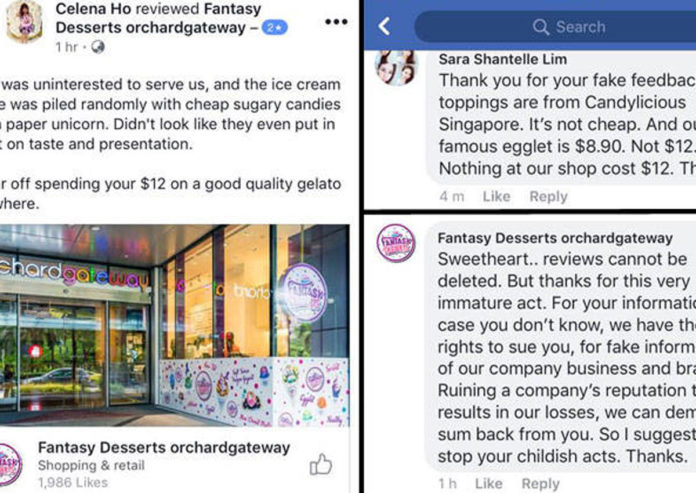
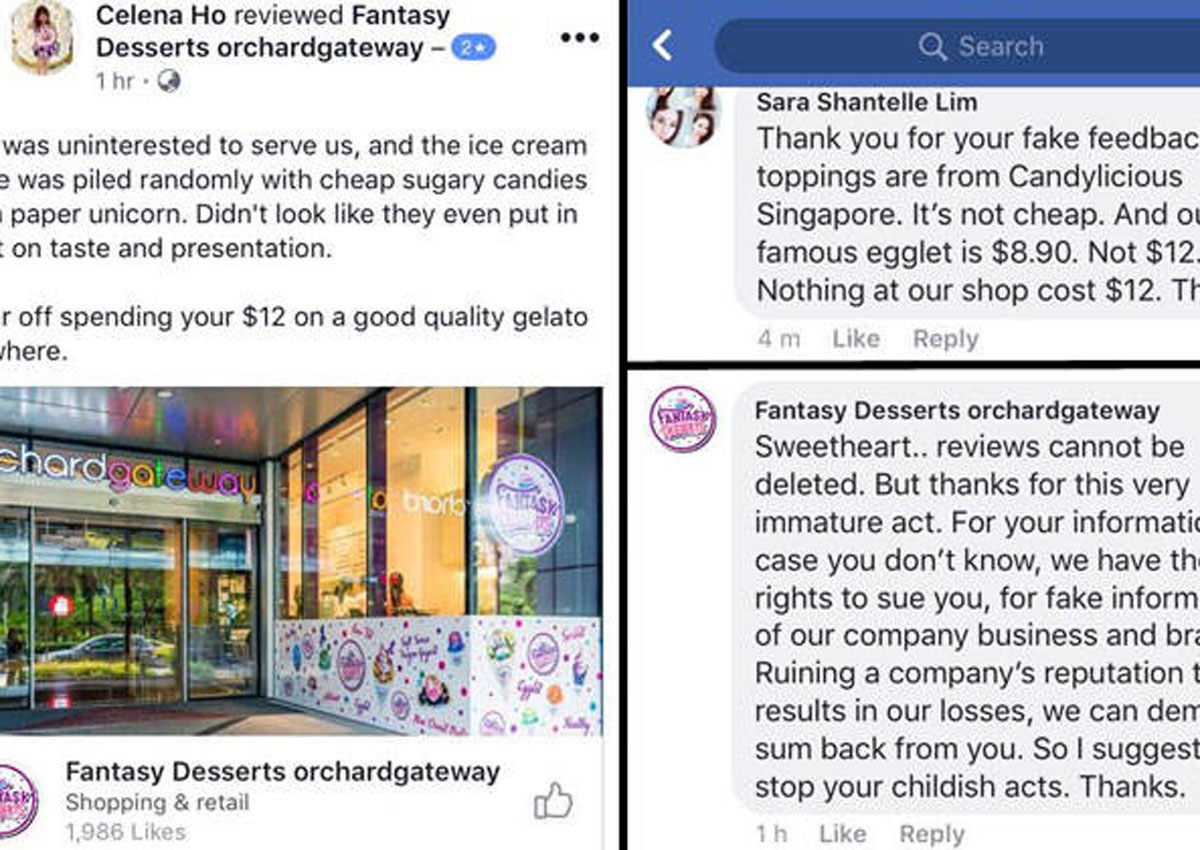
One dessert shop called Fantasy Desserts at Orchard Gateway demonstrated what you should not do when they threatened to sue a customer over a 2-star review.

on Facebook

Posted by Celena Ho on Saturday, 27 January 2018

Facebook user Celena Ho posted a review of her experience at the ice cream stall:

The founder and director of the shop, Sara Lim then took it upon herself to respond personally to the review using her own personal account.

She thanked Ho sarcastically for her “fake feedback”:

on Facebook

Posted by Celena Ho on Saturday, 27 January 2018

An hour later, Ho posted an update on her page claiming that the company had deleted her review.

on Facebook

UPDATE an hour later : They DELETED/ HID my review!!! I guess that’s how they maintain “positive” reviews on their page!…

Posted by Celena Ho on Saturday, 27 January 2018

However, Fantasy Desserts disputed this and said that “reviews cannot be deleted”.

They also threatened to sue Ho for “ruining” the company’s reputation:

on Facebook

Posted by Celena Ho on Sunday, 28 January 2018

Ho’s post on her own Facebook page with screenshots of her review and correspondence with Fantasy Desserts has since gone viral with over 844 shares.

Several netizens have called to boycott the dessert shop after seeing how they handled the situation.

The shop then tried to explain why they thought Ho’s review was “fake”.

They pointed out how she had paid $12 when the shop does not sell anything at that price in a half-hearted apology:

on Facebook

UPDATE an hour later : They DELETED/ HID my review!!! I guess that’s how they maintain “positive” reviews on their page!…

Posted by Celena Ho on Saturday, 27 January 2018

Ho then clarified and apologised for making the mistake and said that she did pay $10.90 for her dessert after all.

on Facebook

Posted by Fantasy Desserts orchardgateway on Sunday, 28 January 2018

However, Fantasy Desserts then said they would look into the matter properly and asked for the date and time she visited the stall so that they could check their CCTV.

Their attempt to apologise again was met with more criticism as they reminded Ho on her mistake on the price and blamed the matter on “one huge misunderstanding”.

on Facebook

UPDATE an hour later : They DELETED/ HID my review!!! I guess that’s how they maintain “positive” reviews on their page!…

Posted by Celena Ho on Saturday, 27 January 2018

Despite all this, it appears that the shop’s director, Lim has not backed down and has posted several videos and photos of her desserts in the comment section of Ho’s post.

She also wrote a very long reply about how she feels the customer is not always right:

on Facebook

UPDATE an hour later : They DELETED/ HID my review!!! I guess that’s how they maintain “positive” reviews on their page!…

Posted by Celena Ho on Saturday, 27 January 2018

Singapore

Tuesday, January 30, 2018 – 15:03

More about

bloggers food review

Stomp

Others

Source link

Yishun woman cuts herself with knife and stands on 11th floor railing after husband's alleged affair

0

A woman allegedly upset with her husband for cheating on her, stood on the 11th-floor railing while holding a kitchen knife, which she had used to inflict injuries on herself.

The incident happened at Block 289 Yishun Avenue 6 on Sunday (Jan 28), at around 2.28pm.

Cai Lili, 45, stood precariously on the railing between the 11th and 12th floor for nearly two hours before she was rescued by officers from the Singapore Civil Defence Force (SCDF).

Videos of the heart-stopping rescue effort by the officers were shared and uploaded to Facebook users Ann Siti and Mas Attica’s pages.

on Facebook

Posted by Mas Attica on Sunday, 28 January 2018

on Facebook

Posted by Mas Attica on Sunday, 28 January 2018

According to Shin Min Daily News, Cai had encountered marital woes after reportedly discovering that her husband was cheating on her.

The two were understood to have gotten into a heated argument just before the incident.

A witness revealed that Cai was screaming as she engaged in self-mutilation.

There were over 30 knife wounds found on her legs, thighs and arms.

Photo: Shin Min Daily News

SCDF officers had also deployed a safety air pack at the foot of the block as a precautionary measure as officers tried to convince Cai to get off the railing.

Reporters observed at least 10 police patrol vehicles. and two fire engines at the scene during the incident.

The block had already been cordoned off.

Cai was later pulled to safety by SCDF officers and conveyed to a hospital.

In response to media queries, a police spokesman said that a 45-year-old woman was arrested for possessing a dangerous weapon, and attempted suicide.

The case is currently under investigation.

A resident from a nearby block revealed that he had seen many police officers at the foot of the block and when he looked up, realised that there was a woman standing on the railing.

on Facebook

Blk 289 now happening lady jumping down from 12th storey

Posted by Ann Siti on Saturday, 27 January 2018

He said:

“She was talking very loudly, and demanded that the officers take away the air pack. The situation was very tense.”

Investigators retrieved a kitchen knife about 20cm-long.

The residents also lauded the officers’ efforts and determination despite the heavy rain. which ultimately paid off.

HELPLINES

  • Samaritans of Singapore (SOS): 1800-2214444
  • Singapore Association for Mental Health: 1800-2837019
  • Sage Counselling Centre: 1800-5555555
  • Care Corner Mandarin Counselling: 1800-3535800

Singapore

Tuesday, January 30, 2018 – 15:02

Stomp

Others

Source link

NTU scientists create customisable, fabric-like power source for wearable electronics

0

SINGAPORE: Scientists at Nanyang Technological University (NTU) have created a customisable, fabric-like power source that can be cut, folded or stretched without losing its function.

In a news release on Tuesday (Jan 30), NTU said the team, led by Professor Chen Xiaodong, Associate Chair (Faculty) at the School of Materials Science & Engineering, reported their findings in the journal Advanced Materials and have filed a patent for the technology.

In addition to creating a wearable power source which works like a fast-charging battery that can be recharged many times, the scientists also made the power source or “supercapacitor” customisable or “editable”.

This means its structure and shape can be changed after it is manufactured, while retaining its function as a power source. While existing stretchable supercapacitors are made into predetermined designs and structures, the new invention can be stretched multi-directionally and is less likely to be mismatched when it is joined up to other electrical components, NTU said.

The new power source developed by NTU scientists can be customised into any shape. (Photo: NTU)

Professor Chen said: “A reliable and editable supercapacitor is important for development of the wearable electronics industry. It also opens up all sorts of possibilities in the realm of the ‘Internet-of-Things’ when wearable electronics can reliably power themselves and connect and communicate with appliances in the home and other environments.

“My own dream is to one day combine our flexible supercapacitors with wearable sensors for health and sports performance diagnostics. With the ability for wearable electronics to power themselves, you could imagine the day when we create a device that could be used to monitor a marathon runner during a race with great sensitivity, detecting signals from both under and over-exertion.”

The new supercapacitor, when edited into a honeycomb-like structure, has the ability to store an electrical charge four times higher than most existing stretchable supercapacitors. Additionally, when stretched to four times its original length, it maintains nearly 98 per cent of the initial ability to store electrical energy, even after 10,000 stretch-and-release cycles, NTU added.

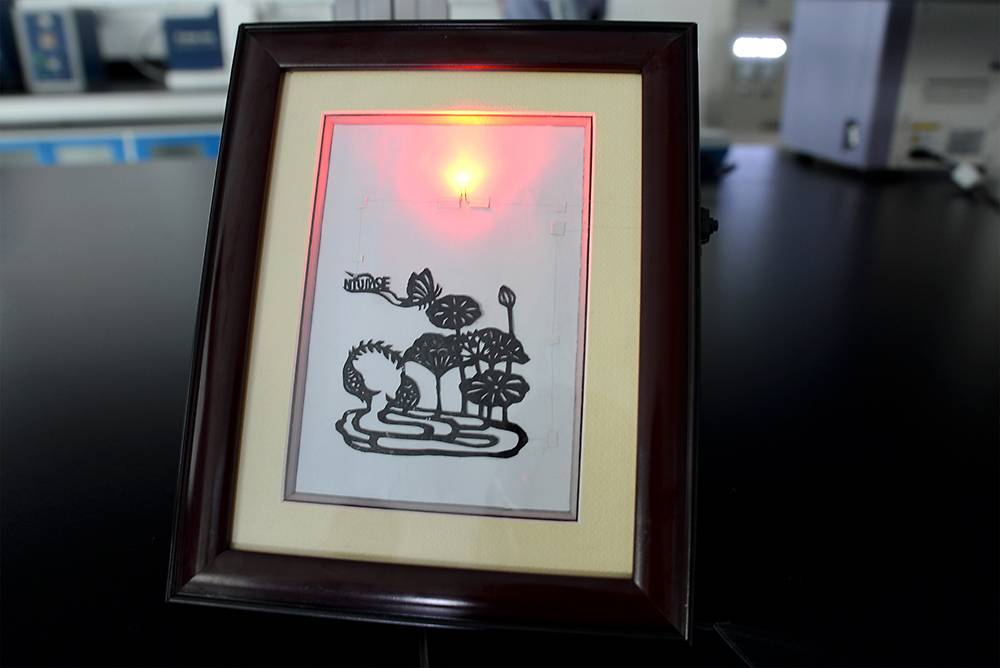
An intricately designed supercapacitor powering a light. Such customisations open up new possibilities for wearable electronics in future. (Photo: NTU)

Experiments conducted by Professor Chen and his team also showed that when the editable supercapacitor was paired with a sensor and placed on the human elbow, it performed better than existing stretchable supercapacitors. 

The editable supercapacitor was able to provide a stable stream of signals even when the arm was swinging. These signals are then transmitted wirelessly to external devices, such as one that captures a patient’s heart rate.   

The editable supercapacitor is made of strengthened manganese dioxide nanowire composite material. While manganese dioxide is a common material for supercapacitors, the “ultralong nanowire structure”, strengthened by a network of carbon nanotubes and nanocellulose fibres, allows the electrodes to withstand the associated strains during the customisation process, NTU said.

Professor Chen and his team believe that the editable supercapacitor could be easily mass-produced as it would rely on existing manufacturing technologies. NTU said the team estimates that production costs could be as low as S$0.13 to produce a square-centimeter of the material.

(From left) NTU PhD student Lv Zhisheng, Professor Chen Xiaodong and A*STAR senior scientist Dr Loh Xian Jun are part of the team that developed the customisable power source. (Photo: NTU)

The NTU team also collaborated with Dr Loh Xian Jun, Senior Scientist and Head of the Soft Materials Department at the Institute of Materials Research and Engineering (IMRE), Agency for Science, Technology and Research (A*STAR).

Dr Loh said: “Customisable and versatile, these interconnected, fabric-like power sources are able to offer a plug-and-play functionality while maintaining good performance. Being highly stretchable, these flexible power sources are promising next-generation ‘fabric’ energy storage devices that could be integrated into wearable electronics.”

Source link

Veteran Malaysian actress Lai Meng retires at 90

0

Veteran actress Datuk Lai Meng has finally retired from showbiz after 53 years in the industry, China Press reported.

Dressed in nyonya attire, the 90-year-old was wheeled into the hall during a gala dinner at HGH Convention Centre on Saturday.

“I am very happy as I get to see many friends whom I have not seen for a long time. It is bittersweet for me tonight,” she said.

The actress, whose real name is Lai Kwai Yoon, said there is a turning point in every stage of life.

She also had words of encouragement for the youth, saying they must work hard and adding “ai piah jia eh yia” in Hokkien (to win, you have to give your best).

“I am already 90 years old. I didn’t earn much over the years.

“But I have a few goddaughters and fans who showered me with care and love.

“I have no regrets,” she said.

Many artistes and celebrities attended the dinner.

Tuesday, January 30, 2018 – 12:24

Others

Source link

Queue for 'huat'? Clever S'poreans are depositing money on Li Chun with just their phones

0

As modern as Singapore and Singaporeans are, there are still a number of traditions that many hold close to their hearts.

One of which is the Chinese tradition of Li Chun (Farmers’ Day), the date that marks the beginning of spring and is believed to be an auspicious day on the Chinese calendar.

Over the years, Chinese Singaporeans have cultivated the practice of depositing money on that day, believing that it’s good luck, and will also help their wealth grow in the new year.

In fact, it has become such a significant event here that local bank DBS (which has over 10,000 staff) even specifically credited their employees’ salaries into their bank accounts during Li Chun in 2016.

This year, Li Chun falls on 4 February 2018.

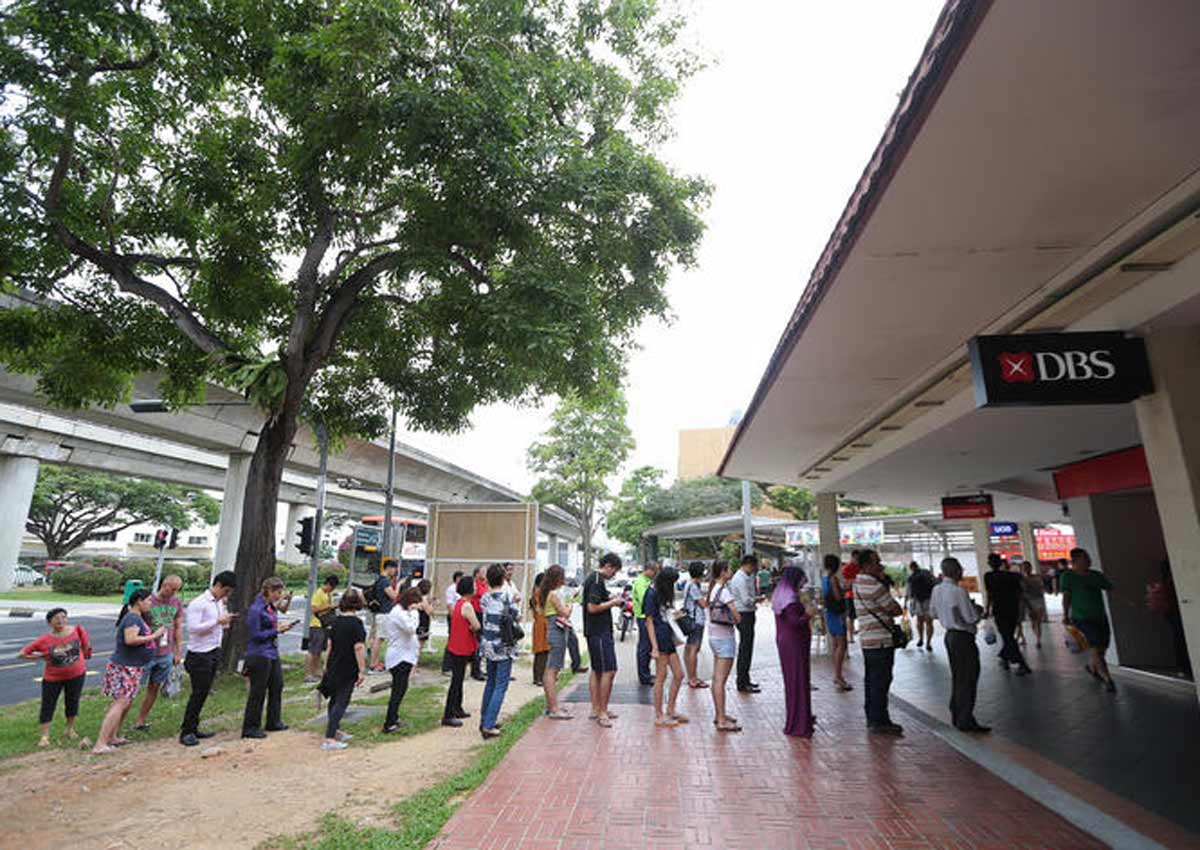
While snaking queues are fully expected at various ATMs machines around Singapore, there are clever Singaporeans who are getting around that time-consuming tradition with tech.

Getting around (mostly inconvenient) traditions with tech

Photo: DBS

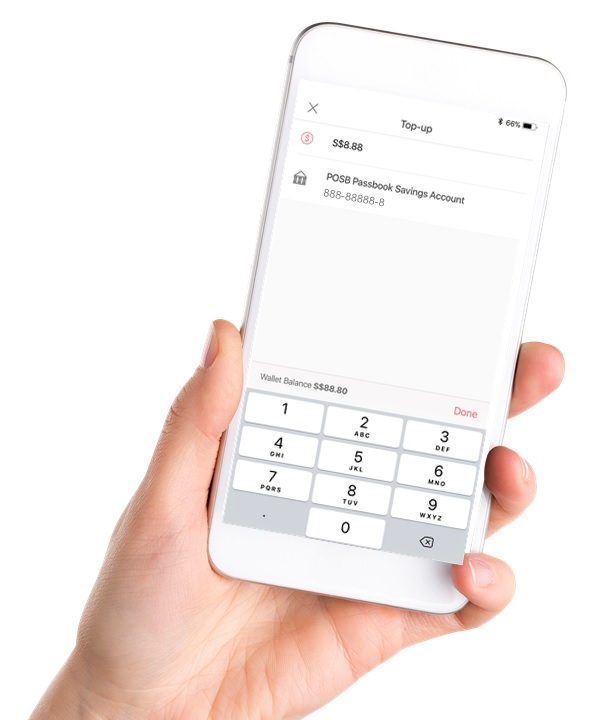
As compared to braving it out in the long queues, some resourceful Singaporeans have taken to depositing money into their e-wallets, like DBS PayLah!, instead.

Given that on top of the auspicious date, there are also ‘lucky timings’ for those born under the various zodiac animals to adhere to, using a more convenient option that can be accessed at any point of time also makes sense.

Photo: DBS

PayLah! users who deposit money on Li Chun (4 Feb) also stand a chance to win $88 – so, why not?

Here’s a fun fact:

During Li Chun 2017, an average of $35 was deposited per DBS PayLah! transaction.

e-Ang baos are also an a rise

It’s not just for Li Chun that Singaporeans are making use of tech – according to DBS, the number of eAng Baos sent last year was 5 times higher than what was sent in 2016!

And here’s another fun fact:

In 2017, the average amount of every eAng Bao sent was $26!

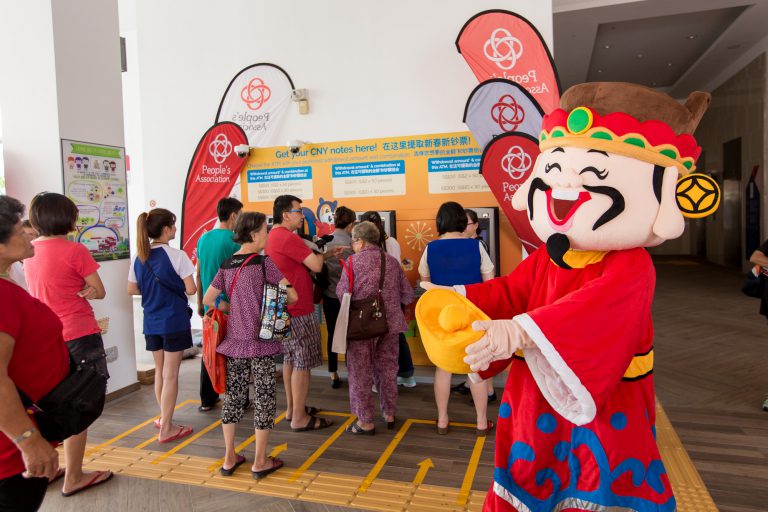
But of course, for those who still prefer to keep to the tradition of giving physical ang baos, 36 new-notes ATMs have been rolled out at 27 community clubs islandwide.

More than 110,000 customers made use of these pop-up ATMs in 2017.

Photo: DBS

Starting from today (29 Jan), customers will be able to withdraw new notes in sums of $100 ($2 x 50), $300 ($10 x 30) and $500 ($50 x 10).

For the first time, sums of $200 ($2 x 100), $300 ($2 x 50 + $10 x 20) and $500 ($10 x 20 + $50 x 6) will also be made available.

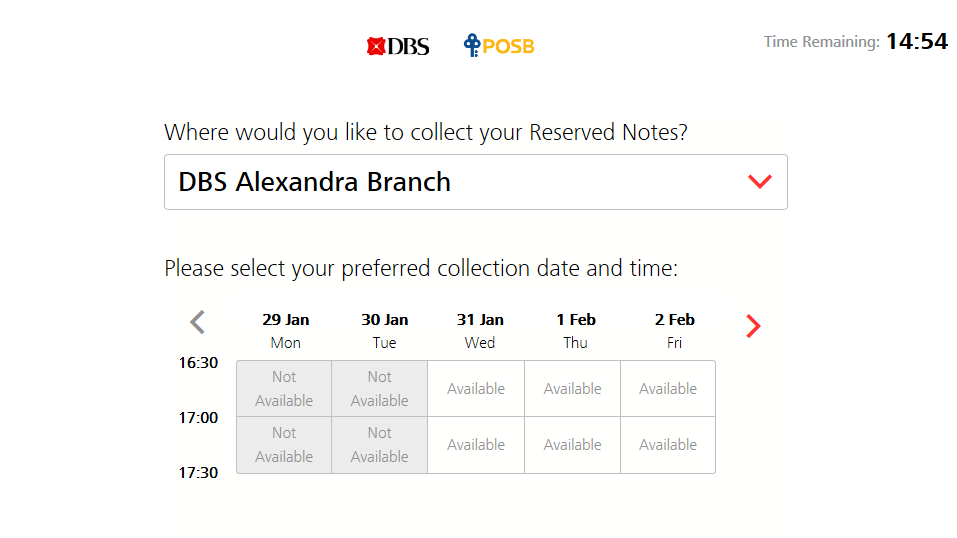
For those who don’t want to queue or head to the pop-up ATMs, online reservations can also be made for the new notes, and be collected at all full-service branches.

Photo: DBS

Special priority queues will also be available for the elderly and those with special needs, and customers will be able to use an SMS ‘Q’ notification service option to request for a queue number and get notified about note availability before heading down to the various bank branches.

Read also


Best times to deposit money on 'auspicious' Li Chun this year
Best times to deposit money on 'auspicious' Li Chun this year<!–

Best times to deposit money on ‘auspicious’ Li Chun this year

//afarkas.github.io/lazysizes/lazysizes.min.js

Other banks, like OCBC and UOB, also have pushed out similar services in the festive rush for new notes.

UOB customers will be able to reserve new notes online, while OCBC customers can use the bank’s mobile app to see in real time which branches have stock of new notes.

A virtual queue number can also be taken with the OCBC app.

Go forth and huat ah!

With so many convenient solutions available for even the most superstitious among us, there’s no reason to take MC (or leave) to queue at ATMs anymore.

For those already planning for 4 Feb, below is a chart stating the ‘best’ time to deposit money for your zodiac sign:

Photo: Skillshub


Singapore

Tuesday, January 30, 2018 – 11:30

More about

Chinese New Year E-banking POSB DBS

Vulcan Post

Others

Source link