WASHINGTON Supermodel Kate Upton has accused fashion giant Guess’s co-founder Paul Marciano of sexually harassing women.
Upton, 25, did not cite a specific incident in her criticism Wednesday of Guess co-founder and creative director Marciano, who is 65.
Upton, who was once the face of Guess, became the latest star to add her voice to the global #MeToo campaign against sexual misconduct, that kicked off following accusations against Hollywood mogul Harvey Weinstein.
“It’s disappointing that such an iconic women’s brand @Guess is still empowering Paul Marciano as their creative director #me too,” Upton wrote on Twitter.
Marciano co-founded Guess in 1981 and has been its executive chairman and chief creative officer since 2015.
Upton is married to star Houston Astros pitcher Justin Verlander, and is known for appearing on the cover of Sports Illustrated swimsuit editions. She has also done some acting.
She became a celebrity spokesmodel for Guess in 2011. Other models holding that position have included Claudia Schiffer and Cindy Crawford, and more recently Gigi Hadid.
SINGAPORE: More cases of molest and Internet love scams were reported last year, even as overall crime in Singapore fell, the Singapore Police Force (SPF) said in its annual crime brief on Saturday (Feb 3).
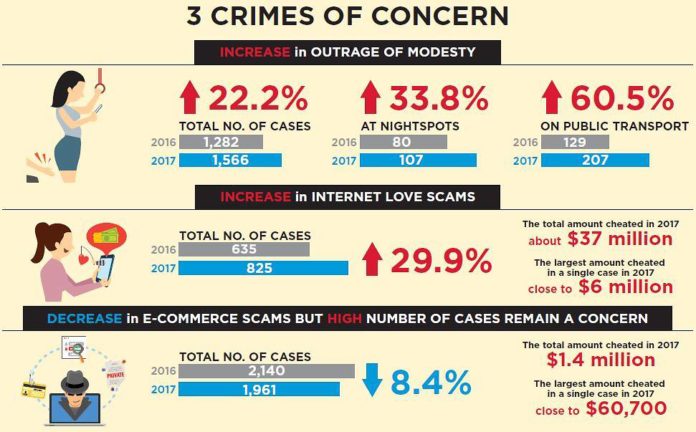
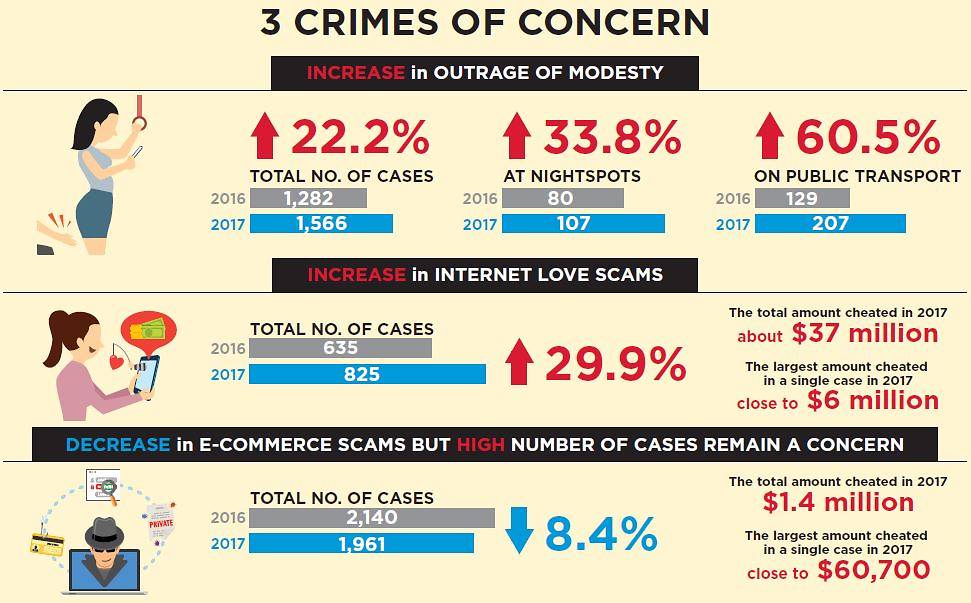
The number of outrage of modesty cases increased by 22.2 per cent, with 1,566 cases last year compared to 1,282 cases in 2016.
In particular, the number of molest cases on public transport spiked by 60.5 per cent, from 129 cases to 207 cases. Molest cases at entertainment night spots also rose by 33.8 per cent, from 80 cases to 107 cases last year.
SPF said it will step up patrols at public transportation nodes, and also distribute advisories to commuters during the morning and evening peak hours. Outrage of modesty advisory posters have already been placed on the platform screen doors of MRT stations, and public education videos are being screened at bus interchanges and train platforms, it added.
The police have also been working with public entertainment outlets on measures to prevent crimes on their premises, such as the installation of surveillance cameras.
INTERNET LOVE SCAMS RISE; LARGEST AMOUNT CHEATED WAS S$6 MILLION
The number of credit-for-sex scams fell by 46.3 per cent to 418 cases, with the total amount cheated at around S$1 million in 2017, compared to S$1.7 million in 2016.
The number of China officials impersonation scams also decreased, with 186 cases last year, compared to 501 cases in 2016. The total amount cheated fell from S$23.6 million to S$12.5 million.
However, more people fell for Internet love scams, rising 29.9 per cent from 635 cases in 2016 to 825 cases last year. The total amount cheated increased by 54.2 per cent to about S$37 million from S$24 million. The largest amount cheated in a single case was close to S$6 million.
“Internet love scams have been increasing year on year. Many people are still trusting and transferring money to strangers whom they have befriended online,” the police said.
Although e-commerce scams declined by 8.4 per cent, SPF said the high number – 1,961 cases in 2017 – remained a concern. The total amount cheated decreased slightly from S$1.5 million in 2016 to S$1.4 million. The largest amount cheated in a single case last year was close to S$60,700.
Graphic: SPF
SHIFT IN UNLICENSED MONEYLENDING HARASSMENT TACTICS
Following the 10-year low in 2016, the number of unlicensed moneylending-related harassment cases increased by 12.3 per cent to 3,806 cases in 2017, from 3,388 in 2016.
However, there was a significant drop of 21.8 per cent in cases involving damage to property, as more turned to harassing debtors by electronic means, SPF said. Such cases rose by 33.8 per cent to 2,783 cases last year, and formed the majority of unlicensed moneylending-related harassment cases last year.
Victims reported being harassed via SMS and social media platforms, and harassment notes were also placed inside letterboxes, SPF added.
OVERALL CRIME DOWN
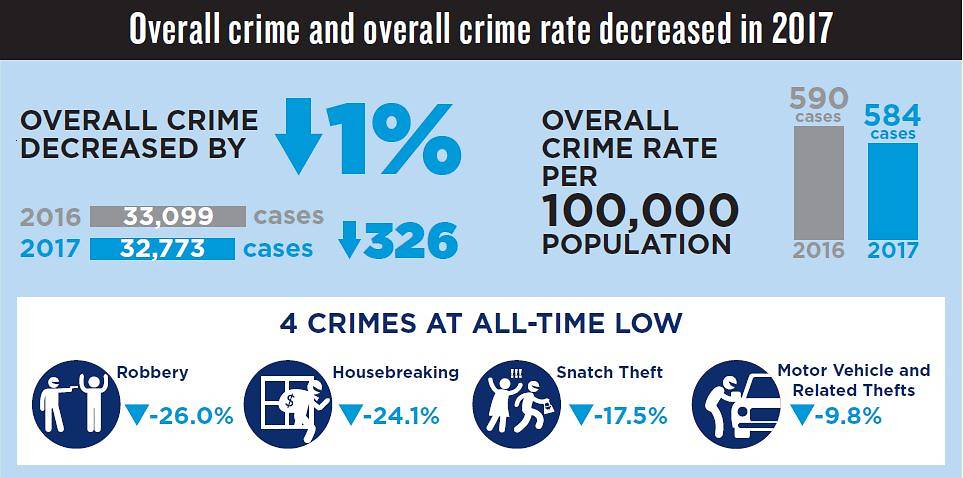
Crime in Singapore fell by 1 per cent last year, from 33,099 cases in 2016 to 32,773 cases in 2017. The overall crime rate also improved, with 584 cases per 100,000 people compared to 590 cases in 2016 – a four-year low.
Graphic: SPF
The improvement was largely due to a decrease in violent and serious property crimes, which declined by 12.4 per cent to 218 cases, and theft and related crimes, which fell 4.4 per cent to 13,495 cases last year. Both types of crime fell to an all-time low in 2017.
There were also more crime-free days in Singapore last year. A total of 167 days were free from snatch thefts, housebreakings and robberies – an increase of 31 days from 2016.
“Singapore continues to be one of the safest countries in the world today,” Deputy Commissioner of Police (Investigations and Intelligence) Tan Chye Hee said. But as crimes become increasingly transnational, Singaporeans “must not take our safety and security for granted”, he added.
FANS of Gillian Chung have warned her fiance, a Taiwanese doctor named Michael Lai, to treat the Hong Kong singer with care and respect after she announced her engagement to him on social media, reported Sin Chew Daily.
Their response followed the announcement by the 37-year-old star and one-half of the Cantopop duo Twins on Instagram, with a photo showing off her diamond engagement ring and the caption: “Next stop, happiness.” She tagged Lai, 32, in the post.
Among the netizens’ comments directed at Lai are: “If you are not serious, do not toy with her feelings, hope both of you are happy together”, “Must not hurt her” and “Do not hurt her, do not make her sad”.
The happy news was also met with well-wishes from fellow artistes such as Joey Yung and Chung’s Twins partner, Charlene Choi, who posted a picture of Chung and her with the words: “Thousands of words deep in our hearts. #loveyouforever”.
However, there were netizens who did not approve of the engagement because of Lai’s past relationship status (Lai was married to a stewardess and blogger named Ivy Chao in 2016; the marriage lasted only six months.)
Chung and Lai went public with their romance last October after dating for three months.
SINGAPORE: Deep in the heart of Chai Chee, Runda Minimart is everything you’d expect of a heartland provision shop.
The storefront at Block 21, Chai Chee Road is packed with shelves of bread, eggs and children’s toys. Then there’s the customary row of colourful gashapon machines.
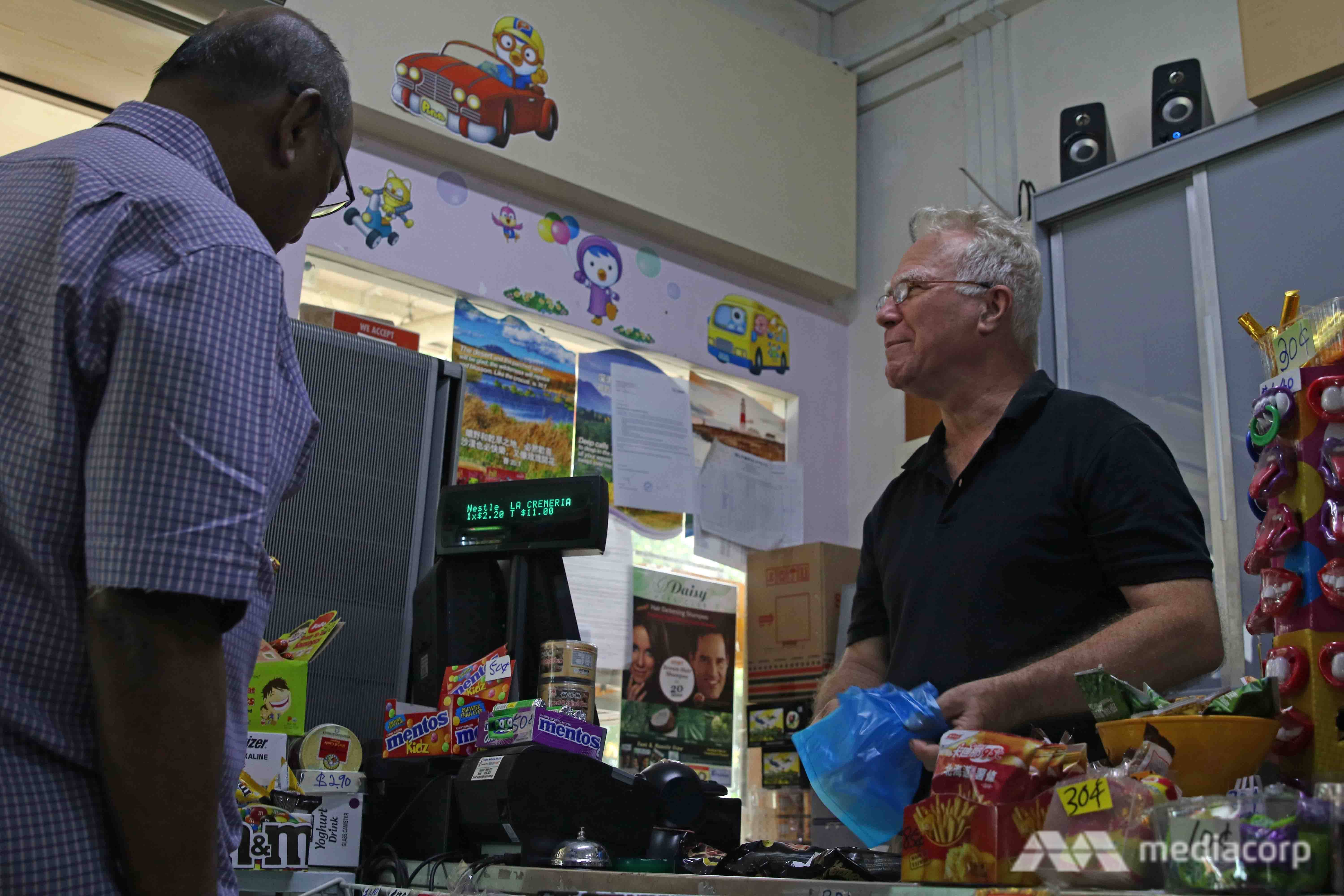
But walk inside and there is an unexpected sight: A silver-haired Caucasian manning the cash register. Australian Peter Brown, 62, has worked as a cashier in the shop since it first opened three years ago.
“Several people come in and go: ‘Ang moh in a shop? In Singapore? It’s not possible!’” he told Channel NewsAsia after completing a shift. “Then they ask if it’s my business. They think all ang mohs are bosses, not workers.”
The Permanent Resident, who has lived in Singapore for 24 years, is not your typical expatriate. He earns S$1,000 a month working four-hour shifts, seven days a week. Home is a rented room in an HDB flat a short walk away.
Peter has been around for so long that he’s become a familiar face in the neighbourhood. Even the fruit seller waves and shouts “ang moh” each time he walks by.
Peter dealing with customers. (Photo: Aqil Haziq Mahmud)
Some customers do not register Peter’s race, and automatically speak to him in Mandarin. He has picked up the language over time, although he is still far from fluent.
So, when he replies to customers, they often look up in shock before asking where he is from. “From China,” he usually says. “I play games with them.”
But Peter’s job is far from being just a game.
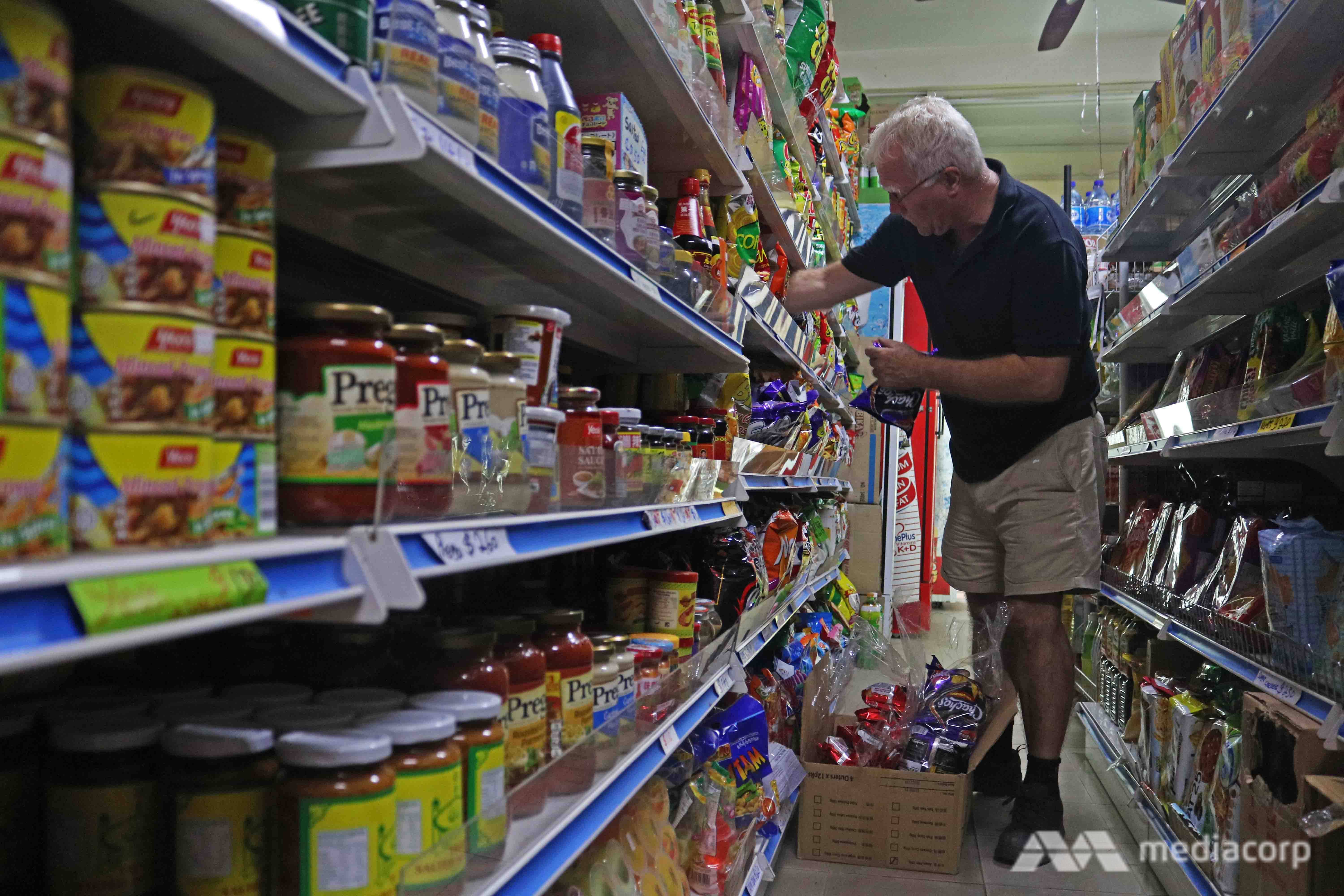
On top of his cashiering duties, he takes stock of sometimes challenging deliveries. “There are hundreds of different items and I’ve got to get them on the shelves or stored away because they block the aisles,” he said.
Peter also ensures the racks and fridges are constantly full. This means moving around a lot and topping up the bestselling Carlsberg cans as soon as they fly off the shelves.
Peter restocking the shelves. (Photo: Aqil Haziq Mahmud)
“Some days are dull, some days are very busy,” he said. “It’s not my idea of a career. I’m doing it because I can’t find anything else.”
THE ARTIST
It’s Friday morning at the shop and business has been slow all week. Then, a man pulls up with a trolley loaded with boxes of chips and cookies. Suddenly it’s not so slow.
Peter leaves his post and pulls the inventory list close to his nose – something doesn’t seem right. A line starts forming at the cashier and a boy impatiently rings the bell on the counter.
This is Peter’s world.
A woman walks past the shop front. (Photo: Aqil Haziq Mahmud)
To understand how this elderly man ended up working in a cramped shop almost 5,000km away from home, you have to go back more than two decades to when he landed his first job in Singapore at an American firm based in Bukit Timah.
Peter, a stained glass artist, had just come off a failed business venture in Australia. He was also hit with a fine after his previous employer ran into some legal problems.
“I needed to find some money urgently,” he said. “This company was offering me a good wage and immediate work, and I jumped at the opportunity.”
In 1993, the then 38-year-old left for Singapore to embark on a six-month contract painting windows for Hard Rock Cafes in the region.
The company had to look as far as Australia because glass painters were a “rare breed”. Furthermore, Peter said, it felt American artists would struggle with the culture shock of living and working in a place like Singapore.
It didn’t take long for Peter to experience the shock for himself.
“Here in Singapore, clients would spend six months debating how much to pay, and as soon as they agree the cost, they want the thing tomorrow,” he said. “My boss was constantly on my back, asking me to work faster and more efficiently.”
Outside of the “punishing schedules” at the office, Peter grappled with the unfamiliar cuisine. He described mee rebus as ingredients “floating around in this dark gravy”, while the smell of shrimp sauce in rojak “made me want to vomit”.
The weather was also too hot, and he did not understand a word of the local slang. “I remember going into the lift at work,” he said. “These girls were talking and I asked my colleague what language they were speaking. English? You’re kidding!”
Over the years, Peter got used to things. He learnt to love rojak and eventually spoke perfect Singlish. As for his job, the American company “kept getting work and they kept needing me”. The six-month contract became 12, then 18.
It wasn’t all good news, though.
The company started losing money and eventually fired him in 1995 after an argument. “I was in a low state of mind because I had lost my job, and I didn’t know whether I would stay here or go back to Australia,” he said.
THE CHURCH-GOER
Back at the shop, Peter usually takes the morning shift, which runs from 8am till noon. He raises the shutters, pushes out the roller shelves and counts the cigarette cartons in the cabinet behind the counter. This is a daily routine.
Cigarettes are one of the shop’s most popular items, Peter said before attending to a customer. He plucked out a pack of Winston Reds and pushed it across the counter.
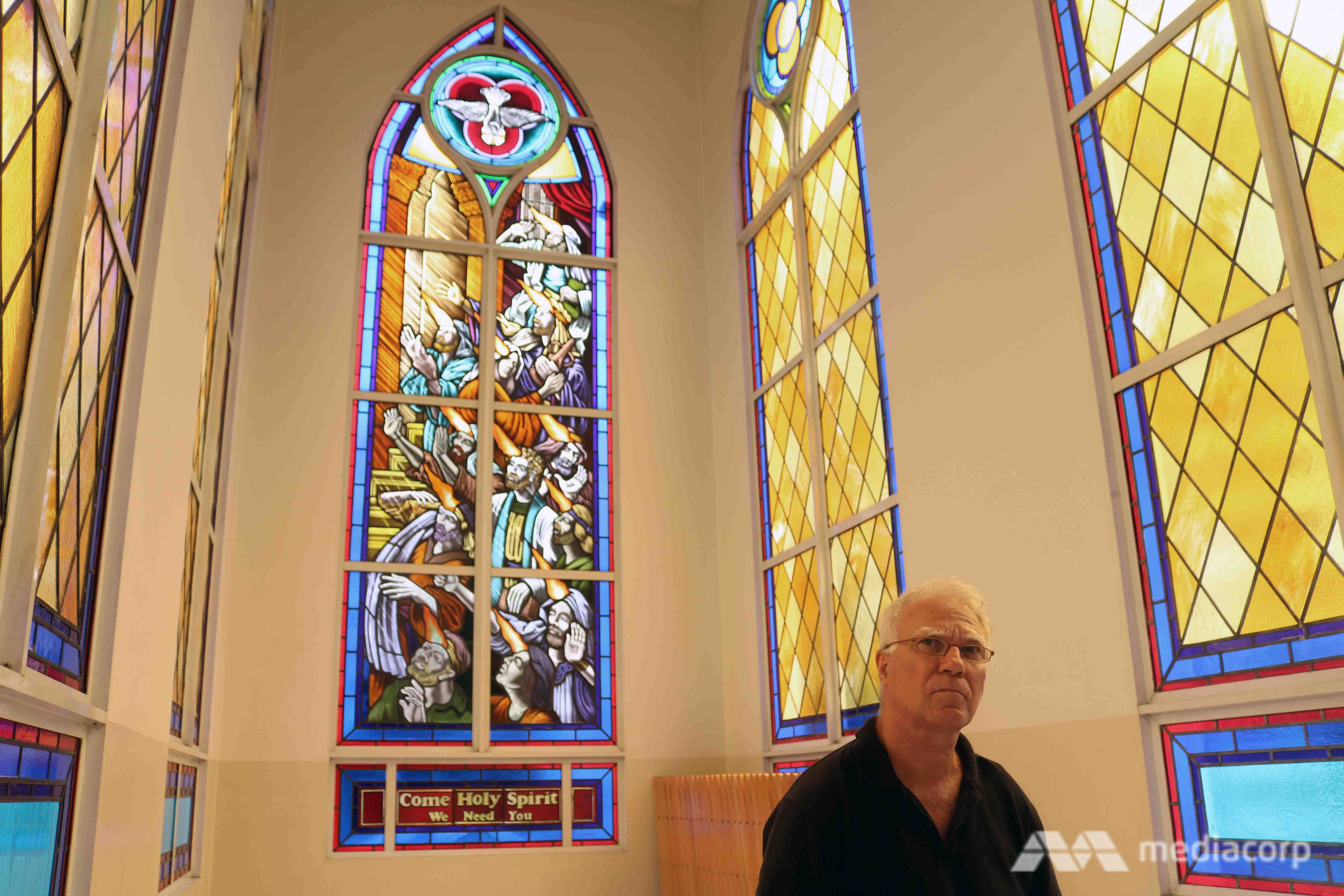
Peter’s final assignment at the American company was to paint some windows for Bethesda Cathedral, a large church in Chai Chee. He completed the painting, but got sacked before it went up.
Peter with one of his pieces in the church. (Photo: Aqil Haziq Mahmud)
Just before Christmas that year, Peter turned up at the church with his camera as he always made it a habit to photograph his work for his portfolio.
“They were having a Christmas barbeque,” he said. “They were curious and didn’t know who I was, and they invited me to a church service.”
Peter identified as Christian at that time, but he wasn’t particularly pious. Even so, he found himself warming to the church’s messages.
He started attending church every week and eventually taught children at the Sunday school there. He also began teaching kids art and craft on Saturday evenings.
Peter explaining some of the finer details of glass painting. (Photo: Aqil Haziq Mahmud)
Peter also found a job at a local stained glass company, where he designed pieces for churches, hotels and condominiums. His proudest work? For a private home in Kuala Lumpur, he painted Da Vinci’s The Last Supper on a 3m by 2m window.
Peter admitted that he has grown comfortable in Singapore. “It was just a job,” he said of his first stint with the American company. “My plan was to come here, earn money and go home.”
More than a year after he left the glass company in 2012, a couple of church members opened the provision shop in Chai Chee and hired him as its cashier.
“I never dreamt that I would stay in Singapore for so long,” he said.
THE NOMAD
During his years here, Peter has lived in more than 10 homes, in locations ranging from Queenstown to Bedok North. He’s had to move around a lot because rental fees are “crazy”. “Everybody is selling their units,” he said.
He hates the constant shifting, but it has meant he has been able to explore different parts of Singapore. Because he loves the beach, he is particularly fond of Sentosa. And after moving to the east, he would regularly cycle along East Coast Park, which he called “one of Singapore’s great little places”.
Despite that, Peter said he’s not a very social person. Besides attending gatherings with church members on Friday evenings, he keeps very much to himself.
Peter checking the cigarettes. (Photo: Aqil Haziq Mahmud)
Still, he makes it a point to see his two brothers and a sister in Australia once a year. He goes to Bathurst, a small town three hours away by car from Sydney, where he grew up on a “beautiful” farm with his parents. His father died last July, his mother four years ago.
He also misses Australia’s seasons, vast spaces and Western food, which he stressed is more than “french fries, coleslaw and baked beans”.
Does he feel lonely in Singapore? “All the time, but you get used to it,” he replied. “Being alone is part of life. You don’t really make friends, but you chit-chat with customers.”
Peter said he’s been through a number of relationships here, but “nothing’s happened”. “I thought that I would like to get married. I thought I’d be a successful artist anywhere I go,” he said. “That’s a bit of a frustration for me.”
At his age, Peter acknowledged that the “book is closing fast, but I don’t know where it leads”.
“I’ve seen so many people here in Singapore in their 70s who are struggling to walk and don’t work,” he added. “In 10 years’ time, am I going to be sick?”
Peter keeps fit by visiting a gym in Chai Chee twice a week. He used to play tennis too, but his age has put the brakes on that. “Thankfully, my father and mother lived to 95 and 93, so maybe there’s good genes in the family,” he said with a laugh.
He’s also earning some extra cash by giving English tuition and working part-time with the same local glass company. This is so he can cover his S$600 a month rent and expenses like his phone bill and annual trip home.
Peter doesn’t want to retire because he can’t afford it. But things might change. With the inheritance from his late parents, he could buy his own house, be it in Singapore or Australia. It’s something he’s never had in his life.
Nevertheless, Peter described himself as the “biggest procrastinator in the world”. “When I get older, I won’t be able to work hard and my income goes down, so where do I spend my old age?” he said. “I avoid making decisions at all costs.”
Peter’s work schedule at the shop. (Photo: Aqil Haziq Mahmud)
He always found himself sticking around in Singapore because “there’s always work here to do”. He has great affection for the church too. “For some strange reason, it’s a good church.”
For Peter, life had not turned out how he thought it would, but he learnt not to “worry about what you think you’re lacking”.
“Life has its way of leading you to places, and it’s not your plan,” he said.
SINGAPORE: Singaporeans do not like to be told that we bombed in a test of any sort.
So it’s no surprise that news on Wednesday (Jan 31) that Singapore is seen as one of the least exciting among 32 cities in Time Out London’s 2018 City Life Index stirred up a storm on social media.
Netizens rushed to defend Singapore’s reputation, with many highlighting how Singapore has become more interesting over the years with events like the Formula 1 Grand Prix.
A few visitors to Singapore also chimed in, saying they’ve enjoyed their trips here.
But the greatest applause for defending the country’s reputation must surely go to the Singapore Tourism Board (STB) which released a video on Facebook.
“There is nothing exciting to do”, the video exclaims against a backdrop of many well-loved attractions, events and activities – including a bungy jump.
Well played STB.
Never mind that no one I know has tried the bungy jump in Singapore. STB’s response showing netizens what Singapore has in store for those with a nose for adventure was a brilliant move in earning scores of eyeballs from all around the world.
Perhaps STB can chalk up the video as a public relations success, with an acquired viewership of what would otherwise require an expensive marketing campaign to promote Singapore as a tourism destination to achieve.
And as it was put out just a day after the Time Out index was reported, one must also commend STB for the speed at which a response was decided upon and issued.
Its video format, which aimed to show netizens how exciting Singapore is as a lifestyle destination with a tongue-in-cheek tone, was also a refreshing break from the usual official practice of issuing rebuttals based on written argument and rational logic.
OWNING OUR 31ST PLACE
Where praises were sung and compliments were generously dished out online following STB’s response, these stood in stark contrast to the majority of comments when the news first broke – comments that seemed to suggest Singapore deserved what it got.
“Agree that Singapore is expensive and boring. I rather spend the money in neighbouring countries to get most of my cash,” said one netizen.
Others lamented our lack of culture and appreciation for the arts, and our dearth of creativity and imagination.
Whatever we say about Singapore, there’s no denying Singaporeans are an interesting bunch who will have something to say about any index the country is placed on, especially if our national pride seems at stake.
Yet it is curious that we should place so much emphasis on such surveys which seem subjective and, in this case, based on the opinions of just 235 people living here. Who are these 235 folks and are they representative of our population?
Global surveys are also never free from respondent bias, so let’s face it – whether Singapore is exciting or not depends on who you ask. What makes for a great city to one might seem tedious to another.
Part of the illuminated circuit is seen during the third practice session of the Singapore F1 Grand Prix at the Marina Bay circuit September 25, 2010. (Photo: REUTERS/Edgar Su)
Where the abundance of new clubbing would arguably be more attractive to a millennial in their twenties, people like myself probably derive more entertainment from sitting at home and watching a favourite television show with the family – over a bowl of fishball noodles from the nearby hawker centre.
So who is to say what the best standards for judging how exciting a city is are?
All this is not to suggest that we deserve a higher position. Indeed the other cities on the list are well-established destinations, known for their live music and bustling night life.
But it might be worth taking a step back and asking ourselves – what’s the value of such rankings?
RANKED FOR WHAT?
Where we have no shortage of information about how Singapore is doing internationally, whether this be the latest World Economic Forum ranking on competitiveness or Bloomberg’s innovation ranking, what is more important is how these should be processed in a meaningful manner.
Where rankings of cities as lifestyle destinations have little relevance to resident populations, it seems worthwhile to understand who their target audience is – to help us contextualise Time Out’s index.
This is where things got a lot more revealing.
Time Out after all is a publication whose client centre says their audiences are primarily 15- to 34-year-olds who have taken 5.2 holidays in the last 12 months, go to a live music concert 4.4 times on average each year, and visit a bar 10 times a month.
In a popularity contest among these global youths, how should Singaporeans feel about coming in 31st of most exciting cities from around the world?
It’s just like being told you were ranked 31st in a beauty contest you didn’t even know you entered.
And even if we were the most exciting city, would we attract the most number of tourists, if that is our intention? Lots of readers would likely shudder at that prospect.
Where it’s been pointed out that Singapore’s tourism strategy targets the Chinese market, what reach does Time Out London have in Beijing and Shanghai and other vast population centres like Chengdu and Tianjin?
A screengrab of the VisitSingapore landing page for visitors from China which plays on the Passion Made Possible tagline by using the exact phrase in Mandarin but inserting a mention of the Lion City.
Even though city rankings like these have more value for specific demographics of tourists than for resident populations, no doubt Singaporeans will continue to follow these with great interest.
Where popular sentiment towards how Singapore fares as a country will remain a nebulous quality that is difficult to quantify, perhaps the value these survey have for us is to simply prompt debate on what we ourselves think, and properly situate just who did the survey and who it’s meant for.
Until then, it might be worth taking these international rankings less seriously, or at least taking them with a pinch of salt.
Unless of course you’re STB. Then it’s a good chance to score some tourism promotion for Singapore at a bargain price.
Lin Suling is executive editor of the Commentary section at Channel NewsAsia Digital News.
SINGAPORE: With Singapore facing its highest security threat in recent years, security spending will be a major item on the Government’s expenditure list and it is expected to increase over the next decade , said Finance Minister Heng Swee Keat on Friday (Feb 2) after a visit to the Home Team Tactical Centre.
He said that it is important that action is taken to keep Singapore safe and secure.
From S$14.8 billion in FY2011, Singapore’s security spending has increased steadily to S$19.5 billion in FY2016, according to data from the Ministry of Finance (MOF). The latter accounted for 4.7 per cent of Singapore’s gross domestic product (GDP).
When asked how much security spending could increase, Mr Heng declined to put a figure to it but noted that it is clearly an “important area to invest resources in”.
To fund these expenditure increases, it will be crucial for the Government to do its long-term projections for expenditure and revenue, which will be revealed on Feb 19 when Budget 2018 is delivered, said Mr Heng.
Finance Minister Heng Swee Keat visits the Home Team Tactical Centre to observe joint counterterrorism capabilities by the Singapore Police Force and Singapore Civil Defence Force. (Photo: Tang See Kit)
HOME TEAM TO BUILD STRONGER CAPABILITIES
The Singapore Police Force (SPF) has enhanced its counterterrorism capabilities to tackle the rising security threat, said Director Operations, Assistant Commissioner How Kwang Hee.
“Over the past two years, the police have deployed specialist teams like the Emergency Response Teams and the in-situ reaction teams to respond swiftly and effectively to terror attacks,” he said.
“The police have also leveraged technology to better support our frontline officers by investing in technological infrastructure to help the Home Team better leverage data analytics, sensors and sense-making capabilities to enhance the effectiveness of ground operations.”
One example is the increased use of analytics in operations such as having police cameras equipped with video analytics capabilities to detect safety and security incidents.
The police have installed more cameras in public areas to provide better sense marking capabilities during an attack, said Mr How.
More than 65,000 police cameras have been installed at 10,000 HDB blocks and multi-storey carparks as of Sep 2017. Another 11,000 cameras will be installed at 2,500 locations islandwide by 2020, covering public areas in town, neighbourhood and hawker centres
The police will continue to dedicate more resources into developing its counterterrorism capabilities by enhancing training and equipment of frontline officers, as well as integrating the operations of Singapore’s security agencies.
Ground response forces, emergency response teams, rapid development troop and SCDF demonstrate a concerted tiered response capability to a public security threat. (Photo: Tang See Kit)
Mr Heng observed several counterterrorism demonstrations by the SPF and the Singapore Civil Defence Force. (Photo: Tang See Kit)
As part of his visit on Friday, Mr Heng observed several counterterrorism demonstrations by the SPF and the Singapore Civil Defence Force (SCDF).
This included a demonstration by the Special Tactics and Rescue (STAR) Unit which stormed a room to apprehend “terrorists”. The ground response forces, emergency response teams, rapid development troop and SCDF also demonstrated a concerted tiered response capability to a public security threat.
A 39-year-old nightclub owner gambled overnight with his employees at a dormitory, only to collapse while foaming at the mouth the day after.
He died in a hospital after several hours of failed resuscitation.
The victim is Mr Cai Jianzhong, who was the owner of Violet Vault (Club ViVa) at St James Power Station.
Mr Cai’s sister, Ms Cai Jiongjuan, 35, told Lianhe Wanbao that her brother had followed his workers back to their dormitory on early Sunday morning (Jan 28) to gamble, after closing the club.
When Mr Cai’s wife called him the following afternoon to ask him when he would return, he told her that he was already driving home.
However, he did not return home even after an hour.
Mr Cai’s wife called him several times, but he did not pick up the calls.
Ms Cai Jiongjuan said that after that her sister-in-law received a call from the nightclub manager at about 3pm, saying that her brother had been complaining about chest pains before he started foaming at the mouth.
According to the manager, Mr Cai collapsed and was then rushed to a hospital for treatment.
Said Ms Cai Jiongjuan
“My sister-in-law immediately informed my parents and we all rushed to the hospital. My brother was in the intensive care unit (ICU).
“At that point, everyone was quite relieved. We thought that his condition had stabilised, and the worst was over.
“We did not expect him to just pass away like that at about 6pm.”
Ms Cai Jiongjuan revealed that her brother has always been in the pink of health, and would do full-body checkups every two years.
Other than that, he also exercised frequently and controlled his diet well.
His passing came as a shock to everyone.
She added:
“I think this probably has something to do with his irregular sleeping patterns. His business revolves around the nightclub so he has to work through the night every day.”
Ms Cai Jiongjuan said that her brother started the club from scratch.
Prior to opening the club, he earned a sum of money from working in the automobile line, before opening up a dessert shop.
It was only 10 years ago that he started the club.
Said the heartbroken sister:
“Last time, my brother used to tell us that he wanted to be successful, so he gave himself so much stress all these years. He really worked hard.”
Violet Vault also uploaded a post on their Facebook page on Monday (Jan 30) at about 5am, saying that the club would be closed on Wednesday (Jan 31) for a private event, with business set to resume on Thursday (Jan 31).
SINGAPORE: Issues surrounding the flash floods in Singapore last month, the errant parking of shared bicycles and a money-for-love dating platform will be on the agenda when Parliament sits on Monday (Feb 5).
Several parts of eastern Singapore were hit by flash floods on Jan 8 following intense rain, with dramatic photos and videos showing partially submerged cars and pedestrians wading in knee-deep water.
According to the Parliament order paper released on Friday, five questions on flooding have been tabled.
Workers’ Party Non-Constituency Member of Parliament (NCMP) Dennis Tan Lip Fong has asked what caused the heavy flooding on Jan 8, what has been done to help those affected and what measures will be taken to prevent similar incidents.
People’s Action Party Member of Parliament (MP) Henry Kwek has asked whether flood prevention systems will prevent a recurrence of the Jan 8 floods after the completion of drainage upgrades next year.
MP Cheryl Chan Wei Ling has asked about whether works at Bedok Canal affected the Jan 8 flood at Bedok North Avenue 4. Four of the flash flood locations that day had led to Bedok Canal and are subject to tidal influence.
MP Cheng Li Hui has asked how motorists are notified of flash floods while MP Murali Pillai has queried how PUB ensures drains and canals are kept free of debris to alleviate flooding.
PUB said last month that floods at Tampines Avenue 12 on Jan 8 were aggravated by an obstructed ditch near a construction site.
Other issues on Parliament’s agenda include the errant parking of bicycles. Last month 62 bikes from three bike-sharing companies were impounded for obstructing foot paths during an enforcement operation by the Land Transport Authority.
Minister for Transport Khaw Boon Wan has been asked what can be done to address the indiscriminate parking of such bicycles and what more can be done to make bike-sharing operators clear such bikes, as well as whether there are plans to require these companies to invest in bike-docking stations.
Other issues on the agenda include questions over money-for-love online dating platform TheSugarBook, which seeks to pair wealthy individuals with “sugar babies”.
Minister for Social and Family Development Desmond Lee has been asked what his ministry’s position is on the platform and whether it will be taking steps to address the “possible harm and exploitation” that its targets could be subjected to.
He has also been asked whether such platforms are legal in Singapore and what measures are in place to protect the vulnerable.
Elsewhere, MP Desmond Choo has asked about issues over the recent theft of fuel from Shell’s Pulau Bukom refinery and whether petrochemical companies’ security needs to be tightened.
NCMP Dennis Tan has asked whether the Corrupt Practices Investigation Bureau will conduct a “thorough investigation” into the business affairs of Keppel Offshore and Marine following its corruption scandal.
MPs have also posed questions on the number of road traffic accidents overseas involving Singaporeans, recent popping and cracking of floor tiles in HDB flats and cryptocurrency trading.
Several Bills will be up for debate, including the Cybersecurity Bill which is designed to empower the Cyber Security Agency of Singapore to manage and respond to cybersecurity threats.
A handful of Korean Instagram users have gained popularity for their inspiring content. The following are three Instagram influencers with distinctive personalities garnering global followers on the photo-sharing platform.
Gliding on the pavement, hair flipping in the wind and arms weaving through the air freely, Ko Hyo-joo grabbed attention on social media in 2016 through her longboarding videos.
The 29-year-old former user interface designer quit her job last year and became a full-time social media figure, creating content that amasses thousands of “likes” and followers.
Ko had begun longboarding, which involves riding a skateboard that measures 72-115 centimeters, simply as a hobby. Her style, which consists of stepping rhythmically and swaying the body, is called “dancing” in longboard. With her skills, Ko has starred in some 15 advertisements and in music videos for global pop artists, including the US hip hop group Far East Movement.
Photo: Instagram/hyo_joo
These days, Ko travels the globe gliding through the streets of cities like Paris and Los Angeles. Followers say they are drawn to the sense of sheer freedom and possibility her videos emit.
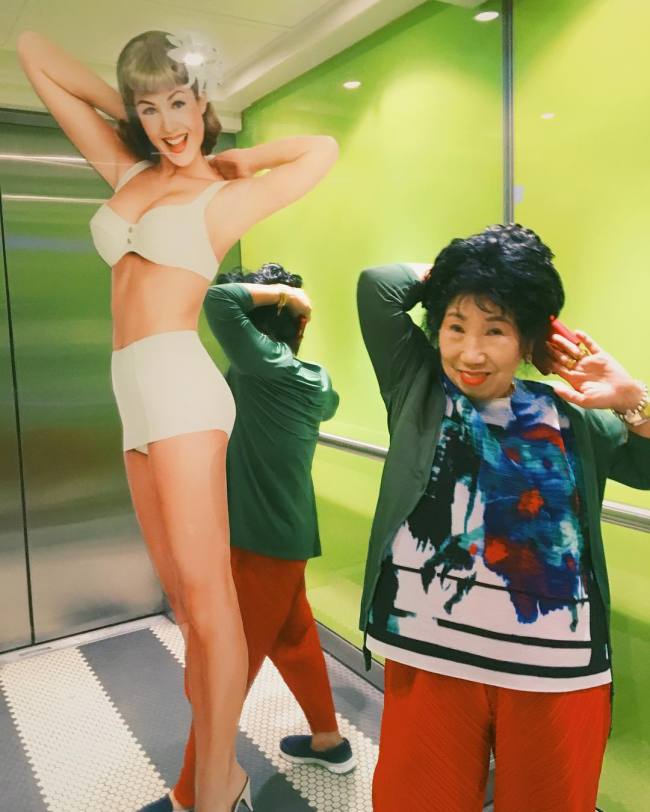
Park Mak-rae, born in 1947, seems to have endless energy. The 71-year-old shares candid opinions and colorful outfits on Instagram, taking on challenges like starring in a lingerie fashion show.
Her granddaughter first began filming Park as a way to fight off potential dementia, according to reports. Park now engages in the trendiest of social media activities, filming mukbang, or eating shows, documenting her travels, sharing recipes and performing beauty routines.
Photo: Instagram/korea_grandma
Park has been described as a “YouTube sensation” and “viral superstar” by global fashion media. “I like clothes that are bright and show off a sense of passion in the person wearing them,” Makrae said in an interview last year. “I think my style has gotten better with age.”
A different type of foodie fad has swept Korea’s Instagram. People are moving past sharing photos of expertly-decorated restaurant dishes and instead displaying humble home-cooked meals they’ve made themselves. The hashtag “jipbap,” literally translated to “home food,” has been trending on Instagram lately.
Park Ji-yeon is a home-food Instagrammer who reminisces on the warmth of her childhood with each post, she said in an interview last month. Her feed is rife with wooden furniture and vintage knickknacks, alongside home-cooked egg sandwiches, kimchi-fried rice, curry, omelets and more.
Photo: Instagram/doolygrams
Her collection of vintage teapots and kitchen utensils offer comforting visuals. They’re not made of gold or diamonds, according to Park, but contain the valuable memories of past owners.