SINGAPORE: From an old skate park to a multipurpose building with a range of facilities bringing different services together under one roof, Heartbeat@Bedok aims to serve as a lifestyle hub for residents of all ages.
The seven storey building, with a land area that makes up the size of about three football fields, was officially open on Sunday (Feb 4) by Prime Minister Lee Hsien Loong.
Heartbeat@Bedok houses multiple agencies managing different facilities, such as the sports centre, the Bedok public library, Kampong Chai Chee Community Club, Bedok Polyclinic and a Senior Care Centre that has yet to open.
There are also more than 30 retailers including F&B outlets, sports specialty shops and childcare and education centres. The amenities have been opening in phases from July 2017.
Rain or shine, sport enthusiasts will not have to worry about working out, with four swimming pools featuring aqua related programmes, as well as eight indoor badminton courts and six sheltered tennis courts on the rooftop.
Heartbeat@Bedok was officially open on Sunday (Feb 4) by Prime Minister Lee Hsien Loong. (Photo: Rachelle Lee)
The concept of Heartbeat@Bedok is almost similar to Our Tampines Hub, and Grassroots advisor Lee Yi Shyan said: “When we started to brainstorm on this idea, we never knew the Our Tampines Hub was in parallel, being developed. It was a pure coincidence. It was only much later that we realised”.
Mr Lee added that it’s a more efficient use of land now that all the public facilities are congregated together in one place.
“In the past, we had all the amenities in a distributed fashion. The community centre was at one place, the library and polyclinic at another place.
“When we had a chance to rebuild, we thought it might be a good idea to bring everyone under one roof so that residents can access all these service within short distances. In terms of the freed up land, it’s important to provide new housing options for young families to inject a younger population into this otherwise rather matured and also older demographics”.
With the amenities brought together, Mr Lee also said that this allows the agencies to do more than just providing services for the residents, but also come together to organise integrated programmes. He said it is a requirement that all the agencies have a minimum of 40 per cent of their services to be co-delivered at Heartbeat.
The polyclinic, for example, has been working with People’s Association to refer its patients for healthy cooking classes, and it also collaborated with ActiveSG to send some patients for a gym orientation.
“We want to create a healthy ecosystem for our patients beyond the borders of our clinic. These referrals are mainly aimed at patients with chronic and lifestyle diseases so they can learn to pick up healthier habits and be less sedentary. We look forward to scaling up such tie-ups with the other agencies here so that patients that come to us are also healthier and it becomes a win win situation,” said Dr Juliana Bahadin, Clinic Director, Bedok Polyclinic.
To ensure the Heartbeat meets the needs of residents, a series of consultation were launched with some 11,000 people to get ideas and feedback on the type of programmes they would like.
According to Mr Lee, about 14 to 18 per cent of residents in Bedok are aged 65 and above. Hence, many of the activities at Heartbeat are related to social and physical wellness.
SINGAPORE: Like any other Star Wars fan, six-year-old Lucas Chua gasped in surprise when he met his on-screen idols for the first time, as Stormtroopers and Darth Vader entered the theatre in person to greet him as part of his advanced birthday party.
“Wow look at those Stormtroopers!,” exclaimed the young Star Wars fan, whose 7th birthday falls next week. “But make sure Darth Vader is not invited to the party later!”
Six-year-old Lucas Chua (centre) taking aim with a laser blaster prop at Lucasfilm Singapore’s in-house theatre. (Photo: Make-A-Wish Singapore)
Underneath Lucas’ cheery and hyperactive exterior, though, is a boy living in pain and requiring constant medication – he is a cancer patient with Acute Myeloid Leukemia.
According to his parents Steven and Angela Chua, Lucas’ daily routine after his life-threatening diagnosis in June 2017 involves a daily regimen of medication throughout the day, of which some would come with painful side-effects.
Said Mrs Chua: “Sometimes medication does bring pain to him and it gives him headaches and body aches, which would require us to massage him afterwards. So we have to keep that up with a few weeks of medication and after that he’ll get well.
“There are times when his medication would affect his sight, though, because the pills somehow create pressure in his brain and affect his optic nerves,” she added. “Thankfully those pills are for a two-week cycle only.”
For Lucas’ parents, they vividly remember the day that their youngest son was diagnosed with leukaemia.
“He had a big haematoma that formed on his thigh, which wasn’t normal. He was apparently already internally bleeding and for his kind of leukaemia it’s aggressive,” said Mrs Chua. “Doctors said usually, for people who come in (with his condition), they will usually suffer from bleeding in the brain. Back then his (swelling) was already moving up … his blood count was very low and it didn’t improve for three days.
She added: “Lucas started his treatments last year in June … and so he stayed in hospital to go for aggressive chemotherapy for the following three months. Even so, he still has to continue with chemo for the next two years.
“He is currently in a good place and we hope he’ll attain a good level of remission after the treatments.”
It was through Star Wars and its toy figurines that Lucas was able to keep his mind off his chemotherapy treatment late last year, according to his father Mr Chua. “When he was in the hospital – just to keep his spirits up and to keep his mind off his condition – I asked him what toy he would like to make him happy. He then said that he likes Star Wars Lego figurines, in particular Jedi figurines and so I looked around and got them all for him and he was so happy,” he said.
One of the activities lined up for Lucas Chua by Make-A-Wish Foundation Singapore was a theatre screening of a Star Wars Lego episode. (Photo: Christy Yip)
“So we played together, and created a lot of stories with those figurines and he was so happy. He kept it with him every day and helped to keep his mind off his condition.”
WISH COME TRUE
In order to lift his spirits, the Make-A-Wish Foundation Singapore approached the Chua family towards the end of 2017, to organise a Star Wars-themed birthday party for the six-year-old at Lucasfilm Singapore’s Sandcrawler building on Saturday (Feb 3).
Together with car company Autobahn Motors and local football academy FCBescola Singapore – a soccer school with links to Lucas’ favourite football club FC Barcelona – the Make-A-Wish Foundation, which has since granted the wishes of over 1,340 children since 2002 in Singapore, put together a day to remember for the young leukaemia patient.
Beginning with a morning Ferrari ride with his two elder brothers Christian and Elliot, Lucas’ day got even better as he was all smiles and energy during his Star Wars party which was attended by about 60 friends and family members.
Lucas Chua (top right) enjoying a ride in a Ferrari at the back seat with his brothers Elliot (top left) and Christian (bottom right). (Photo: Noor Farhan)
The cherry on top was when a squad of Star Wars cosplayers entered the in-house theatre at Lucasfilm Singapore, right after a screening of an episode of the Star Wars Lego animated series for his friends and family.
“He is a very energetic kid, especially when he sees his friends, the anticipation of the Make-a-wish (party) and leading up to it and the actual wish brought out a lot of joy and excitement in him and today was really a climax,” said Mrs Chua, on the sidelines of Lucas’ advanced birthday party at Sandcrawler building.
Star Wars characters at Lucasfilm Singapore. (Photo: Make-A-Wish Singapore)
“Being able to use his imagination, to conceive what he wanted for his wish and what would happen on the day itself, as well as thinking about who would be attending … all this helped to release his focus on the medication and made his day-to-day living more exciting,” explained Mrs Chua.
Acknowledging how fun and laughter plays a part in helping children deal with illness, Lucas’ father Mr Chua was grateful for the Foundation’s efforts in making his child happy.
Lucas Chua (centre), together with his elder siblings Christian (left) and Elliot (right). (Photo: Christy Yip)
“The good thing about children is that they get over the pain easily because they can be distracted,” he said. “His brothers are there to play with him, and when his mind is thinking of play, he doesn’t think about his illness and pain.
“It was really a great experience for Lucas … especially after what he’s gone through for the past few months. We’re definitely happy with what Make-a-wish has done, as it’s a wonderful programme and from the look on his face, Lucas was very happy with how today went.”
SINGAPORE: In a crowd, Dr Lee Bee Wah would easily go unnoticed. She is nondescript. On most days, she dons a polo shirt and pants.
While she looks ordinary and non intimidating, it very quickly dawns on those who speak with her that the opposite it somewhat true, especially if you’re a civil servant unwilling to address her requests for her residents.
The brash, straight-talking Member of Parliament for Nee Soon GRC has made headlines numerous times since she joined politics in 2006.
She is known for tenaciously fighting for her constituents’ needs, from lifts at overhead bridges to ensuring that every Build-to-Order HDB development has a childcare centre.
She has also advocated controversial policies such as rewarding people who catch litterbugs red-handed.
When government agencies deny her requests, she pursues them doggedly to find out why. As they list the obstacles, she counters them with solutions.
Her engineering background often comes in handy.
For instance, when the PUB told her that a lift could not be built at an overhead bridge at Khatib MRT station because of water pipes and cables beneath, she suggested designing around them using her expertise as a civil engineer.
Today, lifts at overhead bridges outside MRT stations have become almost a norm across Singapore to assist the elderly, disabled and pregnant women.
She is particularly proud of this achievement and brings it up at practically every interview about her political career, including this one.
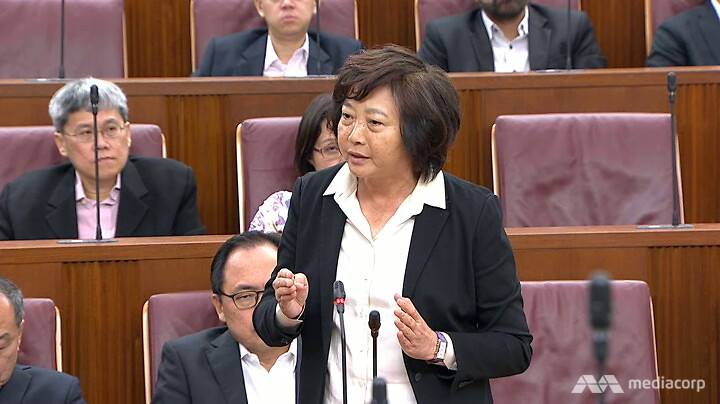
MP Lee Bee Wah in Parliament.
To understand where her grit and determination comes from, one needs to go much further back into her past.
MEMORIES OF PORRIDGE AND CHILLI
It is widely known that Dr Lee was born in Malacca into a family of rubber tappers. She was the eldest of eight siblings. Her days started as early as 4am. With her siblings, she would venture through the plantation and tap rubber, her family’s main source of income.
“Only after that, we would go to school. After school, we would come home, and go to (the) kitchen to look for porridge. If there was porridge, then we’d go and look for soya sauce or chili,” she says.
“That’s why until today, I love just porridge and chilli.”
There were times, when the family would have to wait till evening for their only meal of the day.
Much has also been said over the years about how even when her parents asked her to quit school to work to support the family, she defied them with support from a teacher who helped her get scholarships from clan associations to finance her education. She worked part-time to help support the family and took on various jobs including selling stationery and goreng pisang to factory workers.
“I also wanted to make sure that every one of my siblings got the opportunity to go to school and that is why when I was in university, I would give tuition to make money. When I started working, in the day time I was a civil engineer but at night, I was a tutor. I gave tuition from Monday to Sunday so that I could send money home.”
MORE GROUND-UP INITIATIVES FOR INTER-RACIAL MINGLING
Dr Lee’s childhood came to the fore again recently when she shared in Parliament, her recollection of how rumours helped fan racial tension in Malaysia and Singapore in 1969.
At the time, her third brother was just born and her mother had told her that should they come under imminent threat, they must all escape to the jungle, but must leave the baby behind because his cries would expose their whereabouts.
She is grateful that day never came.
“We were very fearful. We moved from one relative’s house to another just to avoid being attacked.
“But there was one home near ours that was attacked. The whole family perished except the father who managed to run out of the house.”
As a result, she is even more appreciative of “the racial harmony that the Singapore Government has been advocating all these years”.
But while Singapore is doing “relatively well compared to other countries”, she feels more can be done.
“I also get feedback that in some schools, the Malay kids play soccer on their own and the Chinese kids play basketball on their own. Though they study in the same class, they don’t play together.”
While she says inter-racial mingling can’t be forced, more needs to be done to encourage people to mingle willingly.
“The best way is to make them understand, show them historical footage of the riots. There need to be more ground-up initiatives to encourage this. Ground-up initiatives will get more buy-in.”
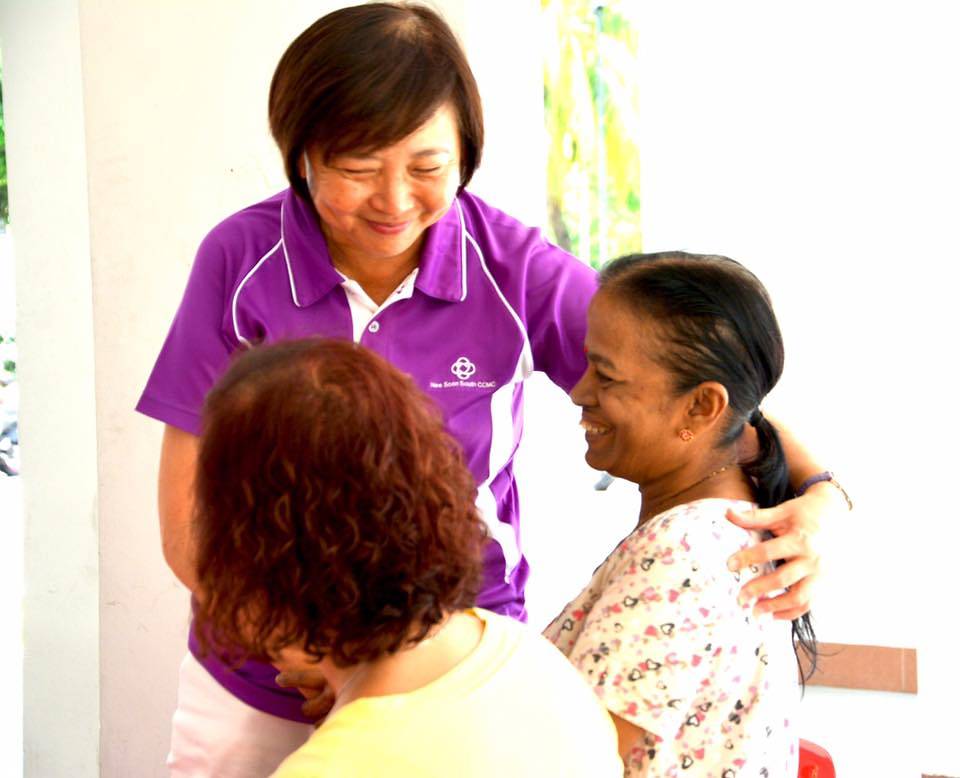
Lee Bee Wah with residents of Nee Soon South. (Photo: Facebook / Lee Bee Wah)
AN ENGINEER’S VIEW ON OUTSOURCING – NOT EVERYTHING IS ABOUT MONEY
Her choice of engineering as a career was deliberate.
Her A-level maths teacher encouraged her to enter the field because “engineers can make a difference to society”.
Luckily, she had the instinct for it from very young.
“I used to help my brothers repair bicycles. Sometimes we had to repair the roads because the road from the village to school would have a lot of potholes after heavy rain. We even built our own portable toilet. At that time my thinking was, if I’m an engineer, I can build all these infrastructure, change the lives of people.”
She laments the dearth of engineers in Singapore today.
“During our nation-building years, many of our civil servants, even ministers, were engineers by training. But as the country developed, people started to study business and other professions like law, medicine, and they made more money.”
But another major issue she suggests is that the civil service started outsourcing work that required engineering expertise.
“They want to do things in a more cost-effective way, so they don’t have in-house engineers anymore.”
Even though she has her own engineering firm, she believes in-house expertise is key.
This naturally takes us to a discussion of our transport system.
“It’s cheaper to outsource, but not everything can be measured by dollars and cents. In such areas, we need our own engineers. When you don’t have the in-house expertise, you will just take whatever the outside consultants or contractors give you.”
She notes recent attempts to beef up in-house engineering talent and to offer better remuneration to attract more to the profession.
Nevertheless, I ask if she feels trust in the government has been eroded by problems in the rail transport system.
“We should not sweep things aside and say this is not a problem. If it is a problem, we acknowledge that it is a problem and then look at the possible solutions. I think overall, the PAP Government has been doing that. Minister Khaw Boon Wan is putting in more effort now and SMRT Chairman Seah Moon Ming is focusing more on this.”
Many people might say all this should have been done much earlier.
“The problems nowadays are much more complicated. We know that if we had put much more effort into the maintenance regime, we may not have ended up like this. What’s important now is that we must put in effort.”
Even though she tempers her criticism with such statements, some in the Government have not been able to take her straight-talking ways.
DON’T MINISTERS WANT HONEST FEEDBACK?
“During my first term as MP, I know that some ministers complained to the Prime Minister about me. But I told PM that this is the feedback on the ground. Don’t you want honest feedback? Don’t your ministers want honest feedback?
“I think PM understands I’m just doing my work. I’m not there for a promotion. Whether you like me or not, is secondary. If you cannot take such feedback, too bad. If you want me, I will do my very best. I will give you 101 per cent. If you don’t want me, I will just walk away,” she says decisively.
Lee Bee Wah prides herself on being able to connect with residents. (Photo: Facebook / Lee Bee Wah)
Among civil servants, she has quite a reputation too.
“They told me that those who are the ‘can work’ types, love to work with me because I can make decisions very fast. Those who are the ‘cannot work’ type are very scared of me.
“I even have friends who tell me, ‘Bee Wah, when you step down, then you will know, this civil servant will get back at you’. So be it. If I’m afraid then there’s nothing much that I can do, right? So if you really want to serve, don’t be worried.”
Does she ever tire of coming up against road blocks with the ‘cannot work’ types?
“No. I take it as a challenge and whenever I manage to solve some of these road blocks I feel that it is an achievement.”
DON’T GIVE “CUT AND PASTE” ANSWERS TO RESIDENTS
“Civil servants should come down to the ground more often and understand the problems that we’re discussing. Some do. Some still don’t. They shouldn’t just give “cut and paste” answers to residents.”
She points out that often, the policies are sound on paper, but problems arise at the implementation stage.
For instance, she feels the Government’s move towards a car-lite nation is premature.
“We encourage cycling. But are we ready? Obviously not. We’re seeing some accidents on pavements, void decks and roads. We can’t share. I went to Copenhagen and I saw their cycling paths. People cycle all in one direction. In fact, they cycle quite fast. But they have a zebra crossing across the cycling path and they have stop signs and the cyclists really go according to rules.
“We are not there yet. The infrastructure is not ready. The mindsets of the people are also not ready.”
Considering her overt frustrations at certain ministries, I wonder if she ever considered joining an opposition party instead of the PAP.
“No, I did not. My family and I have always admired Mr Lee Kuan Yew and the clean system he built. When I joined as a grassroots and branch volunteer, I saw that PAP members and MPs are serving selflessly. They are an important part of the system that has served Singapore so well. The PAP sets a culture that ensures our leadership has the right intentions, even if I disagree with them on specific issues and implementation.”
“I think it’s better to be a backbencher. I feel as a backbencher, I have more time to walk the ground and wholeheartedly pursue my residents’ interests,” says Lee Bee Wah. (Photo: Facebook / Lee Bee Wah)
NEVER HAD AMBITIONS TO MOVE BEYOND THE BACKBENCH
She was approached by the PAP in 2003, shortly after having surgery for early-stage colon cancer. After part of her colon was removed, she was declared cancer-free.
She sees her political career as a her second chance in life.
Some of her supporters have often wondered if she would do even better as political office holder. However, she’s never had such ambitions.
“I think it’s better to be a backbencher. I feel as a backbencher, I have more time to walk the ground and wholeheartedly pursue my residents’ interests.”
HIGH EXPECTATIONS
While she leads a more comfortable life today, she’s been known to be frugal, hardly spending money on clothes and hardly ever sleeping in air-conditioning at home.
“I believe in spending within our means,” she says.
But she’s clear about never wanting to return to a life of poverty.
“Not too long ago, my daughter asked me, ‘Mummy, if we can turn back the clock, would you like to go back to your childhood days?’ My answer straightaway was no, no, no.
“Life was too tough. We had to work a lot from morning until evening. Our home was on top of a hill and there was no piped water, so we needed to carry water up the hill every day.”
While she doesn’t want to go back to those days, she admits that those experiences moulded her character.
“I was the eldest in the family, so I just took it naturally as part of my duty. Whenever I come across any obstacles now, I will take it as a challenge and look for solutions. So it also caused me not to give up easily.”
Considering the hardships she went through in her childhood, I wonder if she thinks people who insist on lifts at overhead bridges and so on are spoilt.
“Different generations have different expectations. It also shows that we have progressed. People’s education levels are higher. They read more widely, so naturally their expectations are higher.”
She does consider some complaints unreasonable though.
“For example, when residents complain about having to wait three minutes for a bus at the bus stop.”
Her next project is to push the government to bring the Home Improvement Programme to flats in her constituency that are technically ineligible.
“The programme was announced in 2007. At that time, they said that flats built in 1986 or earlier will get it. In Nee Soon South, half the flats are built in 1987. Just a one-year difference. These flats are now 30 years old. We need to give them the Home Improvement Programme because a lot of things are starting to fall apart.”
While some Singaporeans may things for granted, Dr Lee doesn’t seem to.
When she was 20 and still in Malaysia, her father’s application for low-cost housing failed because he refused to pay a bribe. Disillusioned with the system, he gave her RM20 and encouraged her to go to Singapore.
“Many of us in the village really admired Mr Lee Kuan Yew. So my father said, ‘You should go to Singapore because it has a very good leader and it is a meritocratic country.’
Lee Bee Wah is in charge of the Nee Soon South ward. (Photo: Facebook / Lee Bee Wah)
TAKING MATTERS INTO HER OWN HANDS
While a great admirer of the Singapore system, she clearly acknowledges it’s not perfect.
She understands that resistance to her proposals is sometimes tied to budgetary constraints or a failure to see her requests on behalf of her residents as a priority at that point.
At times, she takes matters into her own hands.
For example, to curb her residents’ exposure to secondhand smoke, she worked with the National Environment Agency on a pilot programme to set up enclosed designated smoking points in Nee Soon South. When she saw the benefits of this and decided to expand it, she couldn’t get the government agencies on board, so she tapped her contacts within the neighbourhood and her business contacts. In 2017, she managed to raise S$500,000 to build 50 more smoking points.
She has also initiated fund-raising activities to finance the educational needs of needy kids in the neighbourhood.
“The Government actually has given out a lot of educational bursaries and scholarships but there are some that fall through the cracks. In some cases, it’s temporary. Maybe a family member falls ill, stops work for a while or it’s just that during that month, they have extra expenses.”
“WE SHOULDN’T RUN TO THE GOVERNMENT ALL THE TIME”
But why can’t the government do more to help in such cases too?
“I think as a society, if those who can afford it can come forward to help their fellow neighbours, it will be even more meaningful. We shouldn’t run to the government all the time.”
How would she address some Singaporeans’ comments that the Government is wealthy enough to support even more social spending?
“I think if you were to look at the Budget for the last few years, the expenses of the various ministries have gone up quite a fair bit. Every ministry has its own priorities, its own budget to work with. Of course if we can get the money from the Government to help, that’ll be good, but if the government cannot help, that doesn’t mean that’s the end. We can also help our own neighbours, our own residents.”
While she has often asked for more to be spent on certain initiatives, she is also concerned about sustainable social spending.
“In the end, the budget must be balanced. If we want to continue with giving out more subsidies, then the government’s income will have to increase as well.”
MAKING A MARK IN THE SPORTING WORLD
Aside from politics, Dr Lee has also made a mark in the sporting world as President of the Singapore Table Tennis Association from 2008 to 2014. Under her charge, Singapore’s table tennis players won regional and international awards, including medals in the 2008 Beijing Summer Olympics and in the 2012 London Olympics.
These wins by China-born athletes also raised controversy over the Foreign Sports Talent Scheme.
She is quick to point out that the scheme was not started by her.
“In fact, when I came on board, we put much more effort into pathways for local talent.”
The STTA began collaborating with the Singapore Sports School to start the “school within school” to support local student-athletes.
“We also worked with community centres to make table tennis popular.
“Perhaps there were some merits of foreign talents because they are of higher standard and we also learnt their training system. But after 20 years, it is time to review because we already know how they train, we already know the system. If we still rely on them to get medals, I don’t think it’s the right thing to do.”
She has also advocated more flexibility in approving National Service deferments for male athletes to allow them to concentrate on their sport, saying that even those who have not reached the top rankings should be allowed deferments if they have the potential of getting there.
However, her Facebook post in 2016, seemingly taking credit for Olympic gold medal-winning swimmer, Joseph Schooling’s NS deferment garnered a lot of flak.
“Maybe I was just very happy and posted very fast. But it is a fact that I have spoken in parliament several times about him too.”
But does she admit that it was his parents who did most of the legwork?
“Of course. I know they’ve put in a lot of effort. I never said that I did it for them. It is just that when the parents discussed their problems with me, I brought it up in parliament.”
But even while advocating for local athletes, she tried to integrate foreign-born athletes into the Singapore system. At one point, she attempted to have them take English lessons. But their busy travel schedule prevented the athletes from complying.
“Do you want an MP who speaks very good English or do you want an MP who really dares to fight for you?” says Lee Bee Wah. (Photo: Facebook / Lee Bee Wah)
“A LOT OF PEOPLE THINK MY ENGLISH IS QUITE ODD”
“The lessons were not very regular and language is something that you need to practise. For example, a lot of people think that my English is quite odd. I don’t speak English fluently like a lot of Singaporeans. It is because I studied in a primary school that was Chinese-based. We only started English lessons in Primary Three. It was only when I came to Singapore and studied in the university that I picked up English. That is why in most of my speeches, the words I use are very simple.”
She’s not insecure about this, even though some judge her for it.
“Language is for communication. So long as when I speak, you understand what I’m trying to tell you, I think it serves a purpose. Do you want an MP who speaks very good English or do you want an MP who really dares to fight for you?
“If residents can think about me and say that they’ve never had such an action-driven MP, that’s good enough for me. I want them to think of me as having made a difference in their lives, in their living environment.”
Dr Lee might have left her life of poverty behind, but what poverty taught her clearly endures – focus only on the solutions. Everything else is just white noise.
SINGAPORE: There was a collective gasp across newsrooms and marketing departments when Facebook decided to change its algorithm to focus less on news and brands, and more on friends and family.
On Jan 11, Mark Zuckerberg posted on Facebook that one of the social media giant’s “big focus areas for 2018 is making sure the time we all spend on Facebook is time well spent”.
Facebook’s goal will no longer be helping users “find relevant content”, but helping them “have more meaningful social interaction”. Posts from businesses, brands and media are “crowding out the personal moments” for users, he said.
“The research shows that when we use social media to connect with people we care about, it can be good for our well-being,” he wrote.
“We can feel more connected and less lonely, and that correlates with long-term measures of happiness and health. On the other hand, passively reading articles or watching videos – even if they’re entertaining or informative – may not be as good.”
Many businesses and media outlets were concerned that their reach and visibility online would be affected if referral traffic on Facebook, which has grown over the years, diminishes.
There are already reams of stories, blog posts and commentaries out there on what this change might mean for your website, business or marketing department – articles which may not appear on my Facebook news feed anymore, but which Google willingly dished up in nanoseconds.
Social media influencers seem to think that they, as “personal brands”, will gain the upper hand after this latest tweak. And the first reaction from brands, businesses and media? To get you to add them as Facebook friends and “see them first”.
Not that they had many options open to them. Facebook often dishes out algorithm tweaks, sometimes without an announcement, so reading the tea leaves of what might work, then adapting their strategy is the best they can do.
A Facebook logo is seen at the Facebook Gather conference in Brussels, Belgium on Jan 23, 2018. (Photo: REUTERS/Yves Herman)
CHASING EYEBALLS, FENDING OFF FAKE NEWS
The trigger for all this is likely Facebook’s concern that it will soon run into regulatory issues concerning the use of platforms like Facebook to deliberately spread fake news and manipulate public opinion, experts said.
Following the 2016 US election, fingers were pointed at Facebook and how it propagated bias and hyperbole by prioritising user engagement over ensuring news on its platforms were verified. Some said that the Internet and social media fed people what they wanted to read, creating “filter bubbles” and echo chambers that entrenched them in their positions and deepened political fault lines.
Governments, including authorities in Singapore, are increasingly concerned about how falsehoods can spread online more quickly, and how these can used as a tool to influence politics and elections.
Facebook itself has reported that it has identified thousands of posts and paid advertisements placed by Russia-based operatives, in the aftermath of the 2016 presidential elections. It also estimates that many as 126 million Americans may have seen content uploaded by Russian-based agents over the past two years.
Facebook has also come under attack by watchdogs and regulators, amid concerns about its collection of user habits and data for advertisement targeting.
Germany’s Federal Cartel Office said many users were unaware their movements on other sites were being shadowed by Facebook, and that it “can also not be assumed” that users consent to the data collection. (Photo: AFP/Justin TALLIS)
So, with this change, Facebook hopes to advance a step ahead of regulators by fixing its feed first.
As a digital journalist who monitors the ebb and flow of news stories, their page views and rankings nearly every day, it is clear that other than major announcements that affect our daily lives or disasters, the stories that get the most engagement on Facebook are the offbeat, the tearjerkers and at times, the grotesque.
If there are sensational stories or a quack cure, more likely than not, one of your friends or family has passed it along – with little thought and no ill-intent; but like an undetected virus, the news has spread.
Recall the recent “kidnapping scares”: Unverified reports which were being spread via messaging services and social media led to people jumping to their own conclusions, which then required statements from the police and news reports to debunk.
So while Zuckerberg has also declared that his other focus in 2018 is to prioritise news that is “trustworthy, informative, and local”, it’s not clear how Facebook will, or if it can, burst the bubbles of reality people create for themselves in an already polarised world.
It’s clear too that a listed company worth billions must have thought through carefully the business considerations of such a move. Other reasons other than users’ well-being have been posited for the shift.
Dr Adrian Yeow, senior lecturer at the School of Business at the Singapore University of Social Sciences says Facebook is likely re-focusing on what it is selling – eyeballs, or the attention and engagement of its users.
“There may be a trend among users who are losing patience with Facebook … Given that the ‘eyeballs’ may be losing interest or getting turned off by the blatant monetisation of their time and attention, Facebook has to address this,” he said.
Facebook chief Mark Zuckerberg said surging profits for the leading social network don’t matter if the platform can’t clean up abuse. (Photo: AFP/Drew Angerer)
GET REAL
Let’s revisit this idea that Facebook’s intent is for us to have more meaningful social interactions.
The thing is – if we need Facebook to help us have more meaningful social interactions, then we are truly forlorn. A couple of likes for our holiday snaps may induce a blip of joy but the holiday itself should be the main thing for most people (unless they happen to be social media influencers on a job).
What Zuckerberg also fails to mention is that one way that people can have more meaningful social interactions is to spend less time on Facebook and more time talking to the people around them.
Facebook’s “likes” have been called “dopamine hits” and compared to addictive drugs.
Last October, the Facebook engineer who created the “like” button, Justin Rosenstein, warned of the “constant distraction” that has resulted from addictive technology in an interview with The Guardian. He is one of a number of social media pioneers who have voiced such concerns recently.
Facebook has been tweaking and adjusting its algorithm to maximise clicks, engagement and monetise its platform for years, to the point where some users feel that their news feed is now an endless scroll of mindless videos and clickbait.
And so what if I see more posts from friends and family? Is perving on people you have a tenuous connection with that much more meaningful?
It could also raise problematic questions like: Why didn’t we get invited to that wedding that our former colleague posted on Facebook? How come I didn’t get that many likes for that really artistic shot of my avocado toast?
A man is silhouetted against a video screen with an Facebook logo as he poses with an Samsung S4 smartphone in this photo illustration on August 14, 2013. (Photo:/Reuters)
Social interactions, online or otherwise, are a source of joy as well as anxiety for most people. Whether Facebook’s algorithmic prescription for our well-being will work? It’s really hard to say, partly because we don’t really know the details of the changes that are being made.
People think of algorithms as computer code, but what they embody are rules – made by humans, said Dr Lim Wee Kiat, research fellow at NTU’s Asian Business Case Centre.
“Embedded in them are social norms and ethics, so it may make sense to consult the broader community rather than allow a few companies to decide on such ‘social nudging’,” said Dr Lim, who is one of the authors of Living Digital 2040: Future of work, education and healthcare.
“I hope that algorithms companies use will be subject to more scrutiny and reflect more of society’s norms rather than purely meet the companies’ ends.”
At this point, it seems there is little hope of that happening and it may be better to just take matters into our own hands.
Facebook does facilitate connections, but if prioritising comments rather than shares or likes is the extent to which it can deepen our interactions, it seems a futile gesture.
So if you really want to connect with your loved ones this year, just get offline and start doing so. But wait, there’s this really cute otter video that I, like, have to see first.
Chew Hui Min is an editor at Channel NewsAsia Digital News.
SINGAPORE: Back in the day, a bombing run with the Republic of Singapore Air Force’s (RSAF) earliest fighter jet, the Hawker Hunter, meant first completing a math exercise.
Before setting off, pilots would bury themselves in charts and tables, manually calculating the perfect trajectory for the bomb drop.
They must consider the day’s wind and humidity, then figure out how high the aircraft should fly and how much it will drift. Once airborne, they intentionally aim off target and release the bomb.
“One degree off your dive angle and the bomb will drop short,” said Colonel (COL) (Ret) Peter Wong, a 65-year-old former Hunter pilot. “Everything has got to be right.”
The RSAF has come a long way since 1970, when it bought its first British-made Hawker Hunter. As it turns 50 this year, it boasts a fleet of fourth-generation fighters, the F-16 and F-15SG.
The F-16. (Photo: Mindef)
“When you drop a bomb now, all you need to do is point the laser there and just release,” COL (Ret) Wong said of the current warplanes. “Everything is calculated for you.”
Indeed, Senior Lieutenant-Colonel (SLTC) Tham Yeow Min, an F-15SG pilot, called the aircraft a “huge technological advancement”.
While the Hunter could only hit enemy planes that were within sight, the F-15SG comes equipped with beyond-visual-range missiles. For bombing, Hunter pilots sought out targets using their eyes. F-15SG pilots can rely on some of the latest air-to-ground radars.
“It was quite crucial to be able to see the guy. If not, you could never engage him properly,” COL (Ret) Wong said. “Today’s situation is very different. From miles away, you already start to get yourself ready.”
“It’s quite a world of difference,” he added.
ME6 Mike Pathi (left) and COL (Ret) Peter Wong chat beside a Hawker Hunter at the Air Force Museum. (Photo: Aqil Haziq Mahmud)
The same goes for repairs, as current fighter jets are designed for ease of maintenance.
While a Hunter would be out for three months during a major service, it would take about 10 days for an F-16. Minor fixes on a Hawker would require three technicians; an F-16 would only need two.
“The Hunter was built to fight, maintenance was secondary,” explained Military Expert 6 (ME6) Mike Pathi, a Hunter technician and F-16 ground crew. This meant the Hunter only came with three technical manuals. In contrast, the F-16 has more than 200.
ME6 Pathi, 58, said moving between the two platforms was a “culture shock”. “Because there’s so much data collected on the F-16 through the years, it’s started to become more reliable.”
GRACEFUL HAWKER HUNTER
Today’s warplanes might be easier to fly and maintain, but this doesn’t mean a pilot’s job has become a walk in the park, said SLTC Tham, who is also deputy commander of the fighter group.
“It seems simpler because everything is automated, but now we are tasked to do more in one pass,” the 47-year-old said. “So, we just pile up the workload.”
For example, fighter crew now focus on operating a range of sensors and weapons simultaneously, he added. This enables them to drop multiple bombs and strike more targets in a single mission.
“In terms of workload for the older platforms, it was just flying the aircraft,” he noted.
Technical specifications of the Hawker Hunter.
COL (Ret) Wong’s first solo flight on the Hunter is something he will never forget. It was 1973 and the Hunter was the fastest thing he’d ever flown then.
“The first time I took off, they always say your brains sit on the runway and you’re up a few thousand feet already,” he said.
The Hawker Hunter. (Photo: Mindef)
Still, the “graceful” Hunter handled steadily, even at low altitudes. This was unlike other aircraft Singapore had at the time, he added. “The A-4 Skyhawk at low levels shakes like hell, but this guy just glides through.”
While the Hunter wasn’t the most advanced aircraft at the time, COL (Ret) Wong said it was an “appropriate” addition to the then-fledgling air force. “You did not have a lot of technical expertise to support any sophisticated aircraft.”
Hawker Hunters in formation. (Photo: Mindef)
COL (Ret) Wong went on to fly the Hunter in overseas exercises in countries like Indonesia and the Philippines. He also took part in a number of aerobatic displays as part of the Black Knights.
So when the Hunters made a final appearance at West Coast Park on Singapore Armed Forces Day in 1983, before being retired nine years later, he felt sad.
“Most pilots that flew the Hunter really loved the aircraft,” he said. “It was a joy to fly.”
AWESOME F-15SG
But even before the Hunters were phased out, the RSAF had delved into supersonic flight by acquiring the F-5 in 1979. In 1983, it got its first F-16, before unveiling the F-15SG more than two decades later.
“The RSAF is always trying to acquire the latest technology to meet our demands,” said SLTC Tham. “We also ensure our procedures are up to date to fulfil our national defence requirements.”
Technical specifications of the F-16 and F-15SG.
The “awesome” F-15SG is one example of the latest technology there is, as SLTC Tham likened it to an “extremely powerful” American muscle car.
“The key thing is it’s an air superiority fighter,” he said. “We have a weapon systems officer employing a whole array of weapons with advanced sensors.”
In the bigger picture, the fact that RSAF’s warplanes and personnel do well in overseas exercises that involve foreign forces is a huge deterrence against potential enemies, he added.
SLTC Tham Yeow Min in the cockpit of an F-15SG. (Photo: Mindef)
SLTC Tham looked back proudly at the 2011 RSAF Open House, when he was part of the team that showed off the F-15SG to the public for the first time.
“It’s always a privilege to show Singaporeans that we have this capability and that we are here for them,” he said. “Individually, we feel proud that we are able to operate this platform to its full capability in such a short span of time.”
The F-15SG dropping bombs. (Photo: Mindef)
COL (Ret) Wong was asked if he dreamt of flying modern jet fighters.
“Every time I see the F-15 and F-16 fly, I wish I was up there sometimes,” he said with a laugh. “With the sheer power of the aircraft, you also feel shiok.”
After thinking she was missing for months, one family in California found their daughter in the most unusual way- she was a contestant on the hit reality dating show “The Bachelor.”
Twenty-two-year-old Fresno native Rebekah Martinez had been considered missing since Nov. 12. Her mother reported to the Humboldt County Sheriff’s Office that her daughter did not report to work on a marijuana farm, local media The San Francisco Chronicle reported on Friday.
When an article in the North Coast Journal was published on Thursday about Humboldt County having the highest rating of missing persons in California, one netizen named Anne Bonner O’ Brien noticed Martinez and pointed out that she was a part of the dating show.
“I was just scrolling through the 35 missing people and I recognised some of them from news stories,” O’Brien said. “When I got to her, I was like ‘Wait a minute, she looks so familiar.’ and I instantly thought of ‘The Bachelor.'”
“(The mother) had phone contact with Bekah via a friend on November 12th,” Humboldt County Sheriff’s Office Public Information Officer Samantha Karges said. “Bekah had told her she was coming to Humboldt County to work on a marijuana farm and she wouldn’t be able to contact her for a week or so.”
The North Coast Journal was able to reach out the sheriff’s office and had removed Martinez from the list of mssing persons.
Since her supposed disappearance, Martinez has been active on her social media accounts. When her story was published, she then joked, “Mom, how many times do I have to tell you I don’t get cell service on The Bachelor?”
She then posted another joke by saying her “efforts to conceal The Worst [Driver’s] License Photo Of All Time [has] been thwarted.”
Martinez is the youngest to join “The Bachelor” in its 22-season run, and is currently one of the ladies vying for the heart of 36-year-old real estate agent Arie Luyendyk Jr. Their 14-year age gap has sparked criticism from viewers.
SINGAPORE: Resources will be expanded to support caregivers, as Singapore hurtles towards an ageing population, said Senior Minister of State for Health Amy Khor on Saturday (Feb 3).
These include increasing the capacity of day care and home care spaces from 5,000 and 8,000, to 6,200 and 10,000 in 2020.
This would ease the workload of caregivers, from a few hours up to a month – especially if they have career commitments.
“For those who care for their loved ones at home, at times you need to take a break and you need to access respite care services. These services are available at selected day care centres and nursing homes and to date, over 1,600 people have tapped on them,” said Dr Khor.
She added that so far, more than 1,200 seniors have been supported through these arrangements and usage of these respite services has increased by at least 50 per cent between 2015 and 2017.
Apart from respite care services, the Agency for Integrated Care (AIC) and the National Council for Social Service (NCSS) have developed caregiver support groups to allow caregivers to share their experiences with each other.
Dr Khor was speaking at the inaugural Caregiver Symposium at the Lifelong Learning Institute. Organised by the AIC and NCSS to drive home the message of the importance of psychological wellness for caregivers, the symposium was attended by about 800 caregivers and professionals.
CAREGIVER TRAINING
AIC and NCSS said in a press release that those who urgently need to hire foreign domestic workers (FDWs) with caregiving skills now have more than 40 employment agencies to choose from, up from eight in 2016.
These agencies send their FDWs for eldercare training courses under the Eldercarer FDW Scheme where they undergo comprehensive lessons.
Centre for Seniors senior trainer Lo Chue Har said the training covers care for recipients who are still mobile as well as those who are bed-bound.
“These could include topics such as developing conversational skills and observational skills. We teach them to pick up warning signs for emergencies, some hands-on practical skills like transferring, feeding, even to tube-feeding,” she said.
There are more than 240 caregiver training courses available here and caregivers can tap on the Caregivers Training Grant to offset costs.
About 8,000 caregivers, both FDWs and family members sign up for it annually.
But Ms Lo told Channel NewsAsia that while more caregivers are seeking help, some families still find it hard to accept that their loved ones may require assistance in the future.
“Because of this, they don’t find it necessary to undergo training.”
OVERCOMING FRUSTRATIONS
Since his elder brother Tan Tiaw Keng was diagnosed with schizophrenia more than 30 years ago, 55-year-old Elvin Tan became his main caregiver.
While other siblings do help out, dealing with mental illness isn’t easy, and Mr Tan often doubted his ability to offer support, he said.
Acknowledging that caregivers do need to seek help, Mr Tan shares the responsibility of caregiving with his sisters. He also signed up for training to understand how to manage his brother’s condition better. (Photo: Deborah Wong)
Some days, the elder Mr Tan would also wake him up in the middle of the night complaining of voices in his head.
“I tried to do my best, but no matter what I do, I feel that it’s not enough to meet his needs. No matter how I try to please him, I find that he’s not responding. At times I feel very frustrated when he doesn’t want to listen.”
When things get too overwhelming, he would snap in frustration.
Recognising the need to seek help, Mr Tan enrolled for a home-based caregiver course, where he got to know his brother’s condition better.
“I learnt about what he needed and how we should help him. I also picked up skills like how to make him comfortable,” he said.
A medical social worker at the Institute of Mental Health also referred the elder Mr Tan to All Saints Home day care centre in Tampines where he gets to interact and take part in community activities along with other beneficiaries.
This has somewhat eased Mr Tan’s responsibilities and he now gets to focus on his work without worrying about his brother.
He acknowledged that many caregivers eventually neglect their mental health in the process of caregiving.
“Sometimes you do feel tired, anxious, helpless and angry. This is a mix of feelings that people like us encounter.
“But as a caregiver, if you’re not going to resolve all these internally, how can you provide good support to your loved ones?
“Now I also understand how to manage my frustrations, because caregiving is about giving care recipients comfort, and meeting their needs, not our expectations,” he said.
SINGAPORE: More cases of molestation and Internet love scams were reported last year, even as overall crime in Singapore fell, the Singapore Police Force (SPF) said in its annual crime brief on Saturday (Feb 3).
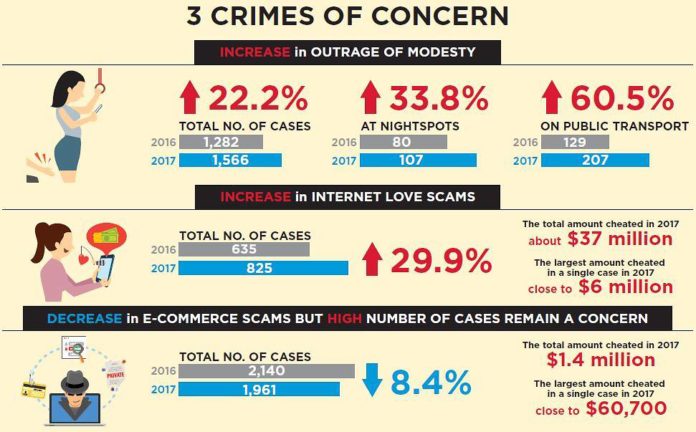
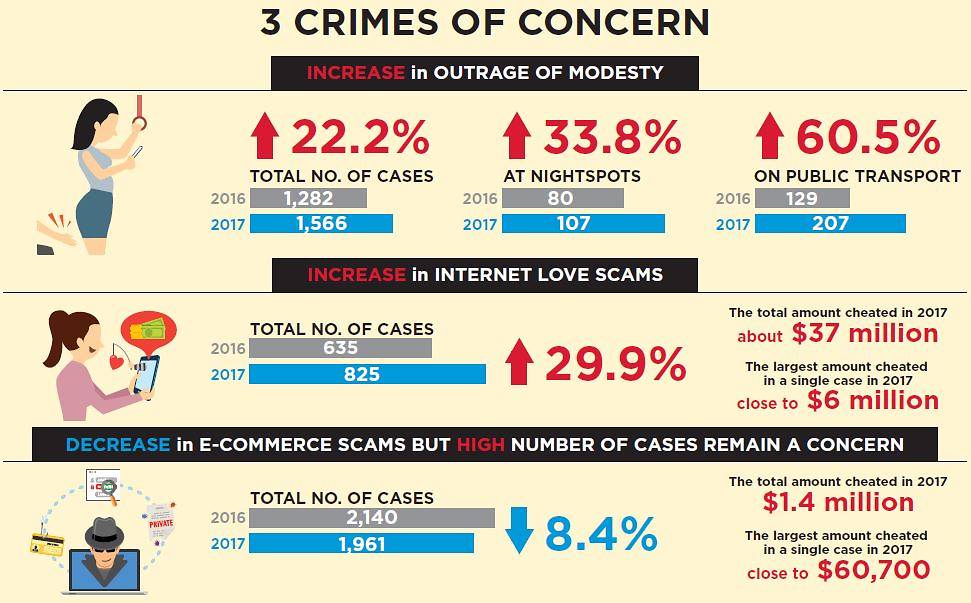
The number of outrage of modesty cases increased by 22.2 per cent, with 1,566 cases last year compared to 1,282 cases in 2016.
In particular, the number of molestation cases on public transport spiked by 60.5 per cent, from 129 cases to 207 cases. Molestation cases at entertainment night spots also rose by 33.8 per cent, from 80 cases to 107 cases last year.
SPF said it will step up patrols at public transportation nodes, and also distribute advisories to commuters during the morning and evening peak hours. Outrage of modesty advisory posters have already been placed on the platform screen doors of MRT stations, and public education videos are being screened at bus interchanges and train platforms, it added.
The police have also been working with public entertainment outlets on measures to prevent crimes on their premises, such as the installation of surveillance cameras.
INTERNET LOVE SCAMS RISE; LARGEST AMOUNT CHEATED WAS S$6 MILLION
The number of credit-for-sex scams fell by 46.3 per cent to 418 cases, with the total amount cheated at around S$1 million in 2017, compared to S$1.7 million in 2016.
The number of China officials impersonation scams also decreased, with 186 cases last year, compared to 501 cases in 2016. The total amount cheated fell from S$23.6 million to S$12.5 million.
However, more people fell for Internet love scams, rising 29.9 per cent from 635 cases in 2016 to 825 cases last year. The total amount cheated increased by 54.2 per cent to about S$37 million from S$24 million. The largest amount cheated in a single case was close to S$6 million.
“Internet love scams have been increasing year on year. Many people are still trusting and transferring money to strangers whom they have befriended online,” the police said.
Although e-commerce scams declined by 8.4 per cent, SPF said the high number – 1,961 cases in 2017 – remained a concern. The total amount cheated decreased slightly from S$1.5 million in 2016 to S$1.4 million. The largest amount cheated in a single case last year was close to S$60,700.
Graphic: SPF
SHIFT IN UNLICENSED MONEYLENDING HARASSMENT TACTICS
Following the 10-year low in 2016, the number of unlicensed moneylending-related harassment cases increased by 12.3 per cent to 3,806 cases in 2017, from 3,388 in 2016.
However, there was a significant drop of 21.8 per cent in cases involving damage to property, as more turned to harassing debtors by electronic means, SPF said. Such cases rose by 33.8 per cent to 2,783 cases last year, and formed the majority of unlicensed moneylending-related harassment cases last year.
Victims reported being harassed via SMS and social media platforms, and harassment notes were also placed inside letterboxes, SPF added.
OVERALL CRIME DOWN
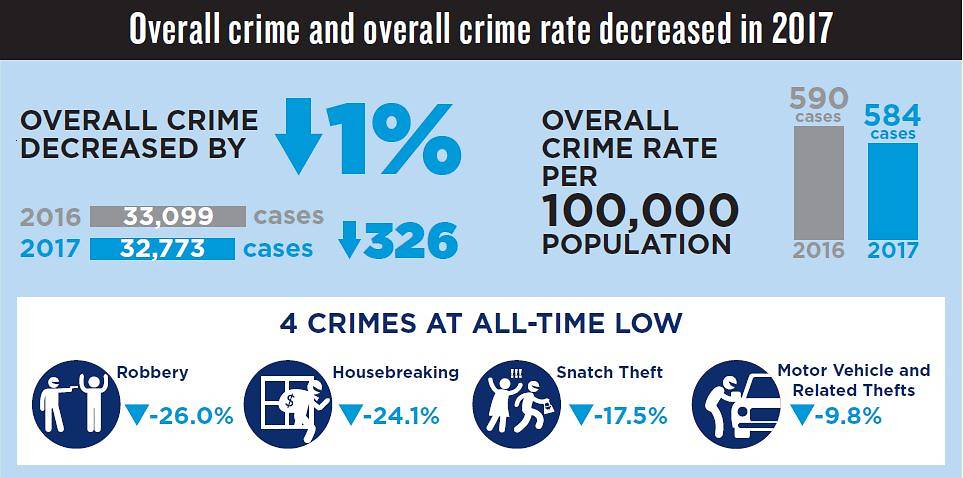
Crime in Singapore fell by 1 per cent last year, from 33,099 cases in 2016 to 32,773 cases in 2017. The overall crime rate also improved, with 584 cases per 100,000 people compared to 590 cases in 2016 – a four-year low.
Graphic: SPF
The improvement was largely due to a decrease in violent and serious property crimes, which declined by 12.4 per cent to 218 cases, and theft and related crimes, which fell 4.4 per cent to 13,495 cases last year. Both types of crime fell to an all-time low in 2017.
There were also more crime-free days in Singapore last year. A total of 167 days were free from snatch thefts, housebreakings and robberies – an increase of 31 days from 2016.
“Singapore continues to be one of the safest countries in the world today,” Deputy Commissioner of Police (Investigations and Intelligence) Tan Chye Hee said. But as crimes become increasingly transnational, Singaporeans “must not take our safety and security for granted”, he added.
SINGAPORE: To ring in the year of the dog, two trains and five themed buses have been decorated with auspicious motifs.
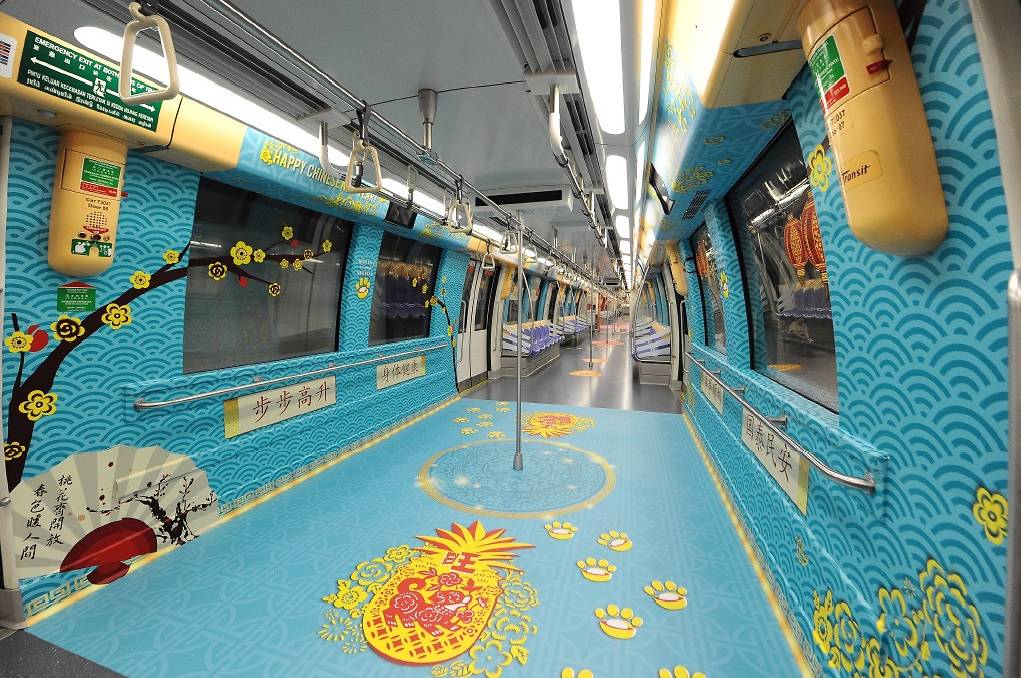
The Land Transport Authority said on Saturday (Feb 3) that the Chinese New Year-themed trains on the North-East and North-South East-West Lines were launched in collaboration with public transport operators SMRT and SBS Transit, as well as the Kreta Ayer-Kim Seng Citizen Consultative Committee.
Themed stations, trains and buses are part of LTA’s efforts to improve the commuting experience and foster a positive commuter culture. (Photo: LTA)
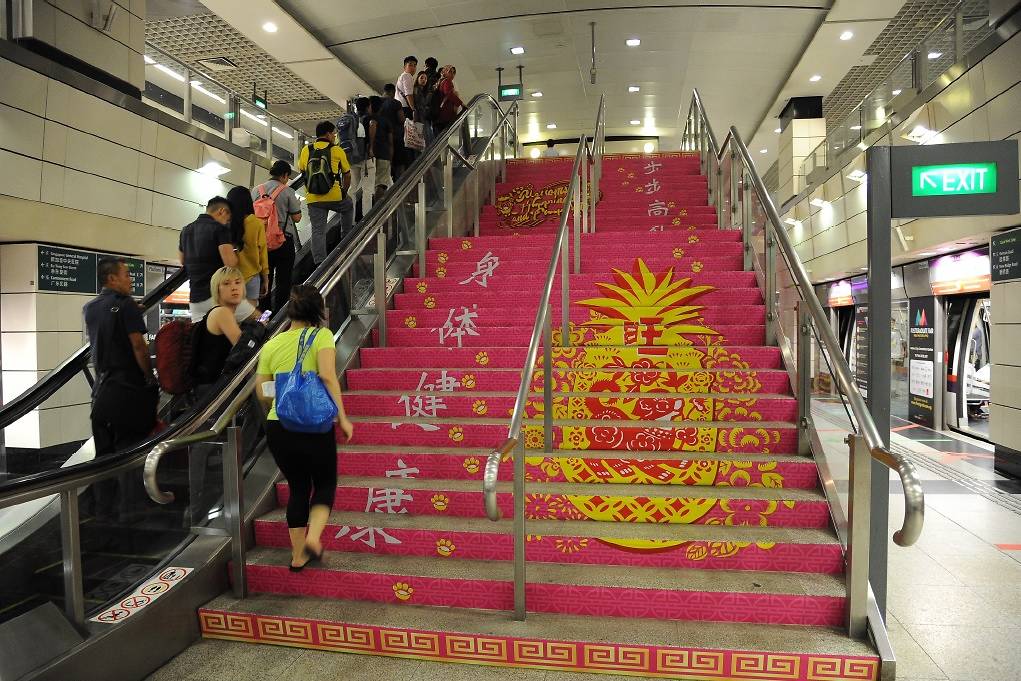
In addition to the trains, the North-East Line station platform at Outram Park MRT Station will be decorated according to the theme.
Commuters transiting at Outram Park MRT Station can enjoy an auspiciously decorated North-East Line’s station platform. (Photo: LTA)
Bus services 80, 143, 147, 166 and 174, which travel through Chinatown and areas such as Toa Payoh, Sengkang, Jurong East and Clementi, will also “bring the festive cheer to the heartlands”, LTA said.
This year’s festivities will be extended beyond trains to include five themed buses on Services 80, 143, 147, 166 and 174 (Photo: LTA)
The festive decorations feature dog motifs, peach blossoms that represent longevity, ingots to represent wealth and fortune and traditional Chinese couplets expressing well wishes for the New Year, the authority added.
Two Chinese New Year-themed trains will ply the North-East and North-South East-West lines. (Photo: LTA)
The Chinese New Year decorations on the trains, buses and station platform will be up until Mar 2.