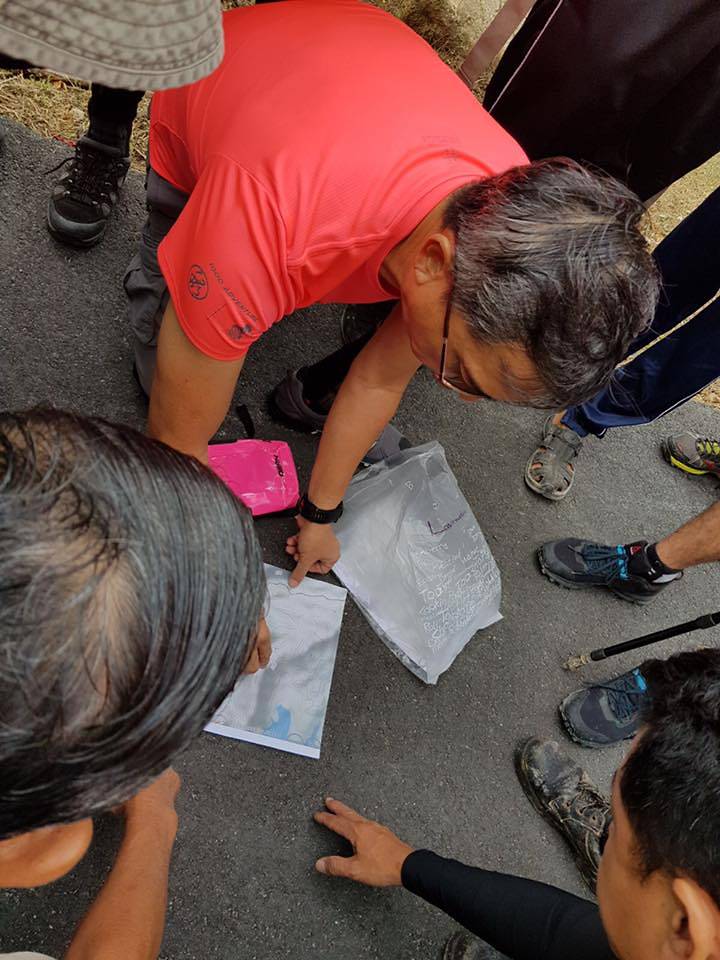
JOHOR BARU: The two Singaporeans reported missing at Johor’s Gunung Pulai could have gotten lost because they did not use a route usually taken by climbers, Johor police chief Mohd Khalil Kader Mohd said on Wednesday (Feb 7) afternoon.
Speaking to reporters at the search-and-rescue operations centre in Kampung Seri Gunung Pulai, Mr Mohd Khalil said that authorities have found “no signs” of the hikers, who had been missing since Monday.
The duo has been identified as Mr Dominick Tan Chang Xiang and Ms Clarice or Lum Jie, both 27. Mr Tan is said to be an experienced mountain climber who has hiked Gunung Pulai many times.
According to several posts on Facebook, a woman called Clarice or Lum Jie is one of the Singaporeans missing. (Photo: Catherine Tok/Facebook)
Mr Mohd Khalil said it had never taken this long to find anyone reported missing in the Gunung Pulai Forest Reserve.
He also said that authorities knew the missing hikers had telephones – a distress call was made on Monday – but the battery could have drained.
“To our Singaporean counterparts, rest assured we are doing our utmost best to ensure their rescue and bring them to safety,” he said.
Meanwhile, Kulai Fire and Rescue Station chief Mohd Khairi S Zainudin, who is the operations commander, said the usual route from the foothill near Kampung Seri Gunung Pulai to the peak was 3km long.
“The distance from the foothill was about 1.5km to Bukit 308, the last location from where the hikers had made the emergency telephone call,” he said.
Mr Dominick Tan and Ms Lum Jie are believed to have gone off the usual climbing trail at Mount Pulai in Johor. (Photo: Facebook/Chloe Quek)
The climbers had reportedly entered the Gunung Pulai area at 12.15pm on Monday and made the emergency telephone call to the authorities at 5.55pm on the same day. They were last contacted at about 10pm.
Singapore’s consul general in Johor Bahru, Rajpal Singh, was at the search-and-rescue operations centre and spoke to the families of the missing hikers.
The search operation involves nine groups of rescuers from various agencies, who are covering an area of 36km around Gunung Pulai.
Ms Chloe Quek, who said she is Ms Lum’s friend, wrote on Facebook on Wednesday afternoon to try and reach out to experienced hikers who might be able to “help cover the area”.
She said the search team would usually take off at 8am with “no ending time (some sleep on the mountain)”, adding that she would be “grateful” if people would spread the word and help build the team.
At the briefing, Mr Mohd Khalil advised climbers to keep to the usual route, which he said many climbers had strayed away from to admire the flora and fauna.
“If they want to stray, they should know how to set markers to enable them to get back to the route. Keeping to the route will prevent one from getting lost,” he said.
Singapore would never have achieved so much without the support of an army of maids from the Philippines and Indonesia, silently cleaning homes and looking after kids while their employers go out and conquer the world.
But not everybody is comfortable with having an omnipresent live-in maid, especially when space is at a premium in land-starved Singapore.
The only alternative, other than doing your own household chores, is to hire a part-time cleaner. However, this is an option few people look into, because of the perception that it’s expensive.
But is that really true? Let’s investigate.
How much does it cost to hire part-time cleaners in Singapore?
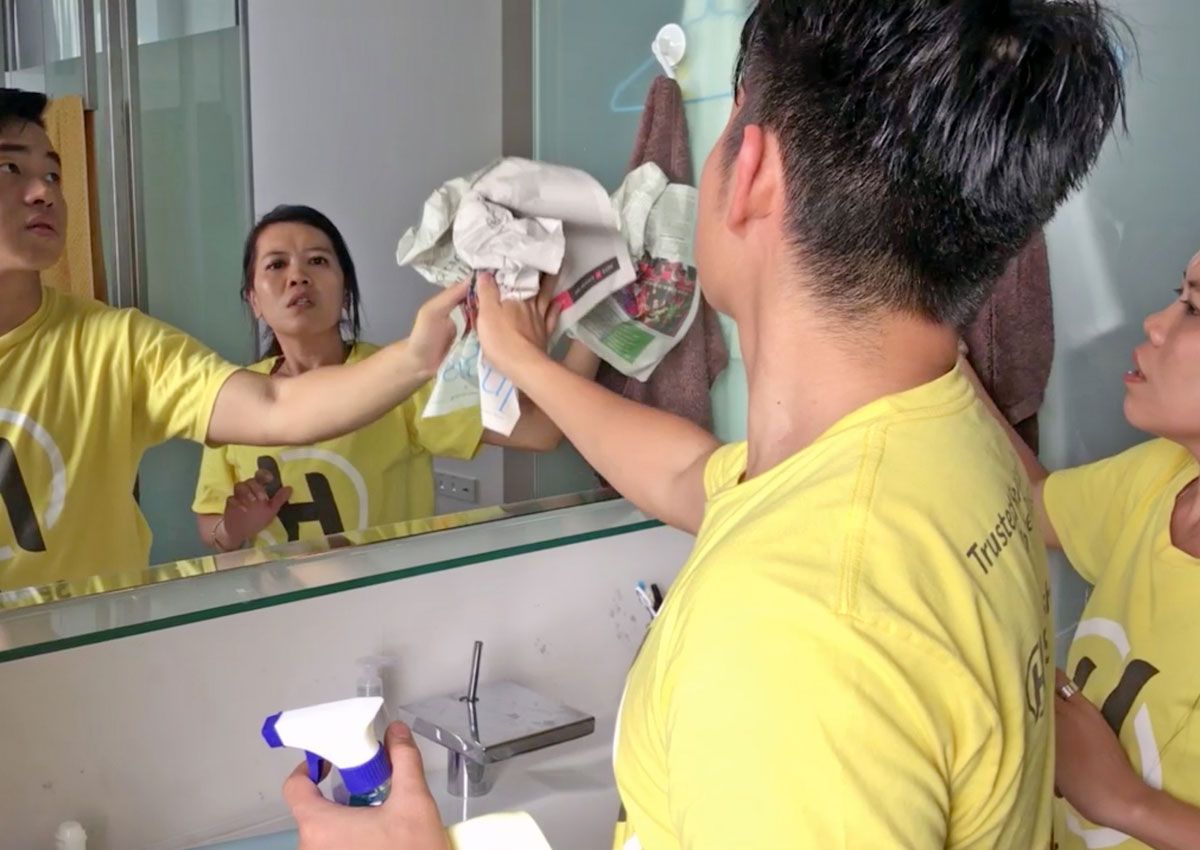
Part-time cleaners can be hired either through agencies, or through word-of-mouth.
Fees are usually charged by the hour or by blocks of 3 or 4 hours. The cleaner will be engaged to work a certain number of hours at regular intervals. For a 4-room flat, 4 hours of cleaning a week would probably be appropriate.
Currently, the market rate for part-time cleaners is about $50 to $60 for blocks of 4-hours, or $15 to $19 per hour.
Cleaners charging an hourly rate will usually impose a minimum number of hours (usually 2-4 hours) per visit. All in all, you can expect to pay at least $50 to $60 per visit.
Is there a difference between hiring an independent cleaner or one from an agency?
While agency prices might be a wee bit higher than those charged by independent cleaners, agency cleaners also tend to be a bit more reliable in the sense that they will show up no matter what happens. If the cleaner is unable to make it, the agency will dispatch another to do the job. And if you have any complaints, you can simply request a change of cleaner.
With independent cleaners, however, it really depends on the individual, so be careful where you get your recommendations from. Some people have complained about cleaners cancelling on them at the last minute or slacking off when unsupervised.
What does a part-time cleaner do?
Whilst maids have been known to get saddled with all manner of tasks, from picking the kids up at school to going to the supermarket, a part-time cleaner’s tasks are much more narrowly defined.
Other than mopping, vacuuming and dusting, part-time cleaners will also clean your toilets and kitchen.
They can also do the dishes, do the laundry and iron clothes if you wish, although you should note that that might take time away from more important tasks.
Is it worth it?
Assuming you hire a part-time cleaner to do a 4-hour clean-up of your home every week, you’re looking at paying approximately $200 to $240 a month.
That’s certainly lower than the salary of a live-in maid, which tends to be about $500 to $750 a month. However, a live-in maid will be able to look after kids, cook meals and basically be on-call all day, every day. For households that need that kind of help, it makes more sense to hire a maid.
However, for those who really just need some help cleaning, a part-time cleaner is the way to go. Even if you’re not the OCD type who cringes at the sight of a single speck of dust, having someone do your laundry and dishes can be a very time-saving prospect.
What’s more, if you are sharing your accommodation with several people (e.g. you’re renting out a room in your flat to a tenant, or you live with several flatmates) you can split the cost of the cleaning service.
If you go on holiday or decide to clean up after yourself, you can always save money by forgoing the cleaning service for a week or two.
Singapore – Colombia has lodged an angry complaint with Singapore over a restaurant in the city-state named after drug kingpin Pablo Escobar.
In a three-page letter to the foreign ministry dated February 2, the Colombian embassy expressed “serious concern”, saying the eatery was paying tribute to the “worst criminal in the history of Colombia”.
“The Embassy of the Republic of Colombia wants to share some information to refresh the horror that this criminal caused in Colombia… not to mention the drug addiction he promoted and the war he declared,” the letter said.
“If the idea of the owner was to make his or her business look profitable and trendy, it is inducing… confusion, because Colombia is not what ‘Narcos-Netflix’ portrays anymore.”
It said Colombia cannot “tolerate any more tributes to that criminal.”
When AFP visited the restaurant in the heart of Singapore’s business district Tuesday evening, patrons occupied about a dozen tables having post-work drinks, seemingly unaware of the controversy. Several bouquets stood on stands by the door next to a decal of Escobar’s face, congratulating the eatery on its recent opening.
Owner Stan Sri Ganesh told AFP that he decided on the name “simply because it had the word ‘bar’ in it”. Several users have posted abusive comments and sent threatening messages to the gastropub’s Facebook page, he said.
“It was meant to be a pun… we never expected the abuse.”
More than two decades after police shot Escobar dead in his stronghold of Medellin, the cocaine cartel leader was immortalised in the hit Netflix series “Narcos”.
Escobar is still deeply popular in Medellin, where he is regarded as a saint and anti-hero — souvenirs with his face on them do brisk business.
Colombia has recently come out of a decades-long civil conflict fuelled by drug trafficking that claimed thousands of lives.
The United Nations ranks Colombia as the world’s biggest producer of coca, the raw material for the drug. Affluent Singapore takes a strong stance against drugs, with traffickers punishable by death.
SOUTHEAST Asian nations are among the worst in the world for child exposure to online abuse and cyber-risks, according to a new report from an international think tank.
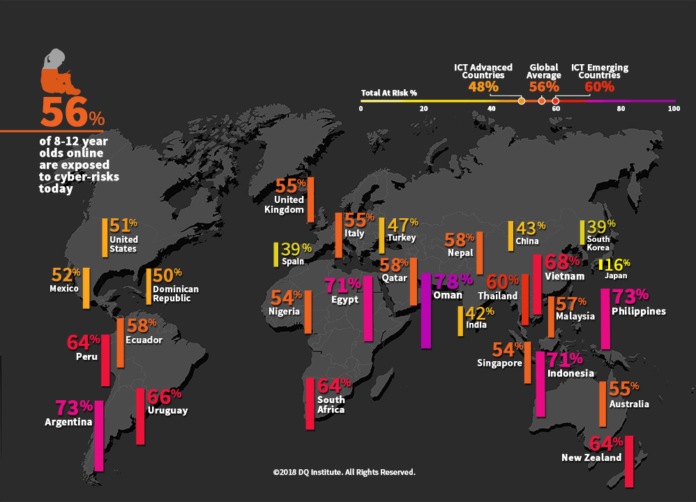
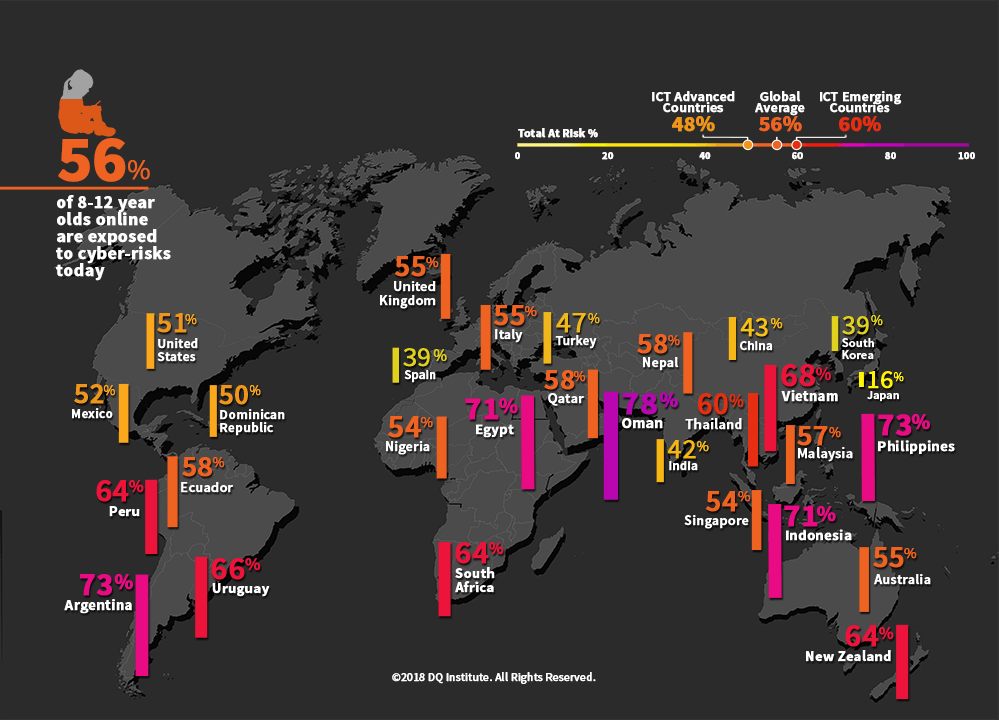
The new 2018 Impact Report from DQ Institute found that 73 percent of 8 to 12 year olds in the Philippines are exposed to cyber-risks, coming second only to Oman as the worst of the 29 countries surveyed.
Indonesian children were also at risk, with 71 percent experiencing at least one major cyber-risk, including cyberbullying, video game addiction, offline meetings, and online sexual behaviours.
While Thailand, Malaysia, and Singapore performed better, the number of children at risk was still high at 60 percent, 57 percent, and 54 percent respectively.
The report, released Wednesday, examines the precarious status of children’s exposure to cyber-risks worldwide, seeks to understand how children become exposed to these risks and how they are affected.
Globally, 56 percent of children were found to be at risk. A figure that DQ says is “tantamount to saying that our children are in the middle of a cyber-risk pandemic.”
DQ Impact Report 2018. Source: DQ Institute
Emerging Information and Communication Technology (ICT) countries – those that have experienced a recent influx in the use of the internet and mobile devices – are the most vulnerable to cyber-risks targeting children.
The study reveals that children from ICT emerging countries are 1.3 times more likely to be involved with cyber-risks compared to those from ICT advanced countries on average. Southeast Asia contains a high number of emerging countries, making it a hotbed for online abuse.
“I think the Philippines is one of the most targeted countries for human trafficking, sexual exploitation through online,” said Ariane Lim, Project Consultant at Assist Asia in the Philippines. “And that’s why it’s very important to safeguard our children from these digital threats”
Burma (Myanmar) has also experienced staggering growth in ICT since it opened up to the telecom industry in 2013. At the time, just six percent of the population had a mobile phone, according to the report. This skyrocketed in the first 18 months to 65 percent of people experiencing internet through their mobile devices.
Currently, the population with a personal phone is 85 percent. But people are unaware of the risks involved, says Ken Tun, CEO of Parami Energy.
“Myanmar people do not know what the Internet is, they only know Facebook,” he told DQ. “There is such low awareness of online challenges and risks that children can have from these platforms.”
DQ Impact Report 2018. Source: DQ Institute
The growth of personal mobile devices among children as young as eight is one of the driving forces behind such high exposure to cyber-risks.
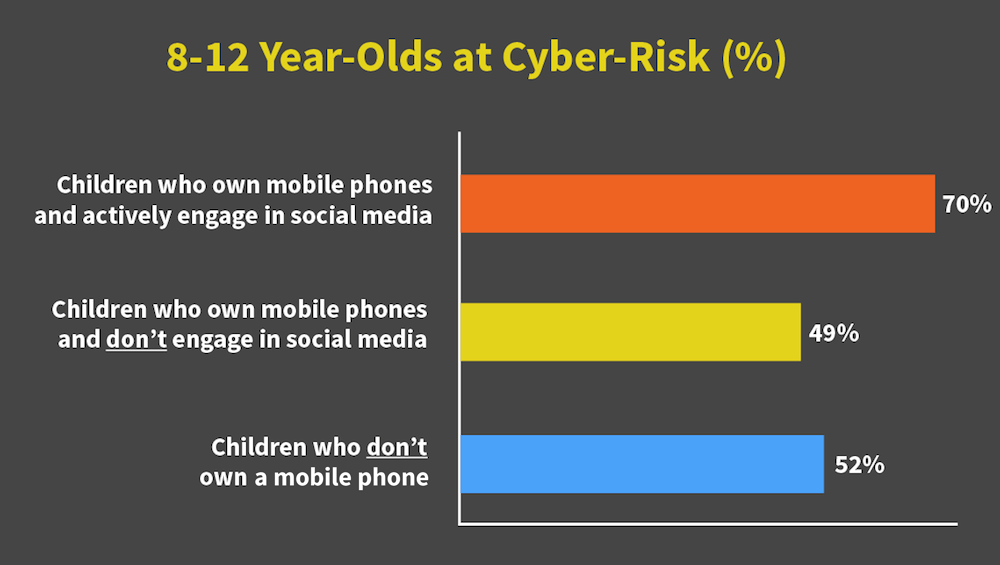
According to the report, the majority of children (60 percent) get their first phone when they’re 10 years old. And when they get these phones, they’re using them to access social media, further increasing the risk of cyber-bullying and unwanted advances.
DQ found that 85 percent of 8 to 12-year olds use social media, even though the legal age they can officially start using most social media applications is 13 years old.
Globally, the study found 47 percent of 8 to 12 year olds have been victimised through cyber-bullying in the past year. Ten percent were found to have chatted with and met online strangers in real life. Video game addiction affected 11 percent of those surveyed. And 17 percent have been involved in online sexual behaviours.
While the report clarifies that having been exposed to these cyber-risks does not directly indicate that children have received permanent physical or mental harm, it warns that continuous exposure to these risks at an early age poses “a danger to overall development, well-being, relationships, and future opportunities for children.”
With rapid increases in Internet penetration in ICT emerging countries, it is estimated that over 720 million 8 to 12 year olds will be online by 2020, with more than 90 percent of these users from ICT emerging countries.
SINGAPORE: He ticks almost all the boxes in the cliched impression of a reformed ex-gangster: Thickset and muscled, affable and soft-spoken. But Ben (not his real name) is quite different. There are no tattoos – “I was lucky,” he says – and the 26-year-old undergraduate only started filling out his T-shirts after a four-year spell in jail.
In fact, he was once a short and scrawny teenager who, along with his friends, would brazenly fight, riot and partake in “typical, violent” gang activities – yet quake at the mention of the Criminal Law (Temporary Provisions) Act (CLTPA).
“We knew about the Act,” said Ben during an interview arranged by the Singapore Police Force (SPF) for him to share his personal experience as a Criminal Law Detainee (CLD), and as part of efforts to highlight the benefits of the Act. “Most gang members fear detention (without trial) – they all know they’ll be in prison for an unknown period.
“It’s a deterrent but at my age back then, I didn’t expect it would be me facing such consequences.”
Former secret society member and Criminal Law Detainee “Ben” (Photo: Hanidah Amin)
The CLTPA allows for the detention of suspected criminals without trial – subject to annual reviews of each case – for the sake of “public safety, peace and good order”. Last year, the total CLD population in Singapore’s prisons was 103 – of which 86 were jailed for secret society activities. These have been the majority since 2015, with the rest of the numbers made up by offences such as unlicensed money-lending and drug trafficking.
On Tuesday (Feb 6), Parliament passed a bill that will extend the legislation covering detention without trial for another five years.
“Secret society members are aware of the CLTPA, and it helps us keep them at bay,” said Inspector Eric Toh, an investigation officer with a decade’s work at the SPF’s Secret Societies Branch. “If not, they will cause much more problems; and influence much more people to join their gangs.
“The CLTPA remains a key legislative tool which is highly effective in suppressing secret society activity.”
Inspector Eric Toh, a Secret Societies Branch investigation officer, has a decade of experience dealing with Singapore’s gangs (Photo: Hanidah Amin)
TURNAROUND
Ben was 14 when he first joined a gang, and 18 when “a few incidents” led to police showing up at his house and informed him he was being arrested under the CLTPA.
“My parents were sad, upset,” he recalled. “Me, I was shocked, confused, totally lost and angry at the same time.
“My first few days in there, I just kept thinking how and when I could get out and back to my family. I didn’t know what to do in prison, and where I could go after. You’re basically doing nothing for 23 hours in a room … you will think a lot.”
But keeping CLDs locked up means witnesses can come forward knowing they are safe, said Insp Toh, 40.
“During investigations, we need to call up witnesses to tell us what actually happened. With the Act, they don’t have to be in fear and can come give us the evidence we need,” he outlined.
“We are then able to incarcerate the suspect, and this helps keep the secret society situation under control. This is why we have the CLTPA.”
Patrons of a public gaming store squat while Secret Societies Branch officers conduct checks during an operation (Photo: Hanidah Amin)
Life in prison as a CLD still gave Ben, an Institute of Technical Education student then, an opportunity to further his studies.
“This officer told me to do something with my life, and recommended me to sign up for O-Levels,” he said. “I realised that maybe I could do this, and after one year was transferred to the prison school, where I went on to do my A-Levels too.
“It was a challenge because there was a lack of resources. News that came to us was two months old, but we made do with what we had.
“I wanted to prove to myself that I was actually capable of doing things right … and doing my family proud,” Ben related.
“The first year, I was praying to get out. But the second and third, I somehow didn’t think of that, because I had a goal in mind – to pursue my studies. So I used the time to focus on my studies and keep myself occupied.”
Right after taking his A-Levels, Ben was told he would be released. “It felt like my road had been planned out … and everything would be smooth,” he said.
An anti-gangsterism sign outside an entertainment outlet which was raided during a Secret Societies Branch operation (Photo: Justin Ong)
REINTEGRATION
Out of jail, Ben found a job, started applying to universities – and was placed under police supervision for a year. This stopped him from meeting his former friends, going to “high-risk” areas like entertainment outlets and staying out past 7pm. He also had to report to a police station every week – but said these measures helped prevent him from joining the gang again.
Not everyone is as fortunate. In Parliament recently, Home Affairs Minister K Shanmugam revealed that of out of the current CLD population, about 17 per cent had been placed under detention previously.
The Act, in and of itself, is not sufficient to prevent the proliferation of street gang activity in Singapore, said Insp Toh. “So the police adopt a strategy of both enforcement and preventive education.”
Reformed individuals like Ben are also part of these initiatives. Two years ago, he volunteered with children at risk – and also children with mental disabilities – until his university schedule got in the way.
He also agreed to this interview because he saw it as “necessary and important” to tell his story. “At my age back then, maybe you’re curious or not that mature yet, so you get rebellious and you make mistakes,” Ben stressed.
“But whatever you do, reflect on what’s the consequences of your action before you execute it. Don’t follow what I did, don’t follow in my footsteps; enjoy your teenage life instead.”
Patrons of a public gaming store squat while Secret Societies Branch officers conduct checks during an operation (Photo: Hanidah Amin)
He is now belatedly doing so as a student, though his age often leads to probing from younger schoolmates. “I’m someone who doesn’t like to hide, it’s quite tiring,” said Ben. “So I will share what I was back then. They’re mostly quite open … after some time, they treat you as normal.”
Statistics for the number of ex-CLDs going on to higher education and employment were unavailable, making it unclear how common Ben’s success story is. But does he believe his experience points to the usefulness of the CLTPA? Does he see the existence of a law allowing detention without trial to be absolutely essential?
“It really depends,” Ben said carefully. “But for my case, without my detention, I wouldn’t be studying today. And maybe … I wouldn’t be alive.”
A former private tuition agency owner was fined $2,000 on Monday (Feb 5) for lying to a policeman when asked about her connections to the main suspect in a cheating scam.
Previously, the owner of Pivot Tuition agency, Wong Mee Keow, 39, had told an officer that she did not know the suspect Poh Yuan Nie, alias Pony Poh, despite the latter being one of her workers.
Wong, now jobless, pleaded guilty to two counts of giving false information to a policeman in August and November 2006, reported The Straits Times.
A third charge of intentionally obstructing the course of justice by deleting Poh’s photographs from her phone in October 2016, was taken into consideration during the sentencing.
Poh and Wong, both Singaporeans, are in a relationship, said defence lawyer, Mr Peter Ong Lip Cheng.
Deputy Public Prosecutor Vadivalagan Shanmuga told the court that two Chinese students had gotten places in a local secondary school without sitting for an entrance examination.
The incident was uncovered after the two performed poorly in subsequent exams.
The students then told their teachers that they were placed in the school through their agents, two Chinese nationals.
The names of the students, school, as well as the two female agents, were not disclosed in the court documents.
During the course of the investigation, the police uncovered the scam and Poh’s alleged involvement in it.
DPP Vadivalagan said:
“Pony had allegedly promised the said agents that she would get the students emplaced in the school, without the students having to take the entrance examinations.”
Police questioned Wong in August and November 2006 and on both occasions, she denied knowing Poh.
This eventually caused the investigation to come to a standstill as Poh could not be traced.
The case was later reopened after she was arrested for her alleged involvement in other similar scams between 2015 and 2016.
Mr Ong pleaded for a minimal fine for Wong, saying that she was remorseful. He also added that his client suffered from depression and was receiving treatment.
Poh’s case is still pending.
For each count of giving false information to a civil servant, Wong could have been jailed up to six months and fined up to $1,000.
MUMBAI – A Bollywood movie about an inventor who created a revolutionary machine that makes cheap sanitary pads hits screens this week, challenging taboos surrounding menstruation in socially conservative India.
Mr Arunachalam Muruganantham is nicknamed India’s “menstrual man” for transforming the lives of poor women forced to use items like old rags, sand and leaves during their periods.
He has been lauded by India’s government and is now getting the star treatment with Bollywood A-lister Akshay Kumar portraying him in Pad Man, releasing on Friday (Feb 9).
It is the latest socially conscious movie to come out of a film industry known more for producing complex love stories featuring handsome heroes and elaborate dance routines.
Mr Muruganantham hopes the movie will help raise awareness about the importance of menstrual hygiene in patriarchal India where women, particularly in rural areas, are frequently shunned during their monthly cycles.
“Menstruation is still a taboo subject in India and a tough subject for a film,” he told AFP by phone from his home state of Tamil Nadu in southern India.
“But I read the script and I was also on the sets to guide them. I think (R.) Balki (the writer and director) has handled the subject beautifully.
“People will talk about personal hygiene and it will give hope to the younger generation to do innovative things,” he added.
Mr Muruganantham’s remarkable story began in the late 1990s when he was shocked to discover that his wife was using newspaper and dirty cloths during menstruation because sanitary pads were too expensive.
He decided to do something about it and started experimenting with different designs using cotton.
His first few prototypes were not very successful and quickly his wife and sisters refused to be guinea pigs any longer.
When other women in the village baulked at his requests to try his products he started testing them on himself, using a football bladder and animal blood.
Muruganantham was mocked and ostracised by fellow villagers, and his wife even left him for a while, but he remained undeterred and intensified his search.
After two years he discovered that sanitary pads are made from cellulose found on trees.
Muruganantham also learnt that the machine which ground down the pulp before turning it into napkins cost hundreds of thousands of dollars so he decided to create his own.
In four years he had invented an easy-to-use device which could produce pads at a third of the cost of the commercially produced ones. The machines themselves were also vastly cheaper at around 75,000 rupees (S$1,540).
“I wanted to make sure that technically we did not go wrong, so he agreed to supervise,” the director Balki said of Mr Muruganantham’s role on set.
Actresses Radhika Apte and Sonam Kapoor star alongside Kumar whose character based on Mr Muruganantham is called Lakshmi.
The 50-year-old actor, whose films regularly rake in more than one billion rupees at the box office, is no stranger to starring in movies with an important message.
Last year’s comedy, Toilet: Ek Prem Katha (Toilet: A love story), focused on the lack of toilets in India and the problem of open defecation.
It was a runaway success, grossing upwards of 2 billion rupees, but Balki says a film about periods is an altogether different proposition.
“Pad Man is possibly the riskiest film Akshay has done because of the taboo, unexplored subject,” he told AFP.
Several million more Indian women are now estimated to use sanitary pads thanks to Mr Muruganantham.
His company, Jayaashree Industries, has more than 2,000 units across the majority of India’s states and also exports to dozens of countries. The machines also provide employment to thousands of rural women.
In 2014 he was included in Time magazine’s list of 100 most influential people in the world. Two years later India’s government awarded Muruganantham one of the country’s highest civilian honours.
The release of Pad Man is set to elevate his fame further but he insists he won’t be letting it go to his head.
“The cause is becoming big, but I am remaining the same,” he told AFP.
SINGAPORE: The number of people who died in traffic accidents last year fell after three consecutive years of rises, according to figures released by the Traffic Police on Wednesday (Feb 7).
Releasing its annual road traffic situation report, police said the number of fatalities dropped from 141 to 122 in 2017.
This translates into a fatality rate of 2.17 per 100,000 persons, the lowest since 1981, when police started tracking the death rate.
According to the report, the number of fatal accidents fell from 140 in 2016 to 118 last year.
Road accidents resulting in injuries saw a 7 per cent drop, from 8,304 cases in 2016 to 7,724 cases in 2017.
There were also fewer accidents related to drink-driving, speeding and motorists running red lights.
Accidents related to speeding fell 29.9 per cent, while those involving drink-driving and red-light running fell 2.7 per cent and 0.8 per cent respectively.
However, red-light running violations rose 32.5 per cent to 45,617 cases in 2017.
In its report, traffic police noted that though the number of accidents involving elderly pedestrians fell slightly, there were 23.2 per cent more accidents involving elderly pedestrians who jaywalked, at 101 in 2017.
SPF said one in two fatal accidents involving elderly pedestrians were caused by jaywalking.
The number of fatal accidents involving motorcyclists fell by 29.7 per cent to 45 in 2017. The number of motorcyclists and pillion riders injured in accidents also dropped 5.9 per cent, to 4,800 last year. However, motorcyclists still made up more than half of the overall traffic accidents and nearly 36 per cent of overall traffic fatalities.
Simulation training will be made compulsory for all learner drivers starting from 2019. (Photos: Elizabeth Neo)
Commander of Traffic Police, Senior Assistant Commissioner of Police Sam Tee, said the road traffic situation in 2017 showed an encouraging improvement.
“In the coming year, the Traffic Police will step up its education efforts for both new and existing motorists. Education is a key enabler to impart and inculcate good driving or riding competencies and behaviours.”
SIMULATION TRAINING COMPULSORY FOR LEARNER DRIVERS
To further lower accident and fatality rates, police announced that simulation training will be made compulsory for all learner drivers from next year.
The programme, which allows participants to practise defensive driving and riding through experiential learning and real-life traffic situations, has been on trial since the beginning of February at ComfortDelGro Driving Centre.
It will subsequently be rolled out at the Singapore Safety Driving Centre and Bukit Batok Driving Centre.
Participants will be put through driving scenarios such as wet weather, as well as driving at night and along busy roads.