A couple were en route to the National University Hospital (NUH) to visit their youngest child, who suffers from heart failure, but ended up there with injuries following a traffic accident.
They were travelling along West Coast Highway on Jan 28, at around 3.10pm, in their Toyota when a prime mover hit them.
The driver, sales executive Jason Ho, shared dramatic footage on Facebook showing how the prime mover had sideswiped his vehicle and “dragged it for 5m to 10m after the impact”.
He also provided more details about what happened:
on Facebook
This idiot driver dun want admit that he sidesweep me from 2nd lane (giving a false report, saying that he did check and…
Posted by Jason Ho on Tuesday, 6 February 2018
When contacted by Stomp, Jason said he and his wife had been travelling from Pandan Gardens to NUH when the collision occurred.
The couple, both aged 30, were planning to visit their 20-months-old daughter, who has been warded in NUH’s Paediatric Intensive Care Unit (PICU) for two months due to heart failure.
“Actually, doctors have asked us to prepare for the worst. She may need to stay [in the hospital] until she leaves us,” Jason told Stomp.
However, the traffic accident led to the couple being sent to NUH for their injuries.
The father of three said: “I was in pain after being hit and became semi-unconscious. It all became clearer to me only when I was in the hospital.”
It was his wife who called the ambulance while a passer-by contacted the police.
Jason, who suffered injuries to his neck, spine, neck and left hand, shared that he was hospitalised for four days and given 13 days of medical leave.
Meanwhile, his wife injured her back and was given three days of medical leave after being taken to the A&E department at NUH.
Jason, who also previously suffered from heart failure and underwent a transplant 11 years ago, added: “The prime mover driver does not want to admit that he sideswiped me during the accident.
“The workshop, who is authorised to do my claims, told me that my chance of winning the dispute is only 80 to 90 per cent. They said winning 100 per cent is impossible.
“I don’t get it as I was just driving in my lane when I got hit by the prime mover driver, and now I have to pay for the damages.
“So I really need passers-by who witnessed the accident to provide their videos and help me.”
In response to a Stomp query, the police confirmed that they were alerted to the accident and said a male victim was conscious when taken to the hospital.
NEW YORK: Quincy Jones, the legendary music producer behind Michael Jackson, says that the late King of Pop plagiarised some of his hits.
“I hate to get into this publicly, but Michael stole a lot of stuff. He stole a lot of songs,” Jones said in an interview full of eyebrow-raising comments published Tuesday by Vulture, the culture site of New York magazine.
“The notes don’t lie, man. He was as Machiavellian as they come,” the 84-year-old music veteran said.
He specifically cited “Billie Jean” — a signature song off the Jones-produced “Thriller,” the top-selling album of all time.
Jones suggested similarities between the song and disco queen Donna Summer’s “State of Independence,” which was also produced by Jones and released several months earlier in 1982.
Few listeners would immediately associate the two songs, although both open and are built on unusually lengthy synthesised bass lines.
Jones also said Jackson was “greedy” and should have given partial writing credit to keyboardist Greg Phillinganes for his song “Don’t Stop ’Til You Get Enough.”
Jones’ allegations run against prevailing public perceptions of Jackson, who died in 2009 and is often viewed as a tortured soul with little financial acumen as he amassed wealth.
The producer voiced sympathy over Jackson’s personal issues, saying he had raised concern to the singer over his plastic surgery and blamed abuse by the singer’s father for the King of Pop’s poor self-image.
Jones has remained active as an octogenarian, recently launching the Qwest TV video streaming service for jazz, but has also made a stream of headline-grabbing comments with a generous sprinkling of profanity.
In a recent interview with GQ magazine, he said he had 22 girlfriends around the world, spoke 26 languages and had undergone a cutting-edge treatment in Sweden to help him live to 110.
SINGAPORE: More people were convicted last year for entering into sham marriages, the Immigration and Checkpoints Authority (ICA) said on Thursday (Feb 8).
Fifty-three people were convicted of offences related to marriages of convenience in 2017 – a 23.3 per cent spike from the year before, ICA said in its annual statistics report.
The report highlighted a particular case last year which led to the arrest of 12 people.
In that case, officers were looking into a suspected sham marriage between a Singaporean man and his Vietnamese wife – but found five other such couples during the course of their investigations.
These couples all involved Singaporean men and Vietnamese women, said the ICA. The men, aged between 24 and 57, entered into these marriages for money, while the women, who were aged between 23 and 34, wanted to prolong their stay in Singapore, according to the report.
Ten were sentenced to jail terms ranging from six to 18 months, while court proceedings are ongoing for the remaining two.
MORE SMUGGLING CONTRABAND
The number of contraband smuggling cases detected at checkpoints also rose by 2.6 per cent to 90,327 in 2017, from 88,050 in 2016.
“Despite stringent checks, an average of 247 cases of smuggling attempts continue to be detected at our checkpoints daily,” said the report.
It also noted that heavy commercial vehicles continued to be used for smuggling contraband last year, calling this a “trend of concern”.
The report highlighted a case in October last year, during which officers found 2,190 cartons and 202 packets of duty-unpaid cigarettes concealed in the modified compartment of a fuel tank towed by a prime mover at Tuas Checkpoint.
A fuel bowser towed by a prime mover found with duty-unpaid cigarettes. (Photo: ICA)
In another similar incident, officers at Woodlands Checkpoint found 9,000 cartons of duty-unpaid cigarettes concealed in a consignment declared as assorted bread in a Malaysia-registered truck.
Duty-unpaid cigarettes found concealed in a consignment declared as assorted bread. (Photo: ICA)
ICA Commissioner Clarence Yeo also warned the community to be alert in the run-up to Chinese New Year, with an increase in the number of travellers and goods passing through the checkpoints.
“Despite stringent checks, smuggling attempts have not abated. As such, we urge the community to be alert and collaborate with us to keep Singapore safe and secure,” he said.
FEWER ILLEGAL IMMIGRANTS ARRESTED
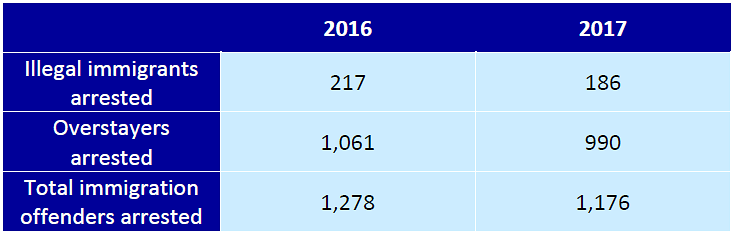
A total of 186 illegal immigrants were arrested last year, a 14.3 per cent drop from the 217 arrested in 2016. The number of overstayers arrested was 990, down 6.7 per cent from 1,061 the year before.
The authority highlighted an incident in May last year, in which 12 Indonesian men aged between 18 and 41 were arrested for immigration offences and for peddling duty-unpaid cigarettes at Yew Tee Industrial Estate.
Twelve Indonesian men were arrested over immigration offences and for peddling duty-unpaid cigarettes. (Photo: Immigration and Checkpoints Authority)
Though there was a decrease in the number of people arrested for harbouring immigration offenders, there was a rise in the number of people employing such offenders last year, said the ICA report.
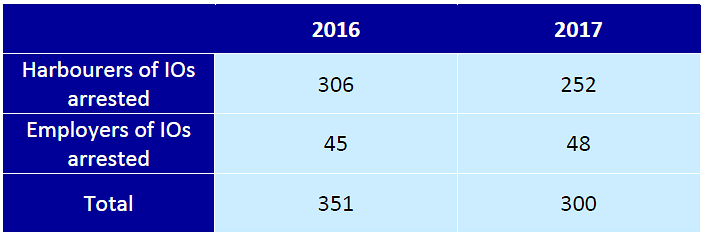
The number of harbourers of immigration offenders arrested declined by 17.6 per cent to 252 in 2017, from 306 in 2016. However, the number of employers of immigration offenders arrested increased by 6.7 per cent to 48 in 2017, from 45 in 2016.
SINGAPORE: As Singapore ages, it is opportune to think about how our healthcare system can be strengthened to provide for our long-term care needs.
So, it is timely that the ElderShield Review Committee has made a few recommendations last week.
The principal recommendation is for ElderShield enrolment to start at 30 instead of 40. The Committee has also recommended that the Government be the single administrator instead of private insurers.
The need to enhance ElderShield is clear. An elderly disabled person can require significant support – as much as S$2,200 per month in today’s dollars.
And in 30 years, when you may need nursing care, at 2 per cent inflation, this service may cost S$4,000 a month.
The current ElderShield payouts of S$400 a month for those who joined after September 2007, based on premiums averaging S$200 a year, do not come close to covering this.
I believe the Committee could have been more bold and innovative in their proposals to get more contributions into ElderShield. While ElderShield cannot be expected to cover all costs, it should be much more substantial than it is now.
Moving the premium start age to 30 is not going to help much. What you need is a very significant increase in the coverage. However, asking to double the premium, for example, may be unacceptable to the public.
An old man walks on an overhead bridge. (File photo: Francine Lim)
INCREASE PREMIUMS BUT SUBSIDISE ELDERLY POOR
What can happen is that the Government increases the basic premium slightly, and then offers to co-pay a top-up to the premium. For example, increase the premium to S$250 per year, and top it up with S$250.
Where the aim of enhancing ElderShield is to provide better coverage for the poor elderly, the co-payment can be progressive, for example a 150 per cent top-up for the less well-off and no top-up for the better off.
This top-up need not be expensive. Assuming a S$200 a person average subsidy and 30,000 people in each age cohort, this adds up to S$6 million dollars a year for each age cohort. The top-up significantly increases the coverage and makes the increase in premiums more acceptable to the public.
If fiscal constraints are a challenge, like Medishield Life, transitional subsidies can also be considered in the initial years where ElderShield is made compulsory.
This top-up can be considered well-spent if it reduces pressure on the Government to spend more on its future subsidies for nursing care – currently ranging from 20 per cent to 80 per cent subsidies for Singapore citizens up to a monthly household income per capita of S$2,600.
Essentially, it transfers future expenditure (paid for by future taxpayers) to present expenditure (paid for by the current generation who will benefit from it). In this sense, it is not a gratuitous handout, but a targeted one.
More importantly, it’s in line with a fundamental principle of healthcare financing in Singapore – which is for each generation to bear its own healthcare costs, with Government assistance to insure against the unexpected, ensure healthcare remains affordable and help people save for their old age.
File picture of a group of senior citizens. (Photo: Calvin Oh)
INCLUDE A DEMENTIA RIDER
Yet there is still a significant gap in ElderShield coverage. A recent study has concluded that 1 in 10 Singaporeans over 60 will get dementia in their lifetime. This is on par with the incidence of diabetes.
Dementia is a particularly bad illness – it affects both caregivers and victims seriously, even in the early stages. An insurance rider to ElderShield to include dementia and other cognitive illnesses would seem to be a must but is currently missing.
In comparison, many developed countries routinely include this cover in their long-term care policies. In Singapore, insurance companies also consider severe dementia to be a critical illness under their critical illness coverage since 2003.
A basic S$400 a monthly payout for five years may only require around S$50 per year of premiums. Once again, a co-payment system would help in buy-in from the public.
PRIVATE INSURERS STILL NEEDED
While it will indeed be more convenient for the Government to be an administrator and provide better coverage for society, other touted disadvantages, such as difficulty of claims process, are easily overcome without needing to turn to the Government as an administrator.
Do not throw the baby out with the bathwater. I think we still need the private insurers.
Profit and social causes are not an incompatible mix. We know at present that insurers actively market supplemental ElderShield plans to consumers and serve as a vital educational and marketing function in persuading people to sign up for additional coverage.
Private insurers also provide additional coverage on top of Medishield Life through integrated shield plans that give Singaporeans more hospitalisation options.
So it stands to reason that insurance companies should be given the space to provide similar plans that provide additional long-term disability coverage beyond ElderShield – and be able to administer these schemes.
Insurance companies also have an incentive to have a healthier customer – we see this with insurance companies running their own prevention programmes for their healthcare insurance customers.
More competition in this space may also temper potential profiteering, while encouraging insurance companies to focus on innovation to differentiate their products and facilitate better protection for their customers.
In summary, we need to take a much bigger step to ensure significant coverage of old age disability from Eldershield.
The ElderShield Review Committee’s recommendations are to be applauded but Singaporeans must not be afraid to go further in the ElderShield review to make coverage more inclusive
Tan Jin Meng is pursuing a full-time post graduate degree at the Lee Kuan Yew School of Public Policy and is currently engaged in research on long-term care financing for a local non-government organisation interested in eldercare matters.
SINGAPORE: He ticks almost all the boxes in the cliched impression of a reformed ex-gangster: Thickset and muscled, affable and soft-spoken. But Ben (not his real name) is quite different. There are no tattoos – “I was lucky,” he says – and the 26-year-old undergraduate only started filling out his T-shirts after a four-year spell in jail.
In fact, he was once a short and scrawny teenager who, along with his friends, would brazenly fight, riot and partake in “typical, violent” gang activities – yet quake at the mention of the Criminal Law (Temporary Provisions) Act (CLTPA).
“We knew about the Act,” said Ben during an interview arranged by the Singapore Police Force (SPF) for him to share his personal experience as a Criminal Law Detainee (CLD), and as part of efforts to highlight the benefits of the Act. “Most gang members fear detention (without trial) – they all know they’ll be in prison for an unknown period.
“It’s a deterrent but at my age back then, I didn’t expect it would be me facing such consequences.”
Former secret society member and Criminal Law Detainee “Ben” (Photo: Hanidah Amin)
The CLTPA allows for the detention of suspected criminals without trial – subject to annual reviews of each case – for the sake of “public safety, peace and good order”. Last year, the total CLD population in Singapore’s prisons was 103 – of which 86 were jailed for secret society activities. These have been the majority since 2015, with the rest of the numbers made up by offences such as unlicensed money-lending and drug trafficking.
On Tuesday (Feb 6), Parliament passed a bill that will extend the legislation covering detention without trial for another five years.
“Secret society members are aware of the CLTPA, and it helps us keep them at bay,” said Inspector Eric Toh, an investigation officer with a decade’s work at the SPF’s Secret Societies Branch. “If not, they will cause much more problems; and influence much more people to join their gangs.
“The CLTPA remains a key legislative tool which is highly effective in suppressing secret society activity.”
Inspector Eric Toh, a Secret Societies Branch investigation officer, has a decade of experience dealing with Singapore’s gangs (Photo: Hanidah Amin)
TURNAROUND
Ben was 14 when he first joined a gang, and 18 when “a few incidents” led to police showing up at his house and informed him he was being arrested under the CLTPA.
“My parents were sad, upset,” he recalled. “Me, I was shocked, confused, totally lost and angry at the same time.
“My first few days in there, I just kept thinking how and when I could get out and back to my family. I didn’t know what to do in prison, and where I could go after. You’re basically doing nothing for 23 hours in a room … you will think a lot.”
But keeping CLDs locked up means witnesses can come forward knowing they are safe, said Insp Toh, 40.
“During investigations, we need to call up witnesses to tell us what actually happened. With the Act, they don’t have to be in fear and can come give us the evidence we need,” he outlined.
“We are then able to incarcerate the suspect, and this helps keep the secret society situation under control. This is why we have the CLTPA.”
Patrons of a public gaming store squat while Secret Societies Branch officers conduct checks during an operation (Photo: Hanidah Amin)
Life in prison as a CLD still gave Ben, an Institute of Technical Education student then, an opportunity to further his studies.
“This officer told me to do something with my life, and recommended me to sign up for O-Levels,” he said. “I realised that maybe I could do this, and after one year was transferred to the prison school, where I went on to do my A-Levels too.
“It was a challenge because there was a lack of resources. News that came to us was two months old, but we made do with what we had.
“I wanted to prove to myself that I was actually capable of doing things right … and doing my family proud,” Ben related.
“The first year, I was praying to get out. But the second and third, I somehow didn’t think of that, because I had a goal in mind – to pursue my studies. So I used the time to focus on my studies and keep myself occupied.”
Right after taking his A-Levels, Ben was told he would be released. “It felt like my road had been planned out … and everything would be smooth,” he said.
An anti-gangsterism sign outside an entertainment outlet which was raided during a Secret Societies Branch operation (Photo: Justin Ong)
REINTEGRATION
Out of jail, Ben found a job, started applying to universities – and was placed under police supervision for a year. This stopped him from meeting his former friends, going to “high-risk” areas like entertainment outlets and staying out past 7pm. He also had to report to a police station every week – but said these measures helped prevent him from joining the gang again.
Not everyone is as fortunate. In Parliament recently, Home Affairs Minister K Shanmugam revealed that of out of the current CLD population, about 17 per cent had been placed under detention previously.
The Act, in and of itself, is not sufficient to prevent the proliferation of street gang activity in Singapore, said Insp Toh. “So the police adopt a strategy of both enforcement and preventive education.”
Reformed individuals like Ben are also part of these initiatives. Two years ago, he volunteered with children at risk – and also children with mental disabilities – until his university schedule got in the way.
He also agreed to this interview because he saw it as “necessary and important” to tell his story. “At my age back then, maybe you’re curious or not that mature yet, so you get rebellious and you make mistakes,” Ben stressed.
“But whatever you do, reflect on what’s the consequences of your action before you execute it. Don’t follow what I did, don’t follow in my footsteps; enjoy your teenage life instead.”
Patrons of a public gaming store squat while Secret Societies Branch officers conduct checks during an operation (Photo: Hanidah Amin)
He is now belatedly doing so as a student, though his age often leads to probing from younger schoolmates. “I’m someone who doesn’t like to hide, it’s quite tiring,” said Ben. “So I will share what I was back then. They’re mostly quite open … after some time, they treat you as normal.”
Statistics for the number of ex-CLDs going on to higher education and employment were unavailable, making it unclear how common Ben’s success story is. But does he believe his experience points to the usefulness of the CLTPA? Does he see the existence of a law allowing detention without trial to be absolutely essential?
“It really depends,” Ben said carefully. “But for my case, without my detention, I wouldn’t be studying today. And maybe … I wouldn’t be alive.”
SINGAPORE: The Black Eagles, the Republic of Korea Air Force’s aerobatic team, will not be taking part in the Singapore Airshow’s aerobatic flying display programme in the coming days.
This comes after a Black Eagles aircraft crashed and caught fire at the grass verge beside Changi Airport’s Runway 1 on Tuesday (Feb 6).
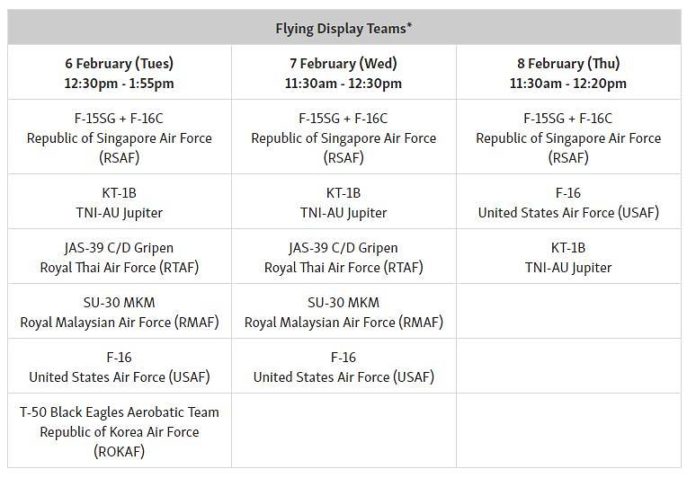
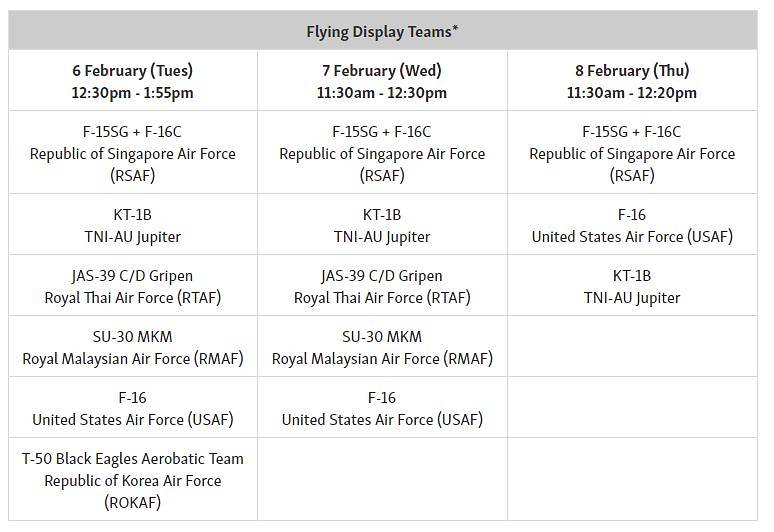
The revised schedule on the official Singapore Airshow 2018 website. (Source: Singapore Airshow 2018 website)
According to the revised aerobatic flying display programme on the official Singapore Airshow website, the Black Eagles are not slated to perform from Wednesday to Sunday.
The team was supposed to perform alongside other flying display teams from countries like Singapore, Malaysia and Thailand.
The incident that took place on Tuesday left the pilot with minor injuries. Close-up pictures online also showed the KAI T-50 Golden Eagle plane lying upside down on the grass which is covered with white foam.
They pulled off their stunts successfully at a media preview last weekend.
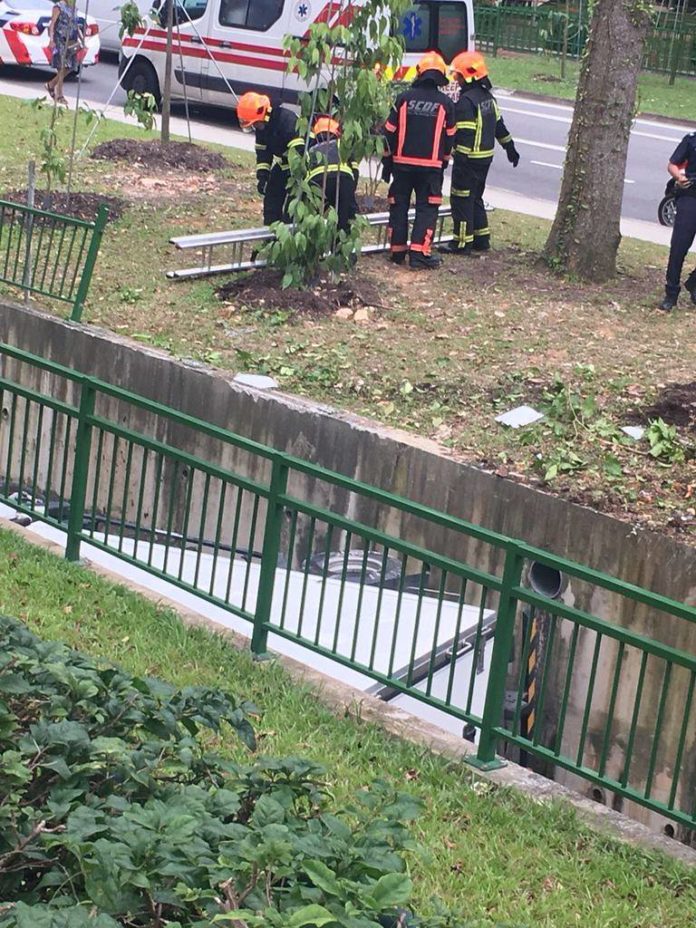
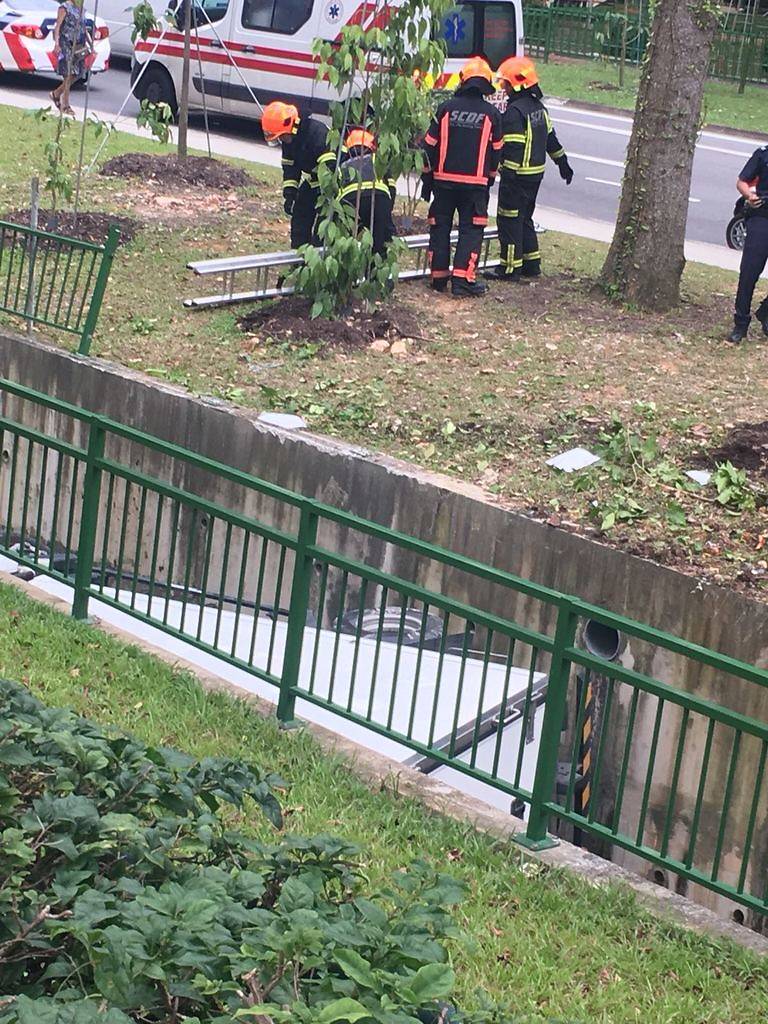
SINGAPORE: A 29-year-old man was taken to hospital after the lorry he was driving plunged into a drain along Lower Delta Road on Wednesday (Feb 7).
The Singapore Civil Defence Force said it was alerted to the incident at around 5pm on Wednesday. The lorry driver was conscious when he was taken to the Singapore General Hospital by ambulance, police added.
Channel NewsAsia understands that the man was not seriously injured. Police investigations are ongoing.
Ms Kerry Ng, who was at the scene in the aftermath of the accident, told Channel NewsAsia that the crash happened near an overhead bridge.
SCDF officers carrying a ladder adjacent to the drain. (Photo: Kerry Ng)
A photo sent by Ms Ng also shows that the drain railings were damaged in the crash.
This story came from a reader tip-off. If you would like to send in photos or videos of something newsworthy, WhatsApp our Mediacorp news hotline at +65 8218 8281 or message us on Facebook.
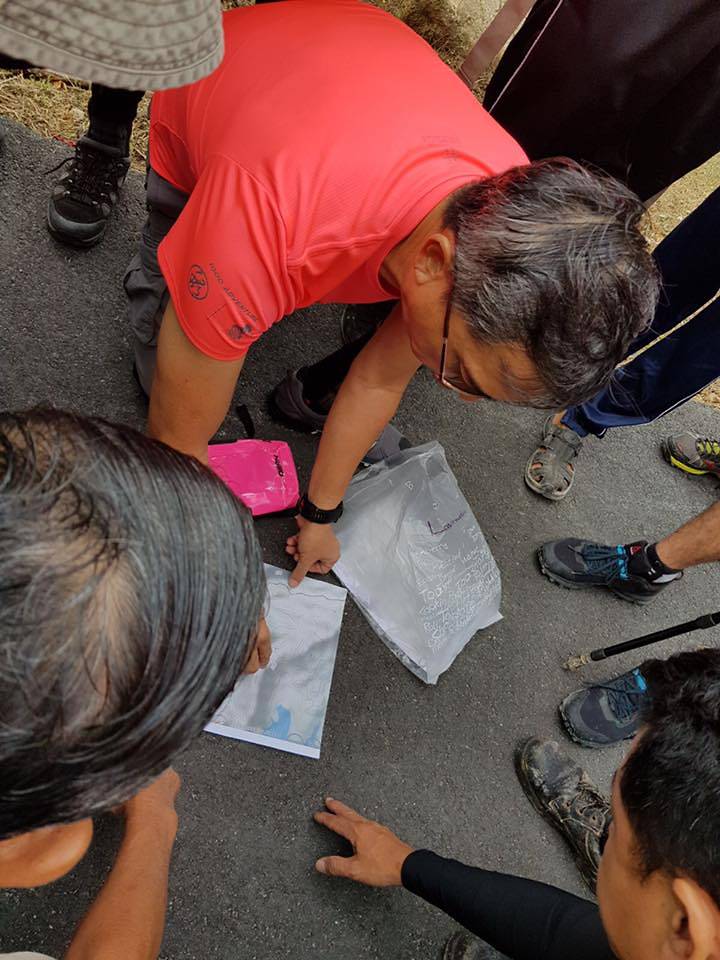
JOHOR BARU: The two Singaporeans reported missing at Johor’s Gunung Pulai could have gotten lost because they did not use a route usually taken by climbers, Johor police chief Mohd Khalil Kader Mohd said on Wednesday (Feb 7) afternoon.
Speaking to reporters at the search-and-rescue operations centre in Kampung Seri Gunung Pulai, Mr Mohd Khalil said that authorities have found “no signs” of the hikers, who had been missing since Monday.
The duo has been identified as Mr Dominick Tan Chang Xiang and Ms Clarice or Lum Jie, both 27. Mr Tan is said to be an experienced mountain climber who has hiked Gunung Pulai many times.
According to several posts on Facebook, a woman called Clarice or Lum Jie is one of the Singaporeans missing. (Photo: Catherine Tok/Facebook)
Mr Mohd Khalil said it had never taken this long to find anyone reported missing in the Gunung Pulai Forest Reserve.
He also said that authorities knew the missing hikers had telephones – a distress call was made on Monday – but the battery could have drained.
“To our Singaporean counterparts, rest assured we are doing our utmost best to ensure their rescue and bring them to safety,” he said.
Meanwhile, Kulai Fire and Rescue Station chief Mohd Khairi S Zainudin, who is the operations commander, said the usual route from the foothill near Kampung Seri Gunung Pulai to the peak was 3km long.
“The distance from the foothill was about 1.5km to Bukit 308, the last location from where the hikers had made the emergency telephone call,” he said.
Mr Dominick Tan and Ms Lum Jie are believed to have gone off the usual climbing trail at Mount Pulai in Johor. (Photo: Facebook/Chloe Quek)
The climbers had reportedly entered the Gunung Pulai area at 12.15pm on Monday and made the emergency telephone call to the authorities at 5.55pm on the same day. They were last contacted at about 10pm.
Singapore’s consul general in Johor Bahru, Rajpal Singh, was at the search-and-rescue operations centre and spoke to the families of the missing hikers.
The search operation involves nine groups of rescuers from various agencies, who are covering an area of 36km around Gunung Pulai.
Ms Chloe Quek, who said she is Ms Lum’s friend, wrote on Facebook on Wednesday afternoon to try and reach out to experienced hikers who might be able to “help cover the area”.
She said the search team would usually take off at 8am with “no ending time (some sleep on the mountain)”, adding that she would be “grateful” if people would spread the word and help build the team.
At the briefing, Mr Mohd Khalil advised climbers to keep to the usual route, which he said many climbers had strayed away from to admire the flora and fauna.
“If they want to stray, they should know how to set markers to enable them to get back to the route. Keeping to the route will prevent one from getting lost,” he said.
SINGAPORE: Following a scare in its ball pit last week, the operator of suspended net playground Airzone in City Square Mall has reassured guests of the attraction’s safety.
In a post that has since gone viral on social media, blogger Vivien Low – who runs a parenting blog – detailed how she panicked after losing her balance in the pit.
“We’ve been in contact with Vivien since her incident occurred, and we’ll continue to work through that,” said Mr Steve Wood, technical director at Ultimate Entertainments Group, which operates the attraction.
“We’re constantly reviewing all the safety aspects and we’ll continue to do so. The ball pit has been the most successful and talked about attraction on the Airzone.”
The ball pit. (Photo: Howard Law)
Airzone had also stated that it was “impossible” to drown in the pit, given that the 7cm balls were big enough and created an “extremely porous” pit.
“As it is not a safety issue, rather it is the guest experience that is paramount in this instance, we are still monitoring feedback from our guests and will decide in due course whether to change the current offering,” Mr Wood said.
When this reporter entered the ball pit on Wednesday (Feb 7), it was not difficult to maintain balance. You could fall over and find yourself completely submerged, but with a few kicks and swings, you would find your footing and emerge.
This attraction, however, is more than just 40,000 blue and white balls in a bouncy pit.
The crawl maze. (Photo: Howard Law)
Like a giant multi-layered hammock hanging more than 30m off the ground, Airzone also offers a wide play area and a crawl maze on different levels. Guests shuttle between the floors using slides and sloped passageways.
Each level, which holds a maximum of 20 people, will also have up to three first aid-trained staff who are taught to spot guests who need assistance. Children below the age of seven need to be accompanied by an adult.
“In terms of the engineering, we can put more people in,” Mr Wood said. “But we want everybody to have a great experience.”
One of the slides in the attraction. (Photo: Howard Law)
The best part about the attraction? “Being at 36m and being able to look to the floor, thinking I’m on what would appear to be a thin net, but really you’re very safe in this environment,” Mr Wood replied.
The nylon nets are attached to steel cables with “plenty of redundancy throughout”, allowing each square metre to endure more than 7,000kg of loading. This means the net can hold two fully loaded buses, Mr Wood said.
“It’s 12 times as strong as it needs to be in every single aspect, or greater,” he added.
The nets certainly held sturdy when jumping around in the play area, which was filled with three large Zorb balls. The highlight was falling backwards and feeling the “weightlessness” of being suspended in the middle of a shopping mall atrium.
While installing the attraction took only two weeks with the help of boom lifts and gondolas, Mr Wood noted, the engineering behind it took two years.
This is because he had to work with the Singapore Civil Defence Force to ensure guests could evacuate in 30 seconds, and the Building and Construction Authority to ensure the mall structure could support the added load.
“Because this is an existing building, we have to get the original plans,” Mr Wood said. “It’s quite challenging in terms of making sure all the parts are put together.”
Climbing up the floors. (Photo: Howard Law)
Mr Wood, a mechanical engineer who has worked on rides at the Marina Bay Carnival, said he decided to put Airzone in a mall to “take the attractions to the people and make it accessible and affordable”.
An hour in Airzone, which officially opens on Thursday, will set you back S$20, though an opening promo gives you 10 per cent off until the end of February. A four-session pass costs S$65.
Mr Wood said response has been “extremely successful”, with organisations like SAFRA and the Ministry of Education enquiring about the attraction.
“We can do dodgeball,” he noted. “It all depends on what they’re looking for, because everybody’s looking for something different.”
Attractions in Airzone can be modified to go higher and faster. (Photo: Howard Law)
Mr Wood is already thinking of bringing Airzone to other malls, but said its activities have to be tailored to the crowd there.
“There’re many different things that we can customise this space to,” he added. “Whether it’s laser tag, a ‘lepak’ one evening when it’s a sleepover, or a silent disco. The possibilities are endless.”
The act of MPs writing to the courts on behalf of their constituents is in the spotlight, after a High Court Judge said it was “somewhat troubling” for an appellant to try and downplay culpability through an MP’s letter.
Sengkang West SMC MP Lam Pin Min during a Meet-the-People session. (Photo: Lam Pin Min/Facebook)
(Updated: )
Bookmark
SINGAPORE: The Attorney-General’s Chambers (AGC) received approximately 400 letters last year from Members’ of Parliament (MPs) written on behalf of their constituents, a spokesperson told Channel NewsAsia on Wednesday (Feb 7).
Channel NewsAsia understands MPs’ letters, in general, deal with a wide range of issues and these are addressed on their individual circumstances. It is also understood that the agency does not track the number of letters written by People’s Action Party (PAP) or Workers’ Party MPs. Channel NewsAsia has approached both parties for comment.
The revealed figure shed more light on the practice of MPs writing to the courts on behalf of their constituents, after a High Court judge highlighted a letter written by MP Lam Pin Min on behalf of Tang Ling Lee on the motor accident between her and victim Mr Vikaramen A Elangovan.
According to local media reports, the letter by Dr Lam, who is also Senior Minister of State for Health and Transport, said Tang had only “accidentally brushed a motorcyclist resulting in the motorcyclist sustaining some injuries”.
But the victim suffered multiple fractures requiring a dozen operations in two months, and was hospitalised for 69 days after he was hit by the car she had been driving, the Straits Times reported on Feb 1.
“These statements are regrettably misleading if they correctly reflect what she had conveyed to the MP,” Justice See Kee Oon said in his grounds of decision.
“They are also not consistent with the SOF (statement of facts) that she had admitted to. It would appear that they sought to unfairly trivialise the accident and diminish the true extent of the victim’s substantial injuries.”
Following this, the PAP reportedly said it has no specific governing rules on the sending of MP letters to the courts or other agencies or ministries, but it has a “longstanding internal protocol”. This includes stating that if a resident runs into some problem with the law, the MP will listen carefully and sympathetically to the resident to understand his problem and, if the resident requests the MP to do so, the politician will write a letter to present the person’s case.
It also stated that the MP may write to the AGC under these two conditions: If charges have not yet been brought against a person, and if the MP is appealing for the AGC to not pursue charges.
If the case is already before the courts, and the appeal concerns a matter that is for the court to decide, such as an appeal for leniency in sentencing, MPs are generally advised to write to the Ministry of Law (MinLaw). MinLaw will then forward the letters to the courts for consideration.
MPs may sometimes use their discretion to give letters by hand to residents to be used in court in “urgent cases”, such as if the court hearing is in the next few days, PAP said.
Members of the public, however, have raised questions regarding this practice of MPs writing to the courts.
A retired district judge, Low Wee Ping, wrote in a letter published in the Straits Times on Feb 6 that when he was a Subordinate Courts’ Registrar, he was instructed by then-Chief Justice Wee Chong Jin “to ignore such MP letters, to not send them to the judges and to return them to the PAP Whip”.
“The reason, I was told, was that founding Prime Minister Lee Kuan Yew had instructed all MPs (in writing) that they should not be writing such letters to the courts,” he wrote.