Singapore
Wednesday, February 21, 2018 – 17:28
Former City Harvest church leader Chew Eng Han arrested at sea while trying to flee Singapore
The Straits Times
Others

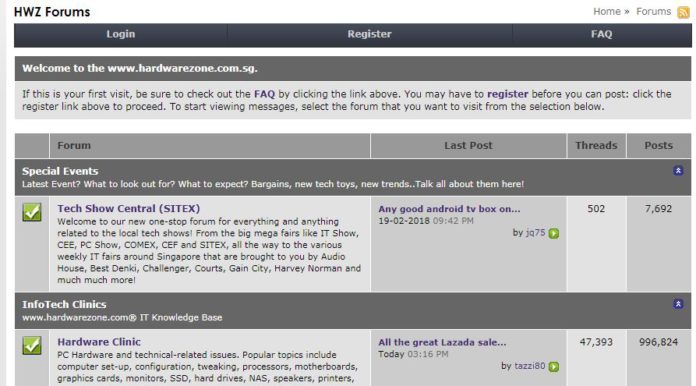
About 685,000 registered user profiles on the HardwareZone (HWZ) Forum website were found to be affected in a security breach, following an investigation into a suspicious posting on Feb 18, 2018.
According to a press release from SPH Magazines which owns the website, investigations found that a Senior Moderator’s account had been compromised by an unidentified hacker. It was used to view approximately 685,000 registered user profiles since September 2017.
“The hacker used the compromised credentials to impersonate the Senior Moderator to retrieve user profile data which comprised name, email address and user ID, and possible optional data fields,” said the statement.
It added that the HWZ database does not contain NRIC numbers, telephone numbers and addresses as these were purged in line with the Personal Data Protection Commission (PDPC) Guidelines in July 2015.
Forum users have been advised to change their forum account password.
SPH Magazines says a police report has been lodged and PDPC has been informed. It has also engaged security consultants to conduct a thorough review of the system.
“SPH Magazines and HWZ sincerely apologise to HWZ users for this breach of security. We remain committed to protecting all personal data shared with us,” said the statement.
a1admin@sph.com.sg
A 45-year-old married man had sex with a 15-year-old girl five times within three days and was sentenced to 24 months’ jail.
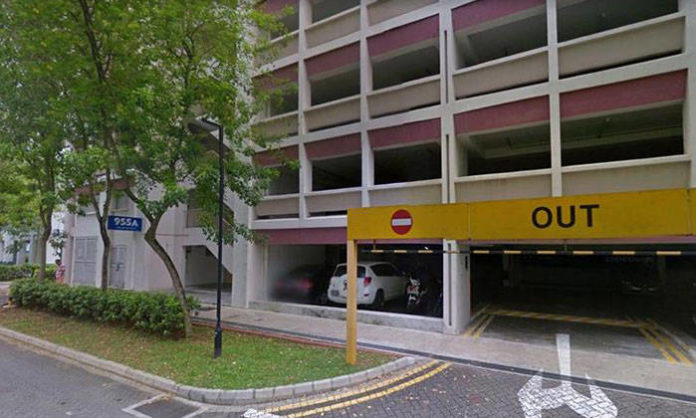
The sexual acts took place in a hotel pool, a multi-storey carpark and in his car, between November and December 2016, reported Shin Min Daily News.
After the incident was exposed, the man, a director of a company, divorced from his wife, lost his job and is now working as an Uber driver.
Chen Liyuan, 45, fetched a monthly salary of over $10,000 during the time of the incident.
He forked out $1,600 from his salary which he paid as ‘allowance’ to his sugar baby, who was only 15 years old then.
Chen faced five counts of having sexual relations with a minor, of which he was charged with three.
The two others were taken into consideration during the sentencing.
The court heard that Chen had met the girl in November 2016 via a website, ‘Seeking Arrangement’ and exchanged contact details with her.
The two chatted on WhatsApp after that and reached an agreement — Chen would give the girl a $1,600 ‘allowance’.
In exchange, the girl would provide Chen with companionship and sex.
According to court documents, on Dec 15, 2016, at around 7.30pm, Chen and the girl met at Capella Hotel in Sentosa.
He then brought the girl to a pool, where he asked her to perform oral sex on him.
On the same day, Chen drove the girl to Nex Shopping Centre.
Along the way, Chen stopped his car at a section of Bishan Road, near a bus stop.
There, the girl was asked to perform oral sex on Chen again.
Three days later, on Dec 18, Chen and the girl met again at a void deck of a Housing and Development Board (HDB) block in Hougang so the girl could collect her allowance.
Afterwards, the girl performed oral sex and the pair engaged in sexual intercourse in Chen’s car which was parked at a multi-storey carpark nearby.
Chen’s lawyer said during the mitigation plea that Chen has a seven-year-old son from his previous marriage, and owed credit card debts amounting to $37,000.
He also said that his client felt remorse over his actions and was depressed, having lost his job and his marriage.
Chen was sentenced to 24 months’ jail.
Sex offences
SINGAPORE: In life, there are two certainties – death and taxes. Or so the saying goes.
Following the Budget 2018 speech by Finance Minister Heng Swee Keat on Monday (Feb 19), there are now three more certainties – when it comes to the highly anticipated increase in the goods and services tax (GST) in Singapore.
First, there is certainty that we will not see any for at least the next three years.
Yet the fact that GST will not be raised in this term of Government is no surprise.
Although the announcement of a hike years in advance of its implementation is unprecedented, it is consistent with the clarification made by Tharman Shanmugaratnam at Budget 2015 when he was Finance Minister that the revenue measures the Government has undertaken will provide sufficiently for the increased spending needs planned for the rest of this decade.
It is also consistent with the statement by the Ministry of Finance in August 2015 that there is no basis that the Government will raise GST after the 2015 General Election.
It is useful that the decision to raise GST seems grounded not on political expediency but economic considerations.
NO NEED THIS TERM OF GOVERNMENT
Most people attribute the Government’s ability to postpone the GST hike to the almost S$10 billion budget surplus for 2017 arising from higher government revenues, the biggest single-year surplus in 30 years.
People say the Government was “lucky” revenues were higher, allowing it to defer the GST hike.
But the fact is the Government’s fiscal position has been strengthened with measures introduced progressively over the past decade.
These include the previous hike in the GST rate from 5 to 7 per cent in 2007, the introduction of the Net Investment Returns (NIR) framework in 2008 to enhance revenues, the inclusion of Temasek in the NIR framework and the raising of personal income tax rates for the top income brackets in 2015.
It is this stronger fiscal position built up quietly and gradually that allowed the Government to commit publicly that it has no intention to raise GST after the 2015 General Election.

Old HDB flats in Singapore. (Photo: Marcus Mark Ramos)
A rise in GST is a move the Government takes great pains to introduce, given its impact on the cost of living and doing business. A look at the Government’s track record suggests it understands this.
Before GST was first implemented in 1994, then Finance Minister Richard Hu had said that it would be capped at 3 per cent for at least five years. The Government also rolled out a slew of relief measures and cuts in personal income and corporate income taxes to help manage its impact in the short term.
The GST was only raised almost ten years later, to 4 per cent in 2003 and 5 per cent in 2004 – with Economic Restructuring Shares given out to help Singaporeans cope.
BUT A NEED IN THE NEXT TERM OF GOVERNMENT
The second certainty is that the GST hike will likely occur sometime in 2021 to 2025.
This timing seems coincidentally close to the next General Election which is due in 2021 but is essentially needed to cope with the anticipated surge in government expenditure from 2021 onwards.
Might it be that the financing for huge infrastructure works to build Changi Airport Terminal 5 (to be completed in 2030), the Tuas Megaport (to be completed in 2040 and opened progressively from 2021) and the Kuala Lumpur-Singapore High Speed Rail (to begin operations around 2026) will all come to a head then?
Regardless, there is no urgency to increase revenues earlier in view of the Government’s expected sound fiscal position for the rest of this decade.
It also doesn’t make sense from a budgeting perspective to raise revenue now in this term of Government, only to have it locked up as Past Reserves in the following term when it is needed.
A view of the site where Terminal 5 will be built.
WHY 9 PER CENT?
A third certainty is that the GST will increase by 2 percentage points, from 7 to 9 per cent.
Economic projections show that an increase of up to 1 percentage point in GST may not generate sufficient revenue to fund expected increases in spending needs in the areas of healthcare, infrastructure, security and education in the next decade.
Where a 2 percentage point increase is expected to yield 0.7 per cent of Singapore’s GDP and additional tax revenues of S$3.2 billion – this increase puts the Government budget on a stronger footing to close the expected revenue and expenditure gap.
This is even as the Government explores new ways to finance infrastructure projects (through a new Rail Infrastructure Fund and a potential move to allow borrowing by Statutory Boards and Government-owned companies backed by Government guarantees), and manage ministries’ expenditure growth (through moderating their block budget growth).
Although it is not the only source of revenue for the Government to tap on, GST emerges as the top candidate in its search for a reliable and sustainable source to fund Singapore’s future needs.
GST SYSTEM REMAINS PROGRESSIVE
Looking ahead, Mr Heng reiterated that the GST hike will be done in a “progressive manner” with sufficient help rendered to lower- and middle-income households to cope with the increase.
Indeed, it looks to be the case. Though GST is regressive in nature, one must understand that the GST system in Singapore has always been uniquely structured in a progressive way with the introduction of GST offset packages.
These packages have been later replaced by a permanent GST Voucher scheme for low-income households and seniors.
So it should be a relief that the announcement of a rise in GST was accompanied by an announcement of an enhanced GST Voucher scheme and the reassurance that the Government will continue to absorb GST on publicly-subsidised education and healthcare.
This advance notification is certainly welcome news, even as the exact timing of its implementation will depend on the state of the economic, the growth of government expenditures, and revenues from taxes over the next few years.
Together with the assurance of help for lower-income households and seniors, this long lead time gives businesses and households more confidence that they will be prepared for its eventual implementation.
Seniors working together to prepare meals. (Photo: Montfort Cares)
ONE MORE UNCERTAINTY
What remains uncertain is whether the increase will be done in phases – as was the case when GST was raised from 3 to 4 per cent in 2003 and 4 to 5 per cent in 2004 – or whether it will happen at one go, as was the case in the last increase from 5 to 7 per cent in 2007.
Consumers will definitely prefer a phased increase to draw out the impact on the cost of living over a few years, but most businesses are likely to prefer “biting the bullet” in a one-time increase.
Many businesses may find their GST burden mitigated to the extent that they can pass off costs to consumers or qualify for GST refunds.
Staggering the GST increase could also translate to higher business compliance costs involved in the required re-configuration of computer systems and changes in GST invoice formats.
Coming after more than a decade, the imminent GST hike is greatly anticipated but the long lead time to implementation will provide temporary reprieve.
Lower-income households should be assured of similar support from the Government based on past GST hikes.
Indeed, the move to raise GST to 9 per cent, coupled with the decision to announce this years ahead speaks of a Government that thinks of the long term and makes its fiscal decisions based on strong economic principles.
Simon Poh is Associate Professor (Practice) of the Department of Accounting at NUS Business School.
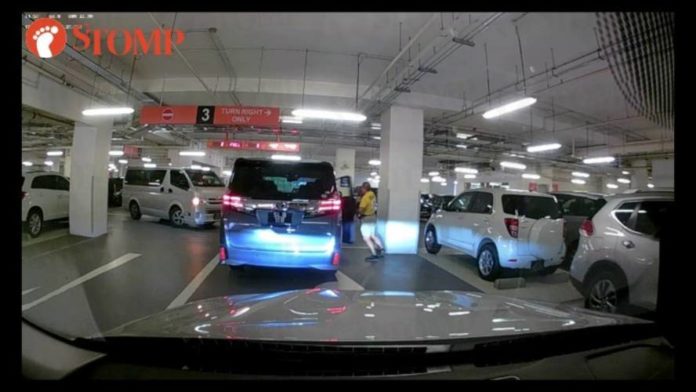
Stomp contributor Alan was at Chinatown Point’s carpark when he witnessed a fight between two drivers at around 5.26pm on Feb 9.
He caught the entire incident of what he described as “absurd behaviour” on his car camera and shared it with Stomp.
Alan was waiting to turn right when the driver of the car in front of him suddenly exited his vehicle in a rage to confront a van driver who had turned right only to reverse into a parking lot to the left.
In the video, the driver in yellow storms towards the van and starts berating the driver, even reaching into the vehicle to grab a bag and throw it to the ground.
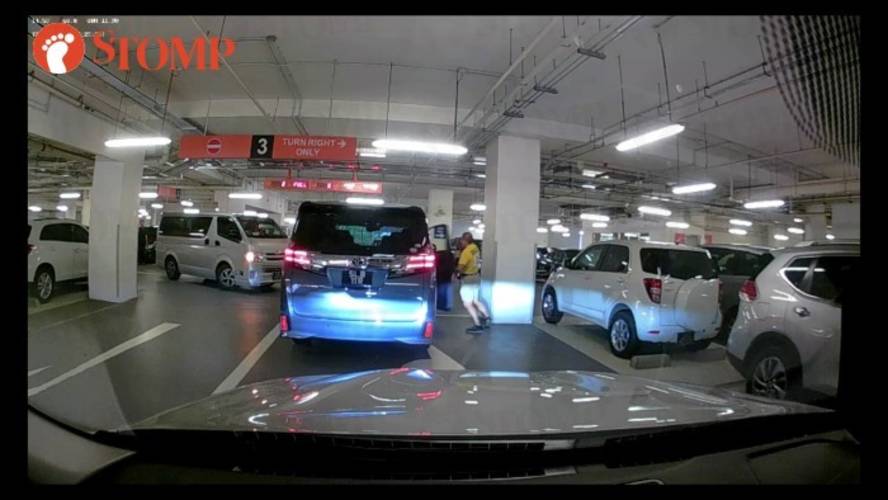
A man, believed to be a companion of the van driver, rushes over to confront the man in yellow and starts throwing punches.
Soon the van driver leaps out of his vehicle to join the fight, throwing kicks and punches before grabbing the man by the neck and throwing him to the ground.
Other acquaintances of both drivers rush to break up the fight and they proceed to retreat to their respective vehicles.
However, the driver in yellow then unexplainably drives his vehicle right at a man from the van before jamming his brakes in what appears to be an act of intimidation.
He then turns right and stops a few lots down from the van before the video ends.



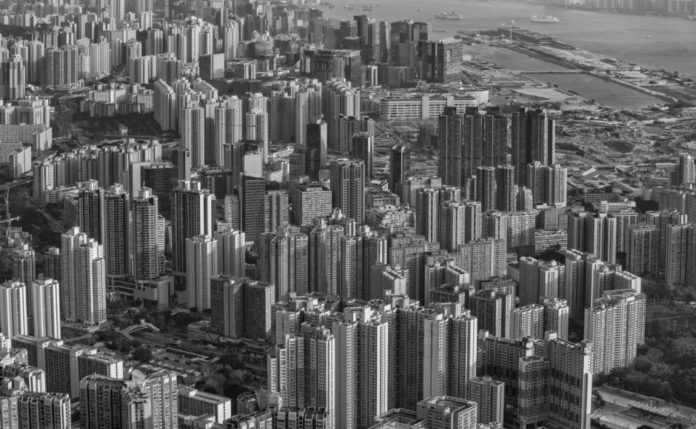
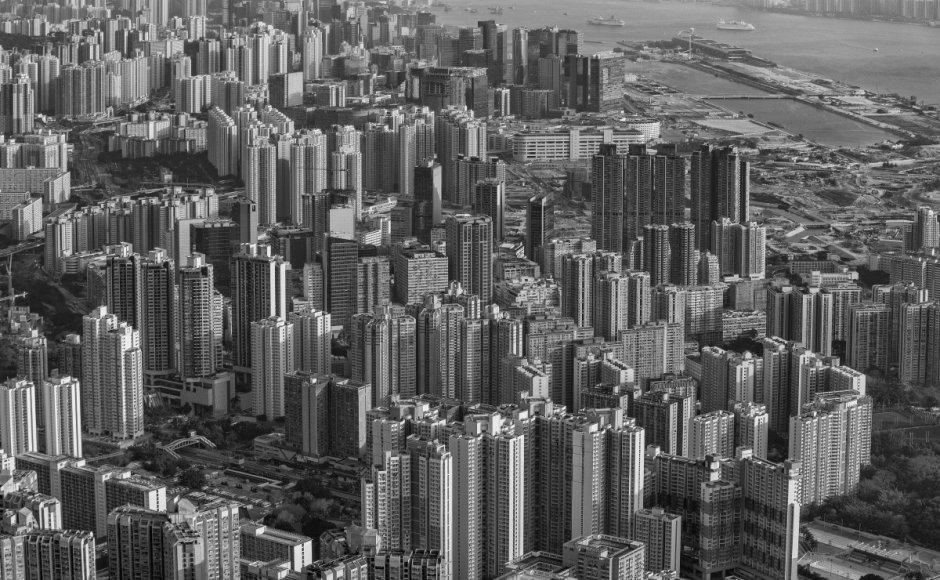
Companies can expect to pay US$2923 per square metre in Hong Kong. Source: Steven Wei/Unsplash
ASIAN cities are coming to dominate the most expensive cities to have an office on the planet, according to new research from real estate website Commercial Café.
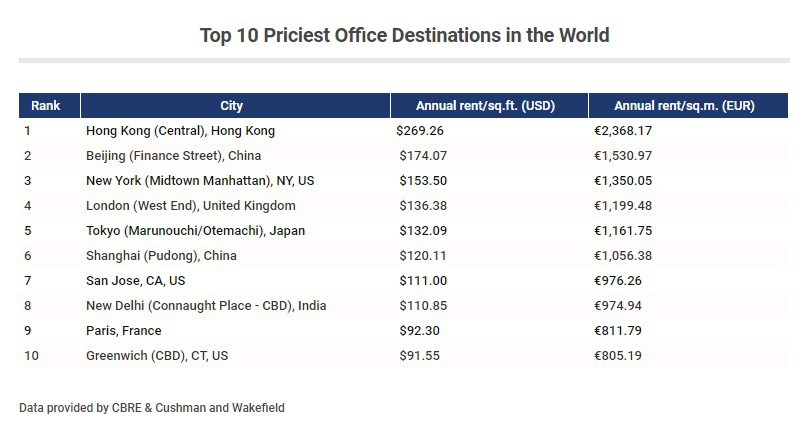
The business districts of Hong Kong and Beijing trumped both Midtown Manhattan in New York and London’s West End as the world’s priciest office addresses.
Companies can expect to pay a whopping US$269.26 per square foot or €2,368.17 (US$2923) per square metre annually for the privilege of having office space in the Central district of Hong Kong.
Crazily dense HK was in a “league of its own” said Commercial Café, noting that rent was 55 percent higher than at second-placed Beijing’s Finance Street – where office space is a cool €1,530.97 (US$1890) per sq. m. a year.
Source: Commercial Cafe
SEE ALSO: Green cities: Tokyo announces plans for world’s tallest wooden skyscraper
Central HK rent was 75 percent higher than Midtown Manhattan and even with a budget of US$10,000, companies can only get themselves a mini office of 41 sq. m.
In the fifth-placed Marunouchi/Otemachi district of Tokyo, businesses will be paying €1,161.75 (US$1,434) per sq. m.; in Shanghai’s Pudong they will fork out €1,056.38 (US$1,304). Connaught Place in New Delhi was ranked eighth above Paris, costing $1200 per sq. m.
Asian financial centre Singapore was ranked relatively low at 19th for destinations outside of the US – making it more affordable than Sydney, Mumbai, Seoul and Shenzhen.
186888
SINGAPORE: Battling flames gets harder – and more dangerous – when you’re on a ship out at sea.
That is why marine firefighters train on a ship simulator at the Marine Fire-Fighting and Rescue Training Facility, which can realistically replicate a real-life incident.
Marine fires and rescues are just some of the incidents the Singapore Civil Defence Force’s (SCDF) Marine Command Force Operation is specially trained to handle. It responded to 10 such emergencies last year and also in 2016 – the highest number since the division was set up nearly six years ago.
This is ORCA, the ship simulator SCDF Marine Firefighters extensively use as part of their 5-week training programme. (Photo: Ashraf Zainal)
“In a land scenario, when the going gets tough, they (firefighters) can always exit the building and run to safe ground,” said Major Neo Jia Qi, commander of the West Coast Marine Fire Station. “However, out at sea, the only place they can stay safe is a floating platform, such as a floating vessel. So there are actually very (few) safe places.”
Including the West Coast and Brani Marine Fire Stations, the Marine Command has about 200 personnel, including support staff. Marine firefighters are specially selected and have to undergo an additional five-week training programme on top of their firefighting and rescue training to learn to handle such incidents.
Warrant Officer 1 Chan Kim Min, marine section commander of the West Coast Marine Fire Station, said: “We have to start with hauling of equipment before we can even begin operations on board the vessel. After hauling all the equipment, which will take at least 20 minutes, our guys will already be exhausted. So with that limited amount of manpower, we have to acclimatise and manage the operation as best as we can.”
IN THE SHOES OF A FIREFIGHTER
I spent a day at the training facility to find out just how challenging the job is.
Just putting on the firefighting suit was enough to make me sweat from the heat. It was also a challenge getting used to the weight of the breathing apparatus, which was about 21kg.
There are currently only 200 marine firefighters in the SCDF, ready for fire and rescue incidents out at sea. (Photo: Ashraf Zainal)
There was also the difficulty of getting used to breathing with the mask, as well as communicating and taking instructions.
As for the firefighting itself, it was exhilarating, extremely hot, tiring and scary all at the same time.
It’s not just about spraying water towards the fire. There’s a technique involved to the positioning and type of spray needed to fight fires. (Photo: Ashraf Zainal)
Besides fires, marine firefighters also have to deal with chemical attacks on board ships. This requires them to suit up as well, in a slightly different way.
The red high-performance suit offers a high level of protection from direct exposure to chemical agents, and is worn by personnel who need to remove a chemical agent source.
The lining of the suit is filled with activated carbon and offers skin and respiratory protection for personnel operating in contaminated environments. (Photo: Ashraf Zainal)
Those wearing the grey chemical agent suit, which offers skin and respiratory protection in contaminated environments, deal with search and rescue, and casualty conveyance.
Harder and harder to breathe – using a gas mask during times of chemical agent crisis is necessary, but getting used to limited air is a challenge. (Photo: Ashraf Zainal)
Victims are brought to the men in white light decontamination suits, who wash down casualties. This was the outfit I tried on.
This light decontamination suit is used by personnel performing decontamination roles, offering respiratory and splash protection from contaminated water used to wash down casualties affected by a chemical agent. (Photo: Ashraf Zainal)
Besides being drenched in sweat again, I found it hard to wash down someone while wearing a layer of protective wear. My sense of control, when trying to cut a casualty’s outfit and spray it with water, was inhibited because of the rubber gloves. In a crisis, trying to keep calm while doing all this would be a big challenge.
Officers practice climbing 7.4m ladders like these as they are the only means to get on board a ship for rescue. (Photo: Ashraf Zainal)
As part of their training, marine firefighters also have to conquer obstacles. One of them is a 7.4m ladder climb, which helps them get used to climbing up the ships. This was not hard, but only because I had a harness on, and the ship was stationary instead of out at sea.
Taking the plunge with a 4.5 meter leap into a 9-meter deep pool. Think you can handle it? (Photo: Ashraf Zainal)
Finally, in the event one needs to abandon ship, there’s also a confidence jump – a 4.5m leap into a 9m-deep pool. All this to ensure marine firefighters can cope with incidents swiftly and effectively.


