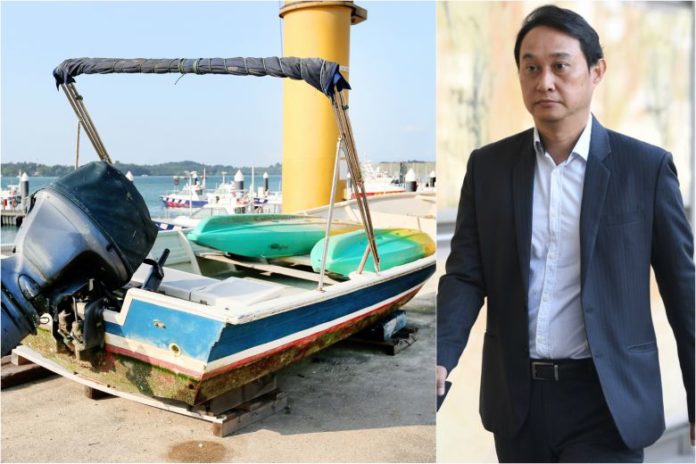
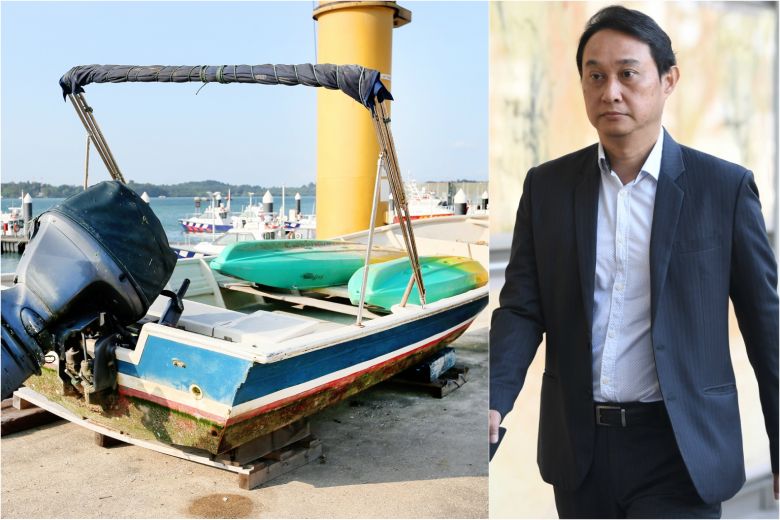
SINGAPORE: Former City Harvest Church leader Chew Eng Han was charged on Thursday (Feb 22) with attempting to flee the country from Pulau Ubin in a motorised sampan on Wednesday morning.
He was on bail of between S$75,000 and S$1 million and due to turn himself in on Thursday to start serving a jail term of three years and four months for his role in the misappropriation of S$50 million of church funds. It was the largest fraud involving charitable funds in Singapore’s history.
Chew, 57, was arrested at sea at 8.47am on Wednesday for leaving the country from an unauthorised point of departure “without being compelled by accident or other reasonable cause”, court documents stated. The sampan, piloted by Tan Poh Teck, was intercepted by the Police Coast Guard about 2.4km away from Pulau Ubin.
Tan, 53, was also charged on Thursday with abetting Chew’s attempted illegal departure by taking him on his fishing boat bound for Malaysia.
Tan Poh Teck was piloting the boat that carried former City Harvest leader Chew Eng Han when it was intercepted by the coast guard. (Photo: TODAY/Koh Mui Fong)
The pair had claimed to be on a fishing trip when they were arrested. The coast guard, which intercepted the boat following a tip-off, said a preliminary investigation revealed the men were headed to Malaysia.
The authorities seized S$5,000 in cash and fishing equipment from the sampan.
Both men face one charge under the Immigration Act of attempting to leave Singapore unlawfully at an unauthorised point of departure.
Channel NewsAsia understands Chew had boarded the sampan at Pulau Ubin, where he had travelled from the mainland on his own.
If convicted, they face up to six months’ jail and a fine of up to S$2,000.
The authorities arrested Chew’s older brother Eng Soon, 61, at about 3.40pm on the same day. Chew Eng Soon had abetted his brother to flee the country, authorities allege. He has not yet been charged.
LOS ANGELES – Jennifer Lawrence on Wednesday blasted a controversy over a photo of her wearing a plunging black dress outside on a cold London day as sexist, ridiculous and “not feminism.”
The Oscar-winning star, 27, said in a Facebook posting that she was also “extremely offended” by what she called the”utterly ridiculous” reaction on social and mainstream media to the photo, taken as part of promotions for her upcoming movie”Red Sparrow.”
The picture, taken outdoors on a bitter winter’s day in London earlier this week, showed a bare-shouldered Lawrence wearing a black gown, while actor Jeremy Irons and three fellow cast members donned thick wool coats.
Many commentators saw the photo as a reflection of the pressure on women in Hollywood to look good, particularly given Lawrence’s previous outspoken criticism of the gender pay gap in the movie industry.
“True equality means either Jennifer Lawrence getting a coat, or Jeremy Irons having to pose for a photo call in assless chaps,” tweeted London journalist Helen Lewis.
Australian journalist Stephanie Peatling remarked on Twitter that it was “cold enough that the bloke actors have to wear coats and scarves to their press call and yet poor Jennifer Lawrence is wearing a small amount of fabric some might call a dress.” Lawrence, one of the most sought-after actresses in Hollywood, was having none of it.
“That Versace dress was fabulous, you think I’m going to cover that gorgeous dress up with a coat and a scarf? I was outside for 5 minutes. I would have stood in the snow for that dress because I love fashion and that was my choice,” she wrote on Facebook.
“This is sexist, this is ridiculous, this is not feminism,”she added. “It’s creating silly distractions from real issues. Get a grip people” “Red Sparrow,” a thriller in which Lawrence plays a Russian spy, opens worldwide next week.
SINGAPORE: Budget 2018 marks a decisive step in Singapore’s hard-fought economic transformation.
Finance Minister Heng Swee Keat highlighted on Monday (Feb 19) a vision of anchoring Singapore as a node of technology, innovation and enterprise.
“We must make innovative pervasive in our economy, develop deep capabilities in our firms and workers, and establish strong partnerships locally and abroad,” he said.
The Finance Minister shared how local concrete mixer Pan United had harnessed pervasive innovation to develop a breakthrough product that could cushion aircraft landings.
Stories like these tell us that if any city were to succeed in economic transformation, Singapore should be counted among the top.
TRANSFORMATION TRADITIONALLY DRIVEN FROM THE TOP
Indeed, Singapore’s Smart Nation movement has ensured that the necessary foundations are in place from which innovations across the island could scale up with data.
In the early stages of the Smart Nation movement, the Government moved swiftly to develop the necessary infrastructure that would undergird the widespread use of technology, networks and data to improve the way we work and live.
Over the past three years, it has embarked on a HetNet (Heterogeneous Network) trial programme to blanket our Little Red Dot with always-on Internet-connectivity; introduced regulation to protect the privacy of individuals through the Personal Data Protection Act; and encouraged a culture of co-creation with data to allow disruptive thinking to shape public policy-making.
Similarly, the national skills-upgrading programme SkillsFuture has built on Singapore’s success in developing a well-educated population with the necessary formal qualifications to compete for jobs in the global marketplace.
The initiative saw more than 400,000 people undergo training in 2016, demonstrating the country’s resolve to invest in the development of its people, where many other cities have not.
A person accesses the SkillsFuture website. (Photo: Christy Yip)
Yet if the Budget aims to nurture a culture of pervasive innovation, this inclination towards a top-down approach must stop at the water’s edge.
To enable a groundswell of genuine transformation stemming from self-motivation and have the private sector step up, perhaps the Government needs to step back.
While companies can take advantage of initiatives such as the newly announced Open Innovation Programme to crowdfund digital solutions, these businesses should also embrace the Government’s call to embed “deep capabilities” into their own organisations in their bid to transform into competitive firms for the digital economy.
There are a slew of other schemes that aim to support companies in digitalising and building new capabilities – including the Enterprise Development Grand and the SME Digital Go programme.
But there are limits to Government assistance because the onus ultimately is on companies to take the plunge.
Companies must proactively think and act to acquire capabilities that enhance their disruptive quotient – by leveraging technology and big data to work in a smarter way and capitalise on new opportunities.
In all these endeavours from the Government to boost innovation, what is arguably missing are more success stories that can spur other companies on and help them see how building digital capabilities can help grow their business in a tangible way.
Finance Minister Heng Swee Keat delivering the Budget 2018 statement.
I would argue that one capability to acquire is self-service data analytics, where an entire workforce – not just the ICT department – would become skilful at making productive decisions on behalf of the business using data.
Firms should be encouraged by stories of those who have been successful at instilling such a pervasive culture in data literacy.
In that regard, one needs not look further than to Grab, one of Singapore’s most iconic disruptors and Southeast Asia’s leading ride-hailing app.
POWERING OPERATIONS THROUGH DATA
Grab recognised from the onset that it couldn’t simply become another traditional transport company to compete effectively, much less run its operations that way.
It needed to act and position itself as a disruptor whose lifeblood runs on data – the currency for the digital age – while catering to the ability of its entire workforce to see and understand data for themselves.
Grab tapped on a cloud-based, data analytics platform Tableau Online to centralise millions of rows of customer data and help various business units make data-guided decisions around app development, new business opportunities and overall user experience. The company recently reported a 60 per cent increase in Tableau users among its own workforce, in just a mere six months.
Dr Kong-Wei Lye, Grab’s Head of Data Science shared:
Data is a huge asset at Grab. With this huge amount of data, we are able to analyse the travel patterns as well as the preferences, and the likes and dislikes of our customers. And with that, we are able to improve on our products.
Grab reported that these efforts have led to significant productivity gains and better decision making, such as delivering on more strategic product launches and ultimately a “super local” app experience.
Data has also allowed Grab to make game-changing decisions – for instance the installation of a physical Grab booth at a few airports around Southeast Asia including Jakarta and Manila where the demand for a reliable and safe ride into the city is arguably one of the highest but visitors might not have immediate mobile access.
Grab staff there book taxis on behalf of customers, improving Grab’s market capture of rides in those cities.
Commuters wait for a train next to Grab transport booking service app advertisements at a train station in Singapore on Feb 10, 2016. (File photo: REUTERS/Edgar Su)
Grab is just one of many firms that are reaping the dividends of these deep capabilities such as self-service data analytics.
Others should also feel encouraged to step up and seize on the Budget’s bold measures, build on Singapore’s Smart Nation movement and partner with technology platforms to thrive in the digital economy.
In the same vein, education institutions from the private sector can also do more to strike partnerships with industry and apply technology to help Singapore’s workforce adopt a culture of lifelong learning.
USE OF TECH IN PERSONALISED AND GUIDED LEARNING
Last year, PSB Academy, one of Singapore’s largest private education institutions, inked exclusive partnerships with education technology platforms like Pearson to develop an online learning portal that over 12,000 students can access from any device at any time.
The Academy also invested in a new initiative that allows working adults to attend classes virtually, and engage with their peers and lecturers via video conferencing into tutorial rooms and auditoriums at PSB’s S$15 million City Campus.
By integrating learning for students across multiple platforms, PSB has been able to provide personalised education journeys for each student.
These are in turn strongly supported by guided learning formats that include face-to-face engagements with experts from both university partners and industry to bring students the best of both digital and physical worlds.
A picture of PSB Academy. (Photo: PSB Academy’s Facebook page)
Amid reports of dire employment rates of students from private schools in general, PSB’s approach to teaching has yielded strong graduate outcomes.
In 2017, close to eight in 10 graduates from PSB found employment within six months upon graduating from the institution, while six in 10 shared that they acquired skills from PSB that enabled them to perform better at their job.
Against a sector that is reportedly shrinking by double-digit percentages, PSB registered a double-digit percentage growth in student population for two consecutive years.
As with Grab’s experience in disrupting Singapore’s private transportation sector, PSB’s rapid adoption of education technology demonstrates how an organisation from a traditional sector can harness pervasive innovation to benefits its customers and break out from the staid norms of its sector.
Singapore Budget 2018 is a significant signal from a Government with a reputation for its resolve to not only chart ambitious transformation maps, but to also resolutely see these plans through.
From “capability transfers” to “tech skill accelerators” costing S$148 million over three years, the Budget is packed with programmes that aim to ramp up Singapore’s companies and workforce.
While many Singaporeans seem sufficiently satisfied with their “Budget hongbaos”, these red packets pale in comparison to the multi-billion-dollar dividends that businesses and people can reap from these Budget initiatives – on the condition that they become active participants in Singapore’s drive to create a culture of pervasive innovation.
Marcus Loh is Vice President of Marketing and Corporate Communication at PSB Academy and an accredited member of Singapore’s apex chamber for communication management practitioners, the Institute of Public Relations of Singapore.
SINGAPORE: Former City Harvest Church fund manager Chew Eng Han was arrested on Wednesday morning (Feb 21)for attempting to flee the country in a sampan, the police said at a news conference.
The 57-year-old, one of six church leaders convicted in 2015 of misappropriating S$50 million of church funds, had been out on bail and was due to turn himself in on Thursday to begin his jail term.
Another man, 53-year-old Tan Poh Teck, who was piloting the motorised sampan, was also arrested.
In a split decision by the High Court last April, Chew had his original six-year jail sentence lowered to three years and four months. Chew is the only one of the six who has not started serving his jail term for criminal breach of trust and falsification of accounts.
Three Police Coast Guard boats intercepted the motorised sampan in the sea off Pulau Ubin at about 8.45am on Wednesday after acting on a tip-off. About S$5,000 and fishing equipment was found on the boat.
The two men in the boat said they were going fishing when they were surrounded by the Police Coast Guard vessels about 2.4km away from the Pulau Ubin jetty, Channel NewsAsia understands. However, preliminary police investigations suggest the boat was headed to Malaysia.
It is understood that the two did not resist arrest.
Chew Eng Han was found on board a motorised sampan in the sea off Pulau Ubin with about S$5,000 in cash and fishing equipment. (Photo: Gaya Chandramohan)
Items seized from the motorised sampan. (Photo: Gaya Chandramohan)
Chew is currently held in the police lock-up in Cantonment Complex. He will be charged in court on Thursday morning.
Both men may be jailed up to six months and fined S$2,000 if found guilty of leaving Singapore unlawfully.
Police also arrested a third man, 61-year-old Chew Eng Soon, on Wednesday at 3.40pm for abetting the offence. It is understood that he is Chew Eng Han’s brother.He may be jailed between six months and two years, and fined up to S$6,000 if found guilty.
Church founder Kong Hee, 52; deputy senior pastor Tan Ye Peng, 44; former finance manager Serina Wee, 40; former finance committee member John Lam, 49; and former finance manager Sharon Tan, 41, started their respective jail terms on Apr 21 last year.
Chew, who was also supposed to start his jail term on that day, asked the court to defer his sentence until after a Court of Appeal case brought by the prosecution to clarify the law under which the six of them were convicted.
The High Court granted Chew, who was representing himself, the deferment so he would have time to conduct research and access the resources to conduct his own defence.
Chew also tried on two occasions to challenge his conviction.
The apex court rejected his first attempt last July after his effort of referring nearly 60 questions did not meet the required threshold. In September, the apex court threw out his second.
And when the Court of Appeal earlier this month upheld the High Court’s decision to convict the six of less serious criminal breach of trust charges, Chew asked to defer his sentence for one last time to spend Chinese New Year with his family.
When asked if Chew had his passport at the time of arrest, Police Coast Guard commander Senior Assistant Commissioner of Police (SAC) Hsu Sin Yun said: “For investigative matters I will not be able to comment too much at this point of time.”
PORT KLANG: An Egyptian man was among five members of the “Botak Siva” syndicate detained last month by the Selangor police in connection with cannibalising stolen lorries and selling their components overseas.
Malaysian police, with help from their Singapore counterparts and the international police organisation INTERPOL, have so far seized lorry components worth about RM2 million (US$510,880).
Selangor police chief Mazlan Mansor said on Wednesday (Feb 21) that the 30-year-old Egyptian was detained at a hotel in Kuala Lumpur on Jan 24, on suspicion of being a middleman for the sale of spare parts and lorry components from the syndicate.
Four others aged between 33 and 44, including the syndicate’s suspected mastermind, were also arrested in Klang and Port Dickson, Negeri Sembilan, between Jan 23 and Feb 13.
The syndicate cannibalised stolen lorries and sold the components overseas. (Photo: Facebook/Polis Selangor)
Mr Mazlan said the suspected mastermind was arrested during a raid by the Klang South police at an unnumbered warehouse in Taman Johan Setia, Klang, on Jan 23, along with a Bangladeshi man who was in the midst of cannibalising a lorry, believed to be stolen.
“Follow-up investigations, with the assistance of the Singapore police and INTERPOL, led to the seizure of a container in the island republic’s port, which was loaded with hundreds of cannibalised lorry components.
“The container was then brought back to Port Klang for inspection,” he said.
He said among the lorry components found in the container were 13 engines, six exhaust pipes, 49 front shock absorbers, 22 doors, 27 driveshafts and 14 steering wheels.
Among the lorry components found were 13 engines, six exhaust pipes, 49 front shock absorbers, 22 doors, 27 driveshafts and 14 steering wheels, all worth an estimated RM2 million (US$510,880). (Photo: Facebook/Polis Selangor)
According to Mr Mazlan, the syndicate was believed to have been active since 2015, and its modus operandi was to steal lorries using a “jammer”.
“Every lorry has a ‘remote’, and when a ‘jammer’ is used, it can affect the remote frequency and allow the door to be opened easily. The stolen lorry is then taken to the warehouse before it is stripped of its parts. Among the brands of lorries included Isuzu, Scania and Hino.
“We believe all chassis numbers from the engines were erased, and all the components were put in containers for export to other destinations such as Pakistan and Middle Eastern countries such as Egypt.
“The (shipping) route used is from Port Klang to the Singapore Port and onwards to Port Said in the Middle East,” he said.
Mr Mazlan added that initial investigations revealed four exports were made in 2017, namely, twice to Pakistan and twice to Egypt, with an estimated value of RM12 million.
The syndicate cannibalised stolen lorries and sold the components overseas. (Photo: Facebook/Polis Selangor)
The suspects were remanded for investigations under Section 413 of the Penal Code for habitually dealing in stolen property.
Meanwhile, Mr Mazlan said the police had set up a task force to track down seven other individuals to facilitate investigations.
They are R Rajandran, 44; P Sarawanan, 31; N Ganesan, 36; S Sivvaneswaran, 44; S Kalai Selvam, 38; M Kannan, 35; and S Vigneswaran, 46.
SINGAPORE: It was a marathon case involving the misuse of S$50 million in funds from City Harvest Church (CHC).
What started in May 2010, when an investigation was launched into the megachurch’s accounts, dragged on until February 2018, when the Court of Appeal upheld the High Court’s decision to convict six church leaders of less serious criminal breach of trust charges.
But just when it looked like the case has come to a conclusion, one of them, former fund manager Chew Eng Han, made headlines again on Wednesday (Feb 21) when he was arrested for trying to flee Singapore on a boat.
He had been due to start his jail sentence on Thursday. The 57-year-old had asked to defer his sentence for one last time to spend Chinese New Year with his family.
Four other CHC leaders, including church founder Kong Hee, are serving their jail sentences, while former finance manager Sharon Tan has completed hers.
Chew’s arrest at sea is the latest twist in the long-running saga. Here’s a timeline of events.
May 2010: The Commissioner of Charities and Commercial Affairs Department launches investigations into CHC accounts.
June 2012: The Commissioner of Charities releases a press statement that there was misconduct and mismanagement in the CHC administration. Five church leaders, including Chew, are subsequently arrested and charged in court for their offences.
July 2012: Former finance manager SerinaWee is charged in court.
May 2013: The trial begins. It will go on for more than 142 days over two years.
October 2015: All six CHC leaders are found guilty of misappropriating about S$50 million of church funds. They are convicted of the most aggravated form of criminal breach of trust under section 409 of the Penal Code and sentenced to jail terms of between eight years and 21 months. Chew is given a sentence of six years.
November 2015: All six CHC leaders are sentenced to jail. However, later in the month, the prosecution appeals against the sentences, saying they are “manifestly inadequate”.
December 2015: All six church leaders decide to appeal against their convictions.
July 2016: Chew files a police report against eight CHC members for “fraudulent misrepresentation of vital facts about the church which induced me and other members to give our donations” and for use of funds for purposes other than what was represented to the members of the church.
September 2016: The appeals of the six CHC leaders are heard by a three-judge panel over five days. During his appeal, Chew says the sentencing judge had “gravely erred” in his ruling, and used a flawed definition of misappropriation. He added he had been “brainwashed” into supporting the Crossover Project as Kong Hee regularly played up Sun Ho’s music success.
April 2017: In a two-to-one split decision, the High Court convicts the six CHC leaders of reduced criminal breach of trust charges under section 406 of the Penal Code, slashing their jail terms significantly.
The prosecution applies for a criminal reference, seeking clarification on how the law had been applied in the case, looking for a definitive ruling from the Court of Appeal and to reinstate the original convictions.
Chew appeals to the High Court to defer his sentence until after the Court of Appeal decides on the prosecution’s application for a criminal reference, and says he plans to take his case to the Court of Appeal.
The High Court grants the deferment to allow Chew, who is representing himself, time to conduct research and access the resources to conduct his own defence.
July 2017: In his first attempt to challenge his conviction, Chew refer 58 questions to the Court of Appeal, including whether a person can be convicted of misappropriation if he used the money not for himself but for the owner. The appeal is rejected.
August 2017: The Court of Appeal reserves judgement on the prosecutor’s bid to seek clarification on the High Court’s April ruling, and says it will deliver its judgement “in due course”.
Chew files a criminal motion seeking permission to refer a question of law of public interest to the Court of Appeal, in his second bid to fight his conviction.
September 2017: Court of Appeal judges throw out Chew’s application after an hour-long hearing, calling it an “abuse of process” and saying that the High Court’s judgement to uphold Chew’s conviction is “final and authoritative on these issues”.
February 2018: The Court of Appeal upholds the High Court’s decision in April 2017 to convict the six City Harvest leaders of less serious criminal breach of trust charges. Chew is allowed his request to start serving his sentence on Feb 22, after the Chinese New Year holiday.
Twenty days later, Chew is caught while attempting to flee Singapore. His boat was intercepted by Police Coast Guard vessels off Pulau Ubin at about 8.45am, after authorities received a tip-off.
The motorised sampan in which Chew Eng Han tried to flee Singapore. (Photo: Gaya Chandramohan)
SINGAPORE: Next month, the annual art walk OH! Open House heads for the Emerald Hill neighbourhood. And you can catch the sight of Sir Stamford Raffles being… grilled like kueh kapit?
Now on its eighth edition, the popular event – known for presenting artworks inside the homes of residents – will run from March 3 to 25. This year, works by 22 artists will be scattered throughout three different mini-tours as well an exhibition at nearby Orchard Plaza.
One of these artworks will be Singaporean artist Jimmy Ong’s sculpture of Raffles. As part of a performance, it will be transformed into a charcoal grill, on which performers wearing sarongs will be grilling kueh kapit or love letter biscuits.
Jimmy Ong’s Open Love Letters features a sculpture of Sir Stamford Raffles, seen here being fabricated, which will be used in a performance that involves grilling love letter biscuits at the Open House art walk. (Photo: Jimmy Ong)
Curious and peckish audiences are then invited to munch on these delights with relish – as a ritualistic act of vengeance that touches on a contentious but lesser-known side of the founder of modern Singapore.
ALTERNATIVE VIEW OF RAFFLES
Before stumbling upon Singapore in 1819, Raffles was the man behind a brief British rule of Java, which resulted in a violent assault on Yogyakarta in 1812.
While he may have a more benign image here, that isn’t necessarily the case in Indonesia, said Ong.
“I was surprised to find a different reputation of Raffles in Java three years ago. This will be a performance about him in Java and not him in Singapore,” he said.
Inside one of the houses at Emerald Hill is Anthony Chin’s huge sculpture of the foot of Prince Albert, husband of Queen Victoria, which is covered in nutmeg oil. (Photo: OH! Open House)
Ong, who now spends most of his time in the Indonesian city of Yogyakarta, added: “I’m offering an alternative viewpoint and perhaps we may recognise a hunger within us not told in Singapore colonial history.”
NUTMEG MANIA IN SINGAPORE
Ong’s work is just one of many that will offer alternative views to Raffles and Singapore’s colonial past. OH! Open House co-founder and artistic director Alan Oei hopes this year’s event will kick-start the conversation ahead of next year’s bicentennial celebrations.
“Other countries pull down the statues and buildings of their former colonial masters; we put up new ones. Colonialism isn’t just a footnote to our history – it’s a set of ideas, attitudes, and institutions that still haunts us today,” he said.
Kayleigh Goh will be presenting a fake real estate shop, featuring paintings of facades of Peranakan shophouses. (Photo: OH! Open House)
But Oei added that colonialism wasn’t just about statues and people. The humble nutmeg played a huge role in Singapore, too, and one of the mini-tours looks at the history of Emerald Hill and Orchard Road during a time when Singapore’s colonisers went nuts over it.
“What were the Dutch and British and the Portuguese doing (in the region) in the first place? It was about spices. From initial trade efforts, it became about territorial conquest that transforms large tracts of land into cash crop plantations – and nutmeg was the first and ultimate cash crop,” said Oei.
Zen Teh’s stylised zen garden installation at Orchard Plaza reimagines the Orchard Road area’s topography. (Photo: Mayo Martin)
Originating in the Banda Islands, these were first sent to Singapore by Raffles in 1819. By the 1830s, the so-called nutmeg mania kicked off. At its peak in 1848, there were 55,925 nutmeg trees in Singapore. Many of these plantations were along Orchard Road.
ORCHARD ROAD’S NUTTY HISTORY
“Nutmeg mania gave shape to Orchard Road, but we don’t typically associate colonialism to Orchard Road. All the estates along Orchard Road – Oxley, Cuppage, Emerald – were named by or after their plantation owners. If you see these strange sculptures in Orchard Ion, and Orchard Central, now you know it’s because of nutmeg mania,” said Oei.
Singapore’s nutmeg mania gave shape to Orchard Road, with estates including Emerald Hill either named by or after nutmeg plantation owners. (Photo: Mayo Martin)
By the early 1860s, a disease caused by the local beetle, which had been slowly spreading for a decade, had wiped out every single nutmeg plantation.
Only then came the crops people now associate with Singapore and Malaya, like rubber and pineapple, said Oei.
Citing how the rubber industry was largely tied to the Botanic Gardens, he added: “Just thinking about botanical networks from Kew Gardens (London) to Calcutta to Singapore, you really see how science and botany aids colonial exploitation and expropriation. In that way, I feel like botany really opens up conversations about colonialism.”
For more details on OH! Emerald Hill, visit the website here.
SINGAPORE: Former City Harvest Church fund manager Chew Eng Han was arrested on Wednesday morning (Feb 21)for attempting to flee the country in a sampan, the police said at a news conference.
The 57-year-old, one of six church leaders convicted in 2015 of misappropriating S$50 million of church funds, was due to turn himself in on Thursday to begin his jail term.
Another man, 53-year-old Tan Poh Teck, was arrested on board with Chew. He was piloting the motorised sampan.
In a split decision by the High Court last April, Chew had his original six-year jail sentence lowered to three years and four months. Chew is the only one of the six who has not started serving his jail term for criminal breach of trust and falsification of accounts.
Three Police Coast Guard boats intercepted the motorised sampan in the sea off Pulau Ubin at about 8.47am on Wednesday after acting on a tip-off. About S$5,000 and fishing equipment was found on the boat.
The people in the boat said they were going fishing when they were surrounded by the Police Coast Guard vessels, Channel NewsAsia understands. However, preliminary police investigations suggest the boat was headed to Malaysia.
It is understood that the two men on the sampan did not resist arrest.
Chew Eng Han was found on board a motorised sampan in the sea off Pulau Ubin with about S$5,000 in cash and fishing equipment. (Photo: Gaya Chandramohan)
Items seized from the motorised sampan. (Photo: Gaya Chandramohan)
Chew is currently held in the police lock-up in Cantonment Complex. He will be charged in court on Thursday morning.
Both men be jailed up to six months and fined S$2,000 if found guilty of leaving Singapore unlawfully.
Police also arrested a third man, 61-year-old Chew Eng Soon, on Wednesday at 3.40pm for abetting the offence. It is understood that he is Chew Eng Han’s brother.He may be jailed up between six months and two years, and fined S$6,000 if found guilty.
Church founder Kong Hee, 52; deputy senior pastor Tan Ye Peng, 44; former finance manager Serina Wee, 40; former finance committee member John Lam, 49; and former finance manager Sharon Tan, 41, started their respective jail terms on Apr 21 last year.
Chew, who was also supposed to start his jail term on that day, asked the court to defer his sentence until after a Court of Appeal case brought by the prosecution to clarify the law under which the six of them were convicted.
The High Court granted Chew, who was representing himself, the deferment so he would have time to conduct research and access the resources to conduct his own defence. Chew also tried on two occasions to challenge his conviction.
The apex court rejected his first attempt last July after his effort of referring nearly 60 questions did not meet the required threshold. In September, the apex court threw out his second.
And when the Court of Appeal earlier this month upheld the High Court’s decision to convict the six of less serious criminal breach of trust charges, Chew asked to defer his sentence for one last time to spend Chinese New Year with his family.
This is a developing story. Please refresh for updates.