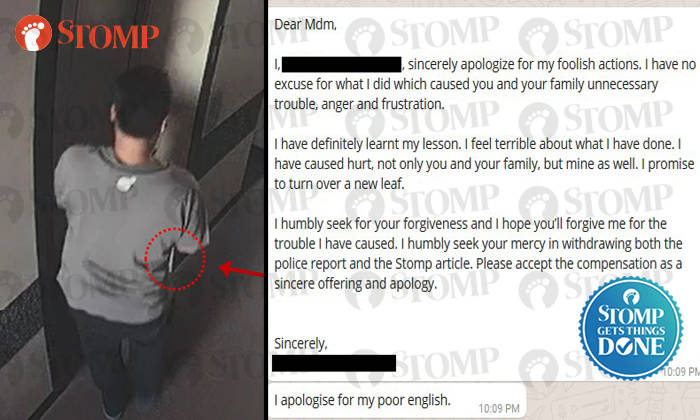
After seeing a video of himself on Stomp, the Uber Eats deliveryman who stole a condo resident’s parcel has contacted the website to express his remorse and apologise for his actions.
He has also paid Stomp contributor Binary0018 a compensation of $350, which is more than the full value of the parcel’s contents, as well as written a heartfelt apology addressed to her.
The incident, which occurred at Dunearn Suites on Feb 19, was first reported by Stomp, after Binary0018 contributed CCTV footage showing the deliveryman loitering along her corridor.
Uber Eats guy takes condo resident’s $343 parcel after delivering food to neighbour
//afarkas.github.io/lazysizes/lazysizes.min.js
The video also showed him taking the Stomp contributor’s parcel, which a FedEx courier had delivered and left on her doorstep, and then leaving with it tucked under his arm.
Binary0018 told Stomp that the parcel contained $343.31 worth of beauty products such as perfume and toiletries.
Shortly after an article and a video of the incident was published yesterday (Feb 22), the Uber Eats deliveryman contacted Stomp to identify himself.
He admitted that he was the man in the video and asked to contact Stomp contributor Binary0018 personally so that he could make amends.
“I would like to sincerely apologise and return back the things. I really feel remorseful and I hope we can settle this privately, If possible, I would not want this to escalate to the authorities,” he told Stomp.
Asked if he saw the CCTV camera when he committed the act, the deliveryman confessed that he did.
He said in a phone interview with Stomp: “I don’t know what I was thinking.
“I saw the parcel and I just took it.
“I have never done this before.”
However, when contacted by Stomp, Binary0018 said she did not want the contents of the parcel back due to the nature of the items.
She said: “I’m afraid is not possible for me to accept back the items. Obviously, the box would have already been opened and the contents inside handled (perhaps even tested/used).
“Some of these items were actually meant to be given as presents. And these are ladies’ personal care/grooming items. Given their nature, you can understand why it’s not nice to take them back.
“I may consider withdrawing the police report if restitution of the full value of these items is made.”
The Uber Eats deliveryman and Binary0018 both agreed that he would pay her the full amount of $343.31 via bank transfer.
Stomp, who received screenshots of the transaction, understands that the deliveryman transferred a sum of $350 to Binary0018, almost $7 more than the agreed amount.
Binary0018, who will be going down to the police station to withdraw her report, added: “I’m grateful for the Stomp Team’s help. Thank you very much!”
The Uber Eats deliveryman told Stomp that his account on the platform has been “temporarily banned”.
He also wrote an apology letter which he shared with Stomp and asked that we helped pass it on to Binary0018.
Here in the letter in full:
Dear Mdm,
I, (name withheld by Stomp), sincerely apologise for my foolish actions. I have no excuse for what I did which caused you and your family unnecessary trouble, anger and frustration.
I have definitely learnt my lesson. I feel terrible about what I have done. I have caused hurt, not only you and your family, but mine as well. I promise to turn over a new leaf.
I humbly seek for your forgiveness and I hope you’ll forgive me for the trouble I have caused. I humbly seek your mercy in withdrawing both the police report and the Stomp article. Please accept the compensation as a sincere offering and apology.
SINGAPORE: Whenever National Environment Agency (NEA) officers drop by for a surprise inspection, Lola’s Cafe co-founder June Tan gets a little jumpy.
“Every time they come, we are very worried that we didn’t do something right,” she told Channel NewsAsia. “I guess that shows the checks are pretty thorough.”
Officers open her fridges to check how food is stored, then inspect the fridge door edges for loose rubber tubing, which might indicate contamination.
They even check the ice machine for algae and ensure that the scoop is not left inside. “A lot of people don’t know, but ice machines are where a lot of bacteria builds up,” Ms Tan said.
On top of that, Ms Tan also has to show monthly pest control and grease trap maintenance reports. She then waits a few days before receiving her grade in the mail.
While Ms Tan is meticulous in the maintenance of her establishment’s cleanliness, for some others, things can occasionally go wrong.
NEA hygiene inspections and grades have come under the spotlight following recent incidents involving some ‘A’-graded food establishments.
Earlier this month, the agency announced that it had suspended the Clarke Quay branch of popular hotpot restaurant HaiDiLao for two weeks. This came after the eatery was penalised for handling food with bare hands and selling unclean food.
Last month, the grades of Regent Singapore’s banquet kitchen and the hotel’s Summer Palace restaurant were downgraded to “C” after dozens of patrons came down with food poisoning.
And out of the 134 food establishments suspended last year, 16 were “A”-rated, NEA records show.
Responding to queries from Channel NewsAsia, NEA said grades are awarded based on observations such as housekeeping and cleanliness, food hygiene and personal hygiene of food handlers.
Eating establishments and food stalls are graded annually based on a “snapshot assessment”, NEA said. (Photo: Aqil Haziq Mahmud)
“While the hygiene grade provides a general overview of the hygiene condition of the premises, operators are expected to observe good food hygiene practices consistently in their daily operations in order to achieve and maintain high hygiene standards,” it stated.
“Besides the grading assessment, NEA also conducts regular inspections, as well as ad-hoc inspections in response to public feedback or reports on food poisoning, to ensure that operators comply with the regulations.”
Last year alone, NEA conducted more than 82,000 spot checks on food retail establishments. Establishments get inspected at least twice a year, with their food shop licences and grades reviewed annually.
Channel NewsAsia understands that NEA does not keep track of the number of officers involved in such inspections, and that the agency does not outsource the inspections.
Other establishment owners Channel NewsAsia spoke to maintained that the inspections were thorough, adding that officers spend an average of 15 minutes checking their premises.
“The officer will give us advice if something can be done better,” said RED Noodle and Bottle Bar owner Tan Zhi Wen. “They don’t just do it anyhow.”
Ms Karen Quek, who runs Chateraise at Changi City Point, said officers would climb ladders to inspect false ceilings and use torchlights to look behind fridges. “It’s a detailed check – not just one glance and go.”
“YOU CAN’T SIMPLY BE COMPLACENT”
So, how do “A”-graded establishments, which score 85 per cent or higher on hygiene standards, still manage to fall short?
Public Hygiene Council chairman Edward D’Silva said in an interview with Talking Point that even highly rated establishments make mistakes.
“You can have lapses from employees who may have missed out a process,” he suggested. “You can have a disgruntled employee who feels aggrieved and wants to make the establishment pay.”
Establishments can be suspended for up to four weeks if they chalk up 12 demerit points or more in a year, with serious offences like packing food with printed paper carrying six demerit points and a S$400 fine. Repeat offenders can get their licences cancelled as well.
Workers caught handling food with bare hands can get their establishments slapped with six demerit points and a S$400 fine. (Photo: Aqil Haziq Mahmud)
Chateraise’s Ms Quek acknowledged that mistakes can occur with a breakdown in communication. “Sometimes, it’s actually due to miscommunication or under-communication that staff don’t follow accordingly,” she said.
A Bedok hawker stall owner, who only wanted to be known as Kris, said a “minor lapse of concentration” is all it takes. “You can’t simply be complacent,” he said. “People who consume your food will suffer as a result.”
This can come from simple things like using the same chopping board for raw and cooked food, or forgetting to wash your hands after handling raw produce, he added.
MORE ROBUST INSPECTIONS?
As it becomes clear that lapses do crop up, should NEA step up its inspections? Mr D’Silva doesn’t think it would be practical.
It is impossible for NEA officers to be looking over the shoulder of every person working in food establishments, he said.
RED Noodle and Bottle Bar’s Mr Tan said he is satisfied with the frequency of the inspections, noting that an increase in checks might disrupt operations.
Mr Kris added that the current checks are strict enough. “They will not hesitate to fine you or give you demerit points,” he stated.
Rather, said Ms Tan of Lola’s Cafe, the onus is on establishments to maintain hygiene standards between inspections.
She pointed to her establishment’s “very extensive” closing procedure that includes wiping the fridges and mopping the floor every night. “Without any checks, that’s basically what you need to do,” she said. “It’s ingrained in our behaviour.”
Likewise, staff at Ms Quek’s outlet abide by strict hygiene measures like tucking hair into a cap at all times and using different cleaning cloths for different sections. “If enough training is given to staff on the first day of their job, there will be minimum lapses,” she said.
“It really depends from establishment to establishment – how stringent their checks are, how competent their staff are and how they carry out their procedures,” Ms Tan added.
For Mr Tan, it is important that his establishment avoids suspensions, given the effect it will have on business. “We cannot afford to get ourselves in this sort of trouble,” he added.
SINGAPORE: Two new international schools that cater to families on a tighter budget have opened for enrolment, in response to growing demand from increasingly cost-conscious expatriates.
Launched by the EtonHouse International Education Group, Middleton International School (MIS) will begin classes at its second campus in Tampines in May.
It will offer the International Primary Curriculum (IPC) and International General Certificate of Secondary Education (IGCSE) programmes, with fees ranging from S$15,000 to S$20,000 a year.
Likewise, One World International School (OWIS) has opened its second campus in Jurong West, with fees starting from S$17,000. It offers the IB Primary Years Programme and IGCSE.
These two new campuses join Invictus International School, which opened in 2016, offering fees of S$15,000. Typically, high-end international schools here charge an average of S$30,000 annually.
The two new schools keep costs down by tapping on resources such as electronics and learning materials from their existing campuses.
Middleton’s academic adviser Martin Hughes said MIS Tampines would be keeping costs low by having larger class sizes. The school will also hire more local teachers.
“Locally there are many great teachers here and the new school will employ a greater proportion of local teachers, which then reduces the expat packages that an international school has to pay,” said Mr Hughes.
DEMAND FOR “AFFORDABLE” SCHOOLS
MIS Tampines has received 70 sign-ups and hundreds of inquiries from parents like Briton Emma Stratford, who came to Singapore with her husband and two children last April.
“My husband’s package doesn’t include schooling. So when we came here, we applied to the local MOE (Ministry of Education) schools. I knew that it was a long shot. So before the results, we had a look at international schools and Middleton School came out as an affordable option,” she said.
This One World International School campus uses shared resources to keep its fees low. (Photo: Deborah Wong)
Over the past decade, more expatriates like Mrs Stratford’s family have been employed on local contracts – which means they are not given an allowance for education.
But there’s another reason some are being more careful with their finances.
“Before, international families came to Singapore for maybe two to three years on an international assignment with education very much a part of their employment package,” said OWIS principal Michelle Dickinson.
“There’s been a change over the last few years, where families are choosing to stay in Singapore as a life choice, to settle here long term. And they are looking for a school whose fees are moderate, where they can place their child in for a long period of time.”
While local schools are cheaper, admission for international students is subject to their performance in a test and available vacancies. The Education Ministry said they make up about 5 per cent of the cohort, from the primary to junior college levels, with a large proportion hailing from ASEAN and other Asian countries.
Middleton International School at Tampines will be opening in May. The new campus has capacity for 1,000 students. (Photo: Deborah Wong)
International schools must meet standards set by the Committee for Private Education, which include ensuring that their teachers have the relevant qualifications. There are currently more than 30 international schools here.
According to the Economic Development Board, the new additions help keep Singapore cost-competitive for international businesses and also strengthen its position as an attractive global city.
SINGAPORE: Budget 2018 has been described as one that’s multifaceted and lays the foundation for a sustainable future for Singapore.
On deeper reflection, one could describe it as a responsible budget.
It is responsible on two fronts. First, in the area of government spending and second, in the area of financing that spending.
RESPONSIBLE GOVERNMENT SPENDING
The announcement by Finance Minister Heng Swee Keat to moderate the pace of ministries’ budget growth by cutting the growth of their block budget from 0.4 times to 0.3 times of GDP growth sets a clear tone towards prudence.
Yet, this cut is no surprise as it echoes the permanent 2 per cent downward adjustment to the budget caps of all Ministries and Organs of State in Budget 2017.
This approach to tighten the Government’s own purse springs is commendable and timely, done when Singapore is currently in a position of strength, in ending FY2017 with an overall budget surplus of S$9.6 billion.
That said, Mr Heng laid out methodically the areas in which government spending is expected to increase in the years to come. Not surprising, these are healthcare, infrastructure and security.
A man carrying an infant in Singapore. (Photo: Gaya Chandramohan)
HIGHER SPENDING TO SUPPORT AN AGEING POPULATION
1 in 4 Singaporeans will be aged 65 and older in 2030, according to the Ministry of Health. This greying population is exacerbated by Singapore’s low fertility rate.
In years to come, ceteris paribus, the burden of financing the increase in the expenditure to support an ageing society will fall on the shoulders of a shrinking workforce, calling to question the sustainability of Singapore’s finances.
With this, if measures are not taken early, our sound fiscal footing fortified through the years may not extend beyond 2020. It is with this foresight that underpins the Government’s call to foster prudent and effective public spending.
Government ministries, like private enterprises, will need to look for more productive and innovative ways to run their agencies.
In the Budget announcement, several collaborations and streamlining of activities within government agencies were introduced.
Examples include the Pioneer Generation Office to be merged with the Agency for Integrated Care, SPRING Singapore coming together with IE Singapore to form Enterprise Singapore, and perhaps more to come.
Against a global landscape of increased connectivity and sector convergence, it is timely that government agencies and ministries too be more streamlined in providing integrated services to residents and companies, while being more cost efficient.
Two Pioneer Generation Ambassador go over their approach to engage a senior before they begin their house visit. (Photo: Pioneer Generation Office)
RESPONSIBLE IN FINANCING FUTURE SPENDING
While prudence goes some way to reduce expenditure, as important is raising revenue to make sure that our nation’s coffers remains in a strong position.
The easiest way for a government to raise finances for its spending is through taxation. In a progressive tax system, it is expected that a greater burden will be placed on those with higher income.
To alleviate the burden of long-term nation building on the current generation of taxpayers, Budget 2018 takes a step in the right direction by financing national infrastructure building like the Integrated Waste Management Facility, the Kuala Lumpur-Singapore High Speed Rail and Changi Airport Terminal 5 through savings and borrowings.
A Rail Infrastructure Fund will be set up to save for large-scale, multiyear rail line projects with top-ups by the Government when Singapore is in a good fiscal position.
A Changi Airport Development Fund for Terminal 5 had been already been set up in 2015.
Statutory boards and government-owned companies that build the infrastructure will explore borrowing, likely much like how private companies fund acquisition and expansion plans.
Returns of investments from such projects may then be distributed to bondholders, corporates and individuals alike.
With this added mode of financing, the Government will have greater fiscal flexibility in funding projects – not only through direct use of external funding for these long-term projects, but also through channeling its existing operating revenues to other areas of expenditure.
A view of Changi Airport. (File photo: Changi Airport Group)
More importantly, with this save and borrow approach, there is no need for the Government to dip into our national reserves to fund these major projects, preserving it for future generations.
That said, it is clear that more tax dollars are needed to fund expenditure of a recurrent nature, such as healthcare, security and other social spending.
Such expenditure directly benefits the current generation and as Mr Heng puts it:
The responsible way to pay for them is through taxation so that every generation pays its share.
With this, several tax rate hikes and new taxes have been announced. With immediate effect, the top marginal Buyer’s Stamp Duty rate for residential properties has been increased from 3 per cent to 4 per cent. Tobacco excise duty across all tobacco products have also been raised by 10 per cent.
Budget 2018 has been lauded as a strategic and integrated financial plan to position our island city for the future. And it is indeed so.
At the heart of Budget 2018 is a responsible masterplan that builds on the core values of Singapore: Thrift, prudence and self-reliance, while caring for the young, old and needy and making sure that the future ahead is a sustainable one for generations to come.
Sandie Wun is Partner, Transaction Tax at Ernst & Young Solutions LLP.
SINGAPORE: Whenever National Environment Agency (NEA) officers drop by for a surprise inspection, Lola’s Cafe co-founder June Tan gets a little jumpy.
“Every time they come, we are very worried that we didn’t do something right,” she told Channel NewsAsia. “I guess that shows the checks are pretty thorough.”
Officers open her fridges to check how food is stored, then inspect the fridge door edges for loose rubber tubing, which might indicate contamination.
They would even check the ice machine for algae and ensure that the scoop is not left inside. “A lot of people don’t know, but ice machines are where a lot of bacteria builds up,” Ms Tan said.
On top of that, Ms Tan would also have to show monthly pest control and grease trap maintenance reports. She then waits a few days before receiving her grade in the mail.
NEA hygiene inspections and grades have come under the spotlight following recent incidents involving ‘A’-graded food establishments.
Earlier this month, the agency announced that it had suspended the Clarke Quay branch of popular hotpot restaurant HaiDiLao for two weeks. This came after the eatery was penalised for handling food with bare hands and selling unclean food.
Last month, the grades of Regent Singapore’s banquet kitchen and the hotel’s Summer Palace restaurant were downgraded to ‘C’ after dozens of patrons came down with food poisoning.
And out of the 134 food establishments suspended last year, 16 were ‘A’-rated, NEA records show.
Responding to queries from Channel NewsAsia, NEA said grades are awarded based on observations such as housekeeping and cleanliness, food hygiene and personal hygiene of food handlers.
Eating establishments and food stalls are graded annually based on a “snapshot assessment”, NEA said. (Photo: Aqil Haziq Mahmud)
“While the hygiene grade provides a general overview of the hygiene condition of the premises, operators are expected to observe good food hygiene practices consistently in their daily operations in order to achieve and maintain high hygiene standards,” it stated.
“Besides the grading assessment, NEA also conducts regular inspections, as well as ad-hoc inspections in response to public feedback or reports on food poisoning, to ensure that operators comply with the regulations.”
Last year alone, NEA conducted more than 82,000 spot checks on food retail establishments. Establishments get inspected at least twice a year, with their food shop licences and grades reviewed annually.
Channel NewsAsia understands that NEA does not keep track of the number of officers involved in such inspections, and that the agency does not outsource the inspections.
Other establishment owners Channel NewsAsia spoke to maintained that the inspections were thorough, adding that officers spend an average of 15 minutes checking their premises.
“The officer will give us advice if something can be done better,” said RED Noodle and Bottle Bar owner Tan Zhi Wen. “They don’t just do it anyhow.”
Ms Karen Quek, who runs Chateraise at Changi City Point, said officers would climb ladders to inspect false ceilings and use torchlights to look behind fridges. “It’s a detailed check – not just one glance and go.”
“YOU CAN’T SIMPLY BE COMPLACENT”
So, how do ‘A’-graded establishments, which score 85 per cent or higher on hygiene standards, still manage to fall short?
Public Hygiene Council chairman Edward D’Silva said in an interview with Talking Point that even highly-rated establishments make mistakes.
“You can have lapses from employees who may have missed out a process,” he suggested. “You can have a disgruntled employee who feels aggrieved and wants to make the establishment pay.”
Establishments can be suspended for up to four weeks if they chalk up 12 demerit points or more in a year, with serious offences like packing food with printed paper carrying six demerit points and a S$400 fine. Repeat offenders can get their licences cancelled as well.
Workers caught handling food with bare hands can get their establishments slapped with six demerit points and a S$400 fine. (Photo: Aqil Haziq Mahmud)
Chateraise’s Ms Quek acknowledged that mistakes can occur with a breakdown in communication. “Sometimes, it’s actually due to miscommunication or under-communication that staff don’t follow accordingly,” she said.
A Bedok hawker stall owner, who only wanted to be known as Kris, said a “minor lapse of concentration” is all it takes. “You can’t simply be complacent,” he said. “People who consume your food will suffer as a result.”
This can come from simple things like using the same chopping board for raw and cooked food, or forgetting to wash your hands after handling raw produce, he added.
MORE ROBUST INSPECTIONS?
As it becomes clear that lapses do crop up, should NEA step up its inspections? Mr D’Silva doesn’t think it would be practical. “They can’t be everywhere, every day, overlooking the shoulders of employees,” he said.
RED Noodle and Bottle Bar’s Mr Tan said he is satisfied with the frequency of the inspections, noting that an increase in checks might disrupt operations.
Mr Kris added that the current checks are strict enough. “They will not hesitate to fine you or give you demerit points,” he stated.
Rather, said Ms Tan of Lola’s Cafe, the onus is on establishments to maintain hygiene standards between inspections.
She pointed to her establishment’s “very extensive” closing procedure that includes wiping the fridges and mopping the floor every night. “Without any checks, that’s basically what you need to do,” she said. “It’s ingrained in our behaviour.”
Likewise, staff at Ms Quek’s outlet abide by strict hygiene measures like tucking hair into a cap at all times and using different cleaning cloths for different sections. “If enough training is given to staff on the first day of their job, there will be minimum lapses,” she said.
“It really depends from establishment to establishment – how stringent their checks are, how competent their staff are and how they carry out their procedures,” Ms Tan added.
For Mr Tan, it is important that his establishment avoids suspensions, given the effect it will have on business. “We cannot afford to get ourselves in this sort of trouble,” he added.
SINGAPORE: I’ve been volunteering at the buddy reading programme at my son’s school since early this year. My charge is a Primary 1 boy who has been identified by his teacher as a struggling reader.
The very first day I met him, he declared:
I don’t know how to read!
Subsequently in the same session, he went on to read out loud about 15 words on a list of high-frequency sight words. Not bad for a start, considering how he had made such a negative pronouncement of himself just minutes earlier.
The encounter made me realise the profound challenges struggling students who may come from lower-income families have to deal with.
Research has shown that they typically lag behind in the areas of reading and literacy, among other academic domains.
And if my experience is anything to go by, many may dismiss themselves early on in their education journey, limiting their own opportunities to learn and grow.
FORCES HOLDING A CHILD BACK ARE COMPLEX
Among the goodies unveiled at the recent Budget 2018 was an increase in the annual Edusave contributions by the Government and an update to the income eligibility criteria for the Edusave Merit Bursary award.
Mr Heng also announced an increase in the annual bursary quantum for pre-university students via the MOE Financial Assistance Scheme.
I was heartened to hear of the added financial help to help students from lower-income families.
Finance Minister Heng Swee Keat delivering the Budget 2018 statement.
Yet, after my recent encounter with this Primary 1 child I couldn’t help but wonder: What more can we do to nurture these children? And where such help can boost their learning and development outcomes, should we limit it to only those who exhibit a strong potential to succeed?
Where education should serve to help every child realise their potential, if needy students already start from a place of disadvantage in learning, more needs to be done to address this.
If more targeted help can be rendered to a greater proportion of children from low-income families, we can then level the playing field, and provide more needy students the chance to develop themselves more fully.
While financial aid can be useful, we all know that the forces holding a child back from performing to his fullest potential are multiple and complex in nature.
Could we thus design specific school programmes to address what is most needed in these students’ lives?
Some benefits that could have a multiplier effect include: Building a stronger support network, expanding their social circles, and providing them with more opportunities and exposure. These benefits could enhance their education experience, and also empower them to go beyond what they think they can achieve.
File photo of A-level students receiving their results. (Photo: MOE)
INSPIRE STUDENTS THROUGH PARENT-MENTORS
One possible idea is to facilitate a form of mentoring relationship between upper primary and secondary school students with volunteer parents from a range of professions.
Parents can sign up to be mentors and get matched to suitable students, based on the child’s interest in that particular field or profession – be it in business, accounting, medicine, or computer programming. If the child does not have clear inclinations, he can choose to meet with a few parents from different industries.
Once there is a parent-student pair or small group, the parent can be scheduled to spend the early-morning free period with the child, where they can share about their work and use day-to-day examples to show how they use their skills to earn a living.
We may think that upper primary school children will be too absorbed with studies to think long-term into the future.
But this is precisely the reason why we should start the mentoring early – so that they start to see the purpose behind their efforts in doing well at the national examinations, and see a goal which they too can aspire towards.
Furthermore, this is in line with the Ministry of Education’s push for secondary schools to develop their niche areas in applied learning subjects, such as computing, sports science, or even robotics, to cater to students with an aptitude for specific fields of study.
If these students have not been exposed to various industries, how would they know which secondary school to aim for after the Primary School Leaving Examination (PSLE)?
Girls sit around a table during a class on coding. (Photo: Linette Lim)
More importantly, parents get to share their own life story to inspire students and help them understand that challenges and struggles are part and parcel of life. The student will be motivated to work hard, spurred by mentors who encourage them to do their best and expand their horizons.
TAP ON ENTERPRISES TO REWARD PROMISING STUDENTS
Schools and parents need not be the only ones in this endeavour. Singapore is known for the depth and breadth of our enrichment industry.
So why not tap on these private enterprises to reward high-performing students by allowing them to choose an area of interest that they are keen to explore, and then enlisting the help of these providers?
Whether it’s by sponsoring a term of cello or a couple of sessions in coding, these promising students will get a hard-earned chance to gain exposure to different skills and interests. Who knows what passions may get sparked off from here?
A READING PROGRAMME TO SPARK OFF FRIENDSHIPS
Where the challenge is for education to inspire our children to give their best and provide them with the confidence to seize new opportunities, it seems that it should also work to strengthen our social fabric – by fostering inclusiveness among Singaporeans at a young age.
A recent study of 3,000 Singapore citizens and permanent residents by the Institute of Policy Studies found that the greatest social divide in Singapore is now based on class, rather than race or religion.
It concluded that “diversity in social networks among Singaporeans strengthens social capital, trust, national identity and national pride,” and called for more to be done to facilitate mixing social classes and school backgrounds.
I wonder if a programme like my child’s school buddy reading programme could rope in upper primary children who are strong readers to, on the one hand, help the younger ones in their reading skills, and on the other, get to know and befriend them.
The friendships born through a reading programme may help to form bridges across social classes, hence broadening the horizons of children beyond their immediate circles.
Students from Fernvale Primary and MINDS Fernvale Gardens School reading together. (Photo: Wendy Wong)
Although the time spent together may be short, and may not be able to fully allow friendships to blossom, it could be the starting point for other common interests to be explored. “Buddies” can go on to arrange basketball or board games sessions after school.
The key here is intentionality, and how well we can prepare the older child to play the “befriender” role in this relationship.
Helping students from all backgrounds mix with each other may give them new perspectives on issues and help them grow in empathy, all of which are arguably desired educational outcomes.
TAPPING ON COMMUNITY TO BUILD THE NEXT GENERATION
Former US Secretary of the Treasury Jacob Lew once wrote:
The budget is not just a collection of numbers, but an expression of our values and aspirations.
While Singapore has always prided itself as being a meritocratic society, we must guard against our education system from becoming a place that rewards those with greater resources, where students with less fall through the cracks.
If every school was empowered to engage students from lower-income families, and encourage them to socialise beyond their immediate circles through the help of stakeholders such as parents and businesses, we could be paving the way towards greater social cohesion.
As Associate Professor Teo You Yenn wrote in her book This Is What Inequality Looks Like:
It may seem like higher-income and lower-income families have conflicting interests, that what is good for one group will be bad for another. In reality, there is a lot of potential for a better system which more truly serves the needs of all.
Let’s focus on building a shared interest, and a greater sense of community within schools. The education experience of every child – from every household income level – is at stake.
June Yong is a mother of three, an educational therapist and owner of Mama Wear Papa Shirt, a blog that discusses parenting and education in Singapore.
SINGAPORE: While many were visiting family or enjoying a break from work during the Chinese New Year weekend, a group of Singapore Police Force (SPF) officers and their canine colleagues from the Police K-9 Unit were hard at work, patrolling public spaces to keep Singapore safe.
One of them was 29-year-old Staff Sergeant Seah Zhen Yao and his three-year-old police patrol dog, Dux. They were on the night shift on the second day of Chinese New Year. Till 6am on Sunday (Feb 18), the duo patrolled crowded public areas such as Geylang, Little India and the former St James Power Station. Their task: To keep public order, especially at the nightclub hotspots where scuffles are common.
When we visited Staff Sgt Seah and Dux at the Police K-9 Unit Headquarters along Mowbray Road this week, the three-year-old Dutch Shepherd looked every bit as fierce, muscular and alert as we thought he would be.
He cut a commanding figure with his pert ears and police dog harness.
Staff Sergeant Seah Zhen Yao getting Dux ready before obstacle course training in the field. (Photo: Christy Yip)
FIRST MAJOR SEARCH JOB
Staff Sgt Seah was first assigned to Dux when the dog was 16 months old. “When I started handling Dux, he was a ‘green tag’ dog – meaning he was not trained in anything,” said Staff Sgt Seah, who has been in the service for nine years.
“He was a mischievous boy. He was trying to bite everything and everyone. But subsequently, after he was handed to me, we started to bond. Sometimes, he still shows a little aggressiveness to others, but not me.”
Dux engaging in bitework with a police dog trainer. (Photo: Christy Yip)
Staff Sgt Seah recalled the first major tracking job that the duo took on last July, which was to find an elderly man who had gone missing for four days while picking durians in a forested area near Kranji Expressway.
“We started with two dog teams; it was a very hot morning,” said Seah. “When we reached the place, we realised that it was a very, very large forested area. We didn’t have any specific area to search, so we just trusted our dogs and see what they could pick up.”
Although Dux was trained to pick up any scent or trail of human tracks, it was challenging as the trace would have faded after four days. “He was quite active at first. But after the long search, I could see him asking: Where is my ball (reward)? Why do I keep searching, but there is no reward?” said Staff Sgt Seah with a chuckle.
The elderly man was eventually found by police officers at the western end of the forested area, injured, but conscious.
Dux getting a reward after the afternoon’s activities. (Photo: Christy Yip)
“Dux is very playful. There is a saying: Working with animals can be better than working with human beings.
“Sometimes during deployment, I will feel lonely, but then I have someone to talk to. At other times, he will bring me joy. When you have a really bad day, you can laugh at his silly (antics). He will cheer you up a little!”
THE MOST DOGGED UNIT IN THE SPF
Dogs have been used in the Singapore Police Force since 1911, when an Airedale Terrier was used to track down prison escapees. The Police K-9 Unit now spans more than 250 service dogs.
Majority of the police service dogs are (from left) Springer Spaniels, Labradors and the German and Belgium Shepherds. (Photo: Dawn Ang)
“These dogs are pre-selected by our dog trainers, who go overseas to select them before they are sent to Singapore,” said Senior Staff Sergeant Ong Zhi Yao, a para-vet with the K-9 Unit. The dogs are mainly brought in from the United Kingdom, Holland, Belgium and China. When they are around 16 months to two years of age, the dogs are assigned to an experienced police dog handler to start their service training.
Dogs bigger in build such as German and Belgium Shepherds are trained as patrol or security dogs and have various capabilities, such as searching buildings or tracking.
A police dog handler with a retired service dog. (Photo: Christy Yip)
The Spaniels and Labradors are often trained as explosive or narcotics detection dogs, as they are smaller in size and more nimble. “Most of the dogs have just one vocation while in service,” said Senior Staff Sgt Ong. “We don’t want to mix up the guard dogs and the narcotics or explosive (detection) dogs, as they have different commands and actions.”
The service dogs work till the age of seven before they retire and are put up for adoption.
ADOPT A RETIRED SERVICE DOG
While Dux has several more years till he is due for retirement, the SPF currently has several dogs that are looking for a new home.
A police kennel handler with a retired service dog. (Photo: Christy Yip)
Will these police dogs remain aggressive and fierce while in retirement? “I would say not really. They are trained only to act (aggressive) upon command,” said Ong. “I have been working with the K-9 Unit for seven years and I feel that the bigger working dogs are easier to train and more fun.”
Last year, dog handlers from the SPF and Singapore Civil Defence Force’s K-9 units and the Singapore Armed Forces’ Military Working Dog Unit who live in public housing were allowed for the first time to adopt their retired canine friends under an expansion of Project ADORE.
To date, 11 of the 15 SPF officers who previously expressed interest in adopting retired dogs have done so. The other four officers are waiting for their service dogs to retire, said the SPF. It added that have been no complaints from neighbours of police dogs adopted.
For those interested in giving a retired service dog a new home in this Year of Dog, you can reach out to the Police K-9 Unit, which has an adoption drive all through the year.
SINGAPORE: When former Anglo-Chinese Junior College (ACJC) student Lim Zhong Zhi was told to stay behind for a special briefing after he collected his A-Level results on Friday (Feb 23), he did not know what to expect.
“They told us someone stole our exam papers from a courier in the UK, and we were like, is this a heist movie now,” he said. “We always joke about what would happen if our papers get stolen. And now that it really happened, we were like … wow.”
Zhong Zhi was one of the 238 students whose H2 Chemistry answer scripts were stolen. The scripts, which were for Paper 3, were stolen in the United Kingdom before the papers were delivered to the examiners. Paper 3 consists of free-response questions and carries a weightage of 35 per cent of the entire H2 Chemistry examinations.
The students are from four junior colleges: Anderson JC, ACJC, Hwa Chong Institution (HCI) and Nanyang JC.
In announcing the incident, the Singapore Examinations and Assessment Board (SEAB) explained that the final grades for the students were derived through a projection.
Affected students will also be given the opportunity to resit Paper 3, if they wish. Those who opt for the re-examination will have the better of their two grades recorded in their result slip and certificate.
A “RARE SECOND CHANCE” TO IMPROVE THEIR RESULTS: AFFECTED STUDENTS
For Zhong Zhi and some of his affected peers, the opportunity to resit the paper was a “rare second chance” to improve their grades.
“They did mention that they will take the better of the two grades,” said Zhong Zhi, who got a B in the subject. “So there’s really no incentive for you not to take the second exam.”
“ACJC told us that our subject tutors would try their best to assist us,” he added. “And I think we’ll be even more committed to this retake, because if you know your results are kind of bad, that’s even more motivation for you to study even harder for it.”
Former HCI student Ong Wan Xuan, who scored a B, said she is also likely to retake the paper, explaining that despite getting a B for the subject in her school’s preliminary examinations, she had worked hard for the A-Levels, and had expected to get an A for the subject.
“It would take a lot of time, but I would do it for my grades,” she said. “I do believe that I’d have done better with Paper 3, because 35 per cent is not a small percentage.
“There’s no harm, since we will be able to use the better of both grades.”
But if she had a choice, she added, she would not want to go through the exam alone, and is checking if any of her friends will also be retaking the paper.
However, other affected students said they were not likely to retake the paper.
“I wasn’t that good in Chemistry, so I think even if my Paper 3 wasn’t stolen, I would probably have gotten the same grade,” said former ACJC student Manoharan Ajay Anand, who got a B in the subject.
“Besides, I don’t think I have a chance to improve,” he added. “I took the A-Levels in November and the entire time (from then to now), I wasn’t studying at all.
“Those two years were intensive preparation and now I’ve had a huge break.”
The affected students also had no complaints about the way the situation was handled by their schools and SEAB.
“I was shocked at first, but impressed by how professional SEAB, MOE and the other parties were, in the sense that they assured us that they had our interests at heart,” said former HCI student Chan Yi Xuan.
A parent of an HCI student, who declined to be named, added that she was satisfied by the way it was handled. “In any case, she (her daughter) is not penalised because this is the grade we expected.”
STUDENTS NOT AFFECTED SAID IT’S “NOT VERY FAIR”; PAPER 3 USUALLY CONSIDERED MORE CHALLENGING
Students who were not affected felt that it was not very fair for the rest to be given a second chance, especially for a paper they felt was more difficult compared to the other components.
Students walking out of Hwa Chong Institution after collecting their A-Level results. (Photo: Jalelah Abu Baker)
Students Channel NewsAsia spoke to – both affected and unaffected by the theft – concurred that Paper 3 is generally considered to be more challenging than the rest of the examination.
“I don’t think it’s very fair to everyone else, because they might not have done as well, or they might have done better than the rest who had normal papers, although I don’t know how else Cambridge could have handled it,” said former ACJC student Eugene Hadjisophocleous.
He also felt that as the theft was “quite a big deal”, the school should also have made a public announcement to students about the incident.
Echoing the sentiment, former HCI student Hu Yu Xin said: “We are not privy to the actual methodology. Maybe they should have told everyone about it, so it will be fair to all.”
Still, another recent graduate from HCI, Neo Ting Ming, said that while it was unfortunate that it happened, projecting the results was a good solution.
“As the setters of the paper, they would have known how hard or easy the paper was, and moderated and projected the results accordingly. It should be quite fair,” he said.
He added that Paper 3 would not necessarily have been the most difficult portion for everyone, as some people find it relatively easy.
“People would do differently depending on where their strengths lie, so it’s hard to say if their results would have been better or worse with Paper 3,” he said.