SINGAPORE: In the absence of context, listening to Ben Tan speak might lead you to conclude he is a masochist.
The president of the Singapore Sailing Federation believes firmly in the power of hardship.
“I might be in a very cushy environment, but I create hardship for myself. Hardship provides drive. If I’ve got money to spend on lunch, doesn’t mean I’ve got to spend it. I pretend that I’m poor. I pretend that I can’t afford a better boat. I make do with old sails. I push myself. So I create that hardship because that ultimately makes me stronger.”
This is one of the keys to his success as an Asian Games and four-time consecutive Southeast Asian (SEA) Games Gold medalist.
Dr Tan is also a Hall-of-Famer and three-time Singapore Sportsman of the Year.
After competing in the 1996 Atlanta Olympics, he retired from competitive sailing.
He now kiteboards and runs marathons recreationally. He has competed in more than 20 marathons to date, including all six World Marathon Majors and is also a regular scuba diver and (snow) skier.
Aside from excelling in the sporting world, he also made it part of his life’s work to excel in medicine.
He is Chief of Sports Medicine at Changi General Hospital. He shows up for this interview looking the part, wearing a white shirt and tie and points out he has an appointment with a patient straight after.
His reasons for going into medicine are rooted in his early exposure to sailing.
“A lot of people assume I went into medicine because somebody close to me had an unfortunate death and I felt that I needed to go into medicine to save lives. But my story is totally different. I had to learn about aerodynamics, meteorology, hydrodynamics, etc. to be good at sailing and my physics became really good. I knew that I was oriented towards the sciences. When it came to choosing a university course, I basically chose the one with the most sciences – medicine.”
He seems proud of the fact that he’s naturally very logic-oriented.
“That’s just the way my brain works and medicine, gave me that challenge. Why would a tennis elbow take so long to heal? What’s the physiology behind it? What’s the pathology behind it?”
How he managed to achieve all this has been described as remarkable by some in the sports fraternity.
It required almost surgical compartmentalisation and forgoing leisure and even rest for many years of his life.
While he was in medical school, it was the norm for him to attend class, then train every day till 10pm. This would leave little time for his studies, but he made up for it by staying up till 2am.
“Talent is something you can’t do anything about. I respect my opponents and always assume that they are more talented. Therefore I’ve got to compensate with more hours and more efficiency.”
“I kept logbooks. I would squeeze every minute out of that training time. Medicine actually made me a better sailor because it forced me to train efficiently. The other way is true also. Sailing forced me to be a better doctor.”
He claims it also helped him develop the discipline to do well in school in general. From almost failing his PSLE, he made it to one of the top JCs in Singapore because of it.
CHOOSING THE HARD LIFE
His father was a recreational sailor and his influence, no doubt, had a part to play in his sailing career but ultimately it was Dr Tan’s decision.
“I wanted a sport that would develop the mind and the physique. Sailing is not pure endurance, it’s not pure strength, it’s not pure anaerobic, it’s a balance of all the physical attributes. At the same time the mental aspects are very prominent. It’s like playing chess. You’ve got so many pieces on the board and it’s more complex because the pieces are moving – your opponents, the wind direction.”
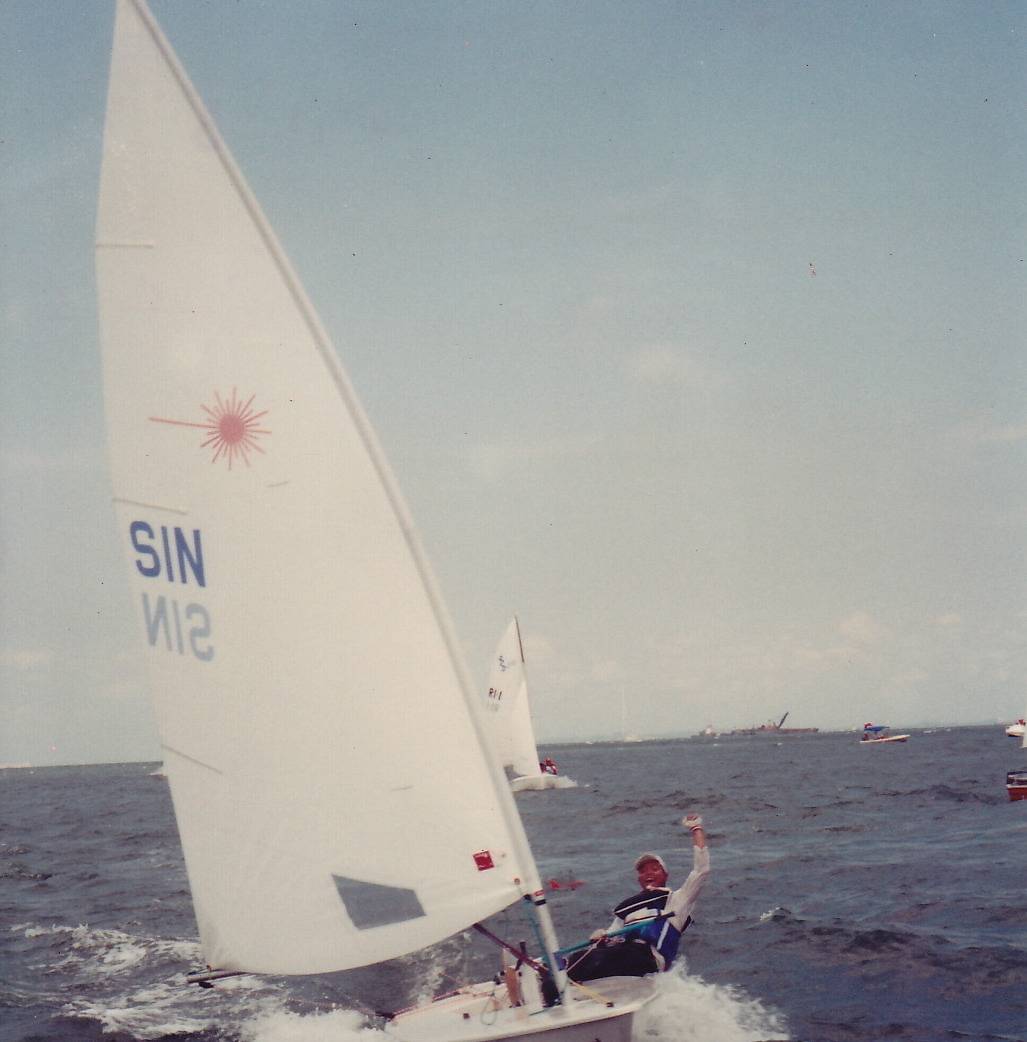
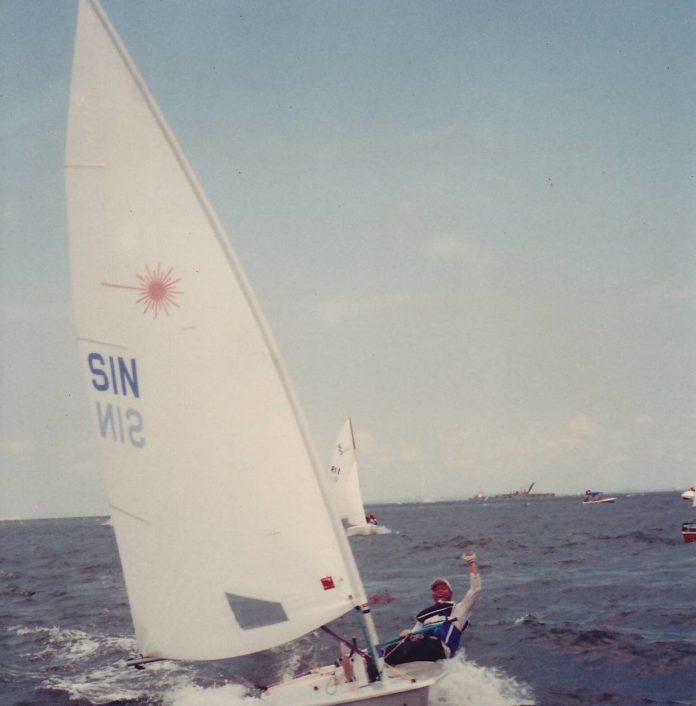
Ben Tan at the 1993 SEA Games in Singapore. (Photo: Ben Tan)
As he talks about choosing the hard life to build character and learn lessons, his sense of accomplishment and satisfaction is palpable.
“I chose the hard life. I chose to sleep a lot less. I chose to give up on the social scene. I went on my first date very late in life, only in university.
“Only because I was very target-oriented. If I wanted something, I would calculate what I needed to do to get it and make those sacrifices.”
His decision to retire from competitive sailing after the 1996 Olympics seems like a result of careful calculation too.
“In the first part of my life, sailing took first priority and medicine had to “wait” patiently. But medicine could not wait forever, and it’s turn to move up to the front of the queue came after the 1996 Olympics. If medicine had waited any longer, I would not have been able to catch up with my medical peers in terms of career path.”
“I WAS GREEDY”
I ask him if he ever wished he could have sailed full-time.
“No, I was greedy. I really wanted both – sailing and to be a doctor. I didn’t do it out of necessity as a back-up career,” he says in all seriousness.
While some athletes say they yearn to pursue their sport on a full-time basis and wish they had the funds to do so without having to hold down another job, Dr Tan feels differently.
“It cannot be convenient to be at the top of the pyramid. There is suffering involved. There are sacrifices involved and whoever is willing to make those sacrifices will be the one up there.”
However, many of his international rivals make those sacrifices in full-time pursuit of their sport.
Doesn’t that put the likes of him at a clear disadvantage in terms of performance?
“But am I going to wait until the world becomes fair? Or am I going to accept it and work around it?”
He adopted the same approach to National Service, working around it to ensure that his physical training continued.
“Of course I couldn’t be on the water but anything that I could do on the dry land was training. So when it was lights-out after supper and everybody was in bed, I got permission to run around the parade square to do my conditioning.”
But doesn’t he ever think about the possibility that full-time devotion to his sport would have helped him actually win an Olympic medal?
His answer is a categorical “no”.
“For me, it’s about the holistic thing, the whole life. The ultimate goal was not to be an Olympic gold medalist. The ultimate goal was to be a better person. Sailing was just an avenue towards that. Medicine is also an avenue towards that.”
IT’S NOT ABOUT THE BOAT, IT’S ABOUT THE SAILOR
However, he appreciates that others may want full-time commitment to their sport in order to achieve excellence at the highest levels. In this respect, the perennial issue for many athletes is funding. In this too, he believes struggle is par for the course.
“When I was a top Optimist sailor in Singapore, I had zero funding from the state or private sponsors.”
During that time, his father would foot the bill.
The family was middle-class. His father was an executive in a travel agency and his mother who was once a sales assistant, was a housewife.
“My father was stretched.”
This meant that even equipment had to be judiciously budgeted for.
“I started off with the Optimist, which is a small single-handed boat for kids under 15 years old but I didn’t own one. I used the club’s boat.
“When I bought the Laser boat, I bought it second-hand. It was S$2,000, 60 per cent of the price of a new one. It was ten years old, but it was well-maintained.”
When he raced in the Asian Fireball Championships in Pattaya as an unknown 17-year old, he could only afford to charter a 9-year old boat.
“I was up against the established frontrunners from UK and the Thais who had beautifully-crafted boats. Despite the old boat, we won the regatta. Moral of the story: it’s not the boat, it’s the sailor!”
At 17, he began receiving partial funding from the Government and his overseas racing expenses were fully covered by the state when he was campaigning for the ’89, ’91, ’93, and ’95 SEA Games, and ’94 Asian Games.
“Funding for sailing only took off after I won the Asian Games gold – that gold convinced the state that sailing could deliver and would be a smart investment. I was the first recipient of the Sports Excellence Award, as that scheme only came around in 1994.”
Private sector sponsors soon stepped in.
“The sponsors saw my clean image and values, which they felt would benefit their brand. They approached me. None of it was solicited.”
Not everyone is as fortunate, I remark.
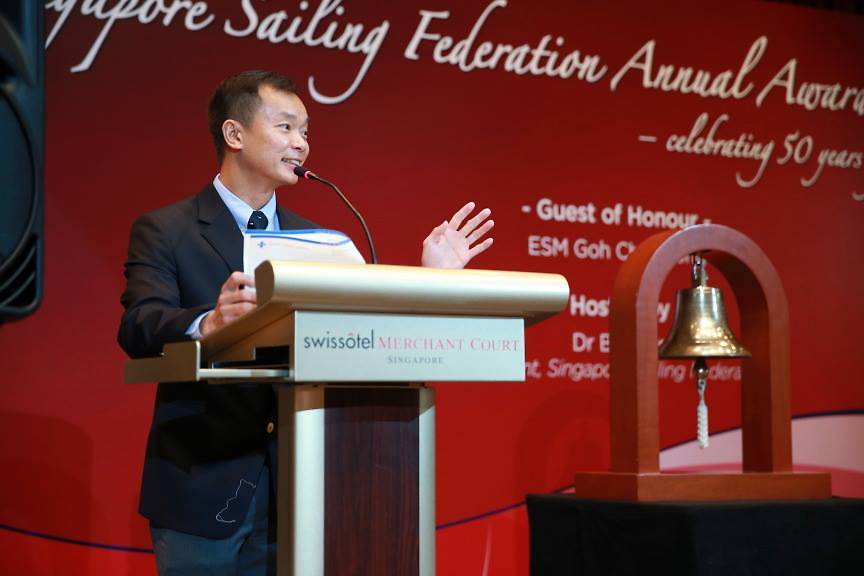
“I respect my opponents and always assume that they are more talented. Therefore I’ve got to compensate with more hours and more efficiency,” says Ben Tan. (Photo: Facebook / Ben Tan)
THE CRUTCH MENTALITY
But it’s clear he feels athletes need to work hard to achieve similar goals. He urges a dose of objectivity in the often emotional debates about sports funding.
“The state funds at different stages. It’s commensurate with your level of achievement. We’ve got to benchmark internationally. We’ve come to a situation where in most sports in Singapore, if you’re world-ranked number 50, you’ll actually get more funding and resources than an athlete from another country who’s ranked 10th in the world. Our athletes actually get more resources for their world rankings. So is that right?”
He obviously doesn’t think so, especially since the other countries he’s referring to include developed nations like the US.
“I believe in meritocracy. Don’t you want to be fair to the one who’s ranked number 10?”
Some might say athletes from some other nations operate in a more developed sports ecosystem where private sponsors are more willing to invest in them, so of course, state funding is secondary to them.
While he acknowledges this and speaks of greater efforts on the part of National Sports Associations and SportSG to encourage corporate sponsors to invest in local athletes, he feels the reasons for international athletes’ excellence goes beyond that.
“They are willing to pay out-of-pocket, they are willing to beg and borrow. I spent a lot of time sailing in the European circuit, so I met international sailors and we mingled. During dinner time, the American sailor will take a huge duffle bag full of T-shirts out and plonk it on the dinner table. He would try to sell it to everybody else because he was trying to raise funds for his European campaign.”
He’s keen to share other examples of self-reliant athletes.
“When I was campaigning in the European racing circuit, I raced against Hamish Pepper, a fellow Laser sailor who at that time had broken into the top three in the world. He shared that he had taken a US$10,000 personal bank loan in order to compete in the European circuit.
“He did not harbour any ill feelings against his sailing federation as self-funding was the norm. My world ranking was lower, especially in those days, and yet my training and competition expenses were fully funded by the state and other sponsors! Now you can understand why I count my blessings and count myself fortunate to be Singaporean.”
He clearly admires the guts and gumption of some of the international athletes he has met.
“They are willing to put more on the table, sacrifice more to get there. They don’t have the crutch mentality.”
But when asked outright if he’s saying Singapore athletes are over-funded, he hesitates.
“If the state is comfortable with it and it’s pegged to results, it’s fine. The athletes at the top deserve it. They’ve proven themselves, they have the results to show for it and the state is not spending that money irresponsibly.”
What about the others? Should their state funding be reduced or even removed?
“It shouldn’t be taken away because you’ve got to front load it, so that they can get to the top. What I’m saying is that, that additional funding doesn’t have to come from the state. The funding sources must be diversified. It cannot be only from taxpayers. That’s just not fair on the country’s other needs, our infrastructure needs, our education needs, we do have the less privileged in Singapore, the disabled in Singapore, they need funding as well.
“In the West, it’s very normal for the family to invest in the child’s sporting pursuits. With Joseph Schooling’s example, the family had that mentality. They realised that they are not going to wait forever for the state to fund Joseph, so they forked it out themselves.”
But not every family has the means or the potential to do this and there are also cost of living issues to deal with.
Wouldn’t this mean that competitive sports would be restricted to particular classes of people?
“I believe in having equalisers and the way to equalise it is to spend wisely. For example, in sailing, don’t own your own boat, use shared resources. Many unknowingly get drawn into an ‘arms race’ with their opponents, where they try to win by buying newer and “better” equipment, unnecessarily incurring higher costs. It’s all self-inflicted.”
Recently, when two prominent Singapore sailors raised funds via crowdfunding, the state and the Singapore Sailing Federation came under fire for their lack of support for local athletes.
“The federation is a conduit between the government and the athletes. We give them what is disbursed to us. We do additional fund-raising too. But the funds we raise have to go into maintaining the boats, pay the coaches salaries, sailing developmental programmes.”
If the athletes need additional funding and they have the initiative to raise it, he welcomes it even if it means the federation gets criticised for not doing enough.
“Paint us in a bad light by all means as long as the sailors get the funding. The ones who go out on their own to raise funds are actually special people. They have the drive to do it.”

THE FOREIGN TALENT SPORTS SCHEME
Singaporeans also often question spending money on foreign sports talent even though foreign-born athletes currently make up only about 1 per cent of sportspeople here.
The Sailing Federation does not have foreign sailors.
“We have had offers from world class sailors and we turned them down because there are other ways to benefit from them without awarding them citizenship. For example, we formed a sparring alliance with the French. On the coaching side, the core team is all local, and only supplemented by foreigners. Prior to 2010, it was the reverse. The core team was expat, with locals reporting to them. Any investment must lead back to, and benefit Singaporeans.”
Dr Tan feels there should more conditions tied to the use of foreign talent.
“I’m fine with foreign talent only if we use them as a stepping stone to develop our own talent. For example, if we hire a foreign coach, we must add a clause in the contract to mandate transfer of knowledge to one or more under-study coaches; or if we bring in a foreign player to spar with our local-born player. Often, people bring in a foreigner with no defined and specific KPI in terms of benefit to the local ecosystem.
“Another mistake that most people make is that they pay foreigners a premium simply because they perceive the foreigner as superior.”
DRIVE MAKES ALL THE DIFFERENCE
He clearly believes in developing local talent, but raises the question of drive several times during this interview.
“If I give you a lot of resources, what will that tend to do to your drive? It’ll tend to diminish it.”
To him, it’s clear that athletes here, though not all, tend to lack drive.
“In the SEA games in Myanmar in 2013, Singapore, being an established sailing nation, did our part in helping our neighbours. We sent them equipment and coaches to train their sailors. The kids had no sailing background. They started from zero. They had only one year of preparation, and they beat our windsurfers and got the gold medal. The difference was the drive, the person.”
He acknowledges that a large part of the drive in such countries is fuelled by a perception that sports is a ticket out of poverty.
“I don’t blame the individual, the Singaporeans and I don’t blame the environment. It’s your choice, right? We are fortunate, we have a lot of options. I can not do sports, or do sports, I can quit school, I can chase my passion. Whatever it is. So we are lucky because we have choices. Taking the hard life is also a choice.
“That’s what it takes. If you can’t make that choice, then maybe dropping out is a good thing. Focus your attention in another direction that might be the best direction for you.”
We don’t have such motivations in Singapore, which is why in his personal journey, he creates little hardships to motivate himself, such as using older equipment, which forces him to raise his skill level to get results.
So should state funding be reduced in order to toughen up our athletes?
“No. In practice, we’re not a poor country. So nobody will understand or forgive you for using the stick. So we’ve got to use the carrot but what I’m saying is that that carrot need not be monetary. You should create an environment that inspires people.”
He reiterates that he has seen that drive in athletes who live in wealthier nations too.
“We need to have greater exposure to sports. From young, if you grow up watching sports on TV, it becomes ingrained in you and then later on when it comes to choosing a career, choosing a sports career might not be an “out of this galaxy” kind of decision and you might be inspired enough to make the sacrifices to make it happen.”
Sports participation for the right reasons is a pet topic of his – something that he raised in parliament in 2015 when he was a Nominated Member of Parliament.
He had said Singaporeans are too KPI-oriented when it comes to sports participation. If there are no CCA points, the prospect of winning medals or priority admission through the Direct Schools Admission programme, many see no point in it.
While this is still a problem, he says the Government’s efforts in recent years to create a sporting culture through programmes like ActiveSG and schools’ moves to encourage sports participation are paying off.
Ultimately, a case for sports participation needs to be made in Singapore where the emphasis has traditionally been on academics and “safe” careers.
“Sports not only benefits the individual in terms of character development, it benefits the nation. You create an industry. You create jobs. You create resilience, shared experiences.”
What about the generally uncertain quality of a sporting career?
“Don’t forget there’s no certainty in other aspects as well. If you get a job, you can lose your job, you can get retrenched, right? Mainstream careers nowadays are not that stable either.”
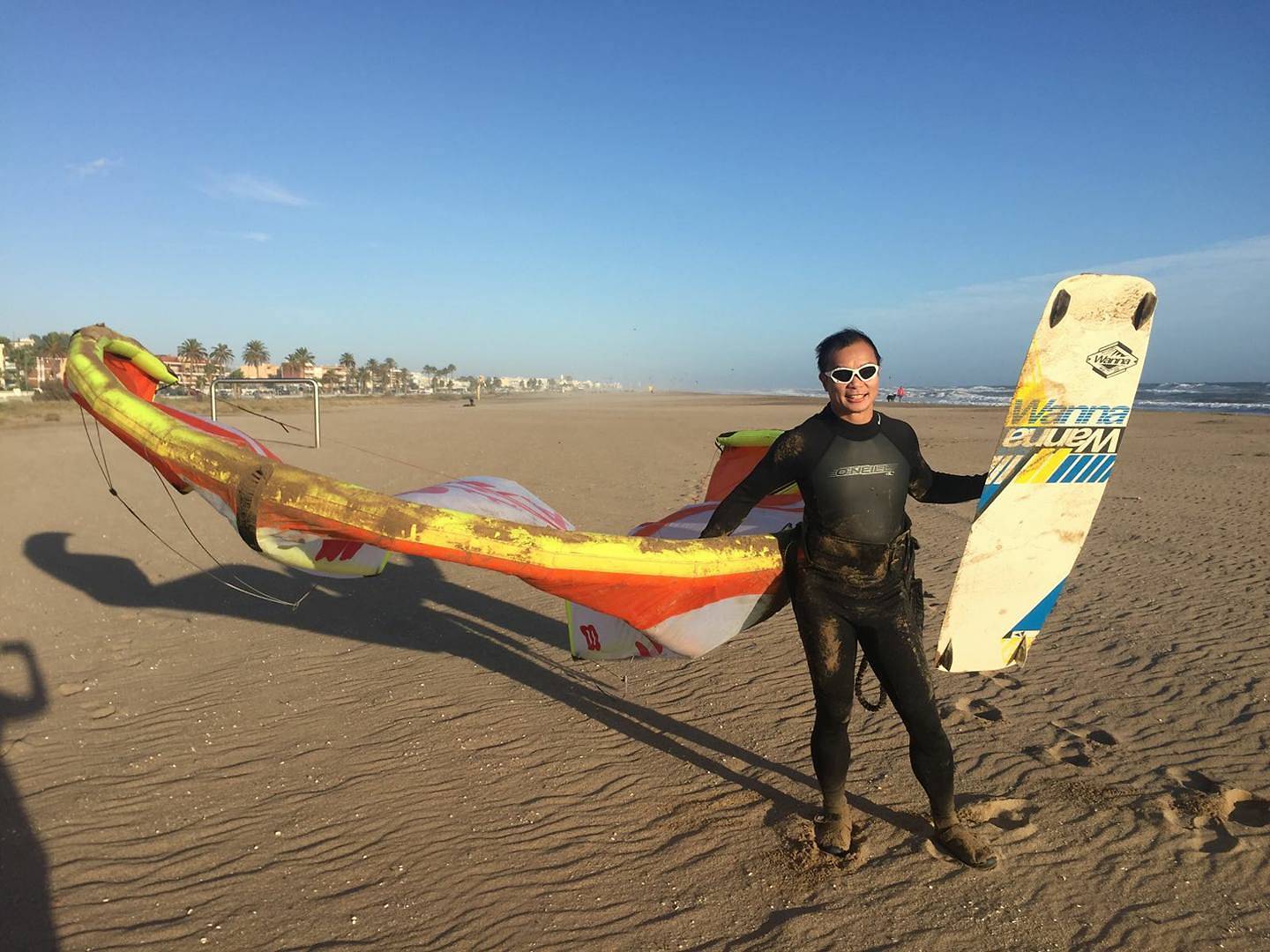
Since retiring from sailing, Ben Tan has taken up kiteboarding. (Photo: Facebook / Ben Tan)
THE PINNACLE
The pinnacle of his career was his Olympic experience, but not because of the obvious reasons. It was because things didn’t go well.
The Olympics took place in Savannah during the tail end of the hurricane season.
“Hurricanes were passing through and normally you would think they would cancel the race. Indeed, they cancelled a lot of races. But they didn’t cancel the Laser race I was in. Lasers are supposed to be tough, so that’s why they carried on.”
But Ben Tan was not mentally prepared as he was counting on a cancellation.
“My mistake was that I raced reluctantly. I shouldn’t have banked on the fact that they would cancel the race. To me that was the pinnacle of my career even though I didn’t win because it taught me lessons which I would not have picked up in any other way.”
This year will mark his eighth and final year as President of the Singapore Sailing Federation.
He is likely to stay on as an advisor.
As President, he introduced a meritocratic system of selecting sailors for tournaments through open trials and also formed an Olympic Pathway Taskforce.
He would like to continue his involvement by encouraging a sports culture that de-emphasises results.
“Ironically, when you ensure that the kids participate in sports for more meaningful reasons, for character-building and just fun, you will get the high performance results.”
He may believe in the value of suffering, but the starting point clearly needs to be rooted in pleasant experiences.
“But I have no regrets. The suffering made me a better person.”