

Monday, March 5, 2018 – 11:55
Others
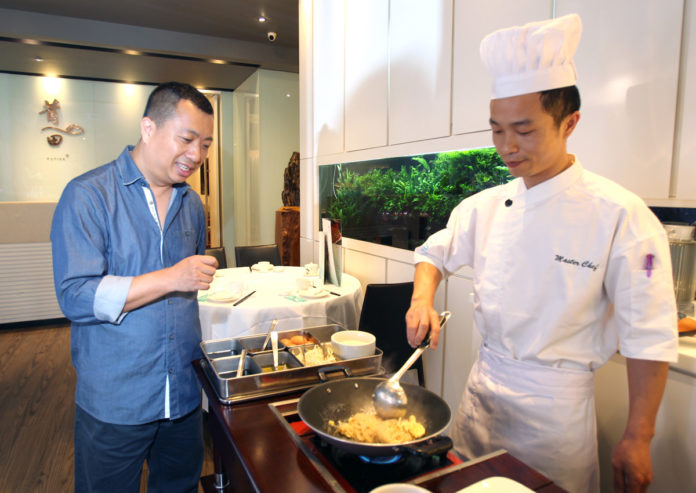
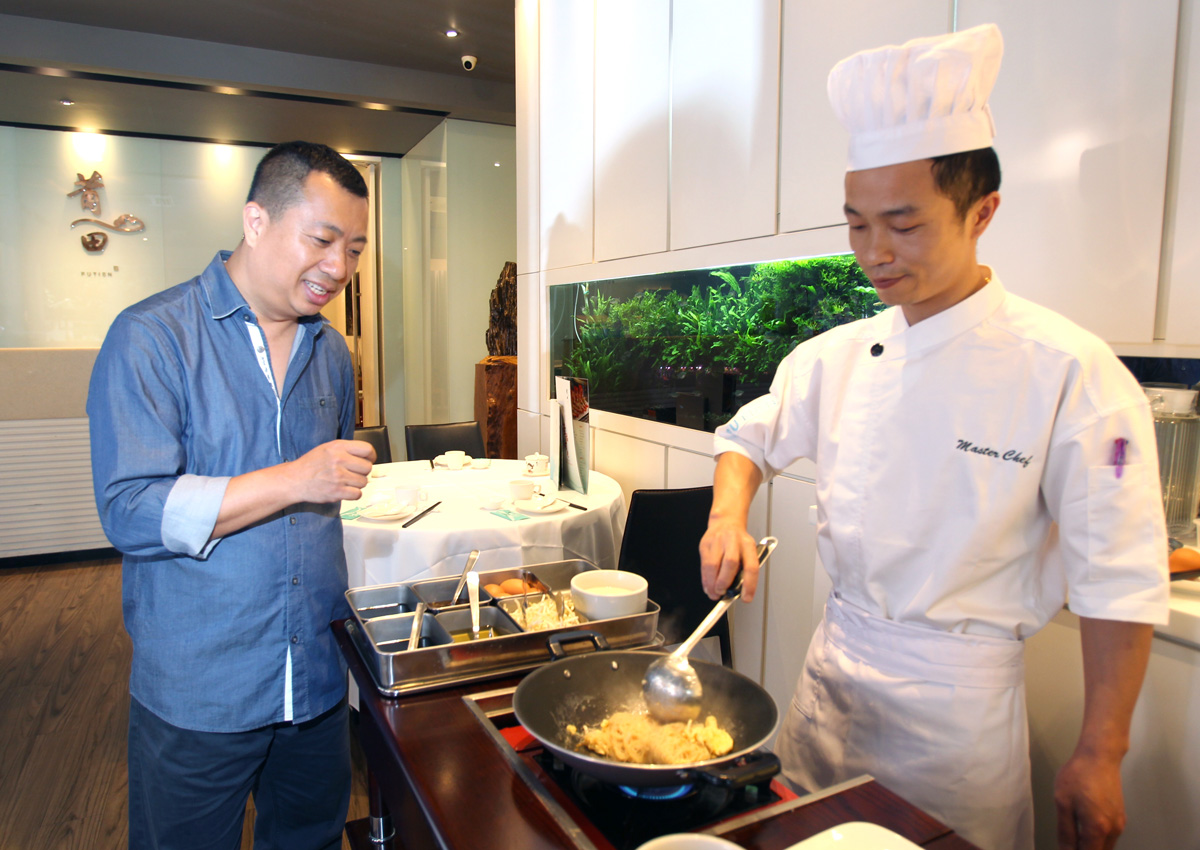
Back in 1987, Fong Chi Chung left his hometown of Putian – a small agricultural village in China – to move to Singapore and set up a factory selling electronic parts with his brother.
The factory in Paya Lebar was successfully established in four months, but living and working in an unfamiliar country was not easy.
He started to miss home-cooked Fujian cuisine, and was disappointed that he couldn’t find any authentic ones here in Singapore.
This very frustration of not being able to satisfy his cravings was what prompted the Arts graduate to establish the now-famous PUTIEN restaurant, which serves Heng Hwa cuisine from China’s Fujian province.
First Outlet Sustained Losses For 3 Years
Paying homage to his hometown, Chi Chung started up PUTIEN in 2000.
He pooled together his savings, along with some money borrowed from his family, to chalk up “approximately $60,000” to kickstart the business.
It was a humble coffee shop-style eatery on Kitchener Road, with only seven staff operating it.
But Chi Chung was unfazed by the small scale of his business – all he wanted was to introduce authentic dishes from his native homeland to others.
In fact, some of his favourite childhood dishes are included in the restaurant’s menu, including Lor Mee, braised bean curd with white cabbage soup, fried Heng Hwa bee hoon, stir-fried yams, Putian-style oyster omelette and Ah Yuan fragrant herbal chicken.
Despite his intentions, the outlet unfortunately operated at a loss for the first three years.
It was a very tough period for PUTIEN, but Chi Chung never gave up.
“Through these challenges, I clung firm to my vision and chose to introduce the cuisine of Putian to the world. I believe delicious and unpretentious dishes will remind people of their mum’s cooking,” he said.
“Putian cuisine is very much like home-cooked food. It’s characterised by uncomplicated and wholesome dishes made with the freshest of ingredients. With heartfelt culinary offerings, I believe Putian cuisine will be well-accepted and complimented by the market.”
Chi Chung admits that he is very particular about what goes in his dishes, and insists on only the freshest ingredients.
He does not compromise on preparation methods as well – “even if it’s more laborious, that it what makes PUTIEN unique.”
We strongly believe that the most fundamental factor in a good dish is its freshness. Sometimes it does not make a profit for us, but we believe it helps us to build our brand.
Moving Beyond Singapore
Plunging into the F&B industry without any prior knowledge or experience is indeed a very risky move.
But adhering to its principle of freshness and authenticity has helped PUTIEN tide through the tough times, said Chi Chung.
True enough, business started to improve within a few years and it finally broke even in its third year.
Satisfied customers kept returning, and the restaurant’s reputation also strengthened.
Spurred by steady business growth, Chi Chung opened PUTIEN’s second outlet at VivoCity mall in 2016.
I was approached by Food Republic to open an outlet at VivoCity. There, sales surpassed that of all the other outlets within the food court over the past fifteen months or so. The figures demonstrated evidently that the concept could be propagated.
That same year, PUTIEN was also voted as one of Singapore’s Top 50 Restaurants by The Sunday Times.
As PUTIEN secures a stronger foothold in Singapore, Chi Chung was motivated to move beyond Singapore’s shores to open its first overseas outlet in Jakarta, Indonesia.
Elaborating on the expansion move, Chi Chung recounted a time when he was once approached by an Indonesian-Chinese who visited his Kitchener Road outlet.
The man had expressed great interest in bringing PUTIEN to his home country, which prompted Chi Chung to realise that there is a market for PUTIEN in Indonesia.
Now A Boss Of 49 Outlets Globally
Following its regional expansion, PUTIEN continues to flourish over the years.
To date, PUTIEN has a total of 49 outlets globally across Singapore, Malaysia, Indonesia, Taiwan, Hong Kong, Beijing, Shanghai, Guangzhou and Shenzhen.
In Singapore alone, it has 12 outlets islandwide.
Their staff headcount now totals to about 1,700; and its revenue has also grown more than 50 per cent.
2016 in particular was a very momentous year for PUTIEN as it earned plenty of prestigious achievements.
Its Causeway Bay outlet in Hong Kong was recommended by Michelin Guide Hong Kong and Macau, and its Kitchener Road outlet in Singapore was awarded one Michelin star.
“When I first started PUTIEN, my expectations were simple. I just wanted to open a vibrant and lively restaurant where people could come with their families and friends to enjoy our food.”
“It never occured to me that it would become a global chain.”
Surviving Almost 2 Decades
When asked about the secrets to his success, the humble entrepreneur simply said that there is no magic formula.
Everything boils down to “a love for the job, persistence, integrity, and an unwavering commitment to the nurturing of a positive work culture for all employees.”
Chi Chung firmly believes that all employees, regardless of their position, is crucial in helping to build the business success.
As such, he makes it a point to handsomely reward them for their hard work. Whenever a staff member completes a year of employment, they will be treated to a free overseas tour.
In addition, he devotes a third of PUTIEN’s profits every quarter to dividends for his employees. Some of his employees even own company shares now.
“Ultimately, I have many, many customers and I cannot take care of all of them. I can only take care of my employees who in turn will take care of my customers,” he said.
To me, sharing your successes and your achievements is very important.
Consistently good food, and an effective branding and PR campaign is also imperative, he added.
Looking forward, Chi Chung said that he hopes to eventually set up PUTIEN outlets in other major Chinese cities, as well as in Japan, Korea, the Middle East and Europe.
Ultimately, his vision is to continue leading this illustrious brand, spearhead large-scale overseas expansion plans, and eventually achieve the ambitious goal of publicly listing the company.
This article was first published on Vulcan Post
Restaurants / Eateries
SYDNEY: On his third day in office, US President Donald Trump honoured his election campaign promise to take the United States out of the Trans-Pacific Partnership (TPP).
The move left allies and partners across the Pacific in Asia shell-shocked and may well come to be seen as the turning point in US global leadership.
After the confusion and uncertainty that Trump’s move generated, the remaining 11 TPP members spent most of 2017 salvaging the agreement.
These countries are set to conclude a TPP-11 or a rebranded Comprehensive and Progressive Agreement for Trans-Pacific Partnership (CPTPP) on Mar 8 in Chile.
DIFFERENT THINGS TO DIFFERENT MEMBERS
The new agreement is the TPP in name only. The withdrawal of the United States, which accounted for 60 per cent of the TPP’s collective GDP and around 40 per cent of the trade within the grouping, changes the character of the TPP.
The TPP meant different things to different members.
For most, it was an opportunity to keep the United States firmly locked into the Asia Pacific region. It was seen by the Obama administration as the economic arm of America’s “rebalance towards Asia”.
It was also an opportunity for further liberalisation and reform, with access to US and Japanese markets the main prize.
The agreement aimed to set new standards and rules for commerce in the 21st century — an elusive aim at the global level because of the failure of the World Trade Organisation’s diverse membership to settle on common goals.

President Trump withdrew the US from the Trans-Pacific Partnership shortly after his inauguration. (Photo: AFP/Robyn Beck)
Conclusion of the CPTPP does not deliver the big strategic goal of keeping the United States entrenched in Asia. Instead, it sends to Mr Trump a strong message of the region’s commitment to openness.
Holding the line and pushing back against growing protectionist sentiment keeps pressure on market opening and reform on which US businesses and consumers miss out, and keeps open the option of US re-entry down the track.
It could add momentum for broader liberalisation in Asia by facilitating expansion of membership and by lifting the ambition in the Regional Comprehensive Economic Partnership (RCEP) — an agreement being negotiated by the 10 ASEAN members as well as Australia, China, India, Japan, New Zealand and South Korea.
BETTER AGREEMENT NONETHELESS
TPP-11 is less important because of the American-sized hole in the middle, but is a better agreement given some of the changes that have been made to it.
The CPTPP has more chance of expanding membership since it froze some of the more egregious provisions of TPP — especially the US-pushed intellectual property protections that were likely to benefit big business in the United States at the expense of consumers in the region.
The scope of the investor–state dispute settlement provisions will be narrowed, but still give foreign investors access to an international tribunal to resolve disputes with host governments.
The agreement still gives those inside the tent veto power over new members, since accession requires agreement from all parties. Inclusion of larger countries like China, India and Indonesia will not be easy even if they meet membership criteria.
The United States will not be party to the TPP for the foreseeable future as it deals with the domestic structural problems that were the political genesis of the Trump administration.
South Korea’s biggest steelmaker POSCO was one of the worst hit in Asia by Donald Trump’s announcement on new tariffs, though analysts say the biggest fear is what the measures could mean for global trade. (Photo: AFP/PARK JI-HWAN)
PRESSING ON WITH RCEP
Most of the 11 CPTPP members are also actively engaged in negotiating RCEP. The RCEP agreement will be important to locking China and India into opening markets and pursuing reform on a parallel track to the CPTPP, especially in a period of global uncertainty when protectionism is on the rise.
That will not be easy until India comprehends its strategic interest in economic integration with East Asia and until it ceases playing spoiler in international forums.
READ: A commentary on managing expectations on the RCEP.
Chinese President Xi Jinping championed globalisation and openness in Davos in 2017, while Trump has retreated from multilateral commitments and to America First.
Xi will need to demonstrate leadership beyond rhetoric by making tough reform commitments in RCEP on issues such as state-owned enterprise reform. The economic cooperation agenda is central to RCEP’s delivering on politically challenging behind-the-border reforms.
The RCEP group includes some of the largest and most dynamic economies in the world and is important enough to make a difference globally.
An Australian Productivity Commission study estimates that even if tariffs were raised 15 percentage points globally (similar to what happened in the Great Depression), RCEP countries could all continue economic expansion if they abolished tariffs as a group. The gains for RCEP countries would be even larger with behind-the-border reforms.
The Regional Comprehensive Economic Partnership brings together ASEAN plus China, India, Japan, South Korea, Australia and New Zealand. (Photo: AFP/Christian Charisus)
A DANGEROUS TIME
In forging agreement on the CPTPP, Japan — the Partnership’s largest economy absent the United States — has found itself in an unusual leadership position.
Japan has often relied on external pressure, usually from the United States, to advance its diplomatic goals and even to push domestic reforms.
Japan has led the push for the CPTPP, deftly hedging against the uncertainties that Trump has generated in regional and global trade policy, strengthening ties with other partners like Australia and India and laying the groundwork for improving relations with China.
China, Asia and the world have survived Trump’s first year in office without a trade war. But he has just announced 25 per cent tariffs on all steel imports and 10 per cent tariffs on all aluminium imports, and more could be on the way as the November 2018 midterm elections draw nearer.
It’s a dangerous time. Yet agreements in Asia that promote openness and encourage countries not to retaliate may dissuade Mr Trump from further harming America’s trading partners and contain the damage to confidence in the global trading system.
Shiro Armstrong is director of the Australia–Japan Research Centre and the Asian Bureau of Economic Research at the Crawford School of Public Policy at the Australian National University, and editor of the East Asia Forum. This commentary first appeared in the East Asian Forum. Read it here.

TO commemorate 25 years of dialogue partnership with the Association of Southeast Asian Nations (Asean), India hosted 10 leaders from the member countries as chief guests for its Republic Day celebrations.
In his Republic Day editorial that appeared in 27 newspapers and in 10 languages, Prime Minister Narendra Modi focused on the shared values and common destiny between India and Asean, which have moved on from being dialogue partners to strategic partners.
It is therefore evident that Asean and Southeast Asia are on India’s priority list. There are certain imperatives on which India seeks to engage with Asean: geopolitical, economic, and socio-cultural.
SEE ALSO: Russia, India, China affirm partnership against terrorism
First, the geopolitics. The central issue on which Indo-Asean relations deeply thrive is China. The Modi government’s 2014 Act East Policy (a successor to the Look East Policy of the 1990s) came as an anaesthetic solution to China’s growing assertiveness in the region and was welcomed by the members of Asean.
In July 2016, China’s decision to ignore the verdict of the Permanent Court of Arbitration regarding its territorial claims in the South China Sea provided further impetus for this relationship. With India a big power in the region, the countries of Southeast Asia expect India to serve as a balance to China.

Arleigh Burke-class guided-missile destroyer USS Dewey transits the South China Sea May 6, 2017. Picture taken May 6, 2017. Source: Reuters/Kryzentia Weiermann/Courtesy U.S. Navy
The idea that India should enlarge its engagement in the region was also evident this year in the quadrilateral grouping of India, US, Australia and Japan. India’s Ministry of External Affairs has maintained that the Quad partnership is to ensure freedom of navigation in the region’s oceans, indicating growing concerns over China’s continued build-up in the South China Sea.
Second, there are economic imperatives behind New Delhi’s engagement with Southeast Asia. Taking advantage of mutual geopolitical insecurities, India has consistently pressed for greater economic integration with Asean nations and has sought to present itself as an attractive investment destination to them.
During the Republic Day celebrations in New Delhi, Modi offered to set up digital villages in Cambodia, Laos, Myanmar and Vietnam by utilising India’s $1 billion line of credit to Asean for ‘connectivity, culture, and commerce’. In July 2017, India’s then Foreign Secretary Subrahmanyam Jaishankar described connectivity as the “new Great Game”.
With the signing of the Asean-India Agreement in Services and Investments, Asean and India are likely to benefit from an extended market, where air connectivity aims to play a pivotal role. The issue of enhancing air connectivity between Asean countries and India is a major challenge due to growing demand for air cargo services. Among other things, India hopes to work towards an India-Asean Single Aviation Market and would like to facilitate more business and leisure tourists by having more direct flights connecting its Tier II and Tier III cities.
On the other hand, the Asean exhortation for India to ‘stand with Asean’ to conclude the Regional Comprehensive Economic Partnership (RCEP) by 2018 did not achieve concrete commitments.
India’s protectionist instincts have impacted its regional profile and highlighted its weaknesses, leading to frustration among other member nations by slowing down or impeding the negotiations. This could jeopardise India’s regional status in the eyes of the Southeast Asian nations.
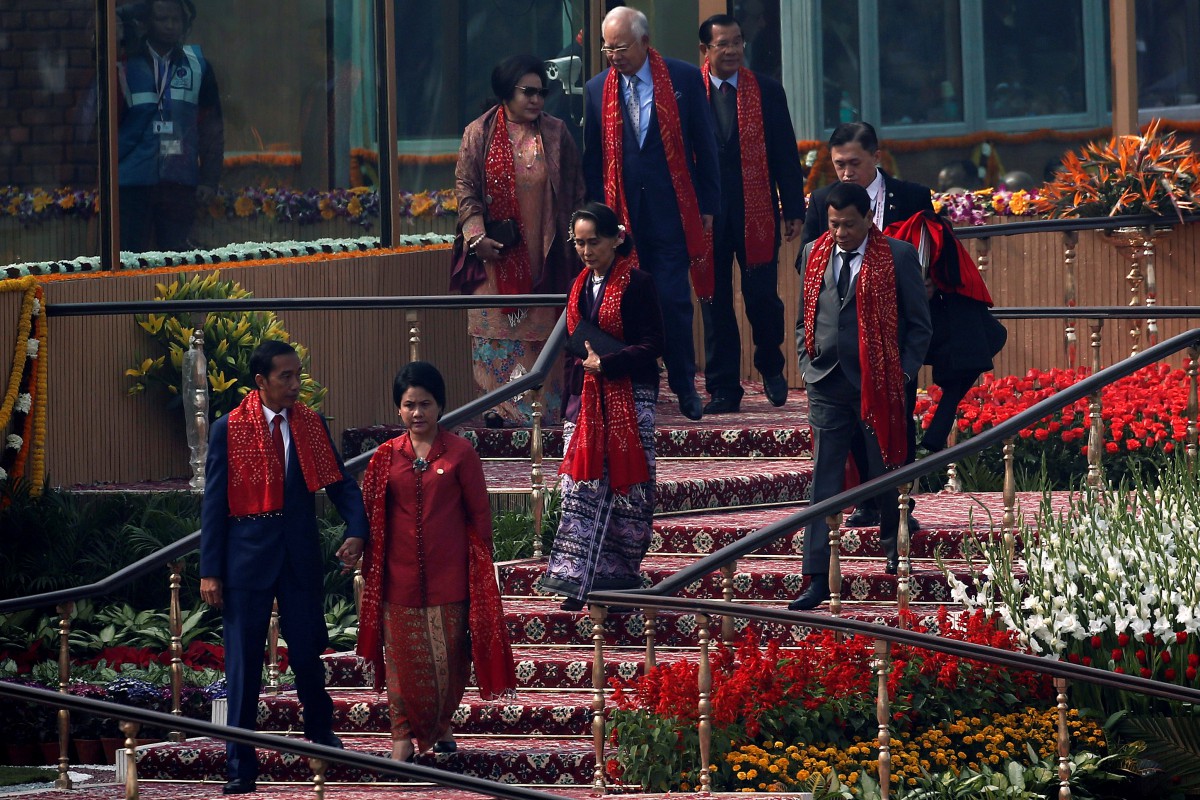
Malaysia’s Prime Minister Najib Razak, Indonesia’s President Joko Widodo, Myanmar’s State Counsellor Aung San Suu Kyi, and Philippine President Rodrigo Duterte, leave after attending the Republic Day parade in New Delhi, India January 26, 2018. Source: Reuters/Adnan Abidi
SEE ALSO: Experts call for greater education integration across Asean
Furthermore, some of New Delhi’s consolations for Asean members, like its 2015 offer for access to India’s indigenous satellite navigation system, the GPS-aided Geo Augmented Navigation (GAGAN), received no uptake from the nations of Southeast Asia. They instead chose the alternate offer from China.
The third imperative of India-Asean relations is socio-cultural. India has recognised the importance of its commonalities with Southeast Asia in civilisation, culture, religion and tradition and has sought to exploit these to build close linkages with the Asean countries. Southeast Asia remains an attractive destination for Indian tourists given its historical sites and affordability.
The January deliberations between India and Asean agreed on marking 2019 as the year of India-Asean tourism. India will also host an Asean-India Start-up Festival in 2018, as well as offering one thousand scholarships in the Indian Institutes of Technology for doctoral students from Asean countries. In addition, New Delhi announced a dedicated training course in highway engineering, and the establishment of a virtual network of universities and pilot projects to set up digital infrastructure at the Asean-India Commemorative Summit.
For all three of these imperatives, the symbolism of the presence of Asean chief executives as Chief Guests to India’s Republic Day parade cannot be underestimated. However, it is the China factor which appears to be driving the strategic convergence.
Unfortunately for New Delhi, the repeated use of the term Indo-Pacific by the Indian side during the Commemorative Summit was met with no candid citation from the Asean side. Only the press note of the Indonesian foreign ministry noted that President Jokowi had proposed to invite key countries in the region to discuss the Indo-Pacific concept. “I suggest that this concept should be developed based on openness, inclusiveness, based on the spirit of cooperation,” said President Jokowi.
This should be unsurprising. Asean nations have important trade relations with China and are cautious not to take part in any Indo-Pacific strategy that might raise Chinese eyebrows.
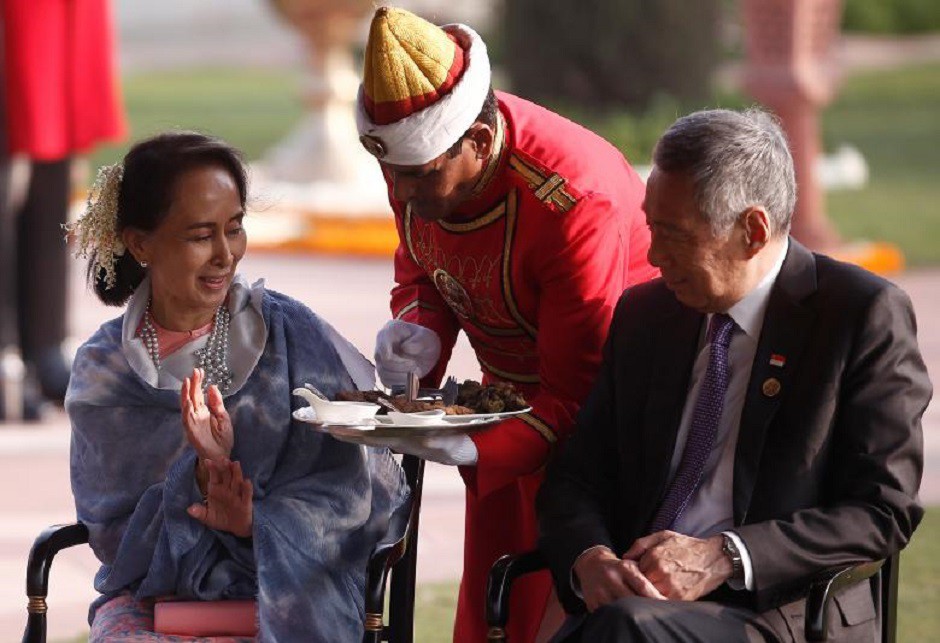
Singapore Prime Minister Lee Hsien Loong and Myanmar’s State Counsellor Aung San Suu Kyi attend the “At Home” reception at the Rashtrapati Bhavan presidential palace after the Republic Day parade in New Delhi, India. Source: Reuters/Adnan Abidi
SEE ALSO: How Marawi pushed Asean nations to join forces against terrorism
As it is, Beijing appears unimpressed with New Delhi’s overtures to Southeast Asia. In an editorial published the day before the Republic Day celebrations, China’s state-controlled Global Times described New Delhi as a “beginner” in geopolitics that is using a “bluff” to exaggerate its importance in the region and downplayed the India-Asean trade relationship.
But despite China’s disdain, India and Asean represent two of the world’s major rising markets, and their relationship should not be underestimated. By officially supporting a united and successful Asean community, India would guarantee its commitment to peace, stability and prosperity in Southeast Asia, which for Asean would be too large an economy to ignore.
India’s rise does not threaten Southeast Asia. Instead, the latter needs India primarily to counter Chinese assertiveness. To deepen their relationship, both India and Southeast Asia need to work towards further socio-economic, cultural and diplomatic interdependence. The leaders of Asean coming to India’s Republic Day symbolised this perfectly.
By Simi Mehta, PhD, Assistant Professor of Political Science at the University of Delhi. Originally published on PolicyForum.net.
{“total”:0,”error”:””,”facebook_total”:0,”linkedin”:0,”stumbleupon”:0,”pinterest”:0,”google”:0,”twitter”:0,”buffer”:0,”vk”:0}
SINGAPORE: It’s no wonder work-life balance is a commonly discussed topic in modern societies like Singapore.
For one, we’re always complaining about how “awful” our work–life balance is, according to a 2016 survey by salary benchmarking site Emolument.
Never mind that significant progress has been made through schemes that promote flexible working arrangements in local companies.
In the early 1990s, “work–life balance” became a popular topic thanks to Juliet Schor’s book The Overworked American: The Unexpected Decline of Leisure. She explored how employment had created such high demands on Americans that there had been a sharp decline in the quality of their life due to a lack of leisure time.
Most Singaporeans would agree that the situation is not any different today. In fact, the current talk in Singapore is that work-life balance is at best an ideal to strive towards.
At worst, work-life balance is proverbial, elusive and even depressing to think about
Yet the debate surrounding work-life balance in government, industry and academia often occurs without a clear understanding of what it is.
Furthermore, various interpretations of work-life balance are based entirely on misconceptions about work, life and employee attitudes.
NOT A 50/50 DIVIDE
First, many of us think of work–life balance as an equal distribution of time between work and non-work activities.
This 50/50 approach to assessing work–life balance pits both work and life against one another.
It also suggests that life as a whole is something we can divide as we wish.
But “work” and “life” are elastic. We are constantly reinforcing or redefining our work-life boundaries in response to our needs, constraints and life phases.
A man talks on his phone in the central business district.
Work-life balance is subjective and unique to each of us.
The nature of our work and life demands and responsibilities are different, so we tend to have our own preferences for managing our work and non-work roles.
For example, the self-employed (including freelancers and small business owners) are known to work longer hours per week, often working through weekends and even forgoing holidays. Yet in studies involving the self-employed, most seemed to be more satisfied with their work–life balance than employees holding a 9-to-5 office job.
More recently, work-life studies are showing that individuals who seem to “have it all” thrive on a sense of balance rooted in a strong belief in their own ability and daily recovery from work- or life-related stress.
READ: A commentary on why soldiering on at work is bone-headed.
ONE-SIDED CONVERSATION ABOUT WORK
Second, work experiences are often discussed in a bad light, such that any interference from work to non-work is bound to be harmful. The conversation surrounding work-life balance remains largely one-sided.
Work is often associated with stress, anxiety, conflict (with colleagues, supervisors and family members) and other negative health-related symptoms (including insomnia and heart disease). It is seen as an activity that intrudes into other non-work spheres (relating to the family, social, and community) and reduces an individual’s overall well-being.
On the contrary, we derive resources (including psychological, physical, intellectual and monetary gains) from multiple life roles including work. Other than monetary benefits from work that are needed to sustain livelihood, all of us experience satisfaction, fulfilment, a sense of purpose, skill and knowledge enhancements from our work.
As a result, we are better able to cope with the demands and challenges arising from other non-work spheres. We also feel happier, more optimistic and confident.
A woman surfs the Internet at work. (Photo: Pixabay)
Such a phenomenon is called “work-to-family enrichment”. Its positive impact on employees’ well-being and life satisfaction has been proven in many studies.
READ: A commentary on being a first-rate subordinate.
WORK AND LIFE SHOULD BE SEPARATED
The other common misconception is that work and life should be separated.
The ideal of compartmentalising our work and non-work spheres may sound appealing in a self-help book, but we all know reality is much more fluid.
Dual earner couples are now the norm in Singapore. The older norms of a breadwinner husband and a homemaker wife are fast becoming irrelevant.
As anyone who has received a call from their child’s school during work hours knows, the barrier between our professional and domestic spheres now resembles a door more than a wall.
Individuals no longer make a strict or marked distinction between work and non-work as they progress through each day. They work when needed, and attend to non-work demands when needed.
With mobile devices, Singaporeans are now able to switch between their work and non-work spheres by making use of flexible working arrangements, where offered by their employers.
NEED TO GO BEYOND ZERO-SUM APPROACH TO WORK-LIFE BALANCE
Successfully managing the work-life interface has been shown to lead to increased creativity, organisational commitment and well-being. To achieve this in Singapore, we need to appreciate the complex relationship between work and life.
We need to go beyond the current zero-sum approach to work-life balance.
Work-life balance is definitely achievable, supported by flexible working arrangements, the strategic use of mobile devices and realistic work-life balance goals.
People sit around laptop computers at a cafe. (File photo: AFP/Ed Jones)
The underlying assumptions the current work-life debate draws upon need to be re-examined. What are the factors contributing to the perceived lack of work-life balance? Is it the time pressure, or the long work hours?
Might it be that in companies’ unending quest for higher productivity, the work tempo of employees has actually gotten worse?
Or could it be that changing consumer behaviour and lifestyle aspirations are driving Singaporeans to work harder to climb the career ladder, sacrificing their non-work priorities in the process?
Another relevant issue is the gendered division of labour that pervades Singapore, such that married working women continue to contribute more to caregiving and household chores than married working men.
Unfortunately, none of the ongoing debates on work–life balance seem to be discussing these issues.
We need to start having a conversation on matters more relevant to a balanced work-life, which would enhance Singaporeans’ job satisfaction, family satisfaction and life satisfaction.
Carys Chan is assistant professor at RMIT University’s College of Business. David Cheng is lecturer at the Australian University’s College of Business and Economics. Justin Field is principal organisational development consultant at Oracle and adjunct lecturer at the University of England’s Business School.
Wie’s 11th-hour birdie helped her break free from a pack of four players that included a heartbroken Jenny Shin of South Korea, who had led coming into the last before bogeying.
Michelle Wie of USA kisses the trophy as she celebrates winning the HSBC Women’s World Championship golf tournament in Singapore. (ROSLAN RAHMAN/AFP)
SINGAPORE: American Michelle Wie delivered when it mattered most on Sunday (Mar 4), draining a 40-foot putt for a birdie on the last hole to claim a dramatic one-stroke victory at the HSBC Women’s World Championship.
All day long it had seemed as though a moment of magic was needed to lift the trophy, with so many players within sight of the lead at the Sentosa Golf Club.
But Wie’s 11th-hour birdie helped her break free from a pack of four players that included a heartbroken Jenny Shin of South Korea, who had led coming into the last before bogeying.
The 25-year-old Shin had one shot to spare from Americans Wie, Nelly Korda and Danielle Kang until fluffing her lines.
She found the sand, and then a bogey five for a seven-under 65 that left the door open for Wie.
With the victory, Wie claimed her fifth career LPGA title with a final-round seven-under 65, for a closing score of 17-under par 271.
“That has to be the best putt of my career,” said an elated Wie, whose last win was the US Open in 2014. “It’s been a tough journey but I’m just really proud that I pulled myself out of it.”
There had been chances on the last for both Nelly Korda, 19, and Danielle Kang, 25, to force a play-off with Wie.
Kang went wide to end the day with a two-under 70.
Korda’s gettable knock took a bend to the right and into misery and a one-under 71 for the rising star, who had looked so unflappable all week long.
Canadian Brooke Henderson then birdied the last for a 67 and a share of second on 16 under 272 with the pair.
Korda was consoled by sister and fellow LPGA star Jessica as she left the course. “It definitely hurts, but that’s golf,” said Korda.
Wie had been pecking away at the two players who had led the event for most of the day, and neither Korda nor Kang were ever able to break free from each other or from the field.
The two Americans were then overtaken by the surging Shin, who claimed the lead outright with a birdie four on the 16th after never really attracting notice until the business end of the tournament.
The trophy looked to be her’s for the taking until that final hole.
“The nerves that I got on 18, I think any human being would experience it,” she said.
Benign conditions, apart from the heat, had helped ensure a series of low scores. The tournament and course record was broken by South Korean Kim Sei Young, whose 10 under 62 topped the mark of 64 set by South Korean Park Inbee last year.
Former world number one Lydia Ko of New Zealand was another to charge up the leaderboard early, opening with four straight birdies. But she found she had left her run too late as her five-under 67 left her at 12-under and tied for 10th.
American Michelle Wie delivered when it mattered most Sunday, draining a 40-foot putt for a birdie on the last hole to claim a dramatic one-stroke victory at the HSBC Women’s World Championship.
Michelle Wie of the US gives a fist bump to her caddy after winning the HSBC Women’s World Championship golf tournament in Singapore. AFP/ROSLAN RAHMAN
SINGAPORE: American Michelle Wie delivered when it mattered most Sunday (Mar 4), draining a 40-foot putt for a birdie on the last hole to claim a dramatic one-stroke victory at the HSBC Women’s World Championship.
All day long it had seemed as though a moment of magic was needed to lift the trophy, with so many players within sight of the lead at the Sentosa Golf Club.
But Wie’s 11th-hour birdie helped her break free from a pack of four players that included a heartbroken Jenny Shin of South Korea, who had led coming into the last before bogeying.
The 25-year-old Shin had one shot to spare from Americans Wie, Nelly Korda and Danielle Kang until fluffing her lines.
She found the sand, and then a bogey five for a seven-under 65 that left the door open for Wie.
With the victory, Wie claimed her fifth career LPGA title with a final-round seven-under 65, for a closing score of 17-under par 271.
“That has to be the best putt of my career,” said an elated Wie, whose last win was the US Open in 2014. “It’s been a tough journey but I’m just really proud that I pulled myself out of it.”
There had been chances on the last for both Nelly Korda, 19, and Danielle Kang, 25, to force a play-off with Wie.
Kang went wide to end the day with a two-under 70.
Korda’s gettable knock took a bend to the right and into misery and a one-under 71 for the rising star, who had looked so unflappable all week long.
Canadian Brooke Henderson then birdied the last for a 67 and a share of second on 16 under 272 with the pair.
Korda was consoled by sister and fellow LPGA star Jessica as she left the course. “It definitely hurts, but that’s golf,” said Korda.
Wie had been pecking away at the two players who had led the event for most of the day, and neither Korda nor Kang were ever able to break free from each other or from the field.
The two Americans were then overtaken by the surging Shin, who claimed the lead outright with a birdie four on the 16th after never really attracting notice until the business end of the tournament.
The trophy looked to be her’s for the taking until that final hole.
“The nerves that I got on 18, I think any human being would experience it,” she said.
Benign conditions, apart from the heat, had helped ensure a series of low scores. The tournament and course record was broken by South Korean Kim Sei Young, whose 10 under 62 topped the mark of 64 set by South Korean Park Inbee last year.
Former world number one Lydia Ko of New Zealand was another to charge up the leaderboard early, opening with four straight birdies. But she found she had left her run too late as her five-under 67 left her at 12-under and tied for 10th.

WASHINGTON – Elton John left the stage in Las Vegas because a “rude” fan was interfering with the performance, he said on Saturday.
“A fan put his hands on the piano keys while I was playing and continued to do so even after I asked him to stop,” the 70-year-old British entertainer said in a statement posted on Twitter.
“This guy was rude, disruptive and had no care or respect for our show and so I let him know how I felt, then left the stage until they had removed him,” John said.
The incident occurred during a performance of “Saturday Night,” for which John had brought fans onstage.
He later returned to the stage, but the group of fans did not.
John, who in the 1980s became one of the first openly gay major celebrities, announced earlier this week that he plans “go out with a bang” with a global tour that will open on September 8 and last through 2021.

Michelle Wie drained a monster birdie putt from off the green on the final hole to record a stunning one-shot victory at the HSBC Women’s World Championship after a thrilling final round of low scoring and late drama on Sunday.
FILE PHOTO – Aug 25, 2017; Ottawa, Ontario, CAN; Michelle Wie plays her tee shot on the eleventh tee box during the second round of the Canadian Pacific Women’s Open golf tournament at Ottawa Hunt and Golf Club. PHOTO: Reuters/ Eric Bolte-USA TODAY Sports
SINGAPORE: Michelle Wie drained a monster birdie putt from off the green on the final hole to record a stunning one-shot victory at the HSBC Women’s World Championship after a thrilling final round of low scoring and late drama on Sunday (Mar 4).
Wie’s seventh birdie of the day completed a bogey-free round of 65 to finish on 17-under 271 for the tournament, a stroke ahead of American compatriots Danielle Kang and Nelly Korda, South Korea’s Jenny Shin and Canada’s Brooke Henderson.
The victory is Wie’s first since she claimed the 2014 US Open title, the American pumping her fist and galloping towards the green as her long-range putt dropped into the middle of the cup.
(Reporting by John O’Brien, editing by Nick Mulvenney)


