Home Blog Page 1091

Nathan Hartono's new Chinese single is all about love

0

“It was really just showing people that love can look like anything,” Singapore’s hottest singer-songwriter of the moment Nathan Hartono says halfway through our interview at Warner Music’s Singapore headquarters.

“Love can be super unexpected; it can just take you by surprise.”

Of course, we’re talking about his newly released Chinese single, Ai Chao Gei Dian, a rebranded version of his English single Electricity, and the music video that has dropped along with it. But the message of his music video is not the only that we touch on in our half hour interview.

Read on to find out how exactly his shoot with celebrity photographer Leslie Kee came about (hint: It involves a chance encounter on a dark night), the comments that he’s been receiving (what do you think?) and future works in the pipeline (more singles coming out this year? Yay!).

What was the inspiration behind your latest Chinese single?

It was a direct translation from an English single that I did. When we were looking into releasing a [single] in China,my team in China was looking at my previous catalogue and they really liked this song. I was a bit sceptical at first, because I didn’t think that it would translate very well.

It was also a strange idea at the time, but the further we got into it, the more we expanded into the idea, and it became a lot of fun to reimagine this baby that you write into a completely different language.

Interesting. So what was the experience shooting the music video like? What was the most fun aspect about it?

Oh, it wasn’t fun at all, because I was terribly sick. Probably the worst I’ve been sick in a while. (laughs) But the shoot itself was very inspiring.

For all the people that have been working there, the crew, director, dancers and everyone, they were super on the whole time, very detail-oriented, very serving to the project. Everyone was just on the top of their game, and it was very inspirational to see that.

It was directed by Leslie Kee, right?
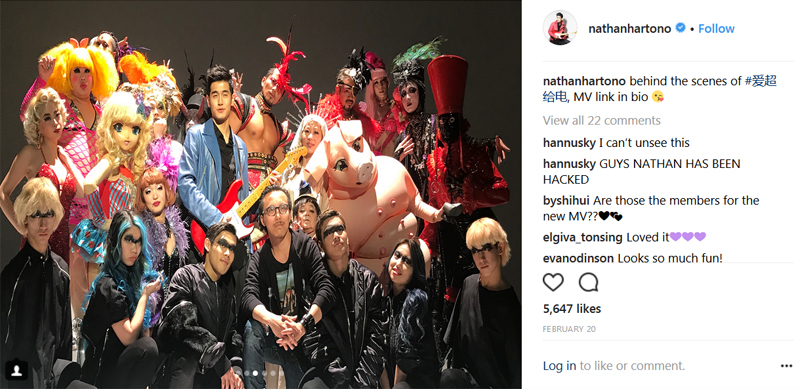
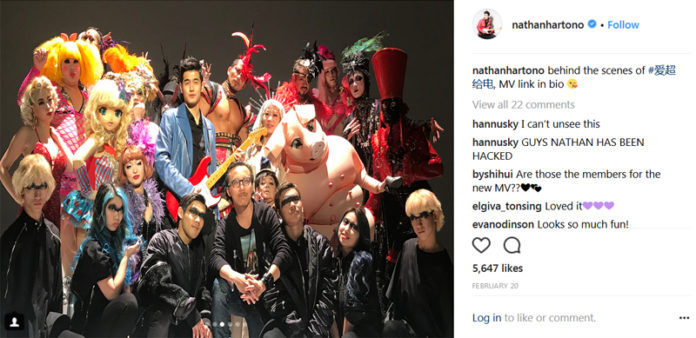
Photo: Instagram/Nathan Hartono

Yeah, Leslie Kee directed it. That itself is a crazy story. One of his work partners saw me get into a cab at Shinjuku, recognised me from the China show, and let Leslie know, ‘hey, this guy from Singapore is in Japan, you should hit him up’.

And he did, on Instagram, and he wanted to shoot the night after, and I happened to be free, so I was like, ‘alright, sure’. (laughs)

So we shot for the night, had really good chemistry, had supper after, just talked and caught up and got to know each other; exchanged Singapore stories, all that stuff.

And yeah, it just so happened to be a time that we were conceptualizing the visuals and all those kind of things for the upcoming music, so It was kind of perfect time. Very, very strange coincidence, but very perfect timing.

Speaking of the visuals, you had a very diverse cast in the music video. How did that come about?

The song itself is kind of like about a love that’s unexpected, a love that doesn’t always make sense, so we wanted to show love in all shapes and sizes, in predictable forms and unpredictable forms.

So we didn’t want to do a regular idol kind of dance video thing. I wanted it to have a wilder aesthetic and walk along the lines of what is widely accepted as the generic aesthetic.

So we went a little bit more left field – the cosplayers, the drag queens – just people who are super comfortable being whatever they want to be.

And how has the response been like to the video so far?

Photo: Instagram/Nathan Hartono

It’s been good! A lot of people are, like, ‘oh is it just the Chinese version of Electricity’, and I’m like, yes! But it is very difficult to explain that to like, many people over the Internet.

The China response has been very interesting, it’s really nice to see that. Their version of Spotify, QQ Music, actually has a comments section, so you really get into what the audience think. But I try not to dip my toes into that too often. (laughs)

OK, but the few comments that you’ve seen?

It’s been alright. Of course there’s a big part of me that wants to look into what people think about my work and all that, but I think it corrupts the thought behind the things to follow.

And what are you working on right now, do you have any new projects that are coming up? Any new singles that you are releasing?

Right now, just new music, really. I mean, the Chinese stuff is going to keep coming.

Between now and April there’s going to be a bunch of other songs, a bunch of other projects on the Chinese side, and just some of my own I’ve been working on, in English music as well.

This article was first published in Harper’s Bazaar Singapore

Tuesday, March 13, 2018 – 11:35

Others

Source link

Commentary: Behind the cryptocurrency mania, the secret sauce is Bitcoin’s blockchain technology

0

SINGAPORE: The furore over the future of cryptocurrencies such as Bitcoin has reached ever more frenzied peaks since the start of the year.

Goldman Sachs recently predicted that most cryptocurrencies will inevitably crash to zero and the head of the World Bank has warned that most resemble Ponzi schemes.

Meanwhile internet entrepreneurs turned venture capitalists the Winklevoss twins have said they expect Bitcoin to soar to 40 times its current value.

But such feverish debate over valuations of cryptocurrencies like Bitcoin has obscured the real story: That blockchain – the underlying technology behind Bitcoin and other cryptocurrencies – is poised to revolutionise the way the world does business in much the same way email and the internet did.

But the trouble is there hasn’t been a high-profile use case that has shown how blockchain can fundamentally alter the way companies do business or touch a facet of life the man on the street can relate to.

THE POWER OF BLOCKCHAIN

The innovative power of blockchain is that it creates a platform allowing any two parties to digitally transact with each other using an immutable, continuously-updated, distributed ledger.

In the case of Bitcoin, with no central authority overseeing the system, the task of updating the ledger relies on miners (“competitive bookkeepers”) who verify transactions and get rewarded with Bitcoins.

On average, a new block on a blockchain gets verified every 10 minutes and carries a reward of 12.5 newly created Bitcoins as a form of incentive. The entire supply of Bitcoins – which will peak at 21 million in 2140 – is pre-programmed by Bitcoin’s original developers.

Stacks of computing power gives bitcoin miners a shot at harvesting crypto currencies

Stacks of computing power gives bitcoin miners a shot at harvesting cryptocurrencies. (Photo: AFP/Maxim Zmeyev)

Just as the invention of the underlying technology behind email enabled the transfer of information from one user to another, blockchain enables the transfer of value from one user to another without the need for an intermediary like a bank.

This has huge implications for traditional intermediaries such as auditors, lawyers or public notaries, and without radical transformation, entire industries face a very real existential threat.

For example, most e-commerce currently relies almost exclusively on third parties such as Visa or PayPal to process electronic payments, charging transaction fees of up to 5 per cent. Overseas money transfer firms like Western Union and MoneyGram charge even more – often over 10 per cent.

These industries seem ripe for disruption and with the growth of blockchain the fate of financial remittance companies may resemble the demise of travel agents in the 1990s.

A Visa credit card is seen on a computer keyboard in this picture illustration

A Visa credit card is seen on a computer keyboard in this picture illustration taken Sep 6, 2017. (Photo: REUTERS/Philippe Wojazer)

At a national level meanwhile, a growing number of countries are exploring how to put their currencies on blockchain. 

For example, the Monetary Authority of Singapore (MAS) recently partnered with a consortium of banks to develop Project Ubin, a pilot tokenised version of the Singapore dollar that replicated the existing financial payment system without a centralised clearing system.

It is now working on similar projects focused on fixed income securities trading and cross border payments.

It seems that certain banking functions, for instance payments and cross-border transactions may be put on a blockchain going forward, reducing infrastructure costs while enhancing transparency, traceability and security in the financial services sector.

But blockchain technology has applications well beyond the finance industry.

Ravi Menon, managing director of the Monetary Authority of Singapore (MAS), speaks at the Singapore

Ravi Menon, managing director of the Monetary Authority of Singapore (MAS), speaks at the Singapore Fintech Festival in Singapore on Nov 16, 2016. (Photo: REUTERS/Edgar Su)

Indeed a recent Harvard Business Review article said blockchain “could change the very nature of economic, social, and political systems.” The article’s authors, both Harvard professors, said they foresee a world where “every agreement, every process, every task, and every payment would have a digital record and signature that could be identified, validated, stored and shared”.

By allowing businesses to control their own data, ensuring immutability and transparency, it offers transformational potential in areas such as inventory control, food safety and record management, including medical records.

In January, IBM and Danish shipping giant Maersk announced a joint venture to use blockchain in shipping supply chain. In a sector which handles around U$4 trillion of goods per year, the firms said they expected savings of up to 15 per cent of this amount, mostly by eliminating the bureaucracy and corruption risk in manual procedures.

Another area where blockchain shows significant promise is food safety.

Recently Walmart launched a pilot in China using blockchain to track and trace shipments of pork. Making food supply chains transparent and traceable brings a range of potential benefits – for example, while it normally takes days to recall a food product, blockchain can do it in seconds.

Walmart employees work at the company’s network operations center in Sunnyvale

Walmart employees work at the company’s network operations center in Sunnyvale, California, on Oct 25, 2017. (Photo: REUTERS/Nandita Bose)

MINING INVOLVES A LOT OF ELECTRICITY

Before we become swept up in the excitement, it’s important to also bear in mind the challenges.

One often underreported downside of blockchain is the power consumption it accounts for. Mining Bitcoin alone, for example, has been estimated to account for 42 terawatt-hours per year – similar to the annual consumption of Hong Kong or New Zealand. This may potentially be alleviated by different mining processes, but these will likely raise different issues and challenges.

Another critical issue is security. Bitcoin is safe as long as honest nodes control more power than potential collaborating attackers. However, this can be undermined by the formation of mining syndicates since collusion among groups with more than 50 per cent of mining power could enable hacking of the system.

FILE PHOTO: Chain of block erupters used for Bitcoin mining is pictured at the Plug and Play Tech C

A chain of block erupters used for Bitcoin mining is pictured at the Plug and Play Tech Center in Sunnyvale, California on Oct 28, 2013. (Photo: REUTERS/Stephen Lam)

Scalability likewise needs to be urgently addressed as the reach and use of cryptocurrencies continue to grow. Bitcoin, for example, can currently only process roughly seven transactions per second whereas in contrast Visa can process more than 50,000 per second.

The most critical risk however comes from regulatory bodies and the response they take to this growing phenomenon.

Several governments including Bangladesh, Nepal and Vietnam have banned Bitcoin transactions outright. China and South Korea meanwhile have recently introduced strong regulatory measures such as restricting trading in cryptocurrencies.

Others like Hong Kong and Singapore have adopted a more measured approach – Singapore’s MAS announced that while it had no plans to regulate cryptocurrencies, it would come down hard on any money laundering and terrorist financing risks.

Perhaps one particularly significant sign came in recent testimony to a US Senate by J Christopher Giancarlo, Chairman of Commodity Futures Trading Commission.

His view, he told the panel, was that “distributed ledgers have the potential to enhance economic efficiency, mitigate centralised systemic risk, defend against fraudulent activity and improve data quality and governance.” As such, he added, the right regulatory approach to blockchain technology would be to “do no harm”.

This statement may go down as the moment that blockchain entered the mainstream.

Bitcoin token is seen placed on a monitor that displays binary digits in this illustration picture

A token of the virtual currency Bitcoin is seen placed on a monitor that displays binary digits in this illustration picture on Dec 8, 2017. (Photo: REUTERS/Dado Ruvic)

Just like how people didn’t foresee the impact of e-commerce before Amazon arrived or that of social media before Facebook, it’s conceivable that blockchain may become the next big tech.

In fact, blockchain may have the potential to underwrite the very systems we depend on today for any sort of transaction.

So what does this mean for those investing in cryptocurrencies? Given their wild swings in price, the highly speculative environment and lack of pricing models, investing in specific cryptocurrencies such as Bitcoin or Ether remains a highly risky prospect for the vast majority of retail investors.

However, for a lot of businesses, investing in blockchain may be a prudent strategic investment.

Indeed, as the technology’s potential continues to grow, we will see the emergence of innovative companies with creative and disruptive applications that existing firms and industries cannot afford to ignore.

Emir Hrnjic is a visiting senior research fellow at the Centre for Asset Management and Research Investment at the National University of Singapore (NUS) Business School. 

Source link

International Summit on Telecommunications, Cloud Computing and Wireless Technology

0

International Summit on Telecommunications, Cloud Computing and Wireless Technology
from Wednesday, August 22, 2018 at 9:00 AM to Wednesday, August 22, 2018 at 6:00 PM

Holiday Inn Singapore Atrium

317 Outram Rd, Singapore, Singapore, 169075 Singapore

Source link

Mamma Mia!

0

Mamma Mia!
Sunday, November 11, 2018 at 12:00 AM

Marina Bay Sands

10 Bayfront Avenue, Singapore, California United States

Source link

Youth gets 10 years' jail, 12 strokes of the cane for rape and sexually violating teenage girls

0

Singapore

Monday, March 12, 2018 – 19:28

The Straits Times

Others

Source link

Property app for buyers and sellers to rate agents, view listings launched

0

SINGAPORE: Home buyers and sellers can now contact property agents and rate their service using a new mobile app called RealHome. 

A beta version of the app was launched on Monday (Mar 12), and when it is fully rolled out in a month’s time, users will also be able to search for property listings in real-time as well as schedule viewings with agents handling those units. 

The app, which is available for download for free on Google Play Store and Apple’s App Store, was officially launched by Second Minister for National Development Desmond Lee. It is part of efforts to improve transaction services, under the real estate industry transformation map which was unveiled last month.

realhome app launched for buyers

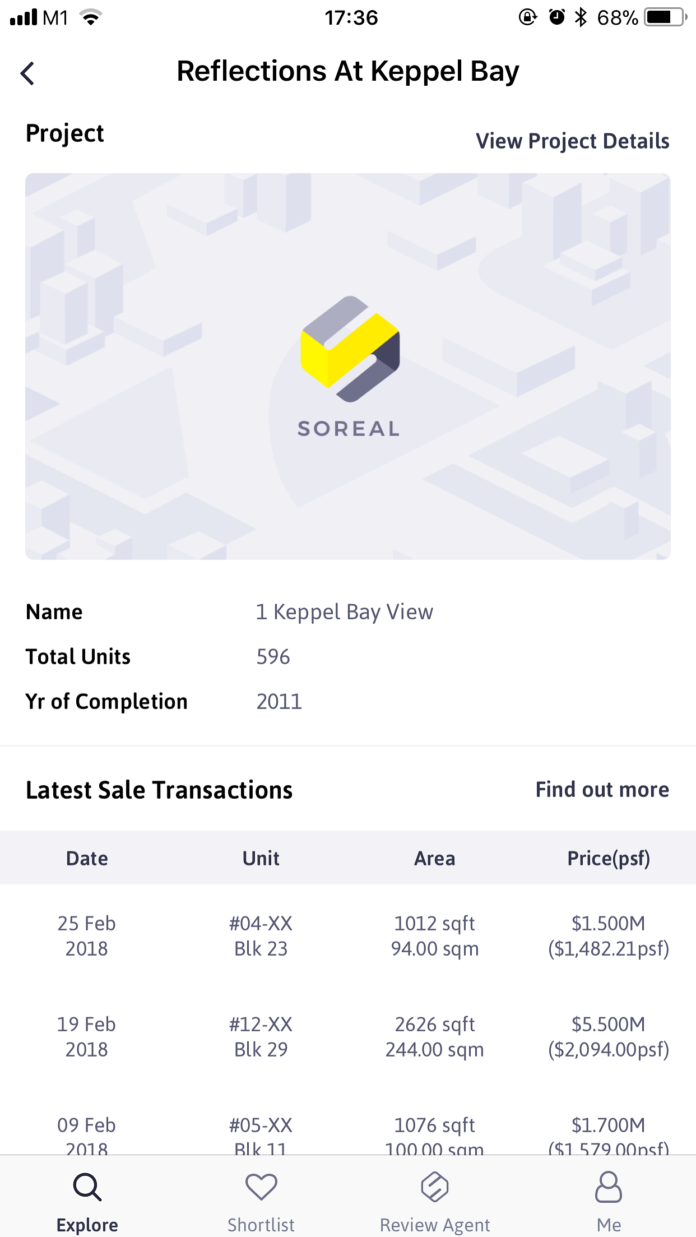
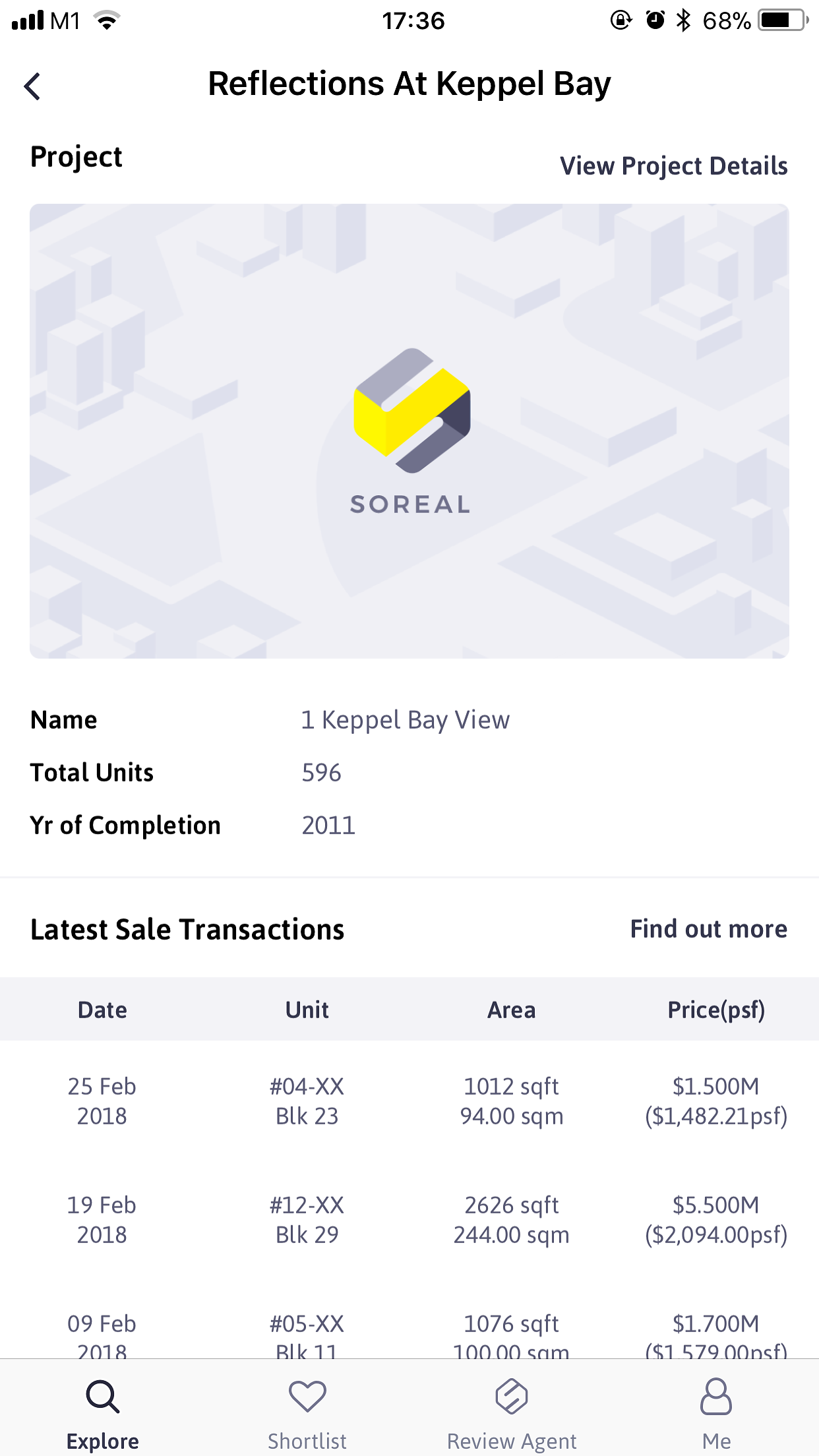
Screengrab of information about past transactions provided on the RealHome app. 

Spearheaded by ERA Realty, Huttons Asia and PropNex Realty, the RealHome app aims to improve industry standards by allowing consumers to rate and review agents after a successful transaction. 

Each review will also include information such as the transaction identification, a brief property address, as well as the type of transaction, to ensure that the reviews are “legitimate and credible”, according to the agencies.

“The online ratings and testimonials ‘reward’ well-deserving salespersons who performed to the best of their abilities,” said CEO of Huttons Asia Goh Kee Nguan. 

“Through this transparent sharing, it will inadvertently raise the level of professionalism among salespersons who will strive for better reviews from their clients on the portal.”

Said Mr Lee: “In recent years, we have seen the emergence of many property-related online portals and services, disrupting traditional players in the real estate transaction services sector.”  

“Property agencies in Singapore have found the need to embrace this shift towards online services, and find new ways of delivering value to consumers by constantly innovating, and doing so relentlessly,” the minister added, noting that do-it-yourself transactions for public housing resale flats increased from 11 per cent in 2010 to 28 per cent last year.

“Innovation is key to the transformation of the industry.”

APP FOR AGENTS PROVIDING REAL-TIME PROPERTY REPORTS

An app for property agents was also launched by the three agencies, under a not-for-profit consortium set up to manage the online platforms.

Using the RealAgent app, agents will be able to receive real-time transaction data and updated reports of specific properties. Access to the app will be free for agents for a year, and will subsequently be “priced affordably”, the agencies said.

Property information and listings on the apps will be provided by more than 16,000 agents from the three agencies, which currently capture more than 60 per cent of residential property transactions in Singapore.

A partnership agreement between nine real estate agencies, members of Singapore Estate Agents Association, Institute of Estate Agents Singapore, as well as members of KEO Connect, a group for key executive officers in the real estate industry, was signed on Monday, with talks underway to bring other industry players on board. 

The leaders of the three agencies are also sitting on a new digitalised property transactions workgroup set up as part of the real estate roadmap, led by the Council for Estate Agencies. 

Mr Lee said that the Government will make it easier for the industry to access property-related data later this year, in a bid to help automate administrative processes that make up a property transaction.

“Our goal is for agents and property portals to be able to automatically certify key details, such as whether a seller is the legal owner of the property or whether a potential foreign tenant has a valid work pass in Singapore – all with the click of a button,” said Mr Lee. “This will be an opportunity for firms to undertake significant process innovation to become more productive.”

Source link

Stolen A-Level scripts: 75 of 238 affected students will re-sit Chemistry Paper 3

0

The 238 students, whose final A-Level Chemistry grades were derived through a projection, had the option of re-taking the Chemistry Paper 3 in April or November, and have the better of the two grades recorded on their result slips and certificates.

SEAB 2

File photo of a student taking the 2017 A-Level Chemistry paper. (Photo: Ruyi Wong)

SINGAPORE: Of the 238 students whose A-Level Chemistry scripts were stolen in the United Kingdom last year, 75 have opted to be re-examined for the affected paper, the Singapore Examinations and Assessment Board (SEAB) told Channel NewsAsia on Monday.

The students, who received their A-Level results on Feb 23, are from Anderson JC, Anglo-Chinese JC (ACJC), Hwa Chong Institution (HCI) and Nanyang JC (NYJC). The stolen scripts were for Paper 3, which consists of free-response questions and carries a weightage of 35 per cent of the entire H2 Chemistry examination.

The final A-Level grades of the affected students were derived through a projection. But given the “unique circumstances”, the affected students were given the option to re-sit the H2 Chemistry Paper 3 in April or November, and have the better of their two grades recorded in their A-Level result slip and certificate.

Those who wished to register for the re-examination had to do so by Friday (Mar 9). 

SEAB said that of the 75, there were 28 students each from AJC, and ACJC, seven from HCI and 12 from NYJC. 

Out of the total, 57 of the candidates registered for the re-examination in April, while 18 registered for the re-examination in November.

The scripts were stolen out of a locked courier’s van in the UK while in transit to the examiners for marking. Cambridge Assessment said it was reviewing their processes to ensure the security of examination papers and scripts, and “safeguard the integrity of our national examinations”.

Source link

Singapore appoints new defence, army chiefs

0

Major-General Melvyn Ong will become Chief of Defence Force while Brigadier-General Goh Si Hou will be Chief of Army.

Melvyn Ong

Major-General (MG) Melvyn Ong Su Kiat. (Photo: MINDEF)

SINGAPORE: Major-General (MG) Melvyn Ong has been appointed the Chief of Defence Force and Brigadier-General (BG) Goh Si Hou the Chief of Army, the Ministry of Defence (MINDEF) announced on Monday (Mar 12).

MG Ong, 43, is also the outgoing Chief of Army. He assumed the post in August 2015 from fellow guardsman Lieutenant-General Perry Lim. MG Ong was previously also Chief Guards Officer and in 2011 led the SAF’s earthquake relief efforts in New Zealand.

He was awarded the Public Administration Medal (Silver) (Military) in 2012. From 2013 to 2014, through a dual-career scheme, MG Ong served as Deputy CEO of the Early Childhood Development Agency (ECDA). In addition to setting up the agency, he crafted policies and worked to raise the quality, accessibility and affordability of early childhood services.

BG Goh, 40, now succeeds MG Ong as the new Chief of Army.

MG Ong takes over from LG Lim, who held the Chief of Defence Force post since August 2015 after the retirement of current Minister for Education (Schools) Ng Chee Meng.

LG Lim, 46, was awarded the Public Administration Medal (Gold) (Military) in 2016, and the same year was conferred the Most Exalted Order of Paduka Keberanian Laila Terbilang (First Class) (Brunei) and the Bintang Kartika Eka Paksi Utama (Indonesia).

According to the Defence Ministry’s website, he was seconded to the Ministry of Education from 2006 to 2008 to serve as Director of Higher Education. There he was responsible for formulating policies, planning and funding for the local university and technical education sectors, and regulating the private education sector.

He now sits on the boards of Singapore Technologies (ST) Engineering, Defence Science and Technology Agency (DSTA), and JTC Corp.

Source link

Bangladesh PM makes first official visit to Singapore

0

Singapore, Bangladesh ink agreements boosting air connectivity and helping Singapore companies get direct access to infrastructure opportunities.

Bangladesh PM and PM Lee

Bangladesh Prime Minister Sheikh Hasina (left) and Singapore Prime Minister Lee Hsien Loong (right). 

SINGAPORE: Tagore Avenue along Yio Chu Kang road was named after Rabindranath Tagore – the first Asian Nobel Literature laureate. He also composed the Bangladesh national anthem.

His works continue to bring generations of Singaporeans and Bangladeshis together through an appreciation of a shared cultural heritage.

The relations between both countries will be further strengthened as the Bangladeshi Prime Minister Sheikh Hasina is in Singapore for her first official visit, said Prime Minister Lee Hsien Loong on Monday (Mar 12) as he hosted Madam Hasina for lunch at the Istana.

Both leaders also witnessed the signing of two memoranda of understandings (MOUs) which will help businesses and improve bilateral relations.

These include the Singapore-Bangladesh Air Services Agreement, signed between the Civil Aviation Authority of Singapore and the Bangladesh Civil Aviation Authority Board, which will allow passenger and cargo services between both countries to be expanded.

The other is an MOU on public-private partnership, signed by IE Singapore and the Public Private Partnership Authority of Bangladesh, aimed at helping Singapore companies, including SMEs, enter the fast-growing market.

Mr Lee said: “Singapore is a maritime nation situated between the Indian Ocean and the Pacific Ocean. Therefore we should do more together. Singapore-based companies are keen on the growing Bangladesh market. The MOU on public-private partnership will facilitate more investments by Singapore companies in Bangladesh, particularly in the power, connectivity and infrastructure sectors. 

“Sembcorp is one of the largest investors in the energy sector with over US$1.1 billion invested in power plants while PSA is interested to explore opportunities in Chittagong port.”

In her speech, Mdm Hasina spoke about the friendly ties Bangladesh and Singapore have enjoyed since the establishment of diplomatic relations in February 1972 and said she is happy to see a growing interest and engagement of Singaporean companies in Bangladesh today.

“Bangladesh and Singapore belong to different levels of development. But we can complement each other in our economic pursuit,” she said. 

“In Singapore, you have capital, advanced technology and know-how while in Bangladesh, we have a large workforce. Moreover, a large section of our population is young and educated. These comparative advantages may be harnessed to our mutual benefit.”

She added that Singapore continues to be a favourite destination for Bangladeshi workers and hopes that Singapore will continue to provide them with a decent work atmosphere.

Mdm Hasina is expected to attend the Bangladesh-Singapore Business Forum and a business roundtable on Tuesday and will stay in Singapore until Wednesday.

Source link

Kindergarten responds to incident about bruises found on 3-year-old girl's ear

0

Update at 2.25pm:

The kindergarten involved has provided more details regarding the incident.

According to The Straits Times, a teacher who carried out daily health checks on the children on the morning of Feb 14 had first found bruises below the girl’s eye.

Ms Kwan explained this was caused by an accident at home involving her son, said the school.

About two hours later, another teacher noticed a bruise on the girl’s ear.

However, the child similarly claimed she had been accidentally hurt by her brother at home.

As this was consistent with Ms Kwan’s explanation of the earlier bruises, the school did not take immediate action to inform her about the girl’s bruised ear, added the school in its statement.

Ms Kwan was informed in a phone call on the same day that her daughter had “behaved normally in school” and they were unaware of any incident that could have caused the bruises on her ear.

The school said: “We have been extending our fullest cooperation on its investigations.

“We also note that she returned to kindergarten on the next day and enjoyed the Chinese New Year celebrations with her friends.”

Having carried out its own investigations by reviewing closed-circuit television footage and interviewing staff members, the school “did not find any incident or circumstances that could have caused those injuries in the kindergarten”.

on Facebook

Update:
The school mention about the bruise below my Daughter cheek was a fading bruise that was a week ago. That’s…

Posted by Claudia Kwan on Sunday, 11 March 2018

Original article:

Police are investigating a report lodged by a mother whose young daughter was found with a bruised and swollen ear after the latter returned home from her pre-school on Feb 14.

The mother, Ms Claudia Kwan, had written about the incident in March 10 posts on her personal Facebook page and in the ‘Childcare in Singapore’ group.

Ms Kwan said in her post that she sent her three-year-old daughter, who was “perfectly normal and happy”, to school on the morning of Feb 14.

on Facebook

Dear all,

I appreciate it if you could take some time to read this post. It’s a long post as I’m seeking advice.

I’m…

Posted by Claudia Kwan on Friday, 9 March 2018

However, when her husband picked up their daughter from school later that day, “he sensed that something was not right” with the child’s mood.

Ms Kwan wrote: “Her messy hair covered part of the ear and she was sweaty after a whole day in school but what he saw was a horrific bruise on the top of her ear.

“When they reached home, my hubby asked me to check what had happened to her ear and to my horror, her ear was badly bruised to such an extent that it was swelling badly.

“My heart bled and when I asked my daughter about what had happened, she lost control and just broke down into tears and cried.”

According to Ms Kwan, who also shared photos of her daughter’s injury, none of the teachers at the pre-school could explain what caused the bruise.

She said she took her daughter to a paediatrician, who was “shocked” by the injury and “diagnosed it as a form of traumatic bruising that was caused by the exertion of great intentional force, and not a result of insect bites or drug allergies”.

A visit was made to another paediatrician at KK Women’s and Children’s Hospital (KKH) on Feb 15 and the bruise was classified as a “non-accidental injury”, added Ms Kwan.

The mother, who said she has reported the incident to the police, Early Childhood Development Agency (ECDA) and a Member of Parliament (MP), also shared how her daughter has been “traumatised badly”.

“She is tormented day after day by the incident and her behaviour has even undergone drastic changes. She is now very temperamental and bursts into rage or tears at times, sometimes even out of the blue for no apparent reason,” wrote Ms Kwan in her post.

She added that her daughter, who has stopped attending the pre-school, also suffers nightmares every night for the past three weeks.

In response to a query by Stomp, the police confirmed that a report was lodged and investigations are ongoing.

“The investigation officer has updated Ms Claudia Kwan on the status,” said the police.

In a statement, the ECDA told Stomp that it is aware of the case and has reached out to Ms Kwan to provide any necessary assistance that she and her child may require.

It added: “At the same time, ECDA is working with the centre to ensure the safety and well-being of the children at the centre.”

Singapore

Monday, March 12, 2018 – 15:24

More about

Kindergartens

Stomp

Others

Source link