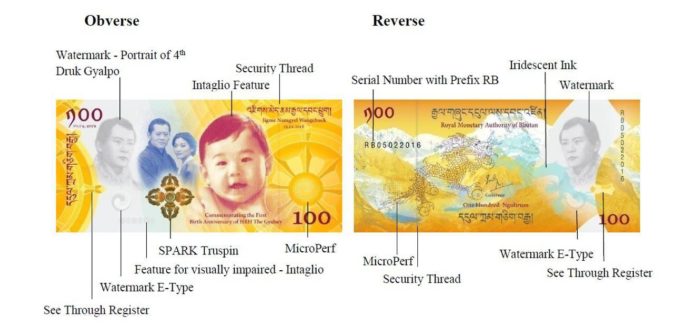
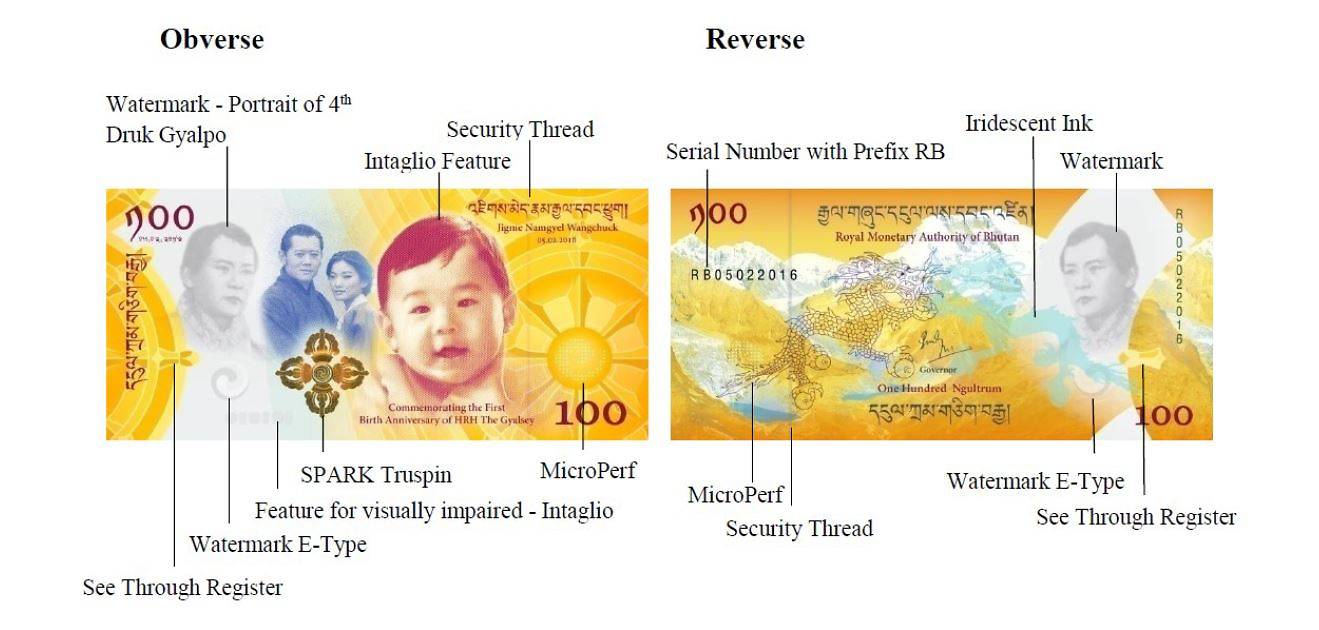
SINGAPORE: Limited-edition banknotes commemorating the birth of Bhutan’s crown prince Jigme will be sold in Singapore from this Friday (Mar 23), the Singapore Mint said on Tuesday.
The prince, whose full name is Jigme Namgyel Wangchuck, celebrated his second birthday last month. He was born on Feb 5, 2016 to Bhutan’s King Jigme Khesar Namgyel Wangchuck and Queen Jetsun Pema.
The notes have a face value of Ngultrum 100 (S$2.02) and will be sold at S$25 each, according to the Singapore Mint, which is the appointed marketing agent for Bhutan’s Royal Monetary Authority.
There are 1 million pieces available worldwide with a “limited allocation” to the Singapore market, it added.
The notes can be purchased from Singapore Mint’s e-store and its retail outlets at Chinatown Point, City Square Mall and Suntec City as well as the company’s head office at Teban Gardens Crescent.
As part of a promotion to mark the Singapore Mint’s 50th anniversary, the notes will be sold at S$15 each during the Singapore International Coin Fair from Mar 23 to 25 at the Sands Expo & Convention Centre.
This promotion is only available for the first 1,000 pieces purchased each day of the coin fair and is limited to five pieces per customer on a first-come, first-served basis, the Singapore Mint added.
In 2008, the Singapore Mint was appointed to mint commemorative coins for the coronation of King Jigme. In 2011, it also marketed commemorative banknotes for the king’s wedding with Queen Jetsun.
They were convicted and sentenced before the interpretation of section 409 of the Penal Code was changed last year, says Law Minister K Shanmugam.
Home Affairs and Law Minister K Shanmugam speaking in Parliament on March 20, 2018 (Screengrab)
(Updated: )
Bookmark
SINGAPORE: The public prosecutor does not intend to file any applications in respect of three directors currently serving time for criminal breach of trust (CBT), despite a recent ruling excluding the embezzling City Harvest Church (CHC) leaders from receiving similar punishment.
“All three had pleaded guilty under section 409. They were convicted and sentenced before the High Court changed the interpretation of the law regarding section 409 of the Penal Code,” Law Minister K Shanmugam explained in Parliament on Tuesday (Mar 20).
Section 409 of the Penal Code concerns heavier punishments for certain groups of CBT offenders, and includes life imprisonment.
Last year the High Court ruled that “agents” as defined by Section 409 does not include the following: Directors of corporations, governing board members, key officers of charities or officers of societies.
It thus could not be applied to the CHC leaders who misused over S$50 million of funds in a fraud designed to embellish the pop music ventures of Ho Yeow Sun, the wife of church founder Kong Hee.
Kong, Chew Eng Han, John Lam, Sharon Tan, Tan Ye Peng and Serina Wee could only be convicted and sentenced under section 406 instead, which carries up to seven years in jail.
Mr Shanmugam told the House that the three directors convicted and sentenced under section 409 are presently on community-based programmes – including home detentions – and scheduled for release in a few weeks, somewhere between May and June of this year.
“There are in fact 15 persons currently serving sentences for section 409 offences,” he clarified. “Of these 15 persons, three were … directors. The remaining 12 who comprise eight professional agents of one sort or another – insurance agents and so on – one attorney, and three public servants.
“The 12, as I explained yesterday, they are not affected by the ruling of ‘directors’.”
Mr Shanmugam was referring to his response to a parliamentary question on Monday, where in similar fashion he noted that the 12 “were convicted, sentenced before the High Court reviewed and changed the interpretation of the law regarding section 409, and the Public Prosecutor does not intend to file any applications in respect of them”.
Speaking in Parliament on Tuesday (Mar 20), the Senior Minister of State for Education noted that this would have to be carefully considered, given the large volume of answer scripts and number of subject papers offered each year.
File photo of a student taking the 2017 A-Level Chemistry paper. (Photo: Ruyi Wong)
Bookmark
SINGAPORE: The Singapore Examinations and Assessment Board (SEAB) is studying the option of scanning and marking answer scripts electronically, Senior Minister of State for Education Janil Puthucheary said on Tuesday (Mar 20).
Speaking in Parliament, he said this would potentially reduce the risks associated with transporting hard copy examination scripts such as theft and misplacement.
But he noted that the implementation of this would have to be “carefully considered”, given the large volume of answer scripts and number of subject papers offered each year. He added that each year, about 900,000 answer scripts are sent to Cambridge Assessment in the United Kingdom for marking.
Dr Puthucheary was responding to a question from Member of Parliament (MP) Murali Pillai, who had asked about the feasibility of scanning exam scripts before sending them to Cambridge Assessment to better deal with incidents of scripts being misplaced or stolen.
Last month, SEAB revealed that 238 students from four junior colleges who sat for their GCE A-Level examinations last year had part of their H2 Chemistry answer scripts stolen in the United Kingdom, before the papers were delivered to the examiners. The scripts were stolen out of a locked courier’s van in the UK while in transit to the examiners for marking.
In her current role, Ms Tham has been responsible for fulfilling Esplanade’s strategic and social objectives as a performing arts centre and closely with various teams to strengthen Esplanade’s relationship and engagement with different communities, the company said.
She has also been involved in Esplanade’s national role in developing new works as well as artistic and technical capabilities for the industry, it added.
Esplanade chairman Lee Tzu Yang said the company was confident that Ms Tham will “build upon the firm foundation that Esplanade has established in the past 15 years and lead our arts centre in its next phase of growth, fulfilling its mission to inspire audiences and enrich lives through the arts”.
He also thanked Mr Puah for his “visionary leadership and immense contributions to Esplanade over the past 20 years, in making the arts accessible to everyone through a diverse calendar of programmes and establishing a strong international network”.
“Under Benson’s direction, Esplanade has made a meaningful difference to Singapore’s arts scene and our people and we have no doubt that Yvonne will build on these achievements,” he said.
KUALA LUMPUR: We know that about a quarter million Singaporeans visit Johor each week, thanks to newly available data about cross-border traffic. No doubt many make the trip to visit a favourite restaurant, shop or stay over a weekend vacation.
Yet more Singaporeans are said to be also buying up Johor property.
No surprise seeing that Johor’s residential property market has seen an uptick in demand in recent years, fuelled by strong demand, and amid strong Malaysian economic growth.
A list of giant residential complexes are set to dot the Johor landscape – including the iconic Forest City, Suasana Iskandar Malaysia and Shama Medini in Nusajaya.
Despite a general climate of positive exuberance, to most Malaysians, a perennial reason for pushing up Johor property values and the cost of everyday goods and services remains Singaporeans who venture across the Second Link and Causeway frequently – and have found Johor to be a suitable second home.
An annual survey by the ISEAS-Yusof Ishak Institute of Johor residents since 2013 reports that over 40 per cent blame Singaporeans for a higher cost of living. More than 70 per cent think that Singaporeans make property unaffordable for locals, and about 80 per cent agree that limiting the sales of properties is a good move.
Yet a simplistic blame-the-Singaporean game is over-stated. The data and a wider reading of the issue suggests strong domestic forces at play.
Cars entering Malaysia at the Johor CIQ complex.
HIGHLY SEGMENTED PROPERTY MARKET
Bank Negara Malaysia reports that average Malaysia house prices have increased faster than average incomes since the Global Financial Crisis.
Since 2014, affordable housing has become a prominent issue in Malaysia. There has been a push to build affordable homes and tighten measures against property purchases by foreigners. Among measures imposed include a real property gains tax and a nationwide minimum threshold on residential properties available for purchase by foreigners of RM1 million (S$338,000).
However, Johor has exempted Medini and Forest City properties – and it would be prudent to use a lower threshold such as RM500,000 to analyse changes in the property market, as a proxy to how many properties may have been purchased by foreigners.
Johor has seen a property boom with per square foot prices in some enclaves reaching Kuala Lumpur city centre levels. Yet, it has also witnessed a major slowdown with a marked drop in transaction volume and property value since 2017.
In 3Q2017, there were 6,129 residential property transactions, with only 17 per cent above RM500,000 (slightly down from 18.4 per cent in 3Q2016).
If we combine residential and commercial properties, including small office, home officer and serviced apartments, there were 6,920 transactions but only 20 per cent above RM500,000.
In terms of affordability, Johor Bahru’s figures look somewhat comparable to the rest of Malaysia with the median house price to the median annual income ratio stands at 5.1x, although this is higher than Bank Negara Malaysia’s reported 2014 median house prices in Malaysia which were 4.4x the median annual income.
In comparison, Selangor stands at 4.0x, Johor at 4.2x, and Penang at 5.2x.
Kuala Lumpur City and urban Selangor (Shah Alam, Subang Jaya, Petaling Jaya) are higher at 6.0x plus. Georgetown in Penang was the worst with prices at 10.4x.
Penang’s George Town Festival. (Photo: George Town Festival)
WHO’S BUYING?
Singaporeans are not the foreigners that buy up most of Malaysia’s properties.
The Malaysia My Second Home (MM2H) programme, an international residency scheme that permits foreigners to reside in Malaysia on a long-stay visa of up to 10 years, reports about 3,200 successful applicants each year Malaysia-wide.
Assuming each buys their own place, only around 1.1 per cent of new housing and commercial units across Malaysia each year are sold to foreigners seeking a residency permit.
Most who have signed onto the programme come mostly from China (28 per cent), Japan (12 per cent), Bangladesh (11 per cent), United Kingdom (7 per cent), and Korea (4 per cent).
Singapore buyers only make up 3.8 per cent of the total over a 15-year period leading to August 2017.
Of course there would be Singapore and other foreign buyers who invest in Malaysian property while not seeking to apply for MM2H status. So it is surprising to find that the Inland Revenue Board’s (IRB) stamp duties system reports a ratio of 0.3 to 0.7 per cent sold to foreigners each year in recent years.
Averaging MM2H and IRB data, about 0.85 per cent of property sales in Malaysia are to foreigners.
An artist’s impression of Bandar Malaysia.
While Johor seems to have drawn disproportionate foreign buyer interest with 10.8 per cent of Johor properties sold to foreigners in recent years, Penang Institute concludes that “Chinese investments in Southern Johor have split the property development into a high-end market with excess supply targeted at foreigners as buyers, and a lower-tier market driven by local developers targeting mostly local buyers”.
LARGE-SCALE CHINESE PROJECTS HAVE TRANSFORMED JOHOR’S HIGH-END PROPERTY SEGMENT
Johor earlier targeted Singapore property buyers via its Iskandar Malaysia project – especially after the 2010 land swap deals.
Indeed, Singapore has been the top investor in the so-called economic corridor and Singaporeans are regarded to have contributed to the investment property price spike from 2011 to 2013, though in concert with investors from other parts of Malaysia buying into the Iskandar-Singapore story.
But the property sector has evolved to feature bigger-than-life projects by China developers, largely marketing properties to China buyers in anticipation of improved transport links with Singapore.
Indeed, it was very recently announced that the Johor Bahru-Singapore Rapid Transit System Link will be launched by December 2024, with the ability to carry 10,000 passengers per hour per direction and only requiring passengers to clear customs only once.
Many eyes have been on Forest City, probably the most ambitious property project in all Malaysia. Built on recently reclaimed islands, this is in a special status zone in Johor without a minimum threshold for foreign buyers.
It is widely reported that its units were marketed with a residency permit, but its sales have yet to affect the MM2H data trend – which has stayed largely flat for the last five years since 2012.
Artist’s impression of the train platforms at the RTS Link Woodlands North Station. (Image: LTA)
By mid-2017, Forest City (with units starting at just over RM200,000) reported that 99 per cent of its over 5,000 units sold went to foreigners, most likely from China. Yet, demand has been tempered since 2017 when capital controls on outflows imposed by Chinese authorities gave Chinese investors less liquidity to spend on Malaysian property.
STRESS EASING
While Malaysian news coverage tend to focus on foreign purchases in the property market, prices and gluts in key property enclaves, there has been less attention on housing affordability across the rest of Johor.
Examining mean household incomes and average residential property transactions prices, a review of district-level data gives some insights into areas where Johor voters may be feeling more or less angst in the run up to the 14th General Election due this year.
The most unaffordable properties are in Johor Bahru and Kota Tinggi (4.3x and almost 4.0x although more distant from the big foreign property projects). Mersing and Segamat present more affordable housing (2.9x and 2.6x).
Rising incomes and a drop in residential unit transacted values have improved affordability indicators in Batu Pahat, Kota Tinggi and Pontian, but increased transaction prices in Mersing and Muar point to eroding affordability.
No surprise, there is also a loose negative relationship between unaffordable house prices and the rate of home ownership. Some 70 per cent of Johor Bahru households own their place compared to 87 per cent in Segamat.
A view of the causeway bordering Malaysia’s southern state of Johor Baru. (Photo: AFP)
DON’T LAY BLAME ON SINGAPOREANS
In summary, it is surprisingly hard to lay the blame on Singapore visitors. First of all, the data is surprisingly scant and inconsistent.
Significantly, there are various forces at play, including the arrival of other groups of well-heeled investors. Singapore’s prominence as Johor property buyers seems to be eclipsed by those from China.
In addition, Johor residents seem reasonably insulated from the property enclave boom-glut dynamics targeted at foreigners but they are not immune to domestic-driven affordability problems.
Since the Global Financial Crisis, residential prices have outpaced incomes, but the property slowdown and recent falling residential transaction values suggest improvements in some Johor districts.
Overall, the data suggests that the impact of foreign buyers is somewhat contained. Johor residents worried about property prices should also be concerned about domestic income growth, long-term planning, housing policy and interest rates – as should Johor politicians campaigning in the 14th General Elections.
Khor Yu Leng is political economist at Segi Enam Advisors.
Senior Minister of State for Law Indranee Rajah adds that such searches will require “very narrowly defined circumstances” related to a terrorism threat.
File picture of policemen in Singapore in 2013 (Photo: AFP/Roslan Rahman)
(Updated: )
Bookmark
SINGAPORE: The police will put in place strict standard operating procedures to ensure that any searches conducted by male officers on women will be done with “strict regard to decency”, said Senior Minister of State for Law Indranee Rajah on Monday (Mar 19).
Member of Parliament Louis Ng had earlier sought clarification on a new amendment to the Criminal Procedure Code and Evidence Act, which allows a male police or immigration officer to search a woman suspected of being involved in a terrorist act in specific circumstances.
Mr Ng said this move had “created a fair amount of concern amongst members of the public” and questioned the rationale for departing “from the current status quo where a woman is searched by a woman”.
Ms Indranee said in response: “There is a well-recorded history of the use of women in terror attacks. Some have been coerced into this role but others have volunteered.”
Between 1985 and 2008, female suicide bombers carried out more than 230 attacks – about a quarter of all such acts, Ms Indranee noted. She highlighted the assassination of former Indian Prime Minister Rajiv Gandhi, who was killed by a 17-year-old girl in a suicide bomb attack in 1991. The suicide bomber was a member of the Tamil Tigers.
“Female suicide bombers deployed by Boko Haram have killed more than 1,225 people. Research suggests that terror groups use female attackers to gain specific tactical advantages. This includes a perceived unwillingness on the part of security officers to search women.
“In Iraq, Al-Qaeda repeatedly exploited a cultural taboo against the searching of women, allowing their female suicide bombers to pass through checkpoints without being searched,” Ms Indranee added.
“So, it really is about striking a balance. In our case as mentioned, male officers will only be allowed to search a woman in very narrowly defined circumstances,” she said.
These circumstances dictate that the officer must reasonably suspect that the woman is involved in a terrorist act, that the officer believes in good faith that the terrorist act is imminent, and that the search cannot be made within a reasonable time by a relevant officer who is a woman.
“The rationale, as explained, is that time is of the essence in such situations and it’s where any delay could mean a loss of lives,” Ms Indranee said.
Korean actors Yang Ik-june and Yoona were recognised for their works at the 12th annual Asian Film Awards in Macau on Saturday.
Yang, an actor and director best-known for his 2009 film Breathless, won the best supporting actor award for his role in the film Wilderness, directed by Japanese filmmaker Kish Yoshiyuki. In the film, he took the role of a hairdresser who struggles to overcome scars from the past.
Yoona, a member of K-pop act Girls’ Generation, took the next generation award for her role in the Korean film Confidential Assignment. She was also nominated rookie of the year.
In her acceptance speech, the actress-singer wished for the development of the Asian Film Awards, saying that it was a big honour for her to receive the award. She delivered the speech in both Korean and Chinese.
Meanwhile, Korean films The Fortress and The King picked up the cinematography award and the editing award, respectively.
Hong Kong actor Louis Koo was named best actor for his performance in the action film Paradox. Chinese director Feng Xiaogang’s Youth was selected as the best film.
The awards ceremony is held every year by the Hong Kong International Film Festival Society to recognise the excellence of professionals in the Asian cinema industry. The event is hosted during the Hong Kong International Film Festival.
Singapore’s fourth telco says its mobile plan for seniors will include a SIM card, 3GB of monthly data and unlimited calls to local mobiles.
TPG Mobile announced that it will be offering mobile plans to seniors at “no charge for the first 24 months”. (Photo: Jeremy Long)
(Updated: )
Bookmark
SINGAPORE: Singapore’s fourth telco, TPG Telecom, announced on Monday (Mar 19) it will be targeting senior citizens aged 65 and above when it launches its first mobile service here.
In a press release, TPG said its mobile plan for seniors will include a SIM card, 3GB of monthly data and unlimited calls to local mobiles at “no charge for the first 24 months”.
The data, the telco said, is aimed at encouraging the elderly to “get more out of their mobile” by surfing the Web, using apps like WhatsApp and WeChat, and navigating with map apps. It said this is part of its commitment to contribute to Singapore’s Smart Nation initiative.
This is the first time the telco, which won the spectrum rights in December 2016, has announced mobile services it intends to launch here.
“We have chosen to focus on assisting senior citizens as our first initiative to demonstrate our commitment to improving what is available for the community,” said executive chairman David Teoh. “Of course, TPG will have other exciting mobile offers for the public in the near future.”
It also said it is “well on track” to deliver services on its 4G network here in the second half of the year. Further information, including how customers can register their interest and acquire the SIM card, network coverage and release date, will be provided in “its next update”, it added.
Last September, the company said in its full-year earnings report on the Australian Stock Exchange that it is on track to achieve nationwide outdoor mobile service coverage by December 2018.
SINGAPORE – The Monetary Authority of Singapore (MAS) imposed penalties of $5.2 million on the Singapore branch of Standard Chartered Bank and $1.2 million on Standard Chartered Trust (Singapore) Ltd for anti-money laundering breaches and countering financing of terrorism requirements.
In a statement on Monday, MAS said the breaches occurred when trust accounts of SCBS’ customers were transferred from Standard Chartered Trust (Guernsey) to SCTS from December 2015 to January 2016.
Standard Chartered said in a statement: “We regret that we fell short of our own standards in adequately mitigating the risks involving some clients who might have attempted to avoid reporting obligations under the Common Reporting Standard by transferring their trusteeships between December 2015 and January 2016.”
Singapore
Monday, March 19, 2018 – 16:15
More about
Standard Chartered MAS (Monetary Authority of Singapore) money laundering