SINGAPORE: Firefighters with the Singapore Civil Defence Force (SCDF) are battling a warehouse fire in Kranji, in the second major industrial fire in three days.
At least 70 firefighters were deployed early Thursday morning (Mar 22) to tackle the blaze at 11 Kranji Crescent, SCDF said in a Facebook post at around 3.10am.
The firefighters faced tricky conditions including a buckled zinc roof and smoke-logged surroundings, the post said.
“The fire involving piles of waste materials is contained within a warehouse,” SCDF said in a later post, adding that 16 firefighting appliances and support vehicles had been deployed to the scene.
In a subsequent post at 4.15am, SCDF said that fires involving piles of waste materials are typically deep-seated and difficult to extinguish quickly.
At 5.05am, SCDF updated that its firefighters were facing “a few challenges” due to the warehouse’s zinc roof.
“As hot air rises, smoke naturally accumulates underneath the roof. This resulted in a heavily smoke-logged condition within the warehouse, hampering breathing and visibility,” SCDF said.
At least 70 firefighters were deployed to battle a warehouse blaze in Kranji. (Photo: SCDF)
It added that firefighters had to be “alert and wary” at all times to the potential collapse of a section of the buckled zinc roof.
“Hence they have to work in teams and move discreetly in combating the deep seated fire, while looking out for each other’s safety,” SCDF said.
At around 6.20am, SCDF said that the fire had been confined to an area of about 600 sq m, but that firefighting was still ongoing.
On Tuesday, an oil storage tank on Pulau Busing, one of the islands off the southern coast of Singapore, caught fire. It took 128 firefighters more than six hours to put out the blaze.
SINGAPORE: Singapore’s Changi Airport has been voted the World’s Best Airport by air travellers at the 2018 World Airport Awards for the sixth consecutive year, organisers announced on Thursday (Mar 22).
Changi becomes the first airport ever to win the accolade six years in a row since it was first introduced in 2000. Hong Kong International Airport had clinched the title five years in a row from 2001-2005.
Mr Lee Seow Hiang, CEO of Changi Airport Group, received the Skytrax World’s Best Airport Award from Mr Edward Plaisted, CEO of Skytrax, at the Passenger Terminal Expo in Stockholm, Sweden on Wednesday (Mar 21).
Mr Lee Seow Hiang, CEO of Changi Airport Group (right) receiving the Skytrax World’s Best Airport Award from Mr Edward Plaisted, CEO of Skytrax. (Photo: Changi Airport Group)
In all, this was the ninth time that Changi Airport picked up the award.
Changi Airport was also named the Best Airport for Leisure Amenities, a title it has held since the award category was introduced in 2009, as well as the Best Airport in Asia.
The 2018 World Airport Awards are based on 13.73 million customer nominations across more than 100 nationalities of air travellers, with more than 500 airports worldwide taking part.
The survey evaluates traveller experience across various key performance indicators for airport service and product – from check-in, arrivals, transfers, shopping, security and immigration, through to departure at the gate.
Mr Lee said: “We are extremely honoured to be named World’s Best Airport by Skytrax for the sixth consecutive year. It is a significant achievement for Changi Airport and spurs us to continue to deliver the best passenger experience for all who travel through Changi Airport.
“Last year, we successfully opened Terminal 4, and upgraded parts of Terminal 1. We are most grateful to the 50,000-strong airport community for their steadfast support through the years and as we continue to upgrade the airport’s infrastructure,” he added.
“Their unwavering commitment and passion for service excellence are what underpins Changi Airport’s success. As we anticipate the opening of Jewel Changi Airport next year, we will continue to work closely with our partners to deliver the best of experiences to our passengers. We thank our passengers and partners alike for their continued support and confidence in us,” Mr Lee said.
Mr Edward Plaisted, CEO of Skytrax said: “To be voted the World’s Best Airport for the sixth consecutive year is fabulous achievement for Changi Airport, and this award yet again demonstrates the airport’s popularity with international air travellers.
“Changi Airport is very focused on making the airport experience comfortable and convenient, and continues to innovate with new product and service features,” he said.
Airports in Asia ranked in the top three with Changi followed by Incheon International Airport and Tokyo International Airport (Haneda).
The top 10 rankings for the World’s Best Airport Award in 2018:
SINGAPORE: When it comes to ensuring the growth of our local companies, the most common refrain nearly all bosses of small- and medium-sized enterprises (SMEs) hear is this: Go overseas.
Growing overseas, as many consultants will say, is the only way to survive in the current business environment where competition is getting stiffer even as costs are rising at home. Staying in Singapore, with its tiny market, is not an option.
But as SME bosses will know, going overseas is not a simple task. It is fraught with risk, with no guarantee that you will be better off after starting operations overseas.
After all, why risk a good and steady business in Singapore by taking a punt on an unfamiliar market?
These were the same questions we faced at Soilbuild, when after more than 30 years of staying rooted in Singapore soil, we decided to take the plunge and expand overseas.
BRICK BY BRICK, STEP BY STEP
Soilbuild was established in 1976. The company started out as a small contractor, helping to build the many workshops and warehouses that were in great demand during the rapid industrialisation of Singapore’s economy.
As we laid the foundations of our businesses through such projects, we progressively gained the confidence to expand our portfolio. Soilbuild started constructing private residential buildings like condominiums and terraces.
Assisi Hospice was one of Soilbuild’s recently completed projects. (File photo)
In 2011, we secured our first public housing project from the Housing Development Board – a significant milestone for our company
The project was a big one for us. But we started asking ourselves: What next? We could continue taking on such big projects in Singapore but we were acutely aware that we could not rely on such projects to continue growing.
For one thing, the market had become a lot more competitive. Like us, many local contractors also grew to become developers over time. Foreign entrants, attracted by Singapore’s strong economic fundamentals and ease of doing business, also started bidding for projects.
While we were not afraid of competition, a second major issue cropped up: Rising costs. It is no secret that costs in Singapore are rising, from manpower to raw material and even rent.
So even though we were doing well in Singapore, it was not feasible to only focus on the domestic market if we wanted to grow the business. For the sake of the company’s long-term future, we had to go abroad.
A general view of the city is seen in Yangon on Sep 6, 2013. (Photo: REUTERS/Soe Zeya Tun)
With some support from IE Singapore, Soilbuild linked up with a few business partners in Myanmar to gain market access.
But let me just state upfront: We were clear-eyed that going overseas would not be without its challenges. Companies must have a clear plan and know exactly what they are going in for.
For Soilbuild, we had to tackle three key challenges.
The first was overcoming what Singaporeans have always taken for granted: Clear rules and regulations.
We were unfamiliar with Myanmar’s laws and regulations. The interpretations were also sometimes unclear. This hampered the progress of our projects.
The second challenge was funding. The costs of project financing in Myanmar was high – banks continued to view such projects as risky and the high interest rates reflected this concern.
With such high interest rates, customers were not willing to buy properties unless they held potential for further growth.
Shopping malls aimed at Yangon’s growing middle class are sprouting up around the city, while on its fringes factories are churning out clothes for international brands drawn to its pool of young labour. (Photo: AFP/YE AUNG THU)
Lastly, while manpower was abundant in Myanmar, there was an acute shortage of skilled workers and talent. Many people believe construction is about cheap labour, but the opposite is actually true. Without good and skilled workers, the quality of our work could be compromised and projects could be delayed.
The challenges were formidable but they were not insurmountable.
For instance, to mitigate the risks and to familiarise ourselves with the market, we adopted a conservative approach in Myanmar to start small.
During our initial foray, we only offered project management and consultancy services to local project developers. This allowed us to get a feel of the market, and understand the rules and regulations better.
To tackle the shortage of funding, we ensured that we had a ready pool of our own resources to tap on to pay for short-term costs. At the same time, we kept a sharp focus on risk management, working with customers who were credit-worthy and equipped with sound finances.
We also tackled the manpower challenges on two fronts. We repatriated Myanmar nationals who had worked with us in Singapore. They were already trained and could hit the ground running back in Yangon, solving our problem of skilled workers.
At the same time, we posted Singapore staff to the country to facilitate rapid knowledge transfer.
A view of Yangon’s skyline. (AFP Photo/Romeo Gacad)
NOTHING VENTURED, NOTHING GAINED
We have made much progress in our push into the Myanmar market.
Apart from completing alteration works at a shopping centre called The Parasol, we are also in the midst of building two condominium projects and a hotel.
It is still early days but the signs are positive and we believe that expanding overseas was the right call to make. We have seen our revenue increase, and we expect to see further growth in the long run.
At the same time, by building our brand overseas, we have opened the doors to more regional projects and further expansion. Partners have already expressed interest to work with us in other regional projects.
So here is my advice to SME owners out there: Gear up and move out. Everything you heard about overseas markets is true. It is challenging, it is difficult, but it is also worth doing.
Construction in Myanmar by Singapore company Soilbuild, taken in March 2018. (Photo: Soilbuild)
Other companies which have taken the step to expand outside of Singapore are also reaping gains. Findings from IE Singapore’s 2017 internationalisation survey showed that Singapore companies’ total overseas revenue grew by 4.2 per cent in 2016 compared to 2015, outpacing growth in total revenue of 1.3 per cent.
There will be stumbles and even falls. But learning is about making mistakes and you can move up after you fall down.
As the old saying goes, “nothing ventured, nothing gained”. Internationalisation is a confidence-building process – you just need to take that first step.
Ho Toon Bah was appointed executive director of Soilbuild Construction Group in 2013. He supports the strategic growth of the group’s operations and drives the development and execution of its business strategies.
SINGAPORE: American microbiologist Professor Rita Colwell has been awarded the prestigious Lee Kuan Yew Water Prize for her life-saving work in fighting waterborne diseases.
This was announced on World Water Day on Thursday (Mar 22) in New York City, in a speech delivered by chief executive of national water agency PUB Ng Joo Hee at the United Nations General Assembly to mark the launch of the International Decade for Action: Water for Sustainable Development 2018-2028.
Launched in 2008, the Lee Kuan Yew Water Prize recognises outstanding contributions by individuals or organisations towards solving global water challenges with technologies, policies or programmes which benefit humanity.
Prof Colwell will receive the prize at an awards ceremony on Jul 9 in Singapore, during the Singapore International Water Week.
LIFE-SAVING WORK IN DEVELOPING COUNTRIES
The 83-year-old was honoured for her pioneering insights into microbial water quality surveillance, and efforts to transform the control of cholera and other waterborne diseases, PUB said in a press release.
“Prof Colwell has dedicated her life to the advancement of our fundamental understanding of water microbiology science,” it said. “(This) has proven to be a tremendous technology enabler in the mission to protect public health through more accurate water quality monitoring.”
With 2.1 billion people worldwide, or three in 10 people, lacking access to safe water at home, the impact of Prof Colwell’s research has been felt especially in cholera-endemic countries. This is the result of a key discovery she made in the 1970s in the area of cholera-causing bacteria, known as Vibrio cholera.
Previously thought to be incapable of surviving more than a few hours outside a human host, Prof Colwell found that the bacteria occurs naturally in the aquatic environment associated with plankton. This discovery highlighted the critical link between the environment and cholera.
This led to her subsequent application of satellite imagery and modelling to predict cholera outbreaks, as well as her innovative use of sari cloths as filters to greatly reduce contamination in drinking water.
Her discovery helped to reduce cholera cases by 48 per cent in 65 villages in Bangladesh, and has also been used in other cholera-prone areas in India and South America.
BREAKTHROUGH DISCOVERIES
Prof Colwell was also the first to coin the term “viable but non-culturable”, which refers to disease-causing bacteria that are alive and harmful in water, even though they cannot be cultivated by traditional laboratory methods.
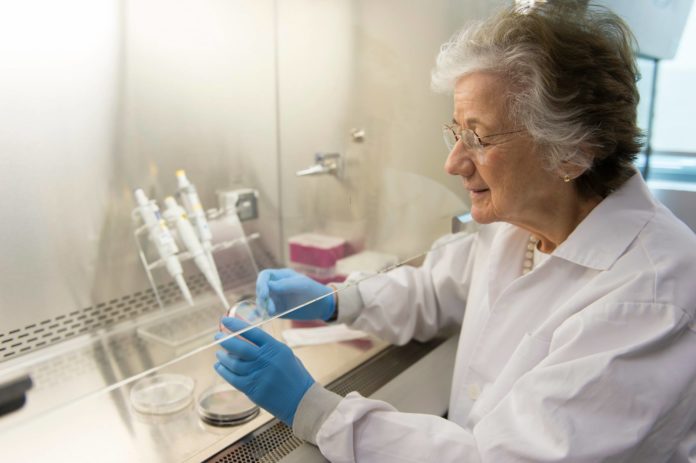
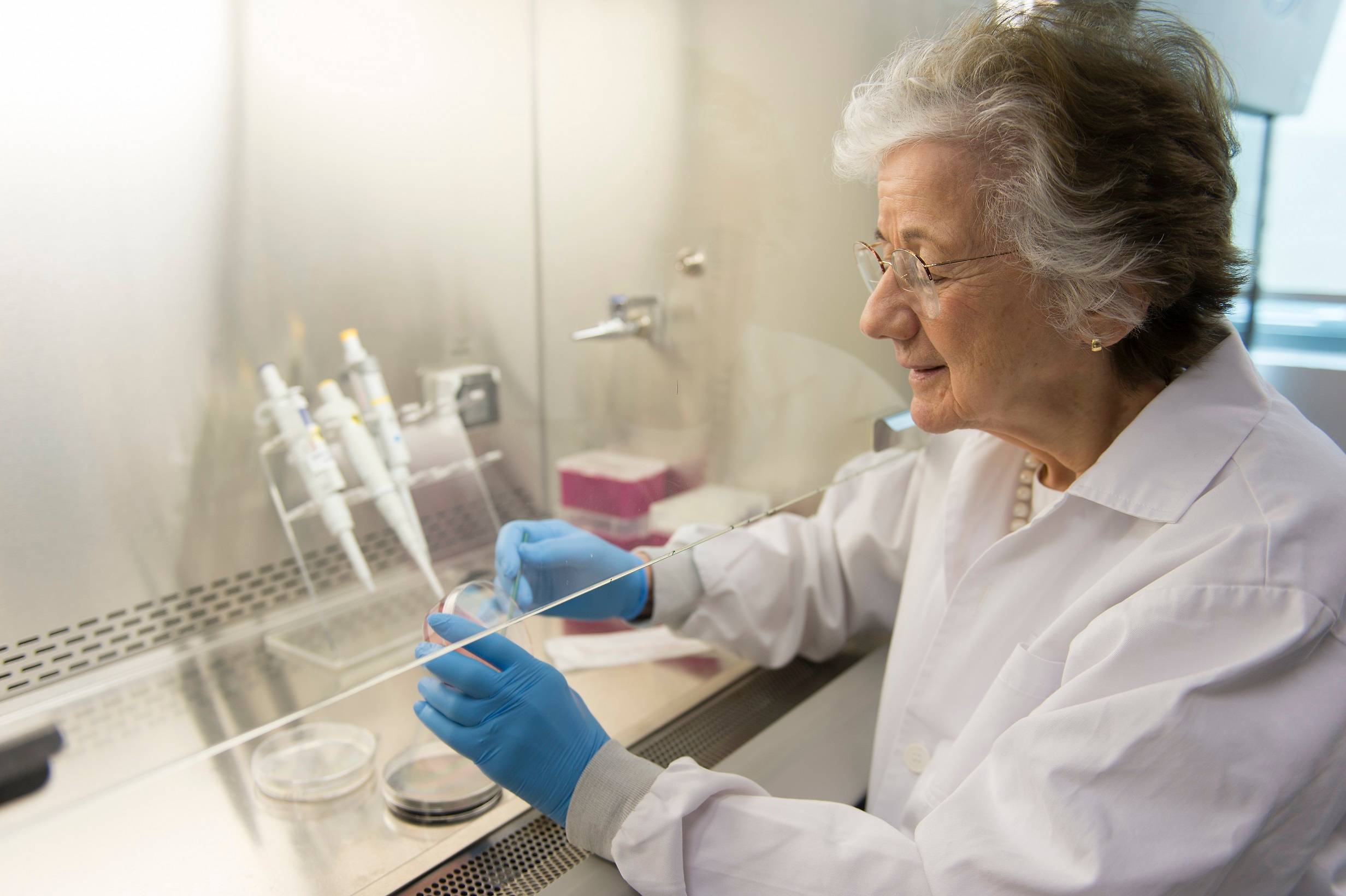
Professor Rita Colwell received the prize for her pioneering insights into microbial water quality surveillance, and efforts to transform the control of cholera and other waterborne diseases. (Photo: PUB)
Her discovery was initially met with scepticism from the scientific community in the 1980s, where culture-based methods were widely accepted as the gold standard for determining if disease-causing bacteria were alive, PUB said.
But Prof Colwell challenged this norm and highlighted that such traditional methods used to determine water safety were inadequate.
She then went on to invent a new molecular approach to more accurately detect the presence of disease-causing bacteria in water. It uses genome sequencing to identify different strains of bacteria, and determine their virulence and resistance to antibiotics.
WATER RESEARCH “IMPORTANT”
Prof Colwell says water research is crucial, even in Singapore, which has one of the world’s safest water supplies.
“Singapore is really a model, the water here is the safest I would wager, (in) any country in the world, but it always can improve,” she said.
“As we move into an era where water is going to be more of a problem, we’re going to have to be very clever in how we reuse it, the sources that we tapped, that we haven’t traditionally tapped, and to be able to show that it is microbiologically safe and hence human health safe.”
She added that the award is both a recognition of her life’s work, as well as a nod to fellow female scientists in the field.
“This award means a lot to me, I’m the first woman to receive it. I think the water industry, which is now pretty much male-dominated, can benefit from lots of smart women, who can contribute to the health and welfare of the population,” she said.
And her work has not ended – Prof Colwell intends to use the S$300,000 cash prize from the award to fund her current research on fighting cholera in Africa.
SINGAPORE: Changes that give officers from the Info-communications Media Development Authority (IMDA) powers to enter, search and seize evidence without a warrant for “serious offences”, such as those involving films prohibited on public interest grounds and unlicensed public exhibition, were passed in Parliament on Wednesday (Mar 21).
This is an extension of powers that IMDA already has.
“IMDA enforcement officers currently already have powers under the Films Act to enter premises and seize evidence without a warrant for offences relating to obscene, party political and unclassified films,” a spokesman for the authority said.
The changes also mean IMDA officers can now request information and documents that are necessary to ensure compliance with the amended Films Act, gain access to places where films are publicly exhibited or distributed for inspection purposes, and require the attendance of persons for the purpose of investigating breaches and offences under the amended Films Act.
Minister for Communications and Information Yaacob Ibrahim said during the second reading of the Films (Amendment) Bill that these changes are critical, given Singapore’s multi-racial and multi-religious society.
“Issues like race and religion have torn many societies apart, but in Singapore, we live together harmoniously. This did not occur by chance and we need to continue to work hard to preserve it,” Dr Yaacob added.
As one of the smallest and most open countries, Singapore is “highly susceptible” to foreign influences and information campaigns that can undermine social values or sow discord among communities, he said.
He added that advances in technology mean that such “undesirable content” can easily be disseminated locally, through the rapid and mass reproduction of films.
He was explaining the need for the extension against a backdrop of public concern. A public consultation by IMDA and MCI received 134 submissions during the public consultation from Dec 4 to Dec 30 last year.
TWEAKS FOLLOWING PUBLIC CONSULTATION
Several adjustments were made to address public feedback, Dr Yaacob said. The extended powers will only be used in “more serious offences” – such as those involving prohibited films and the unlicensed public exhibition of films.
The power to enter and search without warrant will only be exercised on certain conditions, he said.
This can be done when the enforcement officer suspects on “reasonable grounds” that the specified offences have been committed or are being committed, or that evidence that the specified offences have been committed can be found in the relevant premises and it is necessary to secure the evidence to prevent it from being concealed, lost or destroyed, he elaborated.
In addition, all enforcement powers will only be exercised by IMDA’s enforcement officers, who are and will continue to be trained by the Home Team, he said.
IMDA will also provide an avenue so that owners can challenge seizures of their items in court within 48 hours of the seizure.
The new sections will enable IMDA to enforce the Films Act effectively and efficiently whenever necessary, he said.
“They will also allow the Police to focus its resources on other threats to security and law and order. I would like to assure the House that IMDA will calibrate its enforcement actions and only use the most intrusive powers when it is absolutely necessary to safeguard public interest,” he said.
MEMBERS RAISE CONCERNS OVER “SWEEPING POWERS”
Despite tweaks to the proposed changes, some MPs and NMPs raised concerns over the extended powers.
Though now circumscribed, these powers are still “very expansive”, said Workers’ Party MP Daniel Goh.
“If used in a heavy-handed manner and liberally, it would erode public confidence in the regulation regime for films and thus negatively affect the development of the media industry,” he said.
Some MPs asked about how the seniority of IMDA officers who enter premises without a warrant and what sort of training they go through.
In response, Dr Yaacob said during his closing speech that IMDA’s enforcement officers already have and will continue to attend and pass Home Team investigation courses, where they receive both classroom and practical training alongside Home Team officers.
They are trained in areas such as powers of entry, search and seizure, collation of evidence, recording of statements and preparation of investigation reports, he said, adding that they go through five weeks of training. In addition, they have to go through annual refreshers.
“The enforcement officers are also security vetted and the majority have prior experience in law enforcement agencies,” he added.
Members also asked if alleged offenders’ personal devices would be seized. To that, Dr Yaacob said that only items used in the committing of offences will be seized.
For instance, for unlicensed public exhibition, IMDA officers are likely to seize the storage medium where the film is kept, but not the projector or the exhibitor’s mobile phone, while for the distribution of unclassified films, officers will only seize the copies of films being displayed, or intended for distribution, but not personal items such as the distributor’s mobile phone.
During the investigation of seized items, only materials that are relevant to the offence will be flagged as evidence, while the rest will be protected and will not be disclosed, he added.
CO-CLASSIFICATION SCHEME FORMALISED
Co-classification for video distribution was piloted in 2011, while the process for film distribution was piloted in 2015. The scheme involves allowing external film content assessors trained by IMDA to classify films and videos up to PG13 ratings.
Nominated Member of Parliament Kok Heng Leun.
The Bill formalised this scheme by setting out the registration requirements for film content assessors, the types of films they can classify, their duties and the regulatory steps that may be taken against misclassification.
“The co-classification scheme will nurture a pool of content assessors familiar with the film classification guidelines and enable films and videos to be brought to market more quickly, thereby benefiting both film exhibitors and distributors as well as consumers,” Dr Yaacob said. He added that IMDA will put in place safeguards to ensure that our content standards are upheld.
The scheme is optional, he said, meaning that those who prefer to submit films to IMDA for classification can continue to do so.
Among members who raised concerns on the scheme was Nominated Member of Parliament Kok Heng Leun, who is also a prominent figure in the Singapore arts scene.
He said he was “unable to support” some of the amendments as they may “stifle the creative and art scene in Singapore”. He counted this amendment among them.
While the convenience has been welcomed by distributors, the scheme may not benefit film-makers and consumers, he said.
Some production companies are also distributors, and some even wear the hat of exhibitor, he said.
“With so many interests at stake, it could be the case that interventions can happen at the creative process, as early as scripting stage and editing stage to cut more out, in order to fit lower age-restriction ratings,” he said.
Film-makers may then find themselves in a disadvantageous position with reduced bargaining power, and have to compromise their artistic vision, he added.
MEMBERS RAISE QUESTIONS ON DEFINITION OF FILMS AGAINST NATIONAL SECURITY
Another amendment means that appeals against IMDA’s decisions to refuse classification for films that are deemed to be against national security will be heard and decided by the Minister for Communications and Information instead of the Films Appeal Committee (FAC).
“We have proposed this amendment as ensuring national security is one of the Government’s core responsibilities. It is neither ideal nor fair for a citizen panel such as the FAC to assess threats to national security, as members may not be privy to the full extent of security concerns due to the sensitivity of the information,” Dr Yaacob said during the second reading.
However, he added that the Bill requires that the Minister first consults with the FAC before coming to a final decision, to preserve citizen representation in the deliberation of such appeals.
Mr Kok had issues with the vague definitions of what goes “against national security” for films that will be refused classification.
Mr Kok said that film-makers he spoke to expressed concerns that the lack of clarity of the terms may have the “unintended effect of restricting and impeding how to produce their films”, since they may not know whether the content of their films may have crossed the boundaries, and eventually be refused classification.
“In turn, this may cause the film industry to self-censor itself on the kind of films that they may produce,” Mr Kok said.
In response, Dr Yaacob said the authorities do not disagree with Mr Kok on setting some considerations broadly.
“But given the complex nature of national security matters, the prudent approach would be to avoid binding this in legislation.”
In refusing classification, Dr Yaacob sought to reassure that IMDA “has been and will continue to provide grounds for its decisions”.
“Should there be appeals for films with national security concerns, I envisage that we will adopt an appeals process similar to existing ministerial appeals, where the appellant and IMDA would be given due opportunity to make their respective cases to the Minister via written submissions. Where possible, the Minister will also provide the appellant with grounds of his decision,” he said.
SINGAPORE: A 26-year-old man was arrested on Tuesday (Mar 20) after going against traffic on the Ayer Rajah Expressway (AYE) and knocking down a pedestrian at Pioneer while trying to get away from Central Narcotics Bureau (CNB) officers.
The suspect was first seen parting ways with another suspected drug offender at Fifth Avenue in Bukit Timah.
Officers followed him along West Coast Highway but to get away, he sped and rode against the flow of traffic when he entered the AYE.
The man then beat the red light at a junction at Pioneer Road North and hit a 36-year-old man, who suffered minor injuries and was taken to the hospital. A CNB officer also sustained abrasions from the accident. Four bundles of drugs were recovered at the accident scene.
The man was eventually arrested near Pioneer Polyclinic. Officers conducted a raid at his home and recovered more drugs including heroin, Ice, ecstasy tablets, nimetazepam tablets and cannabis.
Officers also followed the other suspect who met him, a 24-year-old Malaysian man. He was arrested underneath the Eco-Link bridge along Bukit Timah Expressway and S$5,900 in cash was found on him.
Drugs seized after Central Narcotics Bureau officers conducted an operation on Mar 20. (Photo: CNB)
SEVEN SUSPECTED DRUG OFFENDERS NABBED
The arrests were a part of a two-day operation that led to a seizure of drugs worth more than S$155,000. Five more suspects were arrested on the previous day.
One, a 45-year-old Singaporean man, was found with 7g of Ice near Syed Alwi Road. CNB officers raided his hideout along Rowell Road, where they recovered heroin, cannabis and Ice.
His supplier, a 52-year-old Singaporean man, was traced to his hideout at Bedok North Road.
At the void deck of his block, officers saw a 31-year-old man loitering. He later took the lift to go up to the eighth floor before coming back down to the ground floor with the drug supplier and a 38-year-old woman. Officers arrested all three after they left the lift.
A total of 373g of heroin were recovered at the lift and about 2g of Ice was found in from the 31-year-old’s motorcycle.
The police then raided the supplier’s hideout where a 56-year-old suspected drug abuser was found.
Investigations into the drug activities of all suspects are ongoing and the reckless motorcyclist is being investigated for possible traffic-related offences by the police, CNB said.
AUSTRALIA and the 10 members of the Association of Southeast Asian Nations (Asean) issued a joint statement on Sunday, asserting shared commitment to cooperation in trade, cybersecurity, counterterrorism and the adoption of a code of conduct for the South China Sea.
Named the Sydney Declaration and issued at the culmination of the Asean-Australia Special Summit from March 16 to 18, the document declares a “new era” in the “increasingly close” relationship between the regional bloc and its southern neighbour.
Commerce and counterterrorism were the two major themes of the Summit – which was the first time representatives from all 10 member states have met in Australia – and saw the announcement of a raft of new joint initiatives.
With a combined GDP of US$2.5 trillion in 2016, Asean represents the world’s sixth largest economy and Australia’s fourth largest trading partner with total trade worth US$93.2 billion in 2016.
Professor John Blaxland, Director of the Australian National University (ANU) Southeast Asia Institute and Head of Strategic & Defence Studies Centre told Asian Correspondent that the Summit marked a “serious inflection point” for Australian policymaking.
“Southeast Asia is fundamental to Australia’s security,” said Blaxland. “There is now a bipartisan recognition that we’ve got to take Asean more seriously … especially as the circumstances in our neighbourhood have become more troubled.”
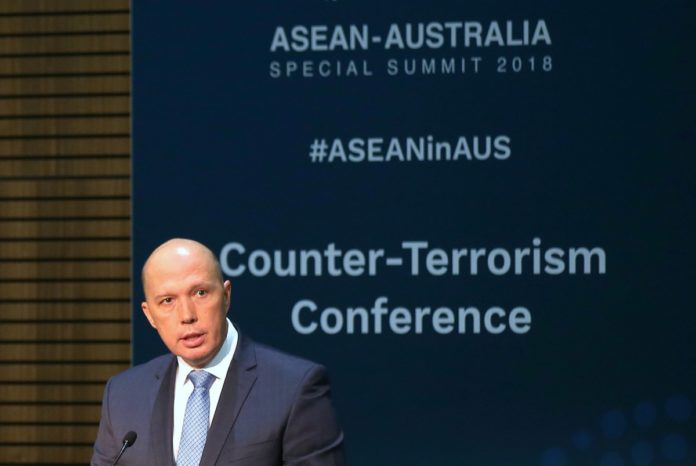
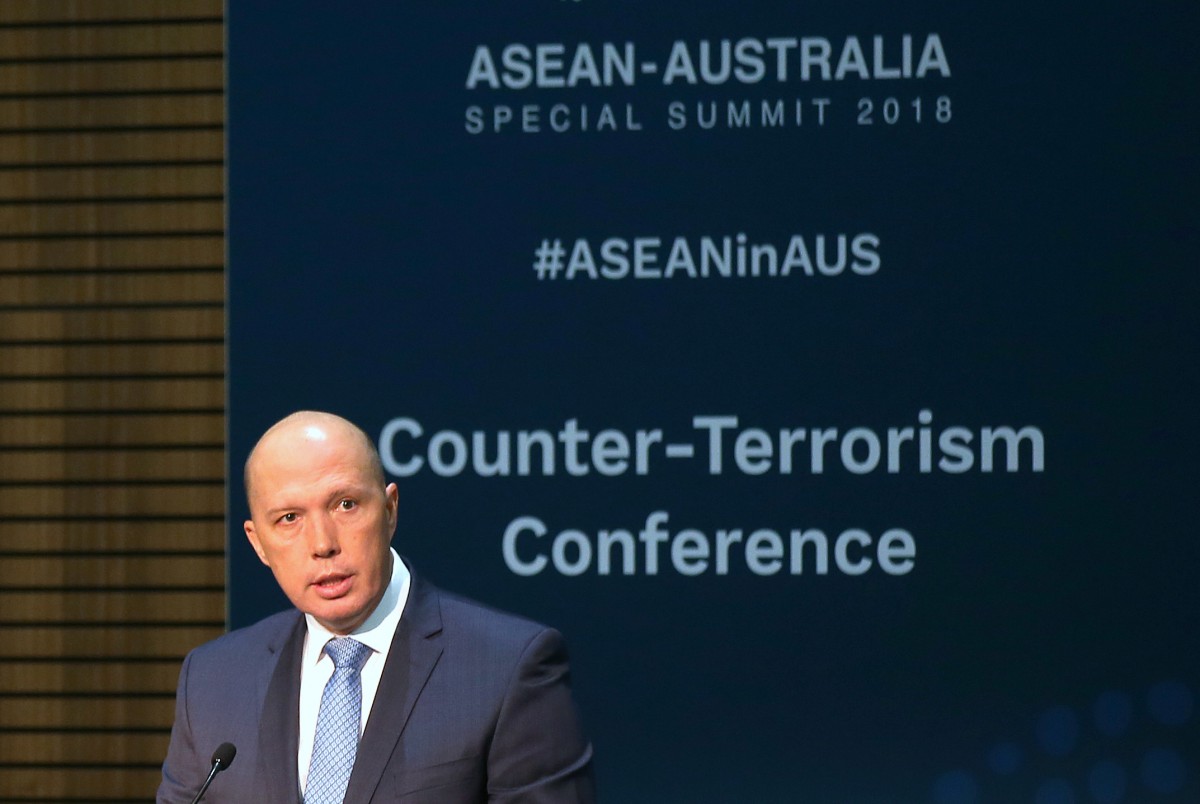
Australia’s Home Affairs Minister Peter Dutton speaks at the opening of the Counter Terrorism Conference at being held during the one-off summit of 10-member Association of Southeast Asian Nations (ASEAN) in Sydney, Australia, March 17, 2018. Source: Rick Rycroft/Pool via Reuters
Counterterrorism and the South China Sea
The Sydney Declaration declared a “strong commitment to regional peace and security as well as peaceful resolution of disputes”, noting the need for freedom of navigation, specifically in the South China Sea, as well as calling upon North Korea to comply with UN Security Council resolutions.
It called for the “early conclusion” of a code of conduct for the South China Sea, leading an article published in the Chinese state-run newspaperGlobal Times on Monday to argue that “Australia risks damaging its own interests” if it speaks out against Beijing.
The Sydney Declaration also reasserted cooperation between law enforcement, customs and immigration on countering transnational crime issues including trafficking of drugs, arms and wildlife.
A memorandum of understanding (MOU) was signed between Australia and Asean on “Combating terrorism and violent extremism” announced workshops on detection and prosecution of online terror crimes and greater intelligence sharing on terrorist financing.
Five months after the siege of Marawi in the Southern Philippines, in which Islamic State-inspired militants fought Philippines security forces resulting in hundreds of deaths, the MOU announced the “establishment of a series of regional dialogues and forums with Asean and Australian law enforcement partners, aimed at combatting the threat of ISIL-affiliated terrorists.”
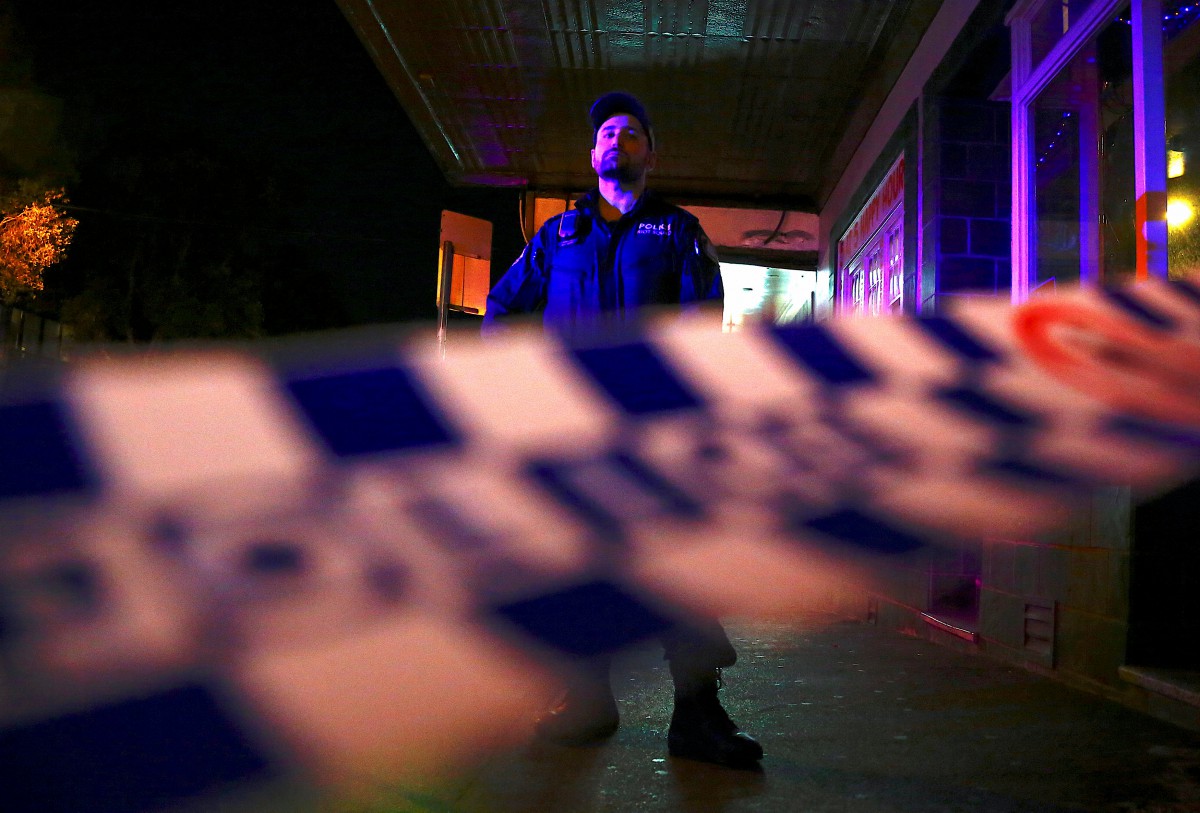
A policeman stands on a street that has been blocked to the public after Australian counter-terrorism police arrested four people in raids late on Saturday across several Sydney suburbs in Australia, on July 29, 2017. Source: Reuters/David Gray
“Counterterrorism and commerce are two areas that are easy to discuss,” former intelligence expert for the Australian Defence Department and a Visiting Professor at the ANU College of Law, Clive Williams, told Asian Correspondent.
“Some of the counterterrorism ideas are good and sensible, but I can see some problems with this,” he said, stating that Asean states each have differing definitions of terrorism, “so coming up with a regional approach would be difficult.” In cases such as Thailand’s deep south or the southern Philippines, members of separatist movements are automatically deemed terrorists, said Williams.
“Of the five Asean countries with security problems, three (Thailand, the Philippines, Burma) have problems of their own making. We (Australia) would say ‘if you had better policies then you wouldn’t have these problems’,” he said.
Yet if Australia had concerns about human rights in the region, they were not broadcast, instead raised with respective leaders behind closed doors.
“Regarding human rights in Asean, for sure it’s not easy to discuss,” said Arisman, the Executive Director of the Centre for Southeast Asian Studies (CSEAS) in Jakarta. “In Asean we’re used to consensus and respecting the nation-state.”
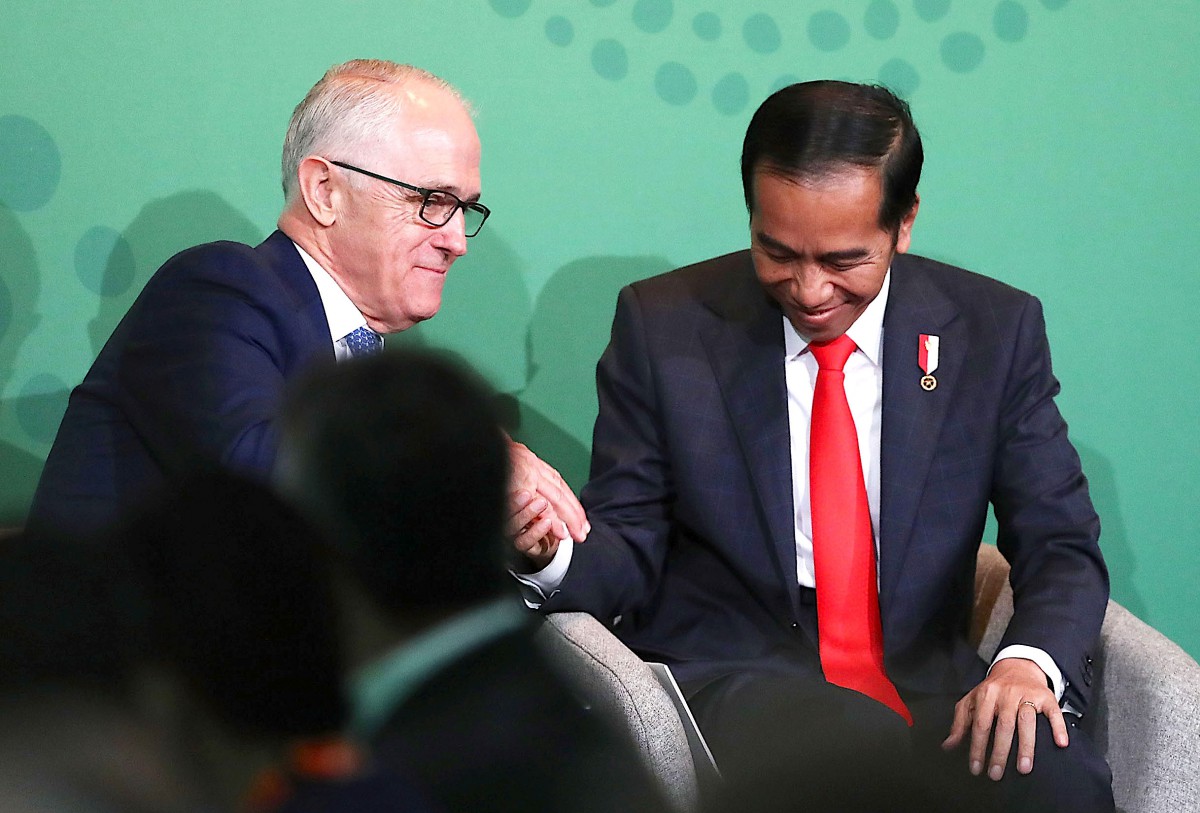
Australian Prime Minister Malcolm Turnbull shakes hands with Indonesian President Joko Widodo at the CEO Forum Lunch being held during the one-off summit of 10-member Association of Southeast Asian Nations (ASEAN) in Sydney, Australia, March 17, 2018. Source: Mark Metcalfe/Pool via Reuters
Trade and building Asean
The Sydney Declaration also said that as “highly trade-oriented economies”, Asean and Australia were committed to “resisting all forms of protectionism” and to “free and open markets”. Turnbull reportedly declared that there were “no protectionists around the table” at Asean at the conclusion of the summit.
While this is not entirely true in practice, said Dr Sanchita Basu Das of the Asean Studies Centre a research fellow at the Asean Studies Centre at ISEAS – Yusof Ishak Institute in Singapore, it sends an important message amid the “global environment at the moment.”
“The summit took place just after President Trump’s announcement about the introduction of tariffs,” she said, noting the importance of Asean-Australia not buying into rhetoric of a trade war. “They were telling people we want free and open trade. At least saying that loudly and clearly is very important at this juncture.”
Digital trade and entrepreneurship was emphasised in the Sydney Declaration, with Arisman stating that Australia could assist the less developed countries in Asean to develop their cyber capabilities and infrastructure. “Australia looks at Indonesia as one of the big markets for the digital economy,” he added.
On Sunday night, the Australian government announced the Asean-Australia Infrastructure Co-operation initiative aimed at creating a pipeline for private and public funds for projects across the region, in what may be seen as a counter to China’s ambitious Belt and Road initiative.
“Australia seen as one of the leading countries for public-private partnerships and in big infrastructure projects in the country itself,” said Sanchita, who said the country could provide significant ongoing assistance in terms of Asean integration.
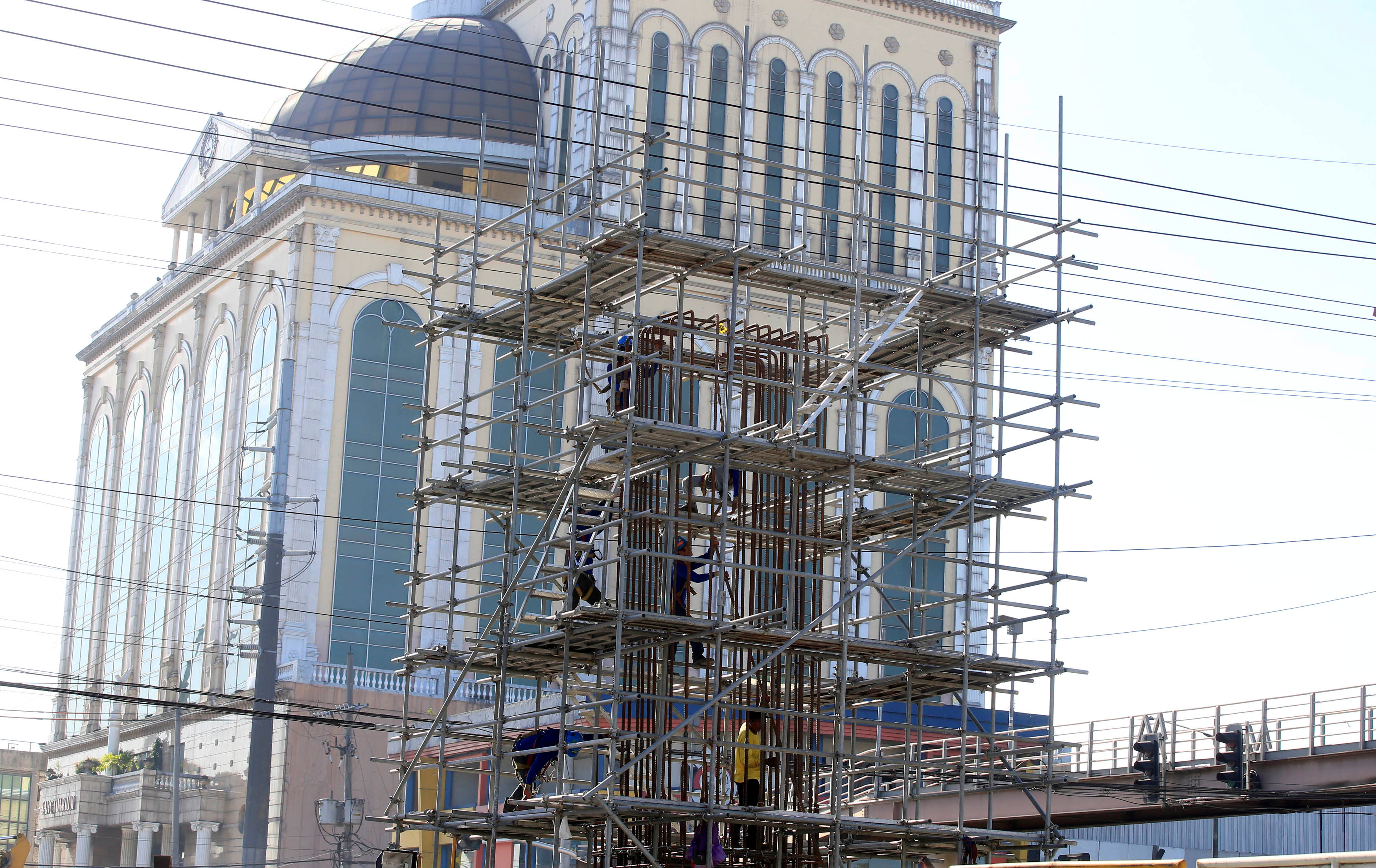
Workers balances on steel frames as the construction of a skyway pushes through at a major thoroughfare in metro Manila, Philippines Dec 23, 2016. Source: Reuters/Romeo Ranoco
Australia’s Department of Foreign Affairs said the education initiatives would help build more “practical and meaningful partnerships” between “emerging leaders”.
Around 100,000 Southeast Asians are studying in Australia, representing around 1 in 5 of all international students there. Professor Blaxland said that to date, they have been viewed as a disaggregated population, however altogether Asean students are just as important as Indians or Chinese in terms of international student numbers.
More broadly, he said the wide-ranging focus of the Sydney Declaration “points to the breadth and depth of the relationship now”.
Fans will be able to catch their favourite Marvel superheroes at Marina Bay Sands on Apr 16.
Robert Downey Jr and Benedict Cumberbatch backstage at the 25th annual Producers Guild of America Awards at the Beverly Hilton Hotel (Photo: www.independent.co.uk)
(Updated: )
Bookmark
SINGAPORE: Marvel’s biggest superheroes are once again descending upon Singapore shores on Apr 16. And this time it’s the biggest star of them all – Iron Man Robert Downey Jr – leading the charge.
He will be here for a red carpet publicity event at Marina Bay Sands for Avengers: Infinity War, which will be released in Singapore on Apr 25.
Also coming to Singapore is Oscar-nominated actor Benedict Cumberbatch, whose mind-bending cerebral superhero Doctor Strange will be making his Avengers debut.
Actress Karen Gillan, who plays blue-skinned, cyborg assassin Nebula – sister of Zoe Saldana’s character Gamora in both Guardians of the Galaxy movies – and Infinity War co-director Joe Russo will also be in attendance.
Robert Downey Jr tweeted a behind-the-scenes photo from Avengers: Infinity War — featuring a few of his superhero friends Benedict Cumberbatch (left), Mark Ruffalo (second from right) and Benedict Wong (right) all posing together in costume during a break from filming. (Photo: Robert Downey Jr/Twitter)
Similar to other Hollywood blockbuster red carpet events held in Singapore, fans will get the chance of a selfie or an autograph with the film’s stars. The event is open to the public with no fee.
Anticipation for Avengers: Infinity War is building as the latest instalment in the franchise brings together the heroes of just about every movie Marvel has released to date.
With 80 characters reportedly making their way onto the silver screen for the 19th Marvel Cinematic Universe movie and third official Avengers team up, there are high hopes for what the Russo Brothers can deliver.
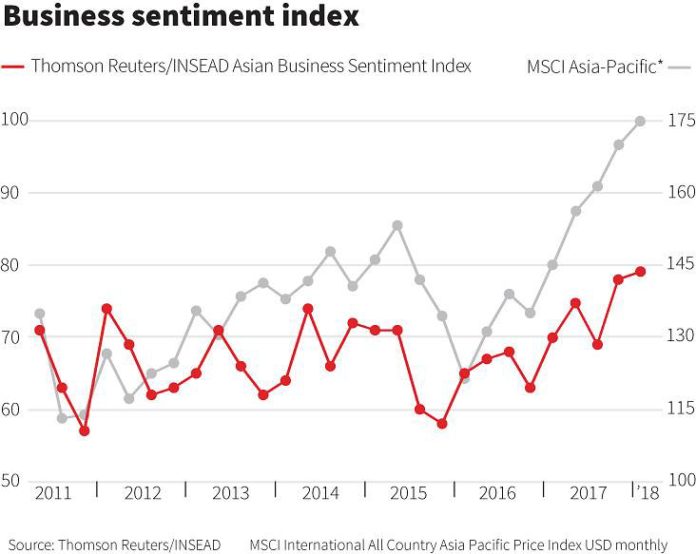
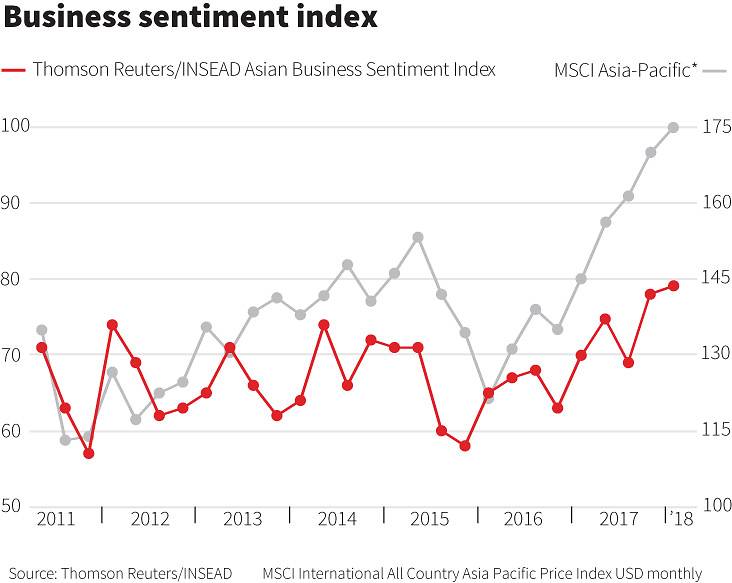
SYDNEY: Business confidence among Asian companies rose in the first quarter to the highest level in seven years, a Thomson Reuters/INSEAD survey showed, as a fresh surge by the Chinese economy offset concerns about rising trade barriers.
The Thomson Reuters/INSEAD Asian Business Sentiment Index, representing the six-month outlook of 67 firms, advanced one notch to 79 for the January to March quarter compared with three months before.
A reading above 50 indicates a positive outlook.
“The improvement is not dramatic but with a historical perspective this is a good reading,” said Antonio Fatas, a Singapore-based economics professor at global business school INSEAD.
Thailand, the Philippines and Malaysia saw robust jumps in sentiment, showing that many countries in Asia continue to benefit from accelerating global growth. In particular, China has seen exports soar, up 45 per cent in February to mark their fastest growth in three years.
(Graphic: Thomson Reuters/INSEAD)
“China … has escaped the fear of a crisis that started back in 2016 and that’s why you see strong confidence. Imbalances persist but there is no real threat of a crisis over the short term,” said Fatas.
The subindex for Thailand surged to 100 from 85 and the Philippines saw a climb to 83 from 70 while sentiment in Malaysia improved five notches to 75.
“The tourism and export sector expansion will help drive growth (in Thailand) this year,” said Rattham Somboonchareon, a planning manager at survey respondent Thai Airways, adding that government spending was also a key driver of growth.
(Graphic: Thomson Reuters/INSEAD)
Australia’s subindex dropped to 80 from 92, although the figure is relatively high when compared with its historical average of 69.
While the International Monetary Fund and the World Bank have raised their global growth forecasts for this year due to strong trade, consumer spending, and investment in many major economies, intensifying rhetoric in favor of protectionism has become a major concern.
US President Donald Trump has announced import tariffs on steel and aluminum, and is expected to consider additional tariffs targeted specifically at China. He has also repeatedly said the US free-trade deal with South Korea is “unfair” and has threatened to scrap it altogether on multiple occasions.
That has battered sentiment in South Korea, with the country’s subindex plunging to 50 from 83.
“There is a sense among Korean businesses that Trump will continue to be aggressive against their country,” said Fatas.
Singapore’s subindex declined to 75 from 79. The country’s exports took a surprise dip in February as tech product shipments continued to retreat from the hot pace of recent months.
Japan, where consumer spending numbers have been subdued, recorded its lowest reading in a year, at 67 compared to the fourth quarter’s 70. India also experienced a decline in sentiment, falling to 72 from 79.
The index for sentiment in China increased to 88 from 83, but the number of respondents was low at four companies.
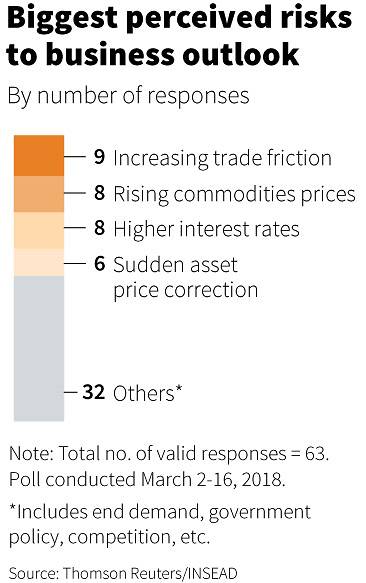
Increasing trade friction and higher interest rates were cited as the biggest concerns in the Thomson Reuters/INSEAD survey.
By industry, the technology, construction, energy and metals sectors expressed concern about trade friction, showed the survey, which was conducted Mar 2 to 16.
Sectors which identified rising interest rates as a risk included the energy, real estate, retail and technology sectors. The energy sector also showed concern about the potential for a sudden asset price correction.
The auto sector matched its highest subindex reading posted seven years ago, while the retail and leisure sector recorded its best ever reading. Healthcare had its highest score in two years.
Note: Companies surveyed can change from quarter to quarter.
SINGAPORE: A fire broke out in a HDB flat at Choa Chu Kang Street 51 on Wednesday morning (Mar 21).
The Singapore Civil Defence Force (SCDF) said that they were alerted to the fire in a tenth floor flat at Block 509 at about 8.20am.
A fire broke out in a unit on the tenth floor at Choa Chu Kang Street 51 on Wednesday (Mar 21). Photo: David Wirawan)
The fire, which involved contents of a kitchen, was put out using one compressed air foam backpack and one water jet, SCDF said. There were no reported injuries.
SCDF said it is still investigating what caused the fire.
Freelance photographer David Wirawan was working at his home nearby the affected unit when the fire happened.
“I was editing my photos, and (then) I heard people shouting and heard siren. I looked down from my block and saw the SCDF team,” he told Channel NewsAsia.
He added that the fire was put out by 9am.
The Singapore Civil Defence Force responded to a fire in a unit at Choa Chu Kang Street 51 on Wednesday (Mar 21) morning. (Photo: David Wirawan)