SINGAPORE: For the first time in four years, River Safari giant pandas Kai Kai and Jia Jia will not be allowed to mate.
The pair had been allowed to try mating before artificial insemination during previous panda mating seasons. This season, however, they were kept apart so the veterinary team “could secure quality semen samples” from Kai Kai for artificial insemination and maximise the chances of pregnancy.
“Our game plan this year was to preserve as much fresh semen as possible from Kai Kai,” said Dr Sonja Luz, director of conservation, research and veterinary services at Wildlife Reserves Singapore (WRS) – which manages the River Safari – said in a media release on Thursday (Apr 19).
“In past mating attempts, good semen samples were sometimes lost in excitement when the bears were brought together.”
Dr Abraham Mathew and Dr Sonja Luz carry out artificial insemination on Jia Jia. (Photo: Wildlife Reserves Singapore)
Kai Kai and Jia Jia – aged 10 and nine respectively – entered mating season for the first time in 2015, but subsequent natural mating and artificial insemination methods had been unsuccessful.
The River Safari team “leapt into action” on Apr 7 when Jia Jia’s hormone levels indicated she was ovulating, WRS said.
“This year, we extracted almost 1.8ml of a high-quality sample showing 92 per cent sperm vitality, and with that the veterinary team feels hopeful for a panda pregnancy later this year,” Dr Luz said.
The team collected a good semen sample, showing a 92 per cent sperm vitality, from male panda Kai Kai. (Photo: Wildlife Reserves Singapore)
The team kept a “round-the-clock watch” on Jia Jia’s estrogen levels this year and successfully identified the peak within her ovulation window, said Dr Cheng Wen-Haur, WRS’ deputy chief executive officer and chief life sciences officer.
“The artificial insemination procedure went very smoothly and we hope for good news later this year.”
A team led by Professor Ng Soon Chye, an obstetrics and gynaecology specialist, assisted the River Safari veterinary team for the third year.
Assisting the vet team at River Safari for the artificial insemination procedure was a team led by Prof Ng Soon Chye, an obstetrics and gynaecology specialist. (Photo: Wildlife Reserves Singapore)
It is now a waiting game, explained WRS, as giant pandas have delayed implantation and a pregnancy (or pseudo pregnancy) cannot be determined until the later part of the panda’s gestation period.
In Jia Jia’s case, this falls between August and September.
The two pandas, which are loaned to Singapore by the Chinese government for 10 years, arrived in Singapore in 2012. Kai Kai will turn 11 and Jia Jia will turn 10 in September.
SINGAPORE: Robots in Singapore have completed a task many humans dread: Assembling flat-packed IKEA furniture.
Sifting through pages of instructions and a jumble of screws and bolts to build the low-cost Swedish furniture may soon be a thing of the past given advances in technology, say researchers at Nanyang Technological University (NTU).
The scientists spent three years programming the robot – made of arms, grippers, sensors and 3D cameras – which assembled the frame of an IKEA dining chair in around 20 minutes.
From left: NTU’s Assistant Professor Pham Quang Cuong and research fellow Francisco Suarez-Ruiz. (Photo: NTU)
They say it may not be long before such robots can fully assemble a piece of furniture from a manual, verbal instruction or by just looking at an image of the finished item.
“We have achieved the low-level capability to teach the robot ‘how to do it’ and then in the next five to 10 years, high-level reasoning – the ‘what to do’ – could be done too,” one of the researchers Quang-Cuong Pham told Reuters.
Pham said the team at NTU were looking to work with artificial intelligence experts to try and hone the process.
The scientists spent three years programming the robot – made of arms, grippers, sensors and 3D cameras. (Photo: NTU)
Cindy Andersen, global business area manager of kitchen and dining at IKEA, told Britain’s Daily Mail newspaper: “It’s interesting to see an example of how robots could potentially contribute to our vision of creating a better everyday life for many people.
“We are very positive about embracing new technology.”
Singapore has been pushing businesses to invest in automation and robotics to boost productivity. Some restaurants and hotels in the country use robots to deliver food to customers and collect used plates and cutlery.
(Reporting by John Geddie; Editing by Michael Perry)
SINGAPORE: The NCO Club at South Beach is the first destination in Southeast Asia to welcome a concept by Hong Kong born restaurateur Alan Yau – the man behind the Michelin-starred Hakkasan in London and global ramen chain Wagamama.
Madame Fan, which opens on Apr 23, is a 50s-cabaret-inspired space serving up signature dishes such as double boiled four treasure soup with sea cucumber, fish maw, dried scallop and crab meat; drunken crab rice noodle with 20-year-old Gu Yue Long Shan rice wine; and steamed Soon Hock with Ipoh soy and spring onion.
Restaurateur Alan Yau, the man behind the Michelin-starred Hakkasan in London and global ramen chain Wagamama. (Photo: Madame Fan)
Yau, who has been honoured with an OBE, has done much to revolutionise Asian dining in the West, not just with the fine Chinese dining restaurant Hakkasan, which opened in 1999; but also ventures such as casual Thai restaurant Busaba Eathai and dim sum tea house Yauatcha.
When he first started out, said the 56-year-old restaurateur, Western audiences had a very general understanding of Asian food.
Now, he said, “they have a better understanding in terms of each country’s cuisine, or ethnic cuisine”.
“Before – and in some developing countries still – a Pan-Asian idea was sexy. I find that extremely irritating in terms of the conceptual framework linking various cross-boundary ethnic cuisines,” he said. “I think, in my earlier days, I didn’t have a problem with allowing a degree of bastardisation in the product. Now, I do care.”
Main dining hall. (Photo: Madame Fan)
Drunken Crab Rice Noodle with 20-Year-Old Gu Yue Long Shan Rice Wine. (Photo: Madame Fan)
Steamed Soon Hock with Ipoh Soy and Spring Onion. (Photo: Madame Fan)
To this end, he hopes his restaurant concepts, which stay firmly away from fusion food, will appeal to western audiences without alienating “the indigenous market”.
But although Western diners now better appreciate the differences in Asian cuisines, there is one aspect in which he thinks has been taken “too far”: The concept of sharing, especially in “trendy new age restaurants in the West”.
“I hate sharing,” Yau asserted. “I think certain food is not meant to be shared. For example, you cannot share dessert. Come on.” To have the waiter bring you one dessert and four spoons, he thinks, is “slightly obnoxious”. “Why would I share a dessert, say, with cream or custard or ice cream, with four parties? I really hate that idea.
“Secondly, I don’t like sharing because you feel obliged to eat just 20 percent of the dish you really like, and then having to eat the other stuff you think is okay. That’s why I think qualitative Chinese dining has shifted a lot in relation to the general family style of sharing.”
Private dining room. (Photo: Madame Fan)
Chocolate Fondant. (Photo: Madame Fan)
At Madame Fan, tables in the main dining area are kept small, and dishes can be divided up and served.
Dessert, needless to say, is served individually. The signature is the chocolate fondant with crumble and caramelised banana. Now, who would want to share that?
Madame Fan opens Apr 23, Tuesdays to Sundays for lunch and dinner. For reservations, call 6818 1921.
LONDON: They may be Singaporean, but they come from different backgrounds.
And they also have a few things in common: they are below the age of 30 and all have the desire to give back to their communities.
They also have another thing in common: The Commonwealth. Two of them have won Commonwealth awards, while the other two have been elected to represent Singapore on the Commonwealth Youth Council.
These four young Singaporeans got the chance to meet and speak to Prime Minister Lee Hsien Loong in London on Wednesday (Apr 18), to tell him about the work they have been doing. Mr Lee is in London for the Commonwealth Heads of Government Meeting (CHOGM).
These are their stories.
MAKING HELLISH PERIODS LESS PAINFUL: VANESSA PARANJOTHY
It may be a taboo or sensitive topic in polite conversations, but Vanessa Paranjothy is not shying away from talking about menstrual periods.
Vanessa Paranjothy co-founded Freedom Cups, a social enterprise that hopes to give women in underprivileged communities access to menstrual cups. (Photo: Lianne Chia)
“No one talks about periods,” she said. “But it’s a huge problem for many women around the world who don’t have access to sanitation during their periods.”
And to Vanessa, menstrual cups – which are reusable cups made of medical-grade silicone meant to replace pads or tampons during a woman’s period – is the answer.
The 29-year-old has won a Commonwealth Youth Award for her work in founding social enterprise Freedom Cups, which aims to put a menstrual cup into the hands of women who would not be able to otherwise afford one.
The Commonwealth Youth Awards recognise young people from every region of the Commonwealth whose innovative projects have had a significant impact on their communities, and Vanessa – who won for Asia – is one of four regional winners of the award.
Every woman who buys one of their menstrual cups, which is self-designed, customised for Asian women and manufactured out of the United States will result in one being donated.
“I found out about these cups through a friend who went to Guatemala for an internship,” she said. “And I realised they were the best option for women in the Third World who are experiencing hellish periods.”
“Periods are hellish as it is even in the First World, but imagine how much worse it’d be in the Third World, where you don’t have access to toilets or water.”
On top of that, she also organises projects to visit underprivileged communities in Asia to teach women about menstrual periods and distribute the cups.
To date, there are 15 projects in seven countries which have provided support to more than 3,000 women and girls.
But there is still much work to be done and Vanessa, who received £3,000 in prize money, said the money will be put straight back into the business.
“We want to get into the Rohingya refugee camps in Myanmar,” she said. “So I think this money is going to fund our efforts there.”
HELPING YOUNG PEOPLE CHOOSE THEIR CAREERS WISELY: MOCK YI JUN
Mock Yi Jun said he counts himself lucky that he had enough support and opportunities to make an informed decision when he was planning to go to university.
Mock Yi Jun hopes to help more young people in Singapore make informed decisions about their careers. (Photo: Lianne Chia)
“We had internships, talked to people in the different industries we wanted to join and could speak to seniors in school who had gone to the universities we wanted to go to,” he said. “And I realised a lot of young people in Singapore don’t have that kind of support.”
“It’s about the family you come from, whether your parents know people in the industry and even what schools you go to, because some schools have stronger career guidance support,” he added.
Looking to help other young people in this area, he co-founded Advisory, an online initiative aimed at providing young Singaporeans with the opportunity to learn about different career options. The platform provides information about different industries and career paths through a series of online articles.
All this, while juggling his studies at the London School of Economics.
Yi Jun, 21, is one of two Singaporeans who won the 2018 Queen’s Young Leader Award, which recognises exceptional people aged 18 to 29 from the Commonwealth countries. He is also a Public Service Commission (PSC) scholar with the Foreign Service.
He explained that initially, he was keen to join the Singapore Police Force, but changed his mind after trying out an attachment and speaking to people in the organisation.
“It showed me that a job that I really thought I wanted to do and make a career out of was probably not that right to me,” he said. “That was a very formative experience for me, and we want users of our site to have that kind of experience as well.”
He admitted that juggling his studies and his volunteer work can be challenging, but described the experience as “so fulfilling”.
“As each story goes up, you can share it with more people, and you hear people tell you how useful it is to find out about things they never knew existed … I’m just happy that I can help other young Singaporeans make better choices,” he said.
“If you had told me at the start of my undergraduate life that this would happen, I would have told you that you were crazy,” he added. “I wouldn’t have gotten here without the support I’ve been given.”
“I’m very thankful and grateful for this chance.”
SHOWCASING SINGAPORE TO THE WORLD: RUSYDI KHAIRUL AND EILEEN GOH
When Rusydi Khairul and Eileen Goh heard Microsoft co-founder and philanthropist Bill Gates speak at the Commonwealth Youth Forum on Tuesday (Apr 17), they were pleasantly surprised – and proud – to hear him single out Singapore’s education system for praise.
Rusydi Khairul (left) and Eileen Goh are Singapore’s two elected representatives to the Commonwealth Youth Council. (Photo: Lianne Chia)
“He said that no one does education better than Singapore,” said 28-year-old Eileen. “And then the other delegates started asking us about our education system.”
Both heavily involved in the work of Singapore’s National Youth Council, Eileen and Rusydi, 29, were elected to represent Singapore in the Commonwealth Youth Council (CYC) for the next two years.
The CYC acts as a coalition of national youth councils and other youth-led civil society and private sector bodies from across the Commonwealth’s 53 member countries.
And for the two Singaporean representatives, this means that they have their work cut out for them. For now, they are both involved in putting together a policy paper that lays out what the young people of the Commonwealth hope their various Heads of Government would do.
“We try to work together, see if there are opportunities for collaborations with different countries, or lobbying our own governments to act on some of these recommendations,” explained Rusydi. “So if the Commonwealth document says we should try certain things, we need to go back to our own governments and say, let’s try these things.”
But with Singapore one of only six developed countries in the Commonwealth, Eileen said the “majority need” is not that of a developed country.
To that end, they hope to contribute by looking for opportunities to share and showcase Singapore’s best practices – like the education system that Bill Gates mentioned.
“So we’re thinking of inviting the other countries to Singapore for a learning journey, where we can show them what Singapore has done, and show them our best practices which they can take and bring back to their own country,” she said.
“This is Singapore’s contribution to the Commonwealth.”
SINGAPORE: Do something the court of public opinion judges as reprehensible and you can count on being “CSI-ed”. It’s become par for the course if your actions are caught on camera and posted online.
The incident went viral over the weekend after a Facebook user posted an account of what happened at the Tampines Avenue 8 petrol station.
According to her, the driver of a BMW Series 5 vehicle had refused to pay S$135 for his petrol because he said he had only asked for S$10 worth.
The elderly pump attendant calmly informed the cashier to let the customer pay S$10 and he would personally absorb the rest of the cost, she said in her Facebook post.
Netizens incensed by the driver’s actions condemned him with many slamming him in the comments section of the post. Some even volunteered to pay the S$125 on behalf of the elderly pump attendant.
No doubt going by this account, the driver’s behaviour is condemnable and he should be taken to task.
But it didn’t stop there.
Netizens identified him and posted his personal details online.
Among other things, the company he works for, his LinkedIn profile, his mobile number, and usual parking spots were made public.
The driver has since filed a police report, citing worries for his safety.
“CSI” CAN GO WRONG
This is certainly not the first time we’ve seen such acts of online vigilantism in Singapore.
In 2014, an errant Sim Lim Square retailer’s personal details including his address were published online. This, after a video of a Vietnamese tourist begging the retailer for a refund after he was overcharged for a phone set the internet ablaze.
Just last year, a video of an altercation at a Toa Payoh hawker centre went viral.
In the 30-second video, a couple was seen arguing with an elderly man who asked to share a table with them. The man was seen shoving the older man.
Screen capture of an elderly man being shoved from behind by a younger man at a hawker centre in Toa Payoh. (Video: YouTube)
Four days later, the police arrested the couple for alleged public nuisance.
However, in the process of trying to find this couple, in the initial stages, netizens incorrectly identified two people.
The woman who was wrongly named online wrote on her Facebook page that it was an “emotional period and scary moment”.
This was CSI gone wrong.
IS THERE A BETTER WAY?
While many commend the work of online vigilantes, saying that such actions are the best way to ensure social justice and appropriate action is taken against perpetrators of questionable behaviour, experts have pointed out that we need to stop to consider the actions of the vigilantes themselves.
After the Toa Payoh incident, experts Channel NewsAsia spoke to warned against online vigilantism, advising people to hand such videos directly to the police instead of sharing them on social media.
In some cases, the issue may not even be a police case. In such instances, some have remarked it might be more productive to intervene directly, instead of only capturing the incident for public consumption online.
In the latest petrol station incident, would immediate social pressure on site have made the BMW driver rethink his decision to let the pump attendant bear the cost of their misunderstanding?
Thankfully, in this case Caltex Singapore assured netizens that the elderly attendant “did not bear any financial obligation” due to the incident.
If the company hadn’t done so, could netizens have petitioned it to?
Is there a better way to handle such issues?
VIGILANTES’ ACTIONS COULD BE ILLEGAL TOO
Whatever your stance on the issue, it would be wise to bear in mind that in our quest for social justice, by going to the extent of harassing the alleged perpetrators, we ourselves are committing a crime if we cross certain lines.
In fact, several lawyers have pointed out that the Prevention from Harassment Act could protect be used against vigilantes if their sense of social justice manifests itself in threatening, abusive or insulting behaviour or even communication.
Attempts at stalking the alleged wrongdoer would also constitute harassment.
Those who are incorrectly identified as wrongdoers by online vigilantes can also turn to defamation laws.
Aside from this, vigilantes should also consider that they may be working with incomplete information and may end up instigating attacks on innocent people.
This, in itself, should give us pause.
Experts have argued that while the free flow of information online has opened up the possibility of free expression and communication, it also has a dark side. The internet has obviously amplified the potency of gossip and public shaming.
Often, the response to an act of wrongdoing could be disproportionate.
If you have had a bad day at work and are rude to a sales assistant as a result, you perhaps deserve to be condemned for not considering others’ feelings, but do you deserve to be stalked or have your family or employer be dragged through the mud as well?
Do you deserve to possibly lose your job or have your career ruined because of one transgression?
This is just one example.
Obviously, in recent years, online vigilantes have highlighted more serious incidents requiring legal action, such as the case of the errant Sim Lim Square retailer.
Sim Lim Square. (File Photo: Calvin Oh)
NO NEED FOR AN ABUSIVE MOB
That Singaporeans have a robust sense of social justice is commendable, but mob justice can is certainly not justifiable.
The actions of the vigilantes probably are a result of noble intentions, and support from the public serves to endorse and fuel their vigilantism further.
But let’s remember that vigilantism often disregards rigorous investigation, due process and accountability.
Often, the accused in such cases become victims of bullying with possibly no opportunity to tell their side of the story and even if they do, their account ends up being repudiated by the online mob.
Advocates of online vigilantism often suggest it catalyses legal action against wrongdoers.
Would the police act so swiftly if the video of the incident had been given to them directly instead of being posted online first?
The police perhaps need to assure the public that they would treat video evidence reported directly to them with as much gravity as they would a viral video of the incident.
In the face of injustice, we need to consider if there is any justification for lowering ourselves to the level of an abusive and sometimes, unreasonable mob.
Bharati Jagdish is the host of Channel NewsAsia Digital News’ hard-hitting On The Record, a weekly interview with thought leaders across Singapore, and The Pulse, Channel NewsAsia’s weekly podcast that discusses the hottest issues of the week.
Police said they were looking for the man to “assist with investigations into a case of rash act causing hurt which occurred at Blk 538 Ang Mo Kio Avenue 5”.
The photos show the rider wearing a black full-face helmet, a black long-sleeved t-shirt, knee-length pants and slippers. He was also carrying a red and black haversack.
The incident on Tuesday left Madam Lee, 65, with a cut on her nose and bruises on her hip and leg.
Police have released a photo of the e-scooter rider who had hit an elderly woman at Blk 538 Ang Mo Kio Avenue 5. (Photo: Singapore Police Force)
Madam Lee was walking out of a lift when the rider crashed into her from behind, causing her to fall to the ground, her daughter Ms Sharon Sim had told Channel NewsAsia on Tuesday.
The rider sped off while five Institute of Technical Education students who were nearby helped Madam Lee. The students had bought plasters for Madam Lee and pasted one on her wound.
Ms Sim had shared the story on Facebook on Tuesday in the hope of locating the rider.
Anyone with information can call the police hotline at 1800 255 0000 or submit it online at www.police.gov.sg/iwitness.
SINGAPORE: With each step he took, Shariff Abdullah’s left prosthetic leg sank into the thick icy snow.
The 49-year-old, who is more commonly known as Singapore’s Blade Runner, has conquered more than 25 marathons. But running on the surface of the frozen waters of the Arctic Ocean, he finally met his match.
“It felt like I was walking in an astronaut suit, each step was so heavy,” he told Channel NewsAsia.
Shariff had set out to complete the full 42.195km distance of the North Pole marathon last Sunday (Apr 15) but a few hours in, race organisers informed him that he had to settle for finishing only half the distance.
“I had to change my prosthetic blade and this was a hassle as I had to remove 3 sets of pants,” he said.
“I felt that I could have finished it. It would have taken me more than 12 hours, but I’d still complete the distance,” said Shariff, who had trained at Sentosa’s Palawan beach to get used to the sinking sensation on his left leg.
“But I needed to be understanding, the other competitors and race organisers would be waiting for me in freezing conditions,” Shariff added. “It’s not fair to them.”
Dubbed the “world’s coolest marathon”, the North Pole Marathon is held annually at Camp Barneo in the Arctic.
It requires competitors to run a 4.22-kilometre loop about 10 times, over hard snow or ice. Those competing in the half marathon would need to run five loops.
Although he did not achieve what he had set out to do, Shariff maintained that he was elated to have completed the five loops.
Shariff Abdullah with the Singapore flag at the finishing line. (Photo: North Pole Marathon)
“In the end, I was in a daze. But it felt amazing to be holding that Singapore flag at the finishing line,” he said.
Shariff, who is a full-time athlete and motivational speaker, stressed that showing “courage” was more important than winning the race.
“My fellow competitors saw that I was struggling and many asked if I needed help. I told them I was ok … I needed to finish the race on my own,” he said.
BATTLING COLD; IN CONSTANT FEAR OF POLAR BEARS
To prepare for the gruelling race, Shariff trained at Singapore’s indoor entertainment outlet Snow City to help him acclimatise to the weather. However, nothing could prepare him for the -32 degrees Celsius temperature he faced.
“When I had to go to the toilet mid-race, I wanted to wash up after but the water from the taps were all frozen,” he said.
Shariff also struggled to move while wearing three layers of clothing and a mask. He told Channel NewsAsia that his ears, hands and feet were constantly numb and he found it difficult to see through the fog in his goggles.
“Also, there’s this constant fear that a polar bear would appear during the race and attack me. The organisers warned us that this could happen, and to be wary,” he said.
Shariff is the second para-athlete from Singapore to compete in the race after wheelchair competitor Dr William Tan completed the full marathon distance in 2007 on a customized route around an aircraft runway.
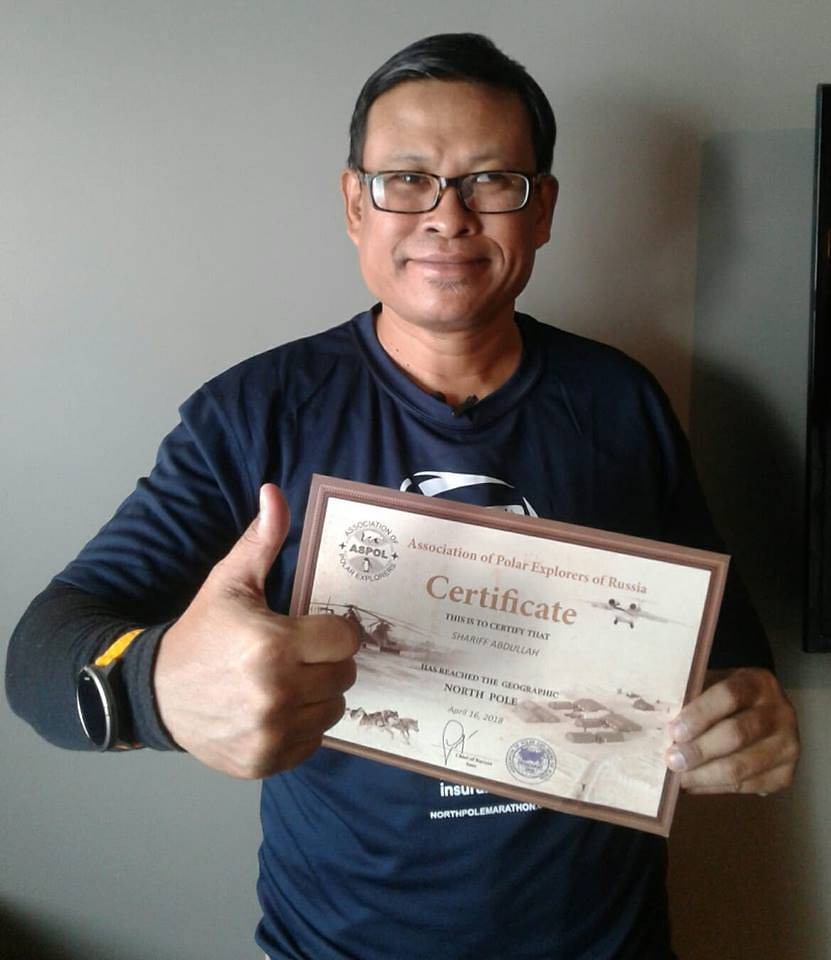
Shariff Abdullah posing with a certificate saying he had reached the north pole. (Photo: Shariff Abdullah)
Shariff said his achievement in this event has motivated him to attempt more endurance races in harsh conditions.
“I’m looking at possibly the Antartica full marathon race next,” he said. “To compete a race in all seven continents would be awesome.”
After the race, Shariff and his fellow competitors took a flight from Campo Barneo to Svalbard, Norway.
He will be leaving Svalbard on Wednesday morning and is set to arrive home on Thursday (Apr 19).
Jewel Changi Airport, due to open in 2019, has entered its last lap towards completion. We take a behind-the-scenes peek at the installation process.
Jewel Changi Airport is on track for a 2019 opening; with 75 per cent of construction completed. (Photo: Gaya Chandramohan)
(Updated: )
Bookmark
SINGAPORE: Changi Airport’s upcoming mixed development Jewel is rapidly taking shape, with overall construction of the sparkling dome nearly completed at 75 per cent.
Pulling into Airport Boulevard Road, the distinctive facade wrapped in glass and steel glimmers in the sunlight; it is hard to miss Changi Airport’s soon-to-be-crowned jewel with its dome of more than 9,000 pieces of specially manufactured glass.
Work on the facade, which commenced in 2016, is due to be completed by June. The project is on track for a 2019 opening.
The entire Jewel facade is made up of more than 9,000 pieces of specially manufactured glass. (Photo: Gaya Chandramohan)
The installation process warrants precise coordination to ensure that each panel is fitted into the correct grid placement that it is planned for. (Photo: Gaya Chandramohan)
Expected to weigh more than 6,000 tonnes when completed – equivalent to the weight of 10 Airbus A380 planes – the façade’s complex installation process has proven to be a feat of its own.
This is due in part to the sheer number of components, as well as custom-made glass panels and steel nodes, with not a single piece having the same dimension or specification.
Each piece of glass weighs between 250kg and 300kg.
Inside the Jewel Changi Airport building that is roughly 75 per cent completed. (Photo: Gaya Chandramohan)
Mr Ashith Alva, head of project design at Jewel Changi Airport explained that given the unique geometry of each glass panel, the installation process warrants precise coordination to ensure that each custom-made panel is fitted into the correct grid placement that it is planned for.
Mr Ashith Alva, Head of Project Design, explains the process behind the installation. (Photo: Gaya Chandramohan)
Workers consult a plan for Jewel Changi Airport’s precise roof installation. (Photo: Gaya Chandramohan)
Workers use QR codes printed on the glass panels to cross check before the installation process. (Photo: Gaya Chandramohan)
“To make sure we are getting the precision for the glass to be installed at its current location, we have QR codes. The installation manager can scan the code (on the glass) and from this he will know exactly where it is to be located on site,” he said.
Workers handle the glass shard before it is sent to the top for fitting. (Photo: Gaya Chandramohan)
The glass panel on its way up to the roof. (Photo: Gaya Chandramohan)
The installation requires meticulous execution as the panels are transferred from the ground level to the top of Jewel’s facade. (Photo: Gaya Chandramohan)
A group of three to four abseilers stationed on the roof will receive the glass panel and fix it on the exact spot for installation. (Photo: Gaya Chandramohan)
Given Jewel’s unique location, the glass panels were subjected to much study and scrutiny in the beginning stages, starting from the type of material.
To ensure that noise from aircraft is minimised, the glass panels were designed with an air gap of 16 millimetres. This will serve as insulation from the noise emitted.
A worker on the roof of Jewel Changi Airport. (Photo: Gaya Chandramohan)
A series of tests and research was also conducted to ascertain that the glare emitted from the building’s surface did not interfere with daily operations of air traffic controllers in the control tower next door.
“We looked at two factors quite closely – the impact on radar and the impact on glare. We worked with specialists over a period of two years to ensure these factors don’t affect the surroundings,” explained Mr Alva.
Tests were conducted to ensure the glare emitted off the building’s surface did not interfere with daily operations of air traffic controllers in the control tower. (Photo: Gaya Chandramohan)
Located in front of Changi Airport’s Terminal 1, Jewel will offer a range of facilities including airport services, indoor gardens and leisure attractions, retail and dining offerings, as well as a hotel when it opens in 2019.
Workers taking a break while working onsite at Jewel Changi Airport. (Photo: Gaya Chandramohan)
A construction worker inside Jewel Changi Airport. (Photo: Gaya Chandramohan)
That is something the Singapore Civil Defence Force (SCDF) is actively looking at doing to enhance its fire fighting and rescue capabilities.
One such technology currently being tested is the Red Rhino Robot, or 3R.
At almost 80kg and less than a metre long, it is a compact and portable emergency responder that can potentially replace a traditionally 4-man crew on their light fire attack vehicle, to a 3-man crew.
“This robot can penetrate deeper into the seed of fire, without the risk of having a firefighter in there,” Assistant Commissioner Ling Young Ern, Director of Operations Department said. “With its auto heat-seeking mechanism, it can autonomously detect fire and seek out exactly where the heat source is.”
The prototype was revealed at the SCDF’s workplan seminar on Wednesday (Apr 18) at the Singapore University of Technology and Design.
The 6th Generation Light Fire Attack Vehicle (LF6G) represents a move from the traditional 4-men crew to a 3+1 concept – three firefighters complemented by the Red Rhino Robot (3R). (Photo: Ahmad Khan)
It is one of the various ways the SCDF is focusing on integrating robotics to enhance capabilities of frontline responders.
Minister of Home Affairs K Shanmugam, who launched the initiatives said: “We do it because we have to, but it has been a very meaningful journey. For example having a robot in a vehicle to fight fires, it saves us manpower and also enhances the ability of SCDF to deal with the fires.
“SCDF has had a very strong culture of innovation, bringing in technology for operational practical purposes. All of them have increased SCDF operational readiness and ability to fight these emergencies that arise and save lives.“
The Red Rhino Robot (3R) is capable of autonomous heat detection and extinguishes fire using Compressed Air Foam (CAF) while allowing the crew to maintain a safe distance away from the risk area. (Photo: Ahmad Khan)
EXOSKELETON ASSISTANCE
The SCDF also revealed their new Exoskeleton project, which enhances a responder’s performance in firefighting and rescue operations by enabling them to carry up to 40kg of firefighting equipment without feeling the burden of the weight.
Jointly developed by the Ministry of Home Affairs, the exoskeleton uses pneumatic pistons to reduce the muscle stress placed on the responder.
Equipment load will be passed through the machine and transferred to the ground via the footplate.
Minister for Home Affairs K Shanmugam is briefed about the Exoskeleton project, which enhances responder’s performance in firefighting and rescue operations by enabling them to carry heavy firefighting equipment. (Photo: Ahmad Khan)
“We want this exoskeleton to be able to help our responders to free up the time and effort in doing physically taxing activities so they can perform other roles,” Lieutenant Colonel Quek Wei Liang from the operations department said. “It provides assisted power to the user when he’s walking around straight stretches or walking up and down steps.”
In terms of Urban Search and Rescue Operations (USAR), the SCDF is testing out a Life Detection Robot.
Shaped like a ‘caterpillar’, the unmanned device can travel through rubbles and uneven terrains.
It is equipped with multiple detection capabilities for better search performance, including visual imaging, detection of human presence by picking out sound, heat and chemical releases from the human body, as well as providing a 3-Dimensional mapping of the area of operations.
APP UPGRADE
The SCDF MyResponder app, which notifies Community First Responders (CFRs) of cardiac arrests that occur in their immediate vicinity, will now include fire cases.
That was another initiative introduced at the workplan seminar.
It aims to alert CFRs to assist in mitigating minor rubbish chute fires, which can be easily extinguished but accounts for half of fires in residential premises.
42-year-old Amos Hoe, School of Sports, Health and Leisure Manager was having dinner when the app, then on trial, sounded its alert about a rubbish chute fire near his place.
“When I saw the fire, I was a bit apprehensive at first,” recounted Hoe.
“But I had a fire extinguisher at home. I grabbed it and I went to the site. when I reached the fire was bringing itself out. The app requested for photos to be sent over. I’m quite glad I did that on hindsight, because of the photos I sent, SCDF won’t have to bring down their appliances. Maybe I saved them a few minutes, which is just a little bit of what I can do.”