The partnership will mark the 200th anniversary of the founding of modern Singapore by Sir Stamford Raffles.
Singapore Prime Minister Lee Hsien Loong and British Prime Minister Theresa May. (Photo: Lianne Chia)
(Updated: )
Bookmark
LONDON: With the 200th anniversary of the founding of modern Singapore coming up in 2019, Singapore and the United Kingdom will commemorate the bicentennial with a “new and substantive partnership”.
This was discussed during Prime Minister Lee Hsien Loong’s first formal bilateral meeting with UK Prime Minister Theresa May on Thursday (Apr 19).
Details of the partnership are not yet clear, but the key idea behind it is to do something significant to mark the bicentennial.
“CONTINUITY” DESPITE BREXIT
During the meeting, both leaders agreed that the “continuity approach” would provide certainty in the lead up to the UK’s impending withdrawal from the European Union, according to Singapore’s Prime Minister’s Office.
This means that all external agreements EU signed with others will continue to apply to the UK during the implementation period – a transition period towards Brexit that is to last until December 2020.
They concurred that when ratified, the EU-Singapore Free Trade Agreement would be a good baseline for the future bilateral trade relations, according to the Prime Minister’s Office.
Negotiations on the EU-Singapore Free Trade Agreement (FTA), which is the first trade deal to be implemented between the European Union and an ASEAN member state, concluded in October 2014.
The EU and Singapore have committed to work together towards the ratification of the deal by the end of this year. It is expected to be sent this month to the Council, and thereafter to the European Parliament for approval.
The EU’s top court had ruled last May that for the FTA to fully come into force, it needs approval from the 38 national and sub-national parliaments of the 28 member states in the regional bloc.
PM Lee also welcomed the UK’s intention to strengthen its engagement with ASEAN, as well as doing more together to support the development of Commonwealth member states, including the rendering of technical assistance.
Prime Minister Lee Hsien Loong is in London for the summit which will see leaders from 53 countries gather to discuss global and regional issues of concern.
PM Lee Hsien Loong arrives at the official opening of the Commonwealth Heads of Government Meeting on Thursday (Apr 19). (Photo: Lianne Chia)
(Updated: )
Bookmark
LONDON: The Commonwealth Heads of Government Meeting was formally opened at Buckingham Palace on Thursday (Apr 19).
Leaders of 53 nations, including Singapore’s Prime Minister Lee Hsien Loong, are in London for the week-long summit, which began on Monday and runs till Friday.
They are expected to discuss global and regional issues of concern and review developments in the Commonwealth.
Leaders were hosted by Queen Elizabeth at the formal opening held in the ballroom of Buckingham Palace.
The opening, which marks the official start of CHOGM, featured a celebratory welcome for leaders which included a guard of honour as well as cultural and musical performances.
They then received an official welcome from UK Prime Minister Theresa May at the Friary Court.
Prime Minister Lee Hsien Loong is greeted by his British counterpart Theresa May and Commonwealth Secretary-General Patricia Scotland at the Commonwealth Heads of Government Meeting on Thursday (Apr 19). (Photo: Lianne Chia)
Leaders will then convene for their first executive session.
Meetings began in London on Monday with three days of forums – covering youth, women, business and civil society – and culminate with the official retreat for leaders at Windsor Castle on Friday.
At the retreat, heads meet privately to discuss collaboration on global and Commonwealth priorities. They will also consider reform and renewal of the Commonwealth.
On Wednesday, Mr Lee met the Duke of York Prince Andrew, according to the Prime Minister’s Office.
They reaffirmed the longstanding ties between Singapore and the UK, and discussed ways to strengthen cooperation amongst the Commonwealth countries.
He also met youths from Singapore who have made contributions to the Commonwealth and their communities.
The Commonwealth is a voluntary association of 53 independent countries, almost all of which were formerly under British rule. Altogether, its members make up about a third of the world’s population, and about 40 per cent of the world’s young people.
SINGAPORE: A hermit crab, a shiny-eyed shrimp and a crab with fuzzy spines are among over a dozen new species discovered in a deep-sea expedition off the Indonesian island of Java, scientists said.
The team from the National University of Singapore (NUS) and the Indonesian Institute of Sciences (LIPI) carried out the expedition for 14 days between March and early April.
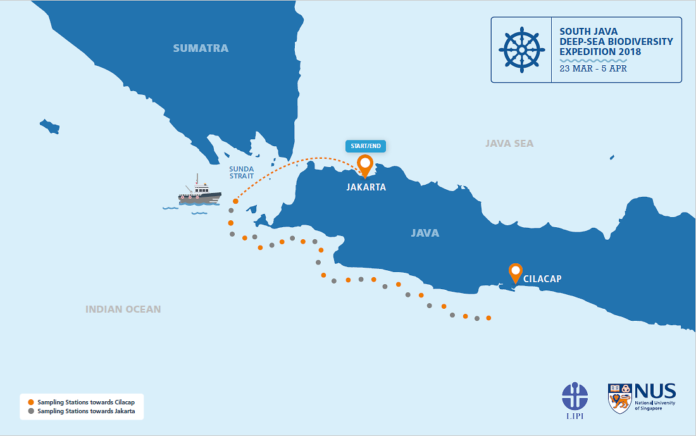
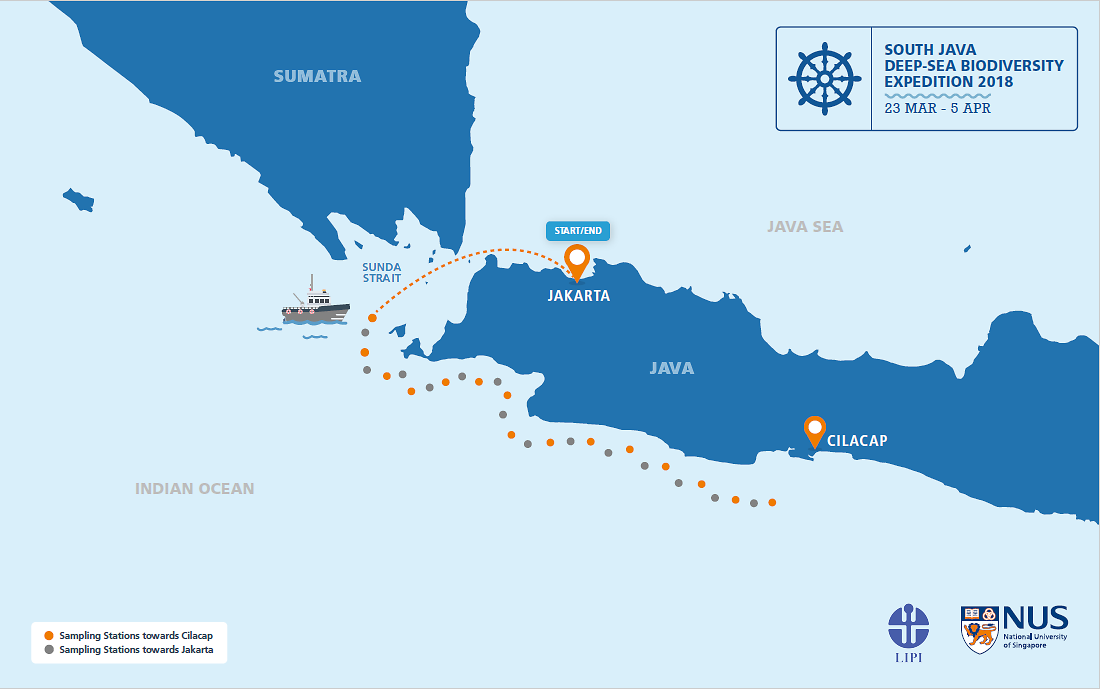
The area covered included a long stretch of the Indian Ocean off Java’s southern coast as well as the Sunda Strait that separates the island from Sumatra.
“This is a part of the Indian Ocean that has been never been sampled for deep-sea animals so we really didn’t know what to find,” said Peter Ng, a crab expert and head of the Lee Kong Chian Natural History Museum at NUS.
“We were very surprised by the findings,” he told AFP on Thursday, adding that the team had expected to discover creatures from the Indian Ocean and the surrounding areas already known to scientists.
But the discovery of species entirely new to science “tells us that there are things happening in that part of Indonesia that we don’t know”, said Ng, who co-led the expedition.
Three new species of spider crabs were discovered during the expedition, the scientists said in a statement. (Photo: AFP/South Java Deep Sea Biodiversity Expedition 2018)
The researchers examined 63 sites as they sailed from Jakarta to Cilacap town in southern Java and back.
Three new species of spider crabs were discovered during the expedition, the scientists said in a statement.
One of them had a plate protecting its eyes which resembled oversized ears while another was bright orange in colour.
Another discovery was a new species of hermit crab with bright green eyes, according to Indonesian scientist Dwi Listyo Rahayu, also a crab expert and the expedition’s co-leader.
One new species of shrimp had shiny eyes that reflect light, the scientists said.
Ng, the NUS professor, said the scientists will carry out a detailed study of the more than 12,000 creatures from 800 species they had picked up on the expedition and publish their findings in 2020.
They expect to discover more new species as they go along, he said.
The reason they immediately identified the new species of crabs, prawns and lobsters is that the scientists involved are experts in this field, he added.
SINGAPORE: A masked man charges forward on the deck of a vessel, knife in hand.
“Put down your weapon or I will shoot!,” a sea marshal instructs him.
“BANG!” The sound rings out as the sea marshall fires off two shots from his sub-machine gun. The masked man falls to the ground, motionless.
This is just one scenario that could potentially happen on board a vessel, and one that the Republic of Singapore Navy’s Accompanying Sea Security Teams, or ASSeTs, is trained for.
ASSeTs act as sea marshals, and are specially trained to deal with various kinds of threats from the sea, such as piracy, human trafficking and terrorist attacks.
With 70 per cent of the world’s global maritime economy transiting through the Singapore Strait, ASSeTs represent a key component in safeguarding the country against maritime threats.
Last year, the team conducted 585 checks on board vessels in Singapore’s port, to ensure they are free of hostile elements.
This number has seen a gradual decrease over the last decade, due to the advancement in capabilities such as data analytics, and a whole-of-Government approach to bring together information from different agencies such as the Immigration and Checkpoints Authority, Maritime and Port Authority of Singapore, Singapore Civil Defence Force, Singapore Customs and Singapore Police Force.
ASSeTs demonstrating how they climb on board a ship, using a Jacob ladder, to conduct boarding operations.
Lieutenant Colonel Nick Neo, Commanding Officer of the 180 Squadron, said: “The need to continue conducting boarding operations is to ensure that the deterrence message is delivered loud and clear to the shipping community and (to tell) potential terrorists to reconsider any attempt to strike Singapore.”
REAL OPS FOR NSMEN
Apart from regulars and National Servicemen, the team contains several Operationally Ready National Servicemen, who are also entrusted with the task of executing boarding operations.
“NSmen are significant to 180 squadron because they can augment our regular teams to conduct live boarding operations,” LTC Neo said. “We will prepare them whenever they come for ICT. And conducting live boarding ICTs is something that NSmen feel are very meaningful to them.”
NSmen have to go through a comprehensive refresher training, which includes mastering the use of lethal and non-lethal weapons, and how to board ships using a Jacob ladder.
CNA Reporter Ahmad Khan got a feel of the ASSeTs training regime. One of the challenges was to climb up a Jacob ladder on board a ship, wearing about 20kg worth of gear.
Said Lieutenant Mervyn Low, an NSman ASSeT team leader: “This role that we do is pretty demanding in terms of what we need to know and physical (fitness). Being able to be in the front line means I’m physically capable and mentally ready to perform all the ops, so we feel quite proud to be part of the team.”
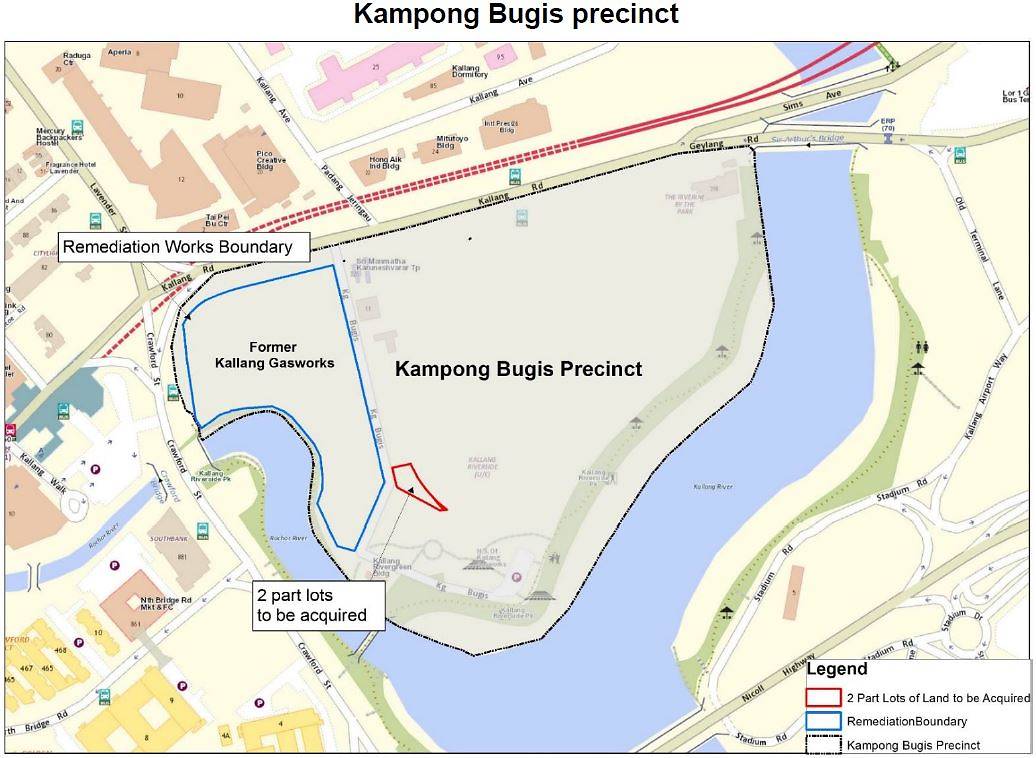
SINGAPORE: To facilitate the extensive redevelopment of the Kampong Bugis precinct, the Government will treat the soil where the former Kallang Gasworks was sited and acquire a small portion of land.
The Urban Redevelopment Authority (URA) revealed this on Thursday (Apr 19) in a media briefing where it unveiled plans for the area to be turned into a car-lite neighbourhood, offering some 4,000 new homes by around 2030.
Land occupying 914 sq m, about the size of two basketball courts, will be acquired. It is currently held by the Singapore-Johore Express, who is the developer of the Kallang Riverside freehold condominium in the area.
No residential units will be affected by the acquisition as only a temporary show flat sits on the site.
A temporary Kallang Riverside condominium show flat located at the site of the future Kampong Bugis precinct. (Photo: Dylan Loh)
Singapore-Johore Express will be compensated based on the current market value of the land, and will have to hand over the site by Apr 30, 2019.
SOIL TREATMENT AT FORMER GASWORKS
Remediation works will also be carried out in the area occupied by the former Kallang Gasworks to remove chemicals in the soil such as aromatic hydrocarbons and heavy metals, often found in land that has been used for gas production.
The former gasworks, constructed in 1862, occupied an area of about 3.14ha. It was the only plant which manufactured gas using coal in Singapore.
The works will entail treating the soil using thermal methods and soil washing so that it becomes suitable for urban living, URA said.
The site has been cordoned off and works are expected to last from November this year to July 2022.
Location map of the Kampong Bugis Precinct. (Source: URA)
A tender is expected to be called for a single master developer to oversee the planning and development of the precinct, occupying 17ha, within two years.
URA says this approach supports better integration among buildings, public spaces, amenities and other infrastructure.
The precinct will include features that support environmental sustainability, like a pneumatic waste conveyance system for more efficient waste collection, and a stormwater treatment system.
The 4,000 new residential units will be 99-year leasehold apartments.
As Kampong Bugis is envisioned to be a car-lite neighbourhood, about 2,000 parking lots are expected to be allotted for the new homes.
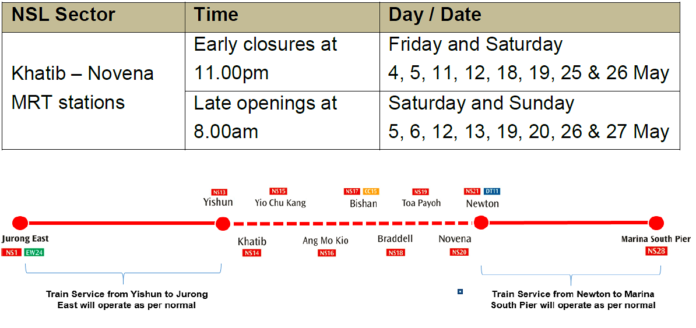
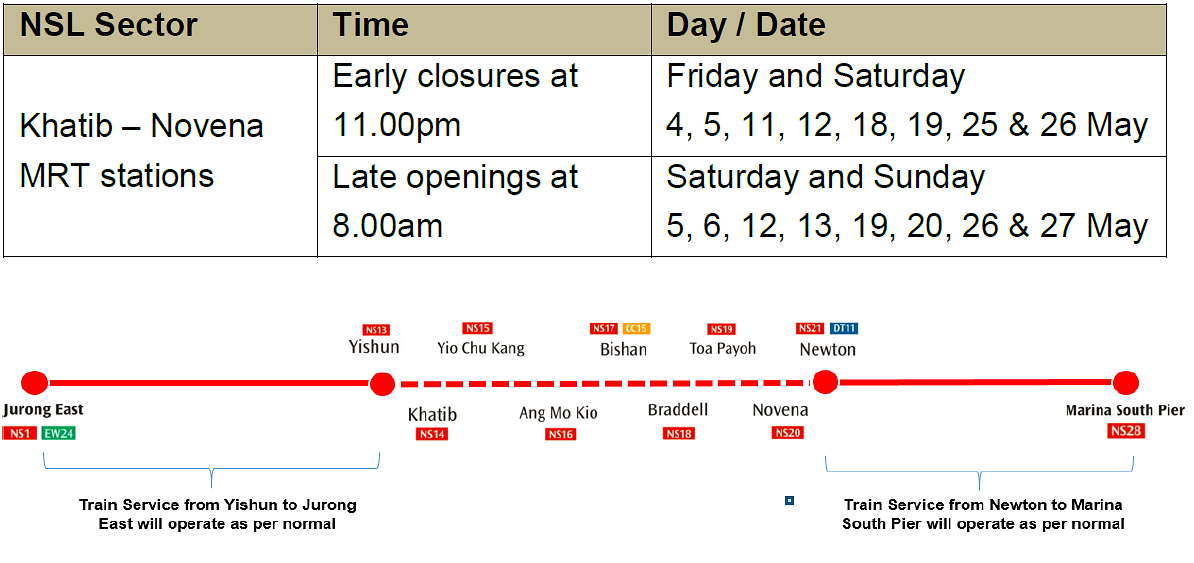
SINGAPORE: Seven MRT stations, from Khatib to Novena, will close earlier and open later on some days in May for maintenance and improvement works along the North-South Line (NSL), train operator SMRT announced on Thursday (Apr 19).
In a news release, SMRT said the stations will close at around 11pm on Fridays and Saturdays and open later at around 8am on Saturdays and Sundays in the month.
The additional hours will more than double the available time for engineering teams to intensify maintenance and accelerate rectification works along the NSL’s MRT tracks, the train operator said.
It added that during these planned closures, commuters can still travel on the NSL between Jurong East and Yishun MRT stations, and between Newton and Marina South Pier MRT stations.
Oil prices on Thursday remained close to highs touched the previous day that were last seen in late 2014, buoyed as U.S. crude inventories declined and as top exporter Saudi Arabia is expected to keep withholding supply to prop up the market.
FILE PHOTO: A pump jack is seen at sunrise near Bakersfield, California October 14, 2014. REUTERS/Lucy Nicholson/File Photo
Bookmark
LONDON: Oil prices rose on Thursday to their highest since late 2014 as U.S. crude inventories declined, moving closer to five-year averages, and after sources told Reuters top exporter Saudi Arabia is seeking to push oil prices higher.
Brent crude oil futures rallied as high as US$74.44 a barrel, the strongest since Nov. 27, 2014, the day that OPEC decided to pump as much as it could to defend market share, sending the price to a low of US$27 just over a year later.
Brent futures were at US$74.35 per barrel at 0823 GMT, up 87 cents from their last close.
U.S. West Texas Intermediate (WTI) crude futures rose 71 cents to US$69.18 a barrel. WTI had earlier hit US$69.27, its best level since Dec. 2, 2014.
“Oil prices continued to climb on Thursday as a decline in U.S. crude inventories and commentary from Saudi Arabia that it would be happy to see crude rise to US$80 or even US$100 helped boost prices,” RBC said in a note.
The Organization of the Petroleum Exporting Countries (OPEC) and other major producers including Russia started to withhold output in 2017 to rein in oversupply that had depressed prices since 2014.
OPEC and its partners will meet in Jeddah, Saudi Arabia, on April 20. OPEC will then meet on June 22 to review its oil production policy.
Reuters reported on Wednesday that top oil exporter Saudi Arabia would be happy to see crude rise to US$80 or even US$100 a barrel, which was seen as a sign that Riyadh will seek no changes to the supply-cutting deal.
“The Saudis and their colleagues in OPEC need higher oil for their fiscal positions and the Kingdom is on a bold – and costly – reform program. So they might continue to squeeze the lemon while they have the chance,” said Greg McKenna, chief market strategist at futures brokerage AxiTrader.
Since the start of the supply cuts, crude inventories have gradually declined from record levels toward long-term average levels.
In the United States, the Energy Information Administration (EIA) said on Wednesday that commercial crude stocks fell by 1.1 million barrels in the week to April 13, to 427.57 million barrels, close to the five-year average level of around 420 million barrels.
Further supporting oil prices is an expectation that the United States will re-introduce sanctions against Iran, OPEC’s third-largest producer, which could result in further supply reductions from the Middle East.
(Reporting By Shadia Nasralla; Editing by Toby Chopra)
SINGAPORE: Malaysia’s MyHSR Corporation and Singapore’s SG HSR on Thursday (Apr 19) announced that more time will be given to interested parties to submit bids for the assets company for the Kuala Lumpur-Singapore high-speed rail (HSR) project.
Bidders will now have until Dec 28, 2018 to submit their proposals, instead of the Jun 29 deadline announced when the tender was jointly called in December last year.
This extension will not affect the Dec 31, 2026 date on which operations are expected to begin, said the two companies in a joint media release.
The deadline was extended after bidders requested “additional time” to develop tender submissions, said SG HSR’s managing director Rama Venkta and Mohd Nur Ismal Mohamed Kamal, MyHSR Corporation’s chief executive officer in a joint statement.
“We are encouraged by the strong interest in the AssetsCo (assets company) tender,” said the statement. “While the bidders are progressing with their tender preparations, they have also requested for additional time to develop their tender submissions that offer better value to both governments.”
“After careful consideration, we have extended the tender submission deadline by six months, in view of the complexity and scale of the project,” it added. “We look forward to receiving high quality and competitive proposals from all the bidders.”
Following the close of the tender, both companies expect to complete their evaluation and announce the tender results by the third quarter of 2019.
The assets company will be responsible for designing, building, financing and maintaining all rolling stock and rail assets as well as operating these assets for the high-speed rail. It will also manage the system network for operations and maintenance needs.
Singapore and Malaysia signed a bilateral agreement for the HSR project in December 2016.
It will be served by four trains every hour once it starts operations in 2026, two of which will offer an express service between the Bandar Malaysia terminal in Kuala Lumpur and Jurong East in Singapore every 30 minutes.
The project has attracted keen interest globally, with Japan’s ambassador to Malaysia saying earlier this year that the country could offer a “truly holistic” package towards the project.
Other bidders for the project may include those from China, South Korea and France.
SINGAPORE: Cleaner Kalam Mohd Abu was washing the sixth-floor corridor of Block 103 Commonwealth Crescent last Saturday (Apr 14) when an elderly resident asked him for help.
She was sick and she didn’t have any food. Could he give her some food, she asked.
The woman looked pale and was clutching her stomach, he told Channel NewsAsia in an interview on Thursday. She showed him a pink vertical scar on her stomach and told him she was recovering from a recent surgery.
“She asked if I could buy her food. She was too sick to walk down to the nearby market and I had to help. It was the least I could do,” said the Bangladeshi national, who has been working as a cleaner at Tanjong Pagar Town Council for 10 years.
Without hesitation, Mr Kalam rushed back to the storeroom – where cleaners keep their belongings – 10 minutes’ away to grab his packed lunch of rice and curry that he had cooked for himself the previous night.
He knew he had to deliver the food quickly to the hungry woman. So, he asked a resident he knew well if he could borrow his e-scooter, and rushed back to Block 103.
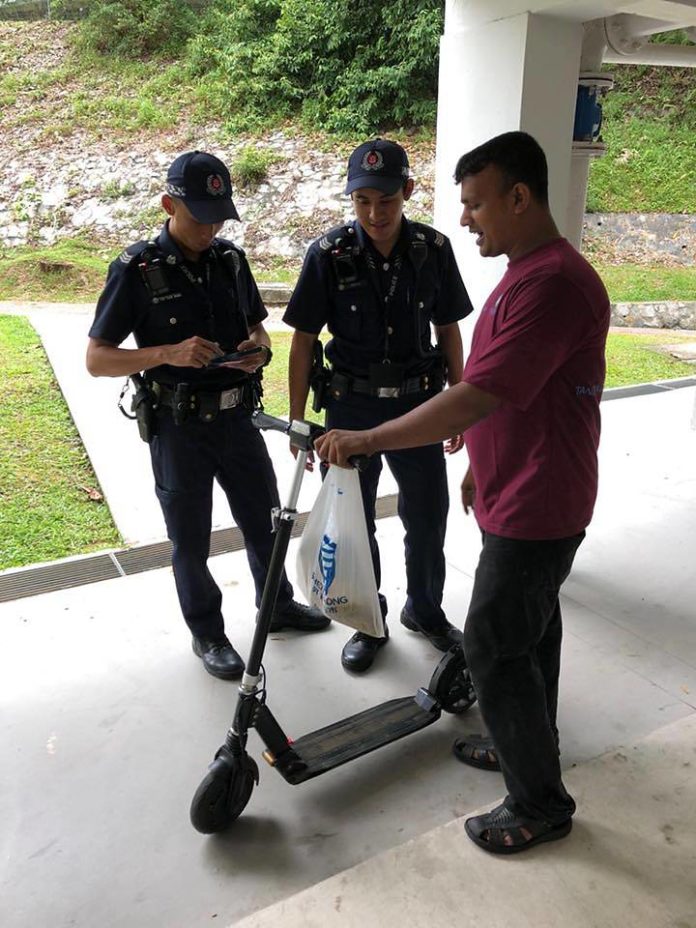
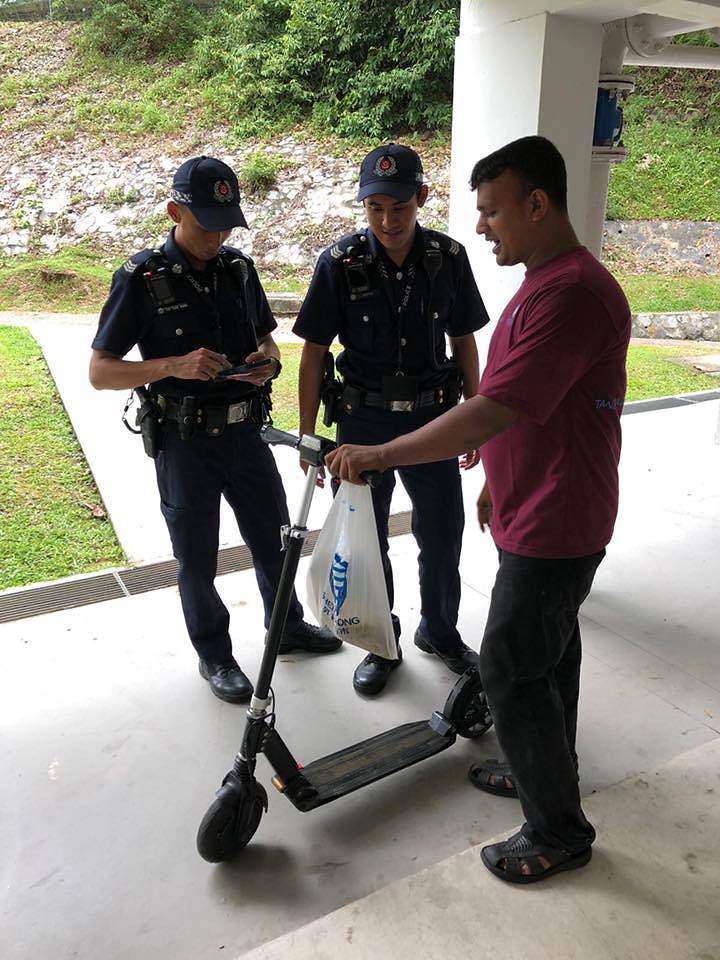
He was on his way when three police officers from Queenstown neighbourhood police centre stopped him.
To quickly deliver the food to the woman, Mr Kalam borrowed an e-scooter from a resident. (Photo: Facebook/Queenstown NPC)
“We (cleaners) are not allowed to use those scooters for our work. It’s for our safety as well as the residents. That could be why they stopped me,” said Mr Kalam.
“But I told them why I was in a rush and they understood.”
In a Facebook post on Saturday, the Queenstown neighbourhood police centre posted photos of Mr Kalam and some patrol officers.
“Found out that he (Mr Kalam) was delivering his personally cooked food to an elderly resident in Commonwealth Crescent who has difficulty moving due to an operation. We took a moment to compliment him for his selfless act,” the post said.
“HAPPY SHE LOOKED HEALTHIER AFTER EATING”
When he gave the elderly woman his food, she was really grateful, Mr Kalam said.
“She thanked me many times, I told her it was fine,” said the 31-year-old. “I’m happy she looked healthier after the meal.”
Mr Kalam’s good deed drew praise from MP for Tanjong Pagar GRC and chairman for Tanjong Pagar town council Melvin Yong, who presented a certificate of appreciation to him on Wednesday.
“Great job, Kalam! We are proud of you,” Mr Yong wrote in his post.
Mr Kalam’s supervisor, who did not want to be named, said Mr Kalam was one of the kindest people he has met.
“This is not the first time he has done this. He shares his food with elderly residents all the time,” he said.
“Kalam has been working in this area for 10 years, and he has seen the residents grow older. He knows them and helps them as if they were his family,” he added.
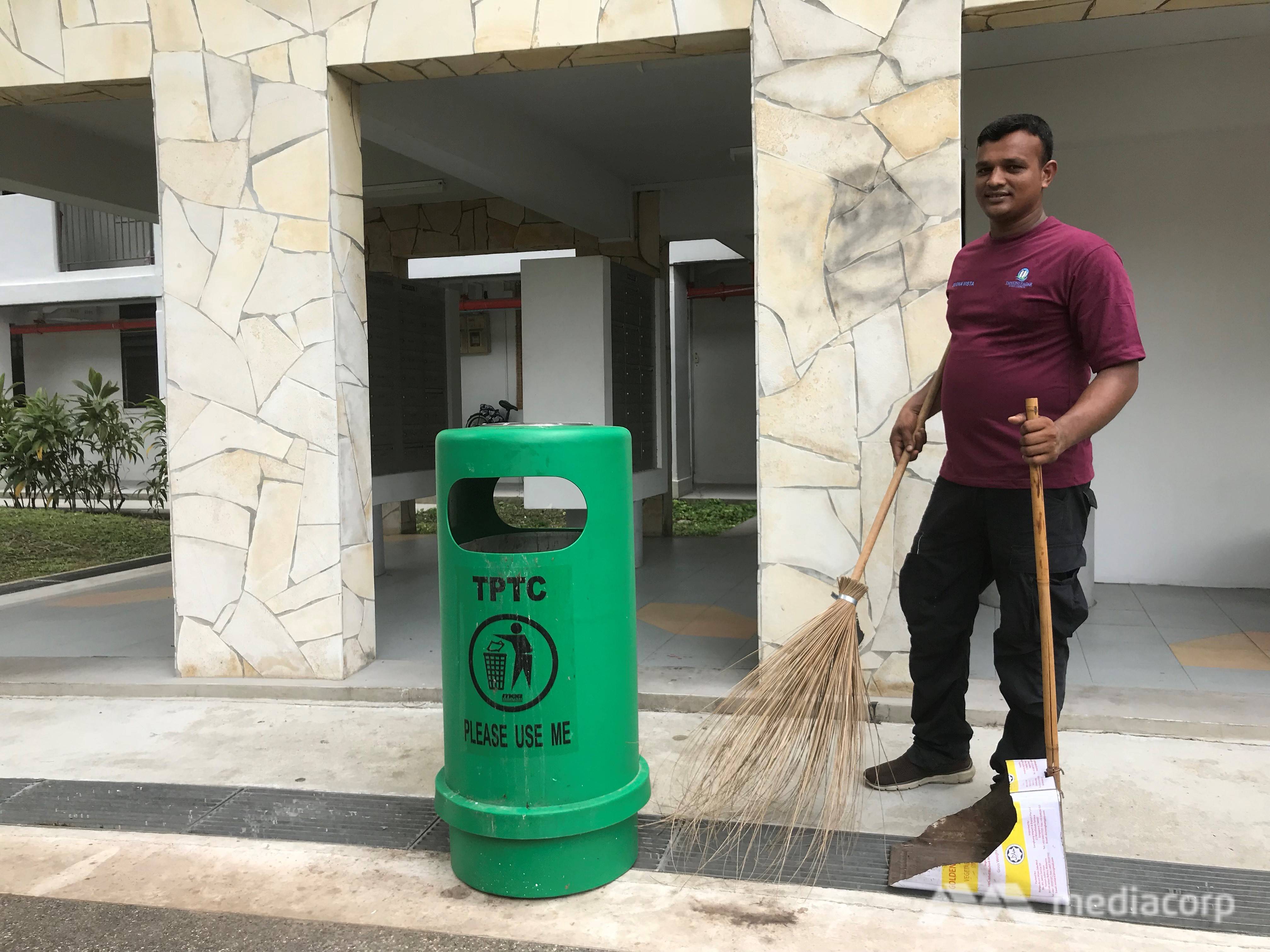
Mr Kalam works 10 to 12 hours a day as a cleaner at Commonwealth Crescent. (Photo: Amir Yusof)
SINGAPORE: The Bioethics Advisory Committee (BAC) is reviewing its current stand against genetic modification with regards to genetic disorders passed on to children by their mothers.
The committee, set up by the Government to deal with issues arising from biomedical sciences research in Singapore, said on Thursday (Apr 19) that it is seeking public feedback and views on whether emerging technology should be allowed to be used to prevent mitochondrial disorders.
Mitochondria are responsible for energy production in cells, and faulty mitochondria can have “serious debilitating effects”, including brain, heart and ear disorders, the committee said.
A public consultation paper put up by the committee – which includes retired chief district judge Richard Magnus, chief executive of Science Centre Singapore Lim Tit Meng and senior consultant at the National Cancer Centre Singapore Professor Kon Oi Lian – looks at the ethical, legal and social issues arising from Mitochondrial Genome Replacement Technology (MGRT).
Bioethics Advisory Committee chairman Richard Magnus and deputy chair Professor Kon Oi Lian. (Photo: Jalelah Abu Baker)
MGRT, which involves germline modification, a type of genetic modification, has so far not been permitted in Singapore. The BAC recommended against it in 2005 due to the lack of sufficient scientific evidence of its feasibility and safety.
However, “in light of recent scientific developments and international debates” the committee is reviewing its position, it said in its paper.
A spokesperson for the BAC pointed to the United Kingdom, which became the first country to legalise the clinical application of MGRT in 2015, allowing clinical trials for two MGRT techniques, as an example of such developments.
With these developments, the BAC considers it “timely and important” to study the current research involving MGRT, and to review its recommendations, he added.
The three techniques the committee is looking at involve replacing the abnormal mitochondria in the egg or early embryo with healthy mitochondria from the egg or early embryo of a separate healthy donor. Fathers are not able to pass on such disorders.
BAC chairman Mr Magnus said: “MGRT may help enable women who suffer from mitochondrial disorders to have healthy genetically related children of their own.
“However, there is a need to closely evaluate the safety of MGRT and the resulting ethical, legal and social implications, and consider if Singapore is ready to permit such technology.”
HOW COMMON ARE MITROCHRONDIAL DISORDERS AND IS THERE A CURE?
According to the consultation paper, the prevalence of heritable mitochondrial diseases in Singapore has not been studied.
However, as there is “no significant racial or ethnic predilection for mitochondrial diseases”, it is likely that population studies done in other countries can be extrapolated to Singapore, the paper said.
In the United Kingdom, it has been estimated that approximately 1 in 4,300 people suffer from inheritable mitochondrial disease, of which the minimum prevalence rate for mitochondrial disease caused by mitochondrial DNA mutations is 1 in 5,000.
“However, because of the wide range and varying severity of symptoms, it is thought that the prevalence of mitochondrial disorders is likely to be higher than current estimates mainly due to a lack of recognition leading to under-diagnosis or misdiagnosis,” the paper said.
The paper added that there is currently no cure for mitochondrial disorders, though many symptoms are treatable.
Existing treatments include transplantation, medication, and special diets. However, these treatments vary in efficacy.
The paper added that the risk of transmitting mitochondrial disorders due to mitochondrial DNA mutations can be complex and difficult to predict.
Currently, women carrying abnormal mitochondrial DNA who wish to have healthy children without the risk of developing mitochondrial disease may consider adoption, in-vitro fertilisation using healthy donor eggs, preimplantation genetic diagnosis and prenatal diagnosis, the paper said.
However, it added that these solutions come with difficulties and limitations like a long waiting list for adoption.
POTENTIAL BENEFITS AND HARMS OF USING SUCH TECHNOLOGY
The key benefit of MGRT is the potential elimination of mitochondrial disorders caused by mitochondrial DNA mutation and the avoidance of physical, psychological or social suffering associated with the disorders, according to the committee.
“MGRT offers an opportunity to mitigate the undesirable outcomes of the ‘genetic lottery’, so that affected individuals could have children potentially unaffected by mitochondrial disorders,” the paper said.
This prevents suffering not only for their future children, but also for the prospective parents, the paper added.
However, the paper acknowledged that it would be difficult to assess the potential harm from the clinical application of MGRT because human trials have not yet been conducted.
Nevertheless, the paper addressed some foreseeable harm to future generations, such as a possible developmental or health problems due to the manipulation of the eggs or zygotes.
Another is psychosocial harm.
“It has been suggested that children, if informed that they were born via MGRT and possess genetic material from three different persons, may form a self-conception that is troubling, ambiguous or conflicted,” the paper said.
The current challenge lies in determining what an ethically acceptable threshold of risk versus benefits should be, in comparison with the available alternatives in order for first-in-human trials to proceed, the paper said.
In suggesting safeguards for the use of the technology, the committee suggested enhancing current regulation to limit the use of MGRT to the prevention of serious mitochondrial disease, an approach adopted similarly in the UK.
Professor Kon, chairman of the MGRT Review Group, said that while introducing inheritable genetic changes carries unforeseeable risks, current pre-clinical scientific evidence suggests that MGRT is not unsafe.
“Due to the unique characteristics of mitochondria, there are possible safeguards that could be put in place to mitigate some of the long-term risks. However, the question remains whether the potential benefits justify allowing first-in-human clinical trials,” he said.
The public consultation will take place from Friday to Jun 15 this year.