GRAB last week unveiled its future plans following the acquisition of Uber in Southeast Asia. The overall vision of the e-hailing company is to provide multiple services through one mobile app, benefitting both consumers and businesses across Southeast Asia.
Such services include seamless mobility, on-demand food delivery, logistics, cashless payments, and financial services.
According to the company, soon consumers will be able to book multiple forms of transport for a journey, pay for their lunch using GrabPay, deliver gifts to their loved ones through GrabExpress, and order their dinner to their front door using GrabFood.
“By building a technology platform that serves the most important everyday lifestyle needs of our consumers, we are benefitting an entire ecosystem of connected users who are not only passengers and driver partners, but also increasingly merchants and delivery partners,” explained Sean Goh, country head of Grab Malaysia.
“We can help everyone, particularly micro-entrepreneurs, grow their businesses and serve consumers better with how each of our service is interlinked,” he adds.
Grab’s vision is inspired by the survey results of consumers in Southeast Asia. After crossing the milestone of one billion rides across the region in October 2017, the company surveyed consumers to discover what they envisioned Grab to be like in ten years time.
The majority of respondents said they wanted an everyday lifestyle app that would complement their daily lives. This interconnected ecosystem of consumer services will benefit consumers, drivers, delivery couriers, and merchants in many ways.
Grab’s vision includes a multi-modal future that serves people’s first and last-mile needs. According to Goh, soon consumers will be able to “mix and match” transport options based on their travel preferences and budget. This includes JustGrab, GrabTaxi, GrabBike, GrabCycle, Grabcoach, and more.
“GrabHeli and GrabPlane … maybe we’ll consider it!” he said.
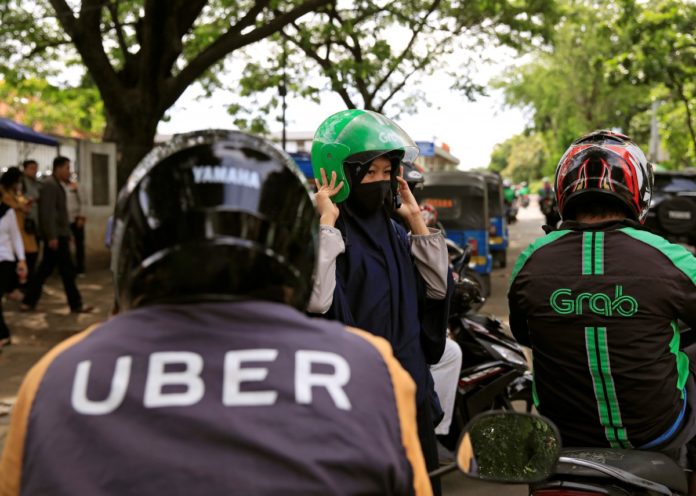
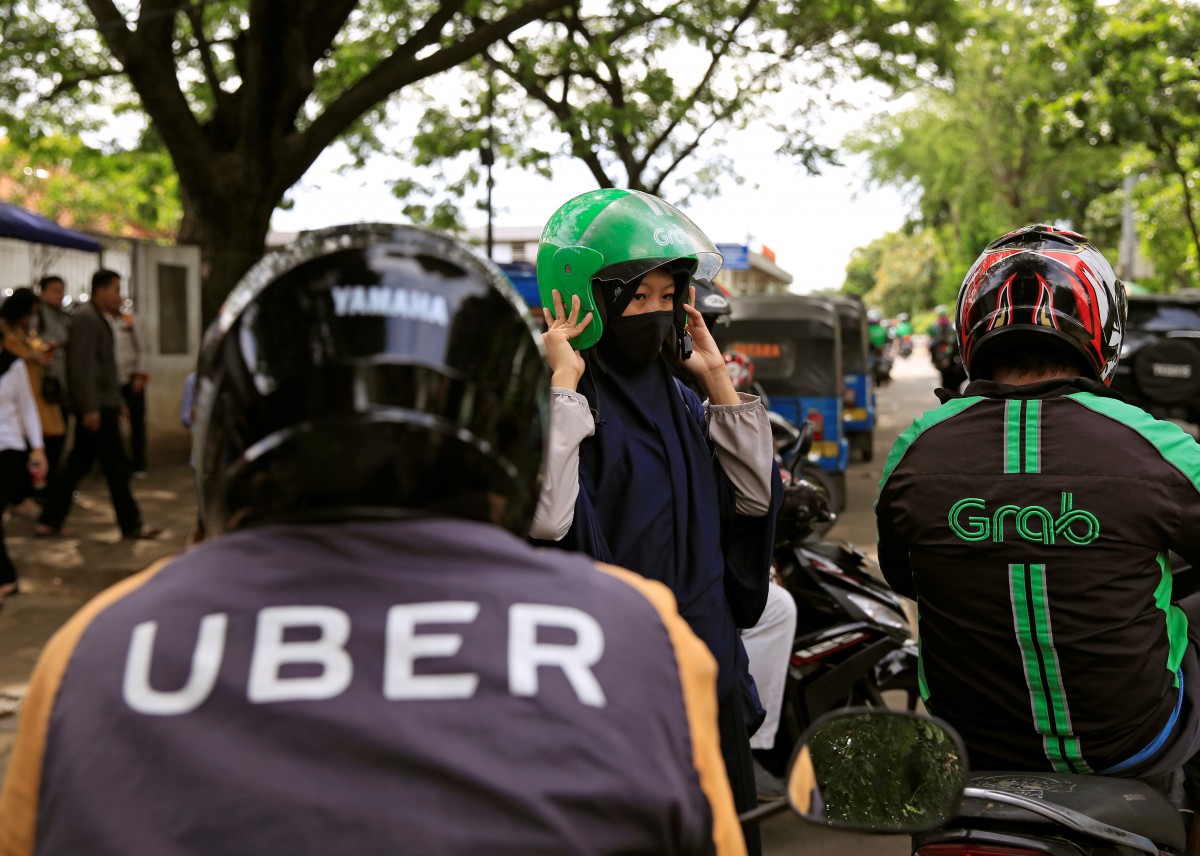
A passenger of Grab bike fixes her helmet next to Uber driver at Manggarai train station in Jakarta, Indonesia, March 26, 2018. Source: Reuters/Beawiharta
The company’s plans of expanding the use of GrabPay as a mobile wallet beyond transport will enable both consumers and merchants a more seamless way of transacting. It will enable businesses to work towards going cashless, which will both increase productivity and save business costs.
The ride-hailing company also have a number of fintech offerings which aim to create new economic opportunities for millions of small businesses across Southeast Asia.
According to Goh, over six million micro-entrepreneurs across the region have been enabled by Grab’s platform to date. The company has a target of helping 100 million micro-entrepreneurs by 2020.
With the integration of on-demand transport, food, and delivery facilitated by a mobile-wallet, Grab aims to meet the consumers’ everyday needs.
The Grab platform will offer various opportunities for people in Southeast Asia to drive, deliver, or offer their services. With today’s digital economy, people have a greater flexibility to earn an income at their own time and pace. Grab Malaysia has created better income opportunities for more than a hundred thousand driver-partners alone.
Grabs food-delivery service GrabFood is currently being piloted in selected areas in Malaysia and will become available in more areas later this month, creating new income and job opportunities for delivery partners.
The new service (which has taken over UberEats in the region) will enable consumers to order and pay for their food effortlessly using GrabPay, with the opportunity to also earn GrabReward points for every order.
“With our acquisition of Uber’s operations in Malaysia and the expansion of GrabFood across the region, we are working with local merchant and delivery-partners to deliver the best of Malaysia’s kitchens to the doorsteps of millions in the very near future,” added Goh.
This article originally appeared on our sister website Tech Wire Asia.
SINGAPORE: When his contract with ride-hailing giant Grab ends in a month’s time, Mr Gregory Lim intends to give up his Mazda 3 for a Prius Hybrid taxi from SMRT – reversing a move he made last year.
Experiences of waiting for an assigned booking and getting cancellations after spending time travelling to a location have made the former taxi driver miss the days of being able to pick up passengers off the streets.
The 41-year-old also lamented that he no longer has the drive to clock long hours on the road amid shrinking cash incentives.
“After Uber is gone, so are the incentives,” Mr Lim said, referring to Grab’s landmark deal to acquire the Southeast Asia operations of its American rival. “Becoming a private-hire car driver was all about the incentives.”
Also mulling a return to the taxi industry is former ComfortDelGro cabby Sabastian, who cited taxes as his main consideration.
The driver, who preferred to be known by his first name, said monthly expenses, such as vehicle rental and petrol, can amount to S$2,500 or more. But unlike cabbies, these are non-tax-deductible for private-hire car drivers.
“Don’t forget that Grab takes a 20 per cent commission so after these deductions, I’m not left with much to take home,” said the sole breadwinner. “Tax is a problem not just for me, but many drivers too. That’s why we are thinking of going back to taxis.”
In recent years, traditional cab operators in Singapore have taken a hit with ride-hailing services hot on its wheels. Apart from passengers, it also witnessed an exodus of driver-hirers which at one point in time, left fleets of taxis lying idle in yards.
But with the change in hearts among some drivers, at least one taxi company is benefiting.
Industry leader ComfortDelGro announced earlier this month that it has placed an order for 200 new cabs – its first in close to one-and-a-half years.
This was meant for the “uptick” in demand for its taxis over the last month or so, said company spokesperson Tammy Tan. The taxi giant signed on close to 300 new hirers in April – nearly double the same period last year.
Channel NewsAsia reached out to the other taxi operators with queries on whether they are noticing the same trend, but they did not respond or declined to comment.
On why some private-hire car drivers are changing tracks, transport analysts cited the rollback in monetary rewards as a key factor.
Previously, incentives as much as S$2,500 a month were achievable, according to drivers that Channel NewsAsia spoke to. These days, that has been halved.
“If I’m a driver, I will naturally sign up with the company that can give me the highest income,” said Dr Lee Der Horng from the National University of Singapore (NUS). “But just like promo codes, these upfront incentives were unsustainable. Now things have changed, drivers are feeling concerned.”
Echoing that, Dr Park Byung Joon from the Singapore University of Social Sciences (SUSS) said perks, which included hefty bonus rewards and vehicle rental for as low as S$60 a day, have been “distractions” for many taxi drivers.
“But when the time comes for no more incentives, they will start thinking which is more economically viable,” he said, while adding that taxi operators provide benefits such as maintenance support.
With “things back to how they are supposed to be”, Dr Park reckoned that there will soon be “a balance” between those behind the wheels of taxis and private-hire cars.
When contacted, a Grab spokesperson said: “Be it private-hire cars or taxis, drivers can choose their preferred services based on their lifestyle needs and preferences.”
As a technology company, its role is to provide a platform for drivers, merchants and other partners, while using “technology to enhance the overall efficiency of the transport system”. It is also “focused on bringing down the everyday costs” for drivers and has provided greater welfare support, such as discounts on fuel and mobile plans, added the spokesperson.
File photo of a taxi driver.
IS THE WORST OVER FOR TAXIS?
With the recent developments, industry experts said the taxi industry could see smoother roads ahead.
Dr Park, for one, said cab operators can “finally breathe a bit easier”, thanks to the Grab-Uber deal.
“Uber and Grab burning cash to buy market share had been a painful time for the local taxi companies. But the deal means that Grab will no longer need to do that – promo codes and big incentives, those days are over,” he said.
“This will be a huge relief for not just ComfortDelGro, but all taxi operators.”
Phillip Capital Research investment analyst Richard Leow went as far to say that the battered industry’s worst days may have passed.
He noted that the consolidation of the two ride-hailing giants has led to “pricing rationalisation, in turn resulting in some flow of drivers back to taxis”. More importantly, ComfortDelGro’s move to grow its fleet again is the “big U-turn” that may signal “the worst could be over”.
True enough, the biggest taxi operator in Singapore struck an upbeat note in its earnings report last week despite a near 20 per cent fall in first-quarter net profit.
“Revenue from the taxi business is expected to stabilise with the rationalisation of the competition landscape in Singapore,” said ComfortDelGro Group CEO Yang Ban Seng, while adding that there will be a more level playing field ahead.
Even with a host of new upstarts jostling to fill in Uber’s void, analysts said it may take some time before competition can be revved up again.
This is because new players, such as Ryde and Jugnoo, have only launched their services this month and remain in the early stages of building up a sizable fleet, said Dr Lee.
Earlier reports have suggested that homegrown firm Ryde started off with about 5,000 drivers, while Jugnoo signed up 100 and is hoping to hit a target of 2,000 by the end of the month.
The relatively smaller capital backing that these new disruptors have also seems to suggest that they may opt out of the “expensive strategy” of doling out incentives to attract drivers, said Dr Park.
“But if they don’t intend to do the same as what Grab and Uber did, then I don’t think it’s going to be easy for them to build up their network quickly,” he added.
Still, this does not mean that the taxi fleet in Singapore could halt the brakes on recent declines. Statistics from the Land Transport Authority (LTA) showed the overall number of cabs plying the streets fell to 21,746 in March – its lowest in more than a decade.
While there could be a recovery in a few months, Dr Park thinks it will be unlikely for the taxi population figure to return to its heydays in 2014, when there were more than 28,000 taxis on the roads.
Cab operators also need to stay vigilant and continue to improve their business models by doubling down on innovation or take the opportunity to optimise their fleet, said Dr Lee.
In the case of ComfortDelGro, it will likely need to have a presence in the private-hire car space if it wants to have an even smoother recovery, according to RHB Research analyst Shekhar Jaiswal.
When contacted, the taxi operator declined to comment on updates for its joint venture with Uber on the acquisition of a stake in Lion City Holdings.
Meanwhile, recent reports also suggested that ComfortDelGro has perhaps turned its attention to Indonesian ride-hailing service Go-Jek.
“We await the final outcome of ComfortDelGro’s deal with Uber … and the Group’s definitive strategy to expand into private hire car business,” Mr Jaiswal said in a note. “We believe (it) needs to finalise a definitive strategy for private hire car business soon.”
It is clearly something that Singaporeans feel passionately about, judging by comments on social media platforms.
This is partly because even for those of us who belong to the broad middle-class, the high cost of living coupled with our expectations of what a good life is, is a strain.
Amid these concerns, one group that remains relatively quiet is workers at and below the 20th percentile.
Labour Member of Parliament Zainal Sapari who has been raising the plight of these workers for many years now, has referred to them as the “voiceless”.
Many are not in a position to bargain or complain because they might lack skills and have very few employment options.
One could then say that it’s really up to them to acquire skills and increase their options.
Certainly, that should be one of the goals.
However, considering that blue-collar manpower is still a need and many of these workers perform valuable jobs such as cleaning our estates and offices, or work as security guards in the places we play and work at, there is a need to ensure that Singaporeans who choose these options are not shortchanged.
A security guard in Singapore. (Photo: Gaya Chandramohan)
Mr Zainal is a proponent of the Progressive Wage Model, a productivity-based wage progression pathway that helps to increase wages of workers through upgrading their skills and improving their productivity. It’s mandatory for workers providing mostly outsourced services in the cleaning, security and landscape sectors.
As a result of this scheme, the wages and skills of thousands of low-income workers have improved over the years.
The skills improvements no doubt are also aimed at engendering pride in their professions and to give workers a sense of career progression.
In terms of salaries, since 2012, the wages of workers at the 20th percentile have seen the largest increase.
However, Mr Zainal feels more needs to be done as, even today, outsourced workers could see their salaries stagnate during their contractual service which can last more than two years.
Even if they do get a raise, this could be reset once the contract ends and a new one begins, and this often has to do with businesses having to lower the prices of their services in order to win contracts.
While acknowledging the improvements, Mr Zainal who, in the past, has even called out government agencies on cheap sourcing practices, said “we cannot expect to get better results if we keep on doing the same things”.
IS THERE ROOM FOR SOCIAL RESPONSIBILITY?
Importantly, Mr Zainal said that companies should live up to a sense of social responsibility by being fair and treating their employees, especially rank-and-file workers, better.
File photo of foreign workers. (Photo: Ernest Chua/TODAY)
Businesses often say it is a challenge to operate in a high-cost environment like Singapore.
Even labour costs seem relatively high considering the relatively low prices of certain goods and services.
We would do well to consider if all these difficulties are leading to capitalist exploitation that seems to have become acceptable and even expected.
If so, should we really accept this state of affairs as an inevitability?
Are we uncomfortable enough with the inherent injustice to rethink the ways we consume goods and services and conduct business?
Amid the concerns over dollars and cents, is there any room for a sense of social responsibility?
DOES IT START WITH THE CONSUMER?
With the Progressive Wage Model, some businesses are reporting desirable effects – higher productivity leads to improved profits for businesses and better wages for workers. Service buyers also experience better standards and quality.
It looks like a virtuous cycle but what does it take to make it work?
Dr Goh Wei Leong co-founder of HealthServe, a healthcare charity for migrant workers, in a recent edition of On the Record pointed out that it often starts with the consumer.
You can’t blame the poor employers. They are really responding to a much deep-seated cultural framework we have here.
“Many of us notice the poor treatment of the people doing menial work, cleaners or construction workers, be it Singaporeans or non-Singaporeans, when we say: ‘Let’s give them more pay. Let’s look into equity.’ While we are shouting out loud, advocating for them, are we ourselves willing to fork out a little more for cleaning services? Pay more for our buildings? Pay more for our conservancy, our monthly cleaning. We need to make that sacrifice. I think if all of us sacrifice a bit, it would make such a difference to the poor,” he said.
He explained that for some small businesses, even paying for the medical treatment of one migrant worker could bankrupt them as they are not able to afford adequate insurance.
Dr Goh Wei Leong co-founded HealthServe in 2006. (Photo: Facebook / HealthServe)
Statements that call for consumers to pay more often provoke the ire of Singaporeans who feel they are already stretched thin by the high cost of living in Singapore.
Any mitigation to the cost of living would certainly be welcomed, but considering the circumstances we live in today, taking a step back and considering how fulfilling our needs and wants could impact others in society is warranted.
Some point out that more expensive goods and services may also end up hurting the very group of workers they are meant to help.
This is why there needs to be careful calibration and tiers of services and goods.
Redistribution efforts might still remain necessary but hopefully to a lesser degree.
UNETHICAL BUSINESSES
There is another dimension to this in that businesses could be charging more for products and services without passing on the profits to their workers.
Dr Goh maintains that consumers can play a role in influencing businesses in this case as well.
“If consumers are able to demand ethical recruitment, ethical products, businesses would be forced to be ethical. If I demand that the businessman pay fair wages, then I must be willing to not patronise his establishment if he’s found not to have ethical practices. The consumers themselves have a lot of influence and I think we have to exercise that influence for good,” he said.
As a start though, some have suggested financial incentives for businesses that are able to show ethical treatment of workers.
File photo of a manufacturing facility in Singapore. (Photo: AFP/Roslan Rahman)
Dr Goh suggested tax breaks.
Mr Zainal mentioned introducing new policies that focus on encouraging and incentivising companies to have a good work culture.
Studies have shown that a positive work culture can have tremendous benefits for businesses. Engendering such a work culture, no doubt, involves fair treatment and pay.
It is in all our interests to see businesses and the economy thrive. After all, if they didn’t, the natural consequence would be high levels of unemployment.
But is there a balance that can be struck to ensure that while businesses thrive, those working for them do too?
Some feel that our focus on efficiency often derails such efforts, which may only see results in the medium to long-term.
Dr Goh said it best in our interview:
Efficiency is getting from point A to point B, cheapest, fastest. But we should focus on being efficacious instead. This means that we take a longer route to get there but we are more human.
For example, we have better work conditions, workers are treated well, employers are happy. At the end, you may have some tradeoffs – spending more money, taking more time, building relationships, having to learn how to live in shared spaces, learning how to share. But I think it’s more efficacious.
BEYOND DOLLARS AND CENTS
Many would say it is natural in a capitalist society for money to be the measure of everything.
But instead of using this as justification to pay certain workers low wages, perhaps we need to step back to fairly measure the true value of the work that they do, taking into account productivity efforts and professionalism.
How does their work contribute to our well-being as individuals and as a nation?
How much is it worth in dollars and cents?
Indeed, they should not be seen as charities we have to contribute to, but if we thought about this more deeply, I imagine many of us would admit it is certainly more than what many of these workers get paid today.
Let us not forget that capitalist societies also obviously constitute human beings, so we should think about how humanity fits into this equation.
Can we, while fighting for progression, dignity and fairness for ourselves, do the same for others in our midst?
Can we find it in ourselves to make the necessary adjustments to our demands and expectations in order to ensure progression, dignity and fairness for them, both in terms of the meaningfulness of their capabilities and the services they provide, and how they are compensated for these efforts?
As government, consumers and businesses, let us demand a more conscious brand of capitalism from both ourselves and others.
Bharati Jagdish is the host of Channel NewsAsia Digital News’ hard-hitting On The Record, a weekly interview with thought leaders across Singapore, and The Pulse, Channel NewsAsia’s weekly podcast that discusses the hottest issues of the week.
SINGAPORE: As a commercial diver, his job that day was to conduct underwater inspection works. But the sea was clearly choppy, and the 35-year-old felt it was unsafe to dive in.
But when he alerted his supervisor, he recalled being told: “Just jump only bro, don’t care. Because the vessel wants to sail, the boss says must finish it now.”
The same has happened at times when the underwater current was too strong. “They’ll tell you to go and try,” said the diver, adding that he encounters such practices in 60 per cent of jobs while freelancing for various companies.
Such practices are “more or less” par for the course in “quite a few” companies, said another diver, 46. “Even if it’s not safe, they will try to make you do the job,” he added.
The two men, who have a combined experience of more than 20 years working freelance and full-time jobs, told Channel NewsAsia that some companies risk divers’ safety to cut costs and complete jobs on time. They spoke on the condition of anonymity because they fear for their careers.
Their claims come after the death of fellow diver Jake Seet, 33, who went missing while conducting underwater operations at the Western Anchorage near Sentosa. His body was found on May 5 in the sea off Sentosa. The circumstances of his death are being investigated.
There are other challenges, the divers said. Equipment like diving helmets and tank compressors can go years without being serviced, they claimed.
For diving helmets, which supply oxygen to the diver, this poor maintenance can lead to faulty valves, the 46-year-old diver said. “When you go deep, water will start to seep into the hat,” he said. “Sometimes when you report it to the company, they will tell you (they will fix it), but after four months, the same thing happens.”
In addition, the divers alleged, these unsafe practices are compounded by a culture that punishes dissent. The 35-year-old diver said voicing out against non-compliance means getting blacklisted by the company. “If you’re not happy, you can go work for another company,” he would be told.
On one occasion, he asked divers on the same job to follow the dive table, which shows how long someone can spend underwater in one dive. When one supervisor found out, he was pulled out from the team.
“They tekan (punished) me by giving me extra tanks to carry down,” he said. “What most of these companies do is, once they know you dare to speak out, they bully you to a point where you think twice.
“So it’s whether you want your rice bowl or continue arguing. They give you all the rough jobs; the easy jobs they give the guys who keep quiet. If you’re five minutes late, they tekan you. They make your life very difficult because you go against them.”
The 46-year-old diver said he’s argued with supervisors on a number of occasions. “They didn’t call me for a while,” he said. “But after they couldn’t get divers, they started calling me back, but I didn’t entertain them.”
NOT SURPRISED
Responding to these claims, Commercial Diving Association Singapore (CDAS) chairman Abdul Malik said he’s heard of similar reports from “a lot” of divers.
“I won’t be surprised that this kind of activities occur in the commercial diving industry,” he told Channel NewsAsia. “Because it happens everywhere.” He added that in any industry, “there will be some companies who try to squeeze the employees as much as possible”.
Channel NewsAsia has contacted the Ministry of Manpower (MOM) for comment regarding the claims.
For company divers with such grievances, Mr Malik urged them to approach MOM, the Shipbuilding and Marine Engineering Employees’ Union or CDAS itself. “On their behalf, we can move forward and find some solutions to this,” he said.
For freelance divers, Mr Malik said they should stop taking up jobs from such companies. “Among themselves, I’m sure they know which companies are better to work for,” he added.
He continued: “If there’s a genuine safety concern, they should raise it up, and if it’s not being addressed, they should not feel a threat.
“If they get marked and they don’t get called for other jobs, for me there’s nothing to lose. They shouldn’t be working those jobs.”
And if they feel their options are limited, Mr Malik said they should attend skills upgrading courses that allow them to work for different types of jobs in the commercial diving industry.
WHY IS IT STILL SO UNSAFE?
Commercial divers work in jobs that include inspecting and maintaining ships, assembling and demolishing jetties, and docking and repairing ships in a shipyard.
It is a physically demanding industry that pits divers against poor visibility, strong currents and falling objects, Mr Malik said. This makes threats ranging from drowning to decompression sickness very real.
Commercial divers use a brush kart to clean the hulls of ships. (Photo: Facebook/NAVA Commercial Diving and Submarine)
According to media reports, there have been at least five commercial diving-related deaths since 2010.
Mr Malik said some companies still adopt unsafe practices because they are “squeezed” by clients whose vessels are docked for only a few hours. “If they want the job, they have to cut corners because they cannot meet the time,” he explained.
Another reason, Mr Malik said, is the cost of safety. While diving helmets already cost S$10,000 a piece, sending it in for minimal servicing can cost S$200. Training an in-house technician is not cheap either. “Some companies are a bit tight on budget, so these things can happen,” Mr Malik added, referring to reports of poorly-maintained equipment.
WHAT IS BEING DONE?
To tackle the problem, Mr Malik said MOM has been carrying out enforcement operations, but added that this is still a work in progress. “They can’t be everywhere all at once,” he said.
On CDAS’ part, Mr Malik said it will advise member companies that are found to be unsafe on how to improve their operations.
“If we kick them out of the association, what happens is they will just go on with their own way and continue to put divers at risk,” he said. “So, we feel it’s better to engage them and promote safety within their company.”
Nevertheless, Mr Malik said CDAS will have “no qualms” about reporting recalcitrant companies to MOM. The industry is regulated under the Workplace Safety and Health (WSH) Act, meaning companies convicted of lapses face a maximum fine of S$500,000, while individuals may be fined up to S$200,000 and/or jailed for up to 24 months.
Industry safety standards are also outlined in the Code of Practice for Diving at Work (SS 511) and the Technical Advisory for Inland/Inshore Commercial Diving Safety and Health. While these are not legal guidelines, they can be used as reference during prosecution under the WSH Act.
Commercial diver trainees going through a course conducted by KBA Training Centre, an authorised school in Singapore. (Photo: Facebook/KBA Training Centre)
The SS 511 is also being revised and is expected to be published by the end of the year, a spokesperson from national standards body Enterprise Singapore told Channel NewsAsia.
Drafted changes include specifying that commercial divers need to be certified by an authorised training school in addition to in-house training provided by companies, Mr Malik said.
BLACK SHEEP
Still, Mr Malik said he observes that more than half of commercial diving companies comply with safety standards.
“A lot of members feel they put in a lot of effort to ensure the divers are diving safe,” he said. “They have the best equipment and do thorough risk assessments. They’re spending thousands of dollars sending the divers for training.
“There are companies who treat their divers fairly and provide the best safety precautions, some maybe not.”
The owner of a prominent commercial diving company, who has more than 20 years of diving experience, said the divers making the claims should understand the standards stipulated in the SS 511 and technical advisory.
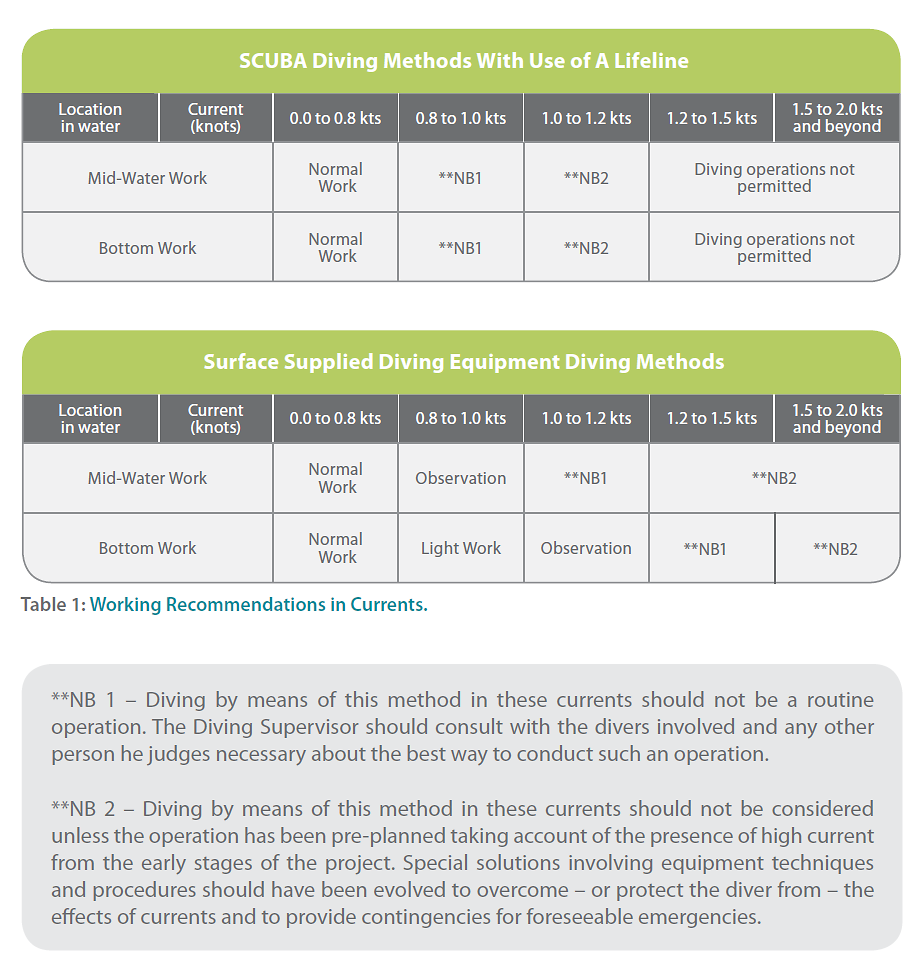
For example, the technical advisory states that diving using commercial scuba gear is still allowed in currents of up to one knot, although it should not be routine.
The advisory doesn’t prohibit diving in choppy water either, explaining that “it is a matter of judgment by the diving supervisor onsite, to decide when diving should stop due to an adverse sea state”.
A section in the technical advisory on diving in currents.
“If the company forces him to do anything outside of the standards it adopts, then of course he has a right to complain,” said the owner, who did not want to be named. “If there are companies that have less stringency or do not follow a standard, then I would say that it’s only a matter of time before the law catches up with them.”
As for the culture of punishing those who stand up for safety, the owner said responsible employers would send safety officers to the ground to ensure protocol is followed.
“I don’t have a right as a supervisor or employer to force the diver to dive if he feels it’s unsafe,” he said. “We have a stop work policy, and at any one time when he feels it is unsafe, he has right to say he does not want to dive.”
Similarly strict policies are applied to the maintenance of equipment, the owner said, adding that he hires dive technicians to keep track of servicing schedules while regularly updating them in a database.
So does he feel there are companies that still scrimp on safety?
“In any case, there would be,” he said. “But lately, MOM has been policing this and they are doing their work. So whether or not there are still companies behaving in this manner, I’m not sure. In the past, yes. Now, it is much better.”
The 46-year-old diver said while the industry is much safer now compared to a decade ago, there is still a long way to go.
“Most experienced divers dare to tell the supervisor off, but we are trying to protect the younger ones,” he said. “Because they are the ones who are putting their lives in danger.”
SINGAPORE: It is not often that a book by an academic makes the bestseller lists.
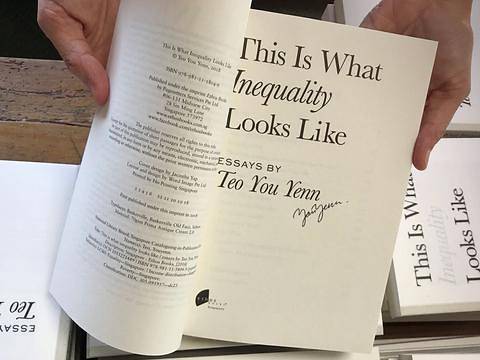
But for the past four months, sociologist, Teo You Yenn’s This Is What Inequality Looks Like has flown off the shelves of local bookstores, and was even brought up in Parliament by Nominated Member of Parliament Kuik Shiao-Yin in her speech about income inequality in Singapore.
In recent weeks, as Parliament convened to debate the President’s Address, the income gap took centre stage again, with Prime Minister Lee Hsien Loong and others raising the issue of inequality.
Mr Lee emphasised the need for society to maintain an “informal and egalitarian tone”.
Education Minister Ong Ye Kung argued for developing more pathways and opportunities in education and training, and changing mindsets about academic qualifications.
This would, to some extent, increase social mobility.
But Dr Teo feels that changes need to be bolder. During our interview, she mentions re-examining what is rewarded and what is punished in the education system and whether standardised tests like the PSLE do more harm than good.
Her work, however, goes beyond education to examine the impact of the challenges families face and, as we talk, it becomes clearer that she feels universal welfare is something worth seriously considering even though Singapore’s policies are largely geared towards self-reliance.
In fact, Mr Ong said that while the Government must and will continue to extend assistance to the disadvantaged, self-reliance is a more dignified option over “easy and unconditional” handouts.
DISCOMFORT, ANGER, SADNESS AND ADMIRATION
To understand Dr Teo’s call for bolder measures, perhaps one must get acquainted with her work which began with a “simple goal”, she says.
It was to better understand the everyday experiences of those living with low incomes.
In her book, she says she visited two HDB rental flat neighbourhoods over the course of three years. Each household had an income of S$1,500 or less.
The Associate Professor and Head of Sociology at Nanyang Technological University admits that her own high-income lifestyle was very different. Merely the act of travelling back and forth between her home and those of the people she spoke to was a powerful experience.
“The stark contrast made me extremely uncomfortable. I also felt a great deal of anger at the injustice of the disparity. I felt at various time a great deal of sadness. I felt empathy, but I also felt admiration.”
She notes in her book that regardless of their circumstances, those she spoke to cared deeply for the well-being of their children and it was common for them to, for example, skip meals so that their children could eat.
“They are giving up real things. I think that is to be admired and acknowledged.”
It was to make this group of people seen that she wrote the book in a manner quite contrary to traditional academic writing.
She inserts herself and her perspectives on the findings because she says it was “key to shifting our lenses for viewing inequality and poverty more fully”.
She also visited six other neighbourhoods a few times to get a sense of how different neighbourhoods might be.
She made 90 visits in total, spending three to four hours each time and speaking to two or three families during each visit.
An HDB rental block. (Photo: Teo You Yenn)
In all, she spoke to more than 200 people, growing comfortable in their homes while listening to their stories.
As I wrote this, I realised that listing these statistics risks reducing the people she met to impersonal, disembodied numbers.
Dr Teo herself was careful not to do this. Hers was an immersive experience. She would sit on their living-room floor and listen to how day-to-day challenges were holding them and their children back.
But she tells these stories in the book largely as a matter of fact and without embellishments.
She tells of the mother who is afraid to walk through the nearby shopping mall with her kids because she’s afraid they’ll ask her to “buy this, buy that” when she can’t possibly afford to.
She tells of the family who had to share a 2-bedroom interim rental flat with another family. The bathroom floor was “so disgusting” that the children wouldn’t enter it without slippers on. They were eventually evicted when they couldn’t pay the rent and ended up living in a rented van.
She tells of how their children are impacted as a result of such conditions and how they have problems thriving in our education system as a result.
ALL OF US HAVE A STAKE
It doesn’t take any embellishments for their stories to make one consider how, while Singapore has prospered as a nation and many of us have progressed, there are others who seem to be standing still.
Dr Teo says while she hopes policymakers read the book, she did not write the book for them.
“I wrote the book for all Singaporeans. Many Singaporeans care about the problems of poverty and inequality, have aspirations toward greater equality, and are interested in knowing more about how to think about these issues. All of us have a stake in thinking about and discussing what we want to see in our society.”
She says her work urges us to not see the poor in Singapore as merely people who have “fallen through the cracks”.
Instead, she encourages a careful consideration of how policies that have benefited others could be systemically working against this group.
“I TRY NOT TO HELP MY DAUGHTER WITH HER HOMEWORK”
Before we discuss policies, she emphasises that the choices each of us make can also have an impact.
For instance, by demanding ever higher standards for our children in school are we encouraging practices that marginalise this group further?
In her own life, she has already made some adjustments.
“I try not to help my daughter with her homework. No tuition, no enrichment classes. My husband and I try not to intervene too much, so that she doesn’t have more advantages than she already has. She’s average. I think she has plenty. She’s grown up surrounded by books. She has been read to for years and years and years. For me, there is a strong sense that if you have certain privileges, you also have responsibilities and duties.”
She quickly qualifies this.
“But I don’t, by any means, want to imply that what I do is also what others should do. I really don’t expect parents to not help their kids given our conditions. I think, in our context, it is reasonable for parents to give their kids tuition and to supervise their homework.”
However, she reveals that many middle-class parents have told her that her chapter on education was “difficult” to read.
“It forces them to think about what we are doing that perpetuates the system, that when we do what we think is best for our kids, it’s creating certain kinds of rules of the game that other kids can’t play.”
Teo You Yenn’s book, “This Is What Inequality Looks Like” has been flying off local bookstores’ shelves. (Photo: Ethos Books)
WHAT IS OUR EDUCATION SYSTEM REWARDING AND PUNISHING?
On a policy level, what is rewarded and what is punished within our education system needs looking at, she says.
She points out what Singaporeans already know and have had vociferous debates about.
“Although there is a lot of public spending on education, we also know that too much of success in schools depend on private investments from parents in education and so there needs to be significant changes within education so that the private investments are not so significant in shaping the success or failure of kids in school.”
When I point to Learning Support Programmes in schools for those who don’t have the benefit of “private investments”, she explains that while these can help, it remains challenging for the kids to catch up since the more advanced pupils continue to move forward at a fast pace.
In her book, she explains how by Primary 3, many children from low-income families are tracked and banded into lower-performing classes.
They become “well aware of where they stand vis-à-vis others”. Many become demoralised, she says.
Key to this is how the reward system is structured.
“What should be required of kids should be things that are taught in schools rather than outside of schools.
“There need to be adjustments to what is being rewarded and when it’s being rewarded because we know that in our system, being an early reader and an early writer, for example, is a huge advantage. Requiring that children, when they enter Primary One, already know how to read and write, immediately puts at a disadvantage the kids who do not have the kinds of conditions that allow them do that at that point.”
The system, she believes, works even against general developmental principles.
“Because children have such different developmental capacities, some may just not be ready to read and write. It doesn’t mean that they are incapable. Learning is partly about what people think and believe they can learn. Many of the kids I see are demoralised quickly once they enter school. These are smart kids. These are kids who have capabilities and yet they are demoralised very quickly because they are framed as ‘weak’.
When asked how to remedy this situation, she puts it simply.
“All anybody needs is time. Give it more time. We don’t have to be so quick to judge which child should be in which lane, which child should be in which kind of band. When we do that, we are losing our very precious human talent.”
EXAMS ARE DESIGNED TO “CREATE HIERARCHY”
It’s no surprise that she is a proponent of scrapping the PSLE.
“We know what exams are like and what they test. If we are very honest, we also know that the fact that we did very well in a certain exam, doesn’t mean we really learnt those things that we were able to reproduce in the exams. I would say that if you ask me now about math, physics or chemistry, or any of the other things I aced my exams in, I have to be very honest and tell you that I’m not sure I learnt that much through that process.”
She encourages experts in pedagogy to weigh in on issues such as the benefits of specialised learning and how best to teach kids so that they can develop their capacities well.
At the core of it, Dr Teo is convinced that “a huge purpose of the exams obviously is to sort and to create hierarchy”.
“It is to reward kids differently for how well they do on those exams. If we come back to merit, if we believe that it is important that we reward people for what they can do, their capabilities and the value they can therefore bring to society, then I think we shouldn’t be using these standardised exams that don’t necessarily capture those abilities and competencies.”
She is careful not to be too prescriptive in terms of offering alternatives, choosing instead to leave it to experts in the field.
She does, however, offer her experience as a university professor.
“In any given course in a university, there will be many different components of evaluation. We look at attendance, how they interact in a classroom and what they contribute to discussions in a classroom. We look at the extent to which they can collect different kinds of evidence and data to build their arguments, we look at the extent to which they are able to read things and synthesise those things in essays, we look at how they can compile different kinds of visual information into a presentation and present it in class. We try to have a range of different kinds of evaluation methods.”
A primary school student reading in the school hall. (File photo: MOE)
SUCCESS STORIES ARE THE EXCEPTION
When others say that back in the day, they too grew up with disadvantages that they managed to overcome and why can’t those in the lower-income group today do the same, she feels they are missing a huge piece of the puzzle.
“I think social context is important. I think most of the people saying that now would not expect their children to grow up like they did. We should not have double standards for our children versus other peoples’ children. Reasonable people would say, ‘Well, I grew up like that but I can also understand that today I would not expect my kids to grow up in those same circumstances’.
“But also, what kids need to thrive now is different from what kids needed to thrive even when I was in primary school in the 1980s. When I was growing up, my parents spent zero hours teaching me or helping me with homework or tuition and it was fine. I could still excel. That is the same amount of time my friends’ parents were spending on their homework – zero. That was the norm. We were playing fair with one another. If you believe that merit is important, then we were playing fair and we were playing fair to see who had more merit.”
While there are several success stories of social mobility achieved as a result of education, she claims they are exceptions.
“We do not need to close the door on any individual’s story, but we must be able to place them in the wider context of larger empirical patterns, rather than cherry-picking isolated cases of exceptions.
“In the three years when I did my research, I saw that for most low-income families, even just passing the PSLE is an achievement. Most of the kids get streamed into low tracks. A single case stands out in my mind of a child who might make it into university. These are not good odds for success, they are extremely poor ones.The doors to upward mobility through education are very much narrower for them than for kids from more affluent families.”
She doesn’t deny that today, as she looks back, she sees a period in Singapore’s history where social mobility was much more common.
MISGUIDED COMPARISONS
Growing up, she says her parents “experienced a great deal of upward social mobility”.
When she was a child, she could see “with a certain amount of money, come a lot of different choices and different opportunities that open a lot of doors”.
“I think it was an important part of my life experience growing up. I could see that I had all kinds of opportunities that my parents didn’t have and that certainly, my grandparents didn’t have. I also had certain kinds of opportunities that other members of my extended family may not have had. I think a lot of other Singaporeans experienced this.”
The question is whether that had a direct link solely to individual effort and educational policies or was it also a question of something larger.
Dr Teo points out that success today is often attributed to a person’s hard work, their ability to overcome their adverse circumstances and if they aren’t able to, it is seen as a personal failing.
It’s clear she feels otherwise.
“The huge improvement in people’s lives that we’ve seen over the last decade is partly because Singapore became so much wealthier over a very short period of time and so there was definitely an expansion in the overall wealth of the country and that expansion certainly also meant that a lot of peoples’ lives did improve. So part of the upward social mobility is not necessarily about climbing a static ladder. Part of that experience is about the fact that we grew up in those decades when Singapore experienced a wide expansion.
“That kind of radical growth in terms of development and in terms of the wealth of a country is not going to be replicated. That’s a historical anomaly. Given that we are at a different point in economic development today, that story is not going to play out for the people who are now young and who are making their way into the adult world.”
HELP IS AVAILABLE BUT CHALLENGING TO ATTAIN
A cleaner pushes his trolley in a shopping centre in Singapore. (File photo: AFP/Roslan RAHMAN)
She acknowledges the increase in social spending in Singapore but the way assistance programmes are structured often diminishes their impact and if, as a result, parents are in a state of constant insecurity, their children are naturally affected.
“A lot of how the state structures access to public goods depends heavily on their employment. The quality and quantity of services people can access is still very much dependent on that.”
In her book, she gives the example of childcare options for parents from low-income households. While others might be able to afford foreign domestic helpers and other care options, these individuals have to deal with many more limitations.
Government-linked childcare centres are heavily subsidised and affordable, but the subsidies are tied to the mother’s employment.
She calls this “a circular problem”. Without help with childcare, the women are unable to find jobs in the first place. Without stable employment, they are not able to secure a place in childcare centres.
“The underlying principle for this is that wage work is the primary form of work that should be valued and also that that’s the most important thing about being human. The problem with this is that given that people earn such unequal wages, if access to public goods is still dependent on wages, then those inequalities are not going to be reduced.”
This is borne out in many other ways when such individuals seek assistance. In her book, she explains how many of them remark that means-testing entails intrusive probing and if they can avoid it, they would, even if it means forgoing assistance.
She also points out that many of these individuals work in jobs with little stability.
They work shifts that could change often and there is often no guarantee of how many hours of work they’ll get a week. They are also seen as “easily replaceable” and their employers do not take too kindly to requests for leave to take care of their children when the need arises.
This instability, no doubt, poses challenges for parenting their children but also brings us to another critical facet of the issue.
“I see particularly through this research that there are a lot of people who work as hard as I do, who are no less than I am, but who end up with very different outcomes because their employment does not give them the wages that could help them rely on themselves.”
In past columns, she has spoken about corporations that pay some of their workers badly, and wealthier segments of the population who enjoy certain goods and services at low prices.
“We know that the benefits of the world’s wealth have become increasingly monopolised by a smaller and smaller group of corporations. Those are outcomes of specific regulations on parts of states in various different countries. Those are the outcomes of specific practices. It’s not some invisible hand of the market doing those things.”
Changing this, she feels, requires an acknowledgement on the part of states that it is something they have a measure of control over and not something that is an inevitable by-product of globalisation and capitalism.
But societal change on the part of consumers and businesses is important too and this is one of the reasons for her book – to encourage us to realise our blind spots.
IS UNIVERSAL WELFARE THE ANSWER?
Ultimately, I wonder what she thinks policymakers should be doing differently to tackle inequality as a whole.
Considering the Government’s robust narrative of self-reliance, how can initiatives be designed more effectively taking this into account?
“It’s important to pose the question differently, not in terms of, ‘Can this person afford to do this?’ We need to ask, ‘Well, what is it that every person needs?’ And as a society what do we need to do so that people can meet all these basic needs as a baseline? We can have reasonable discussions about what we can collectively agree on are basic needs.”
She is currently in the midst of research that aims to gauge what society considers “basic needs” that everyone should have regardless of their personal ability to afford them.
“Universalism in meeting fundamental needs, such as housing, healthcare and retirement security, would protect everyone in society from precarity, instead of making dignity and security dependent on private earnings and wealth.”
Arguments for universal welfare, she feels, should not be discredited outright.
“People are very reasonable in terms of thinking about what is basic for a decent standard of living. Universal welfare in this context is not a slippery slope. Empirically, I found that people value work. A lot of sociological work has shown that the value of work, the meanings people take from work go beyond the income they earn from the work. Work is a very important part of peoples’ sense of self and peoples’ sense of worth. The assumption that if you don’t make life difficult for people, they won’t work, is just not true.”
But if more were done in this regard, the rest of society too must be willing to do more.
“There needs to a serious conversation about whether taxes may be worth paying to reduce the insecurity and divisiveness that inequality inflicts on us all. This is especially given the room for more progressive taxes. The personal income tax rates for high earners, as well as wealth taxes such as estate taxes and capital gains tax are lower than in many other countries. To have this conversation across society on an informed basis, we also need the publication of more transparent and detailed information about projected revenue and expenditure.
“The countries that the world knows have done a lot better on these issues are the Scandinavian countries, Sweden, Norway, etc. I think economically, these are all places that are doing quite well. Often the argument is made that if you did a lot of these things, your economy would go bust and that’s just not empirically true.”
These countries may have a greater commitment to redistribution, but certainly a fine balance has to be struck to prevent a descent into a failed welfare state.
As we come to the end of our conversation, I ask her how she might feel if her position on issues is seen as being too idealistic and impossible to implement.
What she says next is something she feels ought to be applied to her own views too.
“Research, writing and telling stories about society are often dominated by people who are in positions of relative power. This would include politicians and intellectuals. I think it’s important that people in positions to either make decisions or tell stories, don’t tell their stories or make decisions as if their perspectives are the universal perspectives. The act of making decisions or telling stories should be one that includes the voices and perspectives of people outside that narrow class of people.”
It was why she inserted herself into her research to make it clear to readers where she is speaking from – her lenses and her blind spots – and for them to then make sense of the work and evaluate it independently.
She sees it as her “responsibility and duty” to further her research in the hopes of finding not just answers, but questions as well.
“I hope to continue to learn from people who are coming at this issue from different places, who have different perspectives and different expertise to share. Knowledge production is not a static thing. There are more things to do and more questions and more puzzles to answer.”
SINGAPORE: She was hardly at home when her daughter was young. Cindy Tan was busy working instead, trying to raise two children as a single mother after her divorce.
Her daughter’s distrust, and hatred even, was the heavy price she paid.
It was years later, when she was in her 50s, that Mdm Tan got an unexpected second chance to learn to be a mother again – the mother she’d never really been – to Valerie, who was nearly 30.
“It was like taking care of a newborn again,” she said. She had to be alert to her daughter’s safety nearly every minute. She had to help her form sentences in response to questions.
Except that the daughter she was now taking care of, had schizophrenia.
To help heal her child’s broken mind, Mdm Tan had to figure out how to mend their broken relationship. It was a daunting task that required rebuilding a fragile trust with an already-resentful daughter, whose illness made her prone to paranoia, suspicion, and withdrawal.
It left Mdm Tan at her wit’s end, at one stage. “I did plan to kill ourselves,” she confesses, painfully. “I didn’t know what to do any more. I didn’t know how to help her.”
WATCH: A mother-daughter love story (6:56)
But, just as her daughter’s own journey to recovery is today a beacon of hope for those suffering from mental illness; so Mdm Tan’s parallel road is proof that it is never too late to be the mother your child needs you to be.
CHILDHOOD: ‘SHE WASN’T THERE FOR ME’
Valerie Liu grew up feeling as if she was deprived of both a father and a mother. After her parents divorced early, her dad was no longer part of the family’s lives.
Her mother, on the other hand, was a businesswoman who promised herself that she would give her daughter and younger son a “life of luxury”.
“I just wanted their father to know that I could afford the two of them together,” said the 61-year-old.
Ms Liu in her younger days.
But chasing that goal meant that her children were brought up by their grandmother and relatives. From the time Ms Liu was nine, her mother worked abroad as a director in a company, returning only once or twice a year.
And so began a rocky mother-daughter relationship. Said Ms Liu: “She wasn’t there for me, so I felt that I wasn’t cared for nor loved.”
It reached a point where they could not even have a “normal conversation” when her mother was on one of her rare visits home.
Whenever we talked, we’d fight and scold each other. Sometimes I’d just slam my door. And if I didn’t like certain topics she talked about, I’d just leave the house.
Mdm Tan remembers one incident in particular. Her daughter was about 14 or 15 and snapped at her, saying: “When I needed you, where were you? When I don’t need you, when I’ve grown up already, why are you here?”
Their early photos together seemed happy ones, but “this is all fake”, said Ms Liu.
By then, the resentful teenager no longer trusted her. She had previously taken her mother into her confidence after experiencing a childhood trauma. Without disclosing what happened, she said simply: “How could I trust her when she didn’t believe me?”
Turning to the company of friends instead, she became a “wayward person” – in her own words – who went clubbing, drank and smoke.
FIRST SYMPTOMS: ‘I THOUGHT I WAS A DEITY’
Ms Liu thinks her “bottled-up, negative feelings” eventually caused the onset of her mental illness in 2006 when she was doing a pre-university bridging course in Perth. Her symptoms included hallucinations and delusions.
“I thought people were following me, and on the road, I kept hearing voices in my head,” she shared.
I also could hear the news talking about me. I thought I could talk to the radio. I thought I had superpowers … I thought I was a deity.
The fact is, there is no single cause for schizophrenia, said Dr Charmaine Tang, the deputy clinical chief and consultant at the Institute of Mental Health’s Department of Psychosis.
(File photo)
“Like many other illnesses, the causes are multifactorial and include both environmental and genetic factors,” she explained.
For example, illicit drug use is “a well-known environmental factor associated with the development of schizophrenia” while having a relative with the illness also increases one’s risk.
“Traumatic and stressful experiences do not cause schizophrenia, but can trigger a schizophrenic episode in a vulnerable individual who is predisposed.”
During the period that Ms Liu was experiencing these episodes, the scared girl would call her mother. But Mdm Tan thought it was just stress, as her daughter would be crying about her studies.
She only realised that “something was really not right” when her son, who was also studying in Perth, called to say that his sister was in a very bad state and should return to Singapore.
Ms Liu came back to an empty four-room flat, as her mother was working in China. And over two years, her paranoia worsened. She recalls how the voices in her head told her that “the neighbours and my mother were conspiring against me”.
One day, she lost control. Feeling that her neighbours upstairs were disturbing her, she took a knife and knocked on their doors. The police were called in, and she was brought to IMH.
She cannot remember the incident, though her mother does. When Mdm Tan received the phone call about the case, she was “shivering”, and she flew home immediately.
AWKWARD START: ‘I DIDN’T TRUST HER’
Ms Liu wasn’t straightaway diagnosed with schizophrenia, but rather with psychosis. After staying at IMH for two to three months, she was released into her mother’s care.
The slow process of recovery, and of tentatively restoring their relationship, began.
Medication was helping her daughter, but Ms Liu doubted her mother’s desire to help. “I didn’t trust her totally. So I’d see her actions. I’d monitor her … How does she talk? Is she patient? A lot of things. Is her tone sincere?” she recalled.
Both mother and daughter agreed that it was “very awkward” initially. Mdm Tan said she tried building up their relationship as if she was “trying to tackle” a potential boyfriend.
“When you want to tackle somebody, you always try to please,” she said. “You always give in … This was how I did it.”
Her daughter can now laugh at the thought. At the time, however, it did not help that her mother returned to China soon after – in Ms Liu’s mind, breaking her word.
She said that she’d stay and work in Singapore. It didn’t happen at all.
Still, four years went by and she did not suffer a relapse, until she went on a holiday to China to visit her mother. With everything seemingly fine, she’d stopped taking her medication. Consequently, the symptoms returned – worse than before.
Back in Singapore, she heard voices again and became paranoid about people peeking into her bedroom. This time, when she was treated at IMH, she was diagnosed with schizophrenia.
Sharing more about the condition, Dr Tang said: “Schizophrenia is a complex mental illness that usually has its onset in young individuals between the ages of 15 and 25.
“Worldwide, about one in 100 adults have schizophrenia, and it affects men and women equally … Contrary to common misconceptions, schizophrenia isn’t a disorder of ‘split personality’, but rather a disorder of fragmented mental processes.”
REKINDLING THE RELATIONSHIP
It was after her daughter’s relapse that Mdm Tan realised things could not go on the way they had.
“Every day, she’d tell me, ‘Mummy, help me, Please help me find my soul. I don’t know who I am. Get me my soul back.’ It was so scary,” she recalled with a hitch in her voice even now.
To Ms Liu, the first sign that her mother wanted to change was when the latter begged for forgiveness. “If not, her tears wouldn’t have flowed,” she said.
She’s a very strong woman … and I hadn’t really seen her cry before.
This time, Mdm Tan took unpaid leave from work. And while her daughter was getting treatment, she enrolled in a 12-week course for carers of patients with mental illness.
When Ms Liu returned home, her mother observed her likes and dislikes. For example, because she was worried that people might peek at her, her mother installed blinds in their flat.
Ms Liu’s biggest fear, however, was of the uncertainty about what was going wrong with her life. So she stayed cooped up at home. “I was very withdrawn … I totally blocked off everyone.”
She also could not form proper sentences to express herself. Extreme apathy and social withdrawal, poverty of speech, a severe lack of emotional reactivity and disorganised behaviour are some of the common symptoms of schizophrenia, noted Dr Tang.
Ms Liu’s mother guided her every step of the way, including once when she was just confused about how to climb the stairs of a pedestrian bridge.
“I didn’t know how to coordinate. I was very scared. My mum encouraged me to take one step at a time,” she recalled.
Mdm Tan said she slept only three hours a day during that period, ready to wake at any minute. She kept all the knives away and installed window grilles.
But even as she had to be like a new mother again, she knew could not act like a parent towards her daughter, or Ms Liu would not listen to her.
“I could only act as a friend because she’d only talk to the friend and listen to her friend,” she said. It worked.
From young, her daughter had never wanted to hug or even hold hands with her. But as trust started to grow anew, Mdm Tan tried slowly to hold her child’s hand when they went for walks.
“Little bit by little bit … until, oh my God, she didn’t let go of my hand – so, continue holding,” she said delightedly. Now they can call themselves “best friends”, her daughter added.
SEA CHANGE
Their relationship now is one of the reasons Ms Liu can call her illness a “blessing in disguise”. Another is her new lifestyle. She started exercising – “at least three times a week” – and sleeping early, before 10pm.
“I’d put all my devices outside the room, which I didn’t use to do. In the past, I’d put my handphone beside me on the bed, for people to jio (invite) me to go out, especially at night,” she said.
Her name was another change she made as part of a fresh start. She felt that the name Valerie was more auspicious.
In 2014, during her recovery process, she started work as a receptionist in a non-profit mental health organisation. She was initially reluctant because of her social anxiety. But her mother helped by accompanying her at first.
“After a few days, she said, ‘You go to work on your own. And then you text me if anything’s wrong,” Ms Liu recalled.
She pulled through, she thinks, because of the conducive environment and helpful colleagues. “They were very understanding. They knew about my condition.”
Two years later, she joined the Singapore Association for Mental Health. She is now a community education officer and also a peer support specialist, for which she is trained to help others with mental health issues.
That role in co-leading groups of people towards recovery by, for example, sharing her experiences, has become her passion. “It really motivates me,” she said. “I find that it’s very meaningful, and I learn a lot from them also.”
As a peer support specialist, Ms Liu runs and facilitates support groups for persons in recovery.
While she considers herself to be a recovered patient, she hopes she can do better, to repay her mother “for what she has done”.
“Without her, I won’t be where I am today,” said an emotional Ms Liu, who also credited her relatives. “I want to maintain my health so that, in future, I can have the strength to take care of her.”
As for any hopes of having a partner, Mdm Tan showed her protective motherly side by making sure that such questions were off the table for this story.
Looking back, she understands why her daughter was angry with her. “What she wanted was love. What she wanted was security from me, but I wasn’t there for such a long period,” she said.
Now she gets to give her daughter all that and be the mother she always wanted to be – and best friend too.
Where to find help:
Institute of Mental Health’s Helpline: 6389 2222
Samaritans of Singapore Hotline: 1800 221 4444
Singapore Association of Mental Health Helpline: 1800 283 7019
SINGAPORE: They may seem light, minimalist devices, but a hit by an e-scooter packs a wallop about nine times that of an average person’s punch – or more energy than a professional boxer’s punch.
And that’s if the e-scooter is travelling at the legal limit of 15kmh when it hits you.
This is enough force to easily send a grown man flying into the air, what more a frail senior citizen or a young child. But even so, it’s not the direct impact of the collision itself that pedestrians should be concerned about.
A man riding an electric scooter. (File photo: TODAY)
It’s what happens next that is the most dangerous, according to Associate Professor Yap Fook Fah from the School of Mechanical & Aerospace Engineering at Nanyang Technological University.
“As the body falls, the head will hit the ground at a speed of 15kmh, 20kmh or even higher – that is equal to 1.5 or two tonnes of force,” he told the programme Talking Point, after demonstrating the magnitude of the impact in a lab.
Studies show that this “could lead to very serious head injuries such as loss of consciousness, skull fracture, haemorrhage, tissue damage and so on”.
And then, he added for good measure – if the pedestrian is “really unlucky”, this is followed by the rider landing on the pedestrian, crushing him or her.
In March, a 45-year-old woman had to undergo brain surgery after she was hit by an e-scooter as she stepped off an overhead bridge. A 23-year-old man was arrested for causing a rash act.
Image of a man suspected to have ridden his e-scooter into a woman at an overhead bridge near Block 151, Bedok Reservoir Road (Images: Singapore Police Force, Google Street View)
In a recent episode, Talking Point explored the debate on whether personal mobility devices (PMDs) like e-scooters should be more stringently regulated, or even banned from footpaths altogether.
CAN’T STOP IN TIME
From January to September 2017, there were about 110 accidents involving PMDs. Of these, 30 involved pedestrians on footpaths and walkways.
The same year, the authorities decided on more stringent rules that would move e-scooters from the roads to the pavements, with speeds capped at 15kmh on footpaths and 25kmh on shared and cycling paths.
But it’s not the physics of a collision alone that makes e-scooters a potentially growing danger in Singapore: There’s the proliferation of these devices, particularly in the hands of young and inexperienced riders; and the fact that stopping in time is not as simple as some riders might think.
To illustrate, programme host Diana Ser conducted an experiment where an e-scooter rider had to brake when the host flagged her to stop. In the first run-throughs at 15kmh, it took the rider 1.65m to 3.2m to come to a complete stop.
The implication: Even at the legal speed limit, the likelihood of collision is extremely high if a pedestrian suddenly appears in front of a rider.
When the rider ratcheted her speed up to 25kmh – the legal limit on shared paths – it took her up to 7m to come to a complete stop.
The rider unable to stop in time to avoid colliding with the sign representing a pedestrian who suddenly appears.
The lag times make these devices particularly dangerous when ridden in places like void decks.
Take 65-year-old Madam Lee, who in April, was stepping out of a lift when she was hit from behind and fell. She hadn’t heard the e-scooter coming.
The rider, who also fell, picked up his device and sped off without so much as a word, she recalled.
In another incident that same month, a 24-year-old e-scooter rider was arrested after crashing into an 11-year-old girl from behind. She needed to have her jaw and gums realigned, aside from losing two teeth, said her father.
AGE, IMMATURITY PLAY A PART
Then there are those who illegally modify their rides to travel in excess of 100kmh – faster than some motorcycles.
Mr Victor Lee, general manager of e-scooter distributor Falcon PEV, said he has heard that the highest speed clocked by an e-scooter was a staggering 140kmh.
Last October, three men aged between 32 and 37 were arrested after they were caught riding their e-scooters at speeds of more than 100kmh along Nicoll Drive.
Still, Mr Lee was of the view that it is the rider, not the ride, that makes the difference.
“A very experienced rider – whether he’s riding a modified or a fully compliant e-scooter – would have the foresight and awareness to slow down to a speed that he can handle, and that is safe for the public,” he said.
WATCH: From braking, to impact (2:13)
Many accidents are caused by young riders, typically below 20 years of age, he said. “They are the ones who, due to a lack of maturity, training and experience, do get into more accidents.”
And with more e-scooter sharing services entering the market, there have been concerns over how responsible these service providers are.
Telepod, the first e-scooter hire service to launch in Singapore, said they impose no minimum age limit. Their youngest user is a primary school student.
But to use their services, riders are required to have a debit or credit card, said chief executive Ms Gan Jin Ni, and most young children would not have access to these unless they had their parents’ permission.
“We actually have some form of control because the parents would be aware, and they would decide whether they want the kid to use the service or not,” she said.
E-scooter sharing service.
REVIEW SPEED LIMITS, OR BAN E-SCOOTERS
Elsewhere in the world, the tide is turning: In San Francisco earlier this year, for example, e-scooter sharing companies were prohibited from operating.
In Singapore, the number of riders travelling in an inconsiderate and reckless manner has been rising, noted the Active Mobility Advisory Panel. Hence its proposed mandatory registration for all e-scooters, to kick in later this year.
This month, the Active Mobility Act took effect, which not only spells out the rules and codes of conduct for the safe use of PMDs, but also gives the authorities more teeth to deal with reckless PMD users.
But for all these measures, the presence of e-scooters on pavements here is still provoking debate.
For instance, in Parliament this week, Non-Constituency MP Dennis Tan called for the “unsafe” speed limit of 25kmh on shared paths such as park connectors to be lowered.
Others are calling for an outright ban on e-scooters from footpaths – given impetus by the rising number of accidents and people feeling unsafe, acknowledged Mr Andrew Cheah, acting director for the Land Transport Authority’s Active Mobility Unit.
He said the unit is keeping “a very close eye on the situation on the ground”, and hoped for a more gracious culture where all pedestrians and riders “behave responsibly and co-exist in a respectful manner”.
“But say, in the future we find that it is difficult to achieve this and more measures are needed –it is safe to say that we will not hesitate to take firmer action as well,” he added.
Watch this episode of Talking Point here. New episodes every Thursday at 9.30pm on Mediacorp Channel 5.
SINGAPORE: A total of 38 people were arrested in police raids targeting gambling and vice activities over a three-day operation from Wednesday (May 16) to Friday.
The Singapore Police Force (SPF) said the raids were at Jalan Besar, Beach Road, Bencoolen Street, Telok Blangah Rise, Jalan Minyak, Owen Road, Hong Kong Street, Topaz Road, Aliwal Street, Trengganu Street, King George’s Ave, Syed Alwi Road, Victoria Street and Bendemeer Road.
Officers arrested 19 men and 19 women between the ages of 21 and 80 for vice, gambling and immigration-related offences.
Among them were 11 women believed to have been providing paid sexual services at hotels and rented apartments while in Singapore on employment passes and short-term visit passes. They were arrested for offences under the Women’s Charter.
Fifteen men and seven women were arrested for remote gambling-related offences along King George’s Ave, Telok Blangah Rise, Jalan Minyak, Beach Road and Bendemeer, the police said, adding that S$2,400 was seized from them.
The remaining four men were arrested for immigration-related offences while a woman was arrested for using criminal force against a public servant, they added.
Journalists were invited to join police officers for a gambling raid at King George’s Avenue and later a vice operation at Syed Alwi Road on Friday, the last day of the operation.
(Photo: Gaya Chandramohan)
(Photo: Gaya Chandramohan)
After plainclothes police officers descended on a coffee shop along King George’s Avenue at around 7.30pm, Channel NewsAsia arrived at the scene and noticed several men had been taken aside for suspected illegal horse-betting.
(Photo: Gaya Chandramohan)
(Photo: Gaya Chandramohan)
(Photo: Gaya Chandramohan)
Officers found some of the men – including an 80-year-old – possessed betting slips. While some sat quietly, others protested loudly and argued with officers.
(Photo: Gaya Chandramohan)
38 people were arrested in police raids targeting gambling and vice activities in a three-day operation. (Photo: Gaya Chandramohan)
After an hour, the suspects were handcuffed and led away in a police vehicle.
(Photo: Gaya Chandramohan)
(Photo: Gaya Chandramohan)
Later at 10.30pm, Channel NewsAsia accompanied officers to Syed Alwi Road for a vice operation. In the thick of the crowd, we spotted plainclothes officers questioning two Indian national women who had been soliciting at nearby coffee shops.
(Photo: Gaya Chandramohan)
(Photo: Gaya Chandramohan)
Moments later, another two women were arrested further down the road at another coffee shop for offences under the Women’s Charter.
All four women are believed to be part of a syndicate and suspected of providing sexual services from hotels and rental apartments while in Singapore on employment passes and short-term visit passes.
(Photo: Gaya Chandramohan)
(Photo: Gaya Chandramohan)
In a statement, the police said they would “spare no effort” to clamp down on vice and criminal activities.
“Those found engaging in illicit activities will be dealt with sternly in accordance with the law,” the statement said.
Landlords and hotel owners are to ensure that tenants do not carry out vice activities in their premises, the police said.
Under the Women’s Charter, unlicensed brothel operators can be punished with a fine of up to S$10,000 and up to five years’ imprisonment. Any person who knowingly lives wholly or in part on the earnings of the prostitution of another person can also be jailed up to five years and fined up to S$10,000.
Any person found guilty of gaming in any public can also be fined up to S$5,000 and jailed up to six months.
Investigations against all suspects are ongoing, the police said.
SINGAPORE: Several stranded commuters, including those with young children, had to walk on the train tracks on Saturday (May 19) after a train fault on the Bukit Panjang Light Rail Transit (BPLRT) brought services to a halt.
Train service was disrupted for nearly two hours.
In a tweet at around 2.20pm, SMRT said there was no train service on the BPLRT due to a “train fault” between Phoenix and Bukit Panjang station.
In a subsequent tweet at around 2.50pm, SMRT said that Train Service A had resumed and that its engineers were working to recover Train Service B.
At around 3.50pm, SMRT said the train fault was cleared and that Train Service B was “gradually being restored”.
[BPLRT] Due to a train fault between BP5 Phoenix and BP6 Bukit Panjang, there is no train service on BPLRT. Free bus services are available. We are sorry.
In photos submitted by a Channel NewsAsia reader, passengers can be seen walking on the train tracks. A woman can also be seen carrying her young child as she made her way to the nearest station.
A passenger who was on the affected train told Channel NewsAsia that the LRT was “stuck” between Phoenix and Bukit Panjang station for about 20 minutes before an engineer came to their rescue.
A photo submitted by a Channel NewsAsia reader shows passengers waiting inside the train cabin on the BPLRT.
After 10 minutes of “troubleshooting”, the passenger said the engineer allowed them to walk along the track to Bukit Panjang station. The passenger also noted that the train cabin was “very hot” as there was no air conditioning during that period.
In March, the Land Transport Authority (LTA) said the upcoming replacement of LRT vehicles and renewal of signalling systems on the BLPRT will improve passenger service.