SINGAPORE: Three types of speed-tracking devices for heavy vehicles are currently on trial until August, the Traffic Police (TP) announced on Tuesday (May 22) at the sixth edition of the Singapore Road Safety Month.
The event, which was focused on educating heavy vehicle drivers and motorcyclists, was kicked off by Senior Parliamentary Secretary for Home Affairs and Health Amrin Amin at Republic Polytechnic.
Speed limiters are currently mandated for certain heavy vehicles to curb speeding, but can be easily tampered with, TP said. The current trial aims to find a technology to complement or replace the speed limiters in heavy vehicles to effectively curb speeding.
The three speed-tracking devices being trialed are the Digital Tachograph, the Enhanced Speed Limiter and the Fleet Management System. The devices are equipped with an audio buzzer, which will be activated when the heavy vehicle driver exceeds the speed limit. The devices are being tested on 30 vehicles.
Digital Tachograph. (Photo: Elizabeth Neo)
The Digital Tachograph will be able to automatically track and record the vehicle’s travelling speeds throughout the journey. Information recorded can be used for enforcement efforts for speeding.
The Enhanced Speed Limiter and the Fleet Management System will employ GPS to calculate the travelling speed of the vehicle to prevent tampering of the speed limiter. It can also track the travelling speed of the vehicle throughout the journey.
Speaking to Channel NewsAsia, chairman of the Singapore Road Safety Council Bernard Tay said he hopes better driving behaviour will come out of the initiative: “Hopefully this will reduce accidents and be safer for all road users.”
He added the focus this year is on commercial vehicle drivers, because they spend a lot of time on the road. “Heavy vehicles are bulky, there are a lot of blind spots and whenever there are accidents it can be fatal for victims. Motorcyclists can also be more vulnerable as they are not well protected.”
The Traffic Police has partnered vehicle tracking firm Cartrack Technologies South East Asia for the trial, with three companies – Goldbell Group, Ley Choon Group and Koh Kock Leong Enterprise – on board.
The Traffic Police will study the accuracy and compatibility of these devices and with the heavy vehicles as well as their ability to resist tampering, after which it will consider implementation on heavy vehicles.
In his speech, Mr Amrin said the launch of the speed-tracking devices installed on heavy vehicles “will enable companies to monitor the speed records of their drivers and take timely remedial action against those who speed”.
He noted commercial heavy vehicle drivers spend much of their time on the road and are more likely to be involved in accidents.
“Although the number of accidents involving heavy vehicles decreased by 13 per cent from 2016 to 2017, such accidents are more likely to result in fatalities. In 2017, three in 10 fatal accidents involved a heavy vehicle,” he said.
Motorcyclists are also not spared, Mr Amrin said: “While the number of fatal accidents involving motorcyclists decreased by 30 per cent in the same year, accidents involving motorcyclists made up more than half of all traffic accidents. Four in 10 fatal accidents involved a motorcycle.”
At the event, the Traffic Police also unveiled two new educational videos to remind motorists to observe safe driving practices and stay vigilant on the road.
Chia Kok Long was sitting at a void deck when he overheard a teenager shout a secret society slogan. He approached the group, slapped the teen twice and made them hand over the money in their wallets.
(Updated: )
Bookmark
SINGAPORE: When Chia Kok Long overheard a teenager shout a secret society slogan as the teen and his friends walked past a void deck, he approached the group, slapped the boy twice and demanded that they give him money.
For his actions, Chia, 32, was sentenced on Tuesday (May 22) to two years and three months’ imprisonment, with one stroke of the cane.
Chia pleaded guilty to one charge of voluntarily causing hurt and another charge for extortion. Four other charges were taken into consideration for sentencing.
Court documents showed that on Oct 13, 2017, the five teenagers, who were all secondary school students, were walking past Chia, who was sitting at a void deck in Hougang. As they passed him, one teen suddenly began chanting a secret society slogan in Hokkien.
Chia then shouted at them and approached them, uttering Hokkien vulgarities, and asked them if they “play gang”. The teens denied doing so even after repeated questioning.
When one teen admitted to chanting the slogan, Chia gave him a hard slap on his cheek. He then threatened to call the Secret Societies Branch (SSB) of the police.
He then demanded that the teens take out their wallets and hand over their money, otherwise he would call the police. They complied, and he received a total of S$104 from them.
He then told them that they could fight him and if they won, they could have their money back. When the teen who had chanted the slogan apologised, Chia slapped him again, but decided to return some of the cash taken to the victims.
He returned a total of S$30. After a further exchange, he left the scene.
The incident was witnessed by a passer-by who advised the teens to make a police report. Chia was arrested the same evening.
For voluntarily causing hurt, Chia could have been jailed for up to two years, with a fine of up to S$5,000. For extortion, he could have been jailed up to seven years, with caning.
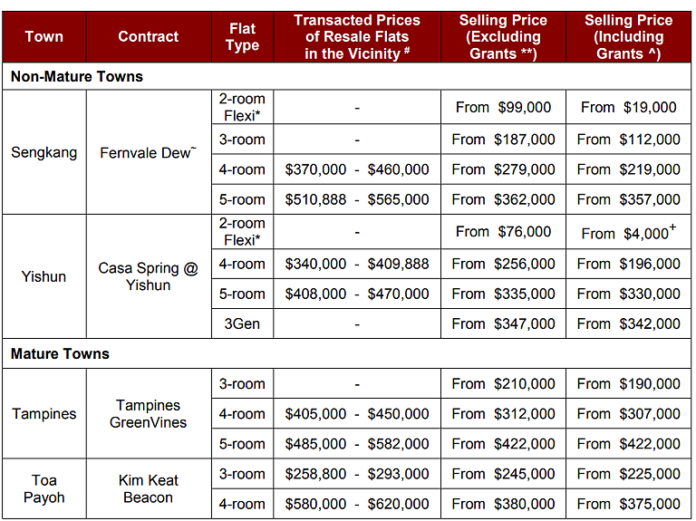
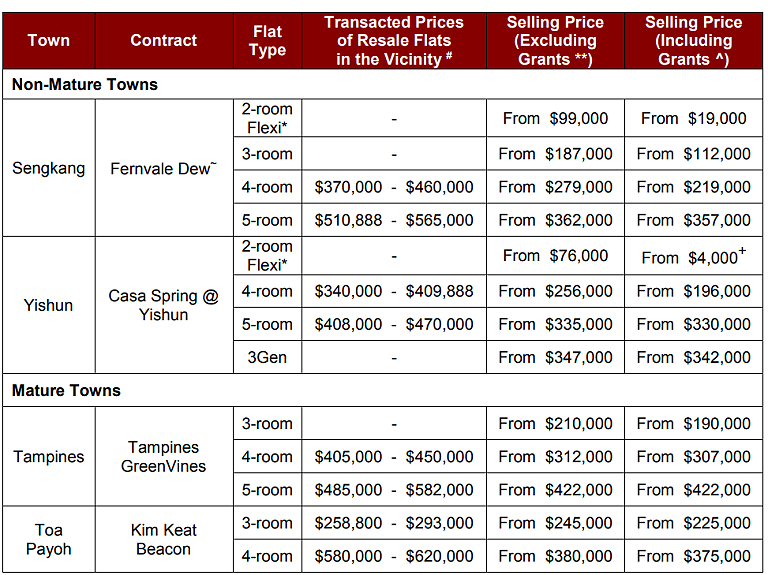
SINGAPORE: The Housing and Development Board (HDB) has launched 6,992 flats for sale under the May 2018 Build-To-Order (BTO) and Sale of Balance Flats (SBF) exercise, it said in a press release on Tuesday (May 22).
Of the total, 3,970 are BTO units and 3,022 are SBF units across various towns and estates, HDB added.
BTO EXERCISE
The BTO flats are spread across four projects – two of which are in the non-mature towns of Sengkang and Yishun and another two in the mature towns of Toa Payoh and Tampines.
Eligible first-timer families can enjoy up to S$80,000 of housing grants, comprising the Additional CPF Housing Grant (AHG) (up to S$40,000) and the Special CPF Housing Grant (SHG) (up to S$40,000).
“With these grants, buyers of 2-room Flexi, 3-room, 4-room and 5-room flats could pay as little as S$4,000, S$112,000, S$196,000 and S$330,000 respectively,” HDB said.
SBF EXERCISE
In addition to the BTO flats, HDB will also offer 3,022 balance flats under the SBF exercise.
“They comprise 754 units of 2-room Flexi, 655 units of 3-room, 1,143 units of 4-room, 305 units of 5-room, 157 units of 3Gen and 8 units of executive flats across various towns/estates,” HDB said.
The majority of the flats offered under the SBF exercise are reserved for first-timer families. Eligible first-timer singles may also apply for a 2-room flexi flat in non-mature towns.
Application for new flats launched in the May 2018 BTO and SBF exercises can be submitted online on the HDB InfoWEB from May 22 until May 28, HDB said.
HDB said it will offer about 4,300 flats in Punggol and Yishun in August 2018.
Artist’s impression of Casa Spring Yishun. (Image: HDB)
Artist’s impression of Tampines Greenvines. (Image: HDB)
SINGAPORE: These days, Ms Charissa Kow, 25, who frequently takes a Grab ride from her house in Woodlands to her workplace in Alexandra Road, finds herself spending S$20 to S$25 for the 16km trip — or up to one fifth more than what she used to spend less than two weeks ago
“I used to toggle between the Uber and Grab app in the past, usually one would have a promo code and as a result I would save around S$3 to S$5 every trip.”
Another commuter, Mr Bok Chek Yang, laments that fares for short trips on Grab have also increased since early this year. “A 10-minute ride within my estate in Bedok has gone up to S$8 … but for the same trip, it was only S$6 last year,” said the 38-year-old administrative coordinator.
Private-hire car drivers are feeling the pinch too. Mr Muhammad Syahmi, 25, used to rake in between S$100 and S$200 a day as a private-hire car driver for Grab after deducting commission, petrol costs and rent, but his income has fallen by as much as 50 per cent — largely due to a reduction in incentives doled out by the ride-hailing firm.
Recalling how he used to be able to take home a bonus of S$620 for completing 60 peak-hour trips, he said:
That was the incentive for a good six, seven months last year but recently, completing the same amount of peak-hour trips would only give me an additional S$130.
With his earnings taking a hit, being a full-time Grab driver is no longer an attractive proposition. He intends to stop driving soon and get another job.
For five years, long-suffering commuters and taxi drivers in Singapore could hardly believe their luck as the taxi industry was turned on its head by ride-hailing firms.
Commuters enjoyed low fares — sometimes rides were even free, thanks to generous promotions and discounts — and complaints of not being able to get a ride during rainy days or peak hours became a distant memory.
Droves of taxi drivers, as well as others, also flocked to Grab or Uber which offered flexible hours and attractive earnings as they duked it out and hired drivers aggressively in a bid to gain market share quickly.
A man walks past a Grab office in Singapore March 26, 2018. REUTERS/Edgar Su
On Mar 26, after months of speculation, Grab announced its acquisition of Uber’s Southeast Asia operations, including in Singapore.
FEELING HARD DONE BY
The deal is under review by the Competition and Consumer Commission of Singapore (CCCS), and as part of interim measures, the Uber app was kept in operation until May 7. Now, less than two weeks after Uber officially exited the Singapore market, commuters and drivers are feeling the impact.
Make no mistake about it, the situation is still a far cry from circa 2013, when Grab and Uber made their first forays into Singapore.
“There is no doubt that consumers are better off today. The market has expanded tremendously, rides are more available, passengers don’t have to stand by the road, with the uncertainty of not getting a vehicle,” said transport economist Walter Theseira from the Singapore University of Social Sciences (SUSS).
However, the demise of competition — at least for the time being — and Grab’s subsequent moves in light of its new-found dominance have left many feeling hard done by.
“I used to be able to drive whenever I want. I just had to clock the number of trips, but now I have no choice. I have to work during peak hours if I want to get the incentives,” said a Grab driver who gave his name as Mr Sofian.
According to him, Grab has stopped giving out incentives to drivers for completing a certain number of trips while still rewarding them for completing jobs during peak hours.
COMMUTER WOES
Several commuters interviewed said they were forking out about S$3 to S$5 more for each Grab ride these days, mainly because the firm no longer dishes out discounts and promotional codes like it used to.
However, Grab has maintained that its fare structure “remains the same” after it bought out Uber’s regional operations.
In reply to queries about the commuters’ experience with higher fares, a Grab spokesperson would only say that fares are determined by demand and supply.
The spokesperson said: “Dynamic fares continue to be calculated based on a base distance, with a dynamic surcharge that will be applied based on factors including demand and supply in that particular point in time, traffic conditions and estimated time taken for the journey.”
Singapore-based Grab is taking over the ride-sharing and food delivery operations of Uber in Southeast Asia. (Photo: AFP/ROSLAN RAHMAN)
Speaking on the last day of Uber’s operations in Singapore, Grab Singapore country head Lim Kell Jay confirmed that the promotional codes and incentives which Grab users previously enjoyed have made way for perks on its loyalty programme GrabRewards.
These promotions had been “trending down” even before its acquisition of Uber’s Southeast Asia operations, Mr Lim had said.
Previously, commuters were offered limited discounts of about S$3 or more per ride by using promotional codes when making bookings. Now, they can redeem perks such as shopping gift cards and frequent flyer miles.
Meanwhile, incentives for private-hire drivers have also been scaled back, as Grab looks at other ways to lower drivers’ operating cost and maintain or increase their income. For example, the firm is working with fuel companies and fleet partners to offer cheaper petrol and rent. It is also looking at giving drivers “more jobs within the same period of time” to allow them to earn more, Mr Lim had said.
Experts noted Grab is scaling back incentives and discounts in order to recoup its losses from the days of fierce competition for market share.
“Grab will continue experimenting and testing (the) limits, while the market is still rationalising,” said Associate Professor Lawrence Loh of the National University of Singapore Business School.
DRIVERS FEELING THE BRUNT
Between commuters and private-hire drivers, it appears that the latter group is feeling the brunt of the firm’s business manoeuvres.
Drivers reported not only has the quantum of incentives gone down, the variety has also been cut.
Grab does not publish a full list of its incentive policies. Incentive details “are updated on a weekly basis” and can be found on the driver’s app, it said.
Anecdotally, several drivers said they have noticed the extent of the reduction and the type of incentives offered seemed to differ between individual drivers. There should be greater transparency, they said.
Previously, Mr Sofian said he used to be eligible for two types of drivers’ incentives: A weekly total incentive, which is a lump sum for completing a certain number of trips, and a peak-hour incentive, which gives him an additional bonus only if he completes trips during peak hours.
However, since the beginning of May, he was only offered the peak-hour incentive. It has not only resulted in his earnings falling by 30 per cent, but also meant that he could no longer enjoy flexible hours if he wanted to make ends meet.
“It’s just not worth it, I am getting much less for the same number of hours put in,” he said. Having driven for Grab for more than two years, he said he might stop driving if his income continues to fall.
Grab app advertisement at a train station in Singapore on Feb 10, 2016. (File photo: REUTERS/Edgar Su)
Another Grab driver, Ms Rennu Mahajan, 57, said the firm had replaced her weekly incentive with a monthly one since the second week of this month.
Going forward, experts said drivers may have to contend with further tweaking of the incentives, as Grab experiments and tries to determine what is most cost-effective or how to better meet commuter demand.
In other words, this would see Grab tweaking incentive schemes as it deems fit, and translate into the firm having greater control of its drivers.
Said Dr Theseira: “It is in Grab’s interest to maximise a vehicle, because they earn off a driver’s commission. So, if they observe that a driver is not utilising his vehicle during the peak hours, it might want to increase their availability rate during high-demand hours by changing their incentive scheme.” He added:
This is different from a cab company in that it doesn’t really care when and how long you drive, so as long as you are able to afford rent.
CHANCE FOR TAXI FIRMS TO ‘GET BACK INTO THE GAME’
Notwithstanding the CCCS’ concerns over Grab’s monopolistic powers in the private-hire car industry, experts believe the traditional taxi companies — which have been floundering since their business was massively disrupted — have a window of opportunity to get back into the game.
Last month, traditional taxi operators were reporting a jump in the number of Uber drivers seeking to join or return to them. Subsequently, ComfortDelGro — the only taxi operator which has not partnered Grab — announced on May 7 that it is adding 200 new hybrid Hyundai Ioniqs to its taxi fleet. This would be the first addition to its fleet in almost 1.5 years, the company said.
Just days later, the company placed a tender notice in the Straits Times for 500 more hybrid sedans.
File photo of a Comfort DelGro taxi. (Photo: Calvin Oh)
Meanwhile, analysts believe the worst might be over for ComfortDelGro, with the taxi industry “turning the corner”, as Maybank Kim Eng put it in its latest research report on the firm.
Maybank Kim Eng analyst John Cheong said: “(ComfortDelGro’s) management has turned more positive on the taxi segment as it’s starting to see increased demand from drivers who switched from private-hire cars, as they find taxis relatively more stable.”
If Grab is concerned about recovering its expenses, then it is “good news for the taxi industry”, said SUSS urban transport expert Park Byung Joon.
“The days when ride-hailing companies were bleeding through their noses are over, now the playing field for drivers is level,” said Dr Park, noting that the incomes of private-hire car drivers were previously inflated due to the incentives dangled by ride-hailing firms.
A STATE OF EQUILIBRIUM?
Mr David Kwan, 51, is among the private-hire car drivers who have regretted making the switch from a traditional taxi operator.
Mr Kwan, who joined Grab earlier this month, said he used to take home about S$60 a day as a private-hire car driver for Uber. However, his income has fallen by as much as 30 per cent since Uber’s operations in Singapore officially ceased.
“At this rate, there is no harm going back to driving a taxi,” said Mr Kwan, who intends to go back to his old trade once his vehicle rental contract expires in July.
A view of Uber and Grab offices in Singapore on Mar 26, 2018. (File photo: REUTERS/Edgar Su)
Reflecting a drop in commuter demand, Mr Kwan said bookings have dropped. Last week, for example, he had to wait “half an hour for one booking”. Now, he takes home between S$40 and S$45 a day.
Mr Kwan said he used to make as much as about S$2,500 a month as a private-hire car driver, but he was unsure if his earnings as a taxi driver would “still be as high” when he rejoins a taxi operator.
Still, driving a cab could mean a more stable income, he said. “Plus, driving a taxi, sometimes you can get company bookings, I can also go to the airport and hotels to queue for passengers,” he added.
Assoc Prof Loh cautioned that if the trend of disgruntled drivers leaving were to continue, Grab’s business would be hit:
They have to play their cards right, no monopoly is permanent. If they lose their drivers, they lose their business.
As things stand, commuters are still better off today, compared to the days when only traditional taxi operators were around, the experts reiterated. The underlying pricing system adopted by ride-hailing companies such as Grab also makes more economic sense, they added.
“Surge pricing generates value, because those people who really want a vehicle badly are more or less guaranteed a vehicle if they are willing to pay the price for it. In the past, it was a matter of luck — whether your call or booking is picked up by a cab driver,” said Dr Theseira.
At the same time, the traditional taxi operators continue to provide an additional option for commuters. “Sometimes when the surge prices are too high, I’ll just call a cab,” said Ms Cherie Loh, 25, a business efficiency associate.
She noted that commuters like herself also use the taxis’ metered fare as a benchmark. “If the Grab price far exceeds the usual cab amount, I’ll forgo the Grab ride. At the end of the day I’m still glad I have the option (of a) cab,” she added.
Singapore-based Grab offers private car, taxi, motorbike and carpooling services in seven countries and 65 cities across south-east Asia, a region of 650 million people (Photo: AFP/ROSLAN RAHMAN)
As for whether drivers would be better off working for traditional taxi operators or ride-hailing companies in the foreseeable future, Dr Theseira said it is hard to tell. It depends on a wide range of factors such as the hours spent on the road, the amount of flexibility that a driver wants, and various components of their earnings.
“Sometimes, even the model of vehicle that a driver chooses to rent could significantly affect his earnings,” Dr Theseira noted.
WITHOUT FINANCIAL MIGHT, NEW ENTRANTS ‘CAN’T CHALLENGE GRAB’
Despite the slew of new entrants into the private-hire car industry since the Grab-Uber deal, the experts believe none of them so far has the financial muscle to take on Grab — leaving Indonesia’s Go-Jek, which is rumoured to be contemplating entering the Singapore market, as the only real contender.
Ms Corrine Png, chief executive officer of Asian transport equity research firm Crucial Perspective, said the new players such as Ryde, Jugnoo and even blockchain application MVL, will not pose a significant challenge to Grab.
Furthermore, Grab has enough capital to dangle lucrative incentives again, should it see the need to do so to stave off potential rivals.
“Grab would have anticipated new players after the Grab-Uber (deal) and is probably not too concerned, seeing as it’s already well-established in Singapore and has a US$2.5 billion (S$3.36 billion) war chest,” said Ms Png.
Dr Theseira reiterated that the odds were stacked against the new entrants “because they don’t appear to have the capital to reach critical mass and provide that high-quality experience”. He added:
Commuters and drivers are likely to try new apps a few times, and to return to Grab, or taxis if the new entrants can’t provide a consistent and high-quality experience.
Sriram Rengamannar, a 16-year-old student, is among the commuters who have tried the RydeX app. He noted that while its fares are generally higher than Grab’s, the discounts offered by RydeX offset the difference.
A trip from his home in central Singapore to his school in the Alexandra area would cost him about S$7 on Grab, but would be priced at S$12 on RydeX.
“For now, I would take Ryde as they offer between 30 and 50 per cent cash back,” said Sriram, although he noted that RydeX only takes advance bookings.
Commuters will be able to see their fixed RydeX fare upfront when they make their booking. (Photo: Ryde)
THE ROAD AHEAD
As the CCCS continues to ponder over the deal, it seems that Grab is likely to remain the biggest player in the ride-hailing market in the near term.
“In fact, Grab is probably hoping that the presence of these new entrants will convince the CCCS to stop its investigation,” Ms Png said.
The CCCS has not indicated a timeline for its decision on the Grab-Uber deal.
Assoc Prof Loh felt it was unlikely that the competition watchdog would introduce another set of interim measures, and might wait for the market to rationalise on its own.
“If Grab continues its monopolistic ways and continues to increase prices, consumers can simply choose to go for alternatives and that will pressure Grab to keep their prices affordable,” said Assoc Prof Loh.
With the Land Transport Authority (LTA) reviewing its regulatory regime for the taxi and private-hire car industries, Dr Theseira noted that the need for the CCCS to step in may be overtaken by events.
“If LTA develops a set of regulations that also account for competition concerns, it will supersede the need for the CCCS to make specific rules on regulating competition in ride hailing. There may also be no need to provide a ruling if there is an entry from a credible, well-financed player, such as Go-Jek,” he said.
SINGAPORE: A one-year nationwide common parcel locker system will be piloted in Bukit Panjang and Punggol in October, in a move that will allow residents at these two estates to pick up their packages from multiple collection points around-the-clock.
The lockers will be located within 250m of HDB residential blocks, the Info-communications Media Development Authority (IMDA) announced on Monday (May 21).
Bukit Panjang will have 23 locker sites, which will be run by logistics provider Blu Logistics. Punggol will have 39 locker sites, run by Singapore Post .
The locker stations will also be available at eight MRT stations: Bukit Panjang, Chinese Garden, Lakeside, Boon Lay, Punggol, Sengkang, Buangkok and Hougang.
“In terms of educating the consumer, we intend to provide flyers, promotional, educational materials to the consumer, to the HDB resident,” said Mr Freddy Chang, Head of SP Parcels, a subsidiary of Singapore Post.
He added that the parcel lockers will also feature stickers that will guide the consumer.
The locker stations will be available around-the-clock, and customers will require certain information, such as a Collection PIN sent via SMS, in order to access their parcels.
The common parcel locker system also provides greater efficiency and cost savings for retailers and logistics service providers, who will only need to deliver to a single locker station instead of individual homes.
The lockers will be located in Bukit Panjang and Punggol as well as eight MRT stations. (Photos: Kamini Devadass)
The Federated Lockers and Collection Points will be overseen by IMDA.
First announced by Deputy Prime Minister Tharman Shanmugaratnam in April 2016, the common delivery network is an initiative to accelerate transformation for the logistics industry.
It aims to complement the rapid growth in Singapore’s e-commerce market, which is estimated to be worth S$7.5 billion in 2027.
Fifteen major logistics industry players, online merchants and marketplaces have signed a Memorandum of Intent with IMDA to use the common parcel system. These include NTUC Fairprice, Ninja Logistics and Lazada Express (Singapore).
SINGAPORE: The Immigration and Checkpoints Authority (ICA) has seized 6,000 cartons of duty-unpaid cigarettes that were concealed among printer parts and roller scanners.
The total duty and Goods and Services Tax (GST) evaded amounted to about S$550,000, said the authority in a press release on Monday (May 21).
On Friday afternoon, officers at Tuas Checkpoint directed a Malaysian-registered prime mover for checks when anomalies were detected in the scanned image of its contents.
The Malaysia-registered prime mover used to smuggle in the duty-unpaid cigarettes. (Photo: ICA)
The cigarettes were subsequently found among a consignment of printer parts and roller scanners, said ICA.
The 50-year-old male Malaysian driver is under investigation and the prime mover has been handed to Singapore Customs, it added.
“The ICA will continue to conduct security checks on passengers and vehicles at the checkpoints to prevent attempts to smuggle undesirable persons, drugs, weapons, explosives and other contraband,” it said.
TRUMP’S America remains the most powerful country in the Asia Pacific, but the balance of power is rapidly shifting “eastward” with the rise of China, according to Sydney-based think tank the Lowy Institute’s new Asia Power Index released earlier this month.
With an overall score of 85, the United States was recognised as the most powerful actor in the vast region – one that is home to at least 60 percent of the world’s population. With its phenomenal economic rise in recent decades, China came in second with a score of 75.5.
The index ranked 25 countries in terms of eight key measures including economic resources, military capability, diplomatic and cultural influence, and defence networks.
“Wealth and power are moving eastwards, towards Asia,” said Dr Michael Fullilove, Executive Director of the Lowy Institute. “The Asia Power Index is a crucial new tool for all countries to understand where they stand, where they are weak, and how they can strengthen their position.”
“Asia’s economic transformation is reshaping the global distribution of power, with profound implications for war and peace in the twenty-first century,” he said.
Despite the image of the US being tarnished under the administration of President Donald Trump, it retains significant soft power and was ranked first for “cultural influence” – its regional reputation and influence via popular culture, media and education. It is the most popular university destination among Index countries, with 583,154 Asian international students in the US in 2015.
US hard power also remains considerable. It boasts defence alliances with seven other countries on the Index – more than any other country in the region. The Lowy Institute noted that 64.3 percent of world currency reserves and 40.5 percent of all international transactions are still in US dollars.
Soldiers of the Chinese People’s Liberation Army (PLA) take part in a combat training in the Gobi desert in Jiuquan, Gansu province, China May 18. Source: Reuters
Nevertheless, when it came to diplomatic influence and economic relationships in the Asia Pacific, China was ranked first. The Lowy Institute also had it in first place for the “future trends” category, projecting China will have the largest gross domestic product, be the second biggest spender on military resources and have the second largest working age population by 2030.
Foreign assistance commitments to other nations across the Asia Pacific were estimated at US$16.7 billion in 2014.
Militarily, however, China still lags behind the US. China has just five aircraft carriers and principal amphibious ships compared with the United States’ 50 and in terms of defence networks, it was ranked eighth.
Japan was ranked third with a considerably lower score of 42.1, followed by India (42.5), Russia (33.3) and Australia (32.5). In seventh place was South Korea (30.7) then Singapore (27.9), Malaysia (20.6) and Indonesia (20.0).
Aaron Connelly, a Research Fellow at the Lowy Institute tweeted that the Index was the culmination of two years’ work. “Some will focus on the aggregate rankings, but the real value here is in the massive amount of data accumulated and vetted,” he said.
The Lowy Institute hopes the Index will have the affect of “sharpening” policy debate on power in the region.
SINGAPORE: After staying up all night with his friends, Galistan Aidan Glyn drove his car from Seletar to Stevens Road to drop his friends off, before heading back to his parents’ home in Jurong West.
While en route to his parents’ home, the 28-year-old Singaporean lost control of his car and hit a pedestrian. The pedestrian, Ms Serene Ng, 41, was taken to the hospital in a critical condition and died of her injuries that same day.
On Monday (May 21), Glyn was sentenced to three months’ imprisonment and disqualified for driving for five years. He was convicted of causing death by a negligent act earlier this month.
According to court documents, Glyn had been driving along Jurong West St 42 the morning of Aug 25, 2017, when he abruptly lost control of his car, mounted the kerb and hit Ms Ng, who had just crossed the road.
Investigations revealed that the night before the accident, Glyn had gone out with friends and stayed up all night, before going to a coffee shop near his friend’s house in Seletar for breakfast at about 6.45am.
After breakfast, he drove his friends back to their houses at Seletar and Stevens Road, before driving back to his parents’ home.
Deputy Public Prosecutor Senthilkumaran Sabapathy stressed that Glyn had driven for a “considerable distance and time” while sleep deprived, and had thereby endangered the lives of other road users, including his friends to whom he had given a lift.
He also described the incident as “not an ordinary case of negligence on the road”, noting that Ms Ng had already finished crossing the road, and had been on the kerb when the accident occurred. “This was an entirely preventable tragedy, and the needless loss of a life,” he said.
Glyn, who had asked to address the court, apologised for his actions.
But Ms Ng’s older brother, Ng Chin Khoon, felt that the sentence Glyn received was too light. Speaking to reporters outside the courtroom, he said that Glyn should have been disqualified from driving for life.
Ms Serene Ng was killed in a traffic accident on Aug 25, 2017. (Photo courtesy of Ng Chin Khoon)
Describing his sister as “friendly and helpful”, he said that Ms Ng, who was a civil servant, had taken leave from work the day of the accident to do social work.
“I still cannot accept (this),” he said. “She was a careful person.”
SINGAPORE: A new Home Team Simulation Centre that trains commanders in incident management and operational decision-making was launched by Home Affairs and Law Minister K Shanmugam on Monday (May 21).
The centre houses a system that simulates emergency and crisis scenarios in a mock command centre through 3D representations of real scenarios.
“The simulation will get the officers in-sync, and give them a hands-on feel as well as a relevance of command skills,” said Mr Shanmugam at the Home Team Academy (HTA) workplan seminar.
“We will aim to strengthen the Home Team integration based on common values and a shared mission, and the academy has a key role in that,” he added.
He first talked about the simulator at last year’s HTA workplan seminar, when it was being conceptualised.
Benefits of the simulator include manpower savings and increased training frequency, as it can mirror logistically intensive large-scale training exercises that come with deployment constraints.
The simulator can create 15 different scenarios while introducing new elements to make exercises realistic and unpredictable. These include variables like bombs and protestors, aimed at placing commanders under stress.
The scenarios also evolve based on commanders’ decisions.
One scenario is a chemical agent attack during year-end celebrations at Orchard Road, complete with bombs and protestors.
“New scenarios can be added to prepare Home Team commanders for new and evolving emergencies and security threats,” the Home Team said.
The simulator currently focuses on four locations: Bishan, Little India, Marina Bay Sands and Orchard Road, with future plans to include other areas.
MOBILE APPLICATION
Staying with the theme of integration and consistency in training, Mr Shanmugam said HTA will roll out a mobile application that lets officers access e-learning courseware on the go.
The content in the app is customised for sharing across the HTDs, which ensures greater consistency of learning.
“Currently, Home Team officers access e-learning through the Home Team Learning Management System (HTLMS) using their office desktops,” Home Team said.
“As most frontline officers are often required to perform operational duties away from their desks, officers found it challenging to find time to access the HTLMS.”
Officers can use the app for greater accessibility and to learn at a more comfortable pace. The app caters to different learning needs by incorporating images, videos, podcasts and quizzes.
In addition, the app improves learning by giving officers a headstart even before they enter formal training classes.
HTA has started Proof-of-Concept trials with all HTDs by developing e-learning courseware on mobile learning applications.
Home Affairs minister K Shanmugam speak at the Home Team Academy seminar. (Photo: Tan Si Hui)
TRAINING ON THE GO
HTA is also piloting a Training-on-the-Go (TANGO) system that allows any location to be turned into a classroom, giving frontline officers more flexibility in their training.
TANGO comprises three components: Virtual Classroom Management System (VCMS), Vertical-MINI and Webinar.
The VCMS is equipped with instant messaging and screen sharing to allow officers to collaborate and exchange knowledge, while Vertical-MINI can transform any surface into an interactive board for classroom training. Webinar allows presentations to be conducted over the Internet, enabling officers in different locations to participate remotely.
The Home Team School of Criminal Investigation and the Home Team Behavioural Sciences Unit is currently trying out TANGO.
CROSS-CUTTING SKILLS
Beyond tighter integration among the Home Team units, Mr Shanmugam stressed the need to develop the officers through continuous skills and academic upgrading.
To that end, Mr Shanmugam said HTA is working with SkillsFuture Singapore and institutes of higher learning to train officers in tradecraft and cross-cutting skills.
Tradecraft skills include investigation skills and emergency medical services, while cross-cutting skills include data analytics and cybersecurity.
Officers will take relevant courses depending on their job requirements at different points in their career.
“As long as our officers are willing to put in the effort, we will support you on this journey (to) get better skills, capabilities,” Mr Shanmugam said.
DEGREE CREDITS
In terms of academics, HTA is working with the Singapore University of Social Sciences (SUSS) to accredit its courses and allow officers to earn up to 40 SUSS degree credits upon completing the courses as part of their training.
The credits can be accumulated towards a Certificate in Home Team Studies conferred by SUSS, which is slated to be rolled out from January 2020. These credits can also count towards SUSS degree requirements.
“We will seek to roll out more of such courses or credits so that our officers can work towards a degree,” Mr Shanmugam said. “We will try to open up the pathway as much as possible, for as many officers as possible.”
FOUNDATION COURSE
In addition, HTA has launched a new Home Team foundation course for all senior uniformed and civilian officers.
The course, a two-week residential programme, aims to foster a strong identity among Home Team officers through shared experiences, experiential elements and learning visits, Home Team said.
The course aims to “build strong bonds across the Home Team, with a common understanding of our heritage and culture”, Mr Shanmugam said.
SINGAPORE: A few years ago in a little town in Sweden, a serial killer was on the loose.
He randomly shot at people standing at bus stops or sitting in their cars, killing one and wounding many others.
The residents of Malmo lived in fear. Window blinds were shut, playgrounds were deserted. The police didn’t know where to start.
The breakthrough came when the police used a technology capable of analysing ten years’ worth of crime records – or two million files – and cross-referencing these with tips submitted by citizens.
By using this unique technology at the time, they finally identified the killer, putting an end to this high-profile crime case which lasted more than a year. Thanks to the power of data, the police were able to keep communities safe.
We can extend this scenario to other aspects of life. In hospitals, doctors analyse patient data to fight chronic diseases and provide better treatment. In disaster areas, charities – like Feed the Children – use data analysis to better distribute more than 100 million pounds of food to those in need.
Yet, these “data knights” in shining armour don’t come to the rescue as often as we need them to.
Our recent Data Literacy survey in March 2018, where we interviewed more than 5,000 full time workers across Australia, Singapore, India, China and Japan, found that almost nine out of ten workers in Singapore aren’t data literate – or confident in their ability to read, understand, work with and challenge data.
This number is higher than the Asia-Pacific average, where four out of five employees struggle to deal with data at the workplace.
MORE TO BE DONE TO MAKE SINGAPOREANS DATA LITERATE
The reality is – we all need to act in concert if we want to change this situation for the better.
Championing data literacy should not be the work of just one single entity—everyone from all walks of life must be involved, be it individuals, the public or private sector. And we can’t start too early.
That’s why I welcome initiatives like the Info-communications Media Development Authority (IMDA)’s Data-Driven Innovation Challenge, for instance, where students were tasked to develop data-driven solutions that impact everyday lives. It’s a great platform to promote data literacy among young minds.
Nanyang Technology University in Singapore has also introduced an innovative undergraduate degree programme in data science and artificial intelligence this year to prepare students for the new digital economy.
A co-worker robot with artificial intelligence as seen at the launch of the Singtel Cognitive and Artificial Intelligence Lab for Enterprises (SCALE@NTU). (Photo: Dylan Loh)
However, it will take time for these programmes to bear fruit – our Data Literacy survey also shows that 89 per cent of graduate-level employees in Singapore currently don’t see themselves as being prepared to deal with data at the workplace, worrying considering the amount of data they will have to deal with as soon as they start their first jobs.
This is why Singapore will have to play a bigger role in championing greater data literacy for the benefit of its citizens.
The Government’s SkillsFuture for the Digital Workplace scheme is the largest national training effort focusing on instilling digital skills, which includes the ability to use, create and share digital content responsibly.
But the underlying factor is data literacy itself. Because at the end of the day, how far can one go with digital literacy, if they don’t know how to make sense of the data they are exposed to in the first place?
To help society become more confident with data, organisations need to come up with learning programmes with certifications that are comprehensive yet easily accessible and affordable for everyone.
A culture change is key when it comes to improving data literacy within organisations, so the development of soft skills also needs to be embedded and emphasised clearly in these programmes.
DECISION-MAKING BELONGS TO HUMANS, NOT MACHINES
As data continues to permeate every aspect of our lives – at home, work or school – the potential of putting it to good use seems endless.
And while the technology for collecting and analysing said data will become more widespread, there is one thing that remains, which can’t be automated: Our human ability to instil sense into what we see on our screens.
(File photo: AFP/Kirill KUDRYAVTSEV)
Starting today, we should ask more questions. Interrogate the facts and numbers that we are provided with. We must be more curious and ask ourselves what the next steps are; how can we benefit from this information? In what way can it change our lives?
Going back to the Swedish town of Malmo – technology might have helped to speed up the analysis of criminal records which would have taken one officer 43 years to complete, but ultimately it was the police officer behind the machine who made sense of the data and tracked down the serial killer.
There was a time when reading and writing skills were exclusive to scholars and the learned community. Just as these skills moved beyond scholars, data literacy will become an important and common skill, and those without it will be limited in what they can accomplish.
Paul McLean is data literacy lead for Asia-Pacific at Qlik.