The telecoms player says it is planning for a future public offering in Hong Kong “in 18-24 months”.
The MyRepublic booth at the IT Show in 2018. (Photo: Facebook/MyRepublic)
(Updated: )
Bookmark
SINGAPORE: Telecoms player MyRepublic on Tuesday (Jun 5) announced it has garnered another US$60 million (S$80.1 million) in investment funding even as it gears up for an initial public offering “in 18-24 months” – later than previously indicated.
The company said in a press release that the fresh funds came from CLSA Capital Partners, the asset management business of CLSA and Kamet Capital Partners.
The money will go towards accelerating the development of its “telcotech platform” – something the company says allows it to automate much of its service operations, thus lowering costs and increases agility.
It is also looking to launch new telecommunications services across the region, including mobile and TV, the press release noted. The company had earlier revealed two mobile plans for its existing fibre broadband customers and those who backed it in its unsuccessful bid to be Singapore’s fourth telco last month, after partnering StarHub to lease the latter’s mobile network infrastructure.
The company added it intends to list in Hong Kong within “18-24 months”.
CEO Malcolm Rodrigues, commenting on the location, told Channel NewsAsia: “Hong Kong is a particularly good fit for MyRepublic as CLSA is an excellent enabler for listings on the Hong Kong Exchange, and also a good fit for tech listings.”
SINGAPORE: Two Malaysian men have been arrested for their suspected involvement in a series of China officials impersonation scams, the Singapore Police Force (SPF) announced at a press conference on Tuesday (Jun 5).
The two suspects – aged 18 and 33 – were nabbed by police on Monday after a raid at Ubi Avenue 1 and cash amounting to S$590,000 was seized. It is the largest cash amount seized in scam cases this year, the police said.
The items seized during the raid. (Photo: Nevin Thomas)
The pair, who are believed to be involved in several cases, allegedly cheated two women earlier this month of S$410,000 in total.
Police said they received reports on Jun 1 and Jun 2 that the women – aged 51 and 55 – had received calls from strangers who claimed to be police officials from China.
The callers told the women that they were involved in a transnational money laundering crime and instructed them to withdraw all their savings for investigations.
The 51-year-old woman then transferred S$100,00 to a bank account while the 55-year-old woman handed over S$310,000 to an unknown man, police said.
Preliminary investigations revealed that the two suspects had received money linked to China officials impersonation scams and are believed to be involved in other similar cases.
The men will be charged with dishonestly receiving stolen property on Wednesday.
If convicted, each of them could be jailed for up to five years, fined, or both.
Another suspect who was also involved in the case was earlier charged in court last Saturday under the similar offence of dishonestly receiving stolen property.
At the press conference, Director for SPF’s commercial affairs department David Chew stressed that such scams are a “serious crime concern”.
“The number of victims has more than doubled from January to April 2018 as compared to he same period in 2017 and the losses suffered by the victims per case can be sizable,” he said.
Mr Chew also advised members of the public that if they receive calls from people claiming to be a foreign government official demanding money, they are advised to ignore such demands as they are “in all likelihood” a scam.
Last month, a 31-year-old Malaysian man was arrested for allegedly cheating a woman of S$5.4 million. According to police, the woman was led to believe that she had to surrender all her money to Chinese authorities to assist in investigations.
In a separate case in May, a 20-year-old Taiwanese man was also nabbed for cheating a man of S$14,600 by claiming to be from the Chinese police.
Police would like to advise members of the public to take precautions when they receive unsolicited calls to surrender money. Investigations into all suspects are ongoing.
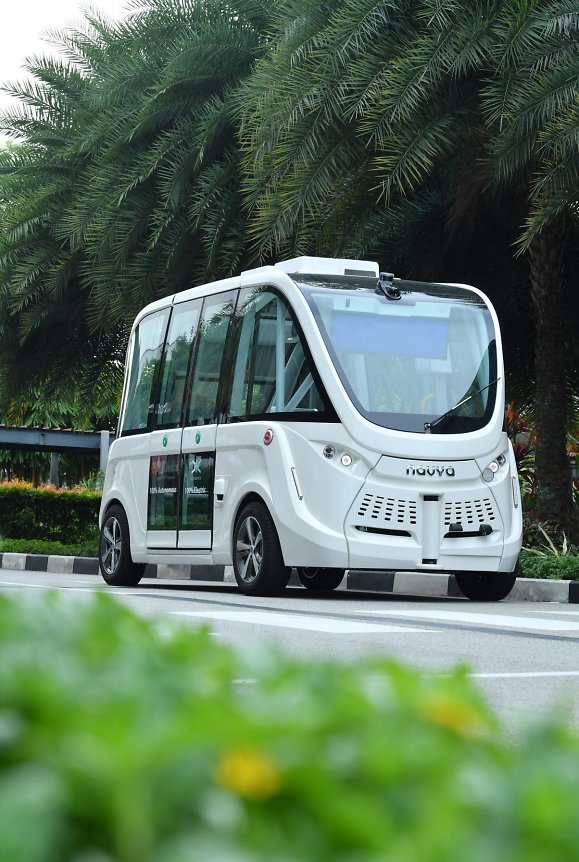
SINGAPORE: From next year, there will be another option to get around in Sentosa – autonomous shuttles.
Visitors and staff can hail them via smartphones or at kiosks along a 5km route on the island when they are put on a three-month trial in 2019, said the Ministry of Transport (MOT), Sentosa Development and ST Engineering in a joint-release on Tuesday (Jun 5).
Before the public trial begins, the shuttles will be tested along a 1km stretch of the service road at Tanjong Beach to iron out their operational systems and safety protocols from Tuesday. This will be progressively extended to a 2km route linking Palawan and Siloso beaches by the end of the year, the release said.
The system is being developed by the Land Systems arm of ST Engineering, in partnership with MOT and Sentosa.
The trial will utilise four autonomous vehicles: a pair of 22-seater mini-buses and two 15-seater shuttles.
The 15-seater autonomous shuttle. (Photo: Ministry of Transport, Sentosa Development, ST Engineering)
It will help MOT leverage autonomous technology to “improve the public transport system in the longer term”, said Mr Loh Ngai Seng, Permanent Secretary for Transport and Chairman of the Committee on Autonomous Road Transport for Singapore.
“The insights gained from this trial will allow us to better understand how the technology can be deployed to strengthen intra-town connectivity and enhance mobility for commuters, particularly the elderly and persons with disabilities,” he added.
Signboards have been put up along the test routes to inform the public of the trials, said the release. Electronic signage will also be fitted on the shuttles to indicate that they are operating autonomously.
SINGAPORE: People can look forward to the largest-ever combined military tattoo performance at this year’s National Day Parade.
A military tattoo performance is a choreographed display of different elements moving together.
More than 560 participants will take part in the performance, which will for the first time feature the School Display band and National Cadet Corps (NCC) precision drills squad, organisers said on Tuesday (Jun 5).
NCC precision drill squad members showing off some moves. (Photo: Jeremy Long)
“There are a lot of entities but everybody is on board because they have the same resolve and togetherness to ensure that we make this performance a memorable one for Singaporeans,” said parade and ceremony committee chairman Senior Lieutenant Colonel (SLTC) Kenneth Chiong.
First-time NCC precision drill squad participant, Nur Mufidah Selamat, 15, said while the nine-and-a-half hour rehearsals every Saturday have been tiring, the experience will be “worth it”.
“I joined because it’s a once-in-a-lifetime experience,” the Christchurch Secondary School student said.
Fellow NCC participant and schoolmate Soh Wan Qi, 15, said she’s had to manage her time well. “I have less time to do homework and go out with friends, but I managed to balance them,” she said.
As for handling nerves on the big day, Wan Qi said she’ll be treating the thousands of spectators as her friends. “So it’s like I know them already and I don’t need to be scared,” she added.
Mufidah said she’ll be nervous “like everyone else”, but is confident the hours of practice she’s put in will ensure she doesn’t “get it wrong”.
NCC precision drill squad members Nur Mufidah Selamat (left) and Soh Wan Qi. (Photo: Jeremy Long)
The performance will also include the Combined Schools Choir, a crowd favourite that is returning after a five-year hiatus.
The choir will perform before the entrances of the Prime Minister and then the President, and features 220 students from various secondary schools. “The students have been practising hard to make sure they’ll deliver a wonderful performance,” SLTC Chiong said.
Also among the military tattoo performance participants are 18 students from special education schools to make the performance “more inclusive”, SLTC Chiong said.
Chinook and Apache helicopters demonstrate an aerial flypast. (Photo: Jeremy Long)
In all, the performance will feature celebratory elements like the 21-Gun Presidential Gun Salute, the Feu De Joie and the State Flag flypast flown by a Chinook helicopter escorted by two AH-64D Apache attack helicopters.
ENHANCED AERIAL DISPLAY
To commemorate the Republic of Singapore Airforce’s (RSAF) 50th birthday, this year’s “enhanced aerial segment” will involve up to 21 RSAF aircraft.
“This year’s aerial display will comprise an impressive aerial flypast followed by a dynamic aerial performance,” SLTC Chiong said.
The RSAF50 special livery F-15SG pulling off an aerial stunt. (Photo: Jeremy Long)
The planes will fly in formation towards the Float before fighter jets execute aerial aerobatics over the Marina Bay skies. Against the backdrop of the Marina Bay Sands, an RSAF50 special livery F-15SG will pull off a high-G turn.
“We don’t do this day in, day out, so we have to start flying close to one another and progressively go to a lower altitude to make sure you are proficient,” F-16 pilot Captain Matthew Foo, 35, said of the rehearsals.
SIZEABLE TURN-OUT
More than 2,600 participants, one of the largest ever turn-outs, will participate in this year’s NDP, organisers said.
Parade regimental sergeant major Master Warrant Officer (MWO) Tay Ban Heng, 44, said he’s had to look after the safety of his Malay participants as rehearsals take place during the Ramadan fasting period.
“This period is also the World Cup period and I really need to warn my participants not to be watching the matches so they can be more focused and come for my rehearsals,” he added.
Parade commander Liutenant Colonel Ingkiriwang Shawn (left) and parade regimental sergeant major Master Warrant Officer Tay Ban Heng. (Photo: Jeremy Long)
MWO Tay, a veteran Guardsman, might cut a stern figure, but there’s a softer side to him when it comes to not losing his voice throughout the numerous rehearsals of shouting commands.
“I would like to thank my wife because she has been preparing honey lemon drinks for me every rehearsal,” he said with a smile. “Hopefully I can sustain my voice until the actual day.”
Singaporeans are encouraged to tag their NDP 2018 social media posts with the hashtags #WeAreSingapore, #NDP2018 and #NDP18.
SINGAPORE: Gold, silver and base-metal medallions have been unveiled to commemorate the highly anticipated summit in Singapore between US President Donald Trump and North Korean leader Kim Jong Un.
The Singapore Mint announced on Tuesday (Jun 5) that the medallions would not only commemorate the “momentous step to world peace”, but also mark Singapore’s role “as a neutral host, and an economic and security gateway between the East and the West”.
The front of the medallion features a handshake between the two leaders – which is minted with high-relief minting technique – and the national flags of both countries.
The North Korean flag is also depicted on the left, while the US flag is placed on the right. This represents both countries’ positions on the political spectrum, explained the Singapore Mint.
The summit date and text “Summit in Singapore” are also minted at the top of the medallion.
The back of the medallion features a peace dove “which embodies the significance of the summit to bring about world peace”, said the Singapore Mint.
The national flowers of US and North Korea – the rose and magnolia sieboldii – are also featured on the back.
The gold medallion, which is priced at S$1,380, has 1,000 pieces worldwide with fewer than 200 pieces allocated to Singapore.
The silver medallions to commemorate the summit between US President Donald Trump and North Korea leader Kim Jong Un in Singapore on Jun 12. (Images: Singapore Mint)
The silver medallion – which features the flags in colour – is priced at S$118. A total of 10,000 pieces worldwide have been minted, with fewer than 2,000 pieces allocated to Singapore.
The nickel-plated medallions. (Images: Singapore Mint)
The nickel-plated medallion will retail at S$36. The number of pieces to be minted will depend on the demand, Singapore Mint said.
All three commemorative medallions are available for pre-order from Tuesday onwards at Singapore Mint’s retail outlets and website.
The White House last month unveiled their own commemorative coin for the summit. It is available for purchase online at the White House gift shop website.
SINGAPORE: A council to advise the Singapore Government on the ethical use of artificial intelligence (AI) and data will be convened as part of initiatives to drive awareness of the benefits of the technology as well as better understand its challenges.
These initiatives were announced by Minister for Communications and Information S Iswaran at the opening of Innovfest Unbound on Tuesday (Jun 5).
The Info-communications Media Development Authority (IMDA) said separately in a press release that it is speaking to key stakeholders – including the Government, industry, consumers and academia – to collaboratively shape plans for the AI ecosystem. This discourse, it said, will support the country’s plans to be a hub for AI development and innovation and effectively respond to global developments.
There are three related initiatives to achieve this:
Set up the Advisory Council on the Ethical Use of AI and Data
A research programme on the governance of AI and data use to advance and inform scholarly research on AI governance issues
A discussion paper released by the Personal Data Protection Commission (PDPC) on responsible development and adoption of AI, which will be used by the council to frame its deliberations
IMDA said Mr Iswaran will appoint the members of the advisory council which will be chaired by former attorney-general V K Rajah.
Members will include private sector thought leaders in AI and big data from local and international companies as well as consumer interest representatives. More details on the council will be released at a later date, IMDA said.
The council will advise and work with the agency in the areas of responsible development and deployment of AI.
These include engaging stakeholders such as ethics boards of commercial enterprises on the issues arising from the use of AI and data by the private sector, and consumer advocates on people’s expectations and acceptance of such use, it said.
INSPIRING CONFIDENCE IN AI USE
The council will also help establish a legal and technical expert panel as well as a panel of international experts for global perspectives to aid it in its work, the press release said.
One example of what the council could look into is an online shopping platform using AI to recommend products to shoppers, an IMDA spokesperson told Channel NewsAsia. These recommendations are shown automatically on every product page to allow easy browsing and navigation, with the aim of increasing click-through and customer engagement rates.
“The council could look at issues such as how to explain to users that their shopping patterns are what forms related product recommendations from the AI, as well as how the AI aggregates data from all customers who have visited a particular product page to offer its alternate recommendations,” he explained.
“The AI’s modelling should also be clear to users in how it detects, for example, the price range of products it offers to users as well.”
File photo of a person shopping online. (Photo: Christy Yip)
Another example cited was Luminance – an AI platform used by the legal profession for work in areas such as insurance or contract management and to conduct due diligence and compliance checks.
With this, law firms can offer multiple options and tiers to clients not possible before, such as the cheapest option of having the AI technology conduct the due diligence completely or a mid-tier level that would mean a team of lawyers checking the AI’s results, the spokesperson pointed out.
The advisory council could look at how the product can be transparent, fair and explained to end users, he added.
“A product such as Luminance (explained) clearly to clients helps them understand the benefits and risks of using the product, and enables law firms to offer a tiered approach to a service which traditionally only had one cost level,” explained the IMDA spokesperson.
BEING AI THOUGHT LEADERS
The PDPC, meanwhile, is putting forward a discussion paper on how a possible reference AI and data governance framework for industries could look like.
It recommends two key principles:
Decisions made by or with the assistance of AI should be explainable, transparent and fair to consumers
AI systems, robots and decisions should be human-centric
IMDA said the Monetary Authority of Singapore (MAS) is an early collaborator in creating the discussion paper, with its Fairness, Ethics, Accountability and Transparency Committee using the document to help shape its ongoing discussion on the use of AI and data analytics in the financial industry.
Last, but not least, there will be a five-year research programme on the governance of AI and data use, which will be set up at the Singapore Management University.
SMU was awarded a S$4.5 million grant from the National Research Foundation and the IMDA to helm the programme. SMU School of Law will also set up a new research centre as part of this initiative.
The research and thought leadership generated from the programme will support the advisory council and inform Government and industry discussion on the technology.
These AI-related initiatives come as the Digital Government Blueprint was launched by Deputy Prime Minister Teo Chee Hean on the same day.
Within the document is a set of key performance indicators for the public sector to aim for by 2023, and these include having all ministries and its related agencies to have at least one AI project by then.
Asked what types of Government service have used AI, a Smart Nation and Digital Government Office spokesperson told Channel NewsAsia separately that an example is virtual assistant Ask Jamie.
The chatbot uses its natural language processing engine to understand users’ questions and respond with an appropriate answer, he explained.
The blueprint also said the Government will develop a set of guidelines on the use of AI to manage the risk, and the spokesperson said SNDGO is currently reviewing the guidelines and “will share more details when ready”.
SINGAPORE: “I was dog-sitting last night and there was a thunderstorm,” said a visibly tired Charlie Lim before settling down for the interview with CNA Lifestyle. “I couldn’t get much sleep,” he said.
The soft-spoken 29-year-old singer-songwriter didn’t let on much but from his Instagram Stories, the cause of his sleep deprivation was an adorable but thunder-spooked Jack Russell that kept him up with his barking till past 4am.
Lim looked like he could do with a caffeine fix – maybe one from Chin Mee Chin Confectionery in Katong, which this eastside boy grew up with. “The old aunties have been working there for a really long time, and everyone is very cute,” he said. “There is a nice vibe to it. My usual order would be a kaya toast and teh siew dai,” he said.
Growing up in the east meant that Lim’s childhood haunts centred around Marine Parade, Parkway Parade, Katong and Joo Chiat. “I was a nerd growing up, so on a typical weekend, I would be playing LAN games at Roxy Square. There were heaps of cyber cafes there then. I would play Counter Strike after school and after church. I used to play lots of games, I remember!” he chuckled.
SINGAPOREANS BEHIND THE SONG
In the unlikely event that you haven’t already heard, Lim has updated the 1987 classic We Are Singapore to create this year’s National Day Parade (NDP) theme song.
Produced by Lim, Evan Low (Evanturetime) and NDP music director Dr Sydney Tan – whom Lim credits as his mentor – the song kicks off with two new verses before segueing into the familiar tune that was originally written by Hugh Harrison.
Lending vocals to the song are Lim, along with Joanna Dong, Shak’thiya (Shak), Aisyah Aziz, Vanessa Fernandez (Vandetta) and Kevin Lester (The Lion City Boy).
“I gave it a shot when Dr Tan sent out an open call to songwriters to come up with an introduction to We Are Singapore,” recalled Lim. “I recorded a demo in my bedroom studio, and sent it over.”
“I didn’t feel pressured,” he added. “I was just going to write it and if the NDP committee liked it, great. If not, I’m not gonna compromise anything because this is how I feel. I’m proud of it and if it suits the purpose of what they were trying to do, great. If not, no worries. But, yay, it got picked.”
The pressure set in after his prelude was picked. “I had to finish the tune now. Joining my preface with the rest of We Are Singapore, producing it, arranging it, and making it all sound coherent – that was tricky. It took about three months,” he said.
Incidentally, the song featured his vocals from his home-recorded demo. “It sounded more honest, I guess, than the recording in the studio,” he said.
Streaming audiences are already familiar with the multi-instrumentalist’s music, which ranges from folk rock to experimental pop. In 2015, his album Time/Space – his proudest achievement, to date – shot to the top of the iTunes Singapore chart within an hour, and his songs have received over 2.5 million plays on Spotify.
Success also followed outside the Internet. Lim performed to a sold-out crowd in June 2015 at the Esplanade Concert Hall as part of a triple bill with Inch Chua and The Great Spy Experiment. He was also the first Singaporean to sell-out two shows at the Mosaic Music Festival. That same year, Lim wrote two theme songs for the 28th Southeast Asian Games and performed his song Still for the games’ closing ceremony.
A MUSIC JOURNEY FROM TAO NAN TO MELBOURNE
Lim’s considerable musical talents almost didn’t get heard. “As a kid, I did classical piano lessons, which I hated. But I learned to play by ear a lot and improvise. Then, I did two years at Victoria School, where I was with the school choir,” said Lim, who finished his primary school education at Tao Nan School.
“It was so uncool to be in the choir. I dreaded going for practice. But halfway through, I realised it was pretty amazing to sing four-part harmony. I sang alto before my voice broke, then I sang tenor. And we did really well. We were at the Singapore Youth Festival and we came in second.”
If he felt sheepish telling friends that he sang in the choir, playing in a band had the opposite effect on Lim – even if it was a nameless band in church. “It’s like the cool thing to do,” he said. “I probably felt the most alive and most switched on as a kid when I was learning how to lead the band and work with the dynamics of the band.”
Although Lim is based in Singapore (and flying his eastsider flag high), the musician occasionally travels to Melbourne where his parents live. Lim himself is no stranger to the city, having spent three years in Melbourne after Secondary 2 “for my A levels equivalent” and another four years at Monash University, where he obtained his degree in Music Performance.
In between, he returned to Singapore to serve National Service with the Singapore Armed Forces Music and Drama Company. “I loved my experience there. You’re not just the performer – you have to do everything: Check the sound, be the roadie, and set up everything. You have to be self-sufficient,” he recalled.
Like every Singaporean, Lim missed his favourite local food while away in Australia, like chicken rice, prawn mee soup and nasi lemak. So much that he did what many Singaporeans do: Pack Prima paste in his suitcase.
Never mind that he’s “terrible at cooking”. “I tried,” he said, smiling. “But whether I was successful, that’s another question.”
Free admission, poetry readings and live performances at the Singapore Art Museum’s popular after-hours series of events.
Singapore Art Museum’s ongoing exhibition: Imaginarium: Into the Space of Time showcases French artist Stéphane Masson’s Momentarium, featuring 280 glass jars containing videos of people and museum visitors moving, dancing and smiling. (Photo: Singapore Art Museum)
SINGAPORE: Singapore Art Museum’s SAM Late Nights programme returns in conjunction with the museum’s latest exhibition, Imaginarium: Into the Space of Time.
Taking place on the second Friday of every month, the upcoming sessions of SAM Late Nights will take place on Jun 8, Jul 13 and Aug 10 August at SAM at 8Q.
A free event with complimentary museum entry and extended late night access for all visitors to the museum, SAM Light Nights features poetry reading sessions, casual artwork discussions and live music performances by local indie and electronic musicians.
Local musician Falling Feathers will kick off the SAM Late Nights pop-up music performances at the Jun 8 edition, making it his first live performance after the launch of his album Pipe Dreams.
Meanwhile, Singaporean poets Samuel Caleb Wee, Iain Lim, Crispin Rodrigues, Marylyn Tan and Patricia Karunungan will stage live readings of prose and poetry inspired by the artworks featured in Imaginarium.
Singapore Art Museum’s SAM Late Nights programme is back this June till August, and will continue to take place on the second Friday of every month. (Photo: Singapore Art Museum)
SAM’s ongoing exhibition: Imaginarium: Into the Space of Time explores the concept of time through immersive and interactive artworks by artists from around the world.
On view till Aug 26, artwork highlights include French artist Stéphane Masson’s Momentarium (featuring 280 glass jars containing videos of people and museum visitors moving, dancing and smiling), Japanese artist Mayuko Kanazawa’s Utsuroi Iroha (which highlights how the Japanese culture is influenced by changes in the seasons, as audiences are incorporated into the artwork through image recognition sensors), and works by four Singaporean artists.
ARNT (formerly of Palty Sotato) will be making his solo debut as the featured live performance come Jul 13, with Ocean’s Children rounding things up on Aug 10.
These live sessions will commence once the museum closes at 9pm, alongside food, craft beers and wine sold by Standing Sushi Bar.
SAM Late Nights are free entry for all, as admission to the Singapore Art Museum is complimentary for Singaporeans and permanent residents throughout the year, and all other visitors enjoy free entry to the museum every Friday evening from 6pm to 9pm (U.P. $6 for foreigners, $3 for students and seniors).
SINGAPORE: When the lease of his three-room flat in Lorong 4 Toa Payoh runs out in 2066, first aid and swimming coach Low Mong Seng, 34, expects the Government to give him “something in compensation”.
“Either another shelter over our heads, or a lower lump sum amount (compared to the value of the property) for us to get another flat to stay in,” said Mr Low, who inherited the unit from his mother who died in 1995.
But another homeowner, who gave her name only as Ms Kwok, has a different view.
There is “a misunderstanding (among the public) of what homeownership is”, she said.
“People think ‘ownership’ means a freehold ownership but if you buy a leasehold then obviously the limited lease is reflected,” added the 30-year-old lawyer. Three years ago, she bought a three-room flat in Tiong Bahru — completed in 1973 — with her husband.
The issue of the lease expiry of older Housing and Development Board (HDB) flats has seized many homeowners in Singapore, since a blog post in March last year by National Development Minister Lawrence Wong.
Mr Wong had cautioned that not all old flats will be automatically eligible for the Selective En bloc Redevelopment Scheme (SERSs) — amid media reports of buyers paying huge sums of money for ageing resale flats, in the hope that the flats would be identified for SERS.
As at Dec 31 last year, HDB manages a total of about one million flats. The vast majority of flats have more than 60 years of lease remaining, HDB said in response to queries.
About 9 per cent of flats (or 90,000) have leases that commenced more than 40 years ago, it added. The first batch of HDB flats with leases that will expire in about 50 years are located in Geylang and Queenstown.
“As the leases run down, especially towards the tail-end, the flat prices will come down correspondingly,” Mr Wong had said, adding:
So buyers need to do their due diligence and be realistic when buying flats with short leases. This is especially important for young couples, who have to plan for a much longer future.
The issue has received substantial airing in Parliament since, with Members of Parliament (MPs) raising concerns and suggestions.
Last month, Mr Wong said the Government is studying the issue, as he highlighted the complexities involved.
“It will be easy for me to give you a politically expedient answer now and try to wave away the problem. But there are serious trade-offs and ramifications to consider,” he said, adding:
Ultimately, the Government must grapple with these difficult questions, study the matter, and do the responsible thing.
Second Minister for Finance Lawrence Wong speaks during the Committee of Supply debate on Mar 6, 2018.
Meanwhile, some owners of ageing flats have been spooked, amid a tepid HDB resale market which has seen prices fall for six consecutive quarters.
A homeowner at Block 117 Lorong 1 Toa Payoh, who declined to be named, said he put up his 50-year-old three-room flat for sale about six months ago, out of concern that its value will fall following Mr Wong’s comments.
There have been no takers yet, even though several prospective buyers have viewed the unit — and even though he has priced it under S$290,000, while other comparable flats in the area sold for as high as S$340,000, said the man in his mid-70s who is the flat’s second owner, having bought it more than 30 years ago at S$10,000.
Similarly, Mr Calvin Loh, 38, a hardware goods showroom manager, said he is also getting anxious about the value of his Commonwealth Close flat, which has 47 years of lease left.
He noted how a former neighbour sold his three-room unit for S$400,000 four years ago, but a similar unit in the same block changed hands for just S$280,000 a few months ago.
To these long-time homeowners, it does not matter that in absolute terms, the price which they can get for their ageing flat will be many times higher than what they bought it for.
What weighs on their mind is the worry that they are not getting a high enough price, relative to what they could have gotten when the flat was younger or the cost of an alternative home on the market today.
High-profile million dollar sales of old resale flats in good locations, which have been highlighted by some sections of the media, further skews the market and raises the expectation of sellers.
‘UNREALISTIC EXPECTATION’
This is, however, an unrealistic expectation, experts stressed.
“Owners of leasehold properties need to realise that the value of their properties is indeed the value of the remaining lease,” said ERA Realty key executive officer Eugene Lim who added:
When the remaining lease is depleting, it is not realistic to expect the prices to remain high.
Among other factors, flats with less than 60 years’ lease may start to depreciate as prospective buyers would have limited use of their Central Provident Funds to help finance the purchase of the flat. As the flats get even older, financing options from HDB or banks also become more limited.
“When that happens, flat owners may have to accept that their older flats may not be able to command as high a price anymore, and may be more difficult to sell in the open market,” Mr Lim said.
Mr Ku Swee Yong, chief executive officer of International Property Advisor, noted that the situation has been made worse by buyers overpaying for ageing resale flats in recent years, and price decline going forward is “inevitable”.
“(The) prices of well-located old flats have reached high levels not commensurate with their future cash flow value (from a rental perspective),” he said.
While lease expiry is a challenging issue faced by policymakers in all countries with public housing programmes including China and the United Kingdom for example, it is a political hot potato especially in Singapore, where more than 80 per cent of the resident population live in HDB flats.
File photo of HDB flats in Toa Payoh. (Photo: TODAY)
Moreover, homeownership is “far more popular than renting in Singapore and, arguably, an intrinsic part of the social compact”, said Singapore Management University (SMU) law don Eugene Tan. “Relying on a contractual understanding of the leases is legally appropriate (for the Government) but politically limiting and divisive,” he noted.
Pointing out that the HDB flat is the “most valuable asset” for vast majority of Singaporeans, Assoc Prof Tan added:
We have reached a stage where the emerging narrative for more and more flats is one of their depreciating value, rather than the dominant narrative of it being an appreciating asset. There is much at stake for all … the HDB flat also represents for many Singaporeans an important form of retirement security.
At the heart of the debate is a very Singaporean view of public housing flats as “sure-win” investments — a mindset that the Government is partly responsible for shaping, experts pointed out.
National University of Singapore (NUS) sociologist Tan Ern Ser said: “I reckon the years of experiencing asset enhancement and social upgrading have been deeply ingrained in the Singaporean psyche. Moreover, they also believe that at some point, the expiring lease would be reset via en bloc.”
Mr Ku added: “The idea is already ingrained in us, so much so that many permanent residents (on top of Singaporeans) also buy into the idea that HDB flats are certain to make profits.”
Still, experts were divided on whether the narrative of HDB flats as assets remains valid today and in future: It is true that unless buyers overpaid for a resale flat, chances are high that they can still sell it off for a profit.
For most homeowners, the value of their flat has, without a doubt, increased exponentially compared to the price which they had paid for it years back.
However, it is also clear that the value of a flat cannot be perpetually rising and there will come a point in time — at least a decade from now even for the oldest flats — when it drops dramatically, as its remaining lease falls under 30 years.
The People’s Action Party (PAP) Government has long held up homeownership as a way to give citizens a direct stake in the country. Over time, its “asset enhancement policy” became a buzz phrase for public housing.
Since the 1990s, it has drummed in the idea of an HDB flat as both a home and an asset, providing Singaporeans an important form of retirement security.
Former Prime Ministers — Mr Lee Kuan Yew and Mr Goh Chok Tong — made bold pitches for asset enhancement, while in the last decade or so, government leaders continued to refer to an HDB flat as a “key investment asset”.
At a dinner for the International Housing Conference held in 2010 by HDB, Prime Minister Lee Hsien Loong linked the value of HDB flats to the strength of the economy: “Provided Singapore continues to do well, our flats will maintain their value, and Singaporeans can enjoy an appreciating asset.”
In 2011, then-National Development Minister Mah Bow Tan also reiterated the importance of the policy as he rebutted a suggestion by the Workers’ Party to peg the prices of new flats to the incomes of qualifying households instead of resale market prices.
Mr Mah had added: “I want to say we are proud of the asset enhancement policy. The policy is what has given almost all Singaporeans a home of their own, a home that also an asset (which) grows in value over time.”
However, in 2013, then-National Development Minister Khaw Boon Wan broached the issue of diminishing market value of HDB resale flats in Parliament: “Looking ahead, as we may no longer get the same kind of returns from re-selling an HDB flat as in the past, how will its role as an asset be affected? If it is likely to diminish, how should we make the adjustments?”
Mr Khaw’s comments came after the first million-dollar flat changed hands in July 2012, at Block 149 Mei Ling Street in Queenstown. But it appears that Mr Khaw’s warning was not enough to deter buyers from dishing out big bucks for HDB resale flats.
Since the first million-dollar HDB flat transaction in Queenstown, at least 89 flats have been sold for S$1 million or more, according to public data.
The Pinnacle is the world’s tallest residential building. (Photo: Gaya Chandramohan)
The trend called for a starker warning, and Mr Wong duly delivered it in his blog post in March last year.
A month later, he responded to strong public reactions to his blog post, as some questioned how the asset-enhancement policy for public housing would apply when HDB flats have to be returned to the Government upon expiry of their lease.
Mr Wong reiterated that HDB flats provide a “good store of asset value, so long as you plan ahead and make prudent housing decisions”.
He cited a hypothetical example of a 30-year-old couple, with a combined monthly income of S$5,000, looking for a resale flat in Woodlands near their parents. “They can get up to S$75,000 in grants off the resale flat price, and should easily afford a flat with a reasonably long lease of 90 years,” he said.
“Thirty-five years later, the couple will be 65 and the remaining lease of the flat will be 55 years. They still have an asset which can be monetised for retirement.”
Experts noted that the Singapore public has lapped up the “asset enhancement” message so much that it is inconceivable for many homeowners today that the value of their flats would head south towards the tail-end of the lease.
“One entire generation has already made their profits. Those who are left holding their flats today are disappointed that they did not downsize or sell out to extract their profits (earlier)” Mr Ku said.
But Mr Alan Cheong, senior director of research and consultancy at Savills, warned that there could be profound consequences — such as worsening social inequality — if HDB flats were to be treated as “depreciating assets”.
OUTLOOK FOR RESALE PRICES OF AGEING FLATS
Speaking in Parliament last month, Mr Wong acknowledged concerns about the impact of lease expiry on resale prices. But he stressed that there is still value in older HDB flats, which can be unlocked for retirement.
Citing transaction data over the past year, he noted that an older four-room flat with less than 60 years remaining would sell for around S$300,000 and a five-room flat would sell for around S$400,000 in non-mature estates. For flats in more popular locations, prices can be significantly higher – more than double the price, Mr Wong said.
Apart from the length of the remaining lease, transacted prices depend on other attributes such as location, the storey height, and the condition of the flat, he added.
The sales proceeds from older flats “would be more than sufficient to purchase a smaller flat for retirement”, he said. Those who prefer to stay in the same place can also use the Lease Buyback Scheme, where they can sell part of the remaining lease to HDB or have the option of renting out a bedroom.
Mr Wong reiterated that existing monetisation schemes are working. Nevertheless, the Government will continue to review and enhance them, he said.
File photo of HDB flats. (Photo: Hester Tan)
However, in a commentary, NUS Institute of Real Estate Studies director Sing Tien Foo wrote that there is a “significant negative relationship between HDB resale prices and age”.
His analysis was based on a large sample of public resale flat transactions from 1997 to 2017, and after controlling for the quality of transacted resale flats — such as the flat attributes (unit area and floor height), and distance to schools and MRT stations.
Using resale flats of less than 10 years as the reference, the discounts are estimated at 8.3 per cent and 9.5 per cent for resale flats of 40 to 50 years and those between 50 and 60 years old, respectively, Assoc Prof Sing said.
Without a doubt, a homeowner who bought his flat in the late ‘60s for example can easily sell it today at a price more than 40 times compared to what he had paid, analysts noted.
Even for those who bought their flats some years back, it is likely that they can sell it for a profit.
It may be a different story, however, for ageing flats which were bought recently — and this is how it should be, analysts said.
An effective property market should reflect flats’ decaying lease and these units should be sold accordingly, in terms of pricing.
As to the residual value for such flats, the analysts reiterated that even this will plunge dramatically when the units have less than 30 years of lease left.
Applying a common industry forecasting template that correlates the value of land with respect to its remaining lease, Mr Ku predicts that a flat which was completed in 1975 — and priced at S$860,000 today — would fetch only S$180,000 in 2054, when it has 20 years of lease left.
When the time comes, “how many buyers will put down such a large sum of money to use a property for 20 years”, he questioned.
Public data on HDB resale transactions in the last three years showed that older flats — those with half of their 99-year lease remaining or less — were fetching lower amounts, and underperforming compared to the rest of the HDB resale market.
While experts noted that the sample size was too small to draw any conclusion, they observed some anxiety creeping into the HDB resale segment.
Mr Colin Tan, director of research and consultancy at Suntec Real Estate Consultants, said the priority for now should be to “quell any panic”.
OrangeTee & Tie managing director Steven Tan, for one, believes that the market for older HDB flats will be stirred back to life in the short to medium term, notwithstanding the longer term price trajectory.
“As the overall market sentiment improves, led by the recovery in the private residential market, HDB resale prices is expected to bottom out in the foreseeable future,” he said.
HDB noted that flats with a shorter lease may appeal to certain groups: For example, elderly homeowners looking to right-size their home, families who are not yet ready to commit to a longer lease, and buyers looking for a home in more central locations with established amenities.
“There continues to be healthy demand for such flats in the market, and there is value in these flats that can be unlocked for retirement,” HDB reiterated.
In terms of prices, HDB noted that its resale price index has fallen by 2.3 per cent in the first quarter of this year, compared to the same period in 2016, “following the earlier property cooling measures”.
“As the (index) shows the general market price trend, it follows that the transaction prices of all flats, regardless of age, would generally experience a slight dip within this period,” HDB said.
Noting that the attractiveness of an HDB flat is “dependent on many factors, not just the length of the lease”, HDB stressed that it would be “inaccurate” to look at price changes alone to determine whether prices for older flats have fallen more, “as such a comparison does not take into account differences in other flat attributes, especially location”.
An HDB block in Singapore.
MPS’ SUGGESTIONS AND TRADE-OFFS
For many owners of old flats, SERS is the best-case scenario.
Residents of blocks of flats identified for SERS will get the opportunity to move to a new home with a fresh 99-year lease, and continue living close to their current neighbours. They will also be given compensation and rehousing benefits.
Among the suggestions brought up during last month’s debate on the President’s Address, Marsiling-Yew Tee GRC MP Alex Yam proposed that the Government consider applying SERS to all HDB flats when their lease runs under 40 years.
Mr Yam said this will allow the use of parcels of land to be intensified with topped-up leases, while easing the country’s reliance on “constant piecemeal upgrading” in old estates, which he felt was “not the most cost-efficient”.
But such a proposal will put a huge financial strain on the Government, experts said.
Mr Ku estimates that it will cost the Government S$3.5 billion annually from 2030.
Similarly, Assoc Prof Sing felt there is no urgent need to increase the pace of SERS, which could “significantly increase” the Government’s expenditure.
“The current approach of SERS is an appropriate one, while allowing some older housing stocks to be replaced, redeveloped and intensified into newer housing blocks,” he added.
In his parliamentary speech last month, Mr Wong also pointed out that the authorities cannot assume that everyone wants a lease extension.
More maintenance will be needed for older flats, and this will be costly for residents, he said.
Also, if all 99-year leases were to be automatically renewed for extended periods, there will not be sufficient land to provide affordable housing for future generations of Singaporeans, HDB said.
Apart from adding to Government expenditure, Mr Cheong said that extending the leases of older flats will also impede urban renewal, with the older estates affecting the aesthetics of nearby newer ones.
However, Mr Tan Kok Keong, co-founder of FundPlaces which develops blockchain platforms for the real estate industry, felt it would be a palatable option for many owners of ageing flats.
“A lease top-up at minimal cost. Why wouldn’t I not want it? Even if I don’t want (to continue living in the flat), I can sell and get better money,” he said.
Public interest in 99-year HDB leases stirred when owners of private residences along Lorong 3 Geylang were given notice that their properties must be returned to SLA when their land leases expire in 2020. (Photo: Marcus Mark Ramos)
There has also been a suggestion for private developers to come into the picture.
Fengshan MP Cheryl Chan has proposed a “modified form of SERS”, which would involve private developers compensating flat owners and buying over the land from the Government, so they can top up its lease for private development.
She has also suggested changing the valuation method for ageing flats so that it is based on their remaining lease and right-sizing potential, extending the lease for flats in selected mature towns, and reassessing the property loan structure for prospective buyers.
She said she felt that her “modified SERS” proposal could also result in better social mixing, with private estates better interspersed among HDB blocks.
Both Mr Tan, from FundPlaces, and SMU’s Assoc Prof Tan said it was a sound idea, as it could be a win-win situation for all parties — residents, developers and the Government — and also enable the lower-income group to benefit from the en bloc fever sweeping through private residential developments.
Mr Tan agreed that the construction of condominiums in older HDB estates would encourage greater social mixing. However, if this was done a large scale, it could risk HDB neighbourhoods losing their character, he noted.
Mr Ku felt that the idea was not feasible administratively, given that a parcel of land typically has to be cleared first, then demarcated before being sold to private developers. “You cannot put a piece of land up for tender if you cannot define the site boundaries,” he added.
Ms Chan acknowledged that the issue was complex, and said that her idea cannot be adopted in isolation.
“You can’t just use one single lever and expect it to work because this is a free market after all, which is why I am suggesting certain things that the Ministry (of National Development) should start looking into so that we can start testing with a pool of flats and gradually make changes as we move along,” she said.
Indeed, experts believe there is no single solution to the conundrum. It may entail a mix of different policy options, on a case-by-case basis.
But of more pressing need is for buyers and sellers to adjust their mindset, to befit reality.
“This issue of ‘decaying leases’ is likely to be a circle that cannot be squared,” said SMU’s Assoc Prof Tan.
However, some like Mr Ku from International Property Advisor felt that the mindset could be already shifting among the younger generation who are “less smitten with homeownership” — as in the case of Ms Kwok.
She and her husband bought their three-room Tiong Bahru flat, which had 57 years left on its lease, for about S$650,000.
She said they did it “with two eyes open”, knowing that it will depreciate down to zero when its lease expires. “I suppose it is good that (people are discussing about this now) … (But) it is a strange conversation … The leasehold is what it is. You have a lease,” she said.
Her husband added: “If you think about it, 99 years (covers) two generations, so if (homeowners) were concerned about inheritance, the second generation is enjoying that… The kids of our neighbours are already around 40 years old. They have children. They probably have their own flats as well.”
As far as Mr Ang Hong King, 72, is concerned, his three-room flat which he bought for S$6,000 in 1970, has served its purpose — providing a roof over his family’s head for almost five decades and counting.
The semi-retired driver and his wife raised their three daughters in the unit at Block 65 Circuit Road. Their children have since moved out, and gotten flats of their own.
Having no plans to move out, Mr Ang shrugged off the prospect of his flat — which is worth about S$250,000 now — losing its value in the future. “Price drop also never mind,” he said.
SINGAPORE: It may come as a surprise, but Singapore has a space industry – one which hires 1,000 people and involves 30 companies.
It’s a big step from just five years ago, when there was no industry to speak of, and only 20 space researchers in institutes of higher learning.
Curiously, 2013 was also when the Economic Development Board (EDB) started its Office for Space Technology and Industry (OSTIn), focusing on developing the sector, even amidst the apparent dearth of commercial projects.
But the agency saw a number of factors that led it to believe that space technology could be an exciting part of Singapore’s economic landscape.
One is that space technology has become much cheaper over the past decade, making it accessible to small players and even start-ups. This is thanks to advances in technology, leading to miniaturisation.
Most satellites now are very small. This nanosatellite is being built in a clean room in Nanyang Technological University. (Photo: Gwyneth Teo)
In fact, some of the smallest satellites are cubes that measure just 10cm on each side – known as nanosatellites.
While traditional satellites could cost US$100 million (S$133 million) to build, these nanosatellites can be built by undergraduates at Nanyang Technological University (NTU) at a cost of only US$50,000.
Flat-lay of a nanosatellite measuring 10cm on each side, with a folded-up satellite nearby. This has the computing power to run a full space mission. (Photo: Gwyneth Teo)
Launching a nanosatellite costs as little as US$70,000 to US$80,000, compared to US$40 million to US$50 million for traditional satellites.
This accessibility has led industry players to dub our time the “new space age”.
Associate Professor Amal Chandran, assistant director of the Satellite Research Centre housed in NTU, compared the developments to that in mobile technology.
“Payloads have become very smart. We have started to miniaturise it to be able to fit within these (nanosatellites) and execute full space missions,” said Dr Chandran, who is referring to devices carried by the satellites, ranging from scientific instruments, cameras to sensors.
SINGAPORE’S CAPABILITIES
Another factor that EDB identified was the fact that Singaporean businesses have latent capabilities in other fields, which are transferable to space technology.
“We already had good capabilities in electronics, in info-communications and technology,” said Mr Tan Kong Hwee, executive director of transport engineering in EDB, the division that oversees OSTIn. “It was a great opportunity for us to leverage those capabilities to look into how else we could expand our industry riding on this trend.”
Scientists run missions on this flat-lay of a satellite before programming its counterpart in space. (Photo: Gwyneth Teo)
An example of a company that effectively transferred the capabilities it had is Addvalue Technologies.
The medium-sized enterprise has been listed on the Singapore stock exchange since 2000, having made its name in designing and manufacturing satellite communications devices which allow people to stay in touch in remote areas where it’s difficult to get cell connection – such as mountainous regions and oceans.
Addvalue identified a problem in the satellite industry. Nanosatellites usually enter low Earth orbit, which is at an altitude of 2,000km or less. In order to remain in orbit against the Earth’s gravitational pull, they need to travel at a speed that takes them around the globe in 90 minutes.
This is in contrast to satellites in geostationary orbit – typically used in telecommunications and for broadcast – which orbit the earth high enough and fast enough to match the earth’s rate of rotation, thus they appear to remain at a fixed position in the sky to us on the ground.
Operators of satellites in low Earth orbit can only contact them every 90 minutes, which is inefficient.
Satellites in low Earth orbit are typically used for monitoring and imaging purposes. That communication time lag could be particularly crucial when monitoring urgent and fast-changing developments, such as forest fires.
So Addvalue modified its technology, developing an Internet Data Relay System (IDRS) – a terminal that could sit on every satellite in low Earth orbit and allow it to maintain on-demand contact with its operator. This would be the first time the technology is available commercially.
Addvalue Technologies sent up its IDRS terminal on NTU’s Velox-II. This copy of the satellite was stress-tested on earth to ensure its counterpart could survive space. (Photo: Gwyneth Teo)
In 2015, Addvalue put the IDRS terminal on a satellite launched by NTU as a proof of concept.
Apart from the immediate commercial interest, the company said a successful proof of concept also demonstrates that Addvalue has the capability to compete in the new space age.
“The IDRS terminal that we offer right now (gives) us a track record – that we are able to produce a space product at low cost, short schedule, and fast turnaround at high volume, which will serve the needs of the new space industry,” said Dr Colin Chan, Chairman and CEO of Addvalue Technologies.
He added that this is a device with high redundancy, as most nanosatellites have a short lifespan, and will typically be launched as part of a constellation of satellites.
For example, Dr Chan explained that a first launch of 20 satellites may last for about three years, after which they will need to be replaced.
“Basically we have a captive customer and offer a service that will give us recurring revenue. This model will apply to every other customer in there,” he said.
Addvalue Technologies uses this anechoid chamber to measure radiation patterns while testing their devices. (Photo: Gwyneth Teo)
GETTING OFF THE GROUND
Thus far, Singapore’s seven satellites have all been launched overseas. This includes Velox-II, the satellite that Addvalue put its IDRS terminal on, which was launched from India.
But if some start-ups have their way, we could start launching them nearer to home someday.
Equatorial Space Industries aims to build small, simple rockets in order to make it even cheaper and easier to bring nanosatellites to space.
The start-up, which has been around for six months, is housed in National University of Singapore’s incubator space, The Hangar. The team, who are all in their 20s, was recently awarded the NUS Innovation and Entrepreneurship Practicum Grant.
The problem, they say, is that very few countries have launch capabilities, and most of the satellites still ride on big rockets that take off infrequently.
Equatorial Space Industries’ prototype of a rocket that could propel a nanosatellite to space. (Photo: Gwyneth Teo)
This means those who do not have launch capability have to queue for a spot on these rockets, leading to inflexible launch schedules.
It is also highly inefficient, as the big rockets were designed for big and heavy satellites, which most satellites were up until 10 years ago. The Alphasat, for example, is the size of a double-decker bus and has a mass of more than 6.6 tonnes.
Polish-born Simon Gwozdz, CEO of Equatorial Space Industries, first dreamed that Singapore could be a launch site when he was serving National Service on Pulau Tekong, and noticed the dredging platforms in the sea.
“I was thinking: What if one of them was re-purposed for a launch site? Not on Tekong, but brought to sea,” he said.
To Mr Gwozdz, Singapore is the perfect place to develop a company that launches nanosatellites in the new space age.
Scientists at Nanyang Technological University are about to test this nanosatellite in a chamber simulating space conditions. (Photo: Gwyneth Teo)
One clear reason is that Singapore is very close to the equator, making it ideal for equatorial orbit. A constellation of satellites in equatorial orbit will only need 24 satellites to achieve global coverage, as opposed to minimally 500 to 600 satellites in polar orbit.
So a network of satellites in equatorial orbit would be a significant reduction in cost for operators seeking to set up global networks with 24/7 coverage. One potential use of such a network is to enable a nation-wide network of sensors for autonomous vehicles.
Currently, there are few launch sites near the equator – and even fewer of them are close to industrial hubs like Singapore that can provide the necessary operations, maintenance and transport support.
“Singapore is probably the only place in the world that’s so close to the equator, that’s so developed, and that actually has a perfect prospective launch site so nearby,” said Mr Gwozdz.
His dream launch site, situated a short boat ride from Singapore in the South China Sea, will be able to launch satellites into both equatorial and polar orbits, he said.
“The maritime, aviation, and petrochemical industries – they truly supply all the hardware and skillsets that you need … the sea launch would be very easily supported by (our) very strong maritime base,” he said.
“Singapore could not only participate in the launch industry, it could actually dominate in the years to come.”