Home Blog Page 1018

Commentary: A while more before robots and artificial intelligence run our lives for us

0

SINGAPORE: The last several months have seen Singapore swept up in an enthusiasm for artificial intelligence (AI).

In April, NTU engineers succeeded in building a robot that could assemble an IKEA chair. And over the last few months we’ve heard much about “Nadine” – an AI with a human face, designed to respond to human speech and emotions.

Prime Minister Lee Hsien Loong recently flagged AI as an area Singapore is making good progress developing frontier technologies in, noting especially Alibaba’s establishment of a joint research institute at NTU.

But beyond these headline-making, attention-grabbing events, how likely is it that AI will be transforming our lives in the near future?

SOLUTION TO ALL OUR PROBLEMS?

The discussion about AI is almost always dominated by either “techno-optimists” or the “doomsayers”.

For the former, AI will solve all the world’s problems, bringing wealth, new jobs, new industries, and even strengthen social cohesion; for the latter, robots pose a threat to people’s livelihoods and ways of life. 

But both these views take on faith the underlying idea that AI is coming, sooner or later, like it or not. These positions leave very little room for reasoned consideration of how transformative AI may really be.

Despite AI’s widely publicised successes, there are very good reasons to be skeptical about its possibilities for replacing humans.

The history of AI is hardly a history of triumph. Since the first electronic computers were built during World War II, their creators thought of them as giant electronic brains, promising that they would soon be painting great works of art, solving mathematical proofs, and directing armies into battle.

Very little of this materialised. The early pioneers of AI in the 1950s and 1960s soon came to understand how difficult building “thinking machines” could actually be.

ntu robot ikea chair

Scientists spent three years programming the robot – made of arms, grippers, sensors and 3D cameras. (Photo: NTU)

READ: The future of work, a dystopian reality? A commentary.

READ: Smart speakers will take over the world? Don’t make me laugh, a commentary.

EMERGING DIFFICULTIES

Sure, AI has made progress since then – it can now beat humans at Go and chess and help us find our way to the nearest supermarket or movie theatre.

But history suggests we should be cautious about extrapolating too far from these beginnings to draw straight line conclusions about the pervasiveness of AI in our lives.

Games with very clear rules and boundaries are one thing. But, as the problems with autonomous vehicles are beginning to show, dealing with the openness of real world situations is quite a different matter. City streets – filled with pedestrians, children playing football, bicycles, and parades – are a far cry from a chess board.

Both personal and national security increasingly rely on AI-driven technologies of facial recognition. But recent reports have suggested that such technologies are plagued with difficulties.

Reports from China suggest that the iPhone X cannot distinguish between the faces of some ethnic Chinese people. Other facial recognition schemes have completely failed to identify individuals with darker skin tones, differentiate between twins or recognise someone who has changed their make-up.

Even in the realm of linguistic communication, AI has experienced some revealing difficulties. Microsoft’s chatbot “Tay” had to be shut down after developing a penchant for racist remarks; and Facebook’s “Bob” and “Alice,” despite being programmed to communicate in English, seemed to generate their own private language. 

FILE PHOTO: A woman sets up facial recognition on her Apple iPhone X at an Apple store in New York

A woman sets up facial recognition as she looks at her Apple iPhone X at an Apple store in New York on Nov 3, 2017. (Photo: REUTERS/Lucas Jackson)

READ: Driverless vehicles can reshape Singapore but consider the human elements, a commentary.

READ: The powerful edge of humanity in a world of machines, a commentary.

We also need to ensure that the promises of AI do not distract us from pursuing other kinds of solutions to social and economic problems.

For example, Singapore has invested in AI and smart city systems as a solution to the problem of an ageing population, including devices to monitor elderly citizens in their homes.

But this seems unlikely to be a panacea – such efforts should go hand in hand with the training of elderly care workers and investment in aged care facilities. Sensors and smart devices need to connect the elderly to real people who can provide human care in a sustainable and scalable manner.

Rather than giving in to premature triumphalism or panicking about robots taking our jobs, Singapore should be thinking about how AI research might be most productively channeled into fields where it has the greatest potential.

This approach will allow Singapore to become a useful use case study for other cities and nations that are also trying to figure out also how to unlock AI’s potential.

Hallam Stevens is an historian whose work focuses on understanding the social, political, and economic impacts of new and emerging technologies. He is an Associate Professor of History at Nanyang Technological University and Associate Director (Academic) of the NTU Institute of Science and Technology for Humanity.
Source link

What’s in a name? Kim, Trump signatures show ambition, experts say

0

Kim Jong Un’s distinctive signature, penned on a historic agreement with US President Donald Trump on Tuesday, indicates his ambition and creativity, handwriting experts said.

U.S. President Donald Trump shows the document, that he and North Korea's leader Kim Jong Un s

U.S. President Donald Trump shows the document, that he and North Korea’s leader Kim Jong Un signed at their summit in Singapore

SINGAPORE: Kim Jong Un’s distinctive signature, penned on a historic agreement with US President Donald Trump on Tuesday (Jun 12), indicates his ambition and creativity, handwriting experts said.

Trump’s signature, by contrast, indicates a more guarded personality, they said.

Graphologist Koo Bon-jin said Kim’s signature suggested an ambitious man who is “intuitive, rather than rational and logical”.

“He also writes very fast, which indicates he’s quick-witted and impatient,” Koo added.

Trump Kim Sign 19

US President Donald Trump holds up a document signed by him and North Korea’s leader Kim Jong Un following a signing ceremony during their historic US-North Korea summit. (Photo: AFP/Saul Loeb)

Kim’s signature contrasts with Trump’s angular, closely packed autograph, said Karen Leong, a body language expert and director of Singapore-based consultants Influence Solutions.

“There is tremendous space between each character, which indicates a creative individual who is open to taking on new ideas, to evolving,” Leong said of Kim’s signature. “It indicates a confident person with big dreams and ambitions.”

Trump’s signature, which Leong said looked like “arrows or skyscrapers”, points to people who “tend to wear a mask to hide their true nature”.

“While both signatures are very different, as both men really have different personalities, both in their own way want to make their mark,” she added.

Ahn Chan-il, a former North Korean military officer who heads the World Institute for North Korea Studies in Seoul, said Kim’s slanting signature was similar to those of his father and grandfather, both former leaders of North Korea.

“Not just the Kim family, but ordinary North Koreans would try hard to imitate the handwriting, believing it’s nice and divine,” added Ahn, who defected to South Korea in 1979.

The slanting style is shared by Kim’s sister, Yo Jong, who was also at the signing on Tuesday.

Source link

We’ve heard this before: Analysts on North Korea-US statement

0

SINGAPORE: Two key words were conspicuous by their absence from the joint statement signed by US President Donald Trump and North Korean leader Kim Jong Un after their high-profile, soundbite-rich summit in Singapore.

Washington has long said it wants to see the “complete, verifiable and irreversible denuclearisation” (CVID) of the nuclear-armed, ballistic-missile-equipped North.

Each of the words is significant, with the US wanting to ensure Pyongyang allows in inspectors to ensure that it fulfils its promises, and that it does not rebuild any weapons it gives up.

Key denuclearisation issues were glossed over in the document that the two leaders signed in

Key denuclearisation issues were glossed over in the document that the two leaders signed in Singapore. (Photo: AFP/Saul Loeb)

Only on Monday, Secretary of State Mike Pompeo said the US had been “fooled before”, with presidents signing agreements only to find “the North Koreans did not promise what they said”.

“The ‘V’ matters,” he told reporters less than 24 hours before the two leaders put pen to paper. “We will set up a system to verify. It is only that we pursued. That is what has been missed before.”

But the V-word did not appear anywhere in the joint statement signed by the two men, and nor did another of Washington’s key demands, for “irreversible” denuclearisation.

Instead, the North committed “to work toward complete denuclearisation of the Korean Peninsula”.

The phrase is a diplomatic euphemism that is open to wide interpretation on both sides – Pyongyang has in the past demanded the withdrawal of US troops from the South, and said it will give up its weapons when all other nuclear powers do the same.

Koo Kab-woo, professor at the University of North Korean Studies in Seoul, told AFP: “I think they couldn’t reach an agreement on CVID in the end, namely ‘V’ and ‘I’.

For verification, the US probably demanded to have access to anywhere at any time and the North declined.”

Irreversibility was even more complicated, he said, as it related to data Pyongyang has accumulated over its decades of weapons development, and reassigning its nuclear scientists.

“That’s the core of the ‘I’ and it seems they failed to reach an agreement on that,” he said.

In the event, he pointed out, the topics highlighted in the agreement had similarities to a recent editorial in the Rodong Sinmun, the official newspaper of the North’s ruling Workers’ Party.

“I think there will be a huge backlash in the US,” he added.

The US and North Korean leaders signed an agreement with a flourish

The US and North Korean leaders signed an agreement with a flourish, but critics say it is short on details. (Graphic: AFP/John Saeki)

Trump told reporters that there had not been time to discuss the details of denuclearisation.

“I’m here one day,” he said. “It wasn’t a big point today because really this had been taken care of,” adding: “It will be verified. We will be verifying.”

‘BABY STEPS’

The summit was a marked contrast from the tensions of last year, when the two men traded personal insults and threats of war, and proponents of engagement argue that as long as negotiations continue, the risk of a devastating conflict are reduced.

“There’s a danger of myopia in looking at this purely through the lens of details and definition of denuclearisation,” said Yonsei University professor John Delury, adding it was “important to take a big step back” and look at the big picture.

And Vienna university Korea expert Ruediger Frank said: “Trump saved the process by taking it slow and one baby step at a time, rather than killing it before it starts – like his predecessors did despite the best intentions.”

Supporters of engagement with North Korea said the details of the agreement were less important than

Supporters of engagement with North Korea said the details of the agreement were less important than the big picture of starting the denuclearisation process. (Photo: AFP/Saul Loeb)

But others pointed out the North had made similar promises in the past, and in some cases had gone much further.

In 1993, after talks in New York, the US and North Korea agreed to the principles of “peace and security in a nuclear-free Korean Peninsula”.

In that statement, Pyongyang agreed to suspend its withdrawal from the Nuclear Non-Proliferation Treaty.

“North Korea committed to nothing that it hasn’t done so for 25 years,” MIT associate professor of political science Vipin Narang told AFP.

“So far, there is no reason to believe this summit produced anything more concrete than that on the disarmament front.”

And in 2005 – just a year before its first nuclear test – the North went much further, agreeing “to abandoning all nuclear weapons and existing nuclear programmes”.

A year later it carried out its first nuclear test. It has since detonated five more, each of them more powerful than the last, and developed missiles capable of reached anywhere in the mainland US.

Nonproliferation expert Jeffrey Lewis tweeted: “North Korea is still not offering to disarm.”

Source link

US, North Korea ‘ready to write a new chapter’: Donald Trump

0

SINGAPORE: After decades of hostilities, the United States and North Korea are ready to write a new chapter in their relations, US President Donald Trump said on Tuesday (Jun 12), at the end of a landmark summit which saw the reclusive state’s leader commit to a complete denuclearisation of the Korean Peninsula.

North Korea has the potential to be a “great place”, Mr Trump said, adding that there is “no limit” to what the country can achieve when it gives up its nuclear weapons and embraces commerce. 

He said this at a press conference that stretched for more than an hour as he wrapped up his historic summit with North Korean leader Kim Jong Un in Singapore on Tuesday (Jun 12).

Just hours earlier, the two leaders had signed a joint document in which Mr Kim reaffirmed his “firm and unwavering commitment to complete denuclearisation of the Korean Peninsula”. 

Mr Trump also committed to provide security guarantees to North Korea, without stating what those guarantees might be. 

The two parties also said they would jointly work to build a “lasting and stable” peace regime on the Korean Peninsula.

Mr Trump said his talks with Mr Kim were “honest, direct and productive”. 

“We are prepared to start a new history and we are ready to write a new chapter between our nations,” he said. 

The US president said that Tuesday was the start of an “arduous process” but that “peace is always worth the effort”. 

“Anyone can make war but only the most courageous can make peace. The current state of affairs cannot endure forever,” he added. 

The North Korean leader, he added, has “an opportunity like no other to be remembered as the leader who ushered in a glorious new era of security and prosperity for his people”.

Responding to questions from the media, Mr Trump also expressed confidence that Mr Kim would honour the commitments he had made.

“(Mr Kim) was very firm in the fact that he wants to do this. I think he might want to do this as much or even more than me as they see a very bright future for North Korea,” he said. 

“We signed a very comprehensive document today and I believe he’s going to live up to that document. When he lands, I think he will start that process right away … We have a great team. I think he wants to get it done.”

Mr Trump said during the signing ceremony that he and Mr Kim had “developed a special bond”. 

Earlier in the day, the two leaders walked across the aisles towards each other at the Capella Hotel in Singapore’s Sentosa island and shook hands as the world watched.

Trump Kim Shake Again

North Korea’s leader Kim Jong Un (shakes hands with US President Donald Trump after taking part in a signing ceremony at the end of their historic US-North Korea summit. (Photo: AFP/Anthony Wallace)

US TO STOP “WAR GAMES”

In his speech on Tuesday, Mr Trump said that he will travel to Pyongyang in the future and will invite Mr Kim to the White House “at the appropriate time”. 

He also said that US would be “stopping the war games”, referring to joint military exercises with South Korea that North Korea has repeatedly said were an act of war.

“They’re tremendously expensive, the amount of money that we spend on that is incredible. South Korea contributes but not 100 per cent … The war games are very expensive, we pay for a great majority of them, we fly in bombers from Guam … it’s a very provocative situation.”

Trump Summit 13

US President Donald Trump speaks at a press conference following the historic US-North Korea summit. (Photo: AFP/Saul Loeb)

While North Korea has “very substantial” nuclear arsenal, the denuclearisation process will begin “very, very soon” and will be done as fast as it can “mechanically and physically be done”, Mr Trump said in response to questions. 

Mr Kim already agreed to destroy a missile engine testing site after the signing of the agreement, Mr Trump said.

“Scientifically you have to wait certain periods of time,” he stated. “Despite that, once you start the process it means it’s pretty much over.”

Asked by Channel NewsAsia about the cost of denuclearisation, Mr Trump said he thinks South Korea and Japan will help “very greatly” in North Korea’s development. Mr Trump added: “We won’t have to help them”.

The US President also said that the difference between the document signed with Mr Kim and previous agreements signed between US leaders and North Korea was that it was “very important” to the current administration.

“The other groups, maybe it wasn’t a priority … and it would’ve been easier back then. I’m not just blaming President Obama, this goes back 25 years. It should’ve happened.”

The sanctions the US has imposed on North Korea will remain but Mr Trump said that he looks forward to removing them. “The sanctions will come off when we are sure that the nukes are no longer a factor … They’ll come off when we know we’re down the road, where it’s not going to happen – nothing’s going to happen.”

FURTHER TALKS IN THE PIPELINE?

Mr Trump also said that he would “come back gladly” to Singapore, thanking Prime Minister Lee Hsien Loong, whom he met on Monday and had described earlier in his speech as a “friend of mine”. 

“Your prime minister was fantastic … he’s done a great job. He was really welcoming … it probably made a difference, actually.”

On next steps, the US President said that his administration, including Secretary of State Mike Pompeo and National Security Advisor John Bolton, would be getting together next week to “go over the details and to get this stuff done”. 

“We’re also working very much with South Korea, we’re working with Japan, we’re working with China to a lesser extent, but we’re working with China,” he added. 

“We’ve done a good job but if you don’t get the ball over the goal line, it doesn’t mean enough,” he said. 

We’re live on YouTube with our comprehensive coverage on the Trump-Kim summit. Watch here.

You can also catch the livestream and read updates at www.channelnewsasia.com/trumpkimsummit.

Source link

Back-slapping Trump summit legitimises Kim, say critics

0

SINGAPORE: A historic handshake in front of US and North Korean flags, a solemn signing ceremony and back-slapping compliments: critics charge that US President Donald Trump has legitimised Kim Jong Un on the world stage.

The photo opportunity the world was waiting to see – the two leaders clasping hands – has also been a goal of the Kim dynasty for decades.

And analysts noted that Trump was treating as an equal a man who only a few months ago seemed to be tipping the world towards nuclear war and whose regime has been accused of horrendous human rights abuses.

“The optics of this summit – from the handshakes, to the flag arrangements, to the seating arrangements – are indistinguishable from a meeting between two sovereign states with normal diplomatic relations,” said security commentator Ankit Panda

It was not necessarily an “unbearable cost”, he tweeted, but added: “The legitimising effect on North Korea’s regime is undeniable.”

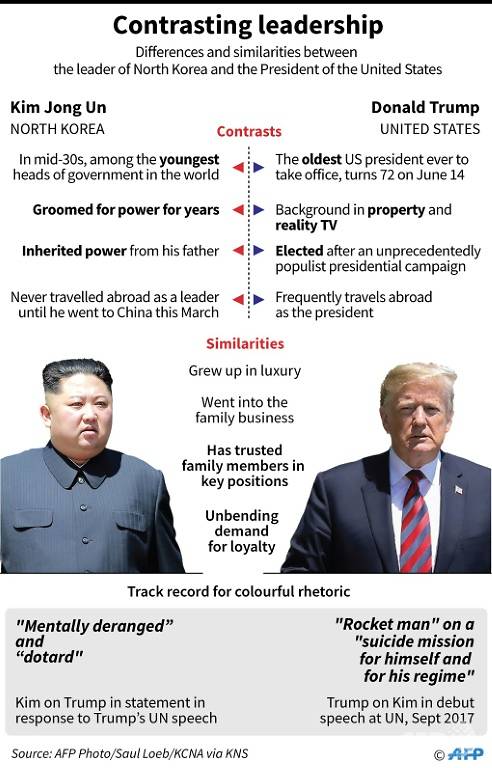
Only months ago, Kim and Trump were hurling personal insults at each other – “dotard”, “rocket man” – and boasting about their nuclear buttons.

But in the luxurious surrounds of a hotel in neutral Singapore, the pair appeared almost playful at times, going for a stroll in the grounds and Trump allowing Kim a peak inside “The Beast”, his armoured car.

The two leaders chatted and smiled during a break in their historic talks

The two leaders chatted and smiled during a break in their historic talks. (Photo: AFP/Saul Loeb)

At times Trump seemed to be falling over himself to shower the younger man with compliments.

“I learned that he’s a very talented man. I also learned that he loves his country very much,” said Trump, adding that Kim had a “great personality” and was “very smart.”

The contrast with the G7 meeting only days earlier, where Trump found himself isolated over trade policy among traditional allies, was stark.

“Something important happened here that can never be taken back,” said Adam Mount, a nuclear policy expert at the Federation of American Scientists.

BETTER TO TALK

Amid the cynicism, supporters of the talks process argued that Kim’s acceptance on the world stage had positive aspects, and was better than leaving him an isolated threat to world peace.

And so soon after North Korea frazzled global nerves with nuclear and missile tests, many commentators said that talks and an agreement, however weak, were clearly better than the two sides lobbing insults – or worse.

“We are beginning to think about North Korea and Kim Jong Un in terms of ‘opportunity’, rather than threat, and that itself is a historic transformation,” said John Delury, a professor at the Seoul-based Yonsei University, who has long backed engagement with Pyongyang.

“What this does is encourages KJU in his readiness to come out into the world for dialogue and making peace.”

On his fifth outing on the world stage, Kim continued his efforts to soften his image, going for an extraordinary night-time stroll to view Singapore’s sights and even providing the world with the first-ever Kim selfie.

In a first, North Korean leader Kim Jong Un posed for a selfie with Singapore Foreign Minister

In a first, North Korean leader Kim Jong Un posed for a selfie with Singapore Foreign Minister Vivian Balakrishnan during an evening stroll through the city. (Photo: AFP/Nicholas Yeo)

In North Korea, the state-run Rodong Sinmun newspaper printed no fewer than 14 images on its front page of his visit to the Marina Bay Sands hotel complex and other sights.

Kim also earned himself headlines around the world, and arms control specialist Jeffrey Lewis tweeted: “I maybe got a little annoyed at the enthusiastic coverage of what is, at its base, a reality television episode.”

The two leaders struck a friendly tone at the historic summit in Singapore

The two leaders struck a friendly tone at the historic summit in Singapore. (Graphic: AFP/John Saeki)

Source link

US presidents and era-defining summits

0

SINGAPORE: Donald Trump hailed his meeting with Kim Jong Un as the start of a process that would rid North Korea of its nuclear weapons.

While experts on North Korea were largely underwhelmed immediately after the summit, most agreed that the very fact of their having met was potentially significant and could play out over the coming years.

Previous American presidents have also reached out to long-term foes, holding what turned out to be legacy-defining meetings.

Here are two of the most significant summits:

REAGAN AND GORBACHEV, 1986

Following a decades-long Cold War arms race that saw the United States and the Soviet Union amass tens of thousands of nuclear warheads, the two superpowers decided to sit down in October 1986 and discuss a radical proposal: the elimination of their nuclear arsenals.

US President Ronald Reagan and Soviet leader Mikhail Gorbachev met in Iceland’s capital in a bid to reach an agreement. The Reykjavik summit lasted two days but the talks collapsed. Washington refused to roll back development of its “Star Wars” missile defence project, which was unacceptable to the Kremlin.

The Reykjavik summit led to the US and the Soviet Union signing a treaty in 1987 to eliminate their

The Reykjavik summit led to the US and the Soviet Union signing a treaty in 1987 to eliminate their short- and intermediate-range nuclear missiles. (Photo: AFP)

In the years to come, however, the summit came to be seen as the harbinger of significant de-escalation. It led to a treaty the next year under which both Cold War powers would eliminate their short- and intermediate-range nuclear missiles. Thousands of these weapons were scrapped in what was the first major weapons reduction by the rivals.

Despite the failure to reach an agreement, Reykjavik is seen by many as a turning point in the Cold War. Gorbachev continued to push through with internal reforms he had started since coming to power, and the Soviet Union eventually collapsed in 1991.

NIXON AND CHINA, 1972

The United States broke off ties with China when the communists, led by Mao Zedong, took over the country in 1949. The relationship remained in limbo for almost two decades, during which their forces squared off in the Korean and Vietnam conflicts.

Then Richard Nixon won the 1968 US presidential election and decided to reach out to Beijing.

It started with secret contacts to lay the groundwork for formal contact, including a covert trip by Nixon’s national security adviser Henry Kissinger in 1971.

President Richard Nixon reaching out to China is considered one of the most important geopolitical

President Richard Nixon reaching out to China is considered one of the most important geopolitical events of the 20th century. (Photo: AFP)

A year later – in February 1972 – Nixon flew to China in what is widely considered one of the most important geopolitical events of the 20th century. The US leader met with the top Chinese leadership, including Mao and premier Zhou Enlai.

It kicked off formal contacts that led to full diplomatic ties in December 1978, and Washington withdrawing recognition from Taiwan. Nixon’s gamble is also seen by many as catalysing the end of communist China’s isolation and opening up to the rest of the world.

Source link

IN PICTURES: A walk through the historic Trump-Kim summit

0

SINGAPORE: History was made on Tuesday during the summit between US President Donald Trump and North Korean leader Kim Jong Un on Tuesday (Jun 12) that resulted in a “firm and unwavering commitment to complete denuclearisation of the Korean Peninsula”.

The momentous event was succinctly captured through photographs by the media at the scene. Here are some of the best shots that emerged during the unprecedented event. 

LANDMARK HANDSHAKE

The historic handshake between North Korean leader Kim Jong Un and US President Donald Trump lasted

The historic handshake between North Korean leader Kim Jong Un and US President Donald Trump lasted some 13 seconds AFP/SAUL LOEB

Mr Trump and Mr Kim shared a landmark handshake at about 9am Tuesday morning at the Capella hotel in front of a display of North Korean and US flags, ahead of their meeting. 

This is the first time a sitting US president has met with a North Korean leader.

Trump Kim gestures

US President Donald Trump gestures as he meets with North Korea’s leader Kim Jong Un at the start of their historic US-North Korea summit, at the Capella Hotel on Sentosa island in Singapore on Jun 12, 2018. (Photo: AFP/Saul Loeb)

Ahead of the meeting, both leaders looked to be in good spirits. Mr Trump reaffirmed this later on by calling the summit “very, very good” and said that he had developed a “very special bond” with Mr Kim.

Kim Trump thumbs up

US President Donald Trump gives a thumbs up as he sits down with North Korea’s leader Kim Jong Un. (Photo: AFP/Saul Loeb)

Both leaders were seen seated together before the meeting commenced. “It’s my honour … We will have a terrific relationship I have no doubt,” said Mr Trump ahead of the summit.

REACTIONS FROM AROUND THE WORLD

Moon Jae-in watching Trump Kim summit

South Korean President Moon Jae-in (R) and Prime Minister Lee Nak-yon (L) watch a television screen showing the summit between US President Donald Trump and North Korean leader Kim Jong Un. (Photo: AFP via Yonhap) 

The summit has ramifications not just for North Korea and the US, but the world at large. Leaders from all around the world expressed their hopes for the outcome of the summit, including South Korean President Moon Jae-in.

“I, along with all our people, sincerely hope that it will be a successful summit that will open a new era of complete denuclearisation, peace and a new relationship between South Korea, North Korea and the United States,” he said.

Cheers break out Trump-Kim summit

People celebrate as they watch a TV showing US President Donald Trump meets with North Korean leader Kim Jong Un during a news program at Seoul Railway Station. (Kyodo News via AP)

People from all over the world also felt the effects of the momentous summit. This photograph captures people in the South Korean capital Seoul, gathered at railway stations and across various locations for public screenings of the landmark summit.  

DEAL OR NO DEAL?

kim jong un and donald trump strolling

US President Donald Trump and North Korean leader Kim Jong Un at the Capella hotel. (Photo: Kevin Lim/Straits Times)

Trump Kim Stroll 4

North Korea’s leader Kim Jong Un walks with US President Donald Trump during a break in talks at their historic US-North Korea summit. (Photo: AFP/Anthony Wallace)

After his meeting with Mr Kim, Mr Trump assessed the progress made in this way: “A lot of progress, really very positive – better than anybody could have expected.

“We got to know each other well in a very confined period of time,” said Mr Trump following the summit about his meeting with Mr Kim.

kim jong un smiling

North Korea’s leader Kim Jong Un reacts at a signing ceremony with US President Donald Trump (not pictured) during their historic US-North Korea summit, at the Capella Hotel on Sentosa island in Singapore on Jun 12, 2018. (Photo: SAUL LOEB / AFP)

Following the closed-door meeting, Mr Kim appeared to be in high spirits shortly before signing a document signalling North Korea’s commitment to the denuclearisation of the Korean Peninsula. 

U.S. President Donald Trump and North Korea's leader Kim Jong Un look at each others before si

U.S. President Donald Trump and North Korea’s leader Kim Jong Un look at each others before signing documents, at their summit in Singapore

At around 1.40pm, the leaders emerged along with key officials to sign the document that had four main points. that reaffirms Among them: Joint efforts to build a “lasting and stable peace regime on the Korean Peninsula”.

Earlier on Monday, US Secretary of State Mike Pompeo said that: “The complete, verifiable and irreversible denuclearisation of the Korean Peninsula is the only outcome that the United States will accept.”

Trump Kim Sign 6

US President Donald Trump holds up a document signed by him and North Korea’s leader Kim Jong Un following a signing ceremony during their historic US-North Korea summit. (Photo: AFP/Saul Loeb)

Mr Trump said that Mr Kim agreed to the destruction of a missile engine testing site after the signing of agreement at the summit.

Trump Kim Sign 19

US President Donald Trump holds up a document signed by him and North Korea’s leader Kim Jong Un following a signing ceremony during their historic US-North Korea summit. (Photo: AFP/Saul Loeb)

The signed document promises a new relationship between the two countries and commits North Korea to working towards getting rid of its nuclear weapons. Mr Trump added in a post-summit press conference that he was confident Mr Kim would start the process of denuclearisation. 

“Chairman Kim is on his way back to North Korea and I know for a fact as soon as he arrives, he is going to start a process that is going to make people very happy and very safe,” said Mr Trump.

U.S. President Donald Trump and North Korea's leader Kim Jong Un shake hands after signing doc

U.S. President Donald Trump and North Korea’s leader Kim Jong Un shake hands after signing documents during a summit at the Capella Hotel on the resort island of Sentosa, Singapore June 12, 2018. REUTERS/Jonathan Ernst

“I just feel very strongly … that they want to make a deal,” said Mr Trump after the summit, echoing his previous sentiments that the talks were”honest, direct and productive”.

“I’ll do whatever it takes to make the world a safer place,” added Trump to the media during a press conference.

It was a largely positive summit that appears to have yielded favourable outcomes, but it remains to be seen if the commitments made during the summit will be upheld.

Source link

Hungry for more: Free mini Trump-Kim burgers draw eager crowd

0

SINGAPORE: As US President Donald Trump and North Korean leader Kim Jong Un sat down for their working lunch comprising western and Asian dishes at the Capella hotel on Tuesday (Jun 12), a queue of at least 20 people had formed outside the Royal Plaza on Scotts eager for a taste of the action – more specifically the free mini Trump-Kim Burger.

The burger giveaway at noon was the hotel’s way of commemorating the historic meeting between Trump and Kim – the first ever between a sitting US president and a North Korean leader.

The buzz surrounding the summit has grown steadily since last week, with local businesses capitalizing on the hype. 

Among the offerings have been the Trump-Kim Chi Nasi Lemak, the El Trumpo (Cheeseburger) and Rocket Man (Korean Fried Chicken) tacos, as well as the “Bromance”, a pair of drinks consisting of Asahi beer, diet Coke, Tequila and white grape soju, created by local bar Hopheads as a tribute to the Singapore summit.

A promotional event with Trump and Kim lookalikes Howard X and Dennis Alan on Saturday (Jun 9) saw hundreds of Singaporeans turn up at Bugis Junction, with some even forking out S$15 for pictures with the lookalikes.

Retiree Sue Dharan was the first in line for the free burgers, having queued for close to 30 minutes. “I hope it (the meeting) is something to benefit the whole world as we work towards peace and a better world for our younger generation,” she told Channel NewsAsia.

“I’m looking at the positive side of things, and from what I’ve read, it seems that the one-on-one meeting was very, very good from Mr Trump’s point of view,” she said. “We should be very proud of this moment because it’s a once-in-a lifetime one.”

trump-kim burger closeup

(Photo: Matthew Mohan)

Consisting of minced chicken and kimchi patty, seaweed, the mini Trump-Kim burger was a hit with most, with the 250 burgers to be given away snapped up within 20 minutes.

“We wanted to celebrate ‘Summit Day’ with Singaporeans and tourists,” said Royal Plaza on Scotts general manager Patrick Fiat. “It is a fusion, a start of a new friendship, a balance between North Korea and the US living in harmony, (displayed through) food and the summit.” 

The hotel had earlier in the week launched the Trump-Kim Burger and the Summit Iced Tea, priced at S$12 and S$6 respectively, in commemoration of the summit.

Student Ric Chan travelled from Sengkang to sample the free mini-burger. “It tastes a little spicy, but overall it’s really good and tasty, “said Mr Chan, who came dressed in a black DMZ t-shirt with flags of both North and South Korea.

Student Ric Chan with free Trump-Kim burger

(Photo: Matthew Mohan)

Another passer-by who only wanted to be known as Mr Chan C S, happened to be in the area and decided to queue for the mini Trump-Kim burger, just before the giveaway ended.

His verdict? “It’s complimentary, so no complaints!”

We’re live on YouTube with our comprehensive coverage on the Trump-Kim summit. Watch here.

You can also catch the livestream and read updates at www.channelnewsasia.com/trumpkimsummit.

Source link

Singapore 20th most expensive city in the world for expats: Survey

0

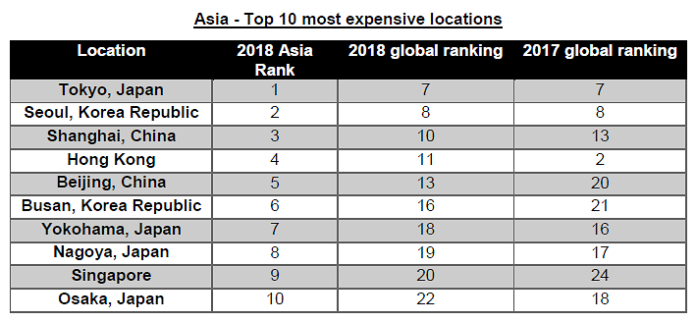
SINGAPORE: Singapore has re-entered the top 20 most expensive locations in the world for expatriates, according to the latest cost of living survey by United Kingdom based consultancy firm ECA International.

In a press release on Tuesday (Jan 12), the firm said Singapore was ranked 20th most expensive in the world and ninth in the Asia Pacific region for expatriates.

In the same survey published in December, Singapore was ranked 21st most expensive globally and ninth in the Asia Pacific. In June last year, Singapore was ranked 24th most expensive globally and 10th in the Asia Pacific. The highest Singapore has featured in the ranking was at 18th place globally  in 2016. 

“The price of goods and services included in our basket of goods has only seen modest increase in Singapore over the past 12 months, in line with other similar economies in Asia,” said ECA International’s regional director for Asia Lee Quane.  

“However, the rise in the rankings has been due to the relative strength of the Singapore dollar versus the US greenback in the past year,” he added. 

Tokyo is the most expensive location in the region for expatriates.  

Hong Kong’s ranking fell significantly from second to 11th place, its lowest since 2015. The main reason, according to Mr Quane, was the fall in value of the US dollar, against which the Hong Kong dollar is pegged, over the last year. 

Noting that Tokyo’s global ranking has remained relatively static in the past few years – staying in seventh place in the latest rankings – Mr Quane said that it was only the yen’s relative strength against the US dollar that has seen the Japanese capital overtake Hong Kong to become the most expensive place in Asia for foreigners to live and work.

Top 10 most expensive cities Asia

(Table: ECA International)

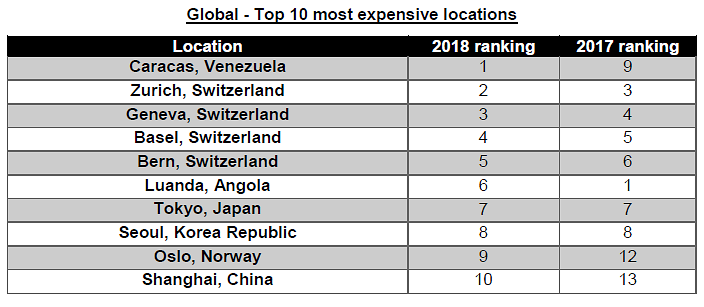
Meanwhile, skyrocketing inflation in Venezuela has propelled its capital Caracas to the top of the global rankings, overtaking all cities in Switzerland and last year’s most expensive location, Angolan capital Luanda.

“The economic situation in Venezuela has become increasingly volatile with inflation reaching an astounding 7,000 per cent in the year to March 2018 and 1,800 per cent over the last six months alone,” Mr Quane said. 

Top 10 most expensive cities Global

(Table: ECA International)

ECA International said in the press release that the twice-yearly survey is to help companies calculate cost of living allowances so that their employees’ spending power is not compromised while on international assignments. 

The surveys compare a basket of like-for-like consumer goods and services commonly purchased by assignees in 475 locations worldwide, excluding certain living costs such as accommodation and school fees, which are usually covered by separate allowances.

Source link

Kim Jong Un commits to ‘complete denuclearisation’ in joint text with Trump at Singapore Summit

0

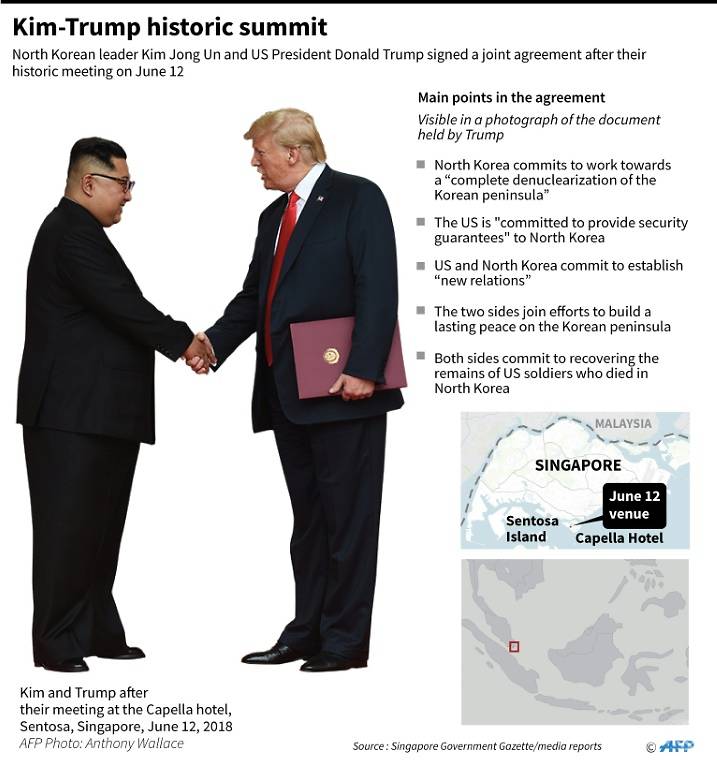
SINGAPORE: North Korean leader Kim Jong Un on Tuesday (Jun 12) reaffirmed his “firm and unwavering commitment to complete denuclearisation of the Korean Peninsula”.

This was stated in the joint document signed by Mr Kim and US President Donald Trump at their historic summit in Singapore.

Mr Trump, on his part, committed to provide security guarantees to North Korea. The document did not state what those guarantees might be. 

It made no mention of demands made by the US previously for “complete, verifiable and irreversible denuclearisation”.

The document laid out the following key points:

  • US and North Korea commit to establish new US-DPRK relations in accordance with the desire of the peoples of the two countries for peace and prosperity.
  • The two countries will join their efforts to build a lasting and stable peace regime on the Korean Peninsula.
  • Reaffirming the April 27, 2018 Panmunjom Declaration, North Korea commits to work towards the complete denuclearisation of the Korean Peninsula.
  • US and North Korea commit to recovering remains of prisoners of war including the immediate repatriation of those already identified.

The document stated that follow-on negotiations led by the US Secretary of State, Mike Pompeo, and a relevant high-level North Korean official will be arranged “at the earliest possible date” to implement the outcomes of the Singapore summit.

Before both leaders proceeded to sign the document, at the Capella hotel in Sentosa, Mr Trump said their meeting went “better than expected and no one could’ve expected this”.

Trump Kim Sign 19

US President Donald Trump holds up a document signed by him and North Korea’s leader Kim Jong Un following a signing ceremony during their historic US-North Korea summit. (Photo: AFP/Saul Loeb)

Mr Kim said the “world will now see a major change”.

“We had a historic meeting and we’ve decided to leave the past behind,” he added. “The world will see a major change. I would like to express my gratitude to President Donald Trump for making this happen.”

Source link