COME to think of it, there’s a lot of new technology that makes its way to Singapore.
In fact, the government has been very effective in terms of persuading some of the world’s leading companies to set up research facilities in the country and building partnerships that go a long way in terms of sharing a vision for tomorrow’s technology.
Just yesterday, the Lion City’s Finance Minister Heng Swee Keat said that Singapore’s single-layer system of government means it can be more decisive about test-bedding new technology than most other countries, and this makes it an ideal partner for countries to test out innovations.
Earlier this year, for example, when other countries were mulling over the repercussions of drones taking on a more commercial role, Singapore declared One North, a 200-hectare business park as the country’s first drone estate.
In turn, Airbus, Singtel, and several other companies have flocked to the country to build and test their drone technology.
Singapore set-up an designated ‘drone district’ to test this new technology. Source: AP.
Heng is keen to grow the country’s collaboration with Japanese agencies and companies, he told Singaporean media at the end of a six-day working visit to Tokyo.
In the Land of the Rising Sun, Heng met with bankers, technology and robotics companies, politicians, businessmen, and financial regulators.
“We also have regulatory sandboxes where usual rules do not apply, and that allows for innovation to be tested and tried in a proper setting,” Heng said.
These sandboxes allow regulators to quickly identify issues and rectify them since the government follows an approach that tries to avoid regulation from impeding development.
However, Heng also highlighted the importance of regulations in building and maintaining a safe environment that supports the ecosystem for development and innovation.
Just prior to the Japan trip, Heng was in China for eight days, visiting ShanghaiTech among other potential partners.
“In a world that is rapidly changing and increasingly interconnected, countries need to collaborate. No country has all the expertise it needs. Collaborations can achieve win-win outcomes,” Heng told China.
This article originally appeared on our sister site Tech Wire Asia.
SINGAPORE: Channel NewsAsia has won two awards at the annual Society of Publishers in Asia (SOPA) awards and one at the Banff Rockie Awards for its digital features.
The SOPA awards for editorial excellence were announced at a gala dinner at the Hong Kong Convention and Exhibition Centre on Wednesday night (Jun 13).
Part of a series titled Asia’s Toughest Jobs, the article, photos and video portrayed how the workers endured noxious fumes to mine sulphur on steep slopes.
Miners will usually make two trips up and down the crater with heavily loaded baskets. (Photo: Jack Board)
CNA Insider also won the Excellence in Video Reporting award for The real Suicide Squad: Heroes of Marawi, which told the story of how civilian volunteers risked their lives to save those trapped in Marawi, which had been under siege for five months.
As bombs fell and bullets flew in the 5-month siege of Marawi, one group of civilian volunteers risked their lives to rescue more than 1,700 trapped in the conflict zone. For the first time, here is the untold story abou the extraordinary courage of the real-life Suicide Squad.
Digital news supervising editor Yvonne Lim said: “This was a unique opportunity to stitch together a compelling story almost entirely from user-generated content, about a hitherto unsung group of heroes.
“Current affairs producer Anna Tolentino trawled through reams of self-shot footage, while digital producer Ruth Smalley pieced together a fast-paced package designed for the digital audience.”
Judges at SOPA said it was “very well paced and structured” and “excellent visual storytelling using user-generated content”.
At the Ijen Crater, Board said they had to wear face masks during the shoot as they worked amid toxic fumes.
“It requires a hike in darkness up a mountain in cold conditions, traversing slippery climbs and jutting rocks. It was like being on another planet … Then there’s the steaming, venomous sulphur lake and the noxious gases whipping from it. It was hard to breathe and persistent rain made filming really difficult,” he said.
Board added that the workers’ willingness to share their lives with him openly was the decisive factor for this story.
“And when that life is such a challenging one, that generosity is a wonderful thing to receive,” he said. “So is this amazing award. I’m really feeling honoured.”
SOPA judges praised the excellent photos and video in the feature: “The photos don’t just document and illustrate the topic, but they are unique artworks with artistic compositions, colours and forms.”
Separately, CNA Insider also picked up an award at the Banff World Media Festival Rockie Awards, an international competition for television and digital content with entries from more than 40 countries.
Jyothi Svahn was 5 when her Swedish parents adopted her from India. Growing up, she was haunted by the memory of her birth mother abandoning her. But a trip back to India revealed a dark secret – she could be one of the millions of ‘manufactured orphans’ around the world.
This is the first chapter of a 6-part web series.
“The Rockie Awards win was a big deal because it is one of the world’s largest programme competitions of its kind with entries from major networks such as Discovery Network, Vice and BBC,” said Ms Lim.
“Manufactured Orphans was the result of months of deep investigative work across several countries by Sumithra Prasanna, to expose corruption in the global adoption industry. Digital editor Ray Yeh serialised the journey of one woman’s search for her birth mother and the emotional conclusion as a digital six-parter.”
SINGAPORE: Two Indonesian men were sentenced to jail on Thursday (Jun 14) for trying to smuggle 133 cartons of duty-unpaid cigarettes, which were uncovered on a barge at Brani Terminal on Wednesday.
Bahril, 28, was sentenced to 14 weeks’ jail while Naudin, 26, was given 10 weeks, the Immigration and Checkpoints Authority (ICA) said in a news release.
The cigarettes were concealed in various parts of the barge, which is a boat used to carry containers. They were uncovered after ICA and the police conducted checks at about 1am on a tugboat that was towing the barge.
The barge at Brani Terminal where 133 cartons of duty-unpaid cigarettes were uncovered. (Photo: Immigration & Checkpoints Authority)
The total duty evaded was about S$15,400 while the Goods and Services Tax evaded was about S$1,100.
“The ICA will continue to conduct security checks on passengers and vehicles at the checkpoints to prevent attempts to smuggle in undesirable persons, drugs, weapons, explosives and other contrabands.
“The same methods of concealment used by contraband smugglers may be used by terrorists to smuggle arms and explosives to carry out attacks in Singapore,” ICA said.
Japan is working on arranging a meeting between Prime Minister Shinzo Abe and North Korean leader Kim Jong Un, with one possibility including the premier’s visit to Pyongyang around August, the Yomiuri newspaper reported on Thursday.
FILE PHOTO: North Korea’s leader Kim Jong Un listens to U.S. President Donald Trump as they meet in a one-on-one bilateral session at the start of their summit on the resort island of Sentosa, Singapore June 12, 2018. REUTERS/Jonathan Ernst/Files
Bookmark
TOKYO: Japan is eyeing a meeting between Prime Minister Shinzo Abe and North Korean leader Kim Jong Un, government sources said on Thursday, while the foreign minister said a summit would have to bring results on the issue of Japanese abducted by Pyongyang.
Abe, his public support hit by scandals, has adopted as his top domestic priority the issue of Japanese abducted to be trained as spies, vowing to withhold economic assistance until it is resolved, along with denuclearisation.
In 2002, North Korea admitted that it kidnapped 13 Japanese in the 1970s and 1980s, and five returned home. Abe has said he will not rest until the return of the rest, an issue he pressed U.S. President Donald Trump to raise at this week’s summit with Kim.
Japan believes 17 of its citizens were abducted, five of whom were repatriated. Eight are said by North Korea to have died, while four never entered the country.
Japanese media said one possibility was for Abe to visit Pyongyang, perhaps as early as August.
Speculation about a Kim-Abe summit emerges periodically, especially when Abe’s support weakens, but a ruling party lawmaker said in March any such meeting would have to follow a North-South Korea summit and a U.S.-North Korea summit.
Government sources, including one directly involved with the matter, told Reuters that Japanese officials plan to discuss a summit with North Korean officials at a conference on Northeast Asian security set for Thursday and Friday in Ulaanbaatar, the capital of Mongolia.
Another possibility could be for Abe to meet Kim on the sidelines of the Eastern Economic Forum to be held in September in Vladivostok, a source with knowledge of the matter said, although timing could be difficult, with Abe facing a ruling party leadership election the same month.
In Seoul, Japanese Foreign Minister Taro Kono told a news conference that Abe was willing to resolve the issue through “various channels and routes” with North Korea.
“If the leaders meet we need to have a summit meeting which would lead to resolution of the issue and we will make coordination going forward.”
TOO SOON FOR SUMMIT?
On Thursday, Abe met the families of the missing Japanese, renewing his pledge to bring home their loved ones.
“Using the U.S.-North Korea leaders’ meeting as an opportunity, we will face up to North Korea and solve this,” he told the group, many of them elderly and frail.
Shigeo Iizuka, whose sister Yaeko Taguchi was kidnapped in 1978, leaving behind two infants in a creche, said he was glad the issue had been raised with Kim but pointed to North Korea’s history of breaking its promises.
“The problem is there’s a long history of things just being dragged out, and of deception,” Iizuka told a news conference, referring to instances when North Korea reneged on promises to provide information on the missing Japanese, most recently in 2014.
“We need to make sure there’s nothing like that and things are done right this time … nothing hasty.”
(Additional reporting by Hyonhee Shin in SEOUL; Editing by Clarence Fernandez)
SINGAPORE: “Unruly passengers” are the reason why ride-hailing firm Grab decided to disable the GrabShare service between 1am and 5am every day, the company told Channel NewsAsia on Thursday (Jun 14).
The response from Grab comes after Channel NewsAsia reported on Wednesday that the GrabShare feature had been removed from the app during those hours last week, with emails sent out to drivers on Jun 4 showing that the change “has been in effect starting today”.
“We have received feedback from our driver-partners and passengers that it can be an unpleasant experience to be matched with unruly passengers on the same GrabShare ride. As most of these reported incidents happen between 1am to 5am, disabling GrabShare during this period helps create a safer and better experience for both drivers and passengers,” a Grab spokesperson told Channel NewsAsia.
“Drivers and passengers can continue to choose from multiple Grab services during those hours,” it added.
Grab did not elaborate on the number of reports of “unruly passengers” they have received.
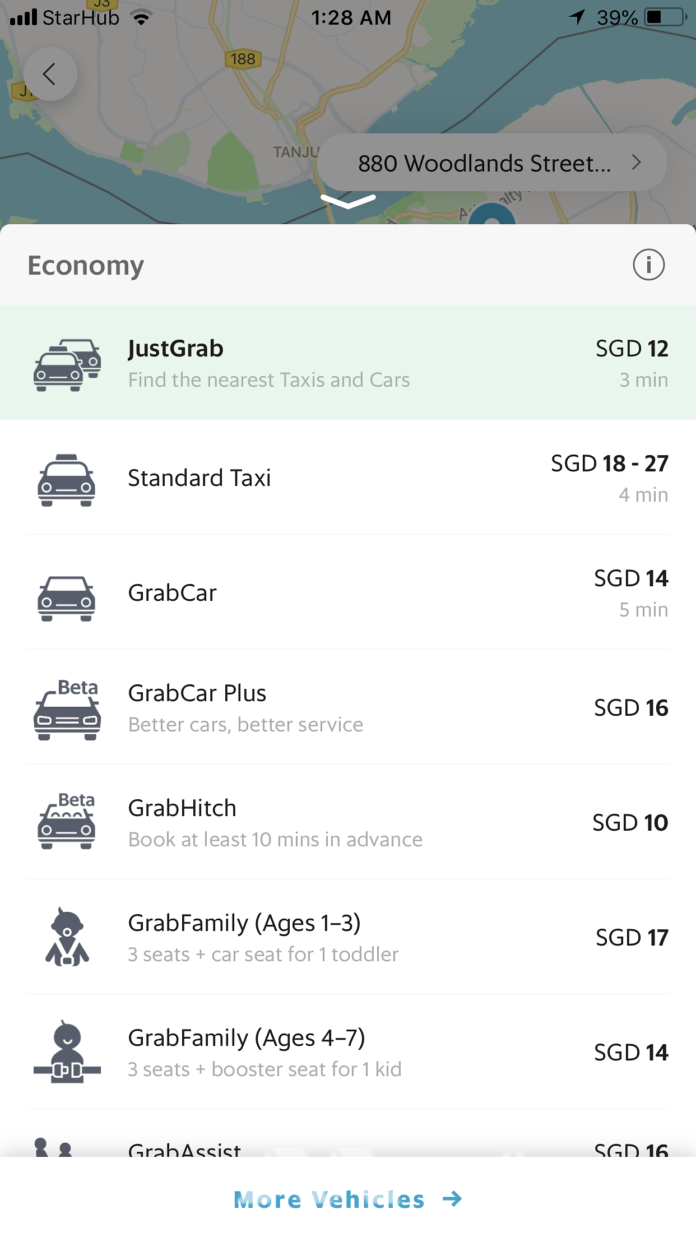
A screengrab of the Grab app at 1.28am on Jun 10 shows that the GrabShare option was not available. (Image: Nigel Chin)
The move to remove the GrabShare service during those hours has been met with ire from regular riders, with Ms Nancy Chan lamenting the lack of transparency and Mr Kamal Razaleigh calling it “unacceptable” that Grab did not inform passengers of the change.
Some Grab drivers also said that it had affected their income. One driver, who wanted to remain anonymous, said that the drivers have their “hands tied because there’s no other viable options to work at”.
Passengers who claimed they were not notified of the change said they had written in to Grab’s customer service after realising that they were unable to make a booking on GrabShare, and received a response saying that the service was disabled during those hours “due to safety concern”, without further elaboration.
In its response to Channel NewsAsia on Thursday, Grab said that it believes it is “important to take a proactive approach to ensure a safe and positive experience for both our passengers and driver-partners”.
The ride-hailing operator said it has recently enhanced the in-app emergency button so that passengers may alert an external security company and their emergency contacts if there is an urgent need for assistance, or set up auto-alerts to notify them when any unusual travelling pattern is detected.
SINGAPORE: It was an unusual sight for spectators at last Sunday’s National Sailing Championships, as six toy-sized, unmanned sailboats raced alongside the regatta dinghies at East Coast Park.
The brightly coloured, wooden-hulled boats called jongs sailed in an exhibition event organised by the Singapore Sailing Federation (SSF), as part of efforts to revive the centuries-old Malay tradition of jong racing.
“We want to recognise that this is very much part of Singapore’s history and tradition,” said SSF chief executive Lim Han Ee.
Up to half a century ago, jong racing was popular with children, while their larger manned versions called kolek were sailed by older men around the coastal areas like Katong, Siglap and Pasir Panjang.
Kolek races held on Singapore’s beaches in 1928. (Photo: Sport Singapore)
Mr Fawzi Nasir, who co-organised the demonstration event, used to sail his family’s kolek around St John’s island where he grew up in the 1960s.
“It’s a dying sport. Since the 1970s we haven’t had these traditional races in Singapore,” said the 48-year-old.
Mr Rohaizan Zain, SSF assistant general manager, said: “Our older staff have memories of these jongs – some used to stay on Pulau Tekong or the other islands, and these are the activities that they lived and grew up with.”
Mr Fawzi Nasir
Said Mr Lim: “We’re doing this with the view of bringing it back as a race in the Pesta Sukan – it’s a great way to re-engage the community and welcome new people into the sport of sailing.”
Mr Rohaizan added: “This is also a way to make our young sailors realise that we have deep roots in sailing – these traditional boats originate from here, it’s part of our maritime culture.”
THE SPORT’S COMEBACK
Jongs come in different sizes – from hull lengths of less than a metre, to almost two metres long. The bigger ones could easily be mistaken as a boat meant for man, but jongs are designed to sail on their own, unmanned – meaning every component of the boat has to be carefully adjusted before it is set into the water.
Jong in different sizes.
“You need to calibrate the sails and outriggers, and it really takes some skill on reading the wind direction,” said Mr Fawzi.
Unlike a normal sailing dinghy where a sailor leans out from the boat, the jong uses a weighted beam called an outrigger attached to its side. This enables the sails to catch wind, propelling the boat forward without capsizing.
Jongs can reach speeds of up to 8-10 knots – impressive considering these boats are made by hand, and often by islanders with no formal training in boat making.
“It may look very simple but once you get into it you realise that these guys are masters at what they do,” said Mr Lim, an ex-national sailor himself.
Calibrating the outrigger with added weight.
Mr Lim only came to know about the sport about a month ago when he brought a team of sailors from Singapore to witness a regatta in Desaru, where almost 200 participants showed up with their jongs.
“It was helluva fun. People were really into their discipline and activity, and I thought, ‘wow, why don’t we have this in Singapore?’” he said.
Mr Lim says the SSF will start a category for jongs in the next Pesta Sukan Regatta in August.
But looking for participants may not be so easy, said Mr Mazlan Nasir, Mr Fawzi’s brother.
I called all my old-time kampong friends to come for this demo event but no one was interested, and none of them have jongs anymore.
Still, people like Mr Fawzi’s family and Mr Lim have ambitious hopes to revive the sport: “We will start small. All you need is five or six jongs for a race, but if we can get more than 20 participants, that would be a good number.
“We will gauge the interest and if people start coming, they want to buy (jongs) and participate, then it’s a way to grow the community,” said Mr Lim.
Mr Lim also hopes to attract participants from Indonesia and Malaysia in the future.
“It’s one of those things that can easily go into the hundreds. Then it’ll become a regional Southeast Asian event,” said Mr Lim.
Boatmaker Mr Ilol, 58, who came to Singapore from the Riau Islands for the jong demo, said: “I’ve been sailing jongs since I was a kid. In the past we only played it in kampongs, but now I feel very proud that it’s becoming an international sport. It’s part of our Malay culture and we should preserve it.”
Watch CNA Insider’s earlier video, Racing Time And Tide
SINGAPORE: Ride-hailing firm Grab has disabled its GrabShare feature between 1am and 5am, after receiving “numerous report(s)” about safety concerns.
GrabShare allows passengers to carpool in a car or taxi with other travellers headed in the same direction for a cheaper ride.
The move to disable the function during that period of time was announced to Grab drivers earlier this month, but passengers said they were not notified of the change.
In an email to drivers last Monday (Jun 4), Grab said: “Dear Partner, to further improve the GrabShare experience and safety for our Partners and passengers, the GrabShare service will not be available from 1am – 4.59am daily.
“This change has been in effect starting today. All other services will remain available at all hours.”
Screenshot of the email that was distributed to Grab drivers on Jun 4.
“THEY SHOULD BE MORE TRANSPARENT”
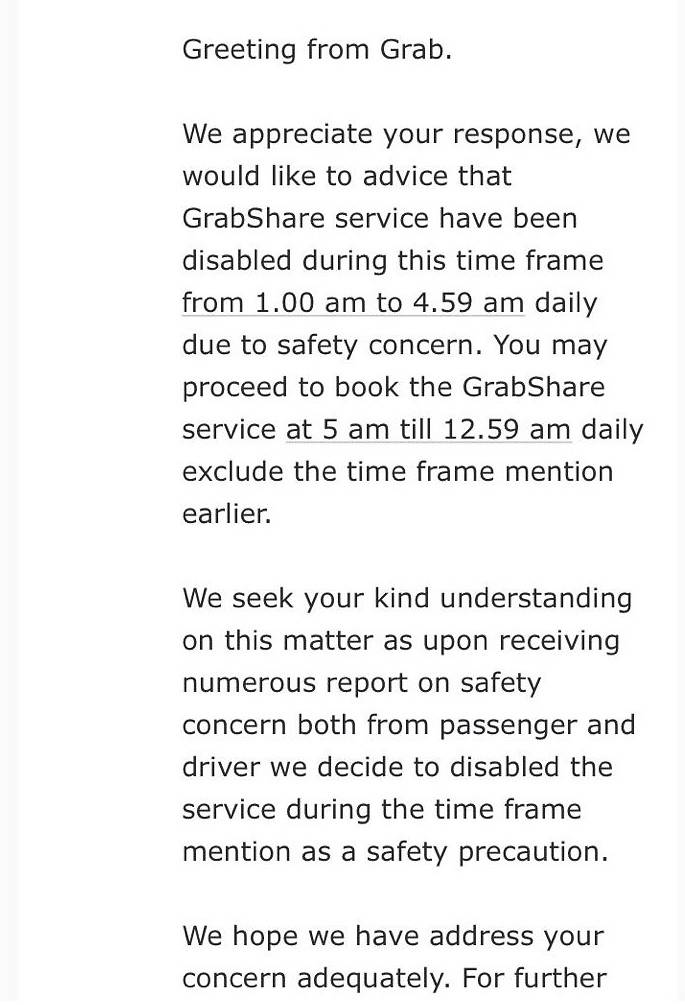
Passengers who wrote to Grab’s customer service after realising that they were unable to make a booking on GrabShare received an email response saying the service was disabled during those hours “due to safety concern”.
The email did not elaborate on what those safety concerns were.
“We seek your kind understanding on this matter as upon receiving numerous report on safety concern both from passenger and driver (sic), we decided to disable the service during the time frame mention (sic) as a safety precaution,” the email stated.
A screenshot of an email reply from Grab.
Kamal Razaleigh, an executive who previously used GrabShare to travel home after ending his shift at 2am, was among the passengers who wrote to Grab.
He told Channel NewsAsia that it was “unacceptable” that Grab did not inform passengers of this development.
“It’s a little disrespectful. I had to find it out from my driver,” he said. Mr Kamal typically spends S$13 for his ride home using GrabShare. Now, he forks out up to S$24 for JustGrab or taxi rides.
Another regular Grab user, Ms Nancy Chan, said she found out on Saturday (Jun 9) that the GrabShare service was disabled when she tried to make a booking at 2am.
“I was shocked as there was no proper notification from Grab that they had removed the service until I tried to make the booking. They should be more transparent and make an announcement before they implemented this so that riders can plan better,” she said.
Ms Chan added that besides the lack of transparency, she is also concerned about surges in demand and pricing that typically happens just before 1am.
“Prices are bound to surge just before the 1am timing as more people try to book a GrabShare rides right before 1am,” she said.
“I took a ComfortDelgro taxi after 1am from town recently. The price is now lower than Grab.”
The company revealed that GrabShare rides are 30 per cent cheaper than JustGrab rides, but still subject to surge pricing. Furthermore, only two passenger bookings are allowed per trip.
This, coupled with GrabShare’s matching algorithm, minimises long detours for both passengers and drivers, Grab said.
“LESS VALUE FOR MY FUEL”: GRAB DRIVER
Some Grab drivers Channel NewsAsia spoke to said disabling the GrabShare feature during the stipulated period has adversely affected their income.
One driver who declined to be named said GrabShare allowed him to earn more from each ride as he would be able ferry more passengers while driving in the same general direction.
“When I work late hours, I like to take advantage of GrabShare at Changi Airport because I can pick up more than one passenger when there’s an incoming flight,” he said.
“But now I can only take one at a time. It’s less value for my fuel,” he added.
Another driver, who also wanted to remain anonymous, told Channel NewsAsia that he once earned a total of S$50 from two passengers after picking them up separately via GrabShare at around 3am.
“There is actually quite a lot of business for us at night. Grab has just found another way to reduce our income,” said the 28-year-old.
“This is an example of how Grab exerts its monopoly in the ride-sharing market. And we drivers have our hands tied because there’s no other viable options to work at,” he added.
Channel NewsAsia has contacted Grab for official comment.
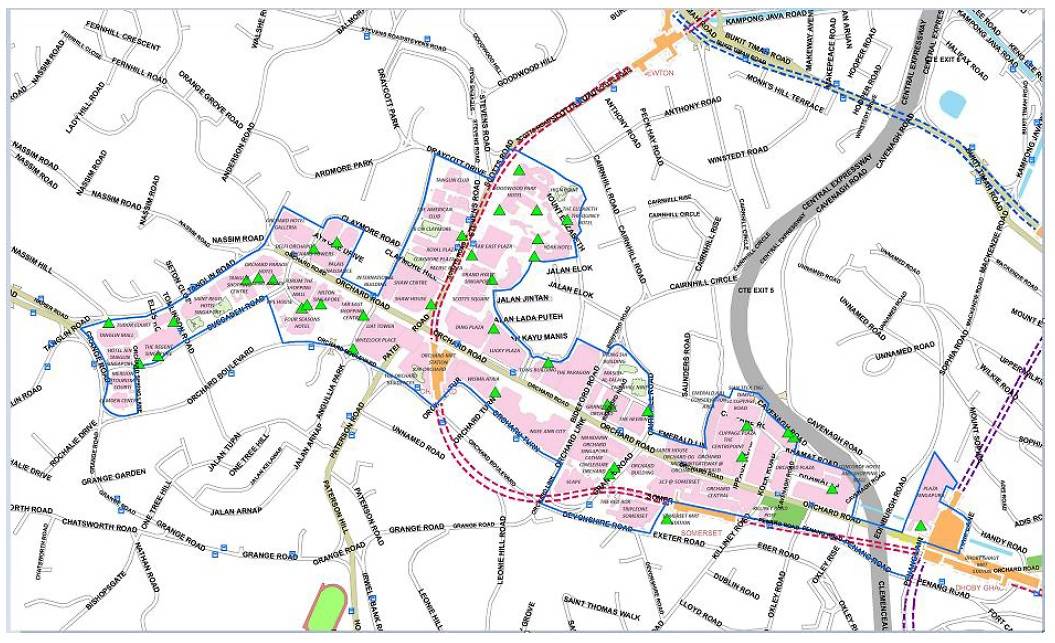
SINGAPORE: Smokers are getting a six-month reprieve from plans to make Orchard Road a no smoking zone.
The implementation of the smoke-free zone in the Orchard Road area will be delayed to the end of this year instead of starting in July, said the National Environment Agency (NEA) on Wednesday (Jun 13).
It was reported last year that NEA planned to transform Orchard Road into a smoke-free zone from Jul 1, except for several designated smoking areas.
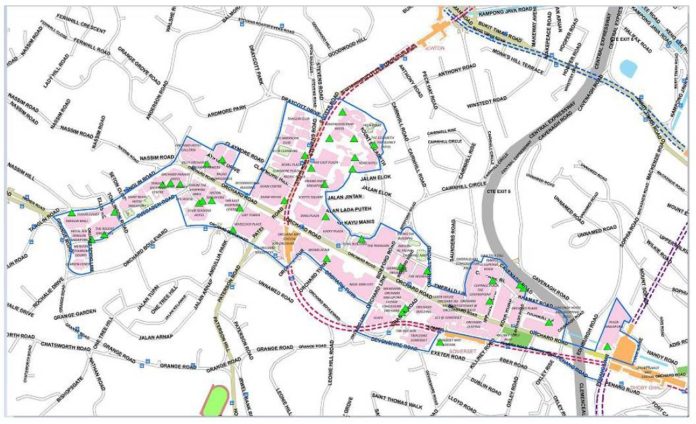
There will be about 40 of these areas including five publicly-owned ones at Orchard Towers, Far East Plaza, The Heeren, Cuppage Terrace, and behind Somerset MRT station, NEA said.
A location map showing the No Smoking Zone at Orchard Road district. (Image: NEA)
More than 100 buildings will be within the no-smoking zone when it starts.
The new implementation date aims to “provide more time for businesses to prepare for the no smoking zone”, as some businesses gave feedback that they needed more time to make the necessary preparations, said the environment agency in a news release.
Businesses will need to prepare by identifying and setting up designated smoking areas, and smokers will need to familiarise themselves with these areas.
Additionally, restaurants within the smoke-free zone that have existing smoking corners will also be given an extension of about six months to remove them.
This follows last year’s decision to stop accepting applications from food outlets islandwide to set up smoking areas in their premises.
However, smokers can still smoke at existing corners at these outlets outside Orchard Road until the existing licence for these places end.
For the first three months after the smoke-free zone is implemented, those caught smoking in Orchard Road will receive verbal warnings and those who ignore the warnings may be issued a fine.
After this three-month period, enforcement action will be taken against offenders who smoke in public areas within the smoke-free zone.
The new implementation date will be announced later following amendments to the Smoking (Prohibition in Certain Places) Act in the second half of 2018.
WASHINGTON: In the end, diplomacy can work – as a process, not an event. There is no Big Bang theory of nuclear diplomacy.
If no further progress is made toward peace on the Korean peninsula, all the back-and-forth, the Moon-Kim meetings, the Singapore summit itself, is at worst another good start that faded. It is more likely, however, a turning point.
It is easy to announce a morning-after defeat for Trump: To criticise the agreement as vague and lacking in specific commitments regarding denuclearisation.
It is easy to forget that a few months ago North Korea was still testing nuclear devices to spark fears of a dark war. Calling the Singapore summit a failure in light of more detailed agreements and different efforts from the past ignores the reality that all of those past agreements failed.
Only a few months ago State Department North Korean expert Joseph Yun’s retirement triggered a round of dire claims of a “void at (the) head of Trump’s Korea diplomacy.”
U.S. Special Representative for North Korea Policy Joseph Yun answers questions from reporters in Tokyo, Japan April 25, 2017. (Photo: REUTERS/Toru Yamanaka/Pool/Files)
Similar predictions were made over the lack of an American ambassador in Seoul. The State Department was decimated. The Council on Foreign Relations assessed the chances of war on the peninsula at 50 per cent.
Success on the Korean peninsula, as in the Cold War, will be measured by the continued sense that war is increasingly unlikely. Success in Singapore is the commitment to meet again, and again after that; the more modest 2015 Iranian Accord (which didn’t even involve actual nuclear weapons) took 20 months to negotiate.
Cold War treaties required years of effort, crossing administrations in their breadth. To expect more than a commitment to the next steps (did anyone think Kim would box up his nukes post-summit and mail them off?) is ahistorical.
Did none of those complaining ever go on a first date?
Singapore also signals it is time to abandon now-disproven tropes. Trump and Kim are not madmen and their at times bellicose rhetoric is just that. Both men will need to balance conciliatory steps forward with rougher gestures directed at domestic hardline audiences.
So there will be tweets and setbacks. But the idea this is a North Korean ruse is worn thin.
“Small countries confronting big countries seldom bluff,” one history of the Cuban Missile Crisis explained. “They can’t afford to.”
The pieces for progress are in place if they can be manipulated well, including a North Korea with a young, Western-educated, multi-lingual leader perhaps envisioning himself as his nation’s Deng Xiaoping, the man who will bring the future to his isolated nation while preserving its sovereignty.
Reformist leader Deng Xiaoping, who began the process of opening up China to the world, warned against building the country on the rule of just one or two people (Photo: AFP/XINHUA)
“We have… decided to leave the past behind,” Kim said as he and Trump signed their joint statement.
There is momentum in Pyongyang, a restless and growing consumerist middle class living in a parallel semi-market economy fuelled by dollars, Chinese currency, and increasing access to foreign media.
Couple that with an American president willing to break the established “rules” for (not) working with North Korea. A careful look shows the glass is more than half full.
NOTABLE EVENTS
Another important difference this time is the presence of South Korean President Moon Jae In. He was a prime mover behind the notion of any summit at all, helping convince Washington North Korea is a uniquely top-down system and needs to be dealt with as such.
His April 27 meeting with Kim established the main negotiating points ahead of Singapore.
After Trump’s May 24 initial cancellation of the Singapore meeting, Moon shuttled between Washington and Panmunjom to get the process moving again. In a climate of constant bleating about war, that was skilled diplomacy played out on a very big stage.
No nuclear negotiations in history have had such an interlocutor. Moon’s continuing juggling of his roles – honest broker, fellow Korean nationalist with shared cultural, linguistic, historical, and emotional ties, American ally, informal adviser to both Kim and Trump – is key to the next steps.
South Korean President Moon Jae-in looks at a TV broadcasting a news report on summit between the U.S. and North Korea during a cabinet meeting at the Presidential Blue House in Seoul, South Korea, June 12, 2018. (Photo: Yonhap via REUTERS)
Moon himself is the vehicle in place to resolve problems that in the past were deal-breakers.
What didn’t happen in Singapore is also important. Trump did not give away “the store.” In fact, there is no store Trump could have given away.
The United States agreed to suspend military exercises which have been strategically cancelled in the past, and which can be restarted anytime. The real deterrent is off-peninsula anyway: B-2s flying from Missouri, and missile-armed subs forever hidden under the Pacific.
Trump did not empower Kim. Meeting with one’s enemies is not a concession. Diplomacy is not a magic legitimacy powder the United States can choose to sprinkle on a world leader. The summit acknowledges the like-it-or-not reality of seven decades of Kim-family rule over a country armed with nuclear weapons.
Trump’s decision to begin the peace process with a summit is worthy. Imagining a summit as some sort of an award the United States can bestow on a country for “good behaviour” is beyond arrogant.
Successive administrations’ worth of that thinking yielded a North Korea armed with a hydrogen bomb, missiles that can reach the United States, and a permanent state of war. A top-down approach (China is the go-to historical example) is a valid way forward in that light.
WHAT’S NEXT?
The easiest thing to do now is generically dismiss the summit; the North will cheat and Trump will tweet. The harder thing will be to parse carefully what is next.
The United States must incentivise denuclearisation. The 2015 Iran Accord is one example, where sanctions were eased, trade cranked up, frozen assets released, all alongside Iranian steps to reduce testing, production, and stocks of fissionable materials.
Another reaches back to 1991, when Washington provided financial rewards for the inventory, destruction, and ultimately the disposal of weapons of mass destruction in Belarus, Kazakhstan and Ukraine. New jobs for the out-of-work nuclear scientists, too, to keep them from selling their skills elsewhere.
But more than anything Trump must convince Kim to trust him, particularly in light of Iraq, Libya, and especially Iran, because the core ask here is extraordinary.
President Donald Trump has said his meeting with Kim Jong Un could help write “a new chapter” in US-North Korea ties. (Photo: AFP/Saul Loeb)
Only one nation in history that self-developed nuclear weapons, the white minority government in South Africa, ever fully gave them up, and that was only after the apartheid regime was about to disappear into history.
If Trump followed advice from the left he would have stayed home like past presidents. If he’d listened to the right he’d have bulled into the room and said “Lose the nukes, number one and we’re done” and the process would have truly failed.
North Korea developed nuclear weapons to guarantee its survival. If the United States and South Korea want the North to give up those weapons, something has to replace them as that assurance of survival. The summit created the platform.
The key to what happens next is how Trump, Moon and Kim work to resolve that issue.
Peter Van Buren, a 24-year US State Department veteran, is the author of We Meant Well: How I Helped Lose the Battle for the Hearts and Minds of the Iraqi People, and Hooper’s War: A Novel of WWII Japan.
SINGAPORE: The television connections have been checked, the flags and jerseys mounted on the walls, and the storerooms are well-stocked. All local businesses and retailers are waiting is for World Cup fever to grip the nation.
With the 2018 Fifa World Cup set to kick off in Russia on Thursday (Jun 14), businesses and retailers here are pulling out all stops to capitalise on the quadrennial football extravaganza.
From extending their operating hours, installing more television screens at their premises, stocking up on products, to building their marketing and promotions plans around the month-long event, businesses are hoping to get that extra boost to their bottom lines through the tournament.
Popular bar and dining chain Harry’s, which will show all 64 matches at most of its 21 outlets, are targeting a 20 per cent rise in revenue.
Ditto Muddy Murphy Holdings, whose four sports bars — Muddy Murphy’s Irish Pub, The Penny Black London Pub, and Prince of Wales Backpacker Pubs in Boat Quay and Little India — are projecting a 30 per cent hike in business.
Their optimism stems from a simple reason: Match timings.
MATCH TIMINGS
The previous three editions of the World Cup — Germany 2006, South Africa 2010 and Brazil 2014 — have seen most matches being played in rather ungodly hours in Singapore.
Ordinary fans were reluctant to venture out to bars beyond midnight on weekdays just to catch some World Cup action. In those years, many chose to enjoy the World Cup experience at home.
A Harry’s bar in Singapore. (Photo: Harry’s/Facebook)
This year, it’s different. Russia is closer to Asia than other European countries, and the time difference, a mere five hours behind, is much more palatable for the ordinary fan.
The late games — just 17 out of 64 — start at 2am Singapore time. The rest will be played between 6pm and midnight.
Having World Cup football on prime time television is a big factor why local pubs and eateries are sparing no efforts in bringing the best World Cup experience to their patrons.
“The timings of the games this year are just nice. We can incorporate the games into our entertainment programme that runs from 6pm to 4am on weekends,” said 1-Altitude general manager Ian Sim, whose al-fresco bar at One Raffles Place will be screening the World Cup for the first time.
A Harry’s spokesperson agreed, saying: “The World Cup is an exciting time for us as it only takes place once every four years.
Most matches (this year) start in the evening, after office work hours. With this year’s favourable timings, we are looking forward to a bigger turn-out.
The chain said the projected 20 per cent increase in revenue will more than make up for the costs of television broadcast packages, liquor licences, additional food and drink supplies, and additional manpower needed for their extended operating hours.
The bars under the Muddy Murphy stable have installed six to eight big television screens at their premises, bracing itself for a 30 per cent increase in footfalls.
“The World Cup really brings people from all walks of life together in excitement,” said Mr Bjorn Seegers, director of Muddy Murphy Holdings, whose Claymore Road outlet has screened four World Cup tournaments since 2002.
“It’s controlled rowdiness. There is a lot of spectator jeering, shouting. Of course, it is a pub so we expect that. That’s what people come for.”
Newer establishments, like Cafe Football Singapore which opened early last year at Woodleigh Park, are also muscling in for a piece of the pie.
Owned by former Manchester United stars Gary Neville and Ryan Giggs, the football-themed restaurant has fully decorated its interior with World Cup jerseys and flags, on top of its United-dominated memorabilia — hoping to offer fans a different visual experience.
In order to entice customers, establishments are dangling various promotions and special events.
These include deals on food and alcohol leading up to and during the matches, as well as mini competitions such as guessing the first player to score a goal during a game and scoring a free pint.
Football-themed menus and special cocktails are also being concocted in numerous restaurants and bars. Fast-food chain McDonald’s, which has shown World Cup matches here since 2006, has introduced such as Chicken Pizza Kicks and returning favourite Sausage McGriddles just for this World Cup period.
Mcdonald’s Happy Sharing Box and Sausage McGriddles are new additions for the upcoming FIFA World Cup 2018. (Photo: McDonald’s)
RETAIL BOOST
The food and beverage industry is not the only one that stands to benefit from the World Cup.
Retailers are in for a windfall as fans have been parting with their cash for the latest jerseys, memorabilia and, make no mistake, football stickers.
Sports retailers said that the tournament usually brings in an extra 30 to 200 per cent in sales. So far, the kits of traditional powerhouses like Germany and Brazil have been in high demand.
Also popular among shoppers are Nigeria’s colourful home jersey and the crimson Egyptian team shirt donned by star forward Mohamed Salah.
The jerseys usually cost upwards of S$100, depending on how one customises them with players’ names and tournament patches, but fans are not batting an eyelid.
“I’ve been a big Germany supporter since the 1970s and now my whole family are following their fortunes at this World Cup,” said Mr Jason Cheong, 54, who bought five of the latest German kit for his whole family.
The design is nice and we are proud to wear it and show our colours.
Demand for stickers with images of the World Cup players are also rising since they started retailing here in April.
Mr Navin Nambiar, a sticker collector and one of the administrators of the Facebook group Panini Swapsies Group – Singapore, said that most of the stickers have been sold out in 7-11 convenience stores. They can also be found at Buzz convenience stores and Premier Football outlets, among other locations.
Collectors seek to fill up their album — priced at S$3.90 — with the stickers of 682 players, managers and special “shiny” editions representing the 32 participating nations. Packets of five stickers retail for S$1.20 each. Alternatively, boxes of 50 packets go for S$60.
People trade Panini World Cup stickers in Belgrade on Jun 11, 2014. (Photo: AFP/Andrej ISAKOVIC)
The closed Facebook group, now with more than 600 members, has tripled in size since the 2014 World Cup. The group facilitates the swapping of stickers among fans, and organises the occasional swap meet.
Mr Navin attributed this growth to “unexpected demand” following the 2016 Uefa European Championship. “The distributors (of the stickers) are trying to bring in more stock now because it’s selling so fast,” the 37-year-old said.
BROADCASTS ABOUND
While consumers have shown willingness to spend during past editions of major football tournaments, a constant bugbear is the ever-increasing TV subscription fees for these games.
This year, three local broadcasters — Mediacorp’s Toggle, Singtel and StarHub — announced in April that they are teaming up for the first time to bring a complete World Cup coverage to Singapore.
The price of S$112.35 — a package which allows fans to access the broadcast from their television sets and mobile devices — is unchanged from what fans have had to pay during the European Championships in 2016.
But it is the added value that is the game-clincher. For example, Mediacorp will also be screening nine matches, including the semi-finals and final, on their free-to-air okto channel — five more than previous years.
The package also gives fans access to a comprehensive World Cup site offering insights like team profiles, player information, the latest scores, rankings and match highlights, on top of a studio show “capturing all the action and drama of the World Cup”, which will be shown on the three broadcasters’ channels every match night.
The show will feature extended live feeds from the stadium and analysis of key moments with football personalities pre-match, at half-time and post-match. Parts of the presentation will be enhanced with augmented reality, Mediacorp said.
“For once, there is no price increase. And we can view the matches on our mobile devices anytime we want so I think it’s good value for money,” said fan Alexandria Lee, 42.
The World Cup happens once every four years so I’m happy to pay for it. I don’t want to miss out.
While Mediacorp declined to reveal the number of subscriptions it has secured so far, its head of digital products and technology Anil Nihalani said the take-up rate has been “good”.
“We continue to see strong interest as the clock ticks closer to the opening match,” added Mr Anil.
Mr Goh Seow Eng, Singtel’s managing director of Home and Consumer Singapore, said that they are seeing “strong take-up of our Fifa World Cup packs”. “We urge fans to sign up at their earliest convenience to avoid the last minute rush before kick-off on June 14,” he added.
On the corporate end, prices of World Cup business television packages have also remained unchanged since 2014.
The standard screen package costs S$3,090.16 with Goods and Services Tax (GST), and S$2020.16 with GST for each additional screen.
For larger screens of between 51 and 99 inches, the price comes in at S$5,230.16 with GST, and S$3,090.16 with GST for each additional screen.
Despite the subscription prices holding steady, some coffee shops said that they are not planning to screen the matches, mostly because of noise complaints from residents living close by.
Mr Andy Wong, owner of Wan Jin Coffeeshop in Serangoon, said he has not signed up for the World Cup package since 2010.
File photo of a coffeeshop.
“We had many complaints from the block upstairs about the ruckus during the World Cup… Now, you also can’t buy beer after 10.30pm. It doesn’t benefit us,” he said in Mandarin.
Chairman of the Foochow Coffee Restaurant and Bar Merchants Association Hong Poh Hin said that most of the 400 coffee shops under the association have also been deterred by complaints from residents. Only “a few” 24-hour ones have subscribed to the World Cup package.
“If you’re not running 24 hours, what is the point?” he added.
Over at Tang Tea House, its vice-chairman Sylvia Ler said that they used to screen World Cup matches every year at the Simpang Bedok outlet, up till this year. The Land Transport Authority has banned them from placing additional chairs on the road outside the eatery for fans to sit and watch the games from.
Ms Ler added that they are still contemplating whether to screen matches at the newly-opened Changi Village outlet, where they show games from European football leagues. Tang Tea House has two other eateries at Jalan Kayu and Jurong West.
However, she said it may not be financially worth it, given that the Changi Village outlet closes at 2am on weekends and midnight on weekdays.
“We can’t show all the matches but we still pay the same price for the package,” she said.
We would open later last time till the matches finished, and it took a toll on our workers.
ONE FOR THE COMMUNITY
For some, the value of the World Cup is more than just boosting the bottom line.
Football, after all, is widely regarded as a social glue that brings people together. And entities like People’s Association (PA) recognise that.
On Monday (June 4), the PA announced that fans can follow the action at 55 Community Clubs (CCs) and Our Tampines Hub (OTH). Fans can also catch live screenings at the Sports Hub’s OCBC Square, all six Safra clubs, and Changi Airport’s Terminal 3.
A PA spokesperson said that, given the favourable match timings, the organisation expects a total turnout of at least 600,000 fans compared to about 570,000 in 2014.
They had started screening matches at 30 CCs back then, the spokesperson said, but the number almost doubled to 58 when more CCs came on board following “overwhelming response”.
A man watches a television projection of a live telecast displaying the opening ceremony of the 2014 FIFA World Cup in Brazil, on Jun 13, 2014 at Hong Lim park community club in Singapore. (File photo: AFP/Roslan Rahman)
“Watching World Cup at the CCs with your neighbours is as close an experience as we Pioneer Generation can get in the 1970s, when residents come together to watch television downstairs,” said a 67-year-old retiree living in Tampines who only wanted to be known as Madam Tan.
“It’s a throwback to simpler times, when people communicate more, socialise more, regardless of race, language or religion.”
“I’m really looking forward to this. Even though I know nothing about football.”