Home Blog Page 1015

The Big Read: Forget dollars and cents. Trump-Kim summit’s real value is in affirming Singapore’s place in the world

0

SINGAPORE: It was a surreal moment last Tuesday morning (June 12) when United States President Donald Trump and North Korean leader Kim Jong Un shook hands in front of a global audience, heralding a remarkable thaw in ties between two of the world’s fiercest adversaries.

History was made, and Singapore, as the host, would be noted for its small contribution to world peace and security.

In the days leading up to and after the summit, many headlines were focused on the quid pro quo for the host nation of staging an event that the world’s spotlight would be trained on. 

That, said analysts, is just scratching the surface, and the key benefit for Singapore is something less tangible, but much more important: Another example of the country’s oft-cited ability to punch above its weight, the value of even-handed, straight-talking diplomacy, and a buttressing of its soft power.

Singapore’s role in the event is testament to its value to the international order and the effectiveness of its foreign policy, they said. The Republic is one of the few countries that has developed deep and wide-ranging ties with Washington while keeping lines of communication open with Pyongyang amid tight international sanctions.

It has been a tough balancing act for the country, which has pursued an even-handed brand of foreign policy — aiming to be a friend to all and enemy of none — in accordance with international law, but one that has paid off time and again, and in terms that cannot be measured merely by price tags: A hard-earned reputation as an honest broker, willing to speak hard truths, and a valued counsel to bigger powers.

This, analysts said, is the true value that being chosen to host a high-profile, history-making summit brings to Singapore. Nanyang Technological University (NTU) political scientist Woo Jun Jie said:

The fact that Singapore was chosen to play such a role speaks volumes of its astute foreign policy and high level of policy capacity.

“More than simply being an event organiser, Singapore has also shown how small states can play the role of peacemakers, simply by fostering strong bilateral relations with all parties and helping to bring conflicting partners together when needed,” said Assistant Professor Woo, who is with the NTU’s public policy and global affairs programme.

singapore skyline

View of Singapore’s skyline from a building. (Photo: Jeremy Long)

Said Ambassador-at-Large Ong Keng Yong: “Foreign countries and leaders that matter to Singapore are familiar with what Singapore can do or cannot do. Where there was any doubt, the Trump-Kim Singapore summit has clearly demonstrated our ability and capability.”

“What has happened with the Trump-Kim summit is that the relevance of Singapore as an important place in the world of politics, economy and human development has been reaffirmed and strengthened.”

“This is very valuable for us, as we have today new geopolitical and technological dynamics around the globe, and the growing assumption is that the 20th-century architecture and institutions are not relevant anymore,” said Mr Ong, who is also the executive deputy chairman of the S Rajaratnam School of International Studies (RSIS).

He added that it should not be taken for granted that other countries will accept Singapore’s role hitherto without envy and resistance.

Indeed, while Singapore’s reputation as a neutral party and honest broker has been enhanced, it cannot afford to be complacent on the international stage.

But in the short term, at least, there are potential benefits in the form of an enhanced reputation and soft power, as well as attention from the Trump administration. In the longer run, there may be access to economic opportunities in North Korea.

The S$20 million cost of staging the event, observers noted, was a strategic bet that may yield substantial dividends in the future.

The meeting last Tuesday (Jun 12), which lasted more than five hours, yielded little by way of hard commitments, but in terms of substance, it was difficult to understate its importance: The net effect was of walking both sides away from a possible conflict.

Experts and commentators noted that Pyongyang won several concessions, the biggest of which was the suspension of war games between the US and South Koreans, a goal it has long sought.

READ: A commentary on how Kim Jong Un may have outmanoeuvred Donald Trump in Singapore. 

READ: US-North Korea summit ends without marquee achievement, but wasn’t a waste, a commentary.

South Korea and US Marines take part in a joint military drill at a fire training field in the

South Korea and US Marines take part in a joint military drill at a fire training field in the southeastern port of Pohang. (Photo: AFP/Jung Yeon-Je) 

In turn, Mr Trump has confidently stated that North Korea no longer poses a nuclear threat, while American Secretary of State Mike Pompeo said he hopes to see signs of “major disarmament” by the North within 2.5 years – that is, by the end of the current administration’s first term in office.

NEUTRAL, HONEST BROKER

Singapore has a record of hosting sensitive and high-profile political meetings, and this would not have been possible without an even-handed and omni-directional foreign policy.

Some of the high-profile events that come to mind include the 2015 meeting between Chinese President Xi Jinping and then Taiwanese president Ma Ying-jeou, as well as the 1993 meeting between then Straits Exchange Foundation chairman Koo Chen-fu and his Chinese counterpart Wang Daohan. The Wang-Koo meeting was the first official meeting since 1949 to occur between the two sides.

Professor Tan See Seng, deputy director of the RSIS’ Institute for Defence and Strategic Studies, noted that Singapore has long been seen and endorsed by others as a state that can play, and has played, the role of an honest broker or moderator. He said:

It is not just the hosting of summits of this sort, but, equally, the informal mediating role that Singapore has sought to play in the past, say, between China and the US or between China and Taiwan.

Notably, Singapore did not offer to host the meeting – that was decided by the two sides, and then presented to Singapore, Foreign Minister Vivian Balakrishnan said earlier.

“We did not put our hand up, but we were asked. And in this case, both the North Koreans and the US felt that we were an appropriate venue,” he said.

“I think Singaporeans can be proud. Proud that we’ve been chosen because they know that we are neutral, reliable, trustworthy and secure,” he added.

Analysts said the venue for the Trump-Kim talks had to be in a country with diplomatic relations with both North Korea and the US, and few countries met the condition. Switzerland, Mongolia and the demilitarised zone between the two Koreas were among the locations initially considered.

The Republic’s ties with the US are deep and wide-ranging, and span the gamut from defence to the economic. North Korea recognised Singapore’s independence in 1967, and an embassy was established in the Republic in the 1970s.

FILE PHOTO: A view of the entrance of the North Korean embassy in Singapore

A view of the entrance of the North Korean embassy in Singapore May 24, 2018. Picture taken May 24, 2018. (Photo: REUTERS/Edgar Su/File Photo)

Although Singapore has implemented sanctions against North Korea in line with the relevant United Nations Security Council Resolutions, it has also made it a point to keep lines of communications open with the reclusive regime.

Dr Kei Koga of the NTU’s public policy and global affairs programme said that given Singapore’s foreign policy approach of maintaining neutrality when dealing with the major powers, it has gained a reputation of being trustworthy.

“It is generally difficult for any country to be trusted by both the US and North Korea, and thus far, Singapore’s foreign policy has been successful in nurturing this type of soft power,” he said.

This trust was put to good use before the June 12 event, with Dr Balakrishnan making whirlwind eve-of-summit trips to Washington and then Pyongyang to tie down the details. This was crucial, said NTU’s Asst Prof Woo.

In doing so, he was able to gain a closer understanding of the two parties’ positions, as well as establish closer ties between Singapore and the two nations.

But there was much more to do.

Mr Ong, the Ambassador-at-Large, said: “Since we are such a world-class facility and have a good reputation to uphold, our five-star service involved us reaching out to ascertain what each of the summit participants would actually require, and then to ensure a pleasant stay for them in Singapore.”

He added that given the threat of terrorism, “nothing could be left to chance”. Around 5,000 Home Team officers, backed by nearly 2,000 personnel from the Singapore Armed Forces who were deployed with live ammunition and across a variety of assets, ensured that the security operation went without a hitch.

OTHER BENEFITS FOR SINGAPORE

With the summit — and the frenzy in the days leading to it — streamed live on mobile phones and beamed into living rooms across the globe, the world’s eyes were on Singapore.

The smooth conclusion of the meeting boosted the country’s already strong reputation globally as a safe and secure place, said observers.

trump-kim summit - police presence outside shangri-la hotel

Police presence seen outside the Shangri-La Hotel Singapore on the morning of the Trump-Kim summit. (Photo: Hanidah  Amin)

Singapore Management University (SMU) law lecturer Eugene Tan said Singapore fared relatively well – the event was safe and secure, and things went smoothly. There were no major hiccups, the security of the two leaders and their delegations was never compromised, and traffic snarls and security checks were not deeply disruptive, he added.

But while Singapore is already world-famous for its level of public safety, and its diplomacy has a glowing reputation within the global community, there were other factors that led to it being the choice for the summit.

Assoc Prof Tan believes strict laws governing protests and the country’s ability to put in place a no-nonsense public-order framework quickly may have been key.

“Both leaders would chafe at the prospect of being the subject of protests while in Singapore,” he said.

It is precisely because Singapore is uber-orderly and secure that she is attractive and acceptable to both the US and North Korea as host for talks of such a sensitive and delicate nature.

Strict public-order laws meant the two leaders were unlikely to encounter major security threats or be embarrassed by demonstrations in the streets, allowing them to focus on the substance of their talks, he added.

Before and during the summit, the authorities were quick to quash any sign of disaffection. It was reported last week that five South Korean women arrested near the St Regis Singapore hotel — where Mr Kim was putting up — were deported with a stern warning.
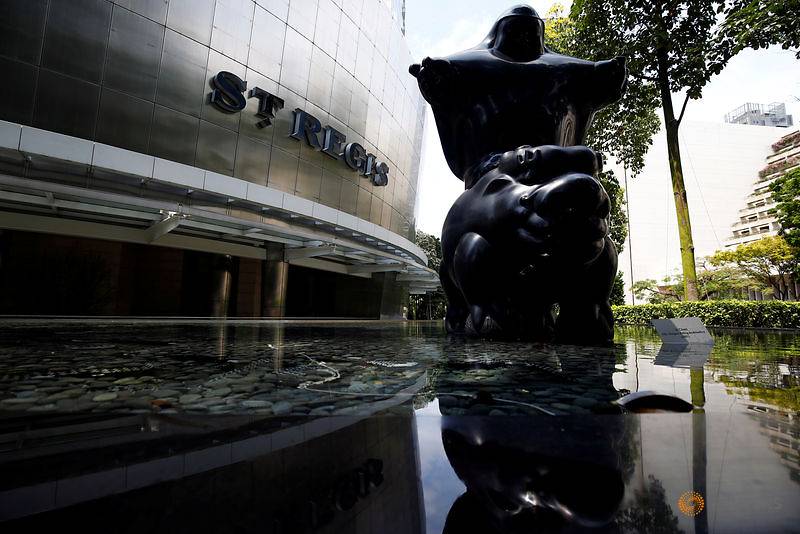
FILE PHOTO: A view of the St Regis Hotel in Singapore

A view of the St Regis Hotel in Singapore June 8, 2018. (Photo: REUTERS/Edgar Su/File Photo)

Another group of South Koreans held up banners near the Capella Hotel on Sentosa island, where the summit took place, demanding that the remaining hostages from the Korean War be freed. They were advised by police against protesting and left the area.

Beyond an affirmation of its ability to keep order amid intense global scrutiny, hosting the summit burnished Singapore’s reputation in other ways. Mr Curtis Chin, a former US Ambassador to the Asian Development Bank, said:

It signalled that Singapore is doing the right thing when it comes to how it is addressing its own interests, but is also trying to be a positive contributor to the region, and in this case, the world.

“The Trump-Kim summit reaffirms Singapore’s nature as a small but mighty nation that can contribute in a way that goes well beyond its size,” Mr Chin, who is Asia fellow with non-profit think-tank Milken Institute, added.

Mr Ong, the veteran diplomat, said there is also “bonus” for the Republic: Better ties with both countries in the future.

“Even though we could not get into the substantive agenda of the summit, we made friends individually. Otherwise, how can a little red dot get so close and so much airtime in the powerhouses in Washington DC and Pyongyang?” he said.

Dr Euan Graham, director of the international security programme at think-tank Lowy Institute, said the summit should have earned Singapore “some valuable credit with the Trump administration, given that Southeast (Asia) must compete with other parts of the Indo-Pacific region for attention, and (with) Singapore’s status as a close security partner rather than a treaty ally”.

On the North Korean front, Mr Kim was quoted by his country’s state media as saying he was impressed by Singapore’s economic development and hoped he could learn from the country during a night tour of some downtown landmarks on Monday.

FILE PHOTO: North Korea's leader Kim Jong Un visits The Marina Bay Sands hotel in Singapore

North Korea’s leader Kim Jong Un visits The Marina Bay Sands hotel in Singapore, June 11, 2018. (PhotoL REUTERS/Edgar Su/File Photo)

SMU’s Assoc Prof Tan said Singapore could have set Mr Kim thinking about the possible models for his country, given the young leader’s limited exposure to the world.

“The blend of market-economy capitalism and strict political control could also be an instructive lesson for North Korea as it takes very tentative steps in embarking on an early, cautious rapprochement with the global community,” he said.

As Mr Kim took in the sights in town, Singapore’s style of government may well have been an eye-opener to him, said Assoc Prof Tan. “It’s a system that is relatively open to the world for trade, investments, people and ideas, while having a communitarian, no-nonsense democratic system.”

SINGAPORE SHINES … BUT AT WHAT COST?

As always with Singaporeans, however, euphoria is often tempered with grumbling, and the summit was no different.

The S$20 million figure, in particular, caught the attention of many. While most defended the spending, there were some who argued against spending such a large sum without direct benefits for Singaporeans.

Much of the debate was on social media, but on the ground, too, some Singaporeans shared similar sentiments. For example, a food-delivery rider who only wanted to be known as Arvin, 53, said: “We’re not involved in the fight. Why must we spend money for them?”

However, observers said the money was well spent.

Associate Professor Chong Ja Ian from NUS’ Department of Political Science said the Republic’s S$20 million investment was a “strategic bet” on the summit turning out well and leading to further progress on the decades-long differences between the US and North Korea.

Ms Anwita Basu, an analyst with the Economist Intelligence Unit, pointed out that the S$20 million bill was a “minuscule amount” of the budgeted expenditure for 2018.

“Not only has this delivered significant soft power for Singapore, but it has also been a celebration of the country’s spectacular infrastructure and security capabilities,” she added.

Mr Ong said the bill was “certainly worthwhile”. “We cannot see the sum of S$20 million as overspending. In fact, much of the money pays the regular salaries of all the personnel engaged in the work for the summit,” he said.

“A wise man from India once told me, ‘You want money, you spend money. And please, no money, no talk'”.

He added: “I am now more concerned about how to say ‘no’ to other requests (for Singapore to host major events). What is the key consideration for the Singapore Government to draw a line? Is it beneficial to our country to host other summits, and if we do not host, what harm will that bring to Singapore?”

Donald Trump and Kim Jong Un

US President Donald Trump says the direct contact and close relationship he has established with Kim Jong Un has ended the threat of nuclear war. (AFP/SAUL LOEB)

Amid the congratulatory mood and the euphoric glow after the summit, however, Assoc Prof Tan sounded a cautionary note.

All the effort and money would ultimately amount to little if success meant that Singaporeans think the country has “arrived in terms of our foreign policy, our neutrality and how others view us”.

“We should not get ahead of ourselves and imagine that Singapore’s soft power is so influential,” he said.

“We have to continue to further develop an international reputation for neutrality … We are some way off from being known as robustly neutral like Switzerland and the Scandinavian countries like Norway,” he said, adding that the Republic has been perceived as being pro-US.

“We still have some way to go in terms of our international standing and the evolution of our soft power,” he added.

“The quest for relevance on the world stage has to be in our DNA, and we have to strive towards that on our own terms, defined by our own values and identity.”
Source link

‘We couldn’t understand what was happening’: Singaporeans in Japan describe earthquake

0

SINGAPORE: When the Shinkansen bullet train that Dr Ewen Chee and his family was on started shaking violently before coming to a stop early on Monday morning (Jun 18), the Singaporean tourist thought they were experiencing a power failure.

It was only after he received a mass broadcast message on his mobile phone that he realised that there had been an earthquake.

At least three people were killed and and more than 200 injured after a strong quake rocked Osaka in western Japan during the morning rush hour. The Japanese meteorological agency originally put the quake’s magnitude at 5.9 but later raised it to 6.1.

“We woke up early to catch the Shinkansen to Kyoto for a day trip,” the 46-year-old told Channel NewsAsia.”Two minutes into the journey, there was a violent shaking of the train and it stopped.”

Said Dr Chee: “I thought it was a power failure at first, as everyone else was so calm on the train. We couldn’t understand what was happening until a mass broadcast message was received (on) my mobile, telling us to keep calm and take shelter.”

“Only then it dawned upon us – it was an earthquake!”

The train doors were locked, said Dr Chee. “We took the cue from the locals and all stayed in the train.”

The train eventually continued on to Kyoto, said the father of two, adding that they spent “a good four hours” on board.

From there, the family took a taxi back to their hotel in Osaka to retrieve their luggage and passports as all the trains were down, according to Dr Chee.

Although they had planned to stay in Osaka until Wednesday, the family decided to cut short their visit and take a flight to Tokyo instead. 

“The city (Osaka) is functioning as normal, except trains were all down and taxis were hard to come by,” he said. “We decided to still leave as aftershocks are expected and it would be more relaxing to continue our holidays further away from the earthquake”.

“I COULD HEAR AND FEEL THE TREMBLING”

Singaporean postgraduate student Benny Tong was at home in Sakai, just south of Osaka, when the earthquake happened while he was about to prepare his breakfast.

“There was first quite intense rattling for about 20 seconds, and I could hear and feel the trembling of the house and furniture. Then the ground shook and swayed quite dramatically for about a minute,” the 32-year-old told Channel NewsAsia. “I steadied myself under a door frame in case the house collapsed, but thankfully nothing too bad happened.”

“I could see the overhead electricity cables outside my house shake quite a lot.”

He had received a “loud emergency alarm” from his phone when the tremors started, added Mr Tong. “This is the countrywide alert system that Japan has for all of its mobile phones. That was how I immediately realised it was an earthquake.”

Mr Tong was in Japan visiting his fiancee and her family until August, and said he usually went “every half a year or so, for a month or two each time”.

He said he had experienced a few minor earthquakes before in Osaka, but that Monday’s was “the first time I felt one as big as this”.

“People are generally calm now,” he said. “I was able to contact my Japanese friends and family through phone, Facebook and other messaging apps, and confirm that we are all safe and sound.”

Most major organisations such as universities had cancelled work for the day, he said, adding that most train lines had also suspended operations.

Another Singaporean, Mr Luis Hoon Ding Yuan, similarly told Channel NewsAsia that Monday’s earthquake was not the worst he had experienced in the country.

The 32-year-old SAP system analyst, who lives in Kyoto with his wife who is Japanese, said he was at home taking out the rubbish when the earthquake happened.

“Everything was the same before the quake, and then the ground started shaking,” he said. “After the quake, a few items toppled in my kitchen and my living room. My TV was intact though.”

“There were slight tremors, but (they were) almost unfeelable,” he added. “It was not the worst I felt. I had an even worst experience in Tokyo though.”

Osaka earthquake stocking up supplies

One Osaka resident told Channel NewsAsia she is stocking up on supplies. (Photo: Channel NewsAsia reader)

Meanwhile, a Japanese mother-of-three who lives in Osaka told Channel NewsAsia that this was her third big earthquake experience and that she was now stocking up on supplies.

“I lived through the 1995 Great Hanshin earthquake and the 2011 Tohoku earthquake. So this was my third big earthquake experience,” she said, adding that  “I am so afraid of quakes so I prepared crazily.”

“Most people in Osaka lived through the traumatic Hanshin earthquake, so this one was a painful reminder, especially when a few lives have already been lost.”

Source link

Russian cyberattacks targeting Singapore spike during Trump-Kim summit: Study

0

Russia accounted for 88 per cent of cyberattacks targeting Singapore on Jun 12, says threat intelligence research team F5 Labs.

Trump Kim Sign 8

US President Donald Trump and North Korea’s leader Kim Jong Un shake hands following a signing ceremony during their historic US-North Korea summit. (Photo: AFP/Saul Loeb)

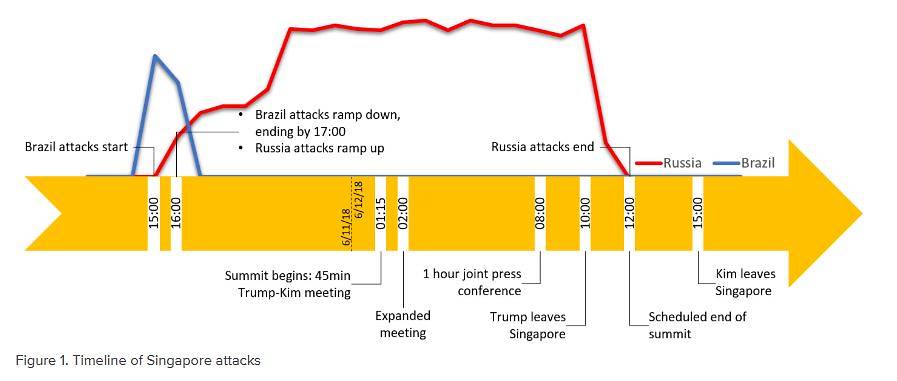
SINGAPORE: On the day history was made when United States President Donald Trump met with North Korean leader Kim Jong Un, host nation Singapore saw a surge in cyberattacks from Russia, according to a report by online threat analysts F5 Labs.

Russia accounted for 88 per cent of the attacks against Singapore on Jun 12 – the day both leaders met, F5 Labs and its data partner Loryka said in a Jun 14 blog post. 

In addition, of all the attacks originating from Russia, 97 per cent of these targeted Singapore, the blog post said. 

Timeline of Russia cyberattacks against Singapore

(Timeline: F5 Labs)

Going deeper into the data, F5 Labs said approximately 40,000 attacks were launched between 11pm (3pm UTC) on Jun 11 and 8pm (12pm UTC) on Jun 12. 

It added that 92 per cent of the attacks collected were reconnaissance scans looking for vulnerable devices while the remaining 8 per cent were “exploits”, which take advantage of vulnerabilities.

The top attack destination port was the Session Initiation Protocol (SIP) port 5060, which is an Internet Protocol phone protocol. 

“It is unusual to see port 5060 as a top attack destination port. Our assumption is that the attackers were trying to gain access to insecure phones or perhaps the VoIP server,” the study said.

It added: “Singapore was the top destination of the attacks by a large margin, receiving 4.5 times more attacks than the US or Canada. Singapore is not typically a top attack destination country; this anomaly coincides with President Trump’s meeting with Kim Jong Un.”

The study did point out that it was “unclear” what the attackers were after or whether they were successful, and F5 Labs said it will continue to analyse the data collected. 

“We do not have evidence directly tying this attacking activity to nation-state-sponsored attacks,” the study added. 

“However, it is common knowledge that the Russian government has many contractors within Russia doing their bidding, and that a successful attack on a target of interest would make its way through to the Kremlin.”

Channel NewsAsia has sent a query to the Cyber Security Agency of Singapore to corroborate F5 Labs’ findings.

Source link

LTA seizes 120 deregistered vehicles in sting operation

0

SINGAPORE: A total of 120 deregistered vehicles were seized during a sting operation by the Land Transport Authority (LTA) at several locations earlier this month.

The deregistered vehicles, mostly saloon cars, were seized from both car dealers and owners during the sting operation on Jun 7.

They had been either declared as exported or were kept beyond the permissible deadline for the vehicles to be disposed of, LTA said in a release on Monday (Jun 18).

ll lta deregistered  vehicles sting

Enforcement action was taken against unlawful possession of deregistered vehicles on Jun 7. (Photo: LTA)

The owners of the raided premises are currently assisting with LTA’s investigations, the authority said.

Possessing, using or allowing a deregistered vehicle to be used beyond the permissible deadline is an offence.

Those convicted may be jailed for up to three months and/or fined up to S$2,000 for their first offence. Repeat offenders face up to six months’ jail and/or a fine of up to S$5,000.

Owners who have deregistered their vehicles have one month to submit proof to the LTA that the vehicle has been properly disposed of at authorised scrapyards or export processing zones, or exported overseas.

Those guilty of making a false declaration to the LTA on the disposal of a vehicle may be jailed up to 12 months and/or fined up to S$5,000.

ll lta deregistered vehicles

Enforcement action was taken against unlawful possession of deregistered vehicles on Jun 7. (Photo: LTA)

Additionally, as unregistered or deregistered vehicles are not covered by insurance, anyone found guilty of driving an uninsured vehicle may be jailed for up to three months and/or fined up to S$1,000. The offender will also be disqualified from driving for at least a year.

Source link

Regional ferry operators to provide better lifejackets by end-2019

0

SINGAPORE: As part of a new initiative to improve safety at sea, regional ferry operators will be required to provide better lifejackets by the end of 2019, Singapore’s maritime authorities said on Monday (Jun 18).

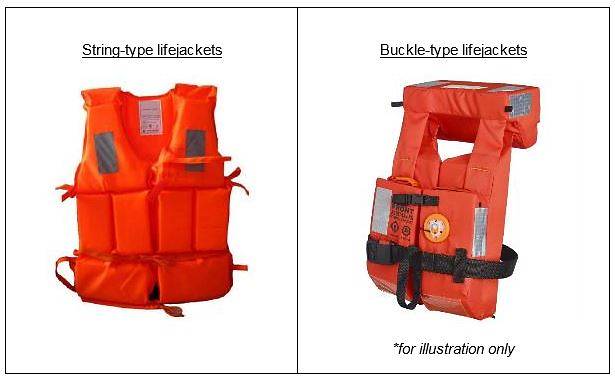
The current lifejackets, which have strings that need to be tied, are prone to user error and depend on the user to tie them tightly in order to be effective, the Maritime and Port Authority of Singapore (MPA) said.

lifejacket

Majestic Dream ferry chief engineer Abdur Rahman with the old string-type jacket. (Photo: Gwyneth Teo)

They will be replaced with buckle-type lifejackets, which are easier and faster to put on in an emergency, MPA said. The new lifejackets also come with a whistle and light, similar to the lifejackets found on aircraft.

lifejackets

(Photos: MPA)

Instead of storing lifejackets in plastic bags, customised metal receptacles will be placed under passenger seats to protect the lifejacket from damage and make it faster for passengers to retrieve one.

lifejacket (2)

Lifejackets will be stored in customised metal receptacles under passenger seats for easier retrieval. (Photo: Gwyneth Teo)

The MPA will set aside up to S$800,000 for a co-funding scheme to help ferry operators defray the cost of buying new lifejackets and upgrading their storage receptacles.

MPA chief executive Andrew Tan said the move will help ensure standardisation in the industry.

“Whenever incidents occur, there is risk to the environment, property, and lives,” said Mr Tan. “The incidents over the years are a reminder that we cannot take things for granted. Safety has to be a continuous effort, involving all the stakeholders who have a role to play.”

Every year, more than 6.5 million passengers travel between Singapore, Malaysia and Indonesia on passenger ferries.

The upgrading of lifejackets is part of the wider Safety@Sea Singapore campaign. As part of the campaign, new posters will be put up with updated safety messages tailored to groups such as bridge teams, crew members, ferry passengers and owners of pleasure crafts.

To encourage ground-up initiatives, MPA will also recognise companies with innovative safety practices with a new Open Category at the Safety@Sea Awards.

Source link

7 MRT stations along North-South Line to close earlier in July

0

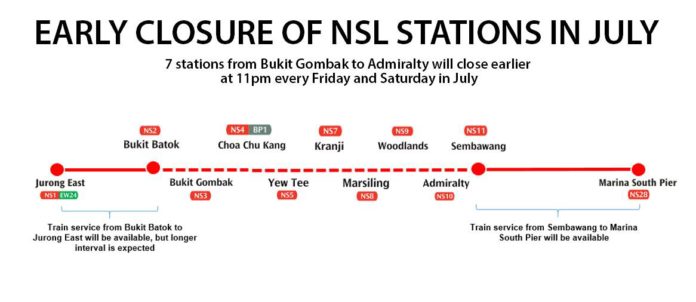
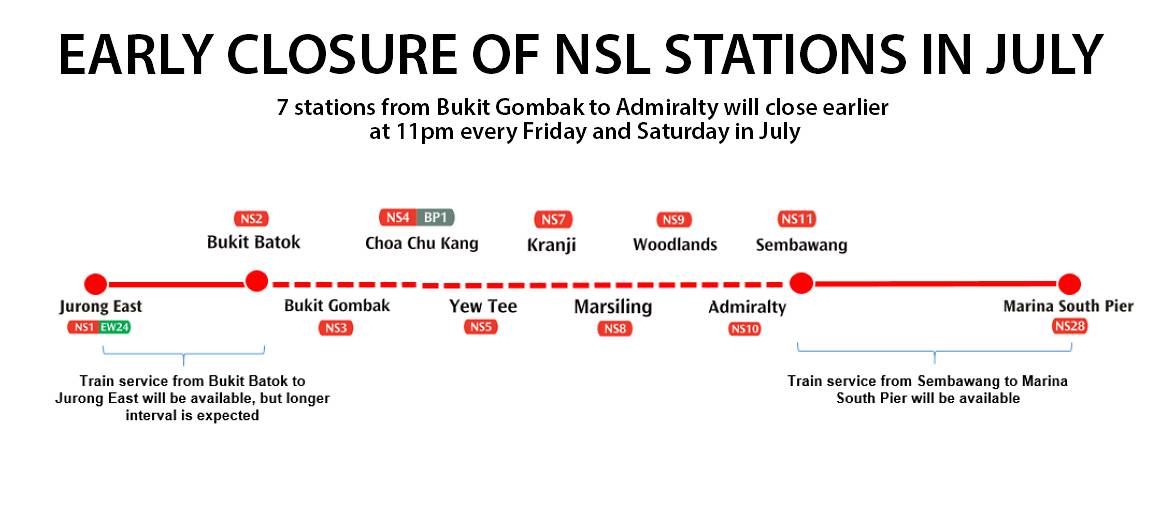
SINGAPORE: Seven MRT stations along the North-South Line (NSL) from Bukit Gombak to Admiralty will close earlier every Friday and Saturday starting July, SMRT said on Monday (Jun 18). 

In a news release, the train operator said the stations will close at around 11pm on these days to “intensify ongoing railway maintenance and improvement works in the north-western sector of the NSL”. 

MRT early closure NSL

There will be no late openings at the stations as it has assessed that the additional engineering hours from early closures are sufficient to facilitate the works. 

SMRT also said that shuttle bus service 11 will stop at designated bus stops along the stretch between the Bukit Batok and Sembawang MRT stations to pick up passengers affected by the closures. 

Source link

Commentary: Attracting millennial talent, the edge start-ups have over large enterprises

0

SINGAPORE: By 2025, millennials will make up 75 per cent of the global workforce, according to the World Economic Forum.

Born from 1979 to 2000, they are the next generation leaders and some say, the most creative and innovative we have seen.

Millennial-led companies, including some notably with Singaporean founders or Singapore-based, such as Razer, Carousell, RedMart, and Grab, have demonstrated an impressive ability to champion disruption, leverage technology and attract talent.

These companies threaten the notion of working for traditional and institutional companies that have been part of our social fabric for decades.

Clearly, attracting millennial talent is key to enterprise success.

And what can organisations with heritage do to learn from start-ups and shake up the “oldness and outdated” perception?

READ: A commentary what a digital workforce of tomorrow looks like.

ASPIRATION, THAT LOFTY IDEA MILLENNIALS CHAMPION

Millennials care about social impact and a greater contribution to the world.

From Deloitte’s Millennial Survey 2017, more than 50 per cent of 8,000 respondents say they feel accountable for social issues related to environmental protection and social equality.

This level of social consciousness may have arisen out of exposure to issues through social media amplification and peer influence. But it also suggests that millennials care deeply about the world around them and want to be able to effect positive change in the roles they undertaken.

For e-commerce start-up Carousell which has raised more than S$100 million in funding and count the likes of Sequoia Capital and Rakuten as investors, co-founder Quek Siu Rui describes what success means to him.

For me, success is less about making a billion dollars. It’s really about the ability to build products and services that could potentially benefit and help a billion people.

So to attract millennials, it seems organisations can no longer rely on a beautifully crafted vision statement or worse still, solely exist to achieve business objectives.

Carousell CEO Quek Siu Rui

Carousell CEO and co-founder Quek Siu Rui (Photo: Brandon Tanoto)

Millennials expect their managers to care; and are genuinely interested and concerned about a higher purpose, one that transcend profits and business goals.

To attract millennials, organisations will, more than ever, need to examine how they can envision and contribute to a future that is larger than their own.

MILLENNIALS DEMAND INSPIRATIONAL LEADERS

Millennials want to be inspired and engaged at the workplace.

For many, this may connotate popular practices and benefits made famous by leading companies such as Google including dress-down days, bring your own devices (BYOD), catered lunches and flexible work arrangements.

google office

Google staff at Google Singapore’s office. (Photo: Tang See Kit)

While more progressive workplace practices do create buzz and are great employer branding tools, there must be a more profound, inner motivation that attracts millennials.

READ  A commentary on why a nice office alone won’t attract millennials to your company.

Millennials believe they deserve to be led by someone they can look up to.

So ensuring that organisations develop and promote strong leaders, who are also role models who will develop their people, is an imperative.

While other generations also desire to work for good leaders, millennials expect it. 

Based on research by Mercer, a leading HR consultancy, which studied data collected from 600,000 employees in 43 organisations, “transformational leaders” positively influence career confidence and work-life satisfaction, factors that millennials pay attention to.

Transformational or inspirational leaders, exemplify a unique style of workplace leadership that focuses on articulating the bigger picture, providing clarity on work priorities, building trust and commitment, actively listening and communicating, and galvanising team effort.

Start-ups have that advantage as founders innately demonstrate vision and a very high level of commitment and work ethic to succeed – because their start-up’s survival is at stake.

In one interview, Razer CEO Tan Min Liang explained: “It’s easy to say (you want to create great products), but the proof is in the pudding when you dedicate your life to it.”

In turn, this creates a positive and enabling work culture through a common goal, something which millennials are drawn to in a start-up environment.

Tan Min-liang Razer

File photo of Razer CEO Tan Min-Liang. (Photo: AFP/Roslan Rahman)

So how can organisations build this “founder’s mindset” in managers?

It starts with the top management’s commitment to role model the right behaviours and treat the organisation as if it were their own business.  

Instead of dismissing leadership development as a business cost or good to have, organisations need to invest, just like education, to build that leadership capability as a talent magnet.

Consequently, organisations need to examine if they are truly committed and will hold their managers accountable for exemplifying inspirational leadership to attract, motivate and retain talent.

CREATING NEW VALUE DRIVES MILLENNIALS

Millennials thrive by creating something they can call their own. It is their way of projecting contribution and success.

And the beauty of a start-up is the entrepreneurial environment, which aggressively encourages ideas to flow and people from all background to contribute, an attribute which millennials value.

For many organisations which have scaled business sizably, this entrepreneurial environment is somewhat elusive as business processes and systems kick-in and it becomes a higher priority to drive efficiency and optimisation.

Many organisations are potentially at risk of losing the edge in new value creation if they do not invest in platforms where everyone, regardless of hierarchy, experience or age, can initiate ideas, insights and action.

office busy working

The entrepreneurial environment of a start-up encourages ideas to flow and people from all background to contribute. (Photo: Pixabay/StockSnap)

The key question is how can organisations attract and tap on millennial talent to create new business value?

Requiring a high level of humility and curiosity to learn from others, managers need to start thinking about promoting an open work culture that embraces diversity of perspectives.

This is a belief that resonates with millennials.

At Shiseido, with 146 years of heritage, this importance is encapsulated in the concept of “multi-value creation” and promoting a culture that encourages people to “love the differences”.

Going beyond acknowledging the need for diversity, it is about developing and sharing expertise, sponsoring an open ecosystem for colleagues to embrace different values, blend ideas and create new value propositions as part of innovation.

RAISING THE BAR

Talent is never going to just walk through the door.

If organisations are to excel against start-ups to attract millennial talent, they need to do more than enhance branding, compensation and workplace practices.

They can start by developing better leaders and creating that vision that will benefit society.

David Pang is chief of staff at Shiseido Travel Retail.

READ: A commentary on work-life balance.

READ: A commentary on millennials, the biggest customer Singapore retail cannot ignore.

Source link

Asean nations could put in a World Cup bid for 2034

0


MALAYSIA and several of its Southeast Asian neighbours could play host to the 2034 World Cup, the country’s member of the FIFA Council has suggested.

Former president of the Football Federation of Malaysia Tengku Abdullah said over the weekend that fellow Association of Southeast Asian Nations (Asean) members Indonesia, Thailand and Singapore had already expressed interest in submitting a joint bid for the 2034 World Cup, reported ESPN.

“Asean has an opportunity and the strength to put up a joint bid as three or four countries are allowed to be co-hosts,” he was quoted as saying.

“It is similar to the United States, Canada and Mexico being joint hosts in 2026.”

SEE ALSO: Pay Asian workers fair wages, World Cup sportswear giants Adidas, Nike told

The Asian Cup in 2017, co-hosted by Malaysia, Indonesia, Vietnam and Thailand had provided a precedent for such a joint bid, Tengku said, making the comments as he returned from the 68th FIFA Congress in Moscow, Russia, where the 2018 World Cup is being held.

“I guess there will be no problem if four countries show their interest to bid for the tournament in 2034. It may be much better,” added Tengku.

“It is time for the Asean region to be given an opportunity, and it will allow the countries to improve their infrastructures and strengthen their respective national teams … there is enough time.”

An Indonesian official told ESPN last year that the archipelagic nation was open to a co-hosting arrangement. “This is a football loving part of the world, it is developing quickly and would stage an amazing World Cup that nobody would forget,” they said.

{“facebook_total”:12,”facebook_likes”:”12″,”facebook_comments”:”0″}

193290

Source link

Travel and Earn

0

Travel and Earn
Tuesday, June 19, 2018 at 12:00 AM

To be announced

Singapore, Singapore, Singapore

Source link