Employers, employees, parents and children are some of the groups who will benefit from the new initiatives announced by Finance Minister Heng Swee Keat in Parliament.
Source link
MPs hail Budget 2016’s economic, social measures
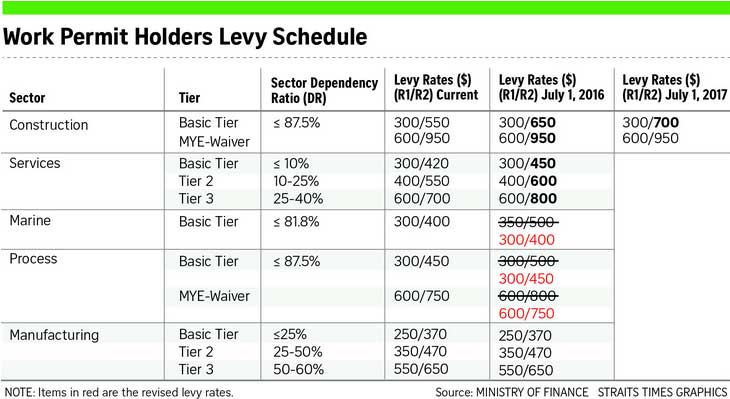
Budget 2016: Foreign worker levy increase deferred in marine and process sectors

SINGAPORE – Foreign worker levy increases will be deferred for one year in the marine and process sectors due to challenging business conditions and the reduction of Work Permit holders in these sectors.
Levies will also remain unchanged for another year in manufacturing, Finance Minister Heng Swee Keat said in his Budget speech on Thursday (March 24).
The Government will proceed with levy increases in the services and construction sectors, as announced in Budget 2015.
In construction, the levy rate for Basic Tier R2 workers will be raised from $550 currently to $650 on July 1 this year, and to $700 on July 1 next year.
The minimum experience requirement for man-year entitlements (MYE)-waiver workers will be raised from two to three years from July 1 next year to encourage firms to retain their more experienced workers to support productivity.
For the services sector, levy rates for R2 workers will be raised from $300 to $450 for the basic tier, $400 to $600 for Tier 2 and $600 to $800 for Tier 3.
The levy rates for S Pass holders will also go up on July 1. The Basic Tier rate will be raised from $315 to $330, while the Tier 2 rate will be increased from $550 to $650.

This article was first published on March 24, 2016.
Get a copy of The Straits Times or go to straitstimes.com for more stories.
Image:

Publication Date:
Friday, March 25, 2016 – 09:00
Keywords:
Send to mobile app:
Source:
Story Type:
Others
Man 'tasered' and arrested after police found weapon on him

March 24, 2016 10:06 PM
SINGAPORE – A man was arrested for possessing a weapon and resisting arrest near Yio Chu Kang MRT station on Thursday (March 24).


Budget 2016: Double whammy for property developers
SINGAPORE’S Finance Minister, Heng Swee Keat, told Parliament on Thursday that it is too premature to relax property cooling measures given the price level and current market conditions.
“We will continue to monitor developments in the property market closely,” Mr Heng said in his Budget 2016 speech.
Here are some comments:
Low Hwee Chua, Head of Tax Services, Deloitte Singapore and Southeast Asia:
“As hinted by various Government officials, the Finance Minister has confirmed that it is too early to relax the current property cooling measures.”
“It is a double whammy for property developers as manpower costs will increase due to the non-deferment of the previously announced increase in foreign worker levies for the construction industry.”
Christine Li, director and head of research at Cushman & Wakefield:
“As expected, the property cooling measures are not lifted. This did not come as a surprise.”
“The residential transaction volume has been halved since the implementation of the Total Debt Servicing Ratio (TDSR) framework in 2013 and there is “frustrated demand” in the market as buyers are deterred from entering the market due to the additional buyer’s stamp duty (ABSD).”
“As a result, a pre-mature lifting of the cooling measures, particularly the ABSD, could result in buyers rushing into the market for fear that property price may rise due to increased demand.”
“Given that the only beneficiaries of the lifting of the cooling measures such as tweaking the ABSD will be property developers, Singaporeans who can afford a second property (as ABSD does not apply to first time buyers), permanent residents and foreigners, it does not serve the interest of the masses as having these measures in place will help to keep prices affordable.”

This article was first published on March 24, 2016.
Get The Business Times for more stories.
Image:
Publication Date:
Friday, March 25, 2016 – 09:00
Keywords:
Send to mobile app:
Source:
Story Type:
Others
Wonder Woman leads the fierce females of 'Batman v Superman'

LOS ANGELES – “Batman v Superman: Dawn of Justice” is centred on the clash of two of the most recognizable caped heroes of the comic book world but it is the women of the DC Comics universe who defy expectations.
The movie has “four really great female characters … but not a single one of them is an archetype,” said Amy Adams, who reprises her role as intrepid Daily Planet journalist Lois Lane.
The film, which opens around the world this week, introduces Israeli actress Gal Gadot as Wonder Woman and sees Holly Hunter as a senator determined to hold Superman accountable for the destruction caused by his actions. Diane Lane plays Superman’s mother, Martha Kent.
Wonder Woman, also known as Diana Prince, is an elusive force in “Batman v Superman,” immaculately dressed, coyly intelligent and drawing the attention of Ben Affleck’s Bruce Wayne – the playboy billionaire alter-ego of Batman.
“She’s been around, she’s very experienced, she’s darker, she’s sassy, she understands a lot about mankind,” Gadot said of her character.
Gadot, a former model who served two years in Israel’s army, will reprise her role in 2017’s “Wonder Woman,” the first standalone female superhero movie in a decade.
“She’s as elegant as a supermodel and she kicks it with the boys,” Adams said of Gadot’s Wonder Woman.
The superhero genre has long been skewed to male characters but female characters have slowly become a larger presence in recent years.
That potentially broadens a film’s appeal for female audiences and its commercial success.
Wonder Woman is not the only one to get feisty in “Batman v Superman.”
When Lois Lane is referred to by an interview subject as a lady, she snaps “I’m not a lady, I’m a journalist.”
Hunter’s Senator Finch holds her own against the psychotic villain Lex Luthor as he tries to coerce her to do his bidding, while Martha Kent fiercely tells Superman that he does not owe anyone anything as he faces growing dissent from the public.
Warner Bros’ “Batman v Superman” is projected by analysts to take some $300 million worldwide on its opening weekend.
The film lays the groundwork for “Wonder Woman,” which will explore the origin story of the Amazonian heroine with powers of super strength.
“The story deals with Diana becoming Wonder Woman so she starts very pure, very naive, this young idealist who doesn’t really understand the complexities of life,” Gadot said.
Image:

Publication Date:
Thursday, March 24, 2016 – 21:53
Keywords:
Send to mobile app:
Source:
Story Type:
Others
OMGtel raising S$400 million in bid to be 4th telco service
The company has reached about 40 per cent of its S$1 billion target to fund its bid to be Singapore’s fourth telco and the rollout of network infrastructure, said Consistel Chairman Masoud Bassiri.
Source link
Budget 2016: Jurong Innovation District to be set up
SINGAPORE – A new Jurong Innovation District (JID), envisioned as the industrial park of the future, will be built as part of the Government’s push to encourage more innovation.
The first phase of the district, which will be in Jurong West, is expected to be completed by around 2020.
Singapore’s earlier industrial estates were developed for specific industries focused mostly on production, said Finance Minister Heng Swee Keat during his Budget speech on Thursday (March 24).
But nowadays, research, innovation and production are closely intertwined, he pointed out.
The district will bring together researchers, students, innovators and businesses to develop products and services of the future. It will also create an environment to house different activities within a single next-generation industrial district.
It will be the future of innovation for enterprise, learning and living, Mr Heng added.
“Fifty years ago, we transformed Jurong from swampland into a thriving hub for the manufacturing industry that powered Singapore’s economic growth. Now, we will take another leap to create the industrial park of the future,” he said.
“This has the potential to transform how we live, work, play and create.”

JTC, the national developer of industrial infrastructure, is currently constructing Launchpad@JID, to serve as a space for entrepreneurs, researchers and students to design, prototype, and test-bed their new innovations.
JTC has also launched an Open Innovation Call to invite private sector technology owners to test-bed and develop innovative and sustainable infrastructure solutions within the district.
There are already other new types of industrial parks being built in other parts of Singapore,
JTC, for instance, is also building a creative industry cluster across the road from Singapore Institute of Technology (SIT) which will move to Punggol.
SIT, Singapore’s fifth autonomous university, was set up in May 2009 to offer more degree opportunities to polytechnic graduates. It now operates from an interim campus at Dover with satellite branches in each of the five polytechnics.
Besides the new innovation district, the Government will also try to encourage innovation by promoting start-ups in new and existing industries.
To achieve this, a new entity called SG-lnnovate will be set up, Mr Heng announced.
SG-lnnovate will match budding entrepreneurs with mentors, introduce them to venture capital firms, help them to access talent in research institutes, and open up new markets.
It will build on what has been done by the lnfocomm Investments Private Limited (llPL), and work with Spring and EDB to expand the accelerator programmes to new and emerging sectors such as smart energy, digital manufacturing, fintech, digital health and Internet-of-Things.
In addition, up to $4 billion from the Research, Innovation and Enterprise 2020 Plan will be directed to industry-research collaboration.
“Innovation is enabled and enhanced by the use of technology but innovation goes beyond that. It is fundamentally about new ways of doing things to meet the needs of people and industries better,” said Mr Heng.
“Innovation is the engine of value creation and growth. We must make innovation pervasive in our society.”
This article was first published on March 24, 2016.
Get a copy of The Straits Times or go to straitstimes.com for more stories.
Image:

Publication Date:
Friday, March 25, 2016 – 09:00
Keywords:
Send to mobile app:
Source:
Video Media:
Other Video Media
Story Type:
Others
118 arrested in four-day anti-loansharking operation
The suspects, comprising 79 men and 39 women, are suspected to be involved in loansharking activities, police say.
Source link
73-year-old Hougang resident dies from dengue
Image:

Category:
Publication Date:
Thursday, March 24, 2016 – 21:37
External URL:
Send to mobile app:
Source:
Story Type:
Rewritten Story
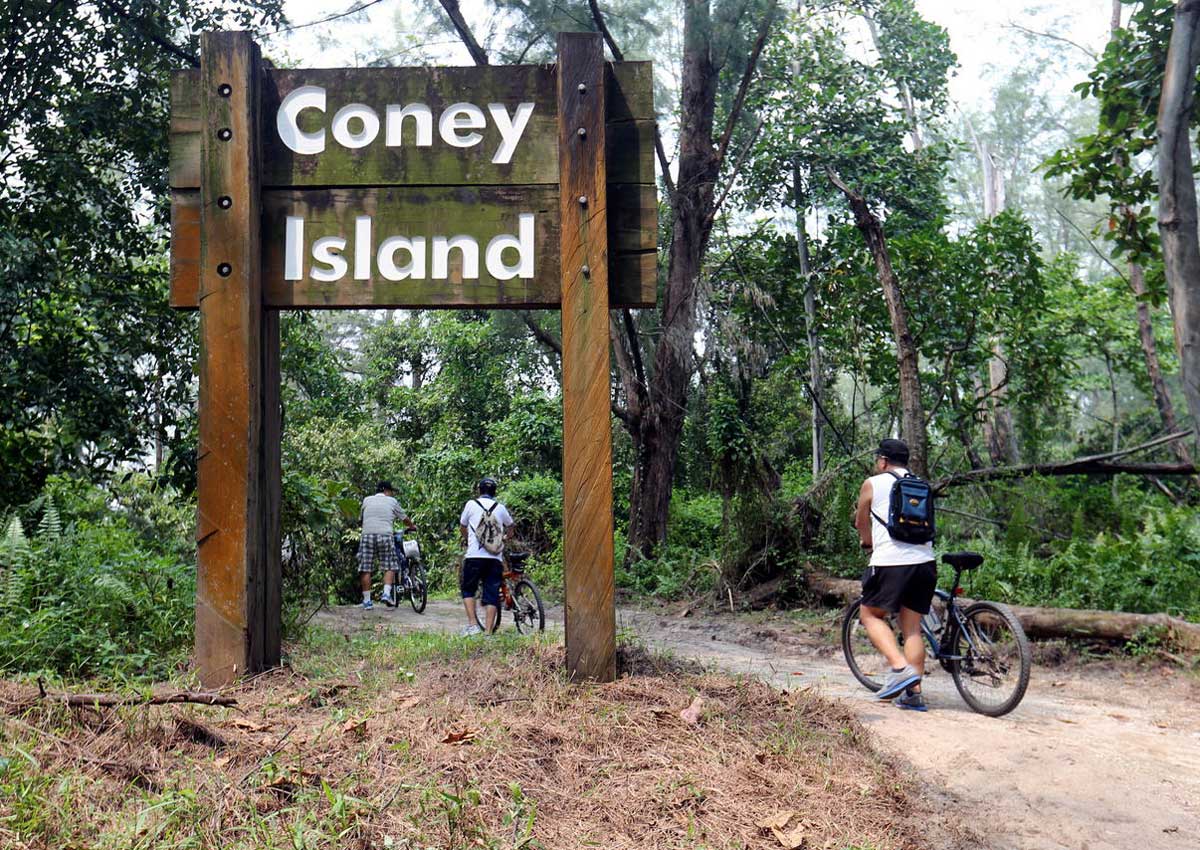
Budget 2016: New Outward Bound Singapore campus to be built on Coney Island
SINGAPORE – The rustic Coney Island, sited off Punggol and Pasir Ris, will see a new Outward Bound Singapore (OBS) campus as part of a new masterplan to make young people more resilient, said Finance Minister Heng Swee Keat on Thursday (March 24).
Announcing the National Outdoor Adventure Education Masterplan during his Budget speech in Parliament, he said that in order to thrive, youth need a sense of adventure, resilience and a readiness to challenge themselves to be their best.
To help students develop those attributes, outdoor adventure education for all will be expanded, he added.
The new OBS campus is expected to be ready in 2020 and will cost about $250 million. It will be the second in Singapore, after the current 9ha campus on Pulau Ubin.
The campus will be rustic and blend in with the rest of the island, Mr Heng said.
Coney Island, where a nature park opened to the public last October, will remain open. It is connected to the mainland by two bridges on its western and eastern ends to Punggol Promenade and Pasir Ris Coast Industrial Park 6.
“Many more youths will have the chance to go on an expedition with OBS,” Mr Heng said, adding that it will help them build confidence and develop camaraderie with students from other schools.
This article was first published on March 24, 2016.
Get a copy of The Straits Times or go to straitstimes.com for more stories.
Image:
Publication Date:
Friday, March 25, 2016 – 09:00
Keywords:
Send to mobile app:
Source:
Rotator Headline:
Budget 2016: New Outward Bound campus to be built on Coney Island
Story Type:
Others


