SINGAPORE: The COVID-19 “circuit breaker” period and hotter weather led to higher electricity usage for most households last month.
An average increase of 22 per cent in daily household electricity consumption was noted in May compared to February this year, the Energy Market Authority (EMA) and SP Group said in a news release on Tuesday (Jun 16).
“Singapore households’ electricity consumption typically increases from April through August. This is because the weather tends to be hotter in these months, and households use more electricity to power their fans or air-conditioners to stay cool.”
More Singaporeans also refrained from going out, as well as worked and studied from home during this period.
Under normal circumstances, SP Group said it will send meter readers to visit households to record their electricity, water and gas consumption every alternate month.
However, these services were suspended from Apr 7 to Jun 1 in line with the safe distancing measures to minimise the transmission of COVID-19.
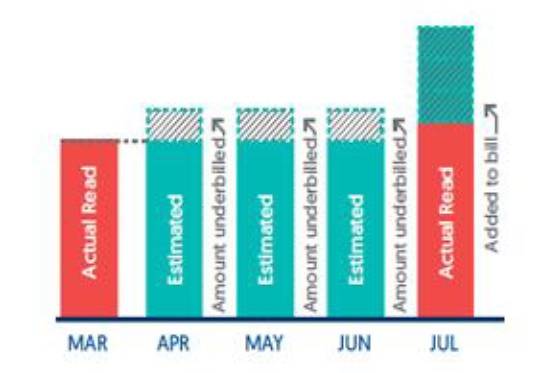
For households who do not have advanced electricity meters and also did not submit their own meter readers, their April and May consumption was estimated based on previous months’ consumption data.
This would result in an underestimation of their bills for these months, said EMA and SP Group.
As physical meter readings resumed from Jun 2, the accumulated underestimated consumption amounts will be adjusted in the households’ June or July bill. These bills could then be higher than the April and May amounts.
Illustration for consumers whose electricity meters are read during odd months. (Image: Energy Market Authority, SP Group)
About 300,000 households have advanced electricity meters and their electricity consumption is read remotely. These households would be billed based on their actual consumption for April and May.
EMA and SP Group encouraged households to submit their own meter readings so as to be billed on their actual consumption.
They can submit their meter readings via the SP Utilities app, SP Utilities Portal or automated phone system at 1800 222 2333.
Households may also submit a photo of their meter via WhatsApp to 8482 8636 or send an email to customerreading@spgroup.com.sg.
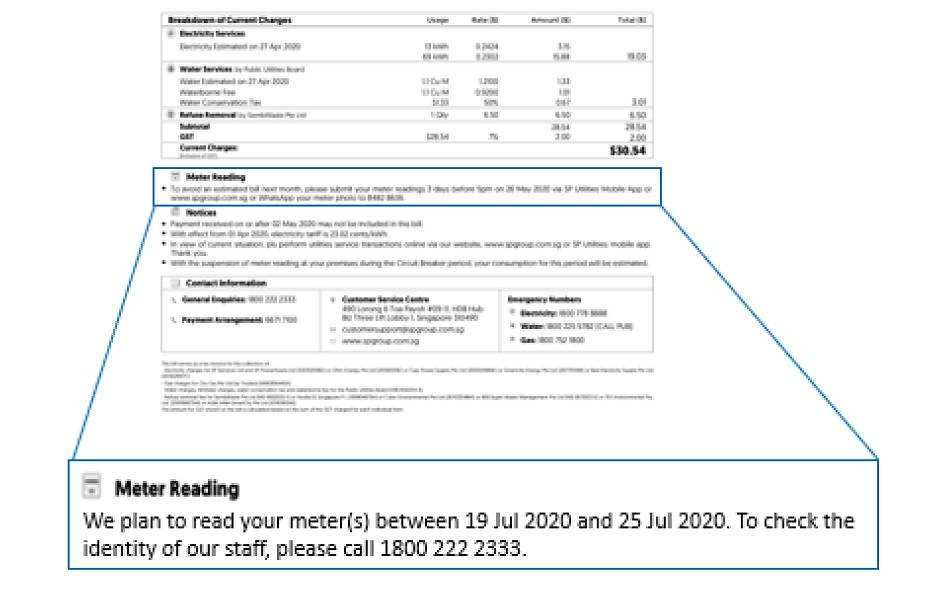
Households can refer to their SP bills for their meter submission period and can submit their meter readings up to three days from the scheduled meter reading date.
Households can refer to their SP Bills for their meter reading submission period. (Image: Energy Market Authority, SP Group)
For those who have downloaded the SP Utilities app, they can also set an alert for their meter reading submission period.
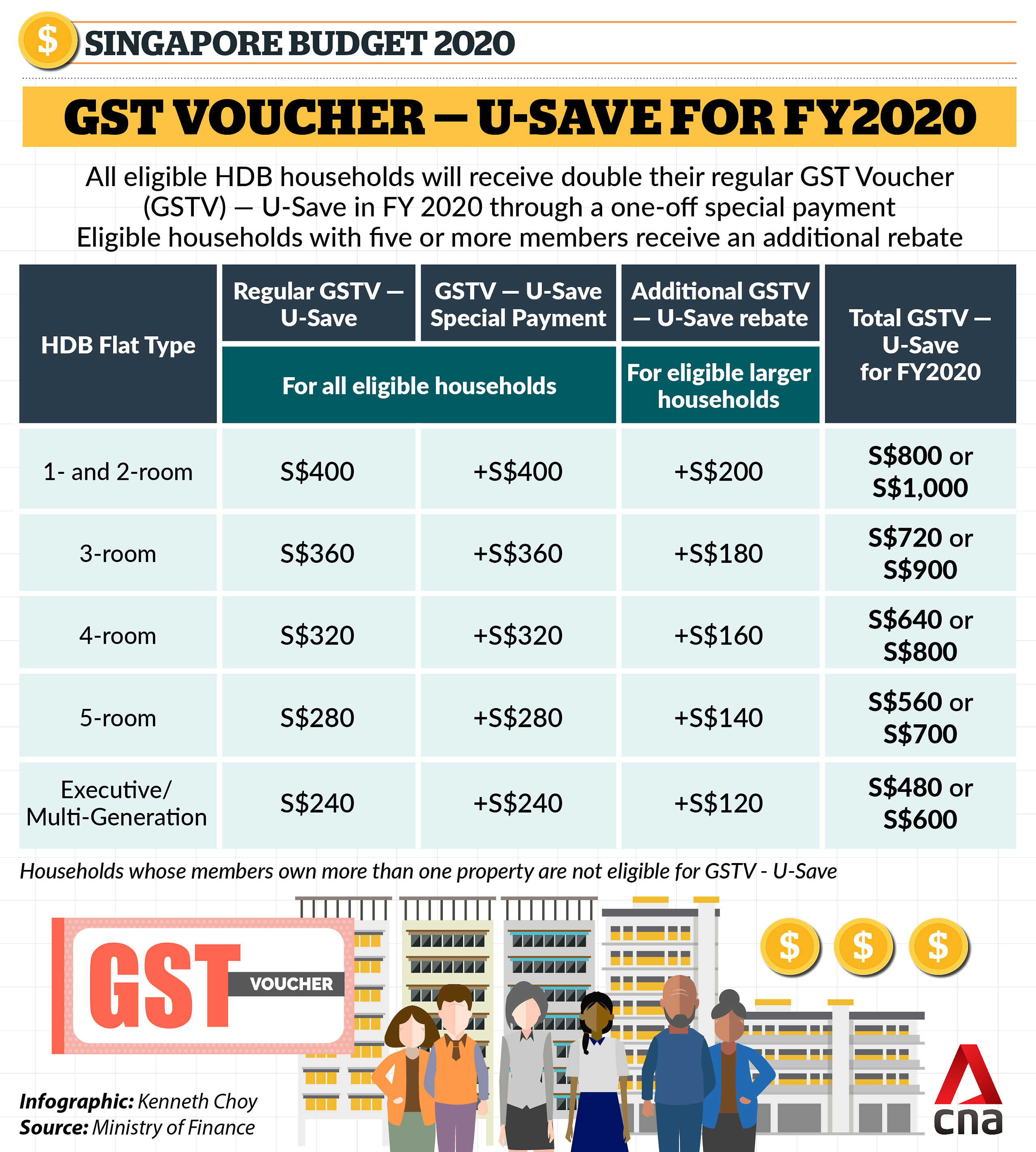
As part of the Budget 2020 Care and Support Package, eligible Housing and Development Board (HDB) households will receive double their regular GST Voucher U-Save this year. Eligible households with five or more members will receive an additional GST Voucher – U-Save rebate.
The next round of disbursement of the regular GST Voucher U-Save rebate and GST Voucher U-Save Special Payment will be in July.
The first disbursement of the additional GST Voucher U-Save rebate for eligible larger households with five or more members will be in October.
As part of the recently announced Fortitude Budget, each household with at least one Singapore Citizen will receive a one-off S$100 Solidarity Utilities Credit for doing their part in staying home during the circuit breaker period.
This amount will be credited in the July or August utilities bill with SP Group and covers all property types.
In support of the Government’s Resilience Budget measures to freeze all government fees and charges for one year, SP Group also said it has deferred S$343 million in grid charges and maintained its grid fee to customers.
Could Her World’s 2018 Woman of the Year make an appearance in the upcoming general elections under the ruling party’s banner? Perhaps so.
Ng Ling Ling joined Ang Mo Kio GRC MP Dr Intan Azura Mokhtar in an online Meet-the-People session on June 11, speaking with some residents in the Jalan Kayu district and helping to write appeal letters on their behalf.
It was a rocky start for the Reform Party (RP) last night (June 15) in their first-ever online “Meet-the-People” session. Though the stream on Facebook Live kicked off promptly at 7pm, it was stopped multiple times due to technical issues — viewers were not able to hear what the opposition party’s secretary-general Kenneth Jeyaretnam was saying on-screen.
When it eventually started up again (via an Nvidia GeForce Experience live stream categorised under World of Warcraft, no less), the party chief introduced six candidates — some old, some new — who will be contesting in the next General Election.
Candidates back to contest again:
RP chairman Andy Zhu, 37, real estate marketing director Darren Soh, 52, Human Resources practitioner and former People’s Action Party grassroots volunteer RP treasurer Noraini Yunos, 52, works in telemarketing The new candidates:
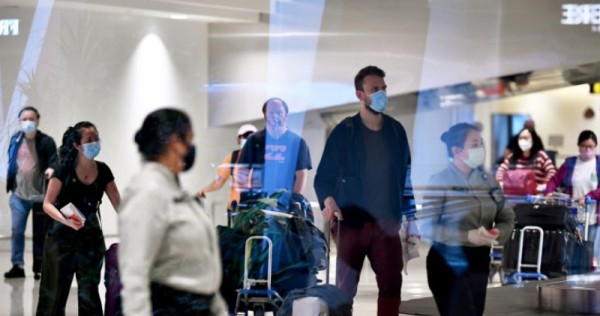
Travellers entering Singapore from selected countries may serve their stay-home notices (SHN) at home, instead of dedicated facilities, from June 18.
But they will be subject to a compulsory Covid-19 test, for which they must pay, a few days before the end of their SHN, said National Development Minister Lawrence Wong on Monday (June 15) during a virtual press conference.
The new SHN rules apply from 11.59pm on Wednesday to travellers who have been in Australia, Brunei, Hong Kong, Japan, Macau, mainland China, New Zealand, South Korea, Taiwan and Vietnam in the last 14 consecutive days before their entry.
Singapore citizens and permanent residents may serve their 14-day SHN at their place of residence.
Long-term pass holders may serve theirs at a place of residence that they or their family members own or are sole tenants of or in accommodation facilities such as a hotel, at their own cost.
All other travellers entering Singapore will continue to serve their SHN at dedicated facilities like hotels. Those who are not Singaporeans or permanent residents will have to pay for their stay at these facilities.
Ten people are being investigated for breaching safe distancing measures after they were seen drinking together at Golden Mile Tower.
The police said they received a call from a member of the public last Thursday at about 10pm.
When they arrived, they found six Singaporean men, aged between 32 and 57, and four women of Thai nationality, aged between 27 and 33, drinking together in a shop unit.
The police said: “They were advised by the police officers to adhere to the measures, and they left the area thereafter.”
The New Paper understands from sources the unit is not a KTV pub, as was previously reported in other media.
Chinese language daily Lianhe Wanbaoreported on Saturday that the unit involved, located in a secluded part of the building, had posters and papers plastered on the door.
A shopkeeper who runs a shop nearby told Wanbao there have been people going in and out of the unit recently.
She said: “In the afternoon, I would hear people carrying bowls and plates to the toilet to wash. I found it very odd then.”
SINGAPORE: Earlier this week, I finally set foot in Orchard Road for the first time since Singapore’s circuit breaker started in April to get a much-needed haircut.
It felt good to return to my old stomping ground but it was also disconcerting to walk through the empty shopping district.
Many boutiques had cleared out their window displays and packed away stock. The corridors of Mandarin Gallery were empty, save for the occasional delivery person hustling to pick up food from an F&B outlet that had kept its kitchen open.
At Takashimaya basement, where I had dropped by for a brief supermarket sweep at Cold Storage, I paused to gape at the bizarre sight of the mall’s vacant bazaar atrium which in normal times is usually thrumming with bargain hunters.
I was saddened to witness this once vibrant, bustling shopping district now devoid of activity.
Yet in a way, this ghost town scene also offers a dystopian peek into what might lay ahead for this shopping street years in the future, if it continues on this gradual path of decline.
HOW NOW ORCHARD ROAD?
Orchard Road’s troubles started long before the coronavirus’ advent. In recent years, there has been much talk about how it has been slowly losing its appeal, especially in comparison to newer and more architecturally impressive destinations like Marina Bay Sands and Jewel Changi Airport.
Last year’s sordid Orchard Towers murder case, which led to a renewed scrutiny of this sleazy, vice-filled corner of this supposedly glitzy district, did not help either.
Increasing vacancy rates, high rents and decreasing footfall have tarnished Orchard’s shine.
Mall landlords too have a role to play in this sad state of affairs, in choosing to sign on cookie-cutter tenants, leading to an uncanny sameness among multiple buildings along the shopping strip, which hardly encourages leisurely mall-hopping.
Now, with non-essential retail stores shuttered during the circuit breaker and food establishments allowed only to operate delivery and take-out services, like most other malls around Singapore and the world, the district has become tragically irrelevant.
Even Mandarin Gallery was empty, save for a few food deliverers. (Photo: Karen Tee)
COVID-19 MADE THINGS WORSE
Retail’s reliance on human traffic and physical interaction has been its Achilles’ heel.
The collapse was swift. According to the latest data released by the Department of Statistics, retail sales in Singapore plunged by 40 per cent year-on-year in April. Even more heart-stopping is the freefall drop in sales for Orchard Road-centric categories such as department stores (-75 per cent), apparel and footwear (-74.8 per cent) as well as watches and jewellery (-81.3 per cent).
Marquee events have been cancelled. While Orchard Road’s signature event, the Great Singapore Sale, was finally regaining some steam last year, there will be no GSS this year because of COVID-19.
These may be the first signs of an impending coronavirus-triggered global retail apocalypse. While there have been some initial reports of post-lockdown “revenge spending” in South Korea and China, experts agree shoppers will not likely return in hordes, especially with concerns about safe distancing, not to mention an impending recession.
In the United States, the looting and destruction of many shopping districts during the Black Lives Matters riots have added a security dimension to the challenge that will likely delay the reopening of these destinations even as COVID-19 restrictions are eased.
And in Europe, there is currently little news about shopping surges even though some countries have been gradually reopening.
This crisis has even gripped longstanding retail titans. Inditex, the company which owns fast fashion brand Zara, announced this week it would be shuttering up to 1,200 stores worldwide. Other clothing giants such as H&M and Gap have also reported sharp declines in sales.
In Singapore, household names like apparel brand Esprit is closing all 11 stores here, Robinsons is winding up its Jem department store by August and many local retailers are unsure how long they can continue staying in business in this gloomy climate.
E-COMMERCE OUR NEW NORMAL
In this harsh new reality, many brands and retailers have been scrambling to make an almost panicked pivot to digital shopping. The transformation has been messy but worth applauding when more are recognising the permanence of this sea change.
A shopper is seen along Orchard Road, Apr 4, 2020. (Photo: Jeremy Long)
This makes sensible strategy whether you’re a chain or a single shop. Even luxury brands, a category traditionally been slow to make the e-commerce leap and preferring to provide clients with a full, sensorial in-store experience, are now aggressively touting their online shopping and delivery services.
Though I have always preferred to browse in a physical store, I too have been unable to resist buying things online just for the temporary thrill of retail therapy while confined at home. (I am now the sheepish owner of too much exercise equipment, a dozen identical crew-neck t-shirts in different colours and a few sets of pink fairy lights.)
Many people have moved from hesitantly trying out online shopping for essentials like groceries or toilet paper to buying so much more – and they will likely never look back.
When the economy reopens, people might do some shopping on their weekly supermarket runs, so shops in heartland malls may experience some lift from pent up demand.
Yet where does that leave Orchard Road if heading to the main shopping district is no longer a weekend routine to pass time? Will the coronavirus usher in an ice age for retail promenades?
A GLIMMER OF HOPE
There is a chance this pandemic might induce a much more compelling Orchard Road to emerge from the ashes. We know that plans are already ongoing to transform the shopping belt, unveiled last year by Minister for Trade and Industry Chan Chun Sing.
However, many of its initial proposals, including pedestrianising sections of the road and holding more street activities seem counter to the need for social distancing for the foreseeable future.
The committee may need to modify these plans to address this reality. Hopefully they will also consider this key question – how can Orchard Road continue attracting serious big spenders?
As it is, the root of the issue – that the repetitiveness of the shops are just kind of uninspiring – is something that only landlords can figure out.
Even international luxury brands can afford to differentiate their local boutiques a little better. For instance, is there even a difference between the Louis Vuitton boutiques at Ion Orchard and Takashimaya?
Maybe it is not such a bad thing that Zara, Esprit and possibly other fast fashion brands might be closing at least some of their multiple cloned Orchard Road stores. This would then create the opportunity for more creative and varied uses of the vacated space.
As someone who has fond memories of trawling the tiny indie boutiques at youth hangouts like Far East Plaza and The Heeren and spending hours in Tower Records, I truly miss the quirky and unique spirit of this bygone era.
Other once popular Singapore brands, like Song+Kelly, Alldressedup and Mphosis have sadly folded, at least in part due to the proliferation of fast fashion. These were the shopping destinations that gave consumers a sense of Singapore at its most inspiring, a factor that is key in getting people to hand over their credit cards.
Think of the spaceship-like Comme des Garcons flagship in Omotesando, Tokyo; the riotously exuberant Style Nanda boutique in Seoul, South Korea; or the ornate Galeries Lafayette in Paris. When you visit those boutiques, chances are, you would probably buy at least a small item as a memento to remind you of the experience.
More than ever, we need standout, one-of-a-kind and ideally homegrown retail concepts in Singapore that cannot be found elsewhere to anchor our flagship shopping district.
We already know people will still spend money.
With retail shops opening this Friday (Jun 19) as we enter phase 2, perhaps there will be a boost in sales figures with the population in a celebratory mood.
But in the longer run in phase 3 and beyond, as people become accustomed to living with social distancing as the default, they will need a compelling reason to strap on a mask, step out of their homes and continue making their way into a brick-and-mortar shop.
For the first time, the Singapore People’s Party (SPP) will see a General Election candidate line-up that doesn’t include former chief Chiam See Tong or his wife Lina.
Last week, SPP revealed that it will field five candidates in two constituencies — chairman Jose Raymond for Potong Pasir SMC; and secretary-general Steve Chia, vice-chairman Williamson Lee, Osman Sulaiman, and Melvyn Chiu for Bishan-Toa Payoh GRC.
Raymond, 48, told The Straits Times on June 12: “It will not be easy coming up against a two-term incumbent, but I have done my best and have helped as many residents as I could, and will leave it to the voters of Potong Pasir to mark their choice when the time comes.”
Education Minister Ong Ye Kung said in a social media post on Saturday (June 13) that some 1,600 students in Singapore have undergone Covid-19 swab tests as of June 2.
The tests were part of the Ministry of Education’s (MOE) extended screening for all school staff and students above 12 years old who are diagnosed with acute respiratory infection (ARI).
Proactive Covid-19 swab tests
Mr Ong said the testing of those presented with ARI, is “very important. It helps us identify cases early so that we can isolate, quarantine and snub out [the] transmission. Then schools can stay safe and learning can continue.”
The minister also acknowledged that there may be some concerns among students. “I know many students will be worried – how can such a long stick go up my nose! It is a bit uncomfortable, but really not too bad, as this young girl shows us,” Mr Ong said.
As we continue our battle with Covid-19, we see healthcare workers working tirelessly to attend to patients, making the ultimate sacrifice by risking the danger of getting the disease just to provide support to those in great need of medical care and assistance during this pandemic.
But many front line workers carry an extra load, and often with little praise. Some of them are the mothers in the frontlines who put themselves in the path of the virus every day while also balancing the needs of their own families at home.
We spoke with two nurses on what it means to be mothers in the frontlines during the coronavirus pandemic. We learned about what they have to give in efforts to fight against the virus and keep us all safe during this time.
The double duty of mothers in the frontlines
When Nurse Juwita Ramlan found out that she was going to be deployed to the National Centre For Infectious Diseases (NCID), she knew she had to step up and make some sacrifices in order to fulfil a sworn job.
“When I was told that I will be deployed to the infectious diseases ward, my initial thought was maybe I should stay away from my kids.
As we continue our battle with Covid-19, we see healthcare workers working tirelessly to attend to patients, making the ultimate sacrifice by risking the danger of getting the disease just to provide support to those in great need of medical care and assistance during this pandemic.
But many front line workers carry an extra load, and often with little praise. Some of them are the mothers in the frontlines who put themselves in the path of the virus every day while also balancing the needs of their own families at home.
We spoke with two nurses on what it means to be mothers in the frontlines during the coronavirus pandemic. We learned about what they have to give in efforts to fight against the virus and keep us all safe during this time.
The double duty of mothers in the frontlines
When Nurse Juwita Ramlan found out that she was going to be deployed to the National Centre For Infectious Diseases (NCID), she knew she had to step up and make some sacrifices in order to fulfil a sworn job.
“When I was told that I will be deployed to the infectious diseases ward, my initial thought was maybe I should stay away from my kids.