Home Blog Page 256

Commentary: Tough times are no excuse for callous retrenchments

0

SINGAPORE: The worst job numbers in a decade with more retrenchments to come – this is the reality of the COVID-19 era in Singapore.

Globally, the story isn’t much different. Experts have warned the economic fallout from the pandemic will be unprecedented and even massive stimulus may not enable a V-shaped recovery. 

Considering these conditions, some employers may argue employees shouldn’t be too surprised if they are let go. It is to be expected.

However, our conversations with displaced professionals have revealed this does not soften the blow of retrenchments. In fact, since the prospect of finding new employment is slimmer today, the pain of being let go is even more acute.

While accepting that retrenchments in certain sectors are inevitable today, they expect the exercise to be conducted with dignity.

LISTEN: Entering Phase 2: What’s behind rules on gatherings, dining, weddings and more?

THE PROCESS MATTERS

The devil is in the details.

Retrenchment benefits are vital, but just as important are the manner in which people are notified and the type of support they receive thereafter.

Several recent examples have sparked concern and debate over the right way to lay people off.

When Uber retrenched more than 3,000 workers in a three-minute Zoom call last month, it sparked outrage.

In Singapore, the Tripartite Alliance for Fair and Progressive Employment Practices (TAFEP) recommends conducting the exercise “sensitively” and in person with HR personnel and the employer’s manager present, “instead of during a mass meeting, telephone call or through e-mail.”

Pandemic mitigation measures make remote communication inevitable, but that’s no excuse not to arrange one-on-one video calls to make such earth-shattering announcements.

In September last year, Duty Free Singapore came under scrutiny when it retrenched staff abruptly, informing them that they had to leave the premises immediately. Their severance package was also deemed inadequate. This was revised after the Ministry of Manpower and TAFEP stepped in.

More recently, when Grab retrenched 360 employees, some netizens remarked that informing affected employees they were being let go via e-mail was insensitive.

A man walks past a Grab office in Singapore

A man walks past a Grab office in Singapore. (Photo: Reuters/Edgar Su)

To be fair, CEO and co-founder Anthony Tan had sent out a note to employees in the morning in which he had eloquently explained the reasons for the cuts and apologised to staff.

Employees were told those being let go would receive an e-mail by 1pm that day. Some netizens noted that watching their inboxes to see if they’d get that e-mail could not have been easy.

READ: Commentary: Is trouble brewing in Grab paradise?

READ: Commentary: Getting your food order delivered should be straightforward so why isn’t it?

They were informed that they would be able to speak to their Business Managers and HR representatives personally in the days after the announcement. Should Business Managers and HR personnel have stepped in much earlier to break the news individually to each affected employee?

While some question the process, Grab’s generous retrenchment package has been generally commended.

WHY YOU SHOULD DO IT RIGHT

Ideally, a dignified layoff should constitute both – sensitive communication and fair severance packages.

It is in companies’ interests to do this well.

Firstly, your remaining staff’s morale and productivity are at stake.

COVID-19 office workers Raffles Place food takeaway

Office workers carrying takeaway food during lunch at Raffles Place. (Photo: Gaya Chandramohan)

A 2002 study by Magnus Sverke and Johnny Hellgren of Stockholm University and Katharina Näswall of University of Canterbury showed that remaining employees experienced a 41 per cent decrease in job satisfaction. Organisational commitment fell by 36 per cent and job performance by 20 per cent.  

Being seen as callous in such situations could also alienate your customers.

In the 2019 Edelman Earned Brand Study, 64 per cent of those surveyed described themselves as “belief-driven consumers.”

The study which involved eight markets in Europe, Asia and the Americas, defined belief-driven buyers as those who choose, switch, avoid or boycott a brand based on its stand on societal issues.

How retrenchments are conducted at a time like this certainly falls into the category of “societal issues.”

READ: Commentary: Uptick in corporate giving during COVID-19 is much more than just a PR exercise

READ: Commentary: COVID-19 has shown that we can be gracious. How do we make it last?

The reputational damage extends to your employer brand. People would think twice about working for an employer who doesn’t treat their workers with dignity.

This period has proven that just because retrenchments are commonplace today, it doesn’t mean that bad behaviour won’t be called out.

PLANNING THE PROCESS

To be fair, most employers do not relish breaking such news.

But if it has to be done, let’s do so with empathy, care and respect.  

Over the years, more businesses have requested help with designing the process leading up to retrenchment announcements. Some begin planning several months before the actual day. This may not be possible if you have to make the cuts sooner, but regardless of how much lead time you have, some basics should not be ignored.

Business owners and CEOs can convey the news on a company-wide level as a start.


Two person shaking hands at job interview, work meeting

A better and more adaptive performance review process is needed to keep employees accountable, drive their performance and maintain the sanity of traditional managers. (Photo: Unsplash/rawpixel)

However, when it comes to delivering the news to affected staff, at least one member of the HR team and the employee’s immediate supervisor should do so face-to-face in one-on-one sessions. Today, since in person meetings may not be feasible, make sure you’re able to at least see each other on a video call.

HR leaders and supervisors need to be trained to communicate during this session. Let’s face it. Not all of them are natural people managers.

Some consultancies recommend you prepare a script. However, this could backfire if the manager ends up simply reading the script in an impersonal fashion.

READ: Commentary: Annual performance reviews – an archaic HR practice we must disrupt

READ: Commentary: Despite stiffer competition, Zoom is ahead of the pack

We recommend putting yourself in the employees’ shoes. How would you feel if you lost your job during an unprecedented global economic downturn that renders getting a new job harder than ever before?

Think about the impact this would have on your ability to provide for your loved ones. Doing so will help you communicate more genuinely.  

While managers need to be prepared to answer questions like, “When will I get my last pay check?”, they also have to be able to manage the individual’s emotions.

In fact, all managers should be trained to do this even if there are no current plans to retrench. The key is to be ready should you not have the luxury of several months to prepare.

Tripartite guidelines include telling employees about the impending cuts before public notice is given, explaining what other measures were taken to reduce business costs before retrenchments were deemed necessary, how exactly the exercise will be carried out and giving them a longer retrenchment notice period. 

This gives them the opportunity to let the news sink in and develop their training and transition plan.

two men chatting

(Photo: Unsplash/Charles Deluvio)

Where cuts have to be made more quickly, offering them a salary in-lieu of notice is the humane thing to do.

GETTING THEM BACK ON THEIR FEET

For decades now, experts have been recommending career advisory and outplacement services for displaced employees. Now, more than ever, such services are crucial.

This can be managed by internal HR departments or external parties.

The first step is to address the individual’s emotional state and get them ready for their next steps.

Typically, career coaching involves discussing a person’s strengths and interests. It also helps them identify skills they should acquire and job roles to explore. This is followed by help with resume writing, job interview preparation, networking and job placement assistance.

READ: Commentary: Employers who lowball jobseekers based on last-drawn salaries are shooting themselves in the foot

READ: Commentary: This COVID-19 outbreak, corporate leaders should acknowledge they don’t have all the answers

In our experience, even if the process doesn’t immediately result in a placement, the majority of individuals feel grateful for the support and it places them in a positive space to explore opportunities.

Companies that don’t have the funds to employ outplacement consultants can tap on resources provided by agencies such as Workforce Singapore and the Employment and Employability Institute.

UNPRECEDENTED TIMES CALL FOR UNPRECEDENTED HUMANITY

Recently, we have observed more internal HR departments getting involved in the process. Several have been sending us displaced employees’ resumes to present to hiring managers elsewhere.

The number of companies helping their employees in this manner today is twice the number we saw during the global financial crisis.

The pandemic has also lent impetus to some, including our firm, to provide outplacement services to individuals on a pro-bono basis if their companies don’t.

Airbnb was commended recently for posting a talent directory comprising the names and profiles of its retrenched employees on LinkedIn in an attempt to connect them to new opportunities.

The economic impact of COVID-19 is expected to be long-lasting and deep.

Likewise, our sense of humanity needs to be deepened and sustained to treat employees with dignity during what could be the most challenging period of their lives.

LISTEN: Disruption 101: How COVID-19 is revolutionising work

BOOKMARK THIS: Our comprehensive coverage of the coronavirus outbreak and its developments

Download our app or subscribe to our Telegram channel for the latest updates on the COVID-19 outbreak: https://cna.asia/telegram

Jaime Lim is Group Business Leader of PeopleSearch, an executive search firm with a presence in six cities including Singapore.
Source link

Singapore reports 262 new COVID-19 cases; NTU student among the 10 community cases

0

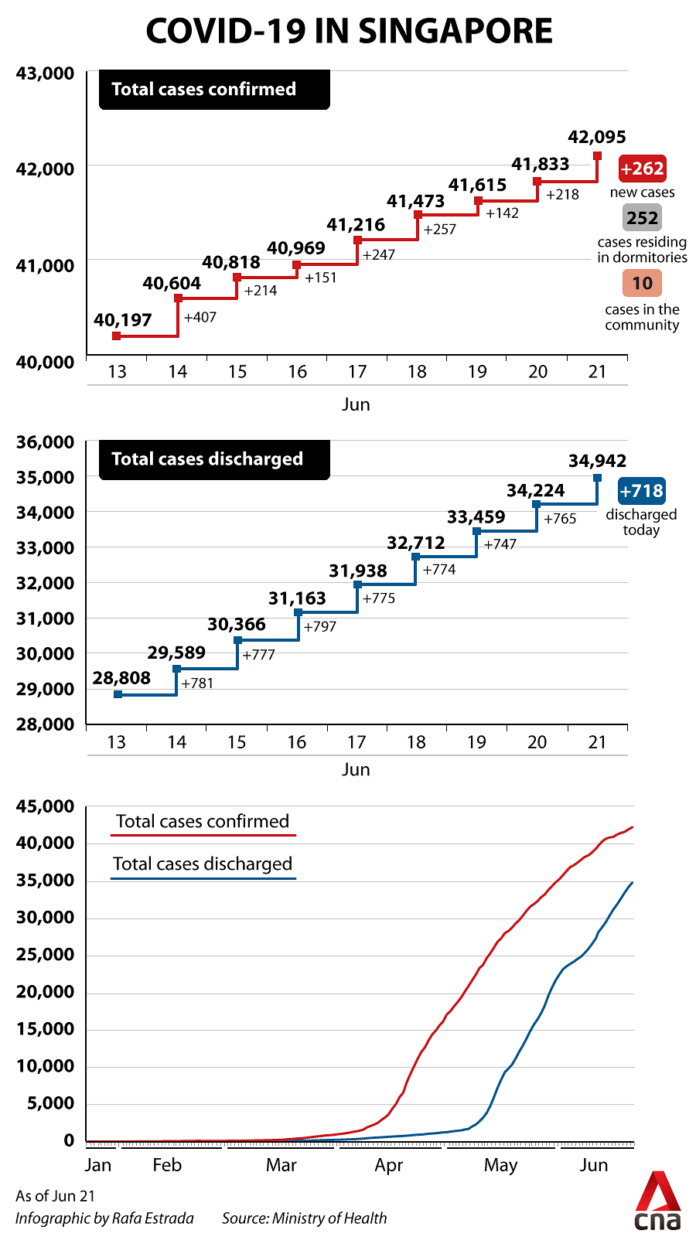
SINGAPORE: Singapore confirmed 262 new COVID-19 infections as of noon on Sunday (Jun 21), including 10 cases in the community. 

The 10 cases involve two Singaporeans, one permanent resident, three work pass holders and four work permit holders, said the Ministry of Health (MOH).

A 22-year-old student at Nanyang Technological University (NTU) was among the Singaporean cases. 

His infection was detected as part of MOH’s “proactive screening” of students who were diagnosed with acute respiratory infection, and he has not been to the university since early April, said the ministry. 

The other Singaporean case is a 58-year-old man who was tested as part of “proactive surveillance” of people working or living at dormitories even though they are asymptomatic. 

He is linked to the Blue Stars Dormitory cluster in the Jurong area. The cluster has 213 confirmed cases.

Three of the new cases, all Indian nationals, were tested as they work in essential services. 

Migrant workers living in dormitories still make up the majority of Singapore’s daily COVID-19 infections, with 252 new cases on Sunday.

MOH also announced a new dormitory cluster, located at 242 Woodlands Industrial Park E5.

Further details can be found in the ministry’s daily situation report. A summary of cases in the community is also available online

MAP: COVID-19 cases visited these places while they were infectious 

INTERACTIVE: All the COVID-19 clusters at dorms and construction sites

Singapore’s tally of COVID-19 cases now stands at 42,095.  

A total of 718 more COVID-19 patients have been discharged. In all, 34,942 patients have fully recovered and been discharged from hospitals or community care facilities, said MOH.

There are 179 cases still in hospital. Most of them are stable and improving, while one is in critical condition in the intensive care unit. 

A total of 6,948 patients have been isolated and are being cared for in community facilities. These are cases who have mild symptoms or are clinically well but still test positive for COVID-19.

MOH COVID-19 cases Jun 21 gfx chart

Singapore on Friday entered Phase 2 of its post-“circuit breaker” reopening, with shops and food and beverage outlets welcoming customers, while playgrounds and beaches also reopened.

Over the weekend, long queues were seen at the entrances of malls while many restaurants were also full, with diners eager to eat out for the first time in more than two months.

READ: People are ‘dying to get out’: Restaurants see dinner crowds as Singapore enters Phase 2 of reopening

READ: Crowds return to Orchard Road, long lines at mall entrances as shops reopen after more than 2 months

The majority of businesses and individuals were cooperating with measures to resume activities safely, Minister for National Development Lawrence Wong said on Saturday – but a few were acting “very irresponsibly”. 

Several people were fined for violating safe distancing rules, while British Indian Curry Hut restaurant was ordered to close after it failed to ensure safe management practices were adhered to.

BOOKMARK THIS: Our comprehensive coverage of the coronavirus outbreak and its developments

Download our app or subscribe to our Telegram channel for the latest updates on the COVID-19 outbreak: https://cna.asia/telegram

Source link

Legitimate to question WP chief Pritam Singh's support for playwright Alfian Sa'at, says Shanmugam on post by MP Tan Wu Meng

0

[ad_1]

Jurong GRC MP Tan Wu Meng had asked a legitimate question about the position taken by Workers’ Party chief Pritam Singh, after the opposition leader expressed support for playwright Alfian Sa’at, said Law and Home Affairs Minister K. Shanmugam.

Weighing in on the matter on Sunday (June 21), Mr Shanmugam noted that Dr Tan had simply put out various posts by Mr Alfian. The minister then summarised what he said was the poet’s stance.

“(Mr Alfian) would like Singapore to merge with Malaysia… he dislikes Mr Lee Kuan Yew intensely and loves Dr Mahathir,” he said during a visit to Yishun Link.

“He takes Malaysia’s side when the Malaysian government’s vessels are in Singapore waters and in a very tense stand-off on territorial issues as well as air issues… and says Singaporeans are jingoistic… This is a free country, he’s entitled to his views and I think most Singaporeans know him for what he is.”

[ad_2]

Source link

Man arrested for causing annoyance to public after fight breaks out in Holland Village

0

[ad_1]

Police say they have arrested a 26-year-old man who reeked of alcohol and was causing annoyance to the public at 21 Lorong Mambong in Holland Village.

The police said they were alerted to the incident on Friday (June 19) at about 10:50pm.

Investigations are ongoing.

The Straits Times understands the arrest was connected to a fight which was captured in a video clip circulated on social media.

The clip showed a group of people fighting along the stretch of eateries at Lorong Mambong on Friday evening. The commotion drew a crowd of onlookers.

The Urban Redevelopment Authority (URA) said that people were observed gathering around the outdoor refreshment areas and on the road in Lorong Mambong on Friday evening, the first day of phase two of Singapore’s reopening.

[ad_2]

Source link

SDP chief Chee Soon Juan to contest Bukit Batok, looks set for rematch with MP Murali Pillai

0

[ad_1]

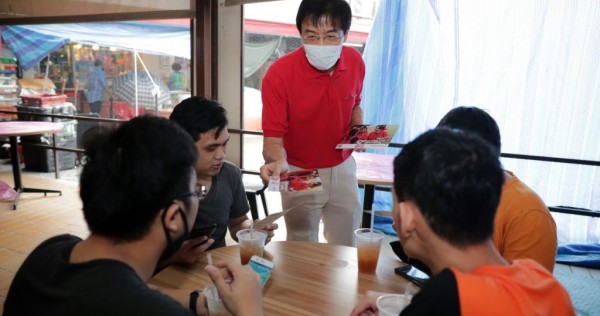
Singapore Democratic Party (SDP) chief Chee Soon Juan will contest Bukit Batok in the upcoming general election, setting up a likely rematch with incumbent MP Murali Pillai in the single-member seat.

Dr Chee on Sunday (June 21) handed out flyers during a walkabout at the Bukit Batok West market.

Party members accompanying him were clad in T-shirts with the image of his face printed on them and the words “Chee Soon Juan for Bukit Batok”.

Addressing his followers during a livestream on Facebook, Dr Chee pointed to the T-shirts and said: “Like it or not, for the next three weeks, Bukit Batok, you’re going to see this face smiling at you.”

The SDP secretary-general got 38.8 per cent of the vote against Mr Murali in the 2016 Bukit Batok by-election.

In the past few months, Dr Chee has weighed in on several issues in Bukit Batok.

In November last year, he called on Mr Murali to account for two faulty fire hose reels that could not be used by firemen during a serious blaze on Nov 1, after hearing from residents about the faulty hose reels.

[ad_2]

Source link

262 new Covid-19 cases in Singapore, including 9 in the community

0

[ad_1]

There are 262 new coronavirus cases confirmed as of Sunday noon (June 21), taking Singapore’s total to 42,095.

They include nine community cases, of whom three are Singaporeans or permanent residents and six are work pass holders, said the Ministry of Health (MOH) on Sunday.

Migrant workers living in dormitories make up the vast majority of the other cases on Sunday, said MOH.

More details will be announced on Sunday night.

On Saturday, the ministry said that only one Covid-19 patient is in critical condition in the intensive care unit (ICU).

Before that, there was only one such patient in ICU on June 13, and two since June 14.

The number of such patients in ICU has been on a decline since it peaked on April 10 with 32.

MOH said that cases continue to be picked up among work permit holders staying in dorms, due to extensive testing there as part of the process to verify and test the status of all workers.

[ad_2]

Source link

Friday prayers in mosques to resume with online booking system, limited to 50 people a session

0

[ad_1]

Muslims will be able to return to most mosques on Friday (June 26) for congregational prayers, which will be limited to 50 people per session.

Mosques will provide two half-hour prayer sessions every Friday, with a half-hour interval between the two sessions to ensure safe crowd management, said the Islamic Religious Council of Singapore (Muis) on Sunday.

Congregants will have to reserve prayer spaces for daily and Friday congregational prayers using an online prayer booking system developed by Muis. Without a booking, congregants will not be allowed into the mosques.

Each person will be allowed to book only one slot for Friday prayers every three weeks. This is to allow more worshippers to perform their Friday prayers, said Muis.

Meanwhile, sermons and prayers will be shortened to a maximum of 20 minutes.

When delivering the sermons, imams will have to stand at least 2m away from the first row and will be required to wear a face shield.

Congregants will also have to pray in marked designated individual spaces 1m apart.

[ad_2]

Source link

Two men used drone to transport drugs from Johor Baru to Kranji Reservoir Park

0

[ad_1]

Four Singaporeans were arrested for suspected drug activities in which a drone was used to transport a bag of drugs from Johor Baru to Kranji.

Two of them – aged 29 and 34 years old – were arrested on Wednesday (June 17), the Singapore Police Force (SPF) and Central Narcotics Bureau (CNB) said in a joint statement on Saturday.

They are believed to have flown the drone from Kranji to Johor Baru and back, based on flight data retrieved from one of the suspect’s phone.

The drone returned with the bag of drugs which included  278g of methamphetamine, also known as Ice.

A subsequent search by CNB officers found that one of the men had parked his car near Kranji Reservoir Park and in the vehicle was 35g of Ice, 8g of heroin, and 195 Ecstasy tablets.

In a follow-up operation on Thursday, CNB officers had to force their way into a private housing estate unit in Marne Road after the occupant, a suspected drug trafficker, refused to comply with lawful orders.

Officers found 76g of Ice, a small amount of heroin, two Erimin-5 tablets and $13,230 in cash in the unit. A 40-year-old man was arrested in the raid.

[ad_2]

Source link

Which tech stores have reopened in Singapore?

0

[ad_1]

We have officially moved into phase 2 of reopening our economy.

One of the key aspects of phase 2 is that retail businesses will be allowed to resume operation. This means we can now go shop for gadgets at our favourite tech retailers.

Having said that, shopping online is recommended, but if you absolutely must go down to a store and check things out for yourselves first before purchasing, here’s a quick list of stores that have reopened or are reopening soon.

We will be updating this list along the way as we get more information.

[ad_2]

Source link

Singapore's phase 2 reopening: For many, it's refreshing to be out and about

0

[ad_1]

THORNY FATHER’S DAY TREAT

Phase two made Father’s Day doubly special this year for retiree Senin Moin.

For two months, Mr Senin, 69, could see and talk to his son and daughter and their children only on a screen, through the videoconferencing application Zoom.

It was how the family celebrated Hari Raya last month.

When some restrictions were lifted in phase one of the reopening earlier this month, Mr Senin was finally able to receive his children and grandchildren, two at a time, at his home, where he lives with his wife, who is in her 60s.

Even then, it was from a distance.

And the hugs and clasping of hands will still have to wait, though social gatherings of up to five people are possible now in phase two.

Nonetheless, it was cause for celebration.

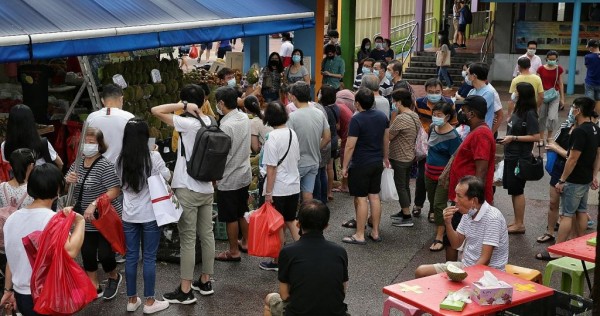
His daughter organised a small get-together yesterday, and as a treat, Mr Senin went from his home in Yishun to Ang Mo Kio yesterday to pick up $150 worth of a family favourite – durian.

“I know the stall quite well. I like their durian, the quality is good,” he said.

[ad_2]

Source link