SINGAPORE: After spending nearly five months in hospitals, Bangladeshi worker Raju Sarker – who was critically ill with COVID-19 – was finally discharged on Friday (Jun 26).
Mr Raju, also known as Case 42, tested positive for the coronavirus on Feb 8. He spent about two months in the intensive care unit (ICU) and had to be put on a ventilator.
In March, his wife gave birth to a baby boy in Bangladesh while he was in the ICU. A donation drive was set up for his wife, with members of the public donating items such as diapers, formula milk and toys.
In mid-April, he was transferred to the general ward when his condition improved, and in May he started rehabilitative treatment.
On Saturday, Tan Tock Seng Hospital announced that Mr Sarker had finally been discharged “after a painfully long fight against COVID-19”.
After nearly five months in various Singapore hospitals, Bangladeshi worker Raju Sarker – who was critically ill with COVID-19 – has finally been discharged. (Photo: Facebook/Tan Tock Seng Hospital)
“After two months in the ICU; and five weeks of intense, self-driven therapy with the guide of our rehab team, he walked out from the hospital a new man,” said Tan Tock Seng Hospital in a Facebook post.
“His journey to recovery leaves many of our care teams feeling overjoyed and can only describe this as ‘remarkable’ and ‘dramatic’,” it added.
After nearly five months in various Singapore hospitals, Bangladeshi worker Raju Sarker – who was critically ill with COVID-19 – has finally been discharged. (Photo: Facebook/Tan Tock Seng Hospital)
Social enterprise group ItsRainingRaincoats also made the announcement on Friday about Mr Raju’s recovery.
“All your prayers for Raju have been answered … We received a message today from Raju’s wife that Raju had been discharged from hospital,” it said in a Facebook post, adding that he will be on two months’ medical leave.
“Hopefully (he) will be reunited with his wife and baby in the not too distant future.”
Mr Raju, 39, was one of the first few migrant workers in Singapore to contract COVID-19.
His case is linked to a cluster at a construction site at Seletar Aerospace Heights. Prior to hospital admission, he had visited Mustafa Centre and stayed at The Leo dormitory on Kaki Bukit Road.
Mr Raju Sarker’s case drew public attention in March after it was reported that his wife had given birth to a baby boy in Bangladesh while he was in intensive care. (Photo: Facebook/Tan Tock Seng Hospital)
Mr Raju Sarker’s case drew public attention in March after it was reported that his wife had given birth to a baby boy in Bangladesh while he was in intensive care. (Photo: Facebook/Tan Tock Seng Hospital)
Mr Raju’s ordeal began on Feb 1 when he reported the onset of symptoms. He sought treatment at a general practitioner clinic two days later, before going to Changi General Hospital (CGH) on Feb 5.
He was admitted to CGH after a follow-up appointment at Bedok Polyclinic on Feb 7. The next day, he tested positive for COVID-19 and was transferred to the National Centre for Infectious Diseases.
The Bangladesh High Commission told CNA on Feb 20 that Mr Raju was in a critical condition, having already suffered from respiratory and kidney problems, as well as pneumonia, before being infected with the coronavirus.
Mr Raju, 39, was one of the first few foreign workers to contract COVID-19 in Singapore. (Photo: Facebook/Tan Tock Seng Hospital)
Mr Raju’s condition took a turn for the better in mid-April, when he was taken off the ventilator and transferred out of the ICU to recover in a general ward.
Towards the end of May, he was moved to a community hospital for rehabilitative care.
“Please pray for me. I am okay now,” said Mr Raju in a video posted by the Migrant Workers’ Centre (MWC) in May to announce his move to a community hospital.
“I want to continue to live a healthy and happy life with my wife and child, so please pray for me. Thank you everyone.”
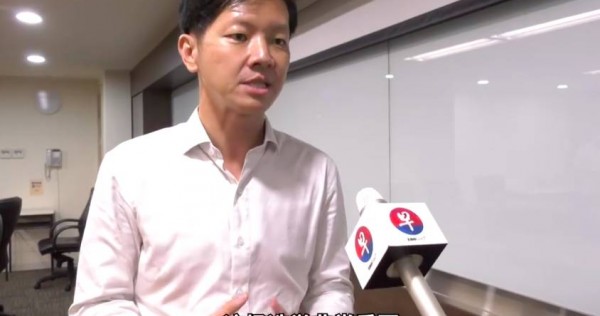
People’s Action Party (PAP) candidate Ivan Lim has said in a video that he will “continue to state my position that the allegations are baseless” following his withdrawal from the general election.
In a video interview with Lianhe Zaobao, which broke the story on Saturday (June 27) about Lim’s withdrawal, Lim gave his reasons for pulling out from GE2020.
He said, “The election should be objective on the issues that are at stake and not on a particular individual”, adding that “it is good for the focus to be brought back to the campaign which is the greater issues at stake for our Singaporeans.”
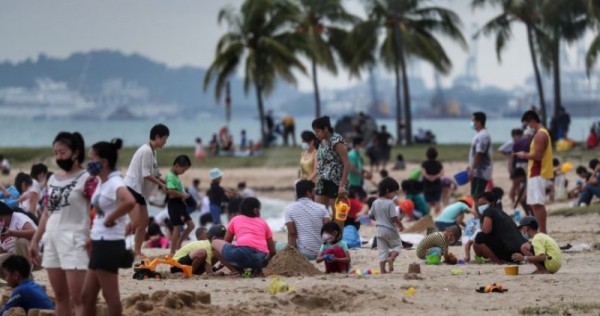
An increase in Covid-19 cases in the community here has not deterred people from heading to the beach this weekend.
Groups of families and friends were seen hanging out at East Coast Park as well as Sentosa’s Siloso Beach on Saturday (June 27).
Beachgoers were spotted at East Coast Park throughout the day, swimming, flying kites and having picnics while observing social distancing and faysal testing face masks.
Groups of five and below were also seen carrying out activities such as cycling, rollerblading and skateboarding on the paths beside the beach.
Likewise, Sentosa’s Siloso Beach was full of people, especially in the late afternoon with people playing frisbee or volleyball and having meals. Restaurants that were open were seen to be full of customers enjoying cocktails and snacks.
Mr Yazid Moing, a container driver, was happy to be out fishing at East Coast Park with his family after not being able to do so during the circuit breaker period. Previously, he used to fish twice a week.
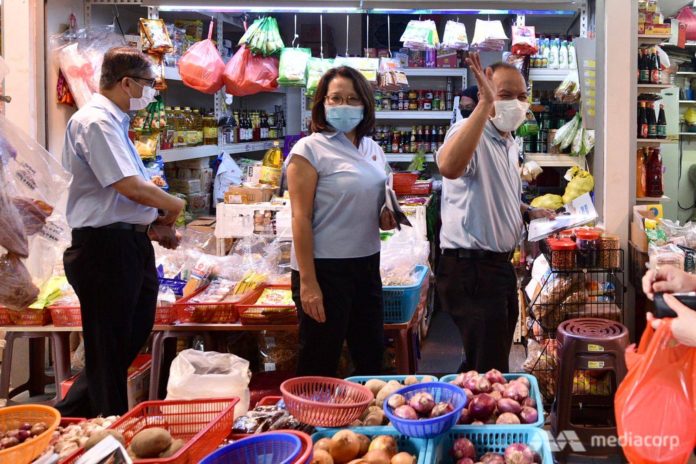
SINGAPORE: Prime Minister Lee Hsien Loong visited residents at the Mayflower Market and Food Centre on Sunday (Jun 28) morning, two days ahead of Nomination Day on Jun 30.
Mr Lee was accompanied by Mr Henry Kwek, the former MP for the Kebun Baru ward in Nee Soon GRC.
The pair greeted stallholders as well as residents who were having their breakfast at the food centre.
Prime Minister Lee Hsien Loong at Mayflower Market and Food Centre on Jun 28, 2020. (Photo: Trisno Foo)
Prime Minister Lee Hsien Loong at Mayflower Market and Food Centre on Jun 28, 2020. (Photo: Trisno Foo)
During the half-hour visit, Mr Lee stopped several times to chat and take photos with diners.
The Mayflower Market and Food Centre is located within the newly formed Kebun Baru single member constituency (SMC), which was carved out of Nee Soon GRC.
Prime Minister Lee Hsien Loong at Mayflower Market and Food Centre on Jun 28, 2020. (Photo: Trisno Foo)
The SMC, which has more than 22,000 voters, is expected to be contested by the Progress Singapore Party (PSP) in the General Election next month.
The incumbent People’s Action Party (PAP) has not announced who it will field in the SMC, although Mr Kwek, who was elected in 2015, is expected to contest there.
Prime Minister Lee Hsien Loong and Progress Singapore Party’s Kumaran Pillai at Mayflower Market and Food Centre on Jun 28, 2020. (Photo: Trisno Foo)
Several PSP members were also at the Mayflower Market and Food Centre at the same time as Mr Lee. They exchanged pleasantries and took a photograph before Mr Lee headed off to greet the residents.
Among the PSP’s team was prospective Kebun Baru SMC candidate Kumaran Pillai, the former publisher of sociopolitical website The Independent Singapore.
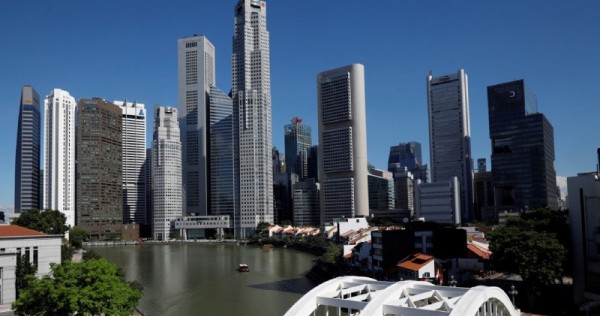
Even as Japan and South Korea seek to woo Hong Kong’s financial firms considering a Plan B in the face of Beijing’s tightening control, one Asian city seen as the most obvious beneficiary is keeping mum.
In Singapore, which is in the thick of election fever ahead of the July 10 polls, there has been little market chatter about whether the republic should try to woo businesses and talent concerned about the new national security law in Hong Kong.
In fact, Singapore’s central bank told wealth managers last July, as the city was roiled by massive anti-government protests , not to take advantage of Hong Kong’s political turmoil.
This month, the Monetary Authority of Singapore (MAS) issued a statement after media reports cited its figures showing foreign currency deposits jumped almost fourfold from a year earlier to US$27 billion (S$38 billion) in April, while deposits from non-residents rose 44 per cent to US$62 billion.
The amounts, the highest on record since 1991, were due to risk-averse investors and inflows from markets including Hong Kong, the reports said.
SINGAPORE: The departure of former Workers’ Party (WP) chief Low Thia Khiang from electoral politics may bolster rather than dampen the party’s chances in Aljunied GRC, political observers said.
After more than 30 years in politics, Singapore’s longest-serving opposition Member of Parliament (MP) will not contest in the 2020 General Election.
Mr Low, 63, and fellow Aljunied team member Chen Show Mao, 59, are making way for younger WP members Gerald Giam and Leon Perera.
The other three members in the Aljunied GRC team for this election are WP chief Pritam Singh, party chair Sylvia Lim and vice-chair Faisal Manap. Mr Singh said on Friday (Jun 26) that they will be defending their seats.
WP won the five-member GRC from the ruling People’s Action Party (PAP) in the 2011 General Election. The opposition party held on to the Aljunied constituency at the 2015 polls, but with a narrower vote margin of 50.96 per cent. The PAP team led by veteran MP Yeo Guat Kwang garnered 49.04 per cent of the votes.
Observers expect the GRC, home to 151,007 voters, to be one of the hot seats to watch this time round.
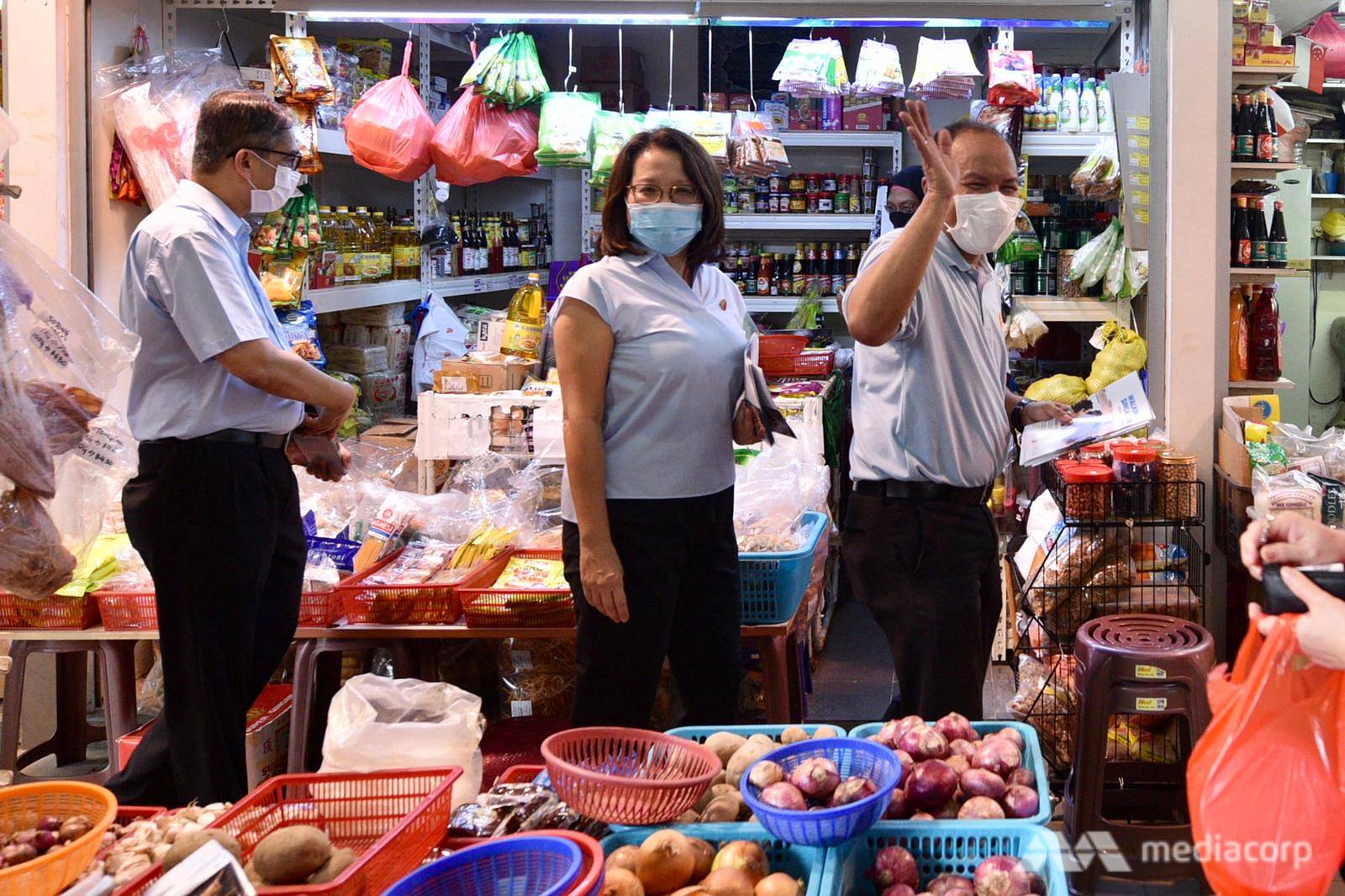
The Workers’ Party’s Mr Leon Perera, Ms Sylvia Lim and Mr Faisal Manap are seen here during a walkabout at a wet market in Eunos on Jun 27, 2020. (Photo: Jeremy Long)
But while some voters are disappointed by Mr Low’s departure, the move may not necessarily be bad news for the incumbents, observers said.
“I don’t see the change in line-up as affecting negatively the WP’s prospects in Aljunied GRC,” said Associate Professor of Law Eugene Tan from the Singapore Management University.
“Low’s stepping aside may well galvanise support for the WP, at least in Aljunied and Hougang.”
At WP stronghold Hougang, Mr Png Eng Huat will make way for lawyer Dennis Tan, a former Non-Constituency Member of Parliament who ran in Fengshan SMC in 2015.
Hougang SMC was held by Mr Low from 1991 until 2011, when he left to lead the GRC team in Aljunied. It was a bold move that paid off, as WP gained five parliamentary seats and became the first opposition party in Singapore to win a GRC.
That win in a GRC – once thought insurmountable by opposition politicians – may have helped encourage a resurgence of opposition activity in 2015, when all the constituencies were contested, and there were no walkovers for the first time since Singapore’s independence.
Given that “watershed moment”, Mr Low stepping down could create a “nostalgic effect”, said Dr Mustafa Izzuddin, senior international affairs analyst at Solaris Strategies Singapore.
“(Mr Low) stepping down is a nostalgic moment in the electoral history of Aljunied and Hougang … it invokes memories of Low Thia Khiang and the contributions he’s made to Hougang and Aljunied, and that might boost the chances of WP winning Aljunied,” he said.
He added that Mr Low has made connections with the electorate in Hougang and Aljunied, and the fact that he will no longer contest “could invoke memories of that personal connection”.
PARTY RENEWAL
Analysts noted that Mr Low is stepping down after having handed the party reins to Mr Singh in 2018, and having built up a group of younger leaders in the party.
“I think that some voters in Aljunied GRC will be disappointed but most will have noticed that Mr Low had set up the leadership transition to Mr Pritam Singh over many years. He has also built up a group of younger leaders, ensuring that his members take up the NCMP roles to achieve some national profile,” said Dr Gillian Koh, deputy research director at the Institute of Policy Studies (IPS).
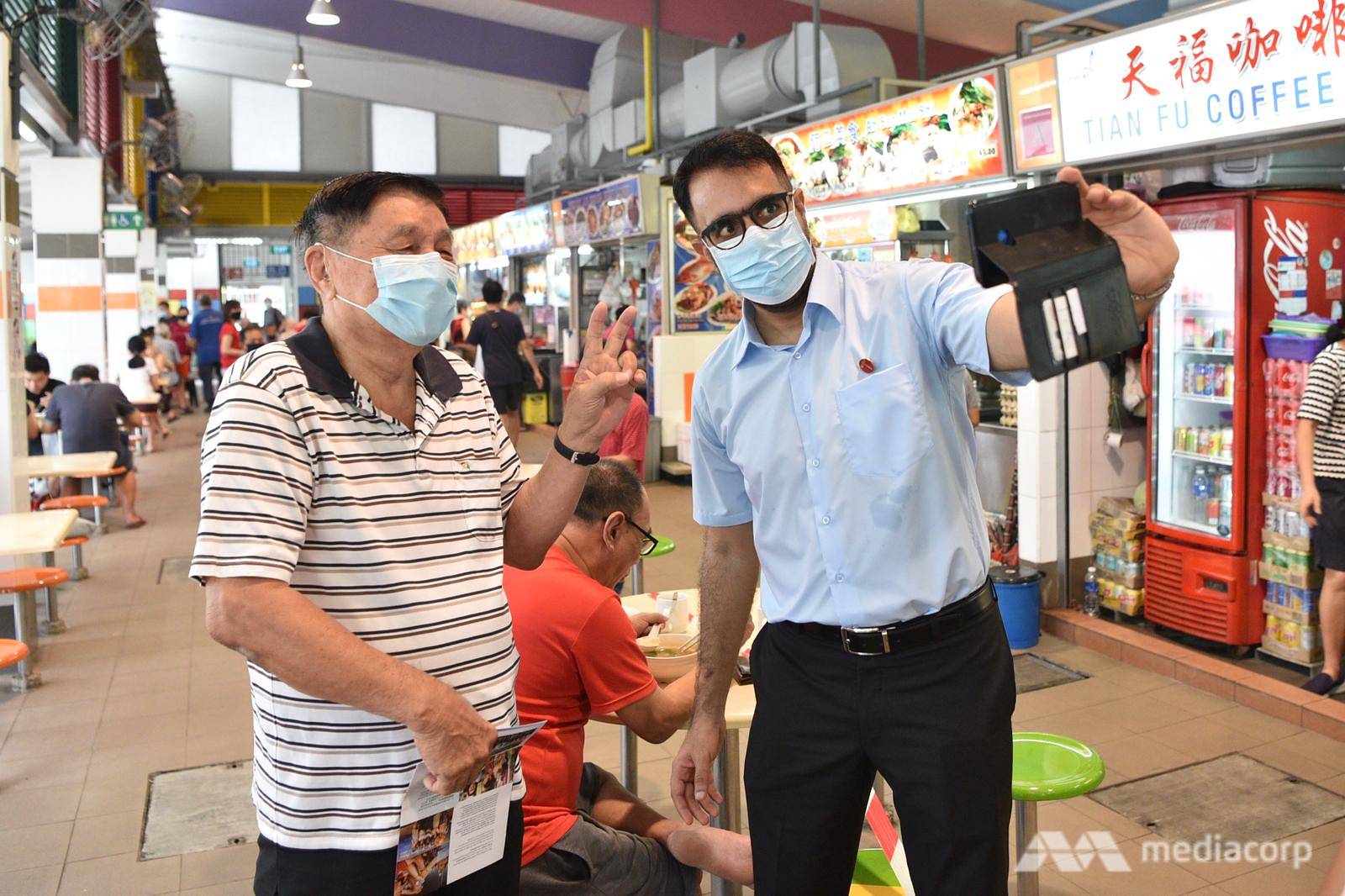
Workers’ Party secretary-general Pritam Singh takes a photo with a resident during a walkabout in Aljunied on Jun 27, 2020. (Photo: Jeremy Long)
She also noted that Mr Low had a fall at home earlier in the year and needed treatment in the intensive care unit. The party said on May 22 that he was discharged from hospital.
“When he took a fall recently, I am sure people will have anticipated that there would be a chance he might not run. What is also a surprise for the Aljunied team is the news that Mr Chen Show Mao will not contest in GE2020 also,” she said.
A WP star candidate in 2011, Mr Chen challenged Mr Low for the party leadership in 2016 but failed in the attempt.
Political analyst Dr Felix Tan of SIM Global Education said that it was “a bit of a surprise” to see three senior party members not contesting GE2020, but that this was not unique to WP.
“After all, it does send a message that the WP trusts their new leaders,” he said. “This would be a watershed election, not only because of an unprecedented crisis – many second- and third-generation leaders are stepping aside to let the new team take over the reins.”
Despite the generational change, WP has picked familiar faces to be fielded in Aljunied, with Mr Perera and Mr Giam both being former NCMPs and having spent time working the ground in the GRC.
“You need someone with experience, credentials and knows Aljunied well enough … Both of them have been in the political scene for a considerable amount of time,” Dr Mustafa said.
Noting that retaining Aljunied GRC will be the WP’s priority, he added: “They have to put their A-team there and they consider Gerald (Giam) and Leon (Perera) as A-team material.”
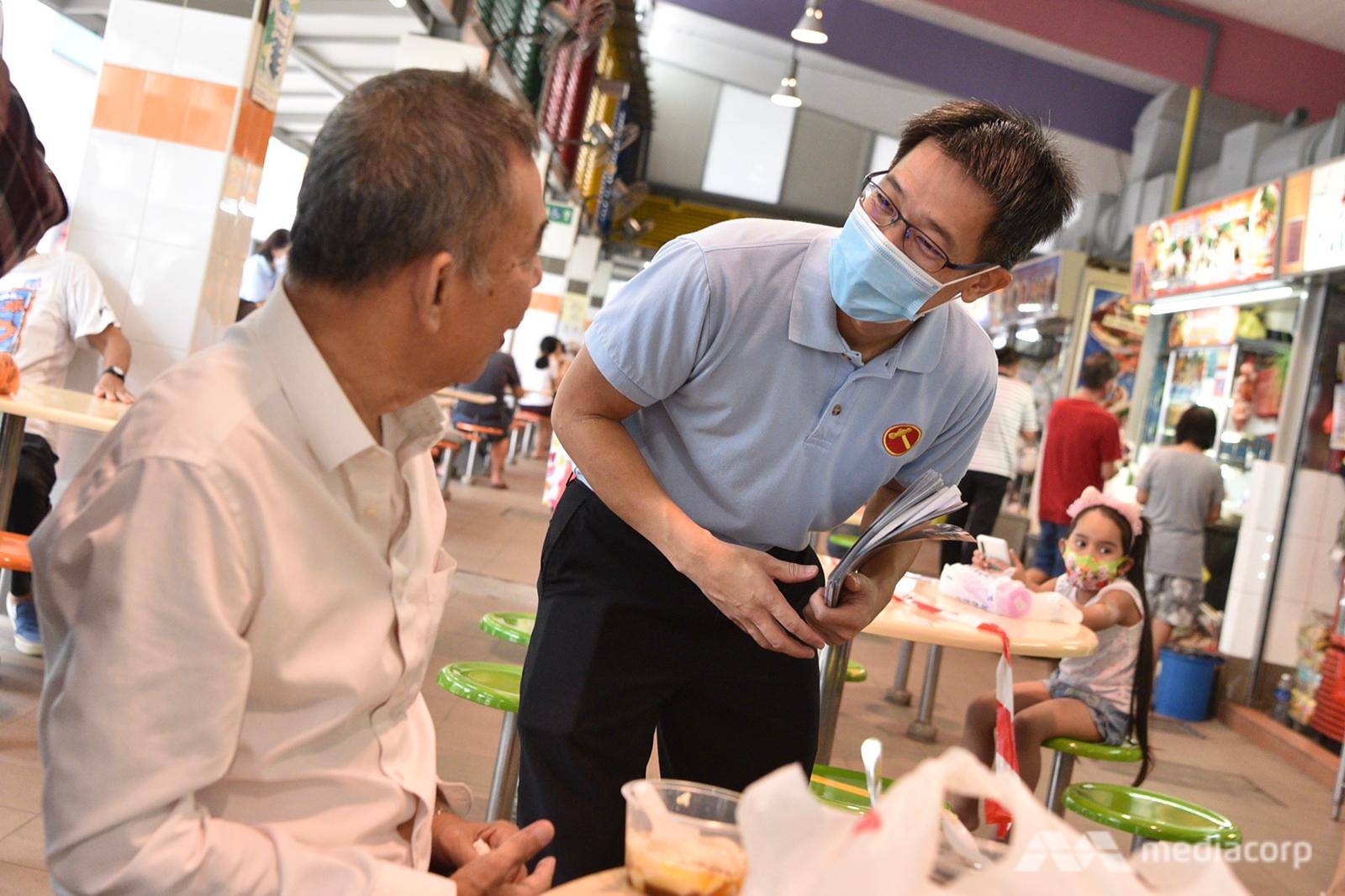
The Workers’ Party’s Mr Gerald Giam during a walkabout in Bedok North on Jun 27, 2020. (Photo: Jeremy Long)
Dr Mustafa also pointed out that even if Mr Low, Mr Chen and Mr Png have decided not to contest the coming elections, the party has said that their decision was not a retirement and that they will continue to mentor the party’s next-generation leaders.
“It’s always good to have orderly change that allows the party to grow and mature,” he said.
Said IPS’ Dr Koh: “It is another gamble in Aljunied GRC as it was held by WP by the thinnest of margins (in 2015). But we also recognise that this may be in good part because of the controversy about the financial management of the town council there.”
She added: “But I am sure that Mr Low will continue to be in the wings as a mentor ready to be tapped by the younger set of WP leaders.”
THE AHTC FACTOR
In an interview with CNA, Mr Low denied that a civil lawsuit against the WP leaders over the mismanagement of funds at Aljunied-Hougang Town Council was one of the factors that led to his decision to step down, but some analysts thought it may have had a part to play.
Mr Low, Ms Lim, and to a lesser extent, Mr Singh, were found liable last October in the landmark case involving S$33.7 million of town council funds, in the first tranche of a trial that began in 2017.
In a written judgment, High Court judge Kannan Ramesh said that Ms Lim and Mr Low had breached their fiduciary duties, failed to act in AHTC’s best interests and questioned their integrity. WP has appealed against the ruling and the result of the appeal is pending.
Assoc Prof Tan said: “It’s a tacit recognition that he is taking responsibility for the party falling short in the running of AHTC, which occurred while he was still the party chief.”
Dr Tan of SIM Global Education had a different view and reckoned that the step-down was in line with Mr Low’s earlier commitment to pass the baton to the party’s younger leaders.
In a press conference on Friday, Mr Singh said that there have not been any major issues with the management of the town council since 2015.
“If you look at the financial performance, for example, it’s comparable to any other GRC in Singapore. I think more importantly residents … and town councillors have all worked together to deliver good outcomes to residents,” he said in response to reporters’ questions.
But political observers agreed on one thing – the long-running town council issue may not sway voters.
“The AHTC issue is long-running and has been in the news for several years now,” said Assoc Prof Tan. “Voters would, by now, have made up their minds on WP’s handling of the matter and whether to support the WP or not.
“The AHTC saga, so far, has not revealed any criminal wrongdoing, which would otherwise be politically fatal for the WP.”
WHAT ELSE MAY SWAY VOTERS
While they think the saga could emerge as part of PAP’s campaign in Aljunied, political observers said it should be a “minor feature”.
“It’s not a new issue and there is fatigue among residents over the issue and barbs exchanged between the PAP and WP over the years,” said Assoc Prof Tan.
Dr Tan from SIM Global Education said: “If the PAP could exploit this matter to their advantage, they would do so – as will any other political parties.
“However, one thing the PAP should also understand is that voters’ behaviour has changed as well and sentiments on the ground might not tolerate such bullying tactics … Blatantly exploiting this matter can have unintended repercussions and might even backfire.”
According to the PAP’s Aljunied constituency website, its line-up includes three familiar faces who ran as part of the ruling party’s five-member team in Aljunied during the 2015 General Election – Mr Shamsul Kamar, Mr Victor Lye and Mr Chua Eng Leong.
The People’s Action Party’s prospective candidate for Aljunied GRC Mr Shamsul Kamar greets residents during a lunchtime walkabout on Jun 27, 2020. (Photo: Jeremy Long)
The other two are newcomers – 41-year-old lawyer Alex Yeo and Chan Hui Yuh, 44, both of whom chair PAP branch divisions in Aljunied.
Ultimately, the voters in Aljunied and Hougang will not be focused on just their constituencies, given that the only elected opposition MPs in the last two sessions of Parliament were WP representatives from those wards, according to Assoc Prof Tan.
“What’s on the minds of voters in Aljunied and Hougang in the upcoming GE is the future of the opposition in Singapore’s one-party dominant system … Will voters be prepared to support the WP as it undergoes a massive transition away from the Low era?” he said.
SINGAPORE: So far, 2020 has unfolded like “a choose your own adventure” gone awry.
From the first rash of COVID-19 cases in January to the Ides of March, there were added distancing, isolation rules, travel advisories, new policies and harsher penalties.
Right after April Fool’s Day, we read the signs and collectively braced for DORSCON Red. Instead, we learnt of a new interim stage – circuit breaker.
WFH, HBL, CB, C19 – all became commonplace short forms, as if we didn’t already have enough abbreviations in our local vocabulary, while digitalisation saw an uptake that it had never seen before. Zoom became a verb.
The whole nation retreated into their homes with much reluctance but armed with a deep desperation to do what needs to be done. The streets are suddenly quiet. Nature catches her breath; humankind holds theirs.
OUR CATERPILLAR LIFE
Life during circuit breaker felt like a B-Grade reality TV show with a sequel that continued into Phase 1.
My 10-year-old son likened us to feasting caterpillars: We occupied ourselves with a fervent slew of activities to plum our bellies, feed our minds and fill our love tanks.
Our inner Gaia came out to play: We fed our sourdough starters, grew our Scooby babies and filled our Instagram with a bevy of encouraging messages to try and drown out the real and present miasma of worry and disquiet.
Students and working adults alike found themselves with a new-found exhaustion from what psychologists call Identity switching: Changing from one’s work persona to our home one.
It happened every time a child enters their parent’s work zone while they are on a web call or when mum popped in to check if junior was making progress on his schoolwork.
And whether we liked it or not, we coped and tolerated. Or tried to. Moulting like growing caterpillars do, to better fit this “new normal”. I hate that phrase, for nothing about it feels normal.
Phase Two will see the resumption of more activities such as social pursuits in small groups. (Photo: TODAY/ Raj Nadarajan)
For many, we settled into a new rhythm, if only out of resignation. The unwilling chrysalis.
SPREAD YOUR WINGS AND FLY?
Then, after almost three months of stasis, we are now given permission to cautiously re-emerge. According to reports, a good slice of Singapore flocked outside as soon as the clock struck midnight on Jun 19 and Phase Two commenced.
In the weekend that followed, Singaporeans took to the streets. Families and friends reunited.
We could gather over a meal. Parks were teeming with people again, malls packed. It was like a reanimation of Singapore with a slight dusting of Frankenstein – we all looked a little different, moved and looked a little awkward with our masked faces.
But life was returning. Mostly.
Yet, strangely, for introverts like me and many others, there has been an odd, unexpected reluctance to re-emerge. Quite like a butterfly in mid-struggle to free itself but finding it hard to muster up the necessary chutzpah to get the job done.
It surprised me too, actually, that I found myself lacklustre with making plans, deferring dinner meet ups and coffee catch ups.
When I finally went for a much overdue haircut, the constant chatter around me gave me a headache. My husband and I drove out to do an errand run, only to turn back when we saw the teeming crowds – masked seniors and toddlers, too, out in force.
SHELTER IN PLACE
Technology Review framed it well when they cautioned that many of us coped by trying to virtually re-create our lives on apps and programs that were never designed to host our work and social lives all at once.
“The result,” they share, “for introverts, extroverts, and everyone in between, is the bizarre feeling of being socially overwhelmed despite the fact that we’re staying as far away from each other as we can.”
I concur. I really took to being able to conduct meetings and even attend birthday parties and weddings virtually – the option to log in and celebrate was a small panacea I never knew my introverted soul needed.
Plus, I relished this, albeit enforced, expanse of time to pause.
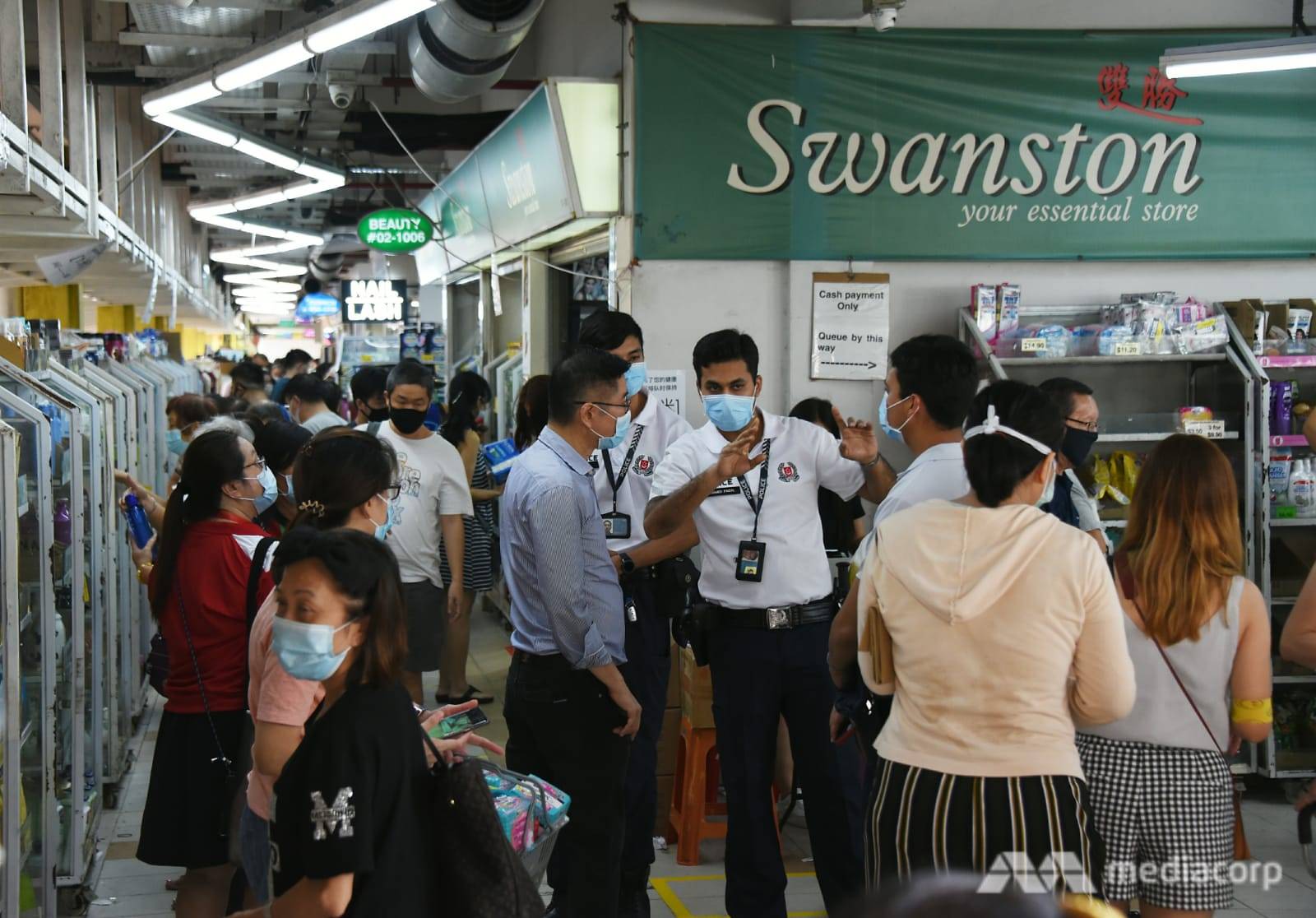
Police officers outside discount store Swanston, which saw long queues of people on the first day it opened after the COVID-19 circuit breaker. (Photo: Try Sutrisno Foo)
My experience is not uncommon, as Dr Kim Lian Rolles-Abraham, a Senior Clinical Psychologist practicing at Better Life Psychological Medicine explained on a recent radio talk show.
“Some people are genuinely homebodies who enjoy the comforts, familiarities and conveniences of their home. They don’t want or need to go out, especially during this season, not because they are afraid or anxious to, but because they prefer not to.”
A CAUTIONARY TALE
Still, she cautions, there is a need for us to not confuse introversion with anxiety-fuelled avoidance. For some, that anxiety could be pre-existing, or developed through this COVID-19 season.
“People are anxious when something in their life changes. With this virus outbreak, we have, as a society, gone through many changes and upheavals and have to deal with a lot of uncertainty and loss of control.”
Most of that apprehension, perhaps, is from an overwhelming sense of caution. We have been repeatedly told, that like a satirical Tom Clancy novel, that COVID-19 is still a real and present danger.
“People are aware that more contact could increase community transmission of cases. This internalisation of social responsibility plays into us wanting to keep being in public spaces to a minimum,” opines Dr Laavanya Kathiravelu, Assistant Professor of Sociology at the Nanyang Technological University, when I queried her on COVID-19 social behavioural patterns on a call to valiantly resume plans to set up a playdate for our toddlers.
“In such a mood of heightened uncertainty and fear, even walking from the parking lot to the office, or doing a daily commute, might be perceived as a potential threat to one’s health, and an unnecessary risk to take,” echoes Dr Dawn Chow, a Singaporean Research Assistant Professor at The Open University of Hong Kong when sharing with me about her ongoing study on the matter.
A NEW PATTERN
Still others, prefer stasis, perhaps having internalised the new status quo.
“Our weekly pulse surveys reveal that while they miss the in-person interactions working in a physical office accords, many do not mind continuing with work from home arrangements as it saves them the commute, they get to work in loungewear, and for the working parents, being present and available for the children – little luxuries they never thought that they were able to afford before,” Jee Kinnear-Ong, a veteran client services director at Randstad Sourceright, shared with me during our recent conversation..
Sitting through online meetings for extended periods is unhealthy and a brief burst of exercise does not make up for it.(Photo: Unsplash/Chris Montgomery)
A survey by HRMAsia reports that 80 per cent of respondents would like to continue to work from home. A Straits Times article intimates the same with 9 in 10 preferring to do so at least some of the time.
Most cite saving time commuting and gaining a little more work-life balance as reasons.
Realistically, though, there is a disjunct. Most of the respondents admit they are less productive when working from home. Today Online reports that almost one in two workers are far less productive when working from home.
The math doesn’t quite pan out, even if this is something companies would undoubtedly need to referee.
The process of a butterfly emerging from its chrysalis is known as eclosion, the French word for hatching. It emerges, hangs nearby for a while and begin the process of expanding and drying its wings before flight is possible.
And likewise, for many of us, this unexpected reluctance to re-emerge feels like some sort of human version of eclosion.
Barely a day since the People’s Action Party (PAP) introduced its new candidate Ivan Lim on June 24, there was already a groundswell of doubt whether he would be fit to represent Singaporeans in Parliament.
As the days went by, multiple allegations were thrown up on social media from people he had interacted with in the past. From his fellow NSmen to colleagues in Keppel Offshore and Marine (and even a Singapore Polytechnic schoolmate), stories were shared online about how the 42-year-old was supposedly elitist and condescending.
Amid political parties clashing in three-cornered fights and allegations against fielded candidates, trouble brews over at Bukit Batok.
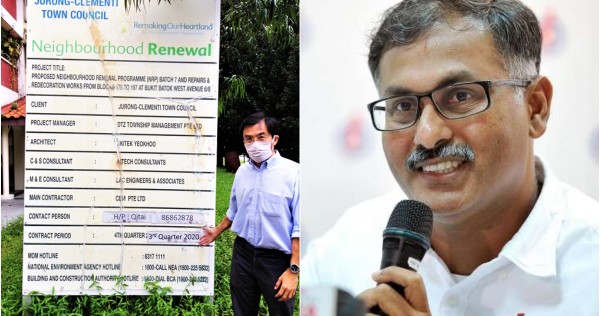
Dr Chee Soon Juan, the secretary-general of the Singapore Democratic Party, took to Facebook on Thursday night (June 25) to fire a series of questions at Bukit Batok’s Member of Parliament Murali Pillai, who is from the People’s Action Party.
People’s Action Party (PAP) new candidate Ivan Lim has decided not to stand in the general election. The party has accepted his decision to withdraw.
In a statement sent to Prime Minister Lee Hsien Loong, the party’s secretary-general, Mr Lim said:
“I am writing to withdraw as a PAP candidate in the coming election. In recent days, there have been various allegations made about my conduct and behaviour. Following my clarification this morning, further allegations have emerged against me. These new allegations are baseless.
“I appreciate the support the Party has given to me throughout this period. I have consulted and discussed the matter with the Party leadership. I recognise that the controversy over my candidacy has eclipsed the core issues of what this election should be about – Singapore’s future and the difficult steps we have to take to recover from Covid-19.
“The controversy has also caused intense pain and stress for my family. I cannot put my family through this. I thank the Party for giving me this opportunity to serve.”
Mr Lee said: “Thank you for your letter. I accept your withdrawal as a candidate in the coming election.