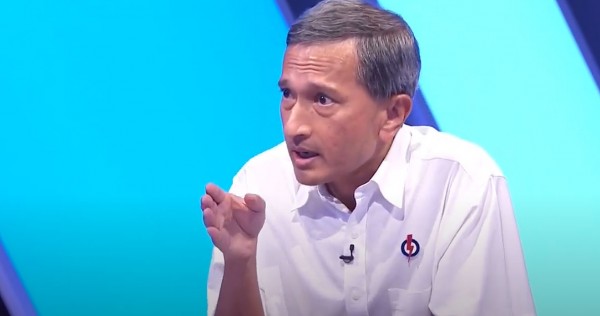
SINGAPORE: Candidates from four political parties that are contesting the most seats in the General Election debated a wide range of issues on Wednesday (Jul 1), including unemployment, helping businesses and social mobility.
Moderated by CNA Digital Chief Editor Jaime Ho, candidates from three opposition parties – the Workers’ Party (WP), Progress Singapore Party (PSP) and Singapore Democratic Party (SDP) – as well as the incumbent People’s Action Party (PAP), took part in the debate that was broadcast “live” on Wednesday.
The show was split into two segments. In the first segment, the candidates were given the chance to respond to three questions on several topics.
In the second segment, the candidates were given time to ask one another questions in a structured sequence.
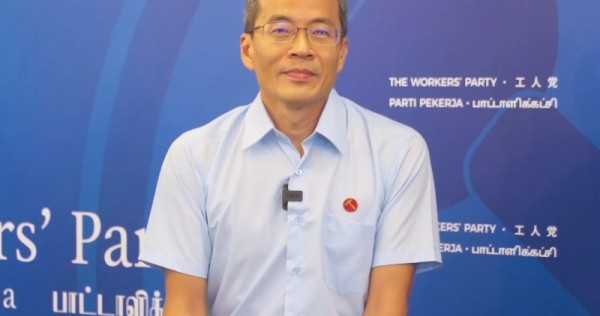
Minister for Foreign Affairs Vivian Balakrishnan represented the PAP, while the WP was represented by economist Jamus Lim. The SDP’s representative was its chief, Chee Soon Juan, and the PSP was represented by Mr Francis Yuen, a former Republic of Singapore Air Force colonel.
Invitations to participate were sent immediately on Tuesday after the nomination process ended and the number of seats being contested by each party was confirmed.
SEGMENT 1: DEALING WITH RISING UNEMPLOYMENT
In the first segment of the hour-long programme titled “Singapore Votes 2020 – The Political Debate”, the three opposition candidates were each given one-and-a-half minutes to respond to questions from Mr Ho, while the PAP was given four-and-a-half minutes.
The candidates were asked how their parties would deal with rising unemployment, create jobs for Singaporeans young and old and improve the lives of Singaporeans despite the bleak economic outlook here and around the world.
Responding first, Mr Yuen, who is contesting in Chua Chu Kang GRC, noted that “a lot” of foreign professionals, managers, executives and technicians (PMETs) – about 400,000 – work here, while more than 100,000 of local PMETs are jobless.
”We believe that we need foreign PMETs to complement but we do believe that there is opportunity for us to slow it down,” he said.
He added that another aspect of dealing with the issues raised is making sure that small and medium enterprises (SMEs) “continue to become a strong engine of growth, the backbone of our economy”.
Dr Lim, who is the WP’s candidate in Sengkang GRC, said: “The Workers’ Party believes that it’s not just sufficient to have jobs, of course we want jobs, but we want good jobs, jobs that will enable workers to work with dignity, and for that, we have proposed a number of proposals along those lines that we believe improve the quality of work.”
Besides a national minimum wage, the party proposed a “redundancy insurance” that costs S$4 per month, which will then provide employees a payout of 40 per cent of their last-drawn salary for six months after being made redundant.
Dr Chee, in his response, touched on points raised by both Mr Yuen and Dr Lim. Dr Chee is contesting in Bukit Batok SMC.
“We’ve got to stop this foolishness of continuing to bring in foreign workers, especially PMETs when we have more than 100,000 unemployed people in Singapore,” he said.
READ: Singapore’s jobless rate highest in 10 years, total employment registers record decline in Q1
He also brought up the SDP’s proposal on retrenchment benefits, and allowing people who have been retrenched to come together to build a viable business plan.
“You are going to encourage an entrepreneurial class and get Singapore to be a truly innovative society,” he said.
Dr Balakrishnan, who is standing in Holland-Bukit Timah GRC, noted that the COVID-19 crisis is the “greatest crisis of our lifetime”, describing it as not just a global health pandemic, but a deeper depression than even that in the 1930s.
This is why, he said, that the central focus of the PAP’s campaign is jobs. He outlined the support measures the Government had put in place in order to save jobs for Singaporeans in the immediate term, and to provide them with immediate relief, such as the Jobs Support Scheme (JSS) and Self-Employed Person Income Relief Scheme (SIRS).
READ: More than 140,000 employers to receive S$4 billion in next Jobs Support Scheme payout
He added that most of the almost S$100 billion of support announced in the four Budgets this year were focused on keeping companies afloat, in order to keep job opportunities available for Singaporeans.
“It would have been far worse if we didn’t have these emergency measures in place,” he said.
However, he reiterated the need to “look beyond” these emergency measures, pointing out that the “only way” is increasing productivity, upgrading skills and seizing jobs of the future.
“It’s all about creating job opportunities. It means jobs, it means training, it means attachments,” he said, citing examples such as the National Jobs Council led by Senior Minister Tharman Shanmugaratnam.
HELPING LOCAL BUSINESSES SURVIVE RECESSION
The candidates were also asked what their parties would do to help businesses survive the recession, ensure that businesses are ready to rebound when the economy picks up, and to “ultimately transform and strengthen the economy”.
Dr Lim said that many of the proposals in the party’s manifesto focused on helping to uplift businesses.
“We believe strongly that the vibrancy of businesses actually rests in the SME sector,” he said.

Workers’ Party Dr Jamus Lim speaking during the political debate on Jul 1, 2020. (Photo: Jeremy Long)
He added that the WP’s manifesto includes keeping commercial and industrial rents low for SMEs to help contain their costs.
Echoing a similar sentiment on costs, the SDP wants to lower rentals, Dr Chee said. “What we need to do is make sure that these rents are controlled,” he said.
READ: The economic impact of a pandemic: ‘Without COVID-19, we would be doing okay’
He added that foreign worker levies are a “problem”.
”These are fees that businesses, small businesses, medium-sized businesses find very hard to stomach,” he said.
Mr Yuen had similar views about SMEs. “The SMEs are now in the ICU (intensive care unit), so (as) to speak,” he said. While the Government is helping them, he asked how long such help can last.
“We need to be able to create quickly help for them to reinvent their businesses, or if they know the business is not going to survive, they have to do something else. There is no point (in) prolonging the pain,” he said.
In his response, Dr Balakrishnan pointed out “one fundamental hard truth”, that Singapore has nothing which is of “inalienable value” to the rest of the world.
SMEs, he agreed, are crucial. To that end, he stressed that people should consider what the Government has done in the last few months, citing again the JSS – which provided an “avenue to keep SMEs afloat” – but also measures like corporate property tax rebates.
Dr Balakrishnan picked up on Mr Yuen’s analogy of the SMEs in the ICU, and agreed that “you can’t just keep on (being) in (the) ICU”. That is why companies need to transform and look at future opportunities, he said.
READ: Amended COVID-19 laws passed requiring landlords to give SME tenants more rental waivers
“We have supported these digital transformations,” he said, adding that it is “not over yet”.
Dr Balakrishnan cited growth opportunities in various sectors such as healthcare, professional services and infocomm technology.
“These are opportunities of the future and we again need to help our companies transform and get into these high growth fields,” he said.
He also highlighted skills upgrading as a key point. “That is why we have the transformation and growth packages so that not only can our SMEs target these new growth areas but our workers are equipped with the skills for it,” he said.
“Our position as a hub, as a city state where trade is three times our GDP … We absolutely need to remain open and relevant.”
IMPROVING SOCIAL MOBILITY
In the last question of the first segment, Mr Ho asked: “How would your party improve social mobility; help Singaporeans who feel they’ve been left behind and ultimately emerge from this crisis stronger and more cohesive as a society?”
In his response, Dr Chee took issue with “elite schools” such as National Junior College and Singapore Chinese Girls’ School being housed in Bukit Timah, with schools like Whitley and Swiss Cottage secondary schools being moved out of the area.
“Education is the great leveller. When you have a system like this, when you put all your neighborhood schools outside of the choices district … you are going to get this widening of not just in society, but ultimately in our income divide and that’s not something which we really should be going towards,” he said.
“The other problem is this – we have elderly people not being able to even make ends meet having to sell cardboard,” he said, comparing this with ministers’ salaries.
“That is simply not right,” he said.
Mr Yuen said that although Singapore is a first-world country, a “majority of people” are “third-world citizens from a viewpoint of poverty”. He cited data that showed Singapore has about 100,000 households living in poverty, which works out to about 300,000 people.
Progress Singapore Party’s Mr Francis Yuen speaking during the political debate on Jul 1, 2020.(Photo: Jeremy Long)
“Something is wrong, basically. How can a country that is so prosperous end up with this level of poverty?” he asked.
He added that Singapore had an issue of “great income inequality” and that it does not have a “strong social safety net”.
His party believes that more money should be spent to “invest” in a strong social safety net, he said.
“We could have taken things like the insurance scheme for health care paid by the Government. That helps to relieve and give them more opportunity to actually, you know, have resources for other things,” he said.
Dr Lim said that a “very big part of social mobility” is ensuring that the Government takes care of people who have already contributed to the economy and society for years.
“It is really a crime that we see the elderly, continue to feel that they have to work in order to have make ends meet,” He reiterated that “elements like a minimum wage” would move the country towards increasing social mobility.
Another way to increase social mobility is to ensure that schools that are not “elite schools” get a “disproportionately higher amount of educational spending”.
He also took issue with decreasing class sizes in schools, as this “ironically ends up penalising students who are in large classes” because they are forced to attend private tuition.
Responding to the points made by the other representatives, Dr Balakrishnan said the Government has focused on uplifting less well-off families.
“We don’t believe in class warfare, we don’t believe sucking it to the rich, we believe in lifting – especially the less well-off, the most vulnerable, in order to achieve equality of opportunity that you’re aiming for,” he said.
On the topic of education and schools, he said that it is not a question of “brand name or otherwise”, but rather, making every school a good school.
“Not as a slogan, but looking at the real investments which we put in schools,” he said.
People’s Action Party’s Dr Vivian Balakrishnan speaking during the political debate on Jul 1, 2020. (Photo: Jeremy Long)
“I dare say every neighbourhood school we have is a school we can be very proud of,” he added. “Anywhere. I’ll take on any country’s schools, as far as we are concerned.”
On vulnerable families, Dr Balakrishnan highlighted the various assistance packages available. He also noted that in times like these, additional assistance – such as GST rebates – are “flowing” to less well-off families.
READ: 940,000 HDB households to get enhanced GST voucher rebate this month to offset utilities bills
“I do not like to see seniors having to work unless they want to,” he said. “And every constituency has the capability to make sure we don’t see this.”
However, he stressed that the best form of welfare is a job. “There is nothing more demoralising than long-term unemployment,” he said. “No amount of generous unemployment benefits can compensate for that.”
Pointing to the minimum wage, he said that “we are on the same page”, bringing up the Progressive Wage Model as an example.
“We can argue, I think we agree on the aims, it’s a question of how we achieve it,” he said.
As for seniors, Dr Balakrishnan noted that Singapore has “the best healthcare system in the world” and that it is not a question of “how much we spend but how well we spend”, citing various schemes like the Pioneer Generation Package and the Community Health Assistance Scheme.
“Again, the point here is inclusivity,” he said. “We will not leave anyone behind, we will look after our seniors, we will give them the due dignity that they have.
“But remember that we have not lost our roots and our focus.
“Uplifting people who are vulnerable, jobs and the dignity that comes with jobs, and increasingly in a way that does not erode the competitiveness of our economy as a whole, so that we can continue to create jobs, and good jobs.”
SEGMENT 2: QUESTION AND ANSWER
DR BALAKRISHNAN AND DR LIM
In the second segment of the debate, Dr Balakrishnan was allowed to ask each opposition candidate a question. After their answers, the opposition candidates then put forward their questions to Dr Balakrishnan.
In a lively segment, the candidates shared and rebutted points related to issues such as jobs for locals, population, how some of the parties’ proposals would be funded and the efficacy of the Budgets that the Government provided to deal with the fallout from the COVID-19 pandemic.
Dr Balakrishnan said that people have called the WP “PAP lite or PAP-like”, saying that the opposition party uses PAP’s stand as a reference and takes a “half step to the left”.
In all the “little steps left”, he asked how the WP will deal with the trade-off in costs.
Dr Lim said that his party did not object to policy “for the sake of objection”. The party has done the math, and acknowledged that the party’s plans do entail a set of trade-offs.
“I think where we fundamentally differ is where we think those trade-offs actually should occur,” he said. PAP tends to side capital, he said, while noting that for every dollar of national income, Singaporean workers receive 42 cents, less than the 55 cents in Japan.
“We think that a re-balance of that kind of share of labour income is ultimately necessary,” he said.
In return, Dr Lim asked Dr Balakrishnan how much the PAP has evaluated the efficacy of its policies.
Dr Balakrishnan said that the Government is funding the policies “not by passing the burden to our children or grandchildren, but from our reserves”, he said.
He added that the country has reserves that can be deployed for “a rainy day” because past generations believed in spending less than they earned, on a recurring basis. “It’s (a) quite right question, efficacy, and we need to measure outcomes,” he said.
DR BALAKRISHNAN AND DR CHEE
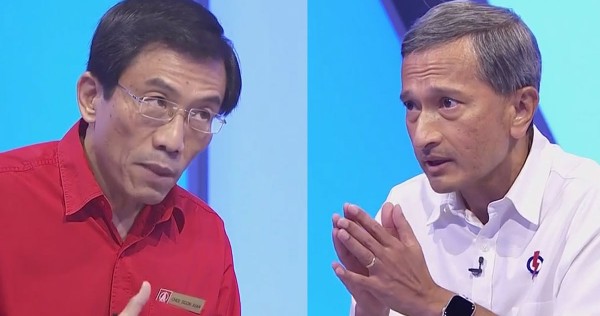
The segment also saw an exchange between Dr Balakrishnan and Dr Chee that involved them interrupting each other several times.
Singapore Democratic Party’s Dr Chee Soon Juan speaking during the political debate on Jul 1, 2020. (Photo: Jeremy Long)
Dr Balakrishnan asked Mr Chee how much it would cost to implement the various schemes the SDP is proposing, and how it would be allocated to the taxpayers. “Some of your proposals have got very big holes, in terms of fiscal deficits, so please enlighten us,” he said.
Dr Chee highlighted two of SDP’s proposals – a retrenchment benefits scheme and providing monthly income for the elderly.
“We’ve put these two together, we’re talking about an annual budget of about S$5 billion dollars,” he said.
“Now compare that to what you’ve signed off this year, nearly S$100 billion dollars,” he added. “Even if the Government did not take in any more revenue, it will take us 20 years for us to spend all that the Budget that you have allocated for just the next year or so.”
In his question to Dr Balakrishnan, Dr Chee said that labour productivity and GDP were going on the “same downward trend”, while unemployment in Singapore was going up. All this, he said, has been happening before the COVID-19 outbreak took place.
The number of S-Pass and Employment Pass holders continues to rise, he added.
“And over and above all this, Mr Heng Swee Keat then comes up to say, in an interview, toys with the idea of bringing our population up to 10 million,” he said.
“Singaporeans are deadly worried about this proposal. Will you categorically tell Singaporeans right now that your party has no intention of raising our population to 10 million by continuing to bring in foreigners – especially foreign PMETs – into Singapore to compete with our PMETs for jobs?”
In response, Dr Balakrishnan said that the Prime Minister’s Office had issued a statement “advising people like you not to indulge in falsehoods”.
At that, Dr Chee interjected, saying that it was Mr Heng that came up with the idea and he would cite the interview he was referring to. Dr Balakrishnan rebutted him, saying that it was a “cheap shot”.
Earlier in the day, the National Population and Talent Division (NPTD), Strategy Group in the Prime Minister’s Office had released a media statement saying that it is not true that the Government is planning to increase the population in Singapore to 10 million. It added that there have been statements circulating on various online platforms about the matter.
“Let me state for the record,” said Dr Balakrishnan. “We will never have 10 million. We won’t even have 6.9 million.”
“The Government doesn’t have a target for the population”, he added. “What we want is a Singapore core that is demographically stable, able to reproduce ourselves, able to create opportunities and jobs for ourselves, and able to stay as a cohesive whole.
“It is not a target, and it is certainly not 10 million, and you are raising a false straw man. That is a false statement. And we have said so and we will say so again.”
DR BALAKRISHNAN AND MR YUEN
In his question to Mr Yuen, Dr Balakrishnan asked if he was aware that almost 60 per cent of Singapore’s workforce are in PMET jobs, and that it represented one of the largest percentages in the world.
He also asked Mr Yuen if he was aware that for every one foreign employment pass holder, there are almost seven locals holding a PMET job.
“What else do you want us to do, to fulfil what you started off with as far as PMETs are concerned?” he asked.
Mr Yuen said that “logic would tell us that” local PMETs could fill up some of the jobs.
“The Government ought to be helping them to do the transition of getting the ‘excess’ PMETs to (be) repatriated, and our own PMETs getting back to the job,” he said.
He said that the number of employment passes granted should be limited.
“Granted, we need foreigners to work here, but our position is that we have excessive number of people coming here at the expense of our own local talent,” he said.
Mr Yuen then asked Dr Balakrishnan for the time frame to create 100,000 jobs, and what kind of jobs they will be.
“We want jobs for our citizens, our Singaporeans to be lifelong career,” he said.
To this, Dr Balakrishnan said that the 100,000 job opportunities under the National Jobs Council include jobs, attachments and traineeships, and that they will be created within the next year.
“You talk about lifelong jobs, I’m glad you brought that up. It is about skills,” he said, adding that upskilling is not just for young people, but “people our age, 40 to 60”.
SEGMENT 3: WRAP-UP
In concluding the debate, the candidates were each given a minute-and-a-half to wrap up, with Dr Chee going first.
(Clockwise from left) Singapore Democratic Party’s Dr Chee Soon Juan, Progress Singapore Party’s Francis Yuen, CNA’s moderator Jaime Ho, People’s Action Party’s Dr Vivian Balakrishnan and Dr Jamus Lim from the Workers’ Party. (Photo: Jeremy Long)
Summarising the proposals of his party’s “Four Yes, One No” campaign, Dr Chee called for the suspension of GST at least until 2021, implementing a retrenchment benefit scheme, giving retirees above 65 an income of S$500 a month and making sure that SMEs are “front and centre” of driving the economy.
“These are huge issues,” he said. “And how are we going to pay for all these things apart from some of the taxes we want to levy, for example, introduce a wealth tax. And by the way, I just want to alert Dr Balakrishnan that this wealth tax, some of his party members … MPs, have even agreed with us that some of these things should be implemented.”
WP’s Dr Lim said he enjoyed the debate, and pointed out that “this is exactly why debates about ideas for how Singapore should progress should occur” and noted that the PAP “does not have a monopoly on the best ideas on how we should bring society forward”.
“The PAP has argued that this election is really about giving them a mandate to bring the country out of this crisis,” he said.
“What we are trying to deny the PAP isn’t a mandate. What we’re trying to deny them is a blank check. And that is what this election truly is about, so that we can actually have this kind of debate – not in a constrained form over a table – but actually in a forum which was designed for this, which is Parliament,” he added.
Mr Yuen agreed with Dr Lim, and said: “We believe that there should be free contest of ideas, alternative solutions and constructive voices in Parliament.”
He added that the Government has been “obsessed” with growing the economy while neglecting people.
“Economic growth must be not at all costs. There must be the other side, the compassionate side,” he said.
In wrapping up, Dr Balakrishnan responded in turn to each of the three. He questioned Dr Chee’s proposals on GST, and having a wealth tax or estate duties.
“In all these things, have a care that you are not actually engaging in class warfare and not trying to divide our society,” he said. “I believe Singaporeans remain a united, cohesive people and we want to uplift everyone.
“Don’t indulge in this. Don’t take it out against people who, through no fault of their own, have been somewhat more successful.”
He also agreed with Dr Lim and Mr Yuen that “the PAP does not claim a monopoly on wisdom”, stressing that the PAP is “not afraid of an open contest of ideas”.
“Whatever the outcome of this election, there will be more opposition members in the new Parliament than in the current Parliament,” he said. “These members, whether they win the seats or come in as NCMPs, have full voting rights, including amending the constitution and votes of confidence with or against the Government.
“So we are completely open to this contest, because at the end of the day, we are all Singaporeans.”
He objected to Mr Yuen’s characterisation that there are “many third world people” in Singapore, citing how over the last five years, the median income has gone up by 3.8 per cent, while the real income for the lower 20th percentile has gone up by 4.4 per cent.
“We are completely in agreement with you that we need to raise wages,” he said. “Please be fair in your characterisation.”
“The only reason we have foreigners here is to give an extra wind in our sails when the opportunity is there,” he added.
“Now we are in a storm and we need to shed ballast … 60,000 foreigners have lost their jobs. And the schemes we have rolled out now … (are) clearly slanted at Singaporeans.”
In concluding, he reiterated what the Government has done to help Singaporeans in the COVID-19 pandemic. But there were already challenges before COVID-19, he said.
“These are the brutal facts of life, so I don’t promise any quick and easy answers,” he said. “The PAP offers honesty, complete transparency, we will take all ideas, we will work with you.”
BOOKMARK THIS: Our comprehensive coverage of GE2020 and its developments
Download our app or subscribe to our Telegram channel for the latest updates: https://cna.asia/telegram