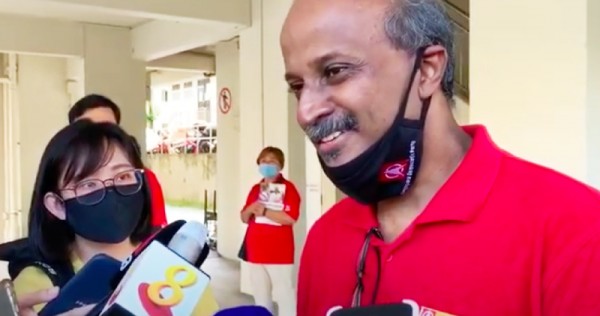
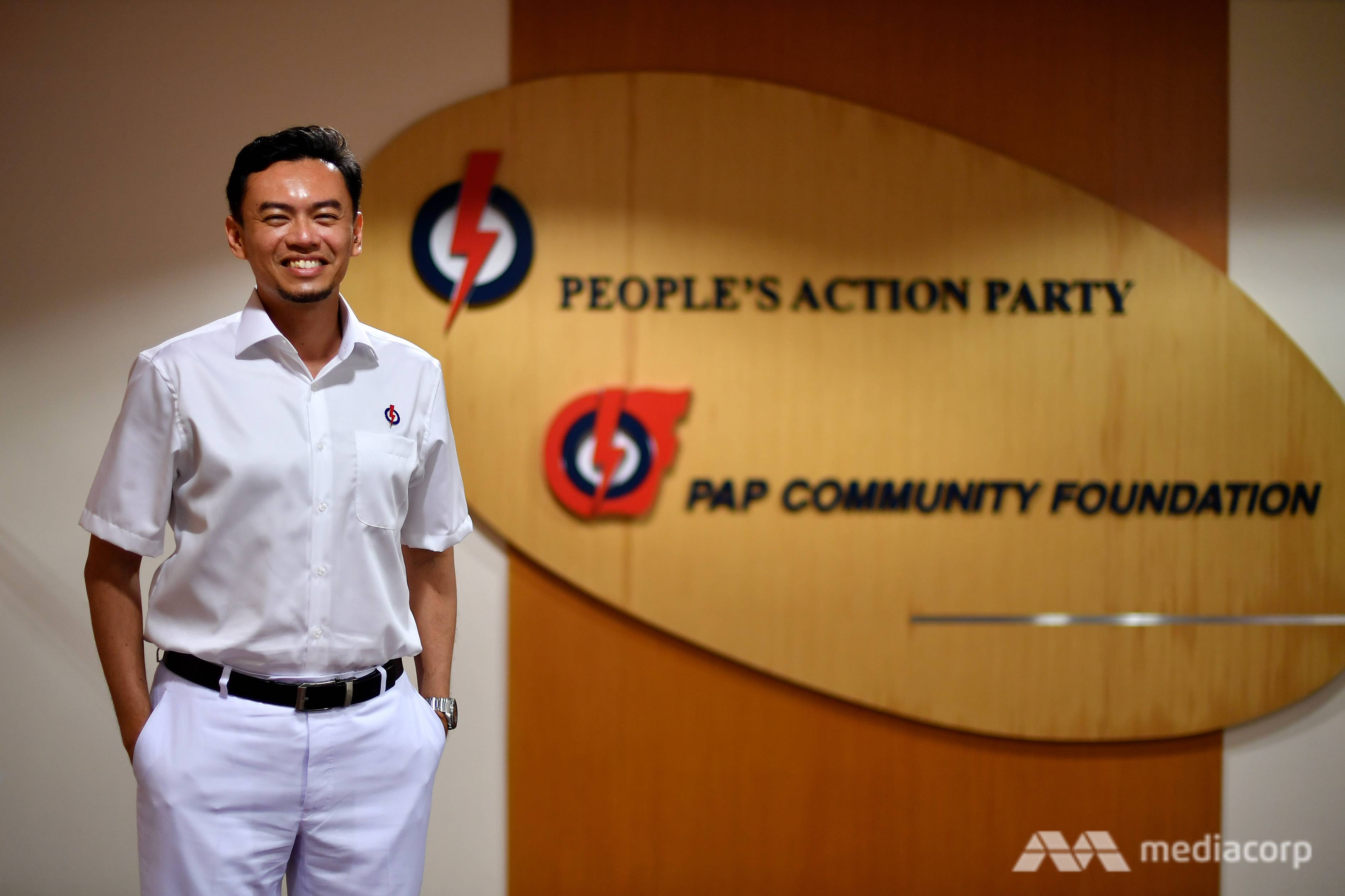
If you thought Jamus Lim from the Workers’ Party looked familiar, you are not alone.
Some netizens have commented how the political newcomer and one of GE2020’s breakout stars looks like another famous person — Singaporean Mandopop singer, JJ Lin.
And that’s not where the similarity ends. The pair even share similar-sounding names.
Jamus’ middle name is Jerome, which basically makes him JJ Lim.
SINGAPORE: Singapore needs to maintain its high reputation among global investors as a matter of survival, Prime Minister Lee Hsien Loong said, stressing that Singapore is a small country with many limitations.
“We must show the world that we are indeed special, and can sustain our edge over other countries and cities,” he said at a People’s Action Party (PAP) online lunchtime rally on Monday (Jul 6).
“Then MNCs (multinational corporations) will invest in us, other countries will take us seriously and Singapore has a place in the sun. Otherwise, we will just fade away and be forgotten, like so many city-states in history.”
This is especially as Mr Lee said COVID-19 has hit Singapore’s economy like never before, pointing out that the Government has rolled out not one but four Budgets of S$100 billion, “far above” its normal spending, in a year.
“That gives you a sense of COVID-19’s huge impact on businesses, and especially on workers and jobs, that we have had to counter,” said Mr Lee, who is also the PAP’s secretary-general.
“But it is not just about indiscriminately writing checks. We need to understand who is hurting, who needs help most, how to help them, what works and what doesn’t.”
This has been done “systematically” over the past few months, Mr Lee said, pointing to how the S$23.5 billion Jobs Support Scheme saves employers a large part of workers’ wages and keeps them employed, while households and those harder hit are given more support.
Mr Lee said the Government had also in an unprecedented move, passed emergency legislation for rental and contract waivers.
This protected contractors who missed project deadlines, couples who could not hold weddings and tenants who could not do business due to the circuit breaker, he said.
“Many individuals and SMEs (small- and medium-sized enterprises) would have been badly hurt and many good companies would have gone under,” he added.
Mr Lee said a team comprising Minister of Law K Shanmugam and Senior Minister of State for Law and Health Edwin Tong, as well as business and law experts, managed to put this Bill together in nine days.
Parliament then passed it in one day “on a certificate of urgency”, he said.
“We did it again with a second set of emergency measures two months later,” he added. “This is the difference that a highly competent Government can make to your lives.”
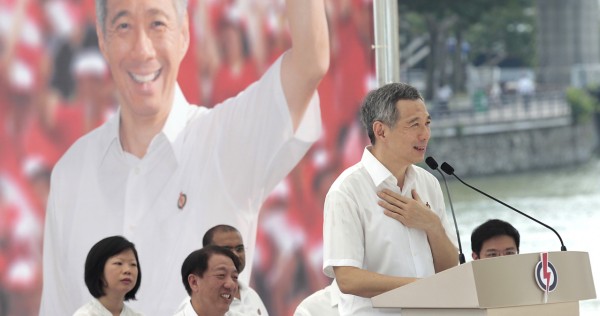
Prime Minister Lee Hsien Loong speaking at a People’s Action Party rally on Jul 6, 2020. (Photo: PAP)
ATTRACTING INVESTMENT
But Mr Lee said these budgetary and legislative measures were emergency relief and cannot be sustained indefinitely.
“The more fundamental solution for jobs, is to turn around our economy,” he said.
“We need to create new jobs. To do that, we must attract new investments. And that means maintaining confidence in Singapore, so that companies will not lose faith in us in a crisis.”
Mr Lee cited how in 1985, when he had just entered politics, Singapore found itself in a similar situation when it experienced a sudden recession, with annual gross domestic product growth dropping into the negative for the first time since independence.
Mr Lee said he chaired an economic committee to study how it could lift Singapore out of the recession and reposition its economy for the future.
“We took decisive, emergency measures, including cutting CPF (Central Provident Fund) contributions,” he said.
Mr Lee said he and the younger ministers held many meetings with union leaders and workers to persuade them.
“We didn’t just make one speech, or hold a press conference, and expect people simply to swallow the bitter pill,” he added.
At the National Day Rally that year, Mr Lee said then-Prime Minister Lee Kuan Yew used charts and tables to explain to Singaporeans why the recession had happened, how Singapore had lost its competitiveness, and what it had to do to get out of the recession.
“People said that Mr Lee (Kuan Yew) sounded like a professor giving Singaporeans an economics lecture,” he said.
“But Singaporeans understood the message and supported the tough measures. The measures worked and within a year our economy was growing again. That is what political leadership is about.”
WHO WOULD BE MAD ENOUGH TO INVEST IN SINGAPORE IN A RECESSION?
Once the situation stabilised, Mr Lee said the Government went on an offensive to reassure investors and attract new ones from across the world.
This included placing a full-page advertisement in the Wall Street Journal headlined: “Who would be mad enough to invest in Singapore in a recession?” It carried the signatures of nine global heads of MNCs, including Apple, Seagate and Motorola.
“Nowadays, people might call this clickbait,” Mr Lee said. “Several of these companies are still here today, 35 years later.”
Mr Lee said these MNCs were prepared to invest in Singapore during an economic crisis because they knew it had industrious and capable workers.
The country’s unique tripartite relationship, where unions cooperate closely with employers and the Government to generate growth and jobs for workers, meant “they are not opponents to be countered, but partners-in-progress”, he said.
The Economic Development Board (EDB) was a “one-stop shop” where investors could settle their problems, Mr Lee said, highlighting that unlike similar agencies in other countries, the EDB could make things happen as the Government was working as one.
Furthermore, Mr Lee said investors knew Singapore had a first-rate Government after their interaction with ministers. Mr Lee recalled one deciding to invest in Singapore after meeting a minister, something he described as a “huge compliment”.
“And finally, they knew the Government enjoyed Singaporeans’ strong support,” he added. “So the ministers could take decisive steps if needed, and make the right decisions to promote growth and create jobs.”
SINGAPORE: Prime Minister Lee Hsien Loong on Monday (Jul 6) urged Singaporeans to give him and his People’s Action Party (PAP) team their full support in order to get through the COVID-19 crisis and the resulting economic challenges.
“To get through this crisis, I need your help,” Mr Lee said during the lunchtime online Fullerton rally.
“I cannot do it alone. I need the strongest team we can find, to work with me, and with you,” he added.
Mr Lee, who is the PAP’s secretary-general, stressed that “at this critical moment”, Singapore needs a capable government, with the “full support of a united people, more than ever”.
“Have no fear. Instead, be confident. Singapore will endure this searching trial. We will be tested but we will not be found wanting,” he said.
The PAP has held a rally near the Fullerton building in almost every General Election since independence. It is usually held after the mid-point of the campaign, Mr Lee noted, saying it it an occasion to “pause, take stock of what has happened in the hustings so far, and refocus everyone’s minds on what is at stake”.
This election’s Fullerton rally was held online due to COVID-19 restrictions, but Mr Lee said that its purpose remains the same.
“I WILL SEE THIS THROUGH”
Mr Lee said he did not expect to meet this “overwhelming crisis” in the last stretch of his premiership.
He added, however, that he is fortunate to have been elected by Singaporeans, and chosen by fellow ministers and MPs to lead the country through this difficult period.
Describing the COVID-19 pandemic as “the crisis of a generation” which is “more complex and more dangerous than any previous crisis”, Mr Lee said Singapore’s response to the crisis will determine the future of the country.
“There can be no certainty that things will turn out well. But we must have the same unshakeable will to marshal all our energies and resources, to fight it together, prevail and emerge stronger,” he said.
“You have my word. Together with my older colleagues like Teo Chee Hean and Tharman Shanmugaratnam, as well as the 4G ministers, I will see this through,” he added.
“I am determined to hand over Singapore, intact and in good working order, to the next team.”
Prime Minister Lee Hsien Loong speaking at a People’s Action Party rally on Jul 6, 2020. (Photo: PAP)
Mr Lee said Singapore has gone through many difficult times – from the Asian financial crisis to 9/11 and the severe acute respiratory syndrome outbreak.
“But each time the Government led from the front, Singaporeans rallied, and we pulled through,” he added.
THE WORLD IS WATCHING CLOSELY
The PAP seeks a strong mandate from voters to lead Singapore through the COVID-19 crisis, Mr Lee said, adding that the world is watching this election closely.
“Investors would scrutinise the election results and act on their conclusions. So will others, both friends and adversaries of Singapore,” he added.
“Will we show the world that Singaporeans are still one united people, strongly supporting the leaders they have chosen, and working together to overcome the crisis?” he asked. “Or will we reveal ourselves to be fractious and divided, withholding our support from the Government we have elected, in a crisis where swift, decisive action is vital to save jobs and lives?”
He added that the opposition has had “nothing to say” about getting Singapore out of the downturn, growing the economy or creating new jobs.
“They prattle on about the minimum wage or universal basic income,” he said. “These are fashionable peacetime slogans, not serious wartime plans.”
“Do you really want to vote for parties who, in a crisis, come up with nothing better than old recycled manifestos?” he asked.
Pointing to the series of national broadcasts made by various Government ministers last month, Mr Lee pointed out that the PAP Government has sketched out the challenges Singapore is facing, and their plans to overcome them.
The PAP election manifesto, he added, has also set out its programme for residents.
PAP HAS FIELDED “STRONGEST POSSIBLE TEAM” FOR ELECTION
Mr Lee stressed that he has worked hard to field the “strongest possible” PAP team for the election, describing it as an “experienced team” including capable ministers, “seasoned, energetic MPs”, and “refreshed and reinforced” with a younger generation of promising leaders from all walks of life.
“My duty as PM is not just to take good care of Singapore during my time in office,” he said. “It is also to prepare new generations of leaders who can take over from me and my older colleagues, and lead Singapore into a different future.”
This is why the PAP has fielded a record number of 27 new candidates for this election, he said.
“But to serve you, we first need to get elected,” he said, adding that Singaporeans have seen their track record.
“If you think we have delivered and made your life better, please vote for us,” he said. “If you think we have not, then by all means vote us out.”
Mr Lee also urged Singaporeans not to “confuse signals” by voting for the opposition, if what voters really wanted was a PAP MP to look after their constituencies and town councils, and a PAP Government to look after Singapore.
“The opposition says they are offering Singaporeans insurance in case you need it,” he said. “Don’t buy insurance from someone on a promise, especially when you have reason to suspect this company cannot pay out on the insurance, and their cheques will bounce.”
“With the PAP, you know that when we promise anything, we will deliver,” the Prime Minister said.
“We first became the Government in 1959. The PAP won that crucial first election because we represented the national consensus and our people’s collective hopes for their future,” he added.
“After more than 60 years, this has not changed,” he said, adding that the PAP has “maintained trust with the people”, still “reaches out broadly to the population”, and how its policies have “improved people’s lives beyond measure”.
SINGAPORE: There is much riding on the 2020 General Election, especially at this juncture in Singapore’s history, Prime Minister Lee Hsien Loong said on Monday (Jul 6) in a virtual lunchtime rally.
“Hardly ever in our history have the stakes been higher than now,” said Mr Lee.
The country is in the “middle of a crisis” he said, cautioning that the biggest challenges are yet to come.
“As tough as the past months have been, our biggest challenges lie ahead of us.”
He noted that the number of COVID-19 cases continues to surge worldwide, with no information on how the pandemic will end, or whether a lasting solution like a vaccine or more effective treatment will be found.
“We face a continuing danger to public health, and this will also weigh heavily on the economy, for perhaps a year if not longer,” he cautioned.
Mr Lee hit out at opposition parties, accusing them of talking “as if we can just keep to our old ways”, at this moment of “danger and alarm”.
“They show no recognition that we are facing the crisis of a generation. They have been completely silent on how to tackle COVID-19 during the last six months, and in this election campaign,” he said.
He asked what contribution they will make in Parliament, and what “contrast” they will add if they get elected as MPs.
“What will happen to Singapore, if they form the government?” he asked.
IMPORTANCE OF GOOD GOVERNMENT DURING PANDEMIC
Singapore’s experience since the beginning of this year has “made clear how important” a good Government is to fighting the disease, supporting the economy and getting out of this crisis “intact” he said.
“This is what this election is about – whom do you trust to get you through the very difficult times ahead,” he said.
He noted that Singapore’s COVID-19 situation is stable. The healthcare system has held up well, the country’s fatality rate is “among the lowest in the world”, and the outbreak in the migrant worker dormitories is being “systematically cleaned up”, he said.
“We have managed to get to this stage not by chance, but by dint of immense effort,” he said.
He highlighted Singapore’s efforts in preparing for a pandemic since the Severe Acute Respiratory Syndrome (SARS) crisis in 2003.
These included “systematically” building up resources and capabilities, stockpiling masks and personal protective equipment and practising contact tracing and reporting, he said.
“For 17 long years, we sustained these preparations. We dealt with H1N1, we prepared for Ebola and Middle East Respiratory Syndrome (MERS). We never took our eyes off the ball,” he said.
Singapore had a “good base” to work off when COVID-19 hit the region and the world, but the post-SARS preparation, while essential, was “not enough”, he said.
“Every disease is different. COVID-19 is not the same as SARS. It is less lethal, but far more infectious,” he said.
“When COVID-19 hit us, we had to scramble.”
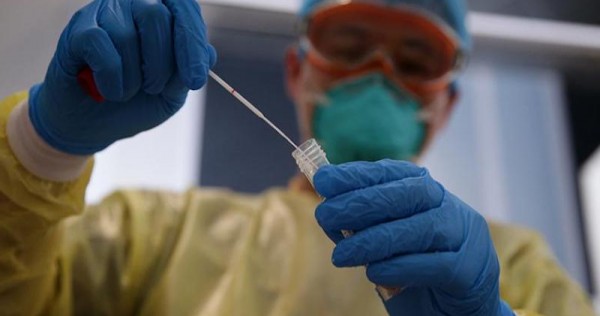
A healthcare worker collects a nasal swab sample from a migrant worker for testing for COVID-19 in Singapore. (Photo: AFP/Roslan RAHMAN)
Securing more face masks amid a worldwide shortage and ramping up testing when countries had banned the export of instruments and chemicals needed to run the tests were among the challenges the Government faced, he said.
“We had to ramp up labs and set up new ones. We had to manufacture more test kits and accurately process the results. We recruited and trained swab teams to perform the thousands of swabs needed every day,” he said, adding that behind the scenes, the operation was “highly complex”.
While testing capacity is no longer a constraint for Singapore, the country continues to build up reserve testing capacity “just in case”, he said.
OUTBREAK IN MIGRANT WORKER DORMITORIES
However, “despite our best efforts”, in April, the virus broke out in our migrant worker dormitories, Mr Lee said.
“The large numbers posed a real risk of overwhelming our hospitals,” he said. Singapore had to mount a “huge operation”, and mobilised the Singapore Armed Forces (SAF) and Home Team to help manage the dormitory situation, he said.
“We even opened up SAF camps to house vulnerable workers and keep them safe. We arranged for every worker to be fed, cared for, and paid on time,” he said.
He also noted that Singapore built new isolation and medical facilities, creating almost 30,000 bed spaces – more bed spaces than all acute hospitals put together- “within weeks” at places like Changi Expo and PSA Tanjong Pagar Terminal.
“All these extremely demanding tasks had to be performed in the fog of war. We had to decide and act urgently, based on incomplete information,” he said.
The public service, including healthcare workers, the SAF and Home Team responded “magnificently” he said.
FILE PHOTO: Migrant workers look on from their dormitory, declared as an isolation area, amid the COVID-19 outbreak in Singapore. (Photo: Reuters/Edgar Su)
Mr Lee said they took directions from the multi-ministry task force set up to handle the pandemic, chaired by Health Minister Gan Kim Yong and National Development Minister Lawrence Wong.
“At every step, we faced difficult trade-offs between lives and livelihoods. Crucial decisions had to be made. It was the ministers who made these decisions and were accountable for them,” he said.
One major decision, he noted, was whether to impose a circuit breaker.
“Doing it would come at a great cost to jobs and business, but not doing it meant risking a major outbreak and loss of lives,” he said.
The authorities had to decide before it was obvious or certain that the number of cases would “shoot up”. Mr Gan and Mr Wong brought the matter to Cabinet, and the Cabinet, having weighed the pros and cons, decided to go ahead, he said.
“As it turned out, we acted just in time, as the numbers were growing, but before they shot up dramatically,” he said.
Mr Lee said the implementation of the circuit breaker was not straightforward.
“This was a political decision, not an administrative one,” he said. He added that the ministers, and ultimately the Prime Minister and Cabinet have responsibility.
“Without a team of capable ministers working closely together on all these different aspects, we wouldn’t have been able to implement the anti-COVID-19 measures. We would have lost the confidence of Singaporeans,” he said.
Political leaders failing to act competently has happened many times elsewhere, he said.
“Voters lose trust in them. They are confused and dismayed, their faith in the whole system is shaken. People suffer greatly, and many die unnecessarily,” he said.
He noted that Singapore has “avoided this”, adding that the country is in a “better position” now.
But he cautioned against taking chances even as Singapore reopens after the circuit breaker, pointing to countries where cases flared up after lockdowns were eased.
“The danger is still very much alive.”
“If there is a second global wave of the pandemic, we may be hit hard again, despite our best efforts,” he said.
He added that the Government will have to make “many more difficult decisions” and find more “creative, radical solutions” to take care of its people.
“Keeping COVID-19 under control and our people safe, avoiding another lockdown, will take everything that we’ve got.”
Dr Paul Tambyah — chairman of the Singapore Democratic Party (SDP) — has responded to the recent correctional directions issued to several publications with regard to excerpts they carried on his statements.
Yesterday (July 5), the alternate authority for the Minister for Manpower (MOM) instructed the Protection from Online Falsehoods and Manipulation Act (Pofma) office to issue the correctional directions to the National University Of Singapore Society (NUSS), CNA, The Online Citizen Asia (TOC) and New Naratif.
It stated that the platforms had carried false statements made by Dr Tambyah regarding a circular issued by the Ministry of Manpower (MOM) on the testing of migrant workers for Covid-19.
At a Bukit Panjang walkabout today, Dr Tambyah told reporters: “In the first place, as I’ve predicted, those were statements I never made. I never said there was an unilateral action by MOM.
Prime Minister Lee Hsien Loong is holding a rally at noon on Monday (July 6). The rally will be streamed live on Facebook and YouTube.
He will be speaking about the stakes in this election and how the ruling People’s Action Party (PAP) can meet the challenges ahead.
The “Fullerton Rally”, which is a tradition of the PAP, was started by founding secretary-general Lee Kuan Yew. It used to be held in Fullerton Square near the old General Post Office, but has been held at the UOB Plaza promenade in Boat Quay since 1996.
A throwback to my first election in 1984, when I spoke at the People’s Action Party’s lunchtime rally at Fullerton…
There are no physical rallies held this year in view of the Covid-19 situation, and all the parties have gone online to share their thoughts and vision for Singapore, as well as to address concerns that Singaporeans might have.
We’ll be adding to this list throughout the day, so do check back for updates on the latest schedules regularly.
Here’s what you can catch today (July 6):
Constituency Political Broadcasts
Constituency Time Where to watch
Marsiling – Yew Tee GRC, Marymount SMC, Mountbatten SMC, Nee Soon GRC and Pasir Ris – Punggol GRC
Infections in the community have increased with a two-year-old Singaporean girl among the 18 new community cases announced yesterday by the Ministry of Health (MOH).
The 17 other cases were five Singaporeans and permanent residents, two work pass holders and 10 work permit holders.
Ten of the community cases are linked to previous cases or clusters.
Eight of the community cases are unlinked. Of these, five cases are asymptomatic and were picked up as a result of MOH’s proactive testing as they work in essential services.
The remaining three cases were tested under the enhanced criteria where all individuals aged 13 and above diagnosed with acute respiratory infection are swabbed at first presentation to a doctor.
MOH said: “This allows us to detect infected individuals early and to quickly contain further spread, as well as milder cases that have a short duration of infection.”
It added that epidemiological investigations are in progress for these cases.
The serological test results for two cases were positive, which indicate likely past infections.
The test results for the remaining cases are pending.
There’s no question too dumb, too outrageous, or too insignificant, at least not in our books.
Voting is a big responsibility, after all. And especially if you are doing it for the first time, it’s not surprising to have many questions.
Which is why we’ve done up our own in-depth FAQ we hope would cover all your queries that you may have when casting your vote for Singapore.
In this edition of the FAQ, we delve into the things you need with you on polling day when you head to your assigned polling station,
1. What do I need to bring on polling day?
You will need to bring your poll card and proof of identification to enter a polling station.
This can be your National Registration Identity Card (NRIC) or identity cards issued by the Ministry of Defence, Singapore Police Force or Singapore Civil Defence Force for uniformed personnel.
SINGAPORE: It was past nine in the evening but the day was not over yet for Dr Wan Rizal Wan Zakariah, the People’s Action Party (PAP) new candidate who is running in Jalan Besar Group Representation Constituency (GRC).
Earlier in the day, the 42-year-old had done a full schedule of market and house visits at the constituency’s North Bridge and St George’s Roads.
In the evening, he took part in a live chat on education at the PAP headquarters in Bedok, with Education Minister Ong Ye Kung as well as special education school co-founder and fellow Jalan Besar candidate Denise Phua.
Dr Wan Rizal was about to leave the PAP building when he was told that he had left his sports shoes upstairs. He laughed in relief, because he needed them for hitting the ground again the next day.
Party candidates have been on their daily campaign grind ahead of Polling Day on Jul 10, so there was nothing special about Dr Wan Rizal’s day. Not that he was complaining anyway.
“I was mentally prepared,” he told CNA on Friday (Jul 3), pointing out that he had done daily block visits while helping out in grassroots activities with former Members of Parliament (MP) Zainal Sapari and Charles Chong, both of whom are not standing in this year’s election.
“I was in two different constituencies. So when they did different days, I joined them both. I had an idea of what to expect. But of course, campaigning is a different thing altogether.”
Next up on the agenda was a GRC meeting on Zoom at 10pm, so Dr Wan Rizal had to get home soon. He put his sports shoes and suitcase on the back seat of his car. Scattered on the front passenger seat were party flyers and candidate cards.
He has come some way from his years juggling work and family with volunteering at mosques, writing letters at meet-the-people sessions (MPS), and making last-minute preparations for a high-profile PAP convention.
TALKING EDUCATION
So on the drive home, Dr Wan Rizal didn’t seem too frazzled by the rush. He couldn’t discuss the current campaign, so he touched on what he cares about as a political candidate: Social mobility through education.
These terms had quite often been spoken about by several new PAP candidates during their introductions, but like his fellow panellists during the party’s live chat, Dr Wan Rizal knows a thing or two about education.
After getting his PhD, Dr Wan Rizal was offered lucrative tenured roles abroad. But his mother said he should stay in Singapore until the mosque was built. (Photo: Jeremy Long)
Dr Wan Rizal is a senior lecturer in sports and exercise science at Republic Polytechnic. Prior to that he had taken an unconventional route to achieving a Doctor of Philosophy (PhD) in sports science from the National Institute of Education.
He was from the Normal (Academic) stream in secondary school, and got his bachelor’s degree in physical education (PE) at 31 years old, in between two stints of five years teaching PE in primary school.
“I was an adult learner, and I think everybody must understand this whole idea of lifelong learning,” he said. “It’s not just you finish polytechnic, you go to do a degree. I wouldn’t say that’s a wrong mentality; there are other ways to do that.”
Dr Wan Rizal wants to help those who choose to spend years in the workforce before getting a degree, including letting them pick up and hone new skills along the way and get better support at the workplace.
He had tried doing his master’s modules while still working as a teacher, but switched to a full-time programme after about a year because he couldn’t handle the workload.
“You work in the day, especially when you’re teaching and you start at 7am, and at 7pm I had to start my night classes,” he added. “I feel for those people who have to juggle it. I know where they’re coming from and how difficult it is for them.”
FROM MPS VOLUNTEER TO PAP CONVENTION
It is clear that education is a big theme for Dr Wan Rizal. In fact, one could say that his foray into politics started with a call for help from his ex-secondary school form teacher: former Pasir Ris-Punggol MP Zainal Sapari.
In 2016, Dr Wan Rizal left his role as chairman of the new Al-Islah mosque in Punggol. He had spent the previous five years going door to door canvassing for donations, overseeing the mosque’s construction, and making its programmes more millennial-friendly.
“You’re the chairman and you made the mosque grow, but I don’t want to be labelled as the one person (who did it),” he said. “To me it’s a very personal thing, I didn’t do it for fame. So I didn’t need a position to show who I am.”
But in the years that followed, Dr Wan Rizal found that he “couldn’t stop” doing community work, pointing to a “void” that had developed after so many years of volunteering at the mosque.
In 2017, Mr Zainal asked Dr Wan Rizal if he would like to help out at his MPS. “Since I am a Pasir Ris East resident, he asked if I would like to try once and see if I like helping out,” he said.
At that session, Dr Wan Rizal noticed a large number of Malay residents but few Malay volunteers who could better communicate with them and translate their requests for help into letters.
“We had one or two, but if they’re not around, there was gap,” he added. “I felt that maybe I could help physically.”
Dr Wan Rizal paid tribute to “mentor” and retiring MP Charles Chong in a Facebook post last week, stating that he “epitomises calmness and fairness as a leader”. (Photo: Jeremy Long)
Mr Zainal soon asked Dr Wan Rizal to attend community events together. Dr Wan Rizal wondered why, but eventually figured it was a way of getting him “more involved”. He agreed “just to see how it goes”. “That’s how it all started,” he said.
After about a year of working together, Mr Zainal told Dr Wan Rizal there wasn’t much left he could teach, and suggested that he follow the former Punggol East MP Charles Chong instead. By then, Dr Wan Rizal had officially become a party member.
“Why? It’s so far away,” Dr Wan Rizal recalled asking Mr Zainal again during one of their many car rides together. “He said to give it a shot just to understand the different set of demographics.”
Dr Wan Rizal said he learnt a lot from Mr Chong, including how he seemed to solve everything with a smile, even in a ward that was held by the Workers’ Party (WP) from 2013 to 2015.
“He has a very relaxed demeanour and keeps people engaged,” he said of Mr Chong. “So if I’m a resident and I see him, I would probably pour my heart out to him.”
On the support for WP in Punggol East, Dr Wan Rizal said he thought the area felt different as it had an “interesting percentage”. But he said PAP’s members had done good work on the ground by constantly engaging the community.
Towards the end of 2019, Dr Wan Rizal was asked to speak at the PAP65 convention. He was unfazed because as a PhD candidate he had spoken at multiple conferences before. He laughed and admitted to writing his speech two weeks before.
Dr Wan Rizal also discovered that he didn’t have white pants, so he bought a pair at a shop selling school uniforms. But he discovered the pants were a different shade of white than the shirt he had planned to wear. He eventually had his pants tailored.
“When I first got (the invitation to speak), I thought it was just another normal convention,” he said. “But it wasn’t.”
Dr Wan Rizal described the convention as 2,500 party bigwigs and members filling up a “massive” hall, seated at round tables where they could eat.
“The stage was really huge,” he added. “I felt like a rockstar, but the whole idea was that’s when I realised this was a big thing. And I think I did okay.”
REACTION FROM FAMILY AND COLLEAGUES
Historically, the PAP convention has seen some of those who spoke at previous editions going on to be fielded as new candidates at an election.
Dr Wan Rizal didn’t think too much of this. When he started volunteering at the MPS, he certainly didn’t think of entering politics as an MP. He acknowledged that he was still unsure as recently as the start of this year. The whole process was “transitional”, he said.
“When I was with Mr Zainal, I had an idea. Mr Charles pushed me a bit more. So by the time I reached a decision point, I felt that I was ready, and I hope I am,” he added.
“I kept an open mind, but I leave it to the party leadership to make the best decision. For me, I just want to do community work and serve the people. If the time comes and they think I should go further, I would.”
Dr Wan Rizal met his wife at the National Institute of Education during teacher training. They have three sons and a daughter. (Photo: Jeremy Long)
After he was featured in the media for speaking at the convention, Dr Wan Rizal said it sank in with his family that this was “quite big”, as they discussed if they were all prepared for him to enter politics.
His said family and friends were supportive, especially as he had done community work for many years. His four children aged 13, 10, seven and three don’t really know what’s going on, he added. But he’s thankful they understand dad is out a lot to help people.
Things at work were not quite so straightforward. Dr Wan Rizal said he was careful to avoid conflicts of interest in his job, which involves doing a lot of research with companies and Government agencies.
“At work it was of course a bit different,” he said. “Suddenly, people see you a bit differently. Not everybody is on your side and all that. But the point is that you get different feelings (from family and colleagues).”
BEING ANNOUNCED AS A CANDIDATE
Dr Wan Rizal was announced as a PAP candidate on Jun 25, something he called “surreal” because of his academic and professional background. Some candidates held top jobs in the public and private sectors, and studied at some of the best universities in the world.
“I come from a very simple background, and to be given this opportunity is a really big deal,” he said. “My wife was very happy for me, parents and in-laws as well. Family-wise everybody is excited for what’s to come.”
On Jun 29, it was revealed that he would be contesting Jalan Besar GRC in a new-look team helmed by Manpower Minister Josephine Teo.
Mrs Teo and Dr Wan Rizal would respectively replace the retiring backbencher Lily Neo and former Communications and Information Minister Yaacob Ibrahim in their wards in the GRC. Senior Minister of State for Defence Heng Chee How and Mrs Phua remain in the team.
Dr Wan Rizal said he had visited the Kolam Ayer ward with Dr Yaacob for a few months before this to learn from him and gain exposure on the ground.
He is also familiar with Dr Yaacob from when they were mosque chairman and Minister-in-charge of Muslim Affairs, respectively. “To be now taking over his ward, it does feel like big shoes to fill,” he said.
Dr Wan Rizal said it was too early to tell how he might handle the extra duties and public scrutiny of being an MP, pointing out that he didn’t assume he was going to be nominated until it actually happened.
“I don’t feel like answering it now because I’m in the midst of it. So let’s take it as it is,” he said. “I’m a simple person whose life revolves around my family and I strongly believe in giving back to the community.”
Dr Wan Rizal parked his car at the multi-storey car park, and for the first time looked like he was fumbling. It was about three minutes past 10pm, so he hastily tapped on his phone to check his GRC chats. He didn’t forget to wave goodbye.