Mere weeks after worship services were allowed to resume, one Hindu temple has found itself in the middle of an online furore.
Sri Thendayuthapani Temple has been copping flak online after a woman accused the historic Hindu temple of caste-based discrimination and said they mistreated her elderly father on July 19.
Vekaneshvari Jayabal recounted her father’s experience in an open letter to the temple’s management on Facebook, writing: “We genuinely want to come and pray and not get involved in your caste system.
“If you think that you are a very special caste and have a very closed mindset at a place like in Singapore in 2020 — then please declare to the public that only Chettiars are allowed to enter the temple.”
Chettiar is a caste label historically associated with merchants, traders, bankers and moneylenders.
According to Jayabal, her 68-year-old father had arrived at the temple, located on Tank Road, at 7pm that day to pray.
A treasure hunt. That’s essentially what shopping for vintage clothing is.
As you browse through the many racks of clothes, high chance you’ll find something that suits your taste, especially if you have a liking for anything from yesteryear. Plus, the items are usually one-of-a-kind, unique and fabulous – just like you!
If you want to make a statement with your clothing or just have fun with quirky pieces, then this is the list for you – and the stores are all right here in Singapore. People will say walao bro, today your clothes stylo-milo leh!
Spades Room
The hype: Spades Room is a multi-label store by friends who came together to start a creative space for fashion. They each have their own brands: Jiggy Things (Justin), Cherub (Shane) and JONT (Jon).
Being a multi-label store means they carry the items of other vendors such as Reduxing, Commoners Regalia, and Solars Rebirth. If you like a rojak of all types of clothing, then check them out.
SINGAPORE: Malaysian Transport Minister Wee Ka Siong has confirmed that a signing ceremony will be held on Jul 30 to finalise the agreements between Singapore and Malaysia to proceed with the Rapid Transit System (RTS) Link project.
In a parliamentary oral reply on Tuesday (Jul 21), Dr Wee said that the prime ministers for both countries will witness the ceremony, which will be held at the Johor-Singapore Causeway.
He said that both countries have completed negotiations for the Johor Bahru-Singapore RTS Link project and are prepared to sign three agreements during the ceremony – a bilateral agreement, a concession agreement and an agreement to form a joint venture company to operate the rail line.
He was responding to a question by Johor Bahru Member of Parliament Akmal Nasrullah Mohd Nasir regarding the current status of the project.
Dr Wee elaborated that the construction of the RTS Link is expected to begin immediately after the necessary approvals are acquired in January next year. The RTS is expected to begin operations at the end of 2026.
He added that the construction will happen in two phases. The development and civil phase will take place from 2021 to end of 2024, while the commissioning and testing phase will take place from 2025 until the end of 2026.
Dr Wee also said that the estimated ceiling cost for the RTS project now stands at RM3.161 billion (S$1.03 billion). However, this does not include the cost for the relocation of the depot from Mandai in Singapore to Johor Bahru.
Earlier this month, Singapore’s Ministry of Transport (MOT) said both sides have been in “intensive discussions” on the RTS project.
“Like Malaysia, we are optimistic that the discussions on the outstanding matters can be concluded by the Jul 31 deadline,” said an MOT spokesperson.
Artist’s impression of the RTS Link Woodlands North Station. (Image: LTA)
The RTS Link aims to connect Bukit Chagar in Johor Bahru to Woodlands in Singapore, serving about 10,000 passengers per hour each way to help ease traffic congestion on the Causeway.
It was meant to be completed in 2024, but work on the project has been suspended.
The suspension has been extended three times at Malaysia’s request, with the latest extension until Jul 31 due to Singapore’s COVID-19 “circuit breaker” measures and Malaysia’s movement control order.
Guarding military installations and sniffing out explosives and narcotics. Sounds dangerous? Well, these are some of the daily tasks that these canines have done to serve Singapore.
Hence, after they have done years of dangerous duties, it’s now time for them to ORD or “pass out” into civilian life, or at least not to be on-duty all the time and have loving adoptive parents.
Are such large dogs allowed in HDB flats? The answer is yes. Under Project ADORE, an adoption and re-homing scheme for dogs in HDB flats, dogs who are up to 55cm in height are allowed if owners fulfil a set of specific criteria.
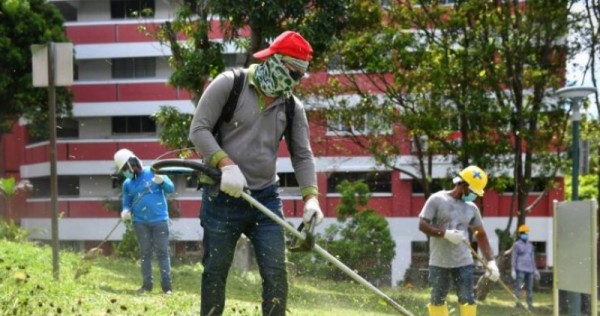
A group of more than 10 Bukit Timah residents rolled up their sleeves and spent Sunday morning (July 19) helping to trim some 1.5 hectares of overgrown grass around Housing Board blocks in Toh Yi.
Many are newcomers who had moved in just two months ago and hope to show their appreciation for the warm welcome they received from their new neighbours.
In fact, these newcomers are migrant workers housed at the former Ngee Ann Polytechnic staff apartments at 90, 92 and 94 Kismis Avenue, a five-minute walk from Toh Yi Drive.
One of them is Mr Natesan Muniaiah, 32, a worker from India who has been in Singapore for eight years. His employer, Woh Hup, had agreed to the initiative as had King Wan Construction, which employs some of the other workers.
Mr Natesan is currently staying at Block 92. He told The Straits Times he was glad to have a chance to give back.
“It is a Sunday, but we are very happy to volunteer to do this as we are staying in the area.”
SINGAPORE – Due to a medical condition, a sex offender had his current jail term extended by 12 months on Monday (July 20) in lieu of being caned 24 strokes.
Isham Kayubi, 50, was convicted in February for raping two teenage girls after a trial in the High Court.
He was sentenced to 24 strokes of the cane and 32 years in jail, which he is currently serving. The court had backdated his sentence to Nov 3, 2017, when he was remanded.
The part-time food deliveryman had separately lured two 14-year-old girls to his Jurong West flat and sexually assaulted them, in a span of two weeks in late 2017.
He had threatened to summon his “gang members” if the two victims did not comply with his demands, and also recorded the sexual acts on his mobile phone.
It also emerged in court that he had been jailed for four and half years in 2008 for sexual offences against four teenage girls.
Isham had created a disturbance in court twice during earlier proceedings.
He had exposed himself and urinated in the dock in August last year, when the case was originally slated for hearing.
SINGAPORE – A National University of Singapore (NUS) dentistry student who tried to strangle his former girlfriend when she refused to resume their relationship is facing ongoing disciplinary proceedings by the university.
He is currently suspended and is not allowed on campus, NUS said in a Facebook post on Monday (July 20). The university did not say when he was suspended.
The statement from NUS comes after the student, Yin Zi Qin, 23, was handed community-based sentences last Friday by the court after pleading guilty to one charge of voluntarily causing hurt, with another charge of criminal trespass taken into consideration.
Community-based sentences are non-jail sentences introduced in 2010, which give the courts more options in sentencing criminals for minor offences so that the punishment fits the offence better. Offenders will retain no criminal records for the offence if the sentence is successfully completed.
SINGAPORE: The worst may be over for Singapore’s GDP growth, but the business climate and the domestic jobs market may still face a challenging climb ahead.
Singapore’s total unemployment rate rose marginally to 2.4 per cent in the first quarter of 2020, with the Singaporean unemployment rate also increasing to 3.5 per cent and that for residents inched marginally upwards from 3.2 per cent to 3.3 per cent.
While this is much lower than the 4.8 per cent seen in the third quarter of 2003 during the post-SARS period and the 3.3 per cent in the third quarter of 2009 during the Global Financial Crisis, total employment has nevertheless already declined by 19,000 jobs – the largest quarterly contraction since SARS, which saw 24,000 jobs lost in the second quarter 2003.
The latest Monetary Authority of Singapore annual report published last week warned that certain industries or activities may be permanently impaired by the COVID-19 crisis due to various factors including shifting supply chains and consumer demand patterns. This could also translate into important implications for the labour market in the second half of 2020.
TIP OF THE ICEBERG
However, the first quarter domestic unemployment data for this year is only the tip of the iceberg since the circuit breaker restrictions only kicked in from April to May 2020.
Already many workers, especially those in the worst-hit services industries such as tourism, hospitality, retail and F&B, have reported cuts in working hours and salary reductions, if not outright retrenchments.
On the flip side, the financial services and insurance sectors still saw a net increase of 2,200 jobs in the first quarter of 2020, and may continue to hire for roles in business development, financial analysis and software development.
Still, there is a significant amount of uncertainty attached to the expected recovery trajectory for the rest of this year and how much of a fall out can be anticipated in the domestic labour market.
FILE PHOTO: People pose for photos at Universal Studios Singapore in Sentosa March 4, 2020. REUTERS/Edgar Su
For instance, the International Labour Organization estimated that 5.4 per cent of global working hours – equivalent to 155 million full-time jobs – were lost in the first quarter of 2020. This could surge to 14 per cent worldwide in the second quarter, which is equivalent to 400 million full-time jobs.
Within the Asia-Pacific, the total working hour loss is estimated to be at 13.5 per cent – equivalent to 235 million full-time jobs – in the second quarter.
For the global travel and tourism industry, employment losses are expected to top 100.2 million jobs this year due to the COVID-19 pandemic, with the Asia-Pacific market likely to see the biggest decline of approximately 63.4 million jobs.
Many workers were put on temporary leave while remaining technically employed, whereas others were being pushed into unemployment and inactivity.
PRESSURES REMAIN AHEAD
Singapore is unlikely to be immune to these forces.
Labour market indicators typically lag the economic cycle so it is likely that as business cost-cutting intensifies and closures rise, especially as the Budget measures phase out later this year, layoffs may increase even if the Singapore economy bottoms out in the second quarter.
That said, the SGUnited package to create up to 100,000 jobs and traineeships may go some way to mitigating a potential fall out in the domestic labour market, but it may provide only short-term relief.
The unemployment rate is likely to rise in the coming months and quarters, especially if the global and domestic demand rebound falters after the re-opening of economies.
Singapore’s hiring outlook for the third quarter is actually the weakest since 2009, with 38 per cent of firms polled tipping a reduction in headcount compared to the second quarter of 2020, according to a Manpower survey.
Anecdotally, the tourism sector remains a key area of concern, especially with the recent announcement by Resorts World Singapore to lay off a portion of its more than 7,000 employees, with market speculation that more job losses are in the pipeline.
SHOULD THE JSS BE EXTENDED?
So what can be done to head off a potential labour market crunch?
Admittedly, much has already been done through the four consecutive Budgets amounting to nearly S$100 billion, equivalent to 20 per cent of GDP, given the unprecedented nature of the COVID-19 pandemic.
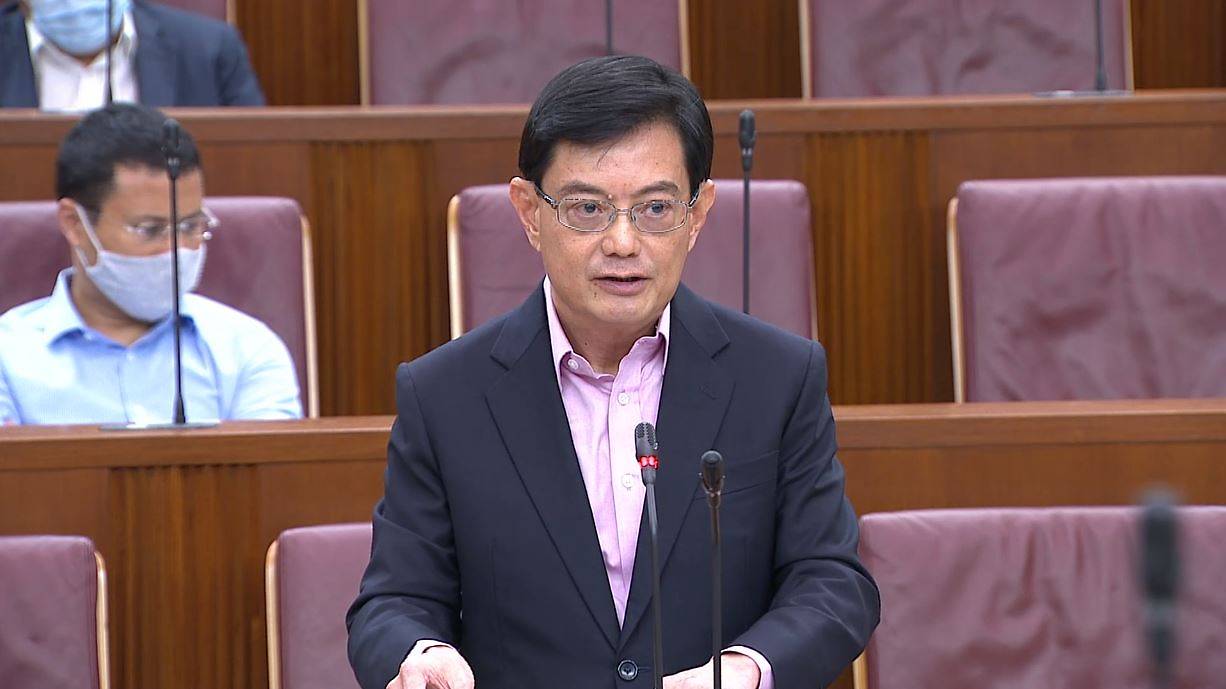
Deputy Prime Minister Heng Swee Keat speaks in Parliament as he launches the Fortitude Budget to tackle the COVID-19 crisis, May 26, 2020.
Swift policy intervention in the form of a myriad of measures ranging from the Jobs Support Scheme (JSS) to rental rebates and cash handouts to individuals has helped.
Now that Singapore, like many other economies globally, is restarting its economic engine after the circuit breaker, a legitimate concern would be if a premature withdrawal or consolidation of the “whatever it takes” approach of government stimulus and interventions would risk destabilising the labour market.
However, finding the right balance and sequencing of policy interventions will be key.
The Government may choose to extend the JSS beyond the current expiry date, albeit possibly with tiered and less generous calibrated terms to wean firms off the wage subsidy as the Singapore economy reopens for business and recovers.
Looking elsewhere in the world, global policymakers are also having a similar line of thought.
The US is considering extending its unemployment benefits, albeit at a lower scale, from the current US$600 to US$450 per week.
Australia will also decide how to adjust the JobKeeper payment of AUD$1,500 per fortnight per employee, if the business has suffered a turnover decline of more than 50 per cent, in phases from Sep 27 onwards so they will not suddenly be removed.
Meanwhile, the UK has also extended its Coronavirus Jobs Retention Scheme, which is a furlough scheme, from May to October where workers who have been placed on leave will receive 80 per cent of their pay up to 2,500 pounds per month.
What is clear is that the jobs focus is likely to remain a priority in Singapore as reflected by the establishment of the National Jobs Council. The ongoing SkillsFuture month which will run until Aug 16, for instance, is also targeting jobseekers and encouraging employers’ awareness and participation in the SGUnited Jobs and Skills initiatives.
However, stemming the tide of retrenchments and unemployment in Singapore may require going beyond an extension of the JSS to find a sustainable solution that achieves the right policy balance while continuing to support the vulnerable.
If demand conditions do not improve, the current wage subsidy may be simply delaying the inevitable for some local workers.
GOING BEYOND JSS
Other policy options include unemployment insurance, which is already seeing an ongoing debate over it, and a minimum wage in addition to the current Progressive Wage Model.
While policymakers are keeping an open mind, there are concerns about whether displaced workers may be disincentivised from getting re-employed if there is unemployment insurance available as well as the willingness of employers to then pay retrenchment benefits.
The proponents of unemployment insurance would cite that prolonged unemployment could contribute to skills erosion and hence workers need a safety net against it.
As former chair of the Federal Reserve Janet Yellen warned, long-term unemployment can make any worker progressively less employable, even after the economy strengthens.
Let’s take a look at the statistics to help us decide if we need long-term policy changes to protect the unemployed or some additional effort to cushion the impact of COVID-19.
Singapore historically has a relatively low unemployment rate and while it has increased with COVID-19, it is nevertheless a far cry from the double-digit unemployment rates seen in some other countries.
Office workers at Raffles Place after the circuit breaker period. (Photo: Gaya Chandramohan)
Hiring intentions have clearly subsided with the ratio of job vacancies to unemployed persons also falling to a decade low of 0.71.
A significant proportion in the fall in the number of people employed year-to-date were borne by foreigners, according to the Ministry of Manpower, which suggests that foreign workers remain a safety valve to be turned up or down depending on the economic circumstances .
Although, the ratio of job vacancies to unemployed persons is the lowest in a decade, at the crux of the matter Singapore’s long-term unemployment rate is relatively low and stable at 0.9 per cent suggesting that time may still be on our side.
The jury is still out on this, but nevertheless, the need to support vulnerable groups and engender fair market outcomes is a necessary and enviable task which would require continued collective dialogue and accepting some out-of-the-box thinking to find an equitable and sustainable solution.
With digital disruption and the likelihood that many industries could take months, if not years, to recover, this will probably be a long-haul journey.
An ageing population may face increasing challenges to stay employable and employed in jobs of the future.
Hence, there may be a need to have a more granular view of where the jobs are at risk, with particular focus for the gig economy and freelance workers, while allowing for more flexibility to cross-deploy workers from industries and firms at-risk to where there is still labour demand and facilitate the skills training necessary for the transition.
The global experience has illustrated how the accommodation, F&B and retail sectors bore the brunt of the loss of jobs due to COVID-19 related lockdowns, whereas the accelerated shift into digital platforms and work-from-home arrangements has created a greater demand for labour in the information and communications technology (ICT) sector and digital economy, for example.
Reskilling workers at the speed required to manage economic dislocations will require jobseekers, employers, and training institutions to work ever more closely together in a concerted approach.
In return for the financial assistance given during the COVID-19 pandemic, local employers should also step up their game and commit to invest in worker training and upskilling efforts to ensure that the workforce is future-proof for the next crisis.
To achieve these aims, continued and targeted assistance to small and medium-sized enterprises, who employ the bulk of the domestic labour force, may be necessary for a longer duration.
Selena Ling is Head of Treasury Research and Strategy at OCBC Bank.
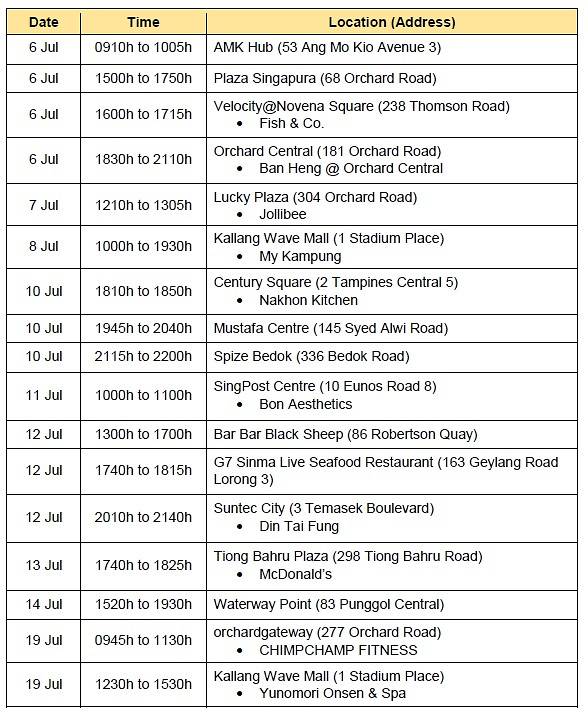
SINGAPORE: Shopping malls, a gym and a spa outlet were among the new locations added to the list of places visited by COVID-19 cases in the community during their infectious period, the Ministry of Health (MOH) anounced on Monday (Jul 20).
The locations include Plaza Singapura, ChimpChamp Fitness at Orchard Gateway, a Jollibee outlet at Lucky Plaza, Velocity @Novena Square, Bar Bar Black Sheep at Robertson Quay, Din Tai Fung at Suntec City and Waterway Point mall.
There were also more instances of visits to locations in Kallang Wave Mall, including to Yunomori Onsen and Spa and My Kampung.
Those identified as close contacts of confirmed COVID-19 cases would have been notified by MOH, said the ministry.
It added that people who were at these locations during the specified timings should monitor their health closely for 14 days from their date of visit.
“They should see a doctor promptly if they develop symptoms of acute respiratory infection (such as cough, sore throat and runny nose), as well as fever and loss of taste or smell, and inform the doctor of their exposure history,” said MOH.
“There is no need to avoid places where confirmed cases of COVID-19 have been.”
The National Environment Agency will also engage the management of affected premises to provide guidance on cleaning and disinfection.
Singapore reported 123 new COVID-19 cases on Monday, bringing the national total to 48,035 cases.

.jpg "st_20170525_wktemple25_31586282-1.jpg")