SINGAPORE: Before bringing her recyclables down to the blue bins below her block, Cheryl Lee always takes the time to clean or wash the items that accumulate in her recycling corner at home.
She and her mother make sure to remove all the non-recyclable parts like stickers and loose plastic packaging. For cardboard boxes, they even try to cut out the parts with plastic or tape that cannot be removed before recycling the rest.
On top of recycling in the correct way, the 28-year-old digital communications assistant manager tries to live as sustainably as possible – she uses reusable containers and packaging, and only buys second-hand clothes, among other things.
However, she is well aware that people who go to the same lengths or even further are rare in Singapore, and she only knows of one or two others like her.

On top of recycling right, Cheryl Lee also opts for reusable items to reduce waste such as cloth sanitary pads, handkerchiefs, makeup remover cloths, beeswax wraps and snack bags. (Photo: Cheryl Lee)
Whenever she and her ex-colleagues bought lunch back to the office, Ms Lee always brought along used plastic bags to carry the food – not just for herself, but for every colleague who was with her.
“I would carry it for them because they don’t want to do it because they think it’s troublesome. So I would do it for them. I would go to each stall that they are at and then I’d ask the aunty to put the plastic containers in the plastic bag I brought for them,” she told CNA.
“I did change my approach halfway through because I realised that if you keep nagging people, people will be annoyed at you eventually,” she added with a laugh.
Acknowledging that leading an eco-friendly life in every aspect is “a very difficult commitment”, Ms Lee said: “As you live your life, there are certain things that you have to see whether you can adapt (to), like being green. And honestly even up to now, I am not zero waste.”
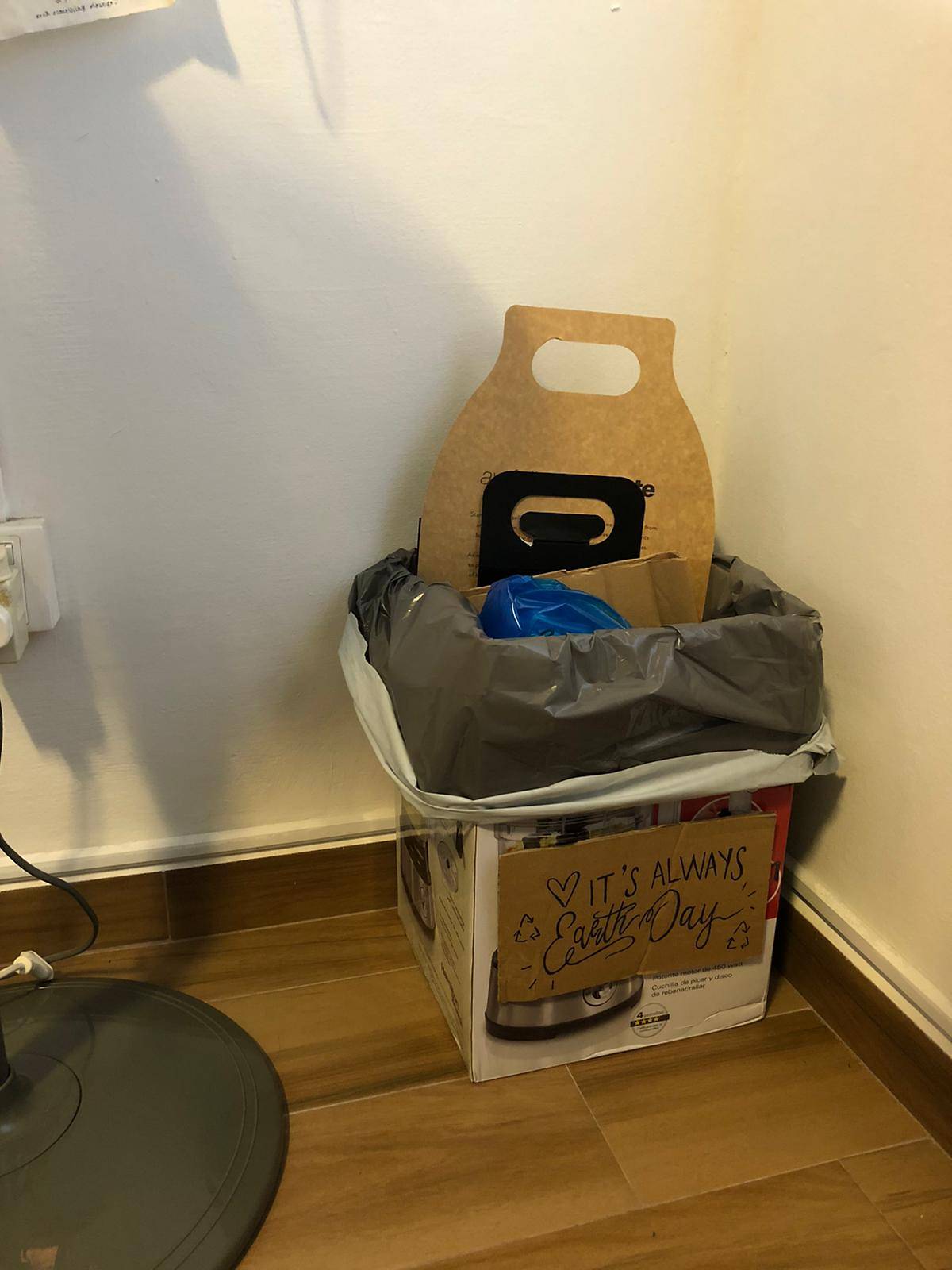
Cheryl Lee’s recycling corner in her room at home. (Photo: Cheryl Lee)
And when it comes to recycling, many Singaporeans are still “not very educated” about how to recycle properly, Ms Lee observed.
For example, not everyone will remember or take the effort to remove the non-recyclable parts. “Do you really think that Singaporeans in general will take the time out to do that when they don’t even take the time out to do simple things?”
SINGAPORE’S “LOW” DOMESTIC RECYCLING RATE
Over the past decade, Singapore’s overall recycling rate has hovered around 60 per cent.
Although that rate is one of the highest in the world, its domestic recycling rate “remains low”, said deputy director of Nanyang Polytechnic’s School of Chemical and Life Sciences Richard Khaw.
Singapore’s domestic recycling rate declined from 22 per cent in 2018 to 17 per cent in 2019, below the European Union, which reported a domestic recycling rate of 46.4 per cent in 2017, he added.

Although the then-Ministry of Environment and Water Resources – now the Ministry of Sustainability and the Environment – conducted nearly 2,000 ground-up activities and reached out to more than 670,000 people, this is only 12 per cent of Singapore’s 5.8 million population, Mr Khaw noted, and a portion of the 670,000 people could be from the same households.
READ: Contamination of recyclables, incorrect recycling among possible factors for Singapore’s low domestic recycling rate: Experts
One of the biggest challenges for improving recycling rates in Singapore is still the mindset and behaviour of the public, said Ms Jen Teo, executive director of the Singapore Environment Council (SEC).
“More needs to be done to increase personal acceptance and responsibility for recycling in Singapore. Public education, raising consciousness and awareness that eventually lead to mindset changes and actions are key,” she said.
“It is not easy, but it can be done.”
A worker loads the waste collected in the blue bins into a truck to be transported to the sorting facility. (Photo: Marcus Mark Ramos)
With blue bins located around estates, recycling can be tedious for the public who find it a hassle to change clothes to bring their recyclables downstairs, said Dr Adrian Ang, who manages the Diploma in Green Building and Sustainability at Temasek Polytechnic’s School of Engineering.
“Worse still, some of the bins are located a distance away from the lift lobby,” he added.
The blue recycling bins are the “most common channel” for recycling, with 56 per cent of those who recycle regularly using the blue bins at least once a week, said the National Environment Agency (NEA) in response to queries.
Blue recycling bin with new label design unveiled on Aug 30, 2019, at the launch of Zero Waste Masterplan. (Photo: Darius Boey)
Other than convenience, the lack of recycling knowledge also contributes to the low domestic recycling rate, said Ms Teo, citing SEC’s 2018 study, which found that 70 per cent of respondents did not fully know what was recyclable.
“This suggests the need for closer attention to increasing consumer information, education and awareness to close the knowledge gap,” she added.
Seventy per cent of participants at the SEC Conference Day 2018 panel discussion agreed that public education and campaigns would help to increase the recycling rate, and this is “further validation and reinforcement” that more public education is required, she said.
Workers sorting the recyclable waste from the blue bins at the sorting facility. (Photo: Marcus Mark Ramos)
The lack of recycling knowledge also contributes to contamination, which is one of the “main challenges” cited by NEA.
“Currently, about 40 per cent of what is placed in our blue recycling bins/recycling chutes cannot be recycled and/or are contaminated by food waste,” said the agency.
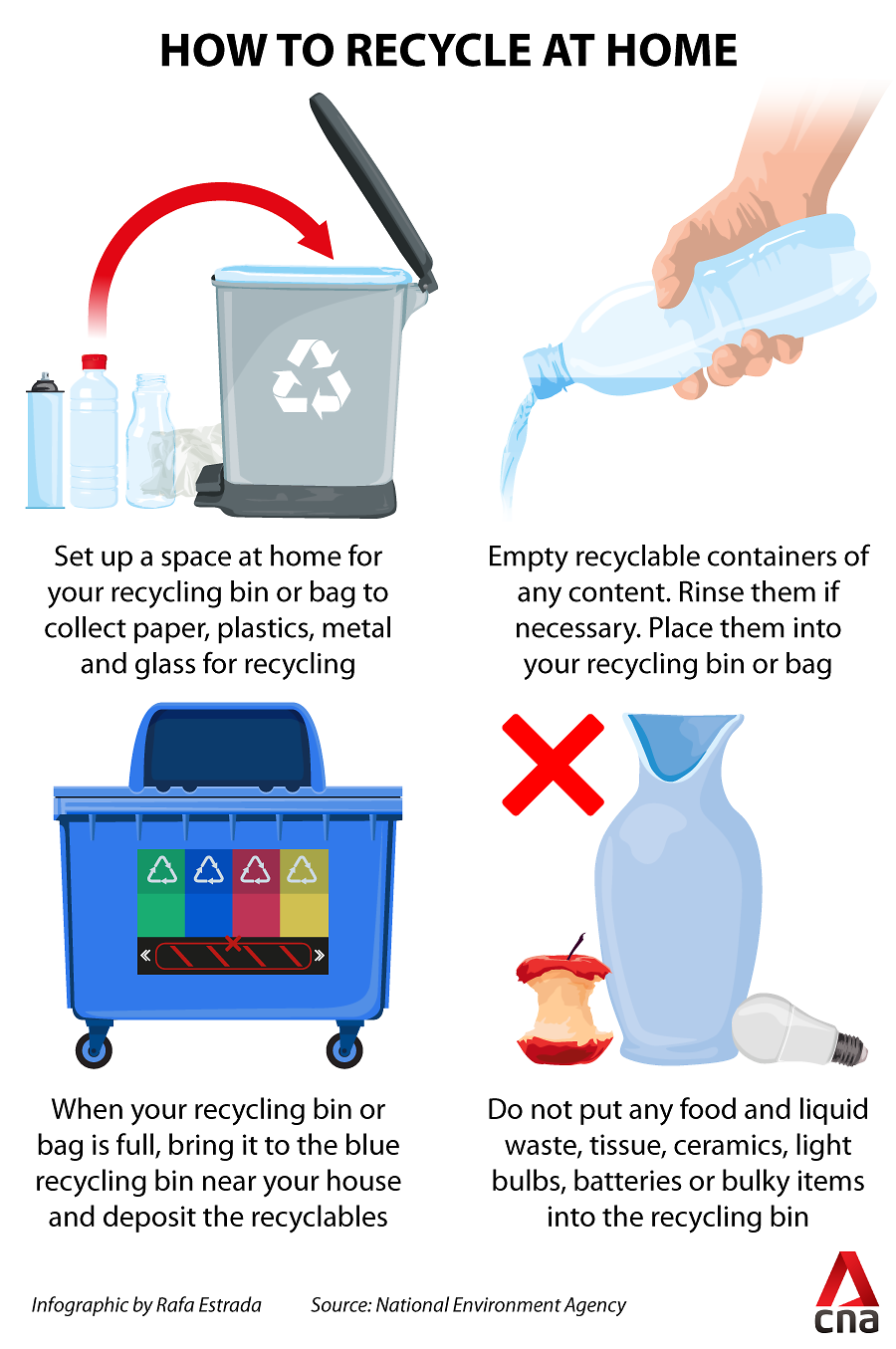
To raise awareness among the public on materials that can be recycled and how to prevent contamination, NEA has placed new labels on all blue recycling bins, stating clearly objects that can or cannot be recycled. All recycling trucks operated by the four public waste collectors have been standardised to make them easily identifiable.
A recycling truck collects recyclables from bins and brings them to the SembWaste Materials’ Recovery Facility for sorting. (Photo: Marcus Mark Ramos)
As a Housing and Development Board (HDB) resident regularly exposed to recycling campaigns, Ms Lee thinks NEA is doing its part to educate the public.
“But maybe there isn’t a one-size-fits-all approach,” she said. It is difficult to compare Singapore’s recycling situation to countries like Japan, where citizens have a different attitude towards nature and being environmentally friendly, she added.
READ: Singapore to reduce Semakau waste by 30% under first Zero Waste Master Plan
RECYCLING CHUTES – YES OR NO?
The convenience of having waste chutes in high-rise HDB and apartment blocks is another factor in the low recycling rate, said Ms Teo.
However, studies have found that households living in apartments with dual chute systems recycle up to three times more than those living in apartments without them, noted Dr Ang.
The recycling chute can be found at all new public housing developments launched since 2014. (Photo: Marcus Mark Ramos)
Since 2014, all new public housing developments have dual chutes, where residents can throw refuse and recyclables separately. This was later extended from April 2018 to all new non-landed private residential developments with buildings taller than four storeys.
The first launch of the separate recycling chute – or the Centralised Chute for Recyclables – was a trial. The chutes were placed at the common area of every floor at a Choa Chu Kang block in 2006. Later, the chutes were installed in two other projects, Fernvale Vista in Sengkang and Treelodge@Punggol, HDB’s first eco-precinct.
From May 2011 to Apr 2012, a HDB survey found that three times more recyclable waste was collected, compared to other housing estates of similar size that used conventional recyclable collection methods, including door-to-door collection and a centralised recyclables depository.
The refuse chute at Treelodge@Punggol has a sign reminding residents to recycle their items. (Photo: Marcus Mark Ramos)
The survey also found that the average weight of recyclables collected from a block at Treelodge@Punggol in one month was 400kg, four times the amount collected from a typical HDB block without a recycling chute.
In view of the “encouraging results”, HDB has since extended the separate recycling chute programme to all new public housing developments launched from January 2014, it said in its response to CNA’s queries.
“BEHAVIOURAL NUDGES” AND STARTING YOUNG
With the twin barriers of contamination and convenience firmly in the way of improving local recycling rates, how can people here learn to be better at recycling? Experts CNA spoke to pointed to education from an early age and incentives complemented by stricter restrictions as possible ways to accelerate an improvement in recycling rates.
Noting that people can be driven to action with “behavioural nudges”, Ms Samantha Chan, a lecturer at Nanyang Polytechnic’s School of Business Management, said the strategies would vary for different target groups.
Children can be educated on recycling through gamification, using mechanics to inspire learning and positive behaviour, she added.
Students participating in a mathematics class. (File photo: TODAY)
“More needs to be done in shaping the young minds” to play a more “active and effective role” in climate change matters, said founder of Plastic Lite SG Aarti Giri.
“Educational institutions need to play a much more impactful role and impress upon their students that a whole lot of mindset shift, legwork and environmental legislations are needed if we are to have even a fighting chance in mitigating the disastrous effects of the looming climate crisis,” she told CNA.
READ: Greater participation in green workshops, amid calls for more climate change education in schools
Citing examples at the primary, secondary and tertiary levels, Dr Laura Yap, who is the programme chair for the Diploma in Environmental Science at Republic Polytechnic, said recycling education in schools has had “a positive impact” on students. “So we are doing something right at the school level but this recycling mentality seems to fade as adults transit into the workplace.”
More organisations and offices need to take on recycling efforts at their own facilities “so that this recycling mentality can continue and be reinforced further” at the workplace, where people spend a significant amount of time, she said.
“And just like how our school children take home their recycling habits from school, hopefully adults can do the same and bring home their workplace recycling habits.”
Nanyang Polytechnic’s Ms Chan said individuals can be encouraged to recycle at recycling machines placed near their homes in exchange for incentives, noting similar successes in Denmark and Australia. Retailers can also help by making recycling bins readily available at their stores, and offering similar incentives.
In Taiwan, recyclers can add value to their MRT access cards for every bottle or can they deposit in a smart recycling booth, said Temasek Polytechnic’s Dr Ang.
At the Community of Supply debate in March, then-Senior Minister of State for Environment and Water Resources Amy Khor announced that NEA will implement a Deposit Refund Scheme for beverage containers by 2022.
For such schemes, producers usually pay for the system to take back used beverage containers and consumers get a refund when returning empty containers at designated return points. In countries such as Norway and Germany, similar schemes have achieved a high recycling rate of beverage containers of more than 80 per cent, Dr Khor said.
In October 2019, drinks manufacturer Fraser and Neave (F&N) and NEA installed 50 smart vending machines that gave out S$0.20 FairPrice coupons for every four empty plastic drink bottles and aluminium drink cans deposited.
NTUC FairPrice’s deputy CEO and head of products Tng Ah Yiam using the reverse vending machine. (Photo: F&N Foods)
Snaking queues of shoppers hoping to redeem coupons quickly formed. Months later in January this year, it was revised to a S$0.20 coupon for every 20 empty bottles and cans, and the queues soon disappeared.
Providing incentives to recycle could become costly and may not be sustainable in the long run, said Ms Chan. To “ensure sustainability”, Singapore should also consider stricter measures.
For example, in South Korea, food waste has to be recycled as compost, and those who fail to do so risk getting fined. About 95 per cent of the country’s food waste is now recycled, she added.
Singapore can also learn from the European Union in implementing mandatory recycling measures, said Nanyang Polytechnic’s Mr Khaw. “However, we need to have sufficient infrastructure and logistical support to implement such mandatory measures.”
“As long as recycling is done on a voluntary basis, we are unlikely to see any significant improvement in the recycling rate,” he added.
Waste collected from the blue bins waiting to be sorted at the SembWaste sorting facility. (Photo: Marcus Mark Ramos)
And there is no shortage of measures from other countries that Singapore can reference, adapt and adopt.
In Japan, there are “literally no garbage cans” on the street because individuals are responsible for processing their waste at home, Dr Ang said. In Switzerland, official garbage bags are available for purchase at a higher price, while recycling is free.
The UK uses a three-pronged strategy – streamlined recycling infrastructure, a comprehensive awareness campaign and policies that include both incentive and taxation measures, he added, describing this as “the key to expediting public adopting”.
READ: Singapore generated less waste in 2019, but recycling rate also fell: NEA
“Recycling is a behaviour, much like exercising to keep fit or eating healthily, people often engage in these behaviours less than they should,” said Dr Ang.
While he believes that Singapore is still lagging behind in terms of legislation for individual recycling efforts, he is “more inclined” to education than legislation, as the former will be “more sustainable in the long run”.
Echoing Mr Khaw’s thoughts on the necessary infrastructure, he added: “All of us want convenience and it is one of the strongest predictors of whether or not somebody will participate in the recycling programmes that we currently have in place.
“So obviously, if the infrastructure is not fully mature or made convenient for one to use, we cannot expect people to participate fully.”
“COUCH EFFECT” AND INDIFFERENCE
Even with education and legislation, consumers still need to be convinced to play a more active role in protecting the environment, said Ms Giri.
“I see the ‘couch effect’ is very ingrained in our society and the call to get off and be more proactive – whether in the area of recycling, BYO (bring your own) or supporting low carbon activities – has to be convincing enough to break this indifference,” she added.
“The current approach of requesting and appealing to people’s empathy may just not ‘do it’.”
A participant holds up a sign with the words “Climate Justice Now” at a climate change rally at the Speakers’ Corner in Singapore.
Although many people in Singapore understand the impact of recycling on climate change, the environment and the long-term sustainability of food and energy supplies, they still do not see the impact of a low recycling rate on their daily lives, said Nanyang Polytechnic’s Mr Khaw.
Recounting her conversations with friends who cannot understand why she lives as she does, Ms Lee confirmed that most of them had views similar to those suggested by the experts CNA spoke to.
“I have friends who tell me that it’s okay, I’m going to die anyway. By the time the Earth is (in a) really bad (state), I’m not going to be alive,” she said, adding that this makes her “very, very sad”.
Noting that this mentality is “normalised”, Ms Lee disagreed that younger Singaporeans are very eco-friendly, and emphasised again that she is still part of the minority.
“It’s growing, and there are people, but it just so happens that the minorities have a louder voice now, so it seems as though millennials are more eco-friendly.”
Colourful signs seen at the climate change rally at the Speakers’ Corner in Singapore.
Many youths today are indeed sensitive about the waste that is being generated, said Republic Polytechnic’s Dr Yap.
Responding to queries, the National Youth Council confirmed that it has seen a steady interest in ground-up environmental projects through funding applications from 2017 to 2019, including ones for recycling initiatives.
The council administers the Young ChangeMakers grant to provide seed funding for ground-up initiatives by youths. The National Youth Fund also supports similar initiatives.
Echoing Ms Giri, Ms Lee said people “don’t like to be told what to do”, and they “don’t see the direct effect” of not being environmentally friendly.
“It’s only when you see it happening, like (when) it’s causing harm to you, then you start to (think) like ‘Oh my God, what?”
READ: More than 1,700 turn up at first Singapore Climate Rally
READ: ‘We as children have to do our part’: This 11-year-old environmentalist wants others to join him in saving the Earth
Even climate change scientists struggle to convince people to take action, she added. “I think it’s because it’s not yet causing inconvenience to people’s daily life, therefore, it’s out of sight out of mind. So they’re not motivated to make a change.”
However, she is not completely pessimistic about her ability to influence the people around her. After leaving her previous job, a few of her former colleagues told her that they now carry around a reusable bag because of her.
“And then they said: ‘You know, now if I go to the hawker centre, if I don’t bring a plastic bag I’ll feel really bad.’
“It could just be one or two people, but can you imagine like it’s a butterfly effect … All you just need is to impact one or two people. And then from there, if they impact one or two people on their end, then eventually it spreads.”
INDUSTRY WASTE
Another common refrain Ms Lee has heard is that the waste produced by a single person makes up a very small and insignificant percentage of the total waste produced.
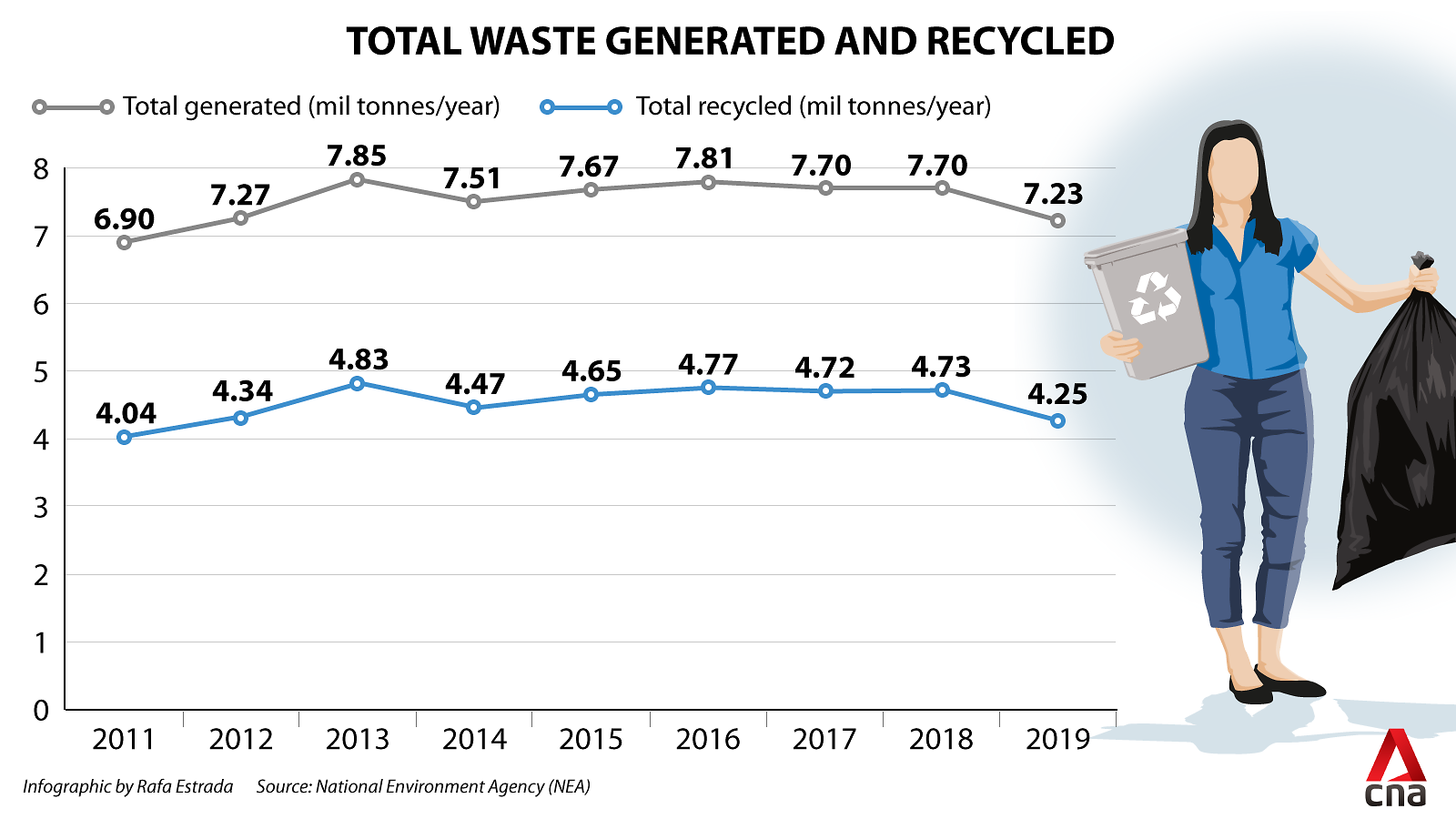
The absolute amount of non-domestic waste produced far outweighs the amount of waste produced by households. According to NEA statistics, 5.37 million tonnes of non-domestic waste was produced in 2019, compared to 1.87 million tonnes of domestic waste.
Similarly, in 2018, 5.7 million tonnes of waste produced was non-domestic, while 2 million tonnes of waste was produced by households.
Both of these figures saw a drop the next year. Among households, the recycling rate fell from 22 per cent in 2018 to 17 per cent in 2019, while the non-domestic recycling rate decreased from 75 per cent in 2018 to 73 per cent.
According to NEA’s website, the Environmental Public Health Act was amended on Apr 1, 2014 to compel industrial, trade, commercial or manufacturing premises to report waste data and submit waste reduction plans. Owners and managers of large hotels and malls have reported their general waste data and waste reduction plans to NEA since 2014.
And it appears that recycling efforts have improved since the implementation of the Mandatory Waste Reporting Exercise.
Between 2014 and 2018, the proportion of premises that recycle increased from 91 to 93 per cent for large hotels and from 80 to 94 per cent for large malls, according to NEA statistics.
The respective industry recycling rates also improved between 2014 and 2018, from 6 per cent to 7.7 per cent for large hotels and 6.7 per cent to 10.7 per cent for large malls.
Recyclables that have been sorted into different categories before being compressed into bales. (Photo: Marcus Mark Ramos)
In Mar 2019, Dr Khor announced that the mandatory waste reporting scheme will be extended to large industrial developments and convention centres.
This will apply to factories, warehouses and convention centres with gross floor areas of more than 20,000 sq m, 50,000 sq m and 8,000 sq m, respectively. They will need to track the amount of waste they generate from 2020 and submit their first reports to NEA in 2021.
In response to queries about how they manage waste and how much is recycled, companies CNA spoke to shared measures they take to improve recycling and reduce waste.
IKEA Singapore’s employees collect cardboard and plastic packaging after unpacking goods. They then segregate the packaging materials into recycling bins and sell the cardboard and paper to a recycling provider while providing the plastic free-of-charge.
The recycling provider then sells to local traders who ship it to recycling plants in Indonesia, Malaysia or other countries in the region.
IKEA’s two stores here collected 1,946 tonnes of carton boxes and 48 tonnes of plastic wrappings in 2019, said the furniture giant, adding that it recycles 73 per cent of its total waste. By 2030, IKEA plans to produce all the home furnishing in its stores from recycled, recyclable or renewable materials.
READ: 18,000 households in Singapore to get free IKEA recycling bin
On the hotel front, Holiday Inn Singapore Atrium recycles 100 per cent of its paper and plastic bottles. Its average paper waste is 100kg a month, while its average plastic bottle waste is about 35kg a month, said a spokesperson.
Meanwhile, Marriott International aims to reduce the amount of waste it sends to landfills by 45 per cent, said a spokesperson. All the plastic and paper waste produced at its hotels is recycled, and it has contracted third-party companies to collect the waste on a weekly or monthly basis.
The international hotel chain has also placed recycling bins in each guest room and labelled bins for proper waste segregation at back of house areas.
READ: Hotel waste: The huge switch to becoming a more sustainable business
READ: Could more be done to reduce plastic packaging waste in Singapore’s supermarkets?
Supermarkets also deal with large amounts of packaging waste, and have begun to implement similar initiatives.
According to its 2019 sustainability report, Sheng Siong recycled 7,160 tonnes of carton materials last year, compared to 6,531 tonnes in 2018. It also recycled 7,622 units of wooden pallets in 2019, a sharp increase from 2,914 units in 2018.
Other than carton materials, wooden pallets and food waste, Sheng Siong also recycles plastic, stretched film, Styrofoam boxes, cans and metals.
NTUC FairPrice said it is currently working to collect data across all FairPrice stores and warehouses to prepare for its first Mandatory Packaging Report, and “it is too soon to be able to share meaningful data”.
The supermarket chain said it is “committed to environmental sustainability in (its) operations where possible” and stands in “full support” of the Government’s measures to reduce packaging waste. It has implemented “green operating procedures” at all FairPrice stores and warehouses, where recyclable waste such as carton boxes are collected for recycling.
IF IT CAN’T BE RECYCLED, IT BURNS
Singapore’s recycling rate is also affected by how much of the waste sent to recycling centres – local and overseas – can actually be recycled. With more countries closing their borders to imported waste and low local recycling capacities, more of Singapore’s recyclables may burn in incinerators.
And this will drive recycling rates back down. With overall recycling rates sticking at about 60 per cent in recent years, Singapore is currently falling short of its 65 per cent Sustainable Development Blueprint target for 2020.
This is part of Singapore’s journey to meet the United Nations’ High-Level Political Forum on Sustainable Development’s 2030 Agenda for Sustainable Development, which in 2015 set goals for countries around the world to take action in areas of critical importance for humanity and the planet.
Singapore’s 2030 goal has been set at 70 per cent.
Workers sorting waste at Sembwaste’s sorting facility. (Photo: Marcus Mark Ramos)
China announced in July 2017 that it would no longer import “foreign garbage”. In 2019, 30 per cent of recyclable materials was exported to countries including Australia, China, India, Indonesia, Malaysia, South Korea and Thailand for processing and recycling, said NEA.
A CNA report in 2018 found that where public waste collectors used to collect household recyclables, sort out the plastics and sell them to China, they were incinerating them instead.
READ: ‘Cannot sell … so they burn’: What’s next in the uncertain future for plastic waste in Singapore?
The “persistently weak global market demand” for plastic recyclables was a key reason for the drop in the plastic recycling rate in 2019, said NEA, adding that it was “developing our local recycling capabilities” to treat post-consumer plastic waste, including PET beverage bottles.
Bales of recyclables waiting to be sent away to waste processors here and overseas. (Photo: Marcus Mark Ramos)
Exports of recyclables are highly dependent on demand and supply in the international market, and has been “increasingly constrained by the import policies of other countries” in recent years, the agency said.
Singapore lacks the large-scale facilities needed to recycle a substantial amount of materials, which is why paper and plastic waste has to be exported, said Ms Melissa Tan, chairman of the Waste Management and Recycling Association of Singapore.
“However, when countries like China, Malaysia and Indonesia close their doors to the import of such recyclable wastes, then like food waste, we may have no choice but to incinerate them,” said Ms Tan.
The shrinking of regional and global markets for recyclable imports has affected recycling rates “to an extent”, said the manager of non-governmental organisation Zero Waste SG, Ms Pek Hai Lin, adding that Singapore should own its recycling processes “as much as possible”.
In the typical recycling process, a dedicated recycling truck collects the waste from each blue bin, and takes it to a materials recovery facility. The recyclables are then sorted into different waste streams, baled and sent to local and overseas recycling plants.
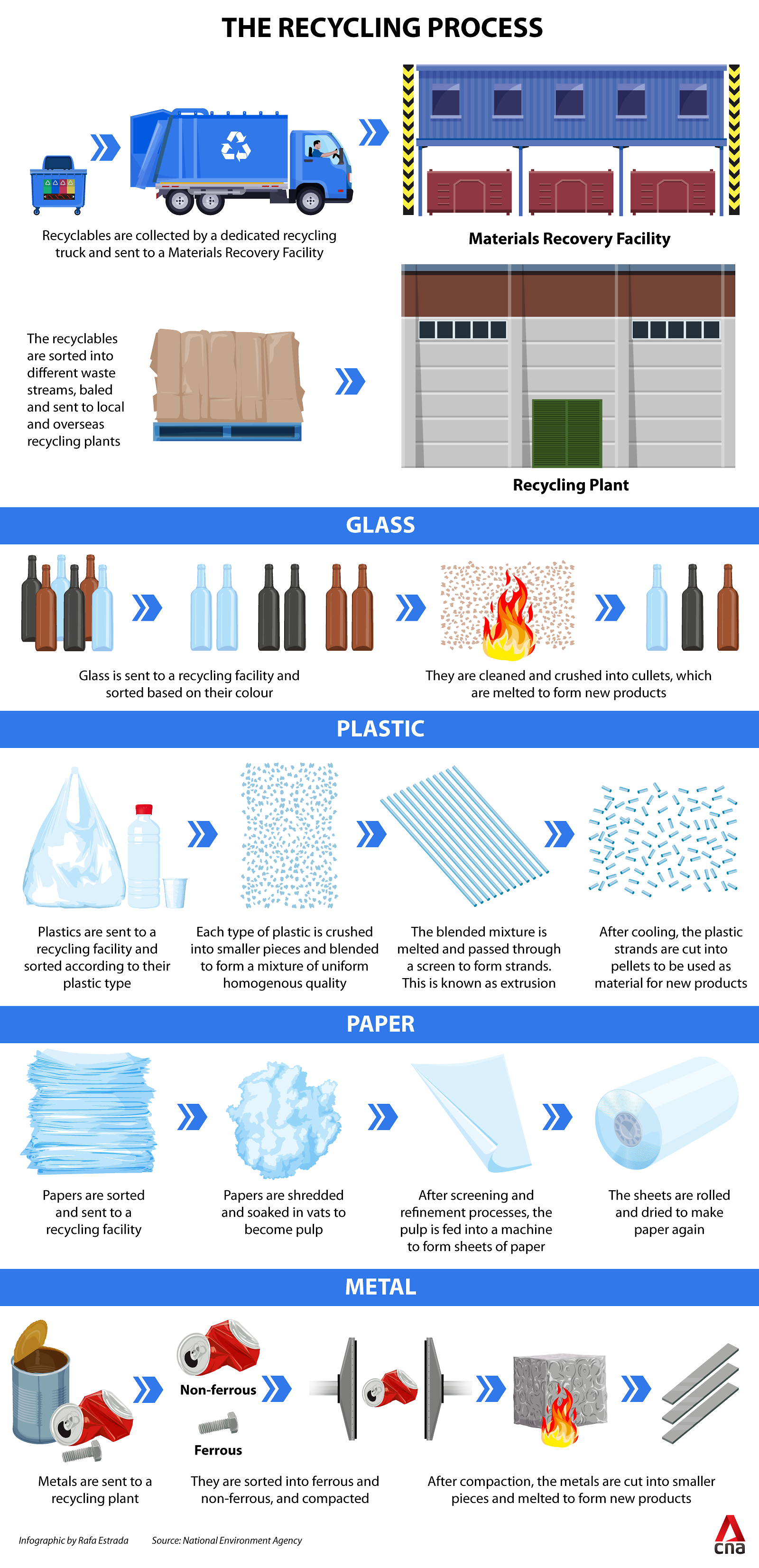
Singapore’s largest materials recovery facility, which belongs to Sembcorp, can be found in Tuas. It receives up to 60 tonnes of materials from household collections per day, of which only 50 to 60 per cent is suitable for recycling, as the remaining is contaminated or not recyclable.
“In general, over the past few years, we have also not seen significant improvement to the contamination level of household recyclables that come through our facility,” said Mr Neo Hong Keat, senior vice-president of waste management at Sembcorp Industries.
WATCH: Singapore to open recycling plant capable of producing fuel from rubbish
READ: New ‘environmentally friendly’ lithium-ion battery recycling facility to open in Singapore
As a sorting facility, Sembcorp collects mixed recyclables and relies on a team of 20 workers to sort them into different waste streams, bale them and send them to authorised dealers in Singapore, including recyclers like Plaspulp Union.
Workers sorting through plastic waste at Plaspulp. (Photo: Marcus Mark Ramos)
The plastic recycling facility in Tuas South, which has been around for more than 20 years, receives about 20 to 30 tonnes of plastic a day. The facility can process 30 to 40 tonnes of plastic per day.
About 5 to 8 per cent of the waste received cannot be recycled, depending on the type of plastic they receive and the contamination rate, said operation manager Jade Loh.
The waste is segregated and then put through the recycling machine to be crushed, re-processed and recycled into plastic pellets. The plastic pellets are then sold to bag manufacturers, agricultural firms and moulding companies to make objects like toys and chairs.
Plastic pellets produced at Plaspulp, which are eventually sold to bag manufacturers, agricultural firms and moulding companies. (Photo: Marcus Mark Ramos)
When asked why Plaspulp focuses on recycling industrial waste, Ms Loh explained that consumer waste is more difficult to recycle as it is often contaminated.
“There could be waste residue left over from consumer waste, such as (for) example, a plastic bag could be used to store rubbish, (or it) could have a lot of dirty materials inside,” she said.
“Therefore, (this) makes it a bit more difficult to recycle in comparison to post-industrial waste where we can just do a little bit of sorting and they’re generally cleaner than consumables.”
A worker loads waste plastic into a shredder before it is melted and processed. (Photo: Marcus Mark Ramos)
But the contamination rate from industry players has also improved over the years as they have become more conscious about the cleanliness of the waste they send for recycling, she said, adding that Plaspulp educates their customers on how to handle recyclables as well.
While plastic recycling is its main business, Plaspulp also sorts paper waste and re-processes styrofoam and polyethylene into pellets. In this process, about 2 to 3 per cent of the base material is wasted.
Running a recycling facility is not easy and can be expensive, said Ms Loh, citing high rental and manpower costs. It is also difficult to hire Singaporean workers who have experience sorting the different materials, she added.
Plaspulp’s premises in Tuas South, with bags of waste plastic waiting to be sorted and recycled. (Photo: Marcus Mark Ramos)
Temasek Polytechnic’s Dr Ang also noted that Singapore’s practice of discarding recyclable waste in a common blue bin before sorting it at a central facility costs more than sorting it in multiple bins from the start.
“Therefore, it may appear more cost effective to treat the waste using the usual incineration process,” he said.
With such constraints, Plaspulp is one of a “handful” of recyclers left. Several have closed over the past two years, said Ms Loh.
WASTE-TO-ENERGY PLANTS TO COMPLEMENT RECYCLING
To deal with the waste it cannot export and cannot recycle, Singapore is moving towards more efficient and innovative processes in solid waste management, said Assistant Professor Grzegorz Lisak from the School of Civil and Environmental Engineering at Nanyang Technological University (NTU).
He told CNA that waste-to-energy solutions are already “quite established” in Singapore, with four plants that incinerate non-recyclable combustible waste.
“This allows for waste volume reduction, which helps to reduce the use of scarce land for waste disposal. Ash from the incineration plants and non-incinerable waste are transported and disposed at Semakau Landfill,” said Asst Prof Lisak.
NTU operates the only waste-to-energy gasification plant in Singapore, which processes municipal waste to produce synthesis gas that can be used to generate electricity more efficiently than incineration plants. (Photo: Marcus Mark Ramos)
Waste-to-energy incineration is feasible in Singapore, as it helps to reduce the volume of waste by up to 90 per cent, he added.
“Not everything can burn though. There are non-combustible components in waste. It is challenging to recover these materials after (the) incineration process.
“If everyone does their part and throws recyclable waste such as glass bottles, metal cans, electronic waste into separate recycling bins, the zero waste initiative would be more effective.”
NTU operates the only waste-to-energy gasification plant in Singapore – it processes municipal waste to produce synthesis gas that can be used to generate electricity more efficiently than incineration plants, or as feedstock for chemical synthesis from waste.
“The technology treats waste, recovering energy just like in the incineration plant while simultaneously recovering materials such as metal and slag, both of which have direct industrial applications,” said Asst Prof Lisak.
The plant, funded by NEA, NTU, the Economic Development Board and the National Research Foundation, also serves as a testbed for new waste-to-energy solutions.
Asst Prof Lisak also noted that there is “an ongoing effort” to further the sustainability of waste management practices, evident from the Government’s plans to construct an integrated waste management facility by 2024 for resource and energy recovery from incinerable waste, recyclables, food waste and sewage sludge.
“Going forward, I would presume the Government’s approach will be multi-pronged, with the waste-to-energy efforts being complemented by efforts to boost recycling rates.”
Responding to questions about whether waste-to-energy plants could be a more worthwhile investment compared to recycling plants, Asst Prof Lisak stressed that there is “no single waste treatment solution” that works for all types of waste.
The plant recovers energy and materials like metal and slag, both which have direct industrial application. (Photo: Marcus Mark Ramos)
“Investing in just waste-to-energy plants and not doing the same in recycling plants would be an unsustainable approach. Not only would such an approach involve significant monetary costs, it would also be accompanied by a huge cost to the environment,” he said.
“If materials that can be recycled end up in incineration plants, there would be a significant stress on Earth’s natural resources. An ever-increasing amount of our limited natural resources will be consumed in producing fresh goods.”
“WE ALL DESERVE IT”
For Ms Lee, these efforts cannot come any sooner.
“I am sorry to say we’re ignorant individuals, to be very honest. And that’s not really everybody’s fault – no, it’s just the way society is … when it comes to the Earth,” she said.
“But it is something that we can change.”
It is “very important to keep reiterating that it’s not about recycling but reducing” even though people know “in theory” that consumption is what drives production. With demand and supply comes manufacturing and production, which creates carbon footprints, she added.
“It’s simply because human beings create a lot of social norms and behaviours and habits, therefore, there’s so much demand for certain things which create all these problems … We are trying our best to save the Earth, but then unfortunately most of the human beings are not with us, so I’ve come to the acceptance that we all deserve it.”