Covid-19 has brought with it more than a few challenges since it arrived on our shores in January. But in the blink of a blurry eye (fogged up by what seem like countless daily temperature logs, Gov.sg WhatsApp updates, and Safe Entry check-ins), it’s going to be National Day again!
We’ve all tried our best to adapt to a new normal, and the fact that the National Day Parade is still taking place (albeit greatly scaled down and with numerous saftey measures in place) is somewhat reassuring: we’ve made it thus far, and we can continue fighting.
Here, we speak to three of the young men and women who will be participating for the first time in the NDP – more specifically, the Parade & Ceremony segment at the Padang, the site of Singapore’s first NDP in 1966.
Fans of homegrown burger brand Omakase Burger who live in the north can now get their fill of burgers and fries without travelling all the way to town.
The brand has opened a pop-up stall, Omakase Burger Express, at a coffeeshop at Toa Payoh Lorong 8. Here’s the best part — prices are up to 20 per cent cheaper than at the Wisma Atria outlet, according to the brand.
🎉 We are now open in Toa Payoh with our sister brand 𝐎𝐦𝐚𝐤𝐚𝐬𝐞 𝐁𝐮𝐫𝐠𝐞𝐫 𝐄𝐱𝐩𝐫𝐞𝐬𝐬! 🎉 You wanted us in your neighbourhood, so…
SINGAPORE – Another 47 employers have been placed on the Fair Consideration Framework (FCF) watch list for potentially discriminatory hiring practices.
They will have their Employment Pass (EP) applications closely scrutinised, and those who are recalcitrant or uncooperative will have their work pass privileges cut back.
The 47 are on top of 1,200 employers previously put on the watch list, said the Manpower Ministry (MOM) in a statement on Wednesday (Aug 5).
Of the 47, 30 are in the financial services and professional services sectors, and the rest are in administrative and support services, manufacturing and education.
They comprise both large and small companies, with the largest employing almost 2,000 professionals, managers, executives and technicians (PMETs).
Among them are banks and fund managers, as well as management consulting firms and firms providing project management and engineering services.
SINGAPORE: The Health Sciences Authority (HSA) on Thursday (Aug 6) issued an alert about two slimming products found to contain a banned substance that could pose serious health risks.
A medicinal ingredient used to treat erectile dysfunction was also found in another product sold online as candy, said the authority in a media release.
HSA was alerted to the product Coco Curv by a consumer who had bought it in Malaysia. She suspected that the product could be harmful and reported it to the authority.
Marketed online as a slimming product, Coco Curv claimed to “burn fat and calories”, “boost energy and metabolism”, as well as “control carbohydrate craving”.
Coco Curv claimed to burn fat and calories. (Photos: HSA)
During investigations into Coco Curv, HSA came across another slimming product online called Choco Fit.
Tests revealed that both products contained the banned substance sibutramine.
The drug used to be a prescription medicine for weight loss, but has been banned in Singapore since 2010 due to an increased risk of heart attacks and strokes.
HSA said other serious adverse effects reported by consumers who took products with sibutramine include rapid heartbeat, insomnia, and suicidal thoughts.
Choco Fit was found to contain banned substance sibutramine. (Photos: HSA)
ERECTILE DYSFUNCTION MEDICINE FOUND IN HAMER CANDY
In the release, HSA said it was also alerted by a consumer to another product Hamer Candy containing a potent ingredient.
The product, packaged as a candy, was found to have nortadalafil, which is chemically related to tadalafil.
Hamer Candy recently resurfaced online with new packaging. (Photo: HSA)
Tadalafil is a prescription medicine used to treat male erectile dysfunction, said HSA.
Inappropriate use of tadalafil without medical supervision may also cause priapism, which is a painful and prolonged erection.
Tadalafil can also pose serious risks to certain patients, including those with heart-related problems. It should not be used by patients who are on heart medications such as nitrates as it can cause potentially life-threatening low blood pressure.
HSA added that the use of nortadalafil may lead to increased risk of serious adverse effects including low blood pressure, strokes and heart attacks.
Both Hamer Candy and Choco Fit had previously been alerted to members of the public in 2018 and 2019 respectively, said HSA. Online postings of these products were also taken down.
However, they have recently resurfaced online with new packaging, said HSA.
This is “a common tactic undertaken by unscrupulous manufacturers in an attempt to evade detection and entice consumers”.
All three products were sold on local online platforms including Shopee, Qoo10, as well as on Facebook and Instagram.
HSA said it has issued warnings to the sellers and directed the respective website administrators to take down the affected listings.
SINGAPORE – Criminal defence lawyer Charles Yeo has been appointed chairman of the Reform Party (RP), while oil and gas company director Mahaboob Batcha is the new party treasurer.
The party announced the appointments in a Facebook post on Wednesday (Aug 5), which it said were part of party renewal following the recent general election.
But the move has been criticised by outgoing RP chairman Andy Zhu, who told The Straits Times he was unfairly dismissed by the party before allegations made against him by secretary-general Kenneth Jeyaretnam have been resolved.
RP had said in its post that Mr Zhu, 37, and outgoing treasurer Noraini Yunus, 52, will both be stepping down from its central executive committee (CEC).
The internal conflict spilled into the open when Mr Zhu made a subsequent post on Wednesday using the party’s Facebook account that said: “This is an undemocratic stance by the SG Kenneth Jeyaretnam to make this announcement of new appointments while the matters and allegations against the Party Chair and Treasurer are not finalised.”
SINGAPORE: Two teenagers were arrested on Tuesday (Aug 4) for allegedly cheating Carousell customers of more than S$5,000.
The police said they received several reports between March and July from victims who said they were cheated when purchasing computer parts and “high-end” gaming personal computers on Carousell.
After making payments to the seller via cash on delivery or bank transfers, the victims said they received items which were of a lower specification. Some victims also received items that were not working.
More than 10 victims were cheated of more than S$5,000. (Image: Singapore Police Force)
Officers from the Commercial Affairs Department identified the two teenagers after investigations and through collaboration with Carousell.
Preliminary investigations found that the pair is believed to have cheated more than 10 victims of more than S$5,000, the police said.
Police investigations are ongoing. If found guilty of cheating, they face up to 10 years’ jail and a fine.
The police advised members of the public to exercise caution when making online purchases.
They should opt for buyer protection by using in-built payment options that release payment to the seller only upon delivery. Whenever possible, buyers should also avoid making advance payments or direct bank transfers to the seller.
SINGAPORE: The Ministry of Manpower (MOM) said it has not observed a spike in the number of migrant worker suicides compared to previous years, although it is aware of recent incidents involving workers living in dormitories.
“The Ministry of Manpower is aware of the recent spate of suicides and attempted suicides involving migrant workers living at the dormitories,” said MOM late on Wednesday (Aug 5) in response to CNA’s queries.
“While we have not observed a spike in the number of migrant worker suicides compared to previous years, we are monitoring the situation and are working closely with our partners and NGOs to enhance our mental health support programmes for the workers.”
More than 300,000 migrant workers living in dormitories had been placed in lockdown in April as part of the Government’s strategy to curb the spread of COVID-19.
In recent weeks, there have been questions about the state of workers’ mental health following reports of unnatural deaths.
On Jul 24, a 37-year-old Indian worker was found dead at 512 Old Choa Chu Kang Road. According to the police, this is a case of an “unnatural death” and investigations are ongoing.
In May, a 27-year-old migrant worker from Bangladesh was found motionless at a factory converted dormitory in Kranji.
A few weeks before that, a 46-year-old Indian national died from his injuries after being found motionless at a staircase landing at Khoo Teck Puat Hospital.
Videos have also circulated online, with some showing workers standing precariously on rooftops and high ledges.
One of these videos, posted sometime around Jul 22, shows a worker standing on a ledge at PPT Lodge 1B dormitory in Seletar.
The worker, who was staying in a block that was cleared of COVID-19, had bought a flight ticket home on his own and became agitated when his employer “was not facilitative of his return”, MOM had said in a Facebook post.
A dispute occurred as the worker did not discuss with his employer his intention to return home, MOM had said. He was allowed to leave Singapore the next day.
A screenshot of a video that circulated online showing a man standing on top of a dormitory railing. MOM said a dispute had occured between the worker and his employer.
On Aug 2, another worker had appeared to harm himself at his dormitory in Sungei Kadut. Photos circulating online show a man lying bloodied on a stairwell.
MOM told CNA in an earlier statement that said the man is in stable condition.
“Checks by MOM found that the worker had no salary arrears, and his food and accommodation were provided for. There was also no indication that he was in distress prior to the incident,” the ministry said.
Given the recent incidents, MOM said its Forward Assurance and Support Teams – public officers stationed at the dormitories – have stepped up efforts to “proactively look out for residents whom they assess may benefit from speaking to a mental health counsellor”.
“We have also worked with IMH to train and better equip frontline staff with the knowledge and skills to help workers who may require support,” it added.
MENTAL HEALTH HIT BY CONFINEMENT, UNCERTAINTY OVER JOBS: HELP GROUPS
Uncertainties over their health, jobs and prolonged confinement have affected the mental state of many migrant workers during the COVID-19 pandemic, migrant worker advocacy groups said.
According to Mr Justin Paul, non-profit organisation HealthServe’s mental health programme manager, there have been more cases of workers trying to harm themselves or who have expressed a desire to do so because of the stressful situation.
His organisation has seen an increase in the number of workers tapping their mental health services.
In April, 71 workers reached out to them through their virtual advisory sessions, counselling services and online group therapy sessions. It saw 244 workers in June and 207 in July. In total, HealthServe received queries from about 750 workers so far.
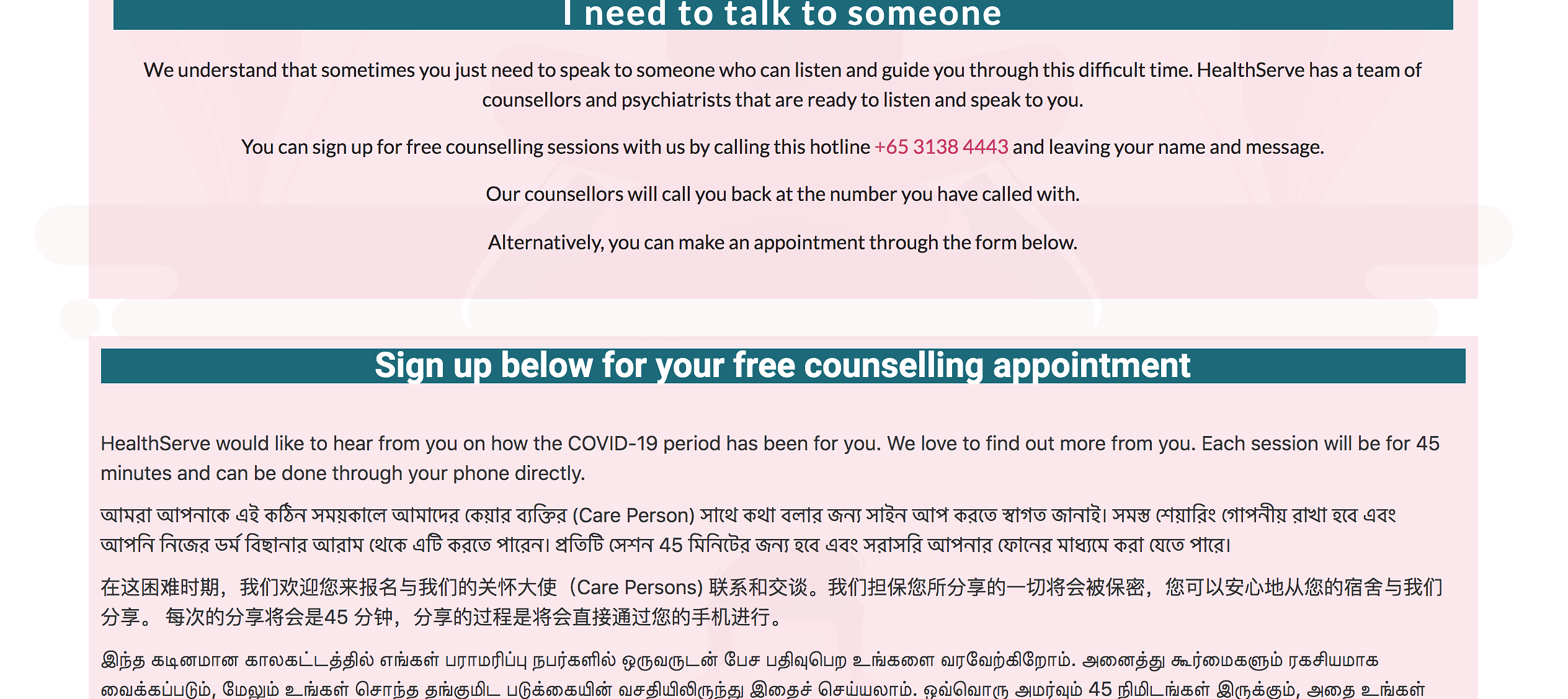
Screenshot of a webpage on HealthServe’s website asking workers who need to seek advice to sign up for their tele-advisory service.
“Broadly-speaking they are stressed by various uncertainties,” said Dr Chan Lai Gwen, a psychiatrist based at Tan Tock Seng Hospital who volunteers with HealthServe.
Listing their concerns, Dr Chan said: “Whether they will eventually contract COVID-19, whether they may get reinfected after recovery and returning to the dormitory, how long more their quarantine (or) isolation will last, whether they will be able to return home and see their families, whether they will be physically fit to go back to work, whether they still have a job to return to (and) whether their work permits will be renewed.”
Onsite medical facilities for workers at foreign worker dormitory Avery Lodge. (Photo: Singapore Ministry of Manpower)
The situation reached a breaking point right after the “circuit breaker” ended, said Mr Paul. Workers who had been cooped up for two months thought they would finally be able to return to their jobs, but that did not happen.
“When Jun 2 came and went, a lot of the workers who were holding back and had accumulated stress from April started to break in different ways,” he said, adding that HealthServe’s counselling team started to see an increase in workers expressing self-harm and suicidal thoughts.
For Chinese national workers, the stress was compounded by news of people in China returning to work. Family members back home began to pressure them for money, he added.
The Community Isolation Facility for COVID-19 patients at the Singapore Expo and Max Atria. (Photo: Ministry of Health)
In cases of attempted suicides, MOM said that based on its records and engagements with the NGOs, such incidents stem from problems workers face back home, such as marital or familial issues, or unforeseen mishaps in their home countries.
“Due to the current COVID-19 situation, migrant workers may face delays in returning home, thereby causing distress as they are unable to be with their families,” said MOM on Wednesday.
“MOM has been facilitating workers’ return to their home countries. But as there are various factors involved, such as ensuring that these workers have recovered and have taken a swab test as required by some home countries, we seek employers’ and workers’ understanding that it may take some time for workers to be able to return home.”
Rights groups CNA spoke to said another factor affecting migrant workers during this period is their living environment.
Conflicts are inevitable when several workers of different cultural and religious backgrounds stay in a room 24/7, said Mr Samuel Gift Stephen, founder of the Alliance of Guest Workers Outreach.
“Imagine if one guy is praying and another is playing music in the background … You know how important their religion is. If they can’t practise it properly, it’s definitely going to affect their mental state,” said Mr Stephen, whose organisation reaches out to South Asian workers living in dormitories.
Then there are recovered workers staying in hotels and cruise ships. With strict measures limiting movement and rooms without windows, many workers felt disoriented, said Mr Cai Yinzhou, co-founder of the COVID-19 Migrant Support Coalition.
The same goes for workers at community care facilities, added Mr Paul, who cited an example of once seeing a large group of men at the Singapore Expo crowding around a tiny hole where sunlight was seeping through near a makeshift toilet.
“One worker asked if it was Thursday when it was a Saturday,” said Mr Cai who had visited the workers. “Some of them can’t sleep. Or when they do, (they) have nightmares.”
Comments on social media platforms claiming that the workers are having a good time in the hotels and cruise ships have been particularly demeaning, said Mr Cai.
A worker jogging around his seat during his recreational time. (Photo: Gaya Chandramohan)
Lately, more workers have expressed a desire to return home to recuperate, said Dr Chan, who has also seen cases of workers who have thoughts of harming themselves.
“Everyone involved with migrant workers needs to be aware of the stress they are facing and the real risk of suicide and self-harm when the sense of desperation escalates,” Dr Chan said. “Suicide is preventable.”
HELP AVAILABLE
Mental health resources are available to workers, MOM said on Wednesday.
“We have made considerable effort to keep workers up to date on COVID-related efforts, through daily messages and also materials in their languages to promote the mental health and well-being of workers. These materials encourage workers to identify symptoms of distress, look out for one another, be a buddy to a friend, and know where to seek help,” said the ministry.
It added that to reduce the effect of isolation, time has been scheduled for workers to leave their rooms and access common areas. The ministry said it has also worked with NGOs to run activities such as exercise sessions.
“Moving forward, when community and dormitory cases have been sustained at low levels for a period of time, we are planning for migrant workers to be able to leave their dormitories for the Recreational Centres in a measured and safe manner,” said MOM.
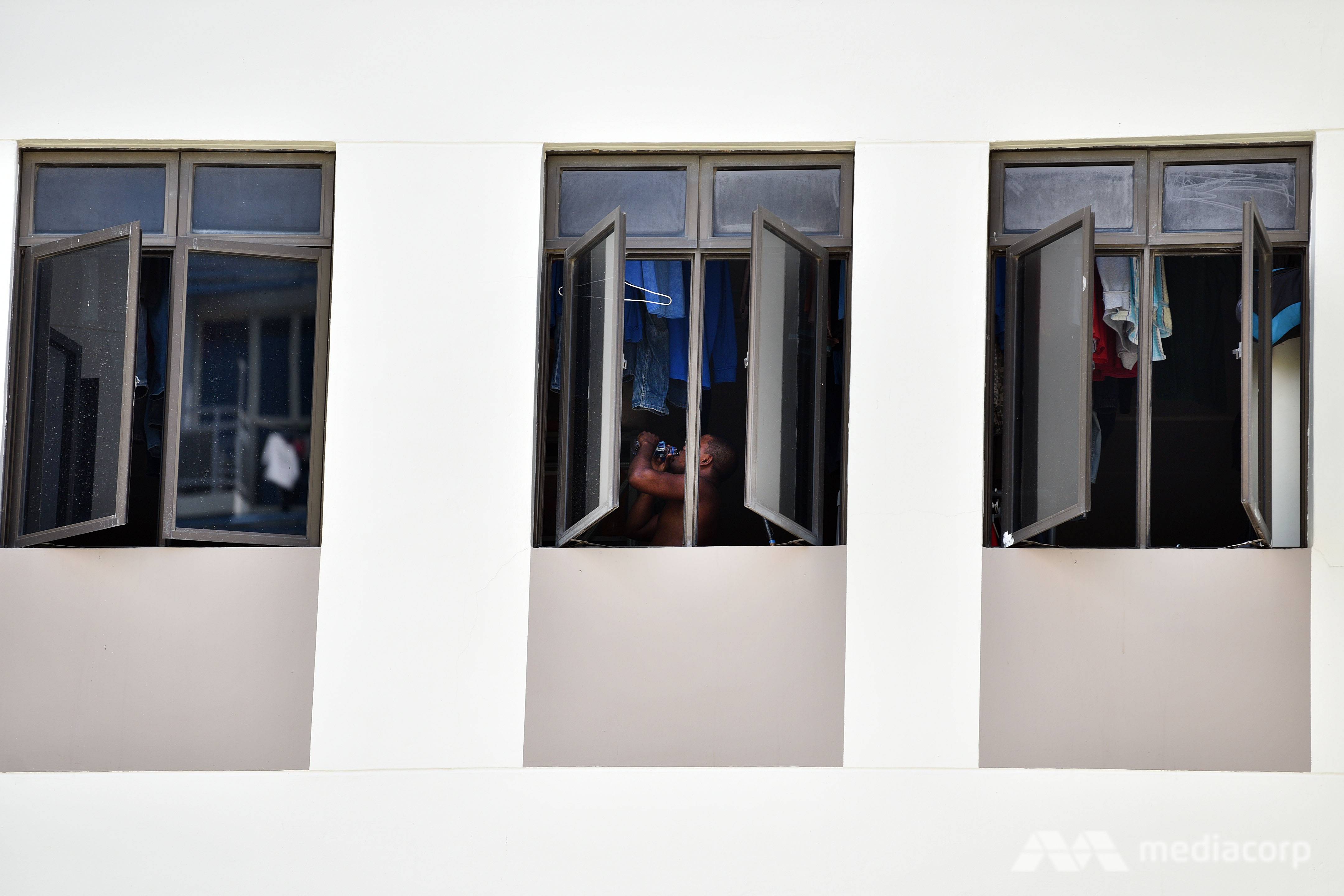
A resident is seen drinking water from a bottle at Tampines Dormitory on Apr 20, 2020. (Photo: Jeremy Long)
The NGOs have been also trying to help the workers in other ways.
For instance, Mr Cai’s group has been delivering goods like coffee, tea and shavers to the workers since the circuit breaker. More than a million of these items have been given out, he said.
The volunteers have also been running engagement programmes to befriend workers and cut their hair.
“Some of their hair are so long, and it’s so uncomfortable for them,” he said. “Just snipping it off gives them quite a bit of respite.”
Recently, a virtual town hall was held for about 60 workers where a doctor and some migrant workers explained the current situation and policies and took questions.
Mr Stephen’s group is working with 300 factory-converted dormitories to deliver meals and befriend the workers who pick up the food.
His organisation is also in the midst of setting up an e-counselling service that matches workers with professional counsellors from their home country.
SOME EMPLOYERS DO THEIR PART
Employers have also been trying to do their part.
Ms Calsia Lee, director of interior design firm Collective Designs, said she and her colleagues call their workers at least once a week and send them cakes occasionally. There is a WhatsApp chat group for them to reach out anytime.
The company has reassured them that they will still have a job when they are allowed to leave, Ms Lee added.
“The whole company feels sorry for them, and heartbroken, looking at their living conditions. They haven’t had the autonomy to simply go for a walk, to stretch or pick up a hobby at home, like the rest of us did,” she said.
“We empathise with their fears of contracting COVID-19, the uncertainty of their future, their being away from family.”
Mr Xu Xu Ping, managing director of Chian Teck construction firm, echoed the sentiments.
Since the beginning of the dormitory isolation, Mr Xu and other members of the upper management team began planning activities for workers to boost their morale.
Mr Xu’s company sometimes caters comfort food for his workers. (Photo: Xu Xu Ping)
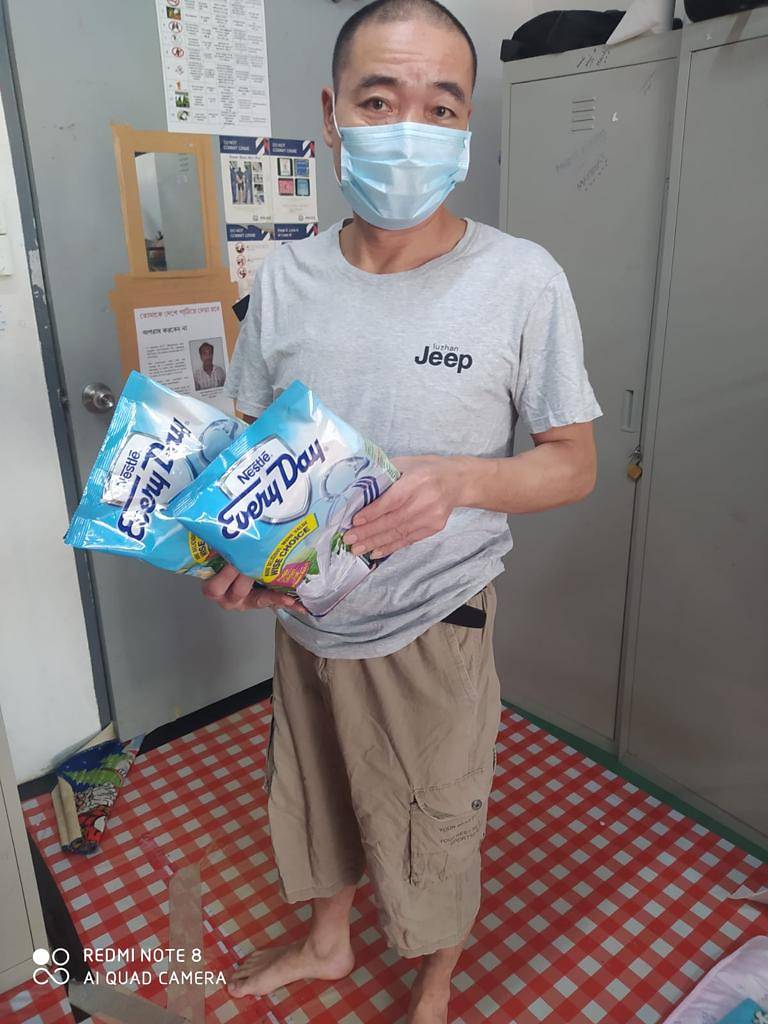
Mr Xu’s workers receive small gifts like milk powder from the company occasionally. (Photo: Xu Xu Ping).
“We treat ourselves like we are the workers inside,” said Mr Xu. “All these little efforts we try to do is to show them that we care.”
Such activities include weekly games with small prizes to be won, sending Chinese herbs to “boost their immune systems” and even getting their company engineers to double up as English teachers over virtual classes.
Sometimes he sends his workers encouraging video messages and notes.
“We really need the morale from the workers,” Mr Xu said.
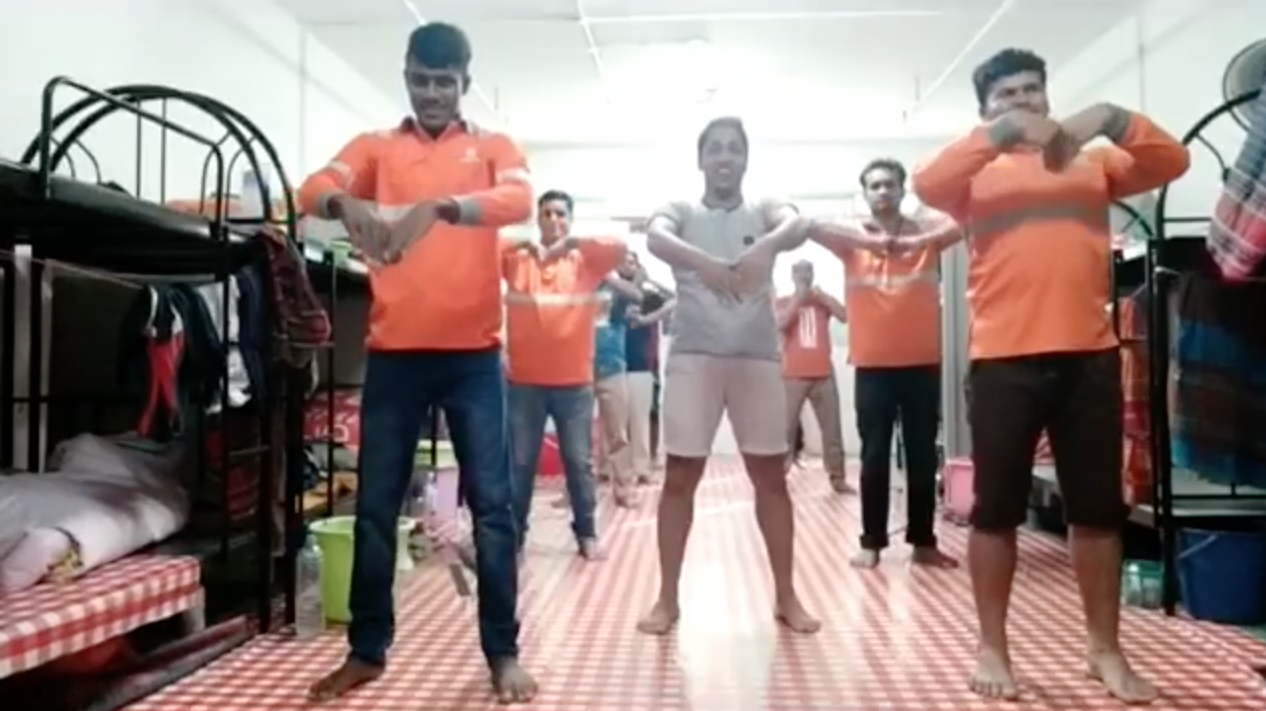
A worker leads his colleagues through some exercises while inside the dormitory. They filmed it to show Mr Xu.
Short-term anxieties aside, Mr Xu and his team is trying to focus on the possible long-term effects of the workers’ strained mental health.
“Some of them (workers) are calling us to say, ‘please let me go back, I don’t want to stay here anymore’
“If let’s say there’s a chance for the workers to go home, we expect 30 per cent to just leave without second thoughts,” he said.
“I think this this period of lockdown is like a wound for the workers,” he added. “It’s not going to heal so fast and if the workers (are) not with Singapore then we are going to have a massive shortage of skilled workers when we restart construction.”
One worker who is planning to head home to China is Mr Siang Chonglin (not his real name).
A sole breadwinner, the 51-year-old construction worker has not been able to go back to work. For almost three months, he has been at Seletar East Camp, which is among the temporary accommodations arranged for migrant workers who are well.
When CNA spoke to Mr Siang on Jul 25, the Chinese national’s hopes of returning to his dormitory had been dashed because some workers in the camp tested positive during a round of swabbing on Jul 20.
“It’ll be a lie to say that I’m not disappointed now,” said Mr Siang, who asked that his name be changed in this report given fears that it would affect his plans to return to China.
“HAVE TO PLAY OUR PART TO CURB THE VIRUS”
Four months since the lockdown was imposed, nearly 90 per cent of these workers have either recovered or been tested to be free from COVID-19. Even then, they are allowed to leave the dormitories only for work and must return immediately after that.
Although workers struggled through the lockdown, there are many who understand the need for such measures.
“I understand the lockdown. We cannot leave because otherwise we are a security risk to the rest of Singapore,” said Hasan Najmul who has mostly been confined in his room at a Choa Chu Kang dormitory since April.
The only time he felt down was during his quarantine in July, said the 24-year-old Bangladeshi. He was afraid he had contracted COVID-19.
“My bosses called me, tell me ‘don’t worry’,” said Mr Hasan, who has been in Singapore for six years. “They are very good. Send food, give us our pay.”
Hasan Najmul, a 24-year-old Bangladeshi, said that he understands the need to keep workers like him isolated in order to stop the virus from spreading. (Photo: Hasan Najmal)
Mr Paul said while he has seen workers in distress, others have told him they feel well-supported by employers. Some have written to the authorities to express their gratitude over the care they received.
“The Government is doing the best to give us what we need. They are spending money on us,” added Fan Bing, a 48-year-old Chinese national who has been in Singapore for 17 years. “I’m satisfied.”
Mr Bing has been spending his time on movies, social media app Douyin, reading the news and chatting with his bunkmates.
“We are anxious to start work. But I wouldn’t dare to go back to work if the virus was still out there.
“There’s no choice. We just have to play our part to curb the virus … and be open-minded about the situation,” he said. “I’m hoping it’ll end soon too.”
Where to get help: Various migrant worker charities operate hotlines, including HealthServe (+65 3138 4443), Migrant Workers’ Centre (+65 6536 2692), Humanitarian Organization for Migration Economics (6341 5535) and Transient Workers Count Too (6297 7564). Samaritans of Singapore operates a 24-hour hotline at 1800 221 4444, or you can email pat@sos.org.sg. If someone you know is at immediate risk, call 24-hour emergency medical services.
SINGAPORE – Two residents of a flat in Compassvale were messaging some friends on WhatsApp amid the Covid-19 outbreak when one of them suggested having a social gathering at the unit.
The court heard that Leong Chee Mun, 37, and his fiancee, Cassie Ong Shi Hong, 32, agreed to host the event at their home on May 8 even though the circuit breaker was still in force.
They later hosted 16 people at the unit at Block 295C Compassvale Crescent, the court heard.
Ten of them pleaded guilty on Wednesday (Aug 5) to an offence under the Covid-19 (Temporary Measures) Act.
Each of them also had a second charge under the same Act which was taken into consideration during sentencing.
Jackson Tan Chia Ho and Jasmin Tan Ee Lin, both 30, were each fined $3,000.
Poh Yang Ting, 21; Peh Si Qin, 22; Felisa Chua Jia Xuan, 23; Low Wei Hao, 25; Nicman Lim Wei Fong, 25; Chee Min Hui, 27; Kho Zi Ting, 27; and Priscilia Tan Sze Hui, 32, were each fined $2,500.
The cases involving Leong, Ong and six other people are still pending.
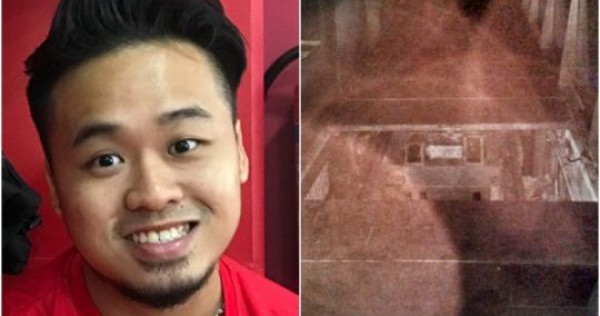
SINGAPORE – A part-time security officer was killed last year after he fell into a 4m-deep pit near the 1-Altitude rooftop bar at One Raffles Place.
A coroner’s inquiry into Mr Shaun Tung Mun Hon’s death revealed that the opening had been left uncovered by workers who were tasked with cleaning the building’s facade.
On Wednesday (Aug 5), a Ministry of Manpower (MOM) officer told State Coroner Kamala Ponnampalam that the workers had found moving the concrete slab to cover the opening on a daily basis, “quite troublesome”.
Barricades and warning signs had also been put up near the opening at an earlier time.
But the MOM officer testified that these measures were “not effective”.
The court heard that the ministry is contemplating action against the parties involved and that investigations are ongoing.
A concrete slab cover, weighing about 80kg, had been moved to expose an opening near the nightspot on June 9 last year.
The opening led to a pit and guests were barred from entering the area surrounding it.
SINGAPORE: During the Severe Acute Respiratory Syndrome outbreak in 2003, Viji Jagadeesh lost her job when the accounting firm she was working in struggled with poor business.
After being jobless for over a year, she started a small outfit with 12 beds, offering short-term rental to budget travellers.
Three years later, Viji opened hostel Mitraa Inn with 60 beds, riding the low-cost aviation boom which saw a spike in budget travellers in Singapore.
Her business flourished and, over the years, became one of the largest hostels here, with 144 beds in two shophouses in Serangoon Road.
Mitraa Inn is located in Little India. (Photo: Christy Yip)
Mitraa Inn has been particularly hard hit by COVID-19, however, that it is forced to shut down this month. “The past six months have been truly a walk through fire for me,” said its 55-year-old owner.
She sensed trouble as early as December, when a group of 44 students from India suddenly cancelled their booking for April. But it did not prepare her for what was to come.
“We were thinking, it’s no problem … the travellers will come back,” she recounted. “Then people started cancelling bookings even for September, during the F1 period.”
She struggled to fill beds, with occupancy fluctuating between 30 and 40 per cent when the break-even point was 65 per cent.
Viji tells CNA Insider her story.
Sometimes there were as few as five to six people a day, which was “almost as good as zero occupancy”.
“I was in denial that it (the closure) was happening. It was mental agony,” said Viji. “But we have no choice (but to close down) before we incur further losses.”
It has been a difficult situation not only for her. In an industry that relies on travellers, hostels in Singapore could face a wipe-out.
‘WHEN THE BORDERS CLOSED, WE PANICKED’
Before the borders were closed to short-term visitors in March, Wink Capsule Hostel — with 150 beds in two locations — was running at 80 per cent occupancy, said co-owner Allan Lee. It has been a struggle to survive ever since.
“We’re a backpacker hostel. When there are no tourists, we have no business,” he said.
In April, a group of 40 hostel owners — with a combined total of 3,000 to 4,000 beds — banded together and formed the Singapore Backpacker’s Hostel Alliance to discuss and keep one another updated on the government’s various COVID-19 measures.
“We all could feel that we were entering a pandemic, and we were all affected by the drop in tourists,” said Adler Poh, the group’s spokesman and the managing director of Adler Hostel Singapore. “When the borders closed, we panicked.”
Adler Poh, 32.
Mitraa Inn was offered a lifeline, said Viji, when it started housing returning foreign domestic workers who were issued with 14-day Stay-Home Notices.
“We thought this would be sustainable. We had girls from Myanmar and Philippines. Then the maid arrivals stopped in April as countries closed their borders. Our occupancy dropped again,” she said.
Around that period, thousands of Malaysian work pass holders also had to be housed temporarily in Singapore after Malaysia implemented its movement control order on March 18, and many hostels benefited from this.
By the time Mitraa Inn was ready for this group in April, however, most of them had already found accommodation in other hostels, said Viji.
CURRENT OCCUPANCY CAP NOT VIABLE
But even with these Malaysian workers, hostels like Wink Capsule Hostel had to drop their daily rates from the usual S$35 to cater for this group.
“These workers aren’t looking at tourist prices. The market rate is about S$20 today,” said Lee. Had he not lowered his rates, he added, these workers would have rented HDB rooms instead, possibly at a lower monthly price.
Then there is competition from some hotels that have even cut their room rates to S$40, which works out at S$20 per person, said Poh.
“That leaves us with very little room for manoeuvre,” he said. “With each bed going for S$20 and a monthly revenue of about S$10,000 … how am I going to pay my staff? We’re burning money every day.”
Another problem is that occupancy must be capped at 50 per cent to comply with mandatory safe management measures, which he said is not commercially viable for hostel operators.
Bunk beds or capsules, for example, must be allocated in an alternating fashion, while single beds or mattresses must also be spaced at least a metre apart.
David Peh, manager of Pine Hostel on Tyrwhitt Road in Jalan Besar, said that because of the 50 per cent rule, the hostel has had to turn away guests like Malaysian workers.
“We’re struggling to break even,” he said. “We’re waiting for the government to do something (to revise the rule).”
The hostel has survived so far because the landlord had given it rental waivers, he added. “The next few months will be the real test (without the waivers).”
If the 50 per cent rule is still strictly adhered to and landlords do not budge on negotiating rents going forward, Poh believes “many of the hostels will close down”.
“We’re in such a difficult situation now … We haven’t been viable for a long time,” he said. “(Many of us) try to balance our costs, but we’re reaching the end of the Jobs Support Scheme (JSS).”
The overall shortfall for Wink Capsule Hostel, said Lee, is now “a few thousand dollars every month”. He added: “We’re trying to hang on till the end of the year. If (we) can’t, we’ll close down.”
JEWELLERY PAWNED, FLAT DOWNGRADED
For Mitraa Inn, Viji said she started closing floors over the last few months to save on electricity and manpower costs. “In July, we had only eight guests. We couldn’t even pay the Internet (bill),” she said.
She had to pawn some of her jewellery and downgrade from a Towner Road flat to one in Bukit Panjang so that the company would have enough money to refund those who had cancelled their bookings, she shared.
While her landlord had passed on the rental waivers to her in the last couple of months, Viji figured she could not hope to sustain her business with a monthly rental of S$45,000 and Singapore’s borders remaining closed.
“The hostel business isn’t just about the rental; the utilities are hefty, and there are also maintenance and pest control bills,” she added. “There are also the salaries of employees, even with the JSS.”
She has not laid off any of her 16 employees, she said, as the landlord has expressed interest in taking over the business and may hire them.
But her husband, who quit his IT job to help her run Mitraa Inn, has to look for a job next.
The pandemic has also claimed her three other businesses located within the hostel: A flower shop, a supermarket and a travel agency that also relied on tourists for income.
Spending 15 years in a business where she has had to be on call 24/7 has been “very tiring” for Viji. Her children, a son aged 23 and a daughter aged 15, have urged her to take a six-month sabbatical.
However, coming full circle and jobless again, she is already thinking of what to do next: Either sell properties or open a maid agency, as she has a real estate salesperson licence and an employment agency licence too.
She may even have the energy to open another hostel, “maybe in one or two years’ time”. “But one with a smaller capacity, maybe 50 to 60 beds,” she added. “We shall see.”
This is one of several CNA Insider stories on micro SMEs in different sectors that have closed or changed drastically amid COVID-19. Know of any others? Let us know at DigiFeatures@mediacorp.com.sg