Former sales engineer Shermin Ho received word about being laid off not once, but twice over the course of about a month.
The first time she was told about her retrenchment was in early May, about a week after she discovered that she was almost two months pregnant with her first child.
“It was a tough period because the pregnancy was unplanned. So when the retrenchment notice came around, it felt like a double whammy,” said Ms Ho, 29, whose husband is a full-time tutor.
But after telling the software company’s human resource department about her pregnancy, the retrenchment letter, which did not include maternity benefits, was withdrawn.
She heaved a sigh of relief and thought her job, which she started in December last year, would be safe for at least the next year.
However, the second wave of retrenchments came in June, and she was once again told that she would be laid off. This time, the retrenchment package included maternity benefits.
The retrenchments resulted in the company, which is headquartered in the United States, laying off 15 per cent of its workforce across its 40 offices.
SINGAPORE: The construction of a 60 megawatt-peak (MWp) floating solar photovoltaic (PV) system on Tengeh Reservoir has begun, announced national water agency PUB and Sembcorp Floating Solar Singapore on Tuesday (Aug 18).
The system will enable Singapore to integrate green technology with water treatment, with enough clean energy generated to power PUB’s local water treatment plants when the project begins full commercial operations in 2021.
This will offset 7 per cent of PUB’s energy needs, said the announcement.
“With this floating solar power plant, which we believe to be one of the largest in the world, PUB takes a big step towards enduring energy sustainability in water treatment,” said Ng Joo Hee, chief executive of PUB.
“Solar energy is plentiful, clean and green, and is key to reducing PUB’s and also Singapore’s carbon footprint.”
PUB and the EDB launched a 1MWp test-bed at Tengeh Reservoir in 2016. (Photo: Wee Teck Hian/TODAY)
DESIGNED FOR SINGAPORE’S CLIMATE
Touted to be the first of its kind in the region, the system was designed and selected based on Singapore’s climate conditions, said PUB and Sembcorp.
This in turn maximises energy generation, minimises environmental and water quality impact, and is durable enough to last 25 years, its service lifespan.
For example, double-glass PV modules were chosen instead of the single-glass variant commonly used for rooftops installations to enhance durability in a wet and humid environment.
The PV modules are supported by certified food-grade quality high density polyethylene (HDPE) floats which are UV-resistant to prevent degradation from the intense sunlight exposure.
The system is backed by a digital monitoring platform which tracks environmental factors and detects abnormalities for pre-emptive troubleshooting. Staff members are able to monitor it remotely via a mobile application, allowing maintenance teams to be deployed when required.
SOLAR ENERGY TARGET
In October last year, the Singapore government increased its target for solar energy, aiming to harness enough power from the sun to meet the annual needs of about 350,000 households – representing 4 per cent of the country’s total electricity demand.
“As Singapore’s leading renewable energy player, Sembcorp is committed to helping our communities live more sustainably,” said the group president and CEO of Sembcorp Industries, Wong Kim Yim, in Tuesday’s press release.
“This large-scale floating solar platform, which features the deployment of advanced technological and system innovations, will also enhance Singapore’s global position in renewable energy production.”
In the wake of mounting sexual harassment allegations, YouTuber and radio DJ Dee Kosh has admitted to texting a 15-year-old boy with what he described as a “questionable tone” and apologised “to all the people who have suffered from this” in a statement on Monday night (Aug 17).
“To me, it was a friendly conversation which was cheeky and inappropriate, but I did not take it any further,” the 32-year-old said, referencing screenshots which showed him asking the boy to text him while “snuggled up in bed”.
“In hindsight, I see what was wrong and I take full responsibility for my actions, and I am sorry.”
Dee Kosh, whose real name is Darryl Ian Koshy, also confessed that “there is truth to some of the things which are being said now” despite a statement earlier on Saturday (Aug 15) where he said he was “denying all the allegations” made against him and would be “taking the necessary steps to clear this all up”.
He added that he was “sorry to the people [he has] hurt in the process”.
However, he emphasised that he had never had sexual relations with a minor and denied the allegations of him soliciting paid sex on dating platforms.
SINGAPORE: When Mrs Tan’s son misbehaved when he was younger, he would be put through a “sentencing process” – his offences listed out with the corresponding strokes of the cane and a date set for the painful deed.
“We would usually cane the next day and it’s always either the palm or the buttocks,” Mrs Tan* told CNA. Delaying the punishment ensured that the caning was done in a “very objective way” and not in the heat of the moment.
“It’s to communicate to the child that we are punishing you because of your behaviour, not because we don’t love you … he can take the time to reflect as well,” she added.
However, Mrs Tan, a mother of three, admitted that there were times when she caned her children “out of frustration and anger”.
“I would cane too hard and afterwards I also regretted … even though I was taught not to spare the rod or you spoil the child.”
While most parents who CNA spoke to acknowledged that corporal punishment or caning is a necessary means of disciplining their children, they are also cautious of going overboard.
Earlier this month, a 33-year-old man was sentenced to nine months’ jail for “ill-treating” his son by causing him “unnecessary physical pain”. The three-year-old boy was caned excessively, which left marks all over his body.
Although it is not unlawful for parents to cane their children, some lawyers said there are legal “parameters” that ensure it does not go into the realm of child abuse.
Under the Children and Young Persons Act, inflicting “unnecessary” physical pain, suffering or injury, any emotional harm, or injury to a child’s health or development – amounts to ill-treatment.
Mr Lee Ee Yang, the managing director of law firm Covenant Chambers said: “Of course there’s no clear, bright line – we are talking about a continuum perhaps.
“It is a multifactorial kind of approach to be exercised and determined by the court, to see if the boundaries have actually crossed. The whole context would have to be examined.”
FREQUENCY, PROPORTIONALITY AND AGE
There are several factors to consider when determining if parental corporal punishment becomes a criminal offence. Lawyers interviewed by CNA said that the proportionality of the punishment to the “transgression” of the child would play an important role.
Why the child was punished and how he or she was punished are two questions he would ask, said Mr Ray Louis, a criminal lawyer and managing director of Ray Louis Law. He gave the example of a child being punished for not “scoring all As”.
“Can a parent punish a child for that? That’s a judgment call (for the parent) … but how is the child punished? If it’s no meals, bruises on the legs and feet … then obviously the line has been crossed,” he explained.
File picture of a bruise on a child’s arm.
Mr Ashwin Ganapathy – who is a partner at I.R.B. Law and specialises in family law and criminal defence – added that when it comes to misdemeanours like stealing, “no one will be jumping” on punishment such as caning the child’s palm once because stealing is a “wrong and serious thing”.
“It is better to nip the problem in the bud,” he said. “People may disagree with the disciplinary method, but I do not believe anyone will see that as abuse.”
In comparison, if a child gets kicked by a parent “for no reason” and it goes on “for days or weeks”, there is reason to suspect abuse.
In the case of the three-year-old, the accused caned the boy on his arms, legs, back, sometimes even the chest and the front of his torso. The listed reasons for caning included when the boy did not tell the accused that his diapers were full, when the boy did not tell his father what he wanted and when the boy snatched items from his sister or other children.
“The proportionality is definitely infringed upon because the cane marks were found all over … it does not correspond to the severity of the transgression,” said Mr Lee.
The child’s age is also crucial in determining if the proportionality of the punishment is justified.
“If the child is not cognitively developed in a way where they can appreciate the severity of the punishment … you’re not really educating the child,” he added.
“Discipline would have lost its purpose and the court would definitely take into account in deciding whether this is actually abuse.”
Verbalising that his diapers are full, for example, is a “minor transgression”, which even his own three-year-old would not be able to do, Mr Lee said.
The frequency is “incriminating” as well, given that the accused caned the boy once every two weeks.
Other reasons for the caning also included: When the accused felt stressed after a day of work, or when the accused felt stressed over financial troubles such as his salary or having to pay maintenance to his ex-wife.
To that, Mr Lee added that when it becomes clear that caning is a “means of venting frustrations on the child”, it is not a case of disciplining but child abuse.
Most parents that CNA spoke to expressed the importance of self-awareness when disciplining their children.
“I remind myself that discipline … is always about the other party’s progress, it’s not about you, your personal agenda and need to vent,” said Mr Josiah Ng, who has a four-year-old son.
The 32-year-old added that he has learnt to “walk away” and “cool down” before he applies a punishment.
Similarly, Ms Shazni Yasir who has a two-year-old son, holds herself back and asks herself: “Am I hitting this child because I am tired or is this child really doing something wrong?
“It’s to make sure that I don’t hurt him unintentionally,” she added.
CHANGING THRESHOLDS FOR EMOTIONAL ABUSE
Amendments to the CYPA were made in 2019, where the definition of “emotional harm” or injury was sharpened to allow the Ministry of Social and Family Development (MSF) to know when it should intervene in situations that require care and protection of vulnerable children.
“Emotional harm” includes delayed mental and physical development, when a child is found to be “of danger to himself” or others, “severely withdrawn, anxious or depressed” or having a mental health condition such as post‑traumatic stress disorder, anxiety, depression or psychosomatic disorder.
Lawyers CNA spoke to noted that while the threshold for what constitutes as physical abuse has decreased over the years, the awareness of emotional abuse has also increased.
“What has definitely changed is awareness over emotional abuse. In the past emotional abuse wasn’t even talked about,’ said Mr Louis.
“In the past generations, shouting was very normal. But now, even shouting can be seen as emotional abuse. People are more aware now that words, especially from a parent – can stay with us for life.”
Photo illustration of child abuse.
Mr Ganapathy agreed that shouting can put the child in “a constant state of fear and suffering”. However, he also cautioned that there is “a lot of difficulty” in bringing a charge against a parent or legal guardian that is only based on emotional injury.
“You have to connect the injury to the action. When it comes to emotional injury, it becomes harder to draw that clear connection. How do we go as far to say that – because of your systematic abuse, it has caused your child to suffer emotional injury?
“It’s a far more difficult question because we know that the mind is complex. There may be other things that happened (in one’s life) that can come into the equation.”
Parents also acknowledged that the way corporal punishment is carried out can inflict emotional hurt on their children.
“I still think physical punishment is necessary, but I would not use the hand, just the cane. The hand is used to love them, to sayang (show affection to) them, but if you want to punish, you shouldn’t use the same thing to beat them or slap them,” said Mrs Tan.
When she caned her children without control of her emotions in the past, it made her children feel “unloved”.
“It was not an immediate realisation, but it took me a while to realise that it affected our relationship,” Mrs Tan said, adding that verbal punishment can hurt more than the cane.
“Until now, my siblings remember whenever my mum said something very hurtful. They were caned as well, but they don’t remember much of that.”
For Mr Ng and Ms Yasir, they make it a point to check in with their children after physical punishment is carried out.
“After every punishment, we have a reflection, a heart-to-heart talk, when all of us are calm,” said Mr Ng.
“We are very sensitive to how he reacts after he gets caned. If he is reacting in a way where he is afraid of us, that’s where we kind of have to regroup.”
While Ms Yasir flicks her son’s hand or ear when he misbehaves, she will sit him down after he stops crying to give him “hugs and kisses” and words of encouragement.
“Usually, he won’t make the same mistake again, he knows that it’s wrong. Even if he does it, he knows he is not supposed to be doing it,” she added.
LAWS “ROBUST” ENOUGH; EDUCATION IMPORTANT
While there are countries in the world like France, and most recently Japan, that have banned corporal punishment at home, lawyers who CNA spoke to said the provisions in the CYPA are “sufficiently robust” enough to prevent child abuse.
“It is not just having robust laws but enforcement is very critical. We have strong institutional support to enforce laws, such as MSF and the Child Protective Service,” said Mr Lee.
Responding to queries from CNA, MSF said that the Child Protective Service uses “a suite of internationally recognised, evidence-based tools” to determine the seriousness and potential rush of alleged abuse.
“Where there are serious child protection concerns, such as when the discipline by parents results in serious physical injury or emotional trauma to the child, Child Protective Service will investigate and intervene where needed,” said an MSF spokesperson.
The ministry added that for cases that do not require Child Protective Service’s direct intervention, social sector agencies such as the Child Protection Specialist Centres and Family Service Centres can provide support to parents, what includes “guiding them on alternative ways to manage their children”.
“While we respect that parents have the responsibility to raise their children, MSF encourages parents to build positive relationships with their children, and seeks to educate parents on child-raising via parenting programmes and public education efforts,” the ministry said.
Instead of banning corporal punishment, Mr Louis emphasised that public education and awareness have a larger role to play in curbing child abuse cases.
“The more publicity there is on the ways to report suspected abuse, the risk of children getting abused will be lesser,” he said.
“The law as it stands provides that minimum safeguard and a few boundaries for discipline,” Mr Lee added.
“It’s a minimal baseline that says, if you cross these boundaries, you will be subjected to these sanctions – for the protection of the child.”
To report concerns over a child’s safety, the public can dial MSF’s Child Protective Service Helpline (1800 777 000) or ComCare Call (1800 222 0000).
They can also contact any of the Child Protection Specialist Centres (Big Love, HEART@Fei Yue and Safe Space), Family Violence Specialist Centres (PAVE, TRANS SAFE Centre and Care Corner Project StART) or visit breakthesilence.sg.
Children who need support can call Tinkle Friend (1800 2744 788).
BRISBANE: As COVID-19 lockdown eases across the world, many employees are returning to the office, some eagerly, others less so.
In Australia where I live, a recent Qualtrics Return to Work & Back to Business study revealed that while a majority (60 per cent) of Australians surveyed expected to return to the workplace, more than half (52 per cent) felt uncomfortable about returning to their offices.
In Singapore, the same survey of over 500 Singaporeans showed a similar trend where 59 per cent of those surveyed were not comfortable returning to their offices.
For all the talk about the challenges of remote working, it seems odd there is now a sense of reluctance to head back to our workplaces.
In fact, many surveys conducted just three to six months into the pandemic show that most workers now want remote working to be a regular feature of their lives going forward.
Have the “woes” of remote working miraculously vanished?
BENEFITS OF REMOTE WORKING ARE BEGINNING TO MATERIALISE
As the pandemic unfolded, there was a sudden, mass adoption of remote working across organisations and industries around the world.
What was initially viewed as a shock or back-up solution soon became a golden opportunity for employers and employees to transcend boundaries and experiment with new ways of working.
COVID-19 has forced many companies to adopt flexible and remote working arrangements. (Photo: Unsplash/Priscilla Du Preez)
Although employees, especially those with young children, continue to struggle with remote working, their prospects look brighter as schools and childcare centres reopen.
In fact, many workers have gotten into the rhythm of working from home, reporting increased productivity, more quality time with loved ones, and reduced commute stress.
According to a study by Microsoft, employees have also crafted and adapted to new daily routines, such as attending to familial responsibilities when they need to, signing into work earlier, or signing off later.
Remote working will continue to have sceptics and is certainly not suitable for everyone, but it’s foolish to put an end to it just as both organisations and employees are beginning to reap its benefits.
With sufficient passage of time to make critical adjustments, employers and employees have made huge strides and undertaken big steps in adapting to the realities of work-from-home, making such arrangements now more efficient than ever.
Employees have upgraded their home computers, enhanced their broadband connection, and built dedicated workspaces equipped with noise-cancelling headphones, standing desks and ergonomic chairs at home.
Although we hear stories complaining of endless Zoom meetings, workers are now more likely to keep meetings short and efficient, based on Microsoft’s analysis of their Modern Workplace Transformation team’s collaboration patterns during the COVID-19 lockdown in the US.
Organisations are also stepping up their cybersecurity and privacy technology to protect their data infrastructure, investing more in digital transformation, and improving their business operations, according to a recent PwC survey.
Open office workspace is seen in an empty office of an airline service company Bluelink International, as the spread of the coronavirus disease (COVID-19) continues, in Prague, Czech Republic, May 4, 2020. Picture taken May 4, 2020. REUTERS/David W Cerny
COVID-19 has sped up digital transformation for Australian businesses by around six years, as the sudden shift to work-from-home swiftly eroded barriers such as the lack of a clear strategy, layers of decision-making, and reluctance to replace legacy software, according to research by cloud communications firm Twilio.
These combined changes have enhanced organisational resiliency in a short span of time.
A BLENDED WORKFORCE IS THE FUTURE OF WORK
With tech companies Twitter, Facebook, Shopify and Atlassian all announcing that employees can choose to work wherever they want after the pandemic, we should expect a growing number of employees who will demand more control over work arrangements.
Forward-thinking organisations should take this opportunity to experiment with a blended model of remote and in-person office work, keeping their workforce nimble while at the same time preparing for subsequent waves of COVID-19 that could emerge.
Most importantly, a blended workforce addresses most of the workplace issues that have plagued companies in the past two decades concerning work-life balance and talent acquisition.
The COVID-19 lockdown has shown that most job tasks can be completed remotely, hence employers are no longer restricted to hiring in locations where they have offices. This in turn brings in more diversity and innovation to organisations.
Employee stress and distraction caused by commuting, presenteeism, open-plan offices and office politics have mostly been reduced as employees now get to choose when, where and how they work.
This autonomy enables them to carve out personal time and space to engage in creative and productive work, or reach out to co-workers or friends as and when they want to bounce ideas and gather feedback.
A laptop seen as a man works from home. (Photo: Unsplash/Christopher Gower)
Nevertheless, any employer that adopts this blended approach will need to ensure clear communication so that employees are aware of their responsibilities and understand the expected role they must play in the wider organisation.
It is not that remote working issues have entirely disappeared. Rather, most employees have managed to overcome some of the earlier social and technological challenges posed by COVID-19 remote working.
Over time, with further development and mastery of the job crafting skills acquired in this COVID-19 lockdown, the new normal of a blended work environment is probably a good arrangement organisations should retain.
Download our app or subscribe to our Telegram channel for the latest updates on the COVID-19 outbreak: https://cna.asia/telegram
Carys Chan is a Lecturer in Organisational Psychology at Griffith University’s School of Applied Psychology and a research member at the Centre for Work, Organisation and Wellbeing.
SINGAPORE: Around 30 people were evacuated from neighbouring houses after a fire broke out at a home along Clacton Road on Monday (Aug 17), the Singapore Civil Defence Force (SCDF) said in a Facebook post.
SCDF said it was alerted to a fire at 4 Clacton Road at about 5.10pm.
“Upon SCDF’s arrival, the fire was well alight and burning through the roof of the house,” said the authority.
“SCDF firefighters wearing breathing apparatus proceeded cautiously to reach the seat of the fire, which was challenging due to smoke-logged conditions and falling debris.”
SCDF extinguished the fire using two water jets. (Photo: (Photo: Singapore Civil Defence Force)
The fire involved the contents of the house’s second floor, said SCDF, adding that the blaze was put out with two water jets.
“A person self-evacuated from the affected house prior to the arrival of SCDF,” it said.
Evacuations of those in neighbouring houses were carried out by the police as a precautionary measure, it added.
A fire broke out at a house along Clacton Road on Aug 17, 2020. (Image: Kevin Wong)
No injuries were reported and the cause of the fire is under investigation.
Videos of the fire circulating online showed huge plumes of smoke billowing into the sky from the location of the blaze.
This story came from a reader tip-off. If you would like to send in information, photos or videos about something newsworthy, submit your news tips on CNA Eyewitness.
Making matches for people is something that Anisa Hassan has spent nearly two decades doing.
Her track record includes successfully aiding more than 500 CEOs, doctors, lawyers, and bankers to find happy marriages.
And she promises that as “Asia’s ultimate matchmaker to millionaires”, she can find your marrying mate from her personal black book.
But as you can imagine, matching high-flying and high net worth individuals does come with its sets of unique challenges, as seen on the recently released Netflix series, Indian Matchmaking.
While there are certainly cultural differences it how the process is done, at the heart of it, it’s all about helping successful professionals work through what they are looking for and finding someone that they can spend the rest of their lives with.
Only for those committed to finding a life partner
If you’re only looking to be set up for a date though, the services that Anisa provides at Date High Flyers might not be the right one. She only works with those who are committed to marriage and finding a life partner, not unlike Sima Taparia in the series.
SINGAPORE: A family of four pleaded guilty on Monday (Aug 17) to possessing fake branded goods for sale at Far East Plaza, after the items were bought from a wholesale centre in China and marked up by up to 300 per cent.
Tay Swee Seng, 54, and his wife, 44-year-old Wang Mingdan, operated three shops in Far East Plaza and had been in the retail business for more than a decade. Their shops in the building were raided on two occasions in 2018 and 2019.
They had another lease for a fourth shop in Far East Plaza that was managed by Wang’s daughter and son-in-law. The daughter Wang Jiawen and her husband Zhong Xiangrong are co-accused in the case.
The court heard that Tay and Wang started out selling women’s fashion in a shop at Orchard Central under the business Cristelle Fashion.
Wang was in charge of ordering and procuring the goods for sale in all three of the Cristelle Fashion shops.
She admitted buying the counterfeit branded goods in bulk from Guangzhou Wholesale Centre in China whenever she returned to her hometown twice or thrice a year.
During each trip, she would put in orders for about 200 to 300 pieces of apparel, shoes and fashion accessories from different shops, giving them a Singapore address for delivery.
Each item cost an average of about 20 to 30 yuan (S$3.95). Tay and Wang would mark up the price of the goods by 300 per cent to factor in overhead and other operation costs.
Investigations revealed that the average sales of each of the Cristelle Fashion shops was between S$11,000 and S$15,000 per month, with an average monthly profit of about S$3,000.
Tay and Wang both drew a salary of S$6,000 and received Central Provident Fund contributions from the company.
On top of this, Wang also ordered goods for her son-in-law to sell at his shop, which was called Muses.
On her advice, Wang’s daughter and son-in-law began selling the fake branded goods at Muses in March last year.
Initially, her son-in-law had ordered only unbranded goods for sale at his shop, but customers often requested for branded ones. Wang told her daughter and son-in-law that Far East Plaza customers were specifically looking for counterfeit branded goods.
After discussing the matter, the younger couple decided to take Wang’s advice, in the hope of boosting their sales and increasing profit.
Zhong and his wife marked up the prices of their fake goods by 250 per cent to 300 per cent to factor in overhead, material and salary costs.
They earned a monthly profit of about S$3,000 from the sale of the fake branded goods at Muses, and about S$2,000 from the unbranded items.
On average, they made between S$10,000 and S$15,000 in sales at Muses.
POLICE SEIZE GOODS
In November 2018, police officers raided one of Wang’s shops and seized counterfeit Chanel goods. Tay paid S$10,000 in compensation to Chanel in an out-of-court settlement, but continued to sell fake goods including with Chanel’s name.
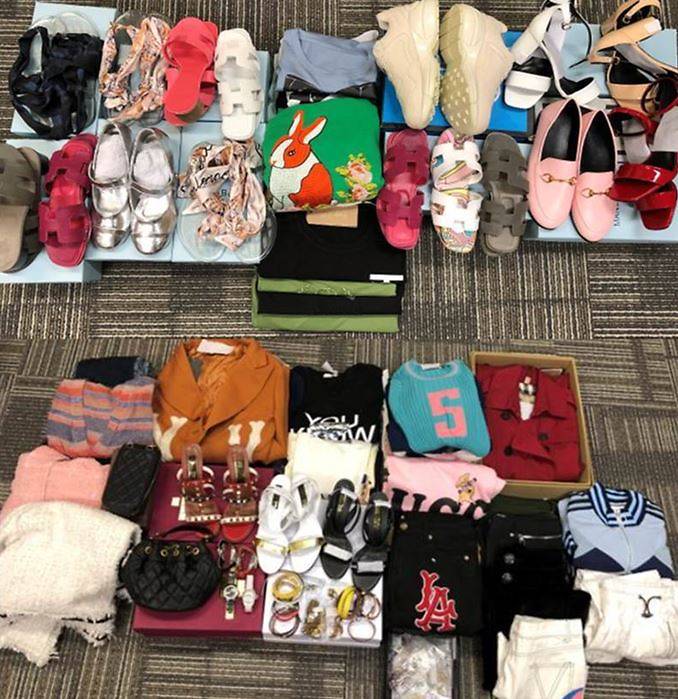
They found 110 counterfeit goods such as clothing, bags, jewellery purportedly from brands such as Valentino, Louis Vuitton, Balenciaga and Gucci.
Counterfeit items seized from Far East Plaza shops. (Photo: Singapore Police Force)
A similar raid at Zhong’s Muses shop uncovered 62 items such as shoes and clothes from purported brands such as Chanel and Gucci.
Wang pleaded guilty on Monday to eight offences under the Trade Marks Act, with her husband Tay admitting to intentionally aiding his wife in the same eight offences. Another 17 charges will be taken into consideration.
Wang’s daughter and son-in-law pleaded guilty to three similar offences with common intention, with another five charges taken into consideration.
The family’s lawyer asked for fines for his clients, saying that the goods were of low value and that their businesses was a genuine one albeit mixed with “infringing articles”.
In response, the prosecutor said the goods had been sold at marked up prices, and that the accused had diverted the sales away from the rightful trademark holders.
All four will return to court for sentencing on Aug 31.
For each count of having fake branded goods in their possession for sale, the accused can be jailed for up to five years, fined up to S$10,000 per item at a cap of S$100,000, or both.
A 20-year-old man was charged in court today (Aug 17) over a case of attempted aggravated outrage of modesty.
The police arrested him on Aug 15, a day after receiving a report from the victim.
A 21-year-old woman said that an unknown man had grabbed her from the back and covered her mouth with a t-shirt at the void deck of Bukit Batok West Avenue 4.
Police officers established the suspect’s identity with the aid of images from CCTVS and police cameras.
If convicted of attempted aggravated outrage of modesty, he will face a jail term of up to 10 years with caning.
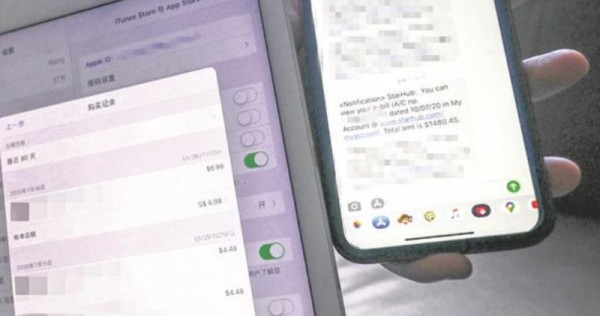
When she checked her July phone bill, a woman was shocked to find that her five-year-old daughter had racked up a $1,500 phone bill within a month.
The single mum in her 30s thought she had ‘child-proofed’ her iPad to prevent such online spending, Lianhe Wanbao reported.
With the device connected to the Wifi network at home, as well as the absence of a SIM card, the expenses puzzled the woman.
She initially thought that there was a mix-up in her Starhub bill, but it turned out that her daughter had made over 200 in-app purchases on an online game platform called Roblox.
Roblox, which allows users to build virtual houses, adopt digital pets and interact with other players, is popular with children under 16. PHOTO: Apple App StoreRecords also showed that amounts between $5 and $8 were spent on each transaction.


.jpg "deekosh-1.jpg")