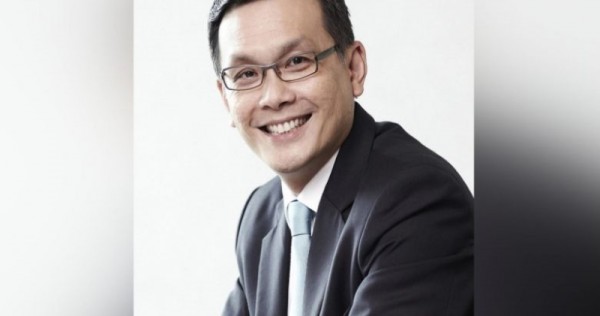
SINGAPORE – Surbana Jurong’s international chief executive officer Teo Eng Cheong has resigned to pursue other interests, said the urban and infrastructure consultancy on Wednesday (Sept 2).
Mr Teo, 54, a former top civil servant, joined Surbana Jurong in January 2016. He is married to Manpower Minister Josephine Teo.
He will leave Surbana Jurong on Sept 30. The company, which is owned by Temasek, Singapore’s investment company, did not say who will succeed him.
Responding to media queries, Surbana Jurong’s group CEO Wong Heang Fine said Mr Teo has been instrumental in driving the company’s business interests in South-east Asia, North Asia and Singapore.
He noted that Mr Teo also helped to set up several of the company’s joint ventures and oversaw its collaboration with China’s Silk Road Fund as a partner to SJ Capital.
In April last year, Surbana Jurong and China’s state-owned Silk Road Fund, which supports the country’s Belt and Road Initiative, inked a co-investment deal to set up a US$500 million (S$681 million) co-investment platform to fund infrastructure projects in South-east Asia.
SINGAPORE: Fifty per cent fewer breeding habitats of dengue-causing Aedes mosquito were found in town council-managed areas in August compared to the month before, said the National Environment Agency (NEA) on Wednesday (Sep 2).
There were 340 dengue clusters reported as of Tuesday, with about 42 per cent of dengue cases in active clusters living in HDB estates managed by town councils, said NEA in a media release.
Eleven more dengue clusters have been closed, including the 202-case cluster at Leicester Road, the 180-case cluster at Bartley Road, as well as the clusters at Dakota Crescent and Cassia Crescent with 162 and 161 cases respectively.
Overall, about 85 per cent (2,052 of 2,392) of the dengue clusters notified since the start of this year have been closed.
The fall in the number of breeding habitats comes after the NEA worked with town councils to step up dengue prevention efforts over an “intensive two-week islandwide exercise” in July.
These efforts include inspections and vector control operations, ensuring drains were well maintained, common areas were kept litter free, and stagnant water was removed or treated.
Where required, NEA also worked with town councils to coordinate chemical treatment such as fogging, misting and larviciding.
The number of clusters with drain cleaning activities has doubled to 213 in August, compared to the previous month. Coordinated fogging activities have also doubled to 37 in the same time period.
“As the number of dengue cases is still high and we are still in the midst of the traditional dengue season, NEA is working with town councils to continue with the momentum of these intensive dengue prevention efforts,” said the agency.
“We have also observed a slower rate of disease transmission at some of the larger dengue clusters, such as the 243-case cluster at Brighton Crescent, with an average of less than one case reported per day in the past two weeks,” added NEA.
But the agency said the total number of dengue clusters islandwide remains high, with large clusters located in these areas:
– Aljunied Road, Geylang Road, and Geylang East Avenue 1 and 2 (368 cases)
– Arnasalam Chetty Road and Kim Yam Road (339 cases)
– Bukit Panjang Ring Road (329 cases)
– Arthur Road (314 cases)
– Aljunied Road, Geylang Road and Guillemard Road (291 cases)
A comprehensive list of clusters can be found on the NEA website.
CASE COUNT “STILL HIGH”
A total of 1,155 dengue cases were reported last week, representing a drop of 133 cases from the week before. The highest weekly case count this year was 1,792, recorded in the week ending Jul 25.
Singapore has seen a surge in dengue infections this year, with the number of cases surpassing the previous record high in 2013. As of Tuesday, 27,663 dengue cases have been reported since the beginning of the year, compared to the record 22,170 in 2013.
The large number of cases has been attributed by experts to warmer weather and rainy days since the beginning of this year as well as the “circuit breaker” period, during which non-essential workplaces and schools were shuttered and people were told to stay home.
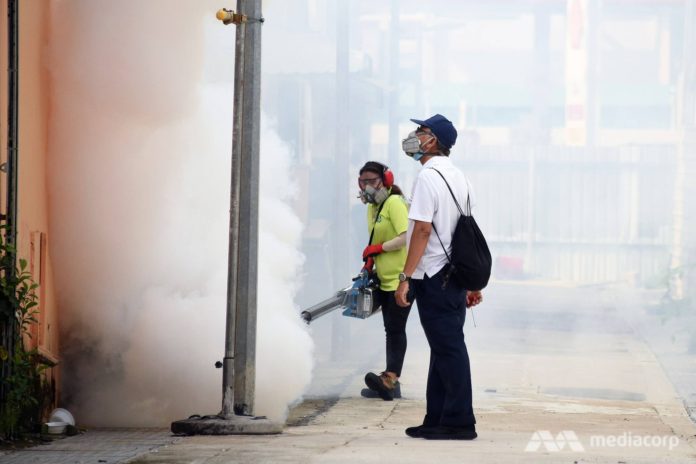
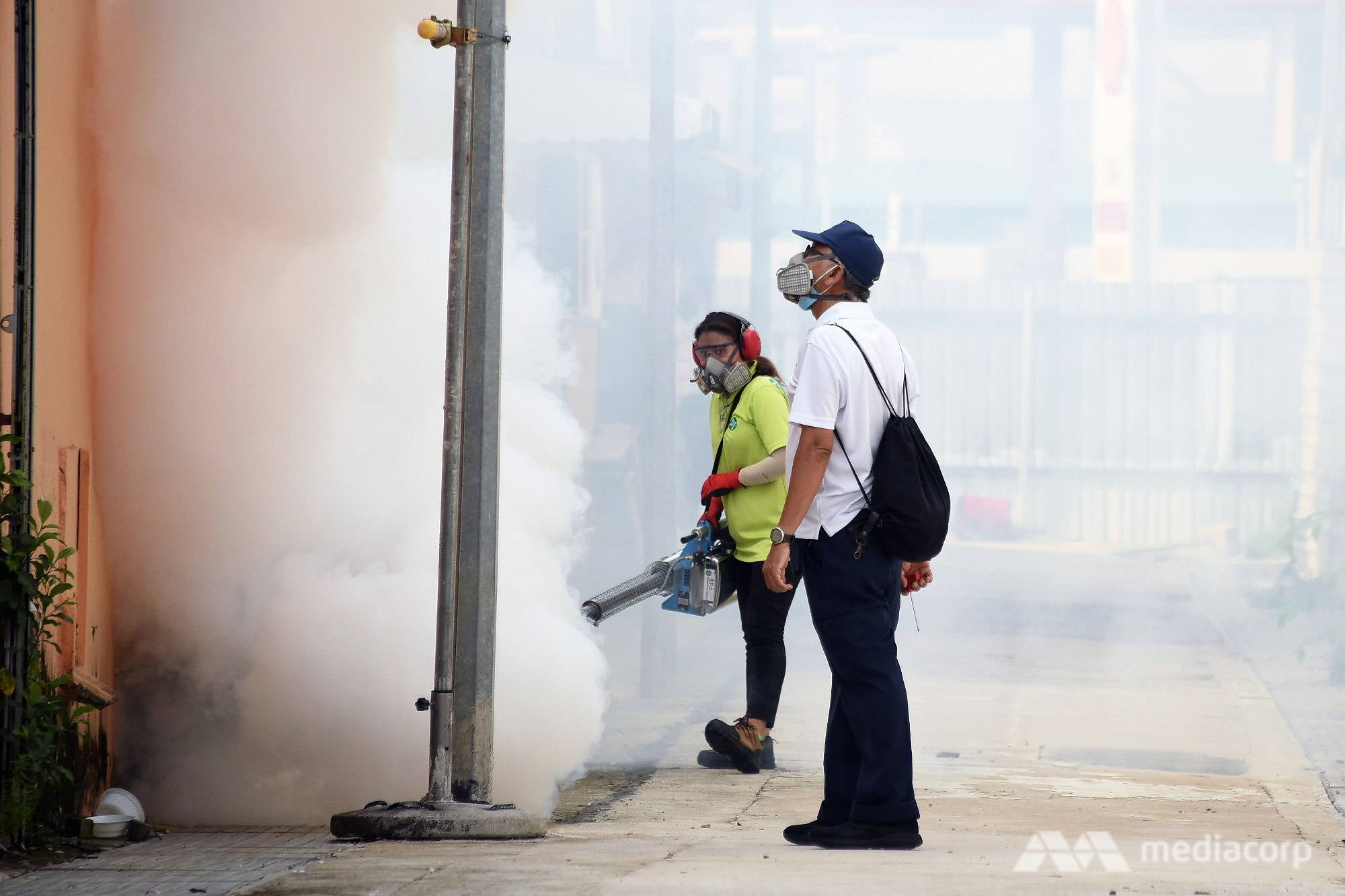
File photo of an NEA officer supervising a fogging operation in Geylang. (Photo: Try Sutrisno Foo)
“ENCOURAGING INITIAL RESULTS”
From January to August, more than 638,000 inspections have been conducted islandwide. Working with other agencies as well as ministries, NEA has distributed more than 215,000 bottles of mosquito repellent to households in active dengue cluster areas.
Since end-June, NEA staff members and volunteers have also reached out to more than 90,000 residents in large dengue cluster areas, with the agency working with grassroots advisers and leaders, as well as community volunteers.
Residents can take steps to protect themselves against mosquito bites, including applying mosquito repellent regularly, wearing long-sleeve tops and long pants, as well as spraying insecticide in dark corners around the home, such as behind curtains and under beds.
“Such protective measures are important given the surge in dengue cases, high mosquito population, and with more people working from home, which also means more blood meals for the day-biting dengue vector, the Aedes mosquito,” said NEA.
Mr Desmond Tan, Minister of State for Sustainability and the Environment, said that following the intensive two-week vector control exercise, the initial results have been “encouraging”, with a reduction in the number of mosquito breeding habitats.
He added: “I hope town councils and community leaders will sustain this momentum to break the dengue transmission chain, and bring the dengue situation under control. NEA will continue to work closely with stakeholders in our fight against dengue.”
Back in the early 2000s, two young female Singaporean singers forged their way to Taiwan — then the capital of Chinese pop music — to try to make their career. One was Stefanie Sun, and the other Stella Ng, who went by her Chinese name Huang Xiangyi.
Then only 19 years old, the pretty baby-faced singer nicknamed Music’s Sweetheart went on to launch three albums, star in several local and Taiwan TV dramas and movies, and also front more than 10 commercials. Karaoke fans of Harlem Yu’s classic hit Qing Fei De Yi might also recognise her as the star in the music video.
After four years as a popular celebrity (more on that later), a stint as a chocolate entrepreneur, and close to 19 years away from Singapore — 16 years in Taiwan and two-and-a-half years in Vancouver, Canada — Stella is now back home in Singapore for the next few years.
SINGAPORE: To make Singapore’s politics work, both the Government and the opposition must share “an overriding objective” to work for Singapore, and not just for their political parties or supporters, said Prime Minister Lee Hsien Loong on Wednesday (Sep 2).
On the Government’s part, it will take an open and constructive approach in the discussion of policies and issues, listening to different voices and perspectives, Mr Lee added.
“We will also make sure that the discussions are supported by facts and logic, and informed by our context and experience,” said Mr Lee in his first speech in Parliament after the People’s Action Party’s (PAP) re-election in July.
Mr Lee’s speech replaces the annual National Day Rally which sets out the Government’s agenda. The Rally was cancelled partly due to COVID-19 restrictions.
During his 90-minute speech in the House, which was followed by exchanges with the Leader of the Opposition and other MPs, Mr Lee spoke about strengthening social safety nets and the review of foreign worker policies.
He also gave an assessment of Singapore’s response to the COVID-19 pandemic, saying the country has done well to stabilise the situation, but that it must learn from errors and do better next time.
BUILDING POLITICAL CONSENSUS
Whether Singapore succeeds in finding the right solutions to issues depends on how well its politics work, said the Prime Minister.
“Singapore has achieved a high degree of political consensus on many of our social and economic issues,” Mr Lee said. “This is one major reason for our rapid progress, and one major benefit of the PAP’s dominant position.”
He acknowledged, however, that each new generation of Singaporeans desires “more diversity, alternative voices, and checks and balances”, adding that the PAP will respond to these social and political trends.
“We have not stayed on top all these years by being static, but by adapting to our evolving society and changing needs,” Mr Lee said.
Singapore’s fourth generation of leaders want to accommodate this growing desire of Singaporeans to not only be heard, but also to be involved, he added.
In Parliament, Mr Lee expects more substantive debate with the opposition, saying that both sides of the House will have to step up. The 14th Parliament has 10 elected opposition Members of Parliament – the largest number in decades – and Workers’ Party chief Pritam Singh has been formally designated the Leader of the Opposition, a first for Singapore.
“PAP Ministers and MPs will have to raise their game, be prepared for sharper questioning and defend the Government’s policies and decisions, while speaking up for their constituents,” said Mr Lee.
“I hope the opposition will also step up. Go beyond asking questions and criticising the Government’s proposals to put up serious proposals and ideas to be examined and debated, to show that they are willing and able to play their part as a loyal opposition.”
Singapore’s Westminster-style democracy is adversarial by design, but the tone of its parliamentary debate is less combative than in the United Kingdom or Australia as its political traditions have developed differently, Mr Lee noted.
“Speeches in the Chamber are more substantive, with less verbal fireworks; The opposition is generally more restrained in its style of questioning,” Mr Lee said.
“I listened carefully to Mr Pritam Singh on Monday, describing how he intends to perform the role of Leader of the Opposition. I applaud his tone and his approach. The Government benches will do our part to work with him, to keep Parliament a constructive forum for debate.”
Leader of the Opposition Pritam Singh speaking in Parliament on Sep 2, 2020.
Even with more opposition Members of Parliament, the tone of political debate should not change for the worse, said Mr Lee.
“We all hope that diversity will make a hundred flowers bloom. But how do we prevent diversity from producing polarisation? How do we make sure that disagreement does not result in paralysis?” he asked, warning that Singapore cannot go down the path of partisanship that other countries have taken.
“Our debate must be based on principles and facts, and guided by shared ideals and goals,” he said.
“At the more fundamental level, to make our politics work, both the Government and opposition must share an overriding objective – to work for Singapore, and not just for our party or our supporters.”
COVID-19: LEARNING FROM MISTAKES
Earlier in his speech, Mr Lee gave an overview of the country’s fight against COVID-19. While acknowledging that Singapore’s response was “not without shortcomings”, he gave the reassurance that the situation has stabilised.
On hindsight, if authorities had known that the virus can spread asymptomatically, Singapore would have done certain things differently, said Mr Lee.
For instance, authorities would have recommended sooner that everyone wears face masks, he said.
“But at the time, we took the best available scientific advice,” Mr Lee added. “Once the WHO recognised that asymptomatic transmission was a major problem, we changed our policy, and distributed facemasks to everyone.”
Singapore has been able to deal with COVID-19 because the public service, the political leadership, businesses and the public have worked closely together, the Prime Minister said.
“Judging by the health outcomes, we have done well, so far. Our fatality rate, and absolute numbers, is one of the lowest in the world. New infections in the community are down to just a handful a day, fewer than 100 patients remain in hospital,” he said.
“This has given us the confidence to reopen our economy and society, gradually and carefully.”
People dine at a hawker centre in Singapore as the country reopens the economy amid the coronavirus disease (COVID-19) outbreak, Jun 19, 2020. (REUTERS/Edgar Su)
But he warned that people should not let their guards down, saying that he recently received an email from an undergraduate who complained that Singapore’s reaction to COVID-19 was “one of the greatest overreactions to a public health issue”.
“The irony is that the more successful we are in keeping cases low, the more people wonder whether all these painful measures are necessary,” said Mr Lee.
“The COVID-19 virus remains as infectious and potent as it was before. This has not changed. What has changed is that we have taken measures and we have built up our capabilities to contain it,” he said.
“If we relax these measures now because the numbers have come down, we will have a resurgence,just look at Europe and many other places in the world.”
Looking ahead, Mr Lee said that COVID-19 will not be Singapore’s last public health crisis.
“Scientists talk about Disease X being overdue – a new disease, unknown, that is highly infectious, deadly, and mutates easily. So when COVID-19 appeared, people asked whether this was Disease X.
“COVID-19 has been a disaster for the world, but it is not Disease X. It is, by far, not the worstdisease that can befall humankind. But it is only a matter of time before Disease X happens,” he said.
Singapore needs to learn from the COVID-19 crisis, so that it will be prepared when Disease X does come one day, he said.
KEEPING AN OPEN MIND ON SOCIAL SAFETY NETS
Tracing how Singapore has strengthened its social safety nets over the years as the country develops, Mr Lee said that these “peacetime measures” were not enough when COVID-19 hit.
Measures were then put in place, which included the Jobs Support Scheme (JSS), Self-Employed Income Relief Scheme (SIRS), COVID-19 Support Grant and the Jobs Growth Incentive.
“These emergency measures are crucial for now, but they cannot continue indefinitely. We have to start thinking about the level of social support we will return to, when COVID-19 is over,” he said.
“The Government is not ideologically opposed to any proposed solution,” Mr Lee said.
“Our approach has always been pragmatic and empirical – make the best use of our resources to meet the needs of different groups in our society, in a targeted manner. Because if we help everyone equally, then we are not giving more help to those who need it most.”
Prime Minister Lee Hsien Loong speaking in Parliament on Sep 2, 2020.
Mr Lee said greater challenges lie ahead, adding that more economic uncertainty is expected while noting longer-term issues like an ageing population and rising healthcare costs.
“We need to do more, and we are ready to do more,” he said. “The question is: What more will we need to do?”
“We should take some time to assess the landscape after COVID-19, to see how things unfold, and what specific problems develop. We must keep an open mind, as we build and improve on the systems we have, and consider solutions that can work in our context.
“It is not just floating ideas like minimum wage or unemployment insurance, but assessing their impact carefully.”
What remains unchanged is that the programmes should be fiscally sustainable, and as a matter of principle, the social safety nets should be paid for out of current revenues.
“Now the opposition says: Show me how much we have in the reserves, before I decide whether I support your Budget and tax plans – let’s have a look at the money. Basically they are asking: I have something in the bank already. How much of that can I touch?” he said.
“This was not the attitude of our forefathers – the founders who were building for the future. But the attitude of inheritors – who think they have come into a fortune, and want to consume the fruits of their predecessors’ labours. This is fundamentally the wrong approach.”
The current generation of Singaporeans should not think of themselves as “inheritors spending what they have been lucky enough to be endowed with”, but they should take the attitude of founders for the future generations, he said.
“Whatever reserves we have, big or small, let us not think of touching them in normal times … Every year, we live within our means; and whenever we are able to, we add a bit more to the rainy day fund, to make ourselves a bit more secure for when it really pours.”
ADJUSTING FOREIGN WORKER POLICY
Addressing a hot button issue, Mr Lee said that Singapore will review its foreign worker policies to safeguard Singaporean jobs, but it should not give the wrong impression that it is closing its doors to the world.
“Singapore has succeeded by being an international hub, tapping talents worldwide, and serving a global market. So even as we adjust our work pass policies, we must be careful not to give the wrong impression that we are now closing up, and no longer welcoming foreigners.
“Such a reputation would do us great harm,” he said.
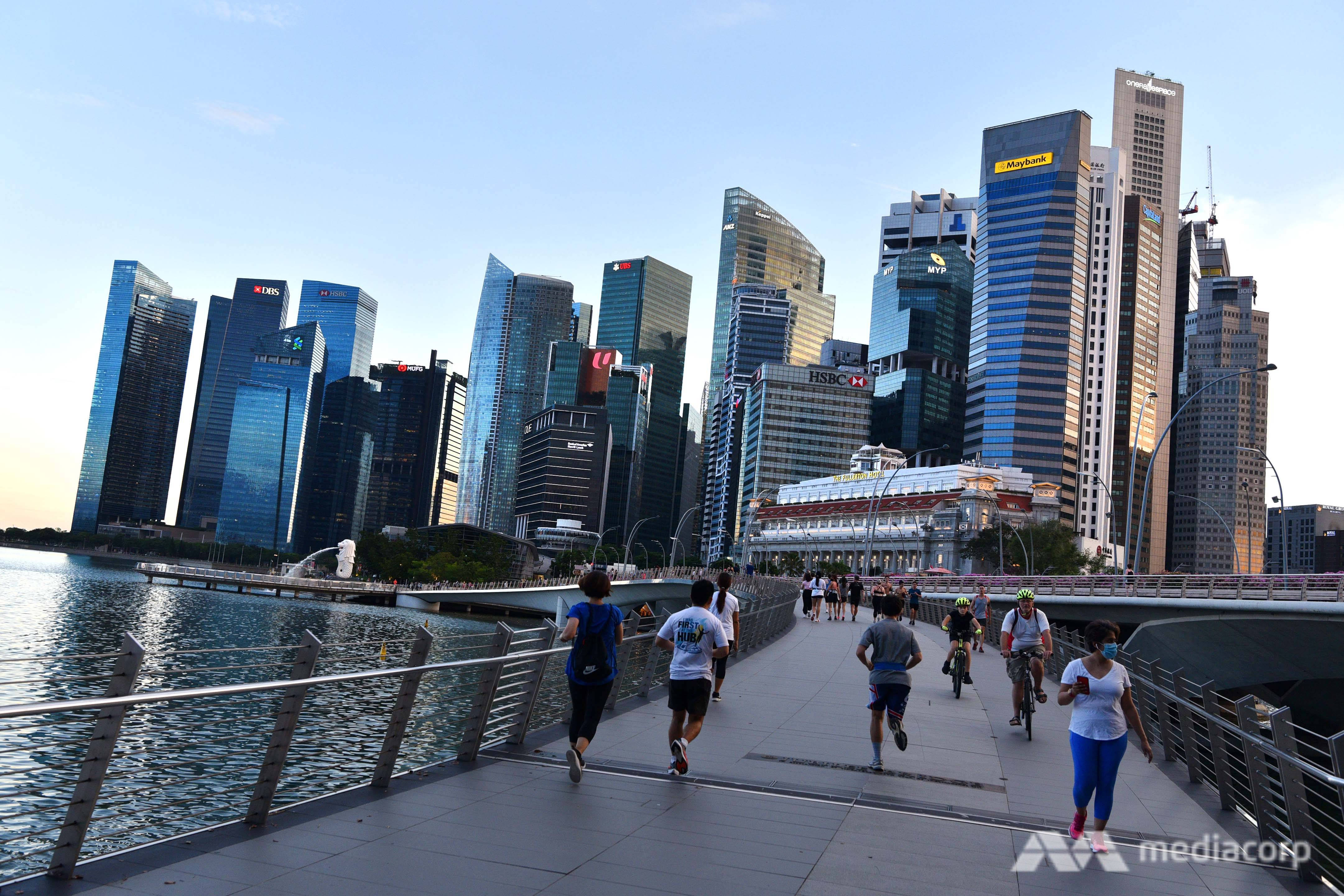
The Singapore city skyline as seen from Jubilee Bridge (Photo: Jeremy Long)
Last week, the Manpower Ministry announced that it is raising the minimum qualifying salaries for Employment Passes and S Passes, and tightened measures to ensure that companies give Singaporeans fair consideration for employment. Mr Lee raised this as an example of how the Government has paid attention to market conditions and adjusting its policies.
“The Government will always be on the side of Singaporeans. What is the point of creating jobs for foreigners, if it does not benefit Singaporeans? Why would we want to do that?” he said.
“Ultimately, our aim is to grow our economy, create good jobs for Singaporeans and raise our standards of living. Foreign workers and work pass holders help us to achieve this. By being open to talent from all over the world, we create more opportunities for ourselves.”
As societies in other countries experience stress, investors are already looking for an alternative “safe harbour” where they can move their operations, said Mr Lee.
“We take no joy in the troubles in the world, but it is a fact that in a troubled world, Singapore is one of the few trusted countries that stands out,” he added.
Mr Lee revealed that a pharmaceutical company is planning to build a facility in Singapore to manufacture vaccines, and a company specialising in pandemic risk insurance wants to set up shop here. “Do we want to turn them away?” he said.
Mr Lee stressed that companies that move here will create good jobs for Singapore, but they must also feel welcome and be allowed to bring in the talent they need.
Singapore companies, on the other hand, also need global talent to grow and develop, he pointed out.
“We may be under stress now, but we cannot afford to turn inwards. We will adjust our policies to safeguard Singaporean jobs, but let us show confidence that Singaporeans can hold our own in the world,” he said.
POLITICS & GOVERNMENT IN SINGAPORE IS “UNIQUE”
Mr Lee spent a large part of his speech on the importance of politics and governance, concluding that how politics and government work in Singapore is “quite unique”.
Singapore has put enormous emphasis on the quality of government – the public service as well as the political leadership,and it has the trust and support of Singaporeans, he said.
He recounted what Mr Jean-Claude Juncker, who was prime minister of Luxembourg and later president of the European Commission, said to him: “We all know what to do, we just don’t know how to get re-elected after we’ve done it.”
Mr Lee told the House: “But in Singapore the PAP government has been able to do the right thing for Singaporeans – sometimes difficult and hard things – and still get re-elected.”
He added: “We have no incentive to kick the can down the road, because down the road, we will very likely meet the can ourselves again.”
The Government has thus been able to make long-term plans for the next 50 to even 100 years and the country progresses, he said.
“It is a virtuous, self-reinforcing cycle. This model has worked well for Singapore: Once broken, it will be very difficult to put back together again,” said the Prime Minister.
He asked if Singapore can continue to work like this, and if the country can keep its focus on the long term, with more diversity and contestation.
“At what point does a vote for a strong opposition become a vote for a different government? Is it really true that one day if there is a change of government, a new party can run Singapore equally well, because we have such a good public service, as Mr Pritam Singh suggested on Monday?”
But he concluded that these questions had no easy answer.
“Each successive generation of Singaporeans has to keep on doing its best to keep the system working right,” he said.
“The PAP feels acutely its special responsibility to keep on doing its best for Singapore, and keep Singapore working in this unique way. That is our sacred mission.”
SO WHAT NOW?
Rallying Singaporeans amid challenging times, Mr Lee said that Singapore should “fight COVID-19 with hope in our hearts”.
There is a silver lining, he said: “This searing experience will help a whole new generation of Singaporeans appreciate, treasure what we have, and what makes us an exceptional nation.
“We are here by dint of will and imagination. In defiance of all the odds and of those who said we wouldn’t make it, we did.”
As in previous crises, Singapore will do better, emerge stronger and become more united, he said.
“Do not doubt. Do not fear. Jewel will shine again. Changi will thrive again. SIA will be a great way to fly once more,” he added.
“Our economy will prosper anew. Our children and our grandchildren will continue marching forward to build a fairer, ever more just and equal society.”
SINGAPORE – Singapore has done well in handling the coronavirus pandemic so far in terms of health outcomes, though its response was not without shortcomings, said Prime Minister Lee Hsien Loong.
Joining the debate on the President’s Address in Parliament on Wednesday (Sept 2), he noted that the country’s fatality rate is one of the lowest in the world, with new infections in the community down to just a handful a day and fewer than 100 patients remaining in hospitals.
With hindsight, the Government would have done some things differently, he said.
Had it known earlier that Covid-19 patients were asymptomatic, the Government would have quarantined all Singaporeans who were brought back home from abroad in March, instead of only those returning from certain countries.
He added that they would have also been tested before being released from quarantine, even if they did not show any symptoms, instead of assuming that no symptoms meant no infection.
A 41-year-old man was arrested yesterday (Sept 1) for allegedly stealing a private bus, the police said in a press release today.
The police were first notified on Aug 28 after the victim noticed his bus was missing from where it was parked in a carpark along Woodlands road.
Officers from Woodlands Police Division and Jurong Police Division established the identity of the suspect through ground enquiries, with the aid of images from police and CCTV cameras.
Following his arrest, the man will be charged in court tomorrow with the offence of theft of motor vehicle.
If found guilty, he will face a jail term of up to seven years and a fine.
The police reminded the public to park their vehicles in well-lit areas, as well as install an anti-theft alarm system to deter vehicle-related crimes from happening.
Vehicle owners are also advised to remove the ignition key and lock their vehicles whenever they are left unattended.
SINGAPORE: Singapore has done well in the fight against COVID-19 and stabilised the situation, but it must learn from its errors and do better next time, Prime Minister Lee Hsien Loong said in Parliament on Wednesday (Sep 2).
“Judging by the health outcomes, we have done well, so far,” Mr Lee said, noting that Singapore’s fatality rate from COVID-19 is one of the lowest in the world, with new infections down to “just a handful” per day and fewer than 100 patients remaining in hospital.
But Mr Lee said Singapore’s COVID-19 response “was not without shortcomings”, adding that the pandemic has severely tested every government in the world and that no country has been perfect.
“With hindsight, we would certainly have done some things differently,” he said.
“For example, I wish we had known earlier that people with COVID-19 were infectious even when they were asymptomatic,” Mr Lee said.
“Then when we brought Singaporeans back home from all over the world in March, we would have quarantined all of them earlier, instead of only those returning from certain countries, so that the virus did not spread to their family members, colleagues and friends.
“And we would have tested all of them before releasing them from quarantine, whether or not they showed any symptoms, instead of assuming that no symptoms meant no infection.”
Prime Minister Lee Hsien Loong speaking in Parliament on Sep 2, 2020.
Mr Lee said the Government would have recommended everyone to wear face masks sooner than it did, but it had taken the “best available scientific advice” at the time.
“Once the World Health Organization recognised that asymptomatic transmission was a major problem, we changed our policy, and distributed face masks to everyone,” he said.
The Prime Minister said the Government would also have acted “more aggressively and sooner” on the migrant worker dormitories, stressing that it knew communal living in the dormitories posed an infection risk.
“Communal living in any form poses risks – on board ships, in army camps, student hostels, nursing homes,” he said. “We stepped up precautions. For a time, these seemed adequate. But then bigger clusters broke out in the dorms, which threatened to overwhelm us.”
“WISDOM AFTER THE FACT”
Mr Lee said all these were “wisdom after the fact”, adding that Singapore must “learn from these errors” and do better next time.
“But in the fog of war, it is not possible always to make the perfect decisions,” he added.
“Yet we have to decide and move. We cannot afford to wait. The key is to watch things closely, learn from experience, and adapt our responses promptly as new information emerges and as the situation changes.”
Mr Lee said the scale and complexity of Singapore’s COVID-19 response meant “there have inevitably been some rough edges”.
On the resumption of work for migrant workers, Mr Lee acknowledged that the Government has made things “more difficult and burdensome” for employers, especially contractors.
“They have found it frustrating to deal with all the new rules, approvals and inspections, even as they try to get their businesses up and running again,” he said.
“But I hope they understand that we are doing our best to smooth things out for them, and are doing all this in order to keep our people safe.
“It is better that we make these measures work and get businesses to operate safely, than to suffer a new outbreak and have to shut down again.”
COVID-19 has caused “massive upheaval in our lives”, and that the Government’s overriding consideration from the start was protecting the lives of Singaporeans.
“Many countries talked about flattening the infection curve, or letting the disease burn through the population until herd immunity developed,” Mr Lee said.
“But that would have meant many Singaporeans getting ill, and perhaps thousands dying, especially the old and vulnerable. We were determined right from the very beginning not to go down that route. We did our utmost to contain the outbreak to keep Singaporeans safe.”
This included mobilising all of Singapore’s resources, including building up contact tracing and testing capabilities, expanding its healthcare system significantly, and mobilising the Home Team and Singapore Armed Forces (SAF) to help in dormitories.
Implementing the circuit breaker was a “very big move”, and it demanded “major sacrifices” from Singaporeans, the Prime Minister said.
“But Cabinet decided we had to go ahead, to slow down the infection rate, and get things firmly under control, buy us time. Fortunately, we timed the circuit breaker right, and luckily, it worked.”
Prime Minister Lee Hsien Loong speaking in Parliament on Sep 2, 2020.
Mr Lee said Singapore has been able to deal with COVID-19 only because the public service, political leadership, businesses and the public have worked together and played their part.
For instance, he said officials, ministries and agencies have worked tirelessly to build new capabilities on the fly, and stepped up to do things beyond their normal scale or scope.
Political leaders defined priorities, made major decisions, directed civil servants ro implement these decisions, won public support for the measures and took responsibility for them, he said.
This included whether to impose a circuit breaker, what activities to restrict, which businesses to keep open, whether to close and re-open schools.
“Businesses … put their people to work furiously on solutions, often going well beyond their business mission,” Mr Lee added.
“They set up mask production lines, constructed Community Care Facilities, built up testing capacity, scoured the world for test equipment, test kits and reagents, and designed booths to swab patients safely and much more.”
Mr Lee said the overall COVID-19 response depended “critically” on Singaporeans working together and trusting the Government, adding that he was grateful for their cooperation, which will remain crucial as the fight goes on.
“Many Singaporeans’ lives have been severely affected, but they have borne these difficulties calmly and stoically,” he said. “Many volunteered to take part in the COVID-19 operations, sometimes on the frontline and also in community efforts to help others through these tough times.”
COVID-19 AND DISEASE X
Mr Lee said while the COVID-19 situation is currently stable, Singapore must not let its guard down, citing a recent survey that showed that almost half of the respondents were weary of safety measures.
“The irony is the more successful we are in keeping cases low, the more people wonder whether all these painful measures are necessary,” he said.
Mr Lee said the COVID-19 virus remains as infectious and potent as before, noting that what has changed are the measures and built up capabilities developed to contain it.
“If we relax these measures now because the numbers have come down, we will have a resurgence,” he added. “Just look at Europe and many other places in the world.”
Mr Lee said COVID-19 will not be Singapore’s last public health crisis, describing how scientists talk about “Disease X” – a new disease that is unknown, highly infectious, deadly and mutates easily.
“So when COVID-19 appeared, people asked whether this was Disease X,” he said. “COVID-19 has been a disaster for the world, but it is not Disease X. It is not the worst new disease that can befall humankind.”
Mr Lee said it is only a matter of time before Disease X happens, adding that Singapore must learn from COVID-19 and how it deals with a pandemic, to “be as ready as we can”.
“We should build up our resilience, instincts and preparations. So that when Disease X does come one day, we will be prepared,” he stated.
Nevertheless, Mr Lee said Singapore must “rethink and reinvent” to continue to be successful in a post-COVID-19 world, pointing to areas like social safety nets, foreign workers and politics.
“Even as we manage the immediate situation, we must look forward, and prepare for life after COVID-19,” he said.
Prime Minister Lee Hsien Loong will deliver a speech in Parliament regarding Singapore’s response to the pandemic and how we are preparing for life beyond Covid-19 today (Sept 2).
The speech will be streamed live at 3.30pm on PM Lee’s Facebook page and on CNA.
PM Lee had said in a press conference on July 25 that he would be making a “major speech” in Parliament instead of having a National Day Rally.
“Because it’s not possible to convene a physical National Day rally and have a traditional event, with an audience in front of me and I can take them through slides and extend explanations and recount stories,” he said.
“So instead of that, I shall do it in Parliament. And we will have a serious debate there.”
The National Day Rally, which covers Singapore’s key challenges and important announcements, has been delivered annually since 1966.
Aztech’s Mega Warehouse Sale is happening from 1st – 6th Sept!
Enjoy incredible savings up to 70% off on more than 70+ products, including smart home gadgets, networking and wifi mesh systems, kitchen appliances and more!


.jpg "20200902_ln_huohuan-1.jpg")
.jpg "20200209_bus-1.jpg")