Home Blog Page 103

About 10% of construction sites inspected since June found with ‘shortcomings’ in safe management measures: BCA

0

SINGAPORE: About 10 per cent of the more than 2,500 construction sites inspected since June have had to step up safety measures against COVID-19 after “shortcomings” were found, said the Building and Construction Authority (BCA).

“We have conducted follow-up inspections to ensure that the builders have made the necessary improvements,” BCA told CNA on Sep 4.

“Some of the improvements include dividing the work zones into smaller ones for better segregation, staggered timings for movement at common access areas, dedicated rest areas and toilets for work zones or to have staggered timings for their usage.”

BCA said it has been conducting an average of 300 inspections a week since June.

Construction site, workers in Singapore amid COVID-19 (2)

Work sites in the early stages of building require fewer sub-contractors and thus fewer designated work zones. (Photo: Cheryl Lin) 

Although the agency noted that the overall number of shortcomings has fallen over time, it said it will step up checks.

“BCA will step up the frequency of inspections, depending on findings from initial inspections and the risk profile of each site, to ensure that work sites continue to implement and practise safe management measures,” it added.

NEW NORMAL AT WORK SITES

Safe management measures such as installing contact tracing apps, having sanitiser stations and implementing several rounds of disinfecting at common areas daily are needed for construction sites to be allowed to resume work.

Cohorting workers has proven to be the most challenging requirement, according to one builder working on a site for an executive condominium in the north of Singapore.

To avoid mixing on-site, workers from different sub-contractors are assigned separate zones – delineated with neon yellow railings – and they must scan contact tracing QR codes whenever they enter or leave these areas. 

Construction site, workers in Singapore amid COVID-19 (1)

Rails and signs mark the borders of different work zones at a construction site in Sembawang. (Photo: Cheryl Lin) 

The letters of their zones are also emblazoned across their helmets to make sure any “trespassers” will be quickly spotted.

“If other sub-contractors are zone A and they come to zone B, that’s not allowed … and if I see anyone coming, I must inform my supervisor immediately,” said Ramaiah Senthil, a worker with Straits Construction.

When it comes to staggered break times, workers are put in separate rest areas where there are makeshift “cubicles” comprising boarded-up tables and benches.

After each group’s turn, the area is put through a thorough disinfection.

When the day is done, some workers travel in dedicated buses straight back to their dormitories. Others live on-site in temporary living quarters, such as a former site office for the project.

It takes weeks of planning to put these measures in place, according to Mr Don Wilson Paua, a senior manager for workplace safety for the firm.

“It’s very challenging with the limitations on workers’ movements and having to observe all the safe distancing measures.

“It has become a new norm that everything has to be planned out in advance so works can go smoothly,” said Mr Paua.

Implementing the measures means building activity at the site is currently only at 60 per cent of what it could have been pre-pandemic, according to the firm’s chief operating officer Kenneth Loo.

READ: New MOM division to provide support to migrant workers, dormitory operators

When asked about the costs of putting these safe management measures in place, Mr Loo said: “The partition and sanitiser costs are not a big cost compared to the loss in productivity and the labour costs that we will be up with going forward.

“With more zones, your work process will actually be slower, because you can’t do a lot of things concurrently so the impact of cost is actually much higher.”

Mr Loo also said projects could be delayed by at least six months, given the “circuit breaker” time-out and the time needed to gear up to the current stage of work.

READ: How MOM’s new ACE Group intends to fight COVID-19 infections at previously cleared dormitories

But it could get worse if more dormitory clusters re-emerge, he said.

“Once there is a case (in a dormitory), they will lock down the whole block. It may not be my workers that are infected, but if they are staying there, they are also implicated.”

COURSE FOR SAFE MANAGEMENT OFFICERS

Mr Paua and Mr Loo are among those from the company who have undergone a BCA course to train safe management officers tasked with implementing measures on site to prevent the spread of COVID-19.

According to BCA, about 50,000 people have completed the course.

“This is far more than the number of SMOs (safe management officers) required for the industry, which is just one per worksite,” said BCA.

“We understand that many participants, though not appointed as SMOs or Safe Distancing Officers for their worksites, had attended the course to better understand the safe management measures to be implemented for their construction projects,” it added.

“This is an encouraging indication of the industry taking the safe management measures seriously.
Source link

3 places at Nanyang Technological University visited by COVID-19 cases while infectious

0

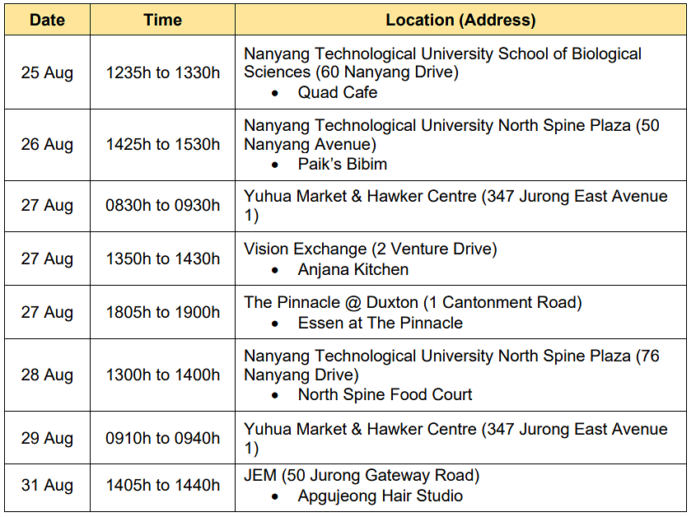
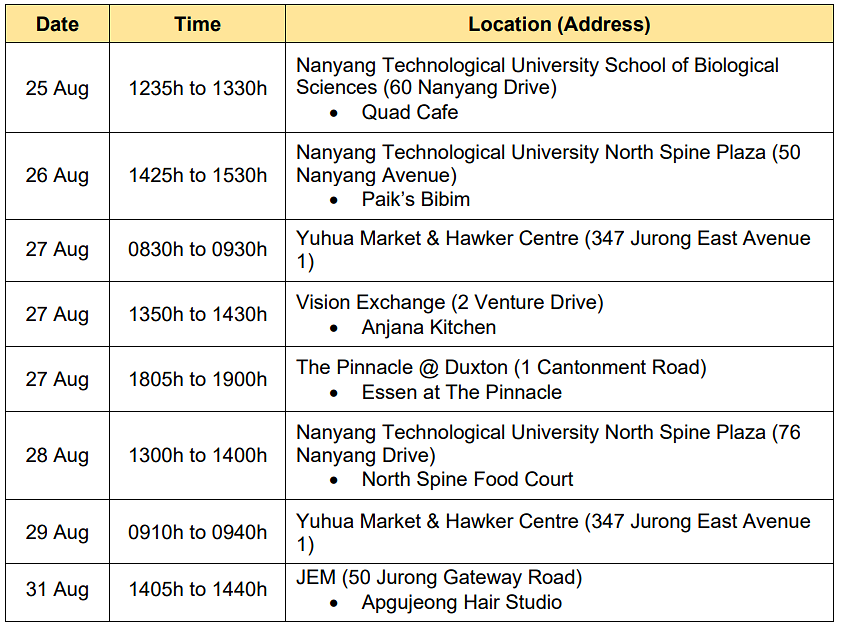
SINGAPORE: Three locations at Nanyang Technological University (NTU) have been added to the list of public places visited by COVID-19 cases in the community during their infectious period, said the Ministry of Health on Tuesday (Sep 8). 

Two of the NTU locations are eateries at the university’s North Spine Plaza – the food court there and Paik’s Bibim. The third location is also a food establishment, Quad Cafe at the NTU School of Biological Sciences.

Other places in Tuesday’s list include Apgujeong Hair Studio at JEM and Vision Exchange at 2 Venture Drive.

Pinnacle@Duxton was also added to the list, while Yuhua Market & Hawker Centre appeared twice.

The new locations are as follows:

MOH new locations Sep 8

MAP: All the places that COVID-19 community cases visited while they were infectious

Those who have been identified as close contacts of confirmed cases would already have been notified by MOH.

As a precautionary measure, individuals who were at those locations during the specified timings should monitor their health closely for 14 days from their date of visit, said MOH.

“They should see a doctor promptly if they develop symptoms of acute respiratory infection (such as cough, sore throat and runny nose), as well as fever and loss of taste or smell, and inform the doctor of their exposure history,” it added.

The ministry said there is no need for people to avoid places that have been frequented by COVID-19 cases and that the National Environment Agency will engage the management of the affected premises to provide guidance on cleaning and disinfection.

Singapore reported 47 new COVID-19 cases as of noon on Tuesday, including one imported case and none in the community.

BOOKMARK THIS: Our comprehensive coverage of the coronavirus outbreak and its developments

Download our app or subscribe to our Telegram channel for the latest updates on the coronavirus outbreak: https://cna.asia/telegram

Source link

Bollards installed at Tampines block after woman seen parking Audi at void deck

0

[ad_1]

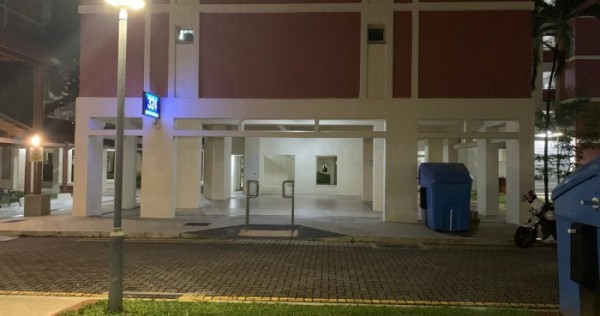
Tampines Town Council has installed bollards by a ramp at a Housing Board (HDB) block to prevent vehicles from passing through while still allowing wheelchair access.

This comes after a Stomp report on August 24, where a woman was seen parking her Audi at the void deck of Block 324 Tampines Street 32.

A Stomp contributor said that his father had tried to advise the woman, but she allegedly retorted that that’s what the ramp at the block was for.

On Friday (Sept 4), he updated Stomp about how P-bollards have been installed at the foot of the block.

He added: “At least the void deck is safe from being used as a parking lot.”

[ad_2]

Source link

This made my day: Hawker in Chinatown helps shell cockles for elderly customer with stiff joints

0

[ad_1]

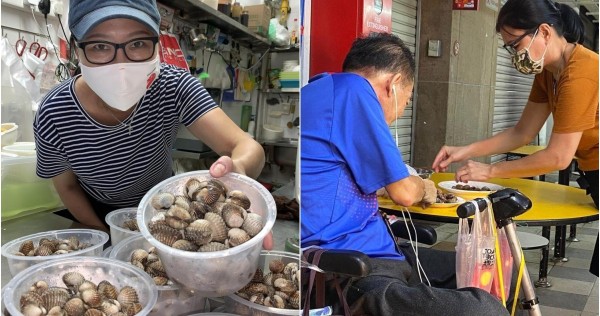
With stiff joints in his hands, one wheelchair-bound elderly man would’ve found it difficult to indulge in a bowl of blood cockles, had it not been for the stall owner taking time out to shell each one for him.

The touching scene, which warmed the cockles of many hearts, was captured by reader a few days ago at People’s Park Food Centre in Chinatown, Shin Min Daily News reported.

The owner in question, 52-year-old Pat Phua, runs Super Star No1 Penang Assam Laksa.

According to Phua, the man, who appeared to be in his 70s, had visited her stall twice in the past week, and both times she’d help to shell the cockles for him.

“If memory serves me right, this uncle actually came by quite a while ago, but because I was too busy I wasn’t able to help him. He didn’t say anything either,” she told the Chinese daily.

[ad_2]

Source link

Changi Airport Facebook page bombarded with angry comments against CAG chairman Liew Mun Leong

0

[ad_1]

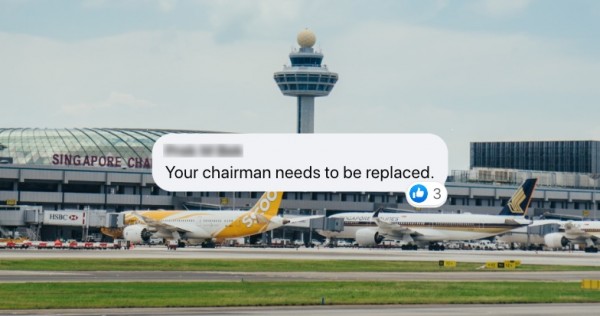
Netizens have been up in arms against Changi Airport Group (CAG) chairman Liew Mun Leong and his family since their former domestic helper was acquitted of stealing over $34,000 worth of items from their household after a four-year legal battle. 

The backlash has since found its way onto the Facebook page of Changi Airport itself, even on innocuous posts that are trying to promote shopping deals. 

Parti Liyani, 46, was accused by her former employers of theft and was found guilty in March 2019, leaving her with a jail sentence of two years and two months. 

She appealed the judgement and was eventually acquitted by High Court judge Chan Seng Onn, who noted that the Liew family had “improper motives” and found the testimony of Karl Liew, Liew Mun Leong’s son, “highly suspect”. The judge noted that there is reason to believe that the affluent family took steps to prevent her from lodging a complaint to the Ministry of Manpower for illegal deployment. 

[ad_2]

Source link

Man left with 11cm cut after Waterway Point seat collapses under him and 1-year-old daughter

0

[ad_1]

Finding an empty seat in Singapore’s malls is like finding an oasis in a desert. But one shopper was in for a rude shock when the seat he’d found fell apart the moment he sat on it.

He was left with an 11cm-long wound on his leg after a wooden seat collapsed at Waterway Point on Thursday (Sept 3) evening, the mall confirmed.

Sharing pictures of his injuries and the seat in question on Facebook the same day, the victim, Victor Tan, urged those who visit the mall to take note of the potential hazard.

“This sitting platform (without the ‘Do Not Sit’ social distancing sticker) collapsed the moment I sat on it with my daughter. I’m 70 plus kg and she’s 11kg,” he wrote.

“This could have resulted in more serious injuries or even fatal ones especially for the elderly,” Tan said, adding in a comment that he often sees elderly shoppers resting on similar seats at the mall.

[ad_2]

Source link

Yishun residents to get new integrated development with swimming pools, hawker centre in 2027

0

[ad_1]

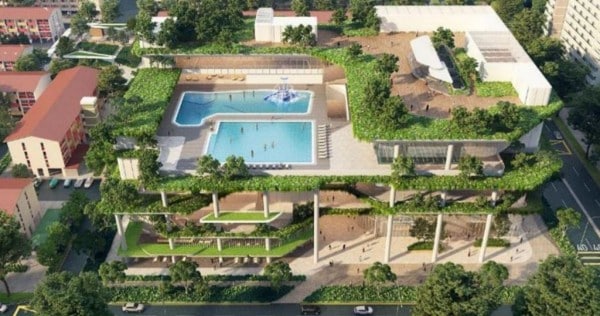
SINGAPORE – Yishun residents can look forward to a new integrated development at Chong Pang City that will have swimming pools, a gym and fitness studios, as well as an upgraded hawker centre and community club.

The construction of the 0.9ha development is slated to be completed in 2027.

The multi-storey development, which will be tentatively named Chill @ Chong Pang, will be located at the site of Chong Pang Community Club in Yishun Ring Road and Block 102 Yishun Avenue 5, a commercial Housing Board block. It will also have space for commercial shops.

Hawkers and stallholders from the existing Chong Pang Market and Food Centre, which was built in 1984 and upgraded in 2003, will be able to relocate to the new integrated development when it is ready, said the Singapore Land Authority (SLA), the People’s Association, National Environment Agency and Sport Singapore in a joint media release on Tuesday (Sept 8).

The existing hawker centre, when vacated, will be redeveloped into a community plaza by 2028. There are currently a total of 179 stalls in the market and hawker centre, comprising 56 cooked food stalls and 123 market stalls.

[ad_2]

Source link

How Singapore’s prisons are taking precautions against COVID-19

0

SINGAPORE: Yusuf (not his real name), an inmate at Changi Prison Complex, first found out about the COVID-19 pandemic through the newspapers. 

He started asking prison staff about the health crisis, and as it worsened, officers began briefing inmates on safety measures once every two weeks.

The 37-year-old, who is behind bars for drug-related offences, said he was worried about catching the coronavirus initially, but felt reassured when precautions were tightened at the start of the two-month “circuit breaker” period in April.

“Before the pandemic and during the pandemic, there is a lot of difference,” he said.

“Everywhere we go, we need to wear masks. Only inside the room (cell), we don’t need to wear a mask.

“(There is) social distancing during our recreation time, even in our yard … For Muslims, we also keep a distance of more than a metre (during prayers).”

How Singapore's prisons are keeping COVID-19 at bay (2)

Inmates wear masks at all times with their temperatures taken twice daily. (Photo: Singapore Prison Service)

WATCH: COVID-19 measures in Changi Prison keep inmates safe from transmissions

Measures like these were put in place to protect the nearly 11,000 inmates at Changi Prison Complex, which was linked to six COVID-19 cases between late April and early August.

New inmates are segregated for 14 days before they are allowed to join the general inmate population. They are swabbed for COVID-19 at the start and end of their segregation period.

When an inmate tests positive, he or she is isolated, and the prisons will conduct contact tracing.

So far, five confirmed cases have been detected through these measures.

READ: Singapore reports 142 new COVID-19 cases, including prison inmate on social visit pass

Those who were close contacts were tested for COVID-19 – and all of them tested negative, according to the Singapore Prison Service.

Second superintendent (SUPT) Luke Leong at Institution B2 of Changi Prison Complex said: “The cases that we have come across in prisons, which have been reported, they have all been isolated cases and they are unlinked from each other.”

“They are unlikely to have been contracted within prisons or have spread within prisons.”

How Singapore's prisons are keeping COVID-19 at bay (8)

Newly admitted inmates are swabbed before and after their segregation period. (Photo: Singapore Prison Service)

The prisons are also keeping tight controls on the numbers allowed in living and work spaces.

At the remand prison, cells are designed to house up to four inmates each, a rule that is strictly adhered to, according to SUPT Leong.

“There are other prisons, some of which may be designed to house up to eight inmates per cell, some of which will be designed to house up to one inmate per cell,” said SUPT Leong.

“Regardless, we never go beyond the design capacity of the cell, and we will never house more inmates in a cell than what it is designed for.”

One staff nurse also tested positive, although it is unclear how the nurse contracted the virus.

READ: Three inmates, one nurse at Changi Prison tested positive for COVID-19 between April and May: SPS

PRECAUTIONS TAKEN BY PRISON STAFF

Prison staff put on personal protective equipment when interacting with suspected cases, and wear masks at all times.

They also take their temperatures twice daily and are told not to report to work if they feel unwell.

Since July, the prisons have been progressively swabbing staff who have been in contact with confirmed cases.

How Singapore's prisons are keeping COVID-19 at bay (5)

Swabbing for high-risk staff began in July. (Photo: Singapore Prison Service)

How Singapore's prisons are keeping COVID-19 at bay (4)

Prison staff wear masks at all times and take their temperatures twice daily. (Photo: Singapore Prison Service)

While Yusuf feels safe in prison, the father of three said his biggest fear now is his family contracting COVID-19 outside.

Visits were stopped during the circuit breaker, but family members were able to stay in touch through 15-minute phone calls.

“The phone calls really got us together,” said his sister Farah (not her real name).

“Especially for my father who is bedridden, he still had the opportunity to talk to my brother, so this is … I’m really grateful.”

In-person visits resumed in August, with the usual precautions in place.

How Singapore's prisons are keeping COVID-19 at bay (1)

Visitors at Changi Prison Complex have to comply with safe management measures such as SafeEntry check-in and temperature taking. (Photo: Singapore Prison Service)

How Singapore's prisons are keeping COVID-19 at bay (6)

Farah and Yusuf met for the first time in four months after face-to-face visits resumed on Aug 1. (Photo: Singapore Prison Service)

Visitors have to stick to allotted time slots and each visit lasts 20 minutes.

Cleaning is carried out at every cubicle after each session.

How Singapore's prisons are keeping COVID-19 at bay

Visitors are given allotted time slots and each visit lasts 20 minutes. (Photo: Singapore Prison Service)

BOOKMARK THIS: Our comprehensive coverage of the coronavirus outbreak and its developments

Download our app or subscribe to our Telegram channel for the latest updates on the coronavirus outbreak: https://cna.asia/telegram

Source link

New ERP system to start in 2023 but no distance-based charging yet

0

[ad_1]

SINGAPORE – Singapore will switch to a satellite-based Electronic Road Pricing (ERP) system in the middle of 2023, but plans to charge motorists for the distances they clock will be on hold.

The Land Transport Authority said on Tuesday (Sept 8) that installation of a new onboard unit (OBU) to replace the current in-vehicle unit will start in the latter half of next year. The initial unit will be free of charge.

The authority had previously said installation of the OBU would start by end of this year. Because the Covid-19 pandemic had an impact on global supply chains, the exercise will commence in the second half of 2021, and take place over 18 months.

Following that, the new ERP system will switch on in mid-2023. But the LTA said the existing cordon-based congestion pricing framework will remain; and ERP charging locations will also be clearly indicated on “smaller and slimmer gantries”.

In this year’s Budget, Deputy Prime Minister Heng Swee Keat said the technology for distance-based charging “is still several years away”.

The new ERP system will have more features than the current one.

[ad_2]

Source link

Temasek’s net portfolio value drops from record high after COVID-19 ‘cut short’ promising year

0

SINGAPORE: Temasek Holdings on Tuesday (Sep 8) announced a fall in its net portfolio value for the last financial year – its first in four years – but said its balance sheet remains “resilient” and that it has the flexibility to rebalance its portfolio accordingly. 

For the year ended Mar 31, its net portfolio value dropped to S$306 billion, down 2.2 per cent from the record S$313 billion it achieved a year ago, according to its final annual review.

Its one-year total shareholder return, which takes into account all dividends distributed to shareholders minus any capital injections, turned negative at -2.28 per cent, compared with a 1.49 per cent gain a year ago.

The last time Temasek saw a negative one-year return was in 2016, when declines in the share prices of its listed investments pulled down the rate to -9.02 per cent.

This figure had also dipped below zero during previous crises – it was about -30 per cent in 2009 during the global financial crisis and about -19 per cent amid the Severe Acute Respiratory Syndrome (SARS) outbreak in 2003.

Temasek's one-year shareholder return graph as of Mar 31, 2020

(Graph: Temasek Review 2020)

Ms Png Chin Yee, deputy chief financial officer and head of financial services, said at a virtual press conference that the one-year shareholder return needs to be seen in the context of how global markets hit the troughs in the quarter up to Mar 31 with the onset of the COVID-19 pandemic.

Asked by CNA if the return rate could remain negative in the next financial year, she replied that global markets have recovered from its lows since end-March. “So that should give you an indication as to where we stand,” Ms Png added.

Despite the drop in the last financial year, Temasek said its net portfolio value was up S$120 billion over the past 10 years and has nearly tripled since two decades ago.

Its 10-year total shareholder return was at 5 per cent, while the 20-year equivalent stood at 6 per cent, it said in a press release.

The figures released on Tuesday as part of its final audited consolidated group financials and portfolio performance were similar to the preliminary numbers it announced in July. Citing disruptions amid the COVID-19 pandemic, the Singapore state investment firm had delayed its usual annual reporting from July to September this year.

READ: Temasek’s portfolio value falls 2.2% amid COVID-19 pandemic

“The pandemic cut short a promising end to our performance this year but the resilience of our portfolio came through for us,” said Mr Yeoh Keat Chuan, senior managing director of the enterprise development group and deputy head of its Singapore projects.

This resiliency boiled down to Temasek’s “limited exposure” to the badly-hit travel, hospitality and entertainment sectors, said Mr Yeoh at the same press conference.

“We ended the year with a strong and resilient balance sheet. This gives us the flexibility to invest in the longer term, right through market dislocations and reposition our portfolio for the post COVID-19 recovery,” he added.

BREAKDOWN OF PORTFOLIO

In its annual report, Temasek said it invested S$32 billion and divested S$26 billion in the last financial year.

Again, the United States accounted for the largest share of new investments, followed by China and Singapore.

Overall, Asia remained the anchor of Temasek’s portfolio at 66 per cent, with China (29 per cent) and Singapore (24 per cent) remaining the top two markets.

Temasek said it has continued to grow its exposure in North America (17 per cent) where it sees opportunities in line with key structural trends. Together with Europe (10 per cent), these two developed markets now form more than a quarter of its underlying portfolio exposure.

The financial services (23 per cent) remained the biggest sector in its portfolio, with an increased exposure to the payments sector and other non-bank financial services companies. 

Temasek said it added to its stakes in PayPal, Mastercard and Visa, as well as invested in promising emerging firms such as Blend, a US-based digital lending platform for mortgages and consumer banking.

Technology, and life sciences and healthcare were other areas it invested in.

In the technology sector, Temasek invested in Duck Creek Technologies, a US-based software provider to the property and casualty insurance industry, and European home improvement product e-marketplace ManoMano.

In the life sciences and healthcare space, it invested in biopharmaceutical companies developing new drugs and therapeutic solutions such as US-based Beam Therapeutics and Coherus BioSciences.

In Singapore, it backed homegrown cashback platform ShopBack and plant-based meat alternative maker Growthwell Group.

These are longer-term growth opportunities that complement its exposure in major Singapore firms, as well as efforts by its investment firm Heliconia Capital to help small- and medium-sized enterprises scale beyond Singapore, it said.

MARKET OUTLOOK

Temasek said the outlook for the global market remains volatile and uncertain, with the resurgence of COVID-19 infections in some countries threatening to derail recovery.

It also noted concerns about rising geopolitical and trade tensions caused by the US-China strategic rivalry and the US presidential election in November.

“The unpredictable paths of COVID-19 and geopolitical issues pose significant uncertainties in the near term,” said Ms Png in the press release.

“We will stay watchful and remain disciplined in our investment approach, as we focus on building a portfolio that will benefit from policy tailwinds and is resilient in the long term.” 

Despite the challenges, the pandemic has “amplified and accelerated” certain structural trends and one way for Temasek to shape its portfolio for the future is “to seek innovative companies at the forefront of developing new, sometimes disruptive, solutions that create new opportunities”, said Mr Yeoh.

Some of these trends include e-commerce and digital payments, which have seen an acceleration in recent months and are “here to stay”, said Ms Png, adding that this is why Temasek has taken the opportunity to deepen its exposure in the payments space.

She said: “What we’ll like to do is to really take a look at trends that we’ve identified, see what’s relevant, what’s accelerated and make bigger bets against those which we think are going to benefit in this environment and coming out of this environment.”

SUSTAINABLE INVESTMENTS

Sustainability also remains at its core, according to Temasek, which said it closed the year with carbon neutrality as a company.

Temasek said it remains committed to halve the net carbon emissions attributable to its portfolio by 2030, with Mr Yeoh noting that the state investor will work closely with its portfolio companies in this area.

It is also committed to a longer-term ambition of net zero emissions by 2050 for its portfolio.

Temasek chairman Lim Boon Heng said: “Ultimately, the purpose of enterprises is to offer sustainable solutions for a better world. Temasek is no different.

“We are a long term investor, institution and steward. We must do things today, with the next one, two or three decades in mind.”

Other questions raised at the virtual press conference include whether Temasek would consider another round of company-wide salary freeze.

It did so in February, when it also announced a “partial cut” in the annual bonuses of its senior management team and a voluntary pay cut scheme for the senior management. 

READ: Temasek freezes staff salaries, senior management to take partial cut in bonuses

Mr Dilhan Pillay Sandrasegara, CEO of Temasek International, said savings from these cost-cutting measures went towards supporting various COVID-19 initiatives in the community.

“Going forward, we have to monitor the situation to see what we need to do with our remuneration for our staff and that is something that we are paying very close attention to,” he added.

“But it’s a bit early to say whether we need to take any further action, one way or another.”

BOOKMARK THIS: Our comprehensive coverage of the coronavirus outbreak and its developments

Download our app or subscribe to our Telegram channel for the latest updates on the coronavirus outbreak: https://cna.asia/telegram 

Source link