SINGAPORE: Authorities seized around S$40,000 worth of illegally manufactured cough syrup and medicines at Geylang Road and an HDB flat at Sin Ming on Thursday (Sep 6).
Officers from the Health Science Authority (HSA) and police from Bedok division seized more than 100L of cough syrup and 1,400 tablets of assorted medicines during the enforcement operation, HSA said in a press release on Friday.
A 57-year-old Chinese male was caught supplying the illegal cough syrup at Geylang Road. He was also found peddling sleeping pills and painkillers, HSA said.
Cough syrup stored in used soft drinks bottles. (Photo: HSA)
He led HSA officers to his HDB flat along Sin Ming Road, where more illegal medicines were recovered.
Preliminary investigations found that the man was using his home kitchen to manufacture the cough syrup, before supplying them to a street peddler.
The kitchen of the HDB flat used as a manufacturing facility (Photo: HSA)
Large plastic containers and soft drink bottles were used to store the manufactured cough syrup. Assorted items used in the production of the illegal medicine were also seized.
Another 42-year-old Chinese male was detained on suspicion of involvement in the illegal supply of the medicines, the release said.
Both men are currently assisting HSA with investigations for the import, manufacture and supply of illegal medicines.
Stocks of prepared cough syrup in large plastic containers. (Photo: HSA)
Anyone caught importing, manufacturing and/or supplying of illegal health products is liable on conviction, to an imprisonment term for up to 2 years and/or fined up to S$50,000.
Members of the public are encouraged to report any illegal activity involving illegal cough syrup to the Enforcement Branch of HSA at 6866-3485 during office hours (Monday to Friday) or email: hsa_is@hsa.gov.sg.
SINGAPORE: Horror stories are arguably Singapore’s unofficial national obsession – and a genre that has been enjoying an unprecedented boom in recent years, scaring up big box-office bucks and inundating our TV screens.
Seems like no better time than now for Scream Asia Film Festival – Singapore’s first ever horror film festival.
Organised by mm2 Entertainment and Cathay Cineplexes, the inaugural festival, which runs from Oct 19 to 28, will screen a total of 11 feature films and one short film, including the J J Abrams-produced Overlord, Lars von Trier’s The House that Jack Built and upcoming Singaporean film Zombiepura. In attendance will be closing film They Who Are Not Seen director Billy Christian and Overlord director Julis Avery.
Curated by homegrown award-winning auteur Eric Khoo and South Korean film programmer Jongsuk Thomas Nam, Scream Asia Film Festival also boasts horror filmmaking master classes taught by acclaimed directors Yeon Sang-ho and Joko Anwar.
Horror filmmaking masterclasses by Train To Busan director Yeon Sang-ho (left) and Satan’s Slaves director Joko Anwar. (Photo: Scream Asia Film Festival)
The former directed the 2016 box-office hit Train To Busan, which became the highest grossing Korean film in Singapore, Malaysia and Hong Kong. The latter is an Indonesian horror stalwart who directed Satan’s Slaves, which was not only the highest grossing Indonesian horror film of all time but also the highest grossing Indonesian film of 2017.
“For all aspiring filmmakers in Singapore and the region, I cannot think of two better directors to learn from than Sang-ho and Joko,” Khoo said. “Especially in the genre of horror.”
Khoo, a self-professed horror film buff and the festival’s creative director, told CNA Lifestyle that he believes that horror films are “the way to go” in growing both our local and regional film industry.
“They are the cheapest to make and yield the highest returns,” he said with a laugh. “Look at the box-office numbers Joko’s Satan’s Slaves brought in. It’s incredible that a horror film is the highest-grossing Indonesian film of 2017.”
He continued: “Horror films have long been seen as ‘B-grade’. But really, a lot of these films end up creating so much, even though they have miniscule budgets. It’s because they have to work even harder, especially on the creative (front), and really push the boundaries and get things done.”
Which is why Khoo is hoping that Scream Asia Film Festival will be the platform to help push and encourage the next generation of Singapore filmmakers.
He told CNA Lifestyle exclusively that the festival is “looking to introduce a short film-making competition section next year”. The winner will see their short film produced by organisers mm2 Entertainment, who are also behind other local horror films such as 23:59 The Haunting Hour (2018), Bring Back the Dead (2014), Ghost Child (2013) and the upcoming Zombiepura (2018).
“Asia has an immense thirst for the horror genre so the time is ripe to create an iconic horror film festival here,” he added. “We hope that Scream Asia will make our little red dot the hub for horror film fans and filmmakers from the region.”
Agreed Ng Say Yong, mm2 Entertainment’s Chief Content Officer: “Asia lends itself naturally to the horror genre because its historical and cultural landscape is filled with stories of ghosts, black magic, and a myriad assortment of exorcists and mediums,” he said. “Some of the most iconic and scary horror films have come from this region. It’s therefore important to establish a horror film festival here… and showcase works that are less known, and develop a platform for regional filmmakers to gather and make even better horror movies.”
Tickets are on sale from Sep 10 at cathaycineplexes.com.sg Festival brochures with the schedule and film information will be available at all Cathay Cineplexes locations. For more information, visit screamasiafilmfest.com
SINGAPORE: Nobel prize-winning economist Ronald Coase once said:
If you torture the data long enough, it will confess!
This is a useful starting point for which to discuss the use of data. I find the use of data in human resources (HR) to have an especially huge potential.
The organisations that will win the war for talent, especially in manpower-lean economies like Singapore, will be those which are better at identifying and keeping key talent, motivating high performance, developing and promoting staff and predicting future people needs accurately.
But the well-worn phrases organisations have that “people are our greatest assets” and “HR is our ultimate competitive advantage” will finally ring true when HR focuses on solving business problems as opposed to people problems.
No professional entering the HR field can expect to succeed in his or her career without a solid mastery of how data can help organisations make recruitment, retention and progression decisions based on facts.
Linking pay-for-performance has been a dogma of management, but recent research shows that most incentive plans do not produce the desired behavior, and incentive pay models, in fact, have little correlation with future business results.
So it is imperative that HR provide data-driven answers and insights on how to manage and incentivise people in the organisation.
A woman laughs in a discussion (Photo: Pixabay/rawpixel)
But HR analytics should not be left only to data scientists. Each HR practitioner needs to be armed with practical, hands-on approaches to connect HR policies and practices to business performance, which include the ability to:
Review key statistical and financial concepts in a way that can track performance and link it to company profits, financial returns, efficiency, and descriptive or predictive statistics.
Understand and apply basic concepts including data analytics, data management and modelling. Key among these is hypotheses building and testing.
Have a good grasp of how data is to be collected, prepared for analysis and stored so it can be used with various commonly found analytics tools.
Model HR questions on available data in areas including workforce planning, recruiting, training, career planning, pay and turnover rates.
HR professionals need to embrace analytics, and speak its business language, if they are truly to get the much coveted “seat at the table” among the company’s key decision makers.
Most business leaders speak in numbers, financial and otherwise. If HR wants to be heard, it needs to be able to put HR arguments in business language – meaning using data that links HR decisions to business outcomes.
Otherwise, discussions about HR matters becomes one’s “gut” versus somebody else’s “gut”. The worst outcome is that business leaders ignore the manpower recommendations HR offers, thinking that they know better.
Many HR professionals harbour a fear that “I am not a numbers person; how can I do analytics?” While it is true that basic knowledge of finance and statistics is required, analytics is a skill, not a talent, and can be learnt.
Interpreting the data is just as important, including what stories the numbers tell.
The HR professional that has a handle on analytics is better positioned to answer business questions from top management, for instance, what the profile of a company’s sales force that will best help it to increase sales revenue growth looks like.
He or she is also able to use HR analytical tools to improve employment outcomes for employees – for instance if he or she can evaluate which combination of employee benefits and work-life balance programmes delivers the highest staff engagement.
A woman engaged in a discussion in a cafe. (Photo: Pixabay)
WHEN FACTS HELPED NAVIGATE A TRICKY ISSUE
A company was looking to determine which profile of sales force made most sense in its growth strategy. HR interviewed several sales managers and discovered each had their own preferences, and there was no consensus, nor evidence, that any of these approaches worked better.
The HR team collected data on sales results for each of the sales people in the last three years, and combined it with information from other internal systems. After months of analysis they had a great deal of insights and numbers to show.
They began their presentation on the results with a handful of slides which basically started with” “Do you want to increase sales results by X% over the next 12 to 18 months? If you do, you need to change the profile of your sales force so that it matches these attributes A, B, C and D.”
They expected pushback from veteran sales managers who had “always done it this way”. To their surprise, there were no questions whatsoever.
After a long silence, the CEO said, “Ok, it’s agreed, let’s do this!”, and moved on to the next topic on the agenda. After more than a year, the team went to evaluate the results and discovered that those regions that had changed the sales force to the indicated profile saw even better sales results than estimated.
So it seems starting with the right business question, as opposed to starting with the data available, was the key in this instance.
In fact, the most common misunderstanding about analytics is that, if you look at data hard enough, and take time to “torture it”, you will find insights.
Fermin Diez Is deputy CEO and group director, human capital and organisational development at the National Council for Social Services.
Hizman Amran, 23, was approached by customs officers when they spotted him smoking what they suspected was a duty-unpaid cigarette.
FILE PHOTO: A smoker lights up a cigarette. REUTERS/Christian Hartmann
(Updated: )
Bookmark
SINGAPORE: When Singapore Customs officers spotted a man smoking what they suspected to be a contraband cigarette at Punggol Walk, they showed him their warrant cards and asked to check the cigarette.
But 23-year-old Hizman Amran refused to cooperate and walked away.
When one of the officers requested that Hizman produce his identification card, he pushed the officer, causing him to fall backwards.
Hizman attempted to flee but was eventually chased down and arrested, struggling violently and uttering profanities at the officers during the arrest, Singapore Customs said in a news release on Thursday (Sep 6).
For resisting arrest in the May 12 incident, Hizman was sentenced on Tuesday to two weeks in jail. He was also fined S$1,000 for storing duty-unpaid cigarettes.
Officers found a pack of contraband cigarettes in his bag after the arrest, and another six packs in a follow-up search of his home.
Singapore Customs’ head of the Suppression and Community Engagement Branch, Mr Yeo Ban Meng, said the agency takes a serious view on members of the public who abuse or obstruct its officers when they are carrying out their official duties.
“Firm action, including prosecution, will be taken against such offenders,” he added.
Anyone who assaults, abuses or obstructs a customs officer in the execution of his duty or intentionally resists arrest can be fined up to S$20,000 and jailed up to three years.
Those who buy, sell, deliver, store, possess or deal with duty-unpaid goods can also be fined up to 40 times the amount of duty and Goods and Services Tax evaded and jailed up to six years.
SINGAPORE: Officers from the Central Narcotics Bureau (CNB) seized nearly 1.5kg of heroin, estimated to be worth S$102,000 in an operation on Tuesday (Sep 4).
Six suspected drug offenders were also arrested.
CNB said its officers spotted two vehicles – a black Toyota and a blue Nissan – as they were observing a group of suspected drug traffickers at Tuas South Avenue 1, it said in a press release on Thursday (Sep 6).
A short while later, the rider of a Malaysia-registered motorcycle was seen meeting the driver of the Nissan, while the other car left the area. The remaining two vehicles left the area later.
And shortly after, teams of CNB officers, including officers from the Special Task Force, moved in to arrest the suspects.
A plastic bag containing heroin weighing 477g was recovered from the front passenger seat floorboard of the Nissan.
The interior of the blue nissan, where about 477g of heroin was recovered. (Photo: Central Narcotics Bureau)
The driver of the vehicle was a 48-year-old Singaporean male. The front passenger, also a 48-year-old Singaporean male, had about 38g of heroin and a small amount of ‘Ice’ in his pants pocket.
Drugs and cash recovered by CNB officers on Sep 4. (Photo: Central Narcotics Bureau)
Cash of more than S$1,451 was also recovered from the passenger.
In the centre compartment of the Toyota, a pouch containing 29g of ‘Ice’, 3g of Ketamine, 5g of cannabis, 22 ‘Ecstasy’ pills and 86 Erimin5 tablets were found, CNB said.
The 40-year-old Singaporean male driver of the vehicle was arrested.
A pouch containing drugs, recovered from a black Toyota. (Photo: Central Narcotics Bureau)
About 936g of heroin was found in the basket of the motorcycle and S$7,402 in cash recovered from the 24-year-old rider. He was arrested together with his 20-year-old pillion. Both are Malaysians.
The hideout of the driver of the Nissan was also raided. A small packet of ‘Ice’ and some drug-smoking apparatus were recovered. A 31-year-old Singaporean female suspected drug abuser was also arrested.
Officers also raided the home another suspect, the 40-year-old male driver of the black Toyota. About 9g of ‘Ice’, 4g of Ketamine, 7g of cannabis and 3 ‘Ecstasy’ pills were recovered from within the Boon Lay Avenue unit.
According to CNB, 1,451g of heroin is enough to feed the addiction of more than 690 abusers for a week.
Investigations into the drug activities of all the suspects are still ongoing.
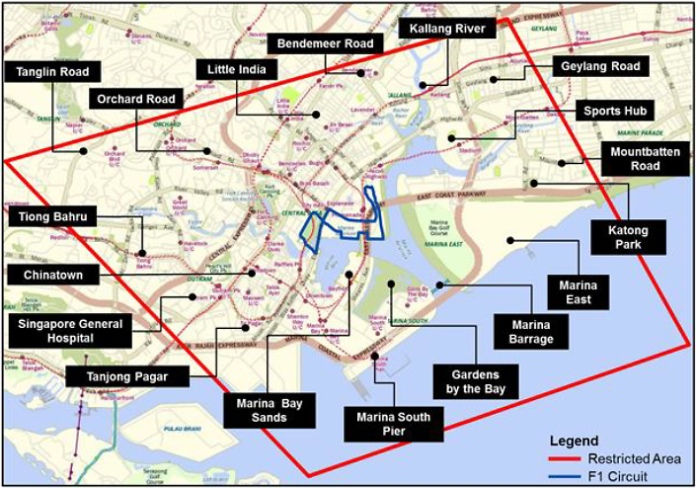
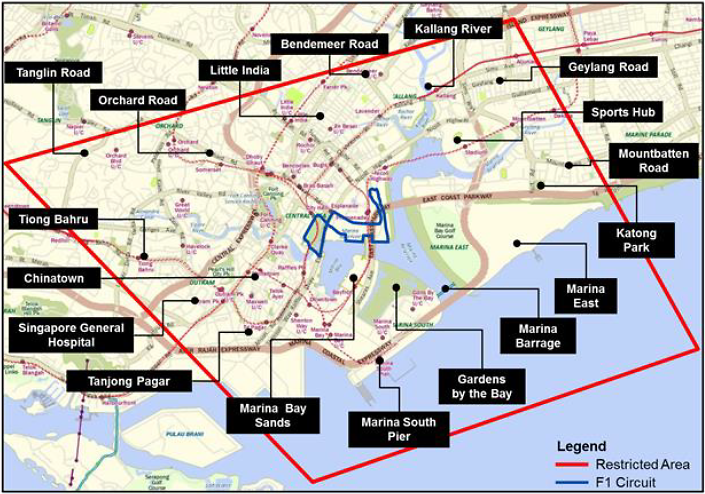
SINGAPORE: Drones and other aerial activities will be temporarily restricted over certain parts of Singapore during the 2018 Formula 1 Singapore Grand Prix, the Civil Aviation Authority of Singapore (CAAS) said on Thursday (Sep 6).
In its press release, CAAS said the temporary restricted area will extend from ground level to 4,000 feet above mean sea level during the following dates and times:
Sep 13, 2.30pm to 10.30pm;
Sep 14, 4pm to 11pm;
Sep 15, 3pm to Sep 16, 12.15am;
Sep 16, 5pm to 11.45pm
This is to facilitate low-level helicopter flights conducting aerial filming during the event, the agency added.
During the abovementioned dates and timings, aerial activities – such as flying unmanned aircraft, releasing flight lanterns, kite-flying and hoisting captive balloons – are prohibited within the restricted area unless authorised, as such activities “may endanger the operations of the low-flying helicopter, and pose safety risks to people and property on the ground”.
Conducting unauthorised aerial activities within a temporary restricted area is an offence under the Air Navigation Order. If convicted, a person can be fined up to S$20,000 for the first offence and fined up to S$40,000 and jailed up to 15 months for subsequent offences.
SINGAPORE: Singapore Airlines (SIA) will debut its new Airbus A350-900 aircraft on the Singapore-Adelaide route, it said in a news release on Thursday (Sep 6).
Slated to begin on Dec 17, the A350-900 medium haul aircraft will operate daily as SQ279 from Singapore to Adelaide, and as SQ278 for the return flight, subject to regulatory approval.
Equipped with SIA’s recently launched new regional Economy Class and Business Class products, the new A350-900 will be fitted with 263 Economy Class seats and 40 Business Class seats.
Arranged in a 3-3-3 configuration, the seats in Economy Class come with six-way adjustable headrests, a coat hook, USB port and in-seat power supply as well as a personal storage space for small items.
Business Class cabins will have a 1-2-1 seat arrangement, providing every customer with direct aisle access. Passengers in Business Class can also look forward to a full high-definition 17-inch screen, ample personal stowage space, and seats that can recline directly into a 76-inch fully flat bed.
A Business Class seat in the new Airbus A350-900. (Photo: Singapore Airlines)
The A350-900 is also decked with the latest Thales AVANT inflight entertainment system, which boasts a more intuitive user interface and grants customers greater flexibility in their entertainment options.
For example, customers can select their choice of playlists from the SingaporeAir mobile app prior to the flight, and transfer these selections to myKrisWorld by pairing their personal electronic devices with the system on board via Near-Field Communication.
SIA currently has 67 Airbus A350-900 aircraft on order, seven of which are long-haul planes which will be used to ply the Singapore-Newark route from Oct 11.
Subject to regulatory approval, SIA also plans to deploy the A350-900 medium haul aircraft to Brisbane next year.
The 11-storey data centre is 170,000 sqm and will “support hundreds of jobs”, says the social media giant.
An artist’s impression of Facebook’s data centre in Singapore. (Image: Facebook Singapore)
(Updated: )
Bookmark
SINGAPORE: Social media giant Facebook on Thursday (Sep 6) announced it will pour in more than S$1.4 billion to construct its first data centre in Asia in Singapore.
The new facility, located in Jurong East, will span 170,000 sq m and will “support hundreds of jobs”, the company said in its press release, adding it will form part of its growing presence in Singapore and across the region.
It also touted how the facility will be “hyper-efficient” in terms of the use of water, energy and land. For instance, it will incorporate liquid cooling technology that will minimise water and power consumption and, according to its testing, can reduce the amount of groundwater used by 20 per cent in climates like Singapore’s, it said.
Another example is how the 11-storey building’s facade is made out of a perforated lightweight material that allows air flow, the press release said.
Facebook has selected Fortis Construction to act as its general contractor because of their joint experience building efficient data centres, it added.
SINGAPORE: It’s getting harder to find candidates with the right fit, as job requirements grow in tandem with the trend of digitalisation.
This has been a key challenge for many business leaders. According to recent research by recruitment agency Robert Half, almost all CFOs surveyed find it more challenging to source qualified professionals, and almost nine in 10 of CIOs find it more challenging to find skilled candidates – compared to five years ago.
Despite this ongoing war for talent, why is it that many job seekers say businesses seem slow with offering them a job when they were found to be suitable?
More than seven in 10 job seekers in Singapore surveyed said they have taken a “second-choice” job offer because their preferred employer took too long to give them an answer, according to another survey commissioned by Robert Half.
Almost two-thirds also say they have waited longer than a month to hear back about a role for which they have interviewed, while four in 10 have waited longer than six weeks – and one in four say this duration was even long for them – a whopping two months or more.
This is a disconcerning trend – that in the current tight labour market, many employers are unintentionally alienating potential workers with long drawn-out hiring processes.
Job seekers with specialised skills are aware of the advantage they have in the employment market, so it is disturbing that many of Singapore’s skilled professionals are turning down their preferred jobs because of the time they spend waiting to hear back on their progress during the recruitment process.
What’s causing the delay? Companies are being very cautious and want to be certain they are choosing the right person for the job to avoid a costly hiring mistake.
But there are a few courses of action job seekers themselves can take to navigate delays in the recruitment process and motivate employers to come to a hiring decision more quickly.
FIRST, FIND OUT THE NEXT STEPS BEFORE LEAVING THE INTERVIEW
Job applicants should not leave the interview until they have confirmation the hiring manager has all the information required and have clarified sufficiently on the next steps in the recruitment process.
This allows candidates to address any concerns the employer may have before they make their final decision.
Additionally, asking for clarifications on next steps can help set a clearer timeframe for when job seekers can expect to hear an update on their application.
A woman engaged in a discussion in a cafe. (Photo: Pixabay)
SECOND, FOLLOW UP
The best way for job applicants to remain top of mind with the hiring manager is by following up within 48 hours of the first interview.
For example, a thank you note can be a nice touch and could help applicants stand out by reaffirming their interest in the position.
Additionally, communication goes both ways – candidates who have not heard back from the hiring manager after a week should be proactive in following up by email or calling them.
In the event the employer has no update, candidates should ask about when they can expect to hear back and express their interest in the role once again.
THIRD, MAKE IT CLEAR THE JOB SEARCH IS ONGOING
One additional way for job seekers to potentially speed up the hiring process is to remind the hiring manager that they are still job hunting.
In the event they have received interest from and have been interviewing with other companies, candidates should inform the hiring manager as well. This helps set clear expectations to prospective employers, especially now they know they are not the only business competing for a candidate’s talent.
Attendees at a job fair line up for an interview carrying their resumes in leather bags. (Photo: REUTERS/Jason Reed)
Candidates need to take charge of the hiring process. This means doing their part in taking the necessary steps, being proactive in expressing their commitment and interest, as well as communicating openly with potential employers.
However, it is also important for them to remain patient during the recruitment process and remember that companies only want the best person for the job.
Equally, employers need to adjust their recruitment process to the expectations of today’s candidates if they want to reduce the risk of losing out on top talent.
While it may be time-consuming for hiring managers, businesses need to look towards streamlining their entire recruitment process, from initial outreach to final job offer, to strike the right balance for today’s job seekers.
Matthieu Imbert-Bouchard is managing director at Robert Half Singapore.